






Abstract
A new artificial diet called CENIBROCA (C) was developed for rearing coffee berry borer. It has fewer ingredients, good characteristics of nutrition to the target pest, good consistency, keeps humidity longer, has low contamination and is easy to prepare. Its reproductive potential and rate of increase were evaluated and compared with the following diets: Diet 140 (A), developed in Mexico in 1993; ECOBROVILL-160 (B), developed in Mexico in 1995, which is a simplification of the diet (A); and parchment coffee (D), the natural medium of rearing coffee berry borer used since 1989. Diets A, B and C were poured into 50x10 mm glass tubes. Each tube contained 1 ml of diet and a recently emerged female. Parchment coffee was evaluated by individual infestation in the same way as artificial diet. On evaluation after 40 days, diet C had a mean production of 53,9 ± SD=6,3 insects per tube of diet, followed by diets A and B with mean production of 46,0 ± SD=6,1 and 40,1 ± SD=8,9 insects per cc of diet respectively, the lowest production was for parchment coffee with 26,9 ± SD=5 insects of CBB. At 60 days, 254,6 ± SD=80,0 stages (50% were eggs, probably third generation) were found on CENIBROCA, showing significant difference (p<0,05) in relation to the diets, 140 with a mean production of 125,8 ± 49,4 states and 107,5 ± 50,9 to ECOBROVILL, respectively. The highest reproductive rate (
Introduction
Chou (1980) quoted by Singh and Moore (1985ab) recorded that insect rearing has been practised for at least 7000 years. The Chinese wrote many books on sericulture and silk technology, and took extreme care in rearing their insects. Other insects have been cultured for a very long time. For instance, Laccifer lacca Kerr, has been reared in India and China for several thousand years. In more modern times the first attempt to rear a phytophagous insect on artificial diet is credited to Bogdanow in 1908, who compounded a diet for the blowfly Calliflora vomitoria. Since then many species have been successful reared and colonised in the laboratory (Singh and Moore 1985a, Vanderzant 1966). However, only since 1936 has been possible to mass-produce insects in a factory (Singh and Moore 1985b).
Vanderzant (1966) said that the terminology used to describe diets for insects is extremely confusing: the terms "artificial", "synthetic", and "purified defined" are used by different investigators to describe diets containing substances that vary greatly in purity. Thus, to some a synthetic diet is a mixture of nutrients, perhaps a plant preparation with vitamins, yeast, or sugar added; to other a synthetic diet is a mixture of pure chemicals only. "Purified" is usually applied to diets containing pure chemicals and natural products such as casein that have been extracted with solvents to remove fats, vitamins, and other trace substance. "Artificial", a more general term, usually refers to any diet that is not the natural food of the insect.
Dougherty (1957) quoted by Vanderzant (1966) suggested the terms holidic to describe diets composed of pure chemical and meridic to describe diets containing at least one substance of unknown structure such as a protein. However these terms have not been widely accepted by rearing insect researcher.
Vanderzant (1966), Villacorta (1991) and Bustillo (1979) gave a list of the substances used in insect diets thus: proteins, casein, albumin, amino acids, carbohydrates, sugar, starch, lipid substances, vegetable oils, phospholipids, fatty acids, sterols, salt mixtures, vitamin mixtures, cellulose and agar. Diets may need extracts from the host plants as a feeding stimulant (Vanderzant 1966). She stated that sugars are perhaps the most important feeding stimulants for phytophagous insects and proteins and amino acids are the second most important class of nutrients that stimulate feeding.
Today knowledge about insect nutrition has shown that a wide variety of insects can be produced in millions and used in various pest control programs. There are various scolytid artificial diets, but there are only a few diets for rearing CBB. The first attempt to rear H. hampei was done by Bautista and Martinez in 1982, but their results were not successful (Villacorta 1989). In 1989 Villacorta developed a successful diet for rearing this insect. Villacorta and Barrera (1993) modified this diet, producing the Ecobrovill-160 artificial diet (1995). Brun et al. (1993) reported another artificial diet for H. hampei on which were reared 15 generations. All of them are apparently successful diet but are very expensive and with many ingredients.
Singh and Moore (1985a,b) stated that diets for rearing insects should be inexpensive, easily prepared from locally available ingredients and supply all the nutritional requirements to complete all stages of the life cycle. Diets should produce an average yield of adults of at least 75% of the initial viable eggs. The size and rate of development of insects should be similar to those in nature. The adults should mate, lay viable eggs and continue to reproduce without loss of vigour or fecundity. The behaviour of insects should be normal and the insects produced should be of an acceptable quality (Singh and Moore 1985b, Vanderzant 1966).
Hence, this investigation was done to achieve an artificial diet for rearing coffee berry borer with the characteristics previously mentioned. Once the diet was obtained a method for mass production of CBB and its parasitoid C. stephanoderis using this diet was developed.
Materials and Methods
This study was carried out in the entomology laboratory of CENICAFE in Colombia. It was conducted in constant temperature environmental chambers at 27°C ± 1 and 85% of relative humidity. The relative humidity was controlled by saturated solutions of salts inside containers.
Two existing artificial diets and parchment coffee were used to compare the new artificial diet. a) Diet 140 (A), developed in Mexico in 1993 ($U.S. 15/l); b) ECOBROVILL-160 (B), developed in Mexico in 1995, a simplification of the last diet ($U.S. 11/1); c) CENIBROCA (C) new artificial diet ($U.S. 1,50/l); and d) Parchment coffee (D) ($U.S.3,5/k) the natural medium of rearing coffee berry borer used since 1989 (Benavides and Portilla 1991).
The CENIBROCA artificial diet was developed considering the ingredients of the 140-diet (A), which was developed by Villacorta and Barrera in 1993. The name 140 diet is because it was the result of the 140 different recipe trials (Villacorta, personal communication, 1995). It was selected because the production of the coffee berry borer on this diet was the best compared with four other diets (Villacorta and Barrera 1993) (see their Table 2, diet # 4).
Composition of the artificial diets
Preoviposition period of coffee berry borer on artificial diets and parchment coffee bean
Mean production of brood produced per female per ml of artificial diet and single parchment coffee bean at various times after artificial infestation
Means followed by the same letter in each row are not significantly different (p < 0,05 Tukey test).
Percentage of the standing population of Coffee Berry Borer produced on artificial diet at 60 days and parchment coffee bean at 40 days after infestation
Primarily, for developing the new diet, substitution of agar and yeast for some locally available ingredients was considered. Thus, agar was substituted by local industrial agar (Disinter-Cali), which is used in Colombia for bakery decorating and also for preparing artificial diets for mass production of the hosts of Trichogramma sp. (Personal communication, Jorge Segura, Laboratorios Trichogramma Palmira, 1997). It is considerably cheaper than from microbiological suppliers. The granulated yeast also was substituted by powdered yeast, which was selected due to its low cost. It was compared with others locally available and the reproductive potential of the CBB was evaluated. Ingredients such as cholesterol and benzoic acid were eliminated and Benomil was incorporated in the new diet. The amount of every ingredient was reduced until the minimum amouni necessary was reached. Each new combination was compared with the combination obtained immediately before and the reproductive potential was evaluated. Finally, a new artificial diet with an encouraging advance in cost reduction was obtained.
The sterilised ground green coffee (2-mm particle size), powered yeast and the industrial agar made a leathery texture diet. This texture allows the CBB to keep laying eggs for longer and mortality of its immature stages to be lower.
Substances and preparation times for A and B diet were taken according to their authors (Villacorta and Barrera 1993, 1995).
Preparation of the diets
140 Diet (Villacorta and Barrera 1993)
Using an autoclave at 120°C and 15 lb pressure the agar and water (Group I) were sterilised for 20 min. After that molten agar was poured into a blender and group II ingredients (Table 1) were added after it was combined and partially mixed. This mixture was blended for about 25 min until it was homogenised. After 10 to 15 min when the mixture had cooled to 50°C, group III ingredients were added and blended in for five more min.
Ecobrovill-1.60 artificial diet
The diet was shipped from ECOSUR, Mexico. Its commercial presentation consists of two packets (Table 1). The steps in the preparation of this diet were as follows:
Step 1. 100 mi of hot (95°C) water was poured into a blender with packet B (PB), 10 mI of ethyl alcohol and 2 mI of formaldehyde (37%). This mixture was blended for 10 min.
Step 2. 600 mI of water was heated to boiling point and mixed with packet A (PA). The mixture was stirred until dissolved and brought to the boil once more. This process should take about 40 min.
Step 3. The mixture from step 2 was tipped. while still hot into the blender with contents from step l. It was blended again for 10 min until complete mixing was achieved.
Cenibroca artificial diet
Dried green coffee beans (12% moisture content) were ground (2-mm particle size) using a Provat Emmerich miller it was autoclaved for 20 min at 120°C and 15 lb/m- of pressure. The agar and water mixed was also sterilised using an autoclave
Group II ingredients were combined and partially mixed and tipped into the blender together with molten agar. The mixture was blended for 10 min to achieve complete mixing. When it had cooled to 50°C, the group III ingredients, dissolved in 10 mI of sterilised water, were added (Table 1).
After a final mixing the completed diets were poured into flat-bottomed glass tubes (10x 50 mm) to 10 mm deep each (1 cc of diet). The tubes of solid diets 140 and CENIBROCA were dried at 50°C for 24 hours and ECOBROVILL-160 for 36 hours. in a heater until the diet attained a leathery texture (55 % diet humidity). Afterwards, the tubes of solid diets were infested with CBB.
About 0.8 g is the average weight of a single parchment coffee bean. Hence, similar weight for diets was considered. 1 cc of recently prepared diet is about 0.85 g after it is dried.
Infestation of the media
Recently emerged adult female borers were used to start the rearing process. These adults were collected from coffee berries naturally infested in the field and kept for some weeks in the laboratory to allow pupae and larvae to became adults. Spraying three times with sodium hypochlorite solution at 2,55% concentration, the adults of CBB were disinfected. After every spray the borers were rinsed using sterilised water. The'rnost active borers were selected to infest of diets and were put individually into each tube.
Parchment coffee cultures were established by placing one freshly emerged adult female borer, obtained as above. in the same kind of tubes used for diet rearing process. Each tube contained a single parchment coffee bean. The tubes with the four treatments medias A, B, C and O were placed into hermetically sealed plastic boxes. which contained inside a saturated solution of potassium chloride. Solution of KCIwas used to achieve a humidity relative of 85%. It was prepared by adding 26,5 g of KCI to 100 mi of H20 (Winston and Bates 1960).
These plastic boxes were held inside the environmental chambers and kept for 60 days in total darkness.
Development of CBB was evaluated by setting up 150 culture tubes per treatment as above. Ave tubes were taken every day for fifteen days to analyse the preoviposition period on the diets and how were its oviposition behaviour on each diet and parchment coffee. 10 tubes that showed progeny of borer were taken from each treatment and dissected every 10 days during 60 days. Each life cycle stage of CBB (eggs, firstand second instar larval. prepupa, pupa and adult) found was identified and recorded. Five tubes were taken to analyse moisture content percentage. It was analysed using HG53 moisture analyser (Mettler-Toledo).
Data Analysis
Reproductive potential and rate of increase were analysed using a random design. Life table statistics such as survival and fecundity, denoted lx (probability of an individual attaining age x) and mx (mean number of stage progeny produced per female of age (x) 10, 20, 30, 40) respectively. The mx value was determined by multiplying the mean number of eggs produced per female at age x by the proportion of females in the progeny of a female at age x. This parameter was estimated assuming a sex ratio of borer of 10 females: 1 male. Thus, from the number of eggs counted per sample, total of eggs laid was calculated. From the numbers of eggs counted in the second sample were subtracted the number of eggs counted on the previous sample, the difference was assumed as m. The net maternity function, lxmx, was calculated by the product of the fecundity and survival at age x. The sum of lxmx over all ages is defined as the net reproductive rate, R
The immature stage mortality and developmental time, which were evaluated and described in Portilla, 1999a were considered for the calculation and incorporated into a cohort for getting more accurate parameter values. To calculate the population parameters only dates obtained until day 40 after infestation were taken into account. This, due to the population of CBB reached at day 60 was probably the product of a new progeny and this could affect the parameter values.
The general linear model (GLM) procedure of SAS software was used to analyse differences in the mean number of stage progeny produced per female of age (x) 10, 20, 30, 40 and 60 days. This program was chosen because its procedure required a balanced data set, which performed the Tukey test in order to compare the reproductive potential of coffee berry borer on each diet. It also analysed differences in development time among the four diets or treatments using comparison of mean by analysis of variance (ANOVA).
Results
Oviposition behaviour of the coffee berry borer on the media
Feeding generally occurred in the first hour after females were put onto the media. In most tubes of the diets A and C, egg laying started within the first 8 days whereas on diet B egg-laying started within the first 2 weeks, D showed egg laying between 2 and 5 days. The long period taken to lay eggs on diet B was due to the borer waiting until the diet become harder, whereas in diets A and C the ingredients caused a leathery texture, harder than diet B. Hence the preoviposition time on these diets was earlier (Table 2).
The eggs in diet C were found in ones or twos on the surface of the diet and the larvae made very superficial tunnels into the diet only when it became hard. In most cases with diet B the eggs were found separated one from the other over the diet surface, wherever the borer had fed.
By day 30 the total of the diet consumed was only 15%. Later the consumed amount increased due to new progeny feeding and breeding on it.
Reproductive potential of the CBB
Table 3 shows the mean production of brood per female at developmental times after borers were placed on the media (Mx). The GLM analysis showed significant differences in the population found at 10 days time. The single parchment coffee bean produced (17,0± SD = 4,26) per female, which was significantly higher than 10,4 ± 5,87, 9,7 ± 3,65 and 6,7 ± 2,16 production of brood per borer per cc for diets A, C and B respectively. However, the mean offspring found at 20 and 30 days, showed further differences with diet C population significantly higher in relation to the other media (p < 0,05).
The mean production at 40 days was C= 53,9 (SD = 6,33); A = 46,0 (SD = 6,07); B= 40,1 (SD = 8,93) and D = 26,9 (SD = 5,89) stages per female per cc of diet. Treatment C was significantly different (p < 0,05) from each other. At 60 days C = 254,6 (SD = 80,3) also was significantly different from the other diets.
Stage structure within the production facility
The percentage of the total brood colony of the six stages for coffee berry borer is given in Table 4. Although the highest number of offspring was obtained on diet C all three artificial diets showed similar results in relation to stage structure and number of stages produced. Eggs represent an extremely large percentage (>50%) the total number in the production operation. Thus, Diet C, B and A showed 64,53%, 57,21% and 45,07%, respectively, which probably reflects a third generation.
At 60 days only few live adults were found on parchment coffee, due to its humidity of 10% did not allow the borer to breed (Fig. 3). Table 4 gives the stage structure, for which values were obtained at 40 days.
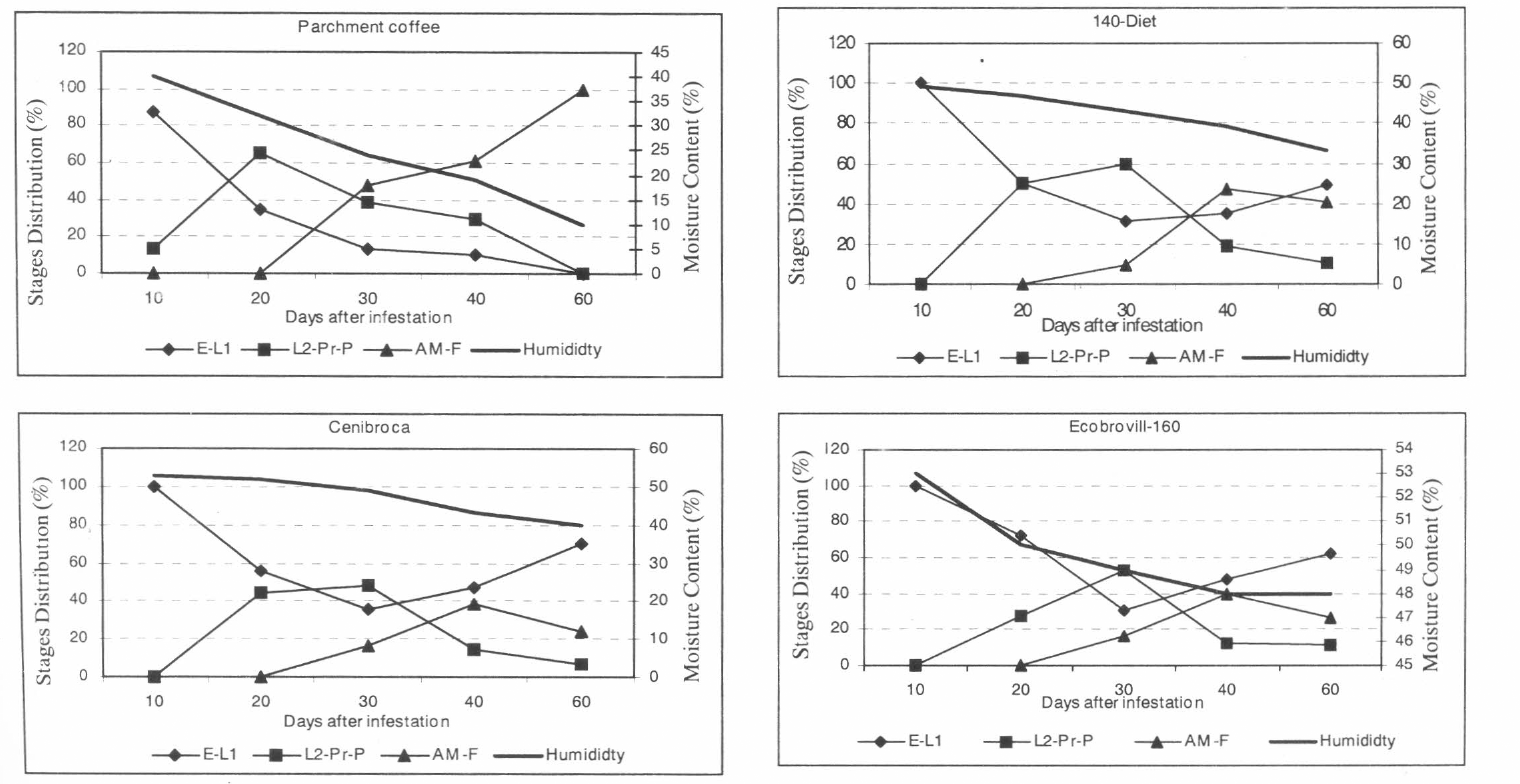
Percentageof the stages structure population for H. hempei on three artificial diets and parchment coffee bean at various times after infestationin relation to moisture content. E-Ll = Early stages, L2-Pr-P = Pre-adults, AMF= Female and male adults.
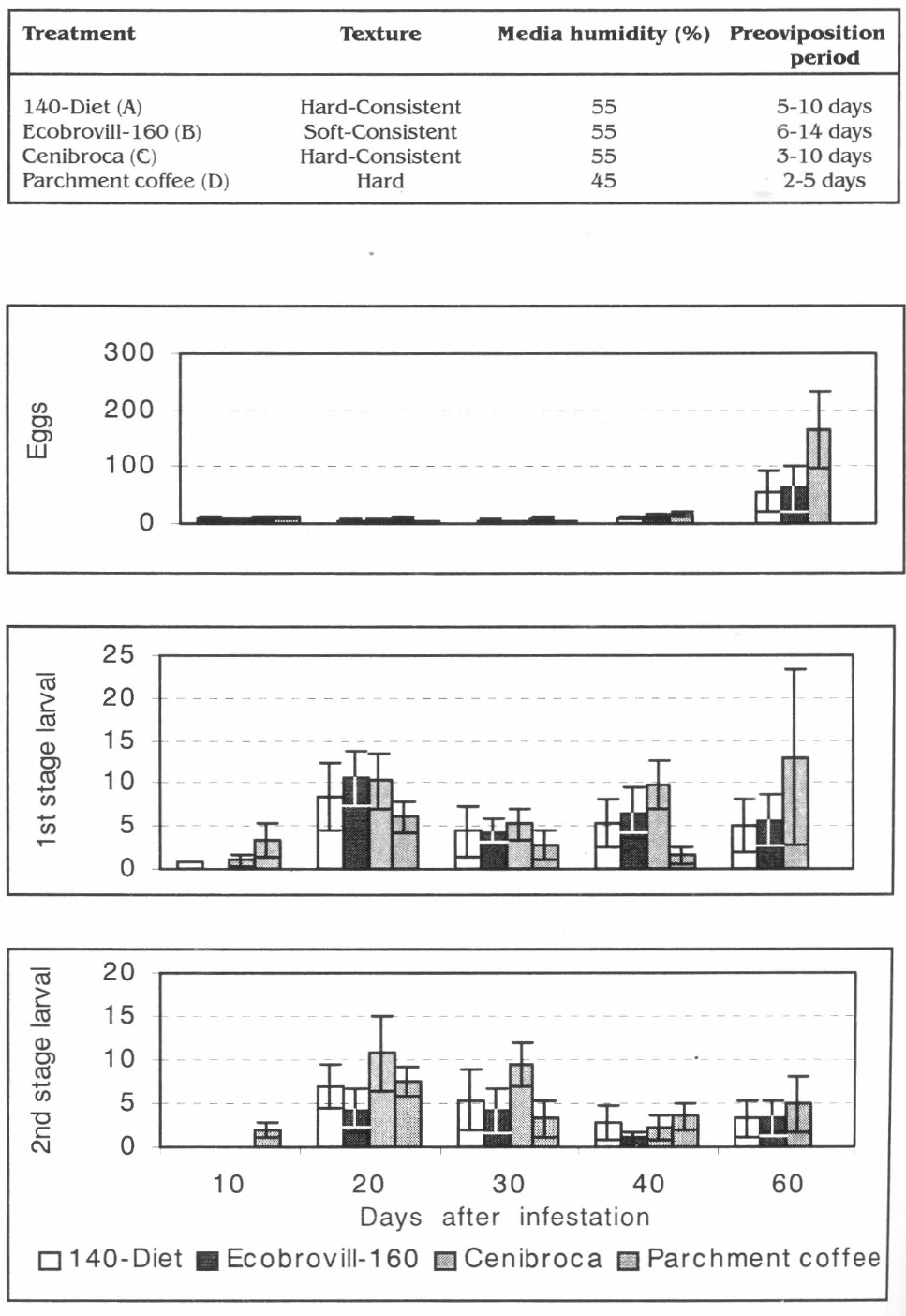
Mean number of eggs, 1st and 2nd instar larval produced per female per cc on artificial diet and single parchment coffee bean during 60 days.
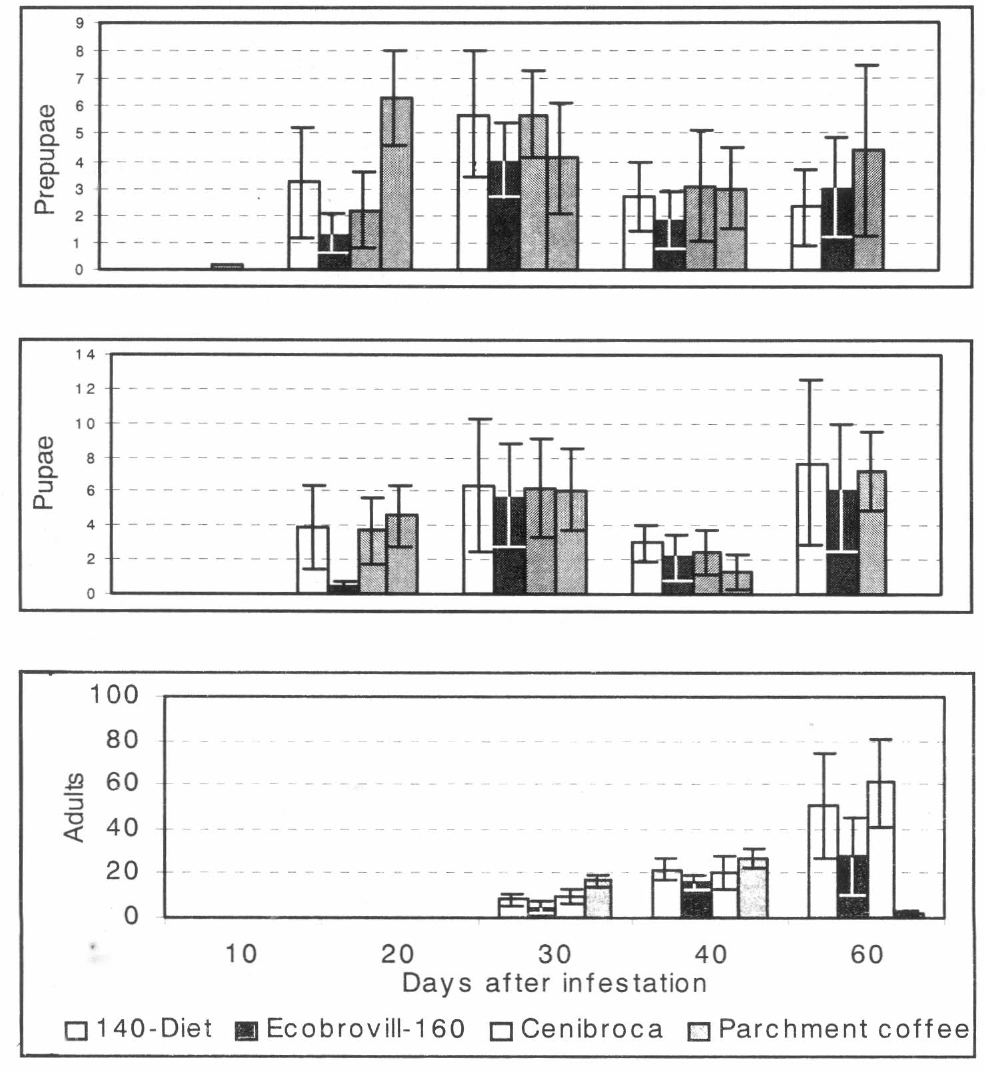
Mean number of prepupae, pupae and male and female adults produced per female of CBB per cc on artificial diet and single parchment coffee bean during 60 days.
The effect of diet humidity on production of the coffee berry borer is shown in Figure 1. The distribution of the harvested population represented in percentage and obtained in the four first evaluations, which showed similar results between all three artificial diets and parchment coffee, but was found different at 60 days. Thus, CBB eggs and first instar larval for A, B, C and D (10 days) are all decreasing until day 40 and increased at 60 days only for A, B, and C diets with 49, 62 and 70% respectively, whereas for D diet was 0%.
The highest percentage of pre-adult was found on day 30 for all three artificial diets (A, B and C) with 60, 53 and 50% respectively and on the 20th day 65% for parchment coffee. Finally, the highest population of adults for A, B and C was found at day 40 and on the 30th for D.
Figures 2 and 3 show the mean production of brood of CBB found per infested cc of artificial diet (A, B and C) and single parchment coffee bean. Although the treatments are similar in stage structure distribution (Fig. 1), there are significant difference between them in relation to total production of brood (Figs. 2 and 3).
Figure 2 shows the mean production of E, L1 and L2 per female at 10, 20, 30, 40 and 60 days after the borer were placed on the media. The GLM analysis showed that there was no significant difference in the population found at 10 days (p < = 0,05) thus: 11,5 ± 3,0 (E ± SD) was found in a parchment coffee bean, and 10,4 ± SD = 5,9, 9,7 ± SD = 3,7 and 6,7 ± SD = 2,2 E for A, C, B respectively. First instar larval populations in parchment (3,3 ± 2,0) were significantly greater (p<0,01) than in the other media, which showed no population. The second instar larval in parchment coffee also had significant differences from the other medias, which showed low populations.
Mean of E, L1 and L2 for each treatment at 20 and 30 days were obtained without any significant difference between treatments. At 40 days E and L1 for parchment coffee showed the lowest mean and were significantly different from each other but L2 at 40 days was found without any significant difference between treatments. E (164,3 ± SD = 66,6) and L1 (13 ± SD = 10,25) means at 60 showed the highest mean for C, it was significant different (p<0,05) in relation to A and B and it was highly significant (p < 0,01) from D which had no population.
Figure 3 gives the mean production of Pr, P and M and F A found during 60 days. Pr and P were found 20 days after diets and parchment coffee were infested. The lowest mean production of Pr and P at 20 days was obtained in diet B, which are significant different (p < 0,05) from each other. However, no significant difference was found at 30, 40 and 60 days. Parchment coffee at those times had no production. Adults were found at 30 days after diets and parchment coffee were infested. Mean production of brood in all treatment at 30 and 40 days were not significantly different and in the last evaluation time, C showed the highest mean of production brood among artificial diets.
Life table parameters
Seven life parameters are presented in Table 5 for each of the four diets. The highest growth rate per generation of H. hampei was obtained in diet C with 29,2 female borers per newborn CBB female in a mean time of 48,4 days, followed by diets A, B and D with 24,9, 21,7 and 18,8 females borers per female, respectively, which were obtained in a mean time of 49,2, 51,4 and 42,0 days, respectively. In the diets C and D its daily growth rate was of 1,08, while in diet A was 1,07. The lowest daily rate was attained in diet B with 1,06 daughter females/female/ day.
Life table statistic for coffee berry borer on artificial diet and parchment coffee bean
Because the highest values of R
Discussion
The kind of ingredients used to develop Cenibroca artificial diet offered the optimum physical make up of the diet compatible with minimum microbial contaminants, ease of preparation, durability once prepared and cost ($ U.S 1,50/l). At present, the only three existing developed artificial diets are considered too expensive to be included as a component in the mass rearing technology (Villacorta 1989, Villacorta and Barrera 1995, Brun et al. 1993).
Brun et al. (1993) found that CBB feeding for his diet was within a few hours after the female was put into it. Egg laying normally began within two weeks, but some eggs also were observed within the first few days. In this investigation the female of the CBB did not tunnel into all three artificial diets, but if it bored into any diet it made small galleries the same as if it was a coffee berry and laid its egg in the tunnel. These eggs hatched and the larvae fed on the diet, making small galleries off the main tunnel made by their founder. This feeding behaviour was found also in parchment coffee. Le Pelley (1968) describes similar feeding habits in berries from the field. Villacorta (1991) found in infested artificial diet with CBB the presence of Trichoderma fungus in the tunnel. Under the conditions of this investigation the only contaminant fungus was apparently Aspergillus and Penicillium among all treatments, but parchment coffee showed a particular green-blue colour in the tunnel where CBB had drilled. However, it was not possible for this isolate to be identified.
The texture of the diet influenced the preoviposition time (Table 2). Most aspects of preoviposition behaviour are similar to other studies. Ruiz (1996) working with life tables of CBB in relation to the physiological maturity of coffee berries found that the preoviposition period depended on consistency on the coffee berries' endosperm. Abraham et al. (1990) said it was longer in green unripe berries in which the endosperm was still soft. Similar results were shown by Le Pelley (1968), Benavides and Cardenas (1975), Alonzo (1984) and Gaviria et al. (1995) who said the borer copulated to postpone oviposition until the berry had dried out.
The results of this chapters show that diet moisture content and the diet texture are important variables that allowed a longer oviposition period of the CBB, and so a large number of stages per CBB could be obtained (Table 3). A gross fecundity of 60 insects per borer per 0.8 g of diet 140 was found by Perez et al. (1995). Benavides and Portilla (1991), Portilla and Bustillo (1995) and Bustillo et al. (1996) registered to parchment coffee from 25 to 30 insects per CBB at 30 days with 45% of coffee bean moisture content. This study reports production to Ecobrovill-160 that differs from Villacorta and Barrera's results (1996). The mean production of brood of 36 to 43 insects per CBB per cc of diet reported by Villacorta was found at 80 days, whereas in this study the same population at 40 days in the same diet was found.
Stage structure distribution is used as a measure to provide the information necessary to built a factory population to full capacity (Carey 1993, Carey and Vargas 1985). In this case the time at which the highest mean number of late stages of CBB (L2, Pr, and P) were obtained will be considered, because L2, Pr and P production will be used for parasitoid reproduction. Figure 3 shows when Pr and P population reaches their peak and Figure 1 the time when these stages reach the highest percentage. Thus, the harvesting period should be between 25 to 30 days after infestation for each artificial diet, and 20 to 25 for parchment coffee bean. In contrast Brun et al. (1993) in studies carried out at 25°C obtained the highest mean production of P at 70 days (34%) due to in part to the protracted period of oviposition. Portilla and Bustillo (1995) found at 23°, 73% of L2, Pr and P in parchment coffee bean on the 30th day after infestation (spraying water on parchment coffee every 5 days).
Under the laboratory conditions of this study, the life table parameters for CBB on all three artificial diets and parchment coffee are similar in many respects. The values obtained show that by rearing CBB under good conditions the reproductive potential can be a bit higher than values obtained in the field (Baker 1992 in Mexico registered r
The experiments and analysis carried out in this investigation was the first step for developing a mass rearing technology of the parasitoid Cephalonomia stephanoderis on immature stages of CBB (Portilla 1999b).
Footnotes
Acknowledgements
This work is an output of the IIBC-CENICAFE collaborative project "Colombia: Integrated Pest Management for Coffee" funded by the Department for International Development (Overseas Development Administration) of the UK and the Federation Nacional de Cafeteros de Colombia. Many thanks to my supervisor John Mumford, Dave Moore and Peter Baker for their many useful comments and suggestions. Thanks are due to all of the CENICAFE team.