






Abstract
Natural dyestuffs are evaluated as green sources to color the fabric in the textile industry. In this study, tea natural dye extracted from Longjing tea was applied to dye cotton fabrics by different dyeing processes. The extraction process was investigated thoroughly according to orthogonal experiments to obtain the optimum results. The acid-base stability, storage stability, heat-resistance, and other properties of Longjing tea natural dye were studied. The rubbing fastness, washing fastness and color difference of natural tea dyed cotton fabrics using different dyeing processes were measured. It has been proved that pre-mordant dyeing process and reactive dyeing process are more suitable for Longjing tea natural dye. The rubbing fastness and washing fastness of the dyed cotton fabrics are both very good, fully meeting the dressing requirements.
Introduction
Natural products derived from plants are gaining attention because of their abundant
availability, biocompatibility, low toxicity, compatibility, and
eco-friendliness.1,2 Due
to the strict environmental standards to avoid the health hazards in textiles, the
use of natural dye in textiles is growing rapidly.3-5 The recent ban on the use of azo dye by the European Union
has also increased the use of natural dye.
6
Tea natural dye, extracted from tea
leaves is a kind of polyphenol compounds. The main component of tea extract is
catechin, which has many health benefits and functionalities, such as antibacterial
activity and UV protection performance.7-9 Previous studies have reported that the pH value of the tea
extract dye bath had a strong effect on apparent color and color strength. The dyed
fabrics possessed good rubbing and washing fastness but presented growing
hyperchromic effect under light with the decrease of pH value.
10
Chitosan can be
utilized in the development of colorful and multifunctional wool fabric without the
need for toxic metal salt mordants. Chitosan pre-treatment imparts excellent radical
scavenging and antibacterial activity against
China is the birthplace of tea and possesses rich tea resources, hence extracting natural dye from the waste tea can improve the economic benefit of tea and promote sustainable economic development. Tea natural dye has a broad application space and excellent development prospects.12-15 In this study, tea dye was extracted from Longjing tea leaves using an inorganic method. The cotton fabrics were dyed with tea natural dye through various processes. Five different dyeing methods of tea natural dye were compared. The properties of tea natural dye, optimum extraction process, and the fastness of dyed cotton fabrics were investigated.
Materials and Methods
Materials
Longjing tea was purchased from Qingdao Laoshan Tea Ltd. Co. (Shandong Province, China). Anhydrous alcohol, hydrochloric acid, acetic acid, sodium bicarbonate, sodium chloride, sodium carbonate, copper sulfate, ammonium sulfate, anhydrous sodium sulfate, and ferric chloride were purchased from Guoyao Group, China. All the reagents were of analytical reagent grade and used as received. Plain-woven, desized, scoured, and bleached cotton fabric was supplied by Demian Co. (Shandong Province, China). Its characteristics were: mass per unit area of 135 g/m2, 66 ends per inch, and 47 picks per inch.
Extraction of Tea Natural Dye
Tea leaves (5 g) were added to distilled water with a certain liquor ratio and boiled for a certain time. After suction filtration, the pH value of the tea solution was adjusted to 7-8 and the volume was concentrated to 20 mL. The tea solution was acidified by hydrochloric acid to pH 4-5 and then anhydrous alcohol was added in volume ratio 1:1 to reflux and distill. Eventually, the alcohol was recycled and the pH value was adjusted to 7. After filtration, the extract was dried at 90 °C.
Stability of Tea Natural Dye
The color change of Longjing tea dye at different pH values, as well as the acid-base stability, storage stability, and heat resistance stability of the tea dye solution were measured.
Dyeing Process
The cotton fabrics were dyed by Longjing tea dye using direct dyeing, reactive dyeing, pre-mordanting, meta-mordanting, and post-mordanting. The dyeing processes are shown in Figs. 1–5, respectively. During the direct dyeing process, we choose 5% concentration of tea dye, 1 g/L of levelling agent, a dyeing temperature of 90 °C, and a liquid ratio of 1:50. During the reactive dyeing process, we choose 5% concentration of tea dye, 40 g/L of NaCl, 10 g/L of Na2CO3, a dyeing temperature of 90 °C, and a liquid ratio of 1:50. During the meta-mordanting process, we choose 5% concentration of tea dye, 2% concentration of copper sulfate, 10 g/L of NaCl, a dyeing temperature of 90 °C, and a liquid ratio of 1:50. During the post-mordanting process, we choose 5% concentration of tea dye, 2% concentration of copper sulfate, 10% concentration of anhydrous sodium sulfate, 1 g/L of levelling agent, a dyeing temperature of 90 °C, and a liquid ratio of 1:50.
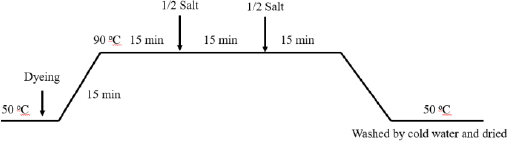
Temperature/time conditions for direct dyeing.
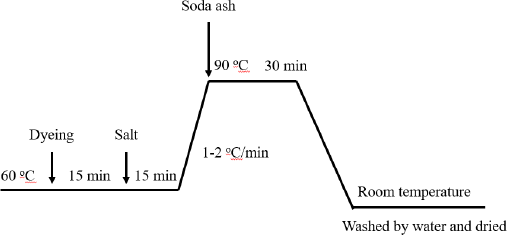
Temperature/time conditions for reactive dyeing.
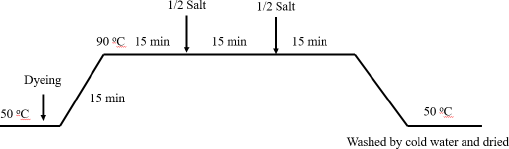
Temperature/time conditions for pre-mordant dyeing.
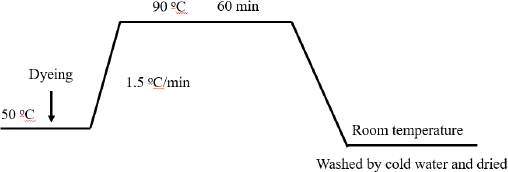
Temperature/time conditions for meta-mordant dyeing.
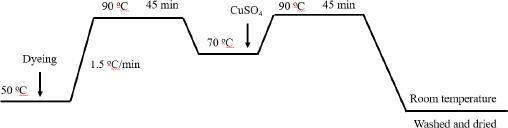
Temperature/time conditions for post-mordant dyeing.
Evaluation of Colorfastness
To evaluate dyeing performance, the CIELAB coordinates of the dyed samples were
measured using a Hunter Lab Color Quest XE spectrophotometer with illuminant
D65 and 10°observer. The color difference is expressed as
Δ
Where Δ
Results and Discussion
Analysis of Tea Dye Extraction Conditions
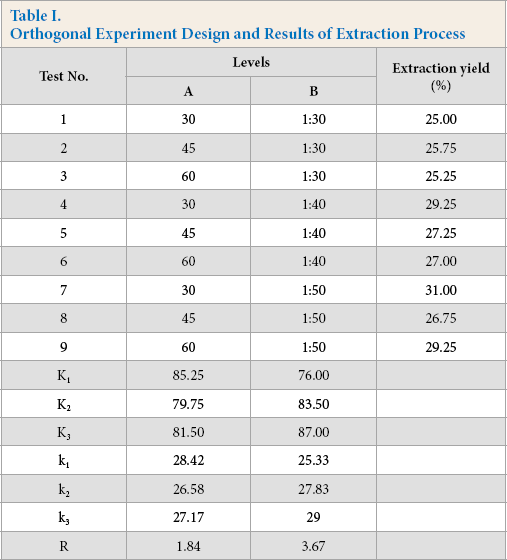
The orthogonal experiment was designed to obtain the optimal extraction conditions of tea dye. The following two parameters were chosen to study the extraction process: extraction time (A), and the liquid ratio (B). The orthogonal experiment results of Longjing tea dye extraction are shown in Table I. By comparing the R value, it can be observed B has a greater level of influence than A, indicating that the effect of the liquid ratio on the extraction yield of Longjing tea dye was greater than that of extraction time. The optimum extraction conditions for the tea dye are predicted to be A1B3, which means that by using a bath ratio of 1:50 and extraction time of 30 min., the highest extraction yield of extracted dye should be achieved.
Identification of Tea Dye
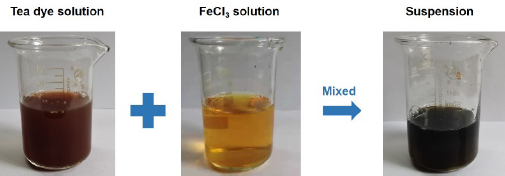
The tea dye was identified by the color test of ferric chloride solution. Black precipitate was generated when Longjing tea dye solution was added into ferric chloride solution. The pictures of the color test are shown in Fig. 6.
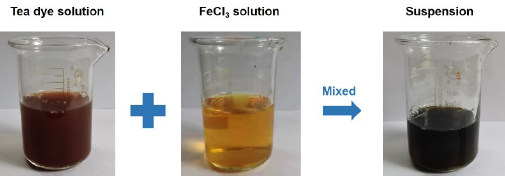
Color test of tea dye.
Orthogonal Experiment Design and Results of Extraction Process
Acid-Base Stability of Tea Dye
The color change of Longjing tea dye at various pH values is shown in Fig. 7. The color of Longjing tea dye became darker as the pH value increases. Longjing tea dye solution (0.5 g/L) was prepared at various pH values and the absorbance of the solutions was measured. The test results were shown in Fig. 8. The maximum absorption wavelength shifted to the right significantly under alkaline conditions, indicating that the stability of Longjing tea dye under acidic conditions is better. Therefore, neutral and acidic conditions are more suitable for the dye.
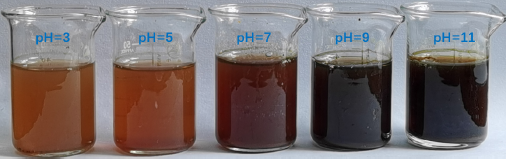
Color change of Longjing tea dye at various pH levels.
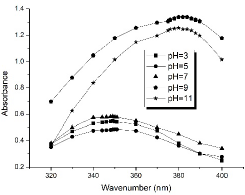
Relationship between wavelength and the absorbance of Longjing tea dye.
Storage Stability of Tea Dye
Longjing tea dye solution (0.5 g/L) was prepared and placed at room temperature for 0 h, 24 h, and 48 h. The absorbance of the solution was measured and the result was shown in Fig. 9. The maximum absorption wavelength of Longjing tea dye solution did not change significantly after storage for 0 h, 24 h, or 48 h. The absorbance of the tea dye solution after storage for 48 h is a little higher than that stored for 0 h and 24 h. This may be because the color of the tea dye became darker after 48 h. Results indicated that the storage stability of Longjing tea dye was excellent.
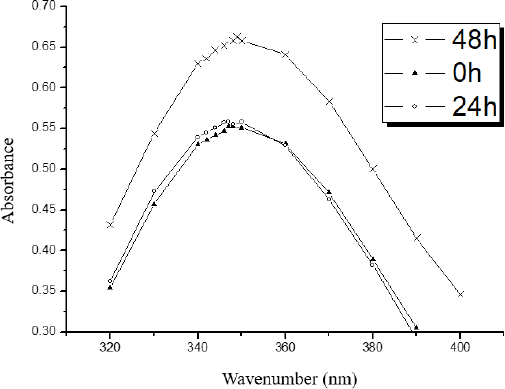
Absorbance of Longjing tea dye after stored for various time periods.
Heat-Resistance Stability of the a Dye
Longjing tea dye solution (0.5 g/L) was kept at 50 °C, 70 °C, and 90 °C for 30 min. The absorbance was measured and the results were shown in Fig. 10. The maximum absorption wavelength of Longjing tea had a red shift when the temperature changed from 50 °C to 70 °C, then to 90 °C, producing a dark color effect. The order of the maximum absorption wavelength and the color shade of the Longjing tea dye solution both followed the trend 90 °C > 70 °C > 50 °C.
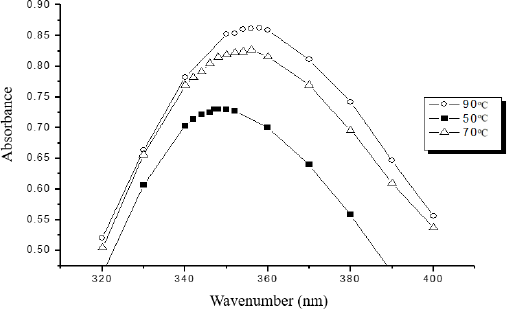
Absorbance of Longjing tea dye at various temperatures.
Color Difference
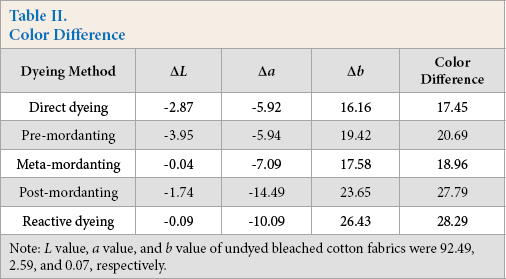
The color difference of cotton fabrics dyed by Longjing tea dye was shown in Table II. The cotton fabrics dyed with Longjing tea dye according to post-mordanting and reactive staining have the greatest color difference and the darkest color compared with that of undyed fabrics.
Color Difference
Note:
Colorfastness to Crocking
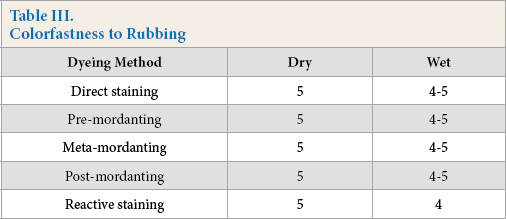
The ratings of dry and wet crocking (rubbing) fastness of dyed cotton fabrics are shown in Table III. Dry rubbing fastness for all cotton fabrics dyed with Longjing tea dye is 4, and most of the wet rubbing fastness level is very good (4-5). Therefore, the rubbing fastness of the cotton fabrics dyed with Longjing tea dye fully meets the requirements of the clothing industry.
Colorfastness to Rubbing
Colorfastness to Washing
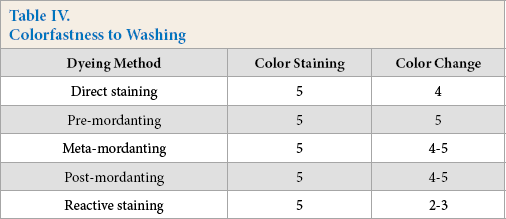
The color staining and color change of dyed cotton fabrics after soaping are shown in Table IV. Washing staining levels of dyed fabrics are all very high, because it is difficult for tea dye with low substantivity to combine with fibers; however, there is a great difference among the color change levels of dyed fabrics using different dyeing methods. The fabrics dyed by the reactive method had the lowest color change level and the worst washing fastness. This may be because sodium carbonate was added into the dyeing solution while the tea dye was not stable under alkaline conditions and was easy to desorb from the fibers after washing. The soaping levels of mordant-dyed fabrics were all high while the color of direct dyed fabrics was relatively light with a higher soaping fastness. The mordant-dyed cotton fabrics had a darker color and higher discoloration levels, among that the discoloration level reached 5, fully meeting the requirement of garment making and possessing a high practical value.
Colorfastness to Washing
Lightfastness
The lightfastness grades for dyed cotton fabrics are shown in Table V. The lightfastness was found to be 4 to 4-5 (good to very good), fully meeting the requirement of outdoor clothing.
Lightfastness

Conclusion
In this study, the extraction process of Longjing tea dye and various dyeing methods on cotton fabrics were investigated. A series of extraction experiments were performed and the optimum conditions of a liquid ratio of 1:50 and extraction time of 30 min. were determined. Longjing tea dye has excellent storage stability, acid-resistance, and heat-resistance. The rubbing fastness, washing fastness, and color difference of cotton fabrics were measured, indicating that the pre-mordanting and direct-dyeing were most suitable for Longjing tea dye. Furthermore, the anhydrous ethanol used for reflux and distillation during the purification process could be recycled. In view of these attractive properties and environmental protection, the natural dye from Longjing tea can be applied as a commercial natural dyestuff and has a significant potential market.