






Abstract
Researchers used nine woven electrothermal fabrics with different structures and silver-plated filament content. Electrothermal performance was tested and analyzed to select the fabric with the best thermal stability and heating performance for additional testing of fatigue resistance. Results show that at room temperature, electrical resistance decreases with the increase of silver-plated filament content, and the nine fabrics show good thermal stability at various voltages. When the fabric is electrified, the surface temperature distribution of the satin fabric is more uniform, and the satin fabric with 10% silvered filament has the best heating effect. At 3 V, the fabric can reach 60 °C. After 200 power cycles (on and off), the fabric still has good thermal performance and good fatigue resistance. After washing, heating remains effective.
Introduction
With the rapid development of science and technology, people′s concept of clothing has changed a lot. People are no longer satisfied with the basic functions of clothing, but pursue the comfort, functionality, and safety of clothing. With frequent outdoor activities of human beings, especially in the cold period, the main problem encountered by border guards, military police, field investigators, polar investigators, etc. is the extremely low temperature. Traditional clothing can prevent heat loss and play a role in keeping warm, but it is passive. In the case of severe cold, it is not good enough. Intelligent heating clothing can generate heat actively, for active warmth preservation. Even in the case of severe cold, it can also provide the necessary warmth preservation temperature for the human body. Therefore, it is extremely important to study intelligent heating clothing.
Intelligent heating clothing is generally made of electrothermal fabric. In general, electrothermal fabric uses carbon fiber or stainless-steel filament and other conductive yarns as electric heating elements, which are made by knitting, weaving or embroidery, or by coating the surface of the fabric to attach conductive material (metal or organic) to the surface of the fabric. After being electrified, a fabric that can convert electric energy into heat energy has the advantages of simple preparation process, high heating efficiency, and controllable temperature. Maity 1 and Liu 2 prepared coated conductive fabric by in-situ method and studied the influence of the preparation process of the electrothermal properties. Pahalagedara bonded conductive carbon black ink to the surface of fabric by screen printing and prepared the electrothermal fabric with conductivity basically unchanged within 25% of the tensile strength. 3 Hamdani used nylon knitted fabric as the base cloth to prepare electric heating fabric by in-situ polymerization of pyrrole mono-mer. 4 The surface temperature of the fabric can reach above 114 °C in less than 3 min. Kim made an electrothermal fabric by coating graphene material on the surface of cotton fabric.5-7 The fabric showed excellent electrothermal properties and thermal stability. Yang prepared conductive cotton fabric by coating the surface of knitted cotton fabric with single-wall carbon nanotubes. 8 The fabric could quickly reach the ideal temperature after applying a certain voltage, showing a strong electric heating effect. At present, weaving is the most popular method to prepare electrothermal fabric at home and abroad. Chen9,11 and Lu 10 prepared four kinds of electrothermal fabrics with various structures by adding silver-plated filament into knitted fabric and compared their electrothermal properties. The experimental results show that the electrothermal fabrics with fat needle, 1 × 1 rib, 4 fat, and double rib constructions have the best heating effect. Liu designed and manufactured three kinds of knitted heating fabrics with silver-plated composite yarn and polyester short fiber yarn, then studied the thermoelectric properties of knitted heating fabrics and silver-plated composite yarn through a series of experiments. 12 Liu 13 and Kayacan 14 studied the relationship between resistance and heating effect in knitted electrothermal fabric. Li wove electrothermal knitted fabric with silver-plated yarn, established the dynamic thermal conductivity model of the fabric, and accurately simulated the electrothermal characteristics of electrothermal knitted fabric under the influence of an external electric field. 15 Wang prepared a kind of soft polypyrrole/knitted cotton fabric, which had good tensile properties and good heating function after stretching.16 The fabric had excellent wearability in thermal clothing. Trough the rapier loom, Wu wove carbon fiber filament into a plain weave and a square weave, to form electrothermal fabrics with good heating effect. 17 These studies have important reference value for the manufacture of electrothermal fabrics, but there are few studies on the impact of woven fabric structure on the thermal stability and thermal temperature uniformity of electrothermal fabrics. Liu developed a three-dimensional conformal porous microstructure polyester woven fabric with enhanced thermal insulation properties, which can achieve higher temperature and save more energy at the same input power compared to traditional fabric shaped wearable electrothermal textiles. 18 Sun used a computerized fat knitting machine to produce six kinds of electrothermal knitted fabrics with various structures. 19 Under a certain voltage, with the passing of time, the resistance value of the knitted electrothermal knitted fabrics first increased and then decreased in a short time, and the temperature gradually increased, reaching equilibrium after about 1000 s. Karpagam chose embroidery to stitch nickel-chromium wire into cotton fabric to produce electrothermal fabric that can heat quickly after applying voltage to the fabric. 20 Embroidery can add conductive yarn into fabric according to any designed circuit, which is more flexible than the previous two forming methods and has the least waste of conductive yarn. Li used weaving for the maximum equilibrium temperature of the silver-plated yarn electrothermal fabric. 21 Under 5V voltage, the fabric can reach above 60 °C. This present study uses silver-plated fila-ment and polyester yarn to weave on a sample machine. Test results evaluate the conductivity and heating performance of the woven fabric to provide a reference for the development of silver-plated fiber heating products.
Experiment
Design and Preparation of Electrothermal Fabric
Raw materials included silver-plated filament (200D, Qing-dao Zhiyuan Xiangyu Functional Fabric Co. Ltd.), polyester yarn (40/2s, Yiwu Najie Ribbon Co. Ltd.), and fine copper wire (0.25 mm, Shenzhen MCC Metal Material Co. Ltd.). Weaving equipment was Tongyuan GA598-B, and the fabric specification design is shown in Table I.
Fabric Specification
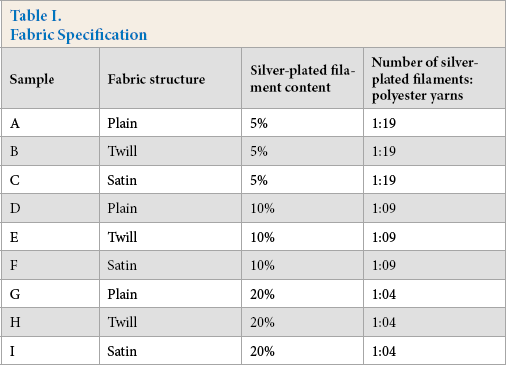
When weaving, each sample had 150 warp and 300 weft yarns. The warp yarns were all polyester, and the weft was silver-plated filament and polyester yarn according to the proportion interval in Table I. At the cloth edge, two thin copper wires of the same length were introduced as conducting electrodes. The specific introduction method was as follows: before weft insertion, the weft yarn was bypassed by the fine copper wire to form a coil, then weft insertion and beating are carried out. The silver-plated filament and polyester yarn were wound with the fine copper wire during weft insertion so that the fine copper wire could be better fixed on the cloth edge.
Fig. 1 shows the woven electrothermal fabrics. It can be seen from the figure that the cloth surface is very flat, and the copper wire has no serious buckling deformation. In this way, silver-plated filaments are connected in parallel to form a circuit, which greatly reduces the phenomenon of fre-quent interweaving of copper filaments with weft. Too many interweavings of warp and weft can cause serious buckling deformation of copper filaments and uneven cloth surface when copper filaments are used as warp yarns in weaving.
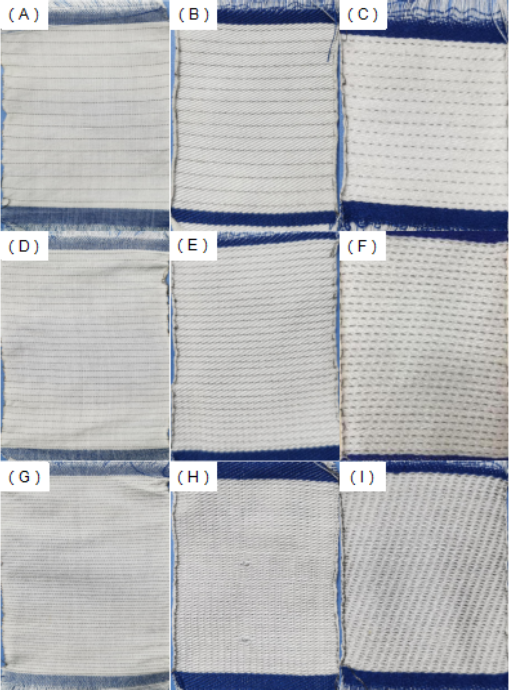
Photographs of woven electrothermal fabric.
Resistance
Fig. 2 is the circuit diagram of the fabric resistance test. The two ends of the thin copper wire of the cloth edge are connected, a parallel circuit is formed by the silver-plated long wire and the slender copper wire. The multimeter and the electrothermal fabric are then connected through the wire. The reading through the ohm range of the multimeter is the resistance value of the electric fabric under normal conditions.
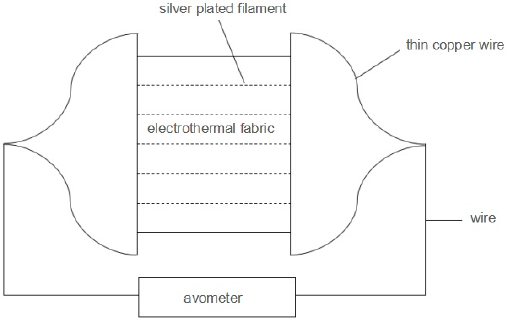
Resistance test circuit diagram.
Thermal Stability
The physical circuit of electrothermal fabric can be regarded as a pure resistance circuit, that is to say, after being electri-fied, all the work done by electric energy is transformed into heat energy. According to Eq. 1, when the voltage is constant, the resistance and the current are constant. According to Eq. 2, the calorific value of the circuit is directly proportional to the current, resistance and time.

Where I is electric current, U is voltage, and R is resistance.

Where Q is circuit calorific value, I is electric current, R is resistance, and t is power-on time.
When time t is fixed, more stable fabric resistance provides more stable heat output; therefore, the resistance value of the fabric is chosen to characterize the thermal stability of the electrothermal fabric. The specific test method is to apply voltage of 0.1V, 0.2V, …, 3V to the fabric until the surface temperature of the fabric reaches stability, then use a multimeter to read the current through the fabric and finally, calculate the resistance value of the corresponding voltage of the fabric based on the voltammetry.
Heating Performance
Under constant 20 °C temperature and 50% relative humidity, the electric heating fabric is provided with voltage of 0.1V, 0.2V, …, 3V by the DC power RXN-303D-II. The average temperature and temperature distribution uniformity of the fabric surface under various voltages are used to characterize the thermal performance of the electrothermal fabric. The average temperature of the fabric surface is obtained by a temperature sensor, and the uniform distribution of fabric surface temperature is obtained by a FLIR T250.
Fatigue Resistance
The temperature of the electrothermal fabric was adjusted to 20 °C. A 3V voltage was applied and the time required for the electrothermal fabric to reach a stable 60 °C for 25 s was recorded. The resistance value of the electrothermal fabric was also recorded at that timepoint. After the fabric cooled to 20 °C, 3V voltage was applied again and maintained for 25 s. The surface temperature and resistance value of the fabric were recorded after 25 s. The entire operation was repeated 200 times.
Washing Resistance
Electric Thermal Performance
Samples were fixed on 5 kg of washing fabric and evaluated using the degree of resistance to water testing machine described in GB - T8629-2017. Standard household cleaning and drying procedures were followed, with 9 b lining fabric and 50 mL detergent. Samples were washed 10, 15, 20, 25, and 30 times, then laid fat to dry. Finally, the surface temperature and resistance of the electrothermal fabrics were tested under the same conditions as before washing.
Bending Stiffness
The bending length of the sample before and after washing 5, 10, 15, 20, 25 and 30 times were tested by the bending length tester. The corresponding bending length and bending stiffness were calculated.
Results
Electrothermal Resistance
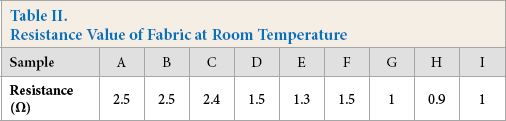
The resistance values of nine fabrics at room temperature are shown in Table II. Resistance decreases with the increase of silver filament content because a parallel circuit is formed between the silver-plated filament and the fine copper wire. According to the total resistance calculation (Eq. 3) for a parallel circuit, the more branches, the less total resistance. With the increase of the silver-plated filament content, branches are increased, so fabric resistance decreases.
Resistance Value of Fabric at Room Temperature
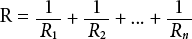
Where R is total resistance of electrothermal fabric; and R1, R2, …, Rn is branch resistance of electrothermal fabric.
Thermal Stability
The test results resistance in the power-on state are shown in Fig. 3. With the increase of voltage, the resistance value of the nine fabrics hardly changed. Because the three primary structures selected in this paper are compact, the degree of thermal expansion of silver-plated yarn is limited, and there is a certain interval between silver-plated filaments. Even if the silver-plated filaments expand, they do not contact each other, do not increase the contact point, and do not form circuits other than the preset parallel circuit. There-fore, in the case of 0 ∼ 3 V, the resistance value is basically unchanged. Electrothermal fabric obtained by the preparation method in this paper have excellent thermal stability.
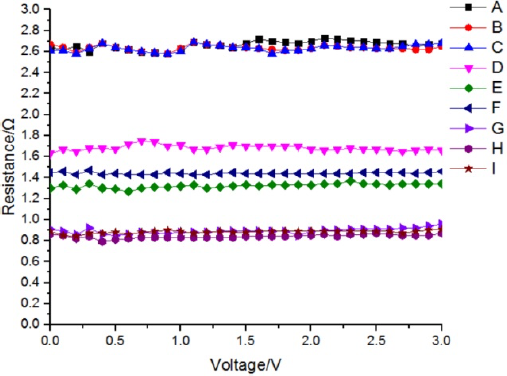
Resistance values of electrothermal fabric under various voltage.
Thermal Properties
Fig. 4 shows the change of surface temperature of electro-thermal fabric under different voltage. With the increase of input voltage, the fabric surfaces temperature increases. Among the samples, the heating rate of sample I is the fastest, and the surface temperature is as high as 80 °C under 3V. The heating rate of sample A is the slowest, and the surface temperature is 42.7 °C at 3V. The heating rate and the maximum temperature of samples G, H, and I are higher than those of other samples because the silver-coated filament content of samples G, H, and I is highest. Resistance is low, so the fabric temperature can be higher according to Eq. 2. Comparing samples G, H, and I, the surface temperature of sample I is highest because the structure of sample I is a satin weave. The weft contact is closer than in plain and twill constructions, and the heat transfer of fabric is faster. The error bar indicates that test results are reproducible.
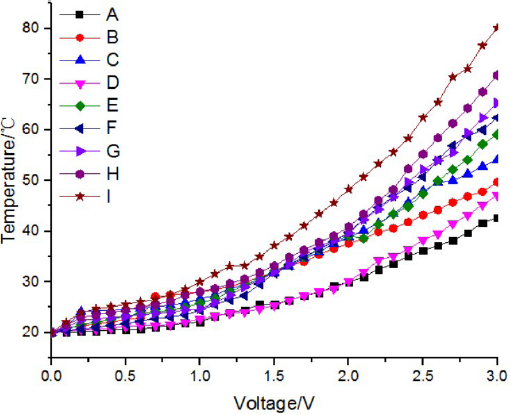
Surface temperature-voltage relationship.
Fig. 5 shows the infrared image of the surface temperature of nine pieces of electrothermal fabric under 3V voltage taken by the thermal infrared imager. In the infrared image, the darker the color, the lower the corresponding temperature; the brighter the color, the higher the corresponding temperature; the smaller the color difference is, the more uniform the temperature distribution is, and vice versa.
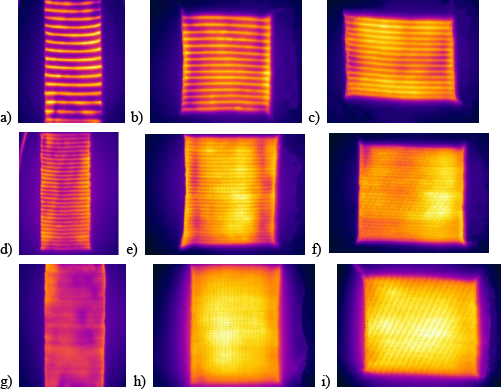
Infrared image of electrothermal fabric at 3 V.
It can be seen from each column in Fig. 5 that the color difference on the surface of electric heating fabric from small to large is: Satin < Twill < Plain, indicating that the surface temperature distribution of electric heating satin fabric is more uniform. Because the satin fabric has fewer weaving points, when beating up, the weft yarns are in closer contact. The distance between silver coated filaments gets smaller, and the range of heat conduction is wider. At the same voltage, the heat generated and transmitted by the satin electrothermal fabric is greater, which makes the surface temperature difference between the silver-plated and polyester yarns smaller, and the heat generated by the fabric more uniform.
It can be seen from each vertical line in Fig. 5 that the content of silver coated filament with small to large color difference on the surface of electrothermal fabric is 5% < 10% < 20%, indicating that more silver-coated filament content creates more uniform temperature distribution on the surface of electrothermal fabric. For the same number of total weft yarns, increasing the number of silver-plated filaments raises the branch circuits in the electrothermal fabric. Based on Eq. 3, the overall resistance of the electrothermal fabric is reduced. Eq. 2 and Eq. 3 together show that under the same voltage, the resistance is decreased and the heat output is increased. In addition, with an increase in the number of silver-plated filaments (heat source), the distance between them gets closer. In summary, the higher the content of silver-coated filament, the closer the heat source and the larger the heat value, which increases the range of heat conduction; therefore, the surface temperature distribution is more uniform.
Fig. 6 shows that under the constant temperature and humidity condition of 20°C ± 2°C and 50% ± 2% relative humidity, the electrothermal fabric shows a strong correlation with binomial fitting between the input voltage and the surface temperature of the fabric. Where x represents the input voltage and y represents the temperature. The correlation coefficient between input voltage and the surface temperature is above 0.9949, which indicates that there is a strong correlation between input voltage y and surface temperature x.
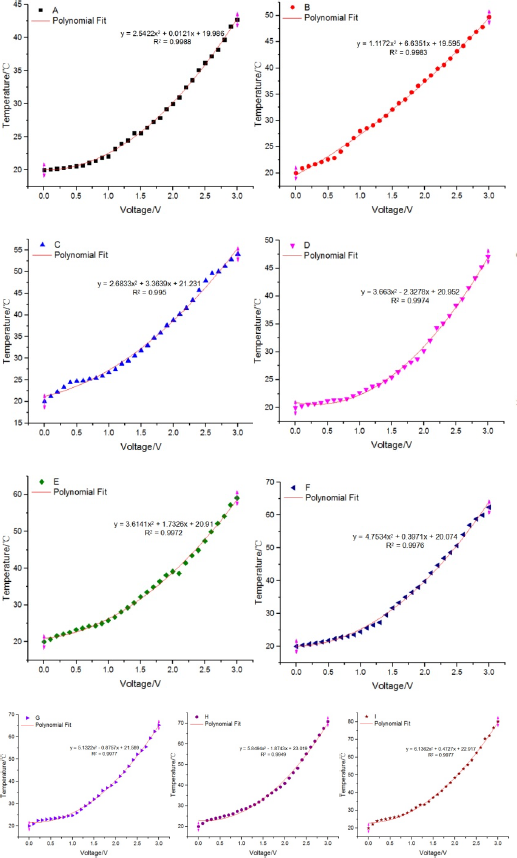
Correlations between input voltage and surface temperature of electrothermal fabric.
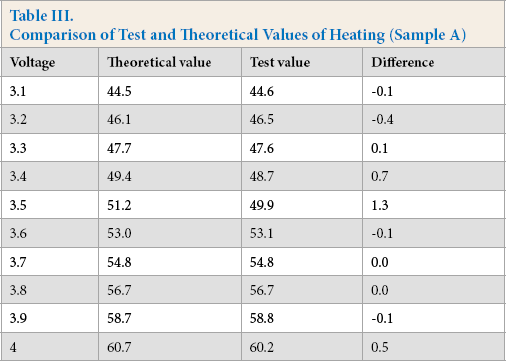
Table III shows the comparison between the test value and the theoretical value of the heating performance of sample A. It can be seen from the table that when 3-4V is applied to the electrothermal fabric, the theoretical value calculated by the correlation formula is very close to the actual test value, and the difference between the two groups of values is less than 1.3. The correlation formula can accurately predict the 4 heating performance of electric heating fabric. Based on the voltage applied to the electrothermal fabric, the temperature of the fabric can be estimated. The desired temperature for the electrothermal fabric can also be used to calculate the voltage that should be applied. The temperature of electrothermal fabric can be adjusted at will, and easily controlled.
Comparison of Test and Theoretical Values of Heating (Sample A)
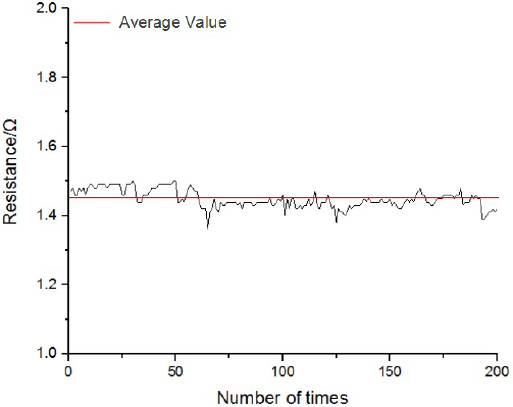
Change trend of resistance of electrothermal fabric.
Fatigue Resistance
Fig. 7 shows the temperature of the sample F after 200 times of repeated power on and power of cycling. The average value of 200 groups of values is 62.7 °C. It can be seen from the figure that after 200 on-off cycles, the surface temperature of sample F does not show a significant downward trend, fluc-tuating up and down at 62.7 °C, and the fluctuation range is -23.6% ∼ +21.5%. The lowest temperature point is the 125th, after which the temperature rises again. This shows that the surface temperature of sample F does not decrease obviously after 200 times of repeated power on and of, and it can still maintain a good heating effect.
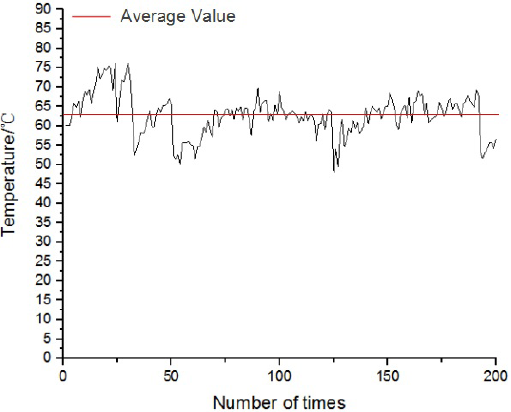
Change trend of surface temperature of electrothermal fabric.
Fig. 8 shows the resistance value of the sample F after 200 times of repeated power on and power of. The average value of 200 groups of values is 1.47. The resistance of the sample F is 1.50 Ω before repeating power on and of. After 200 on-off cycles, the resistance value of the sample F has no obvious downward trend, fluctuating up and down at 1.47 Ω, and the fluctuation range is -7.5% ∼ +2%. The lowest point of sample F resistance is 1.36 Ω, which appears 65 times. Although the resistance fell by 7.5%, the overall trend of sample F resistance did not decrease significantly. This shows that sample F, even after 200 times of repeated power on and of, maintains a relatively stable resistance value and has good thermal stability.
In conclusion, after 200 times of repeated power on and off, sample F still has good heating effect and thermal stability, which shows that sample F has good fatigue resistance.
Washing Resistance
Electrothermal Performance
Fig. 9 shows the variation trend of fabric surface temperature under 3V voltage applied to sample F after repeated washing. With additional washes, the fabric surface equilibrium temperature of sample F decreases gradually after applying 3V voltage. After washing 20 times, the fabric surface equilibrium temperature tends to be stable, still reaching 93.1% of that before washing.
Change trend of surface temperature of electrothermal fabric after washing.
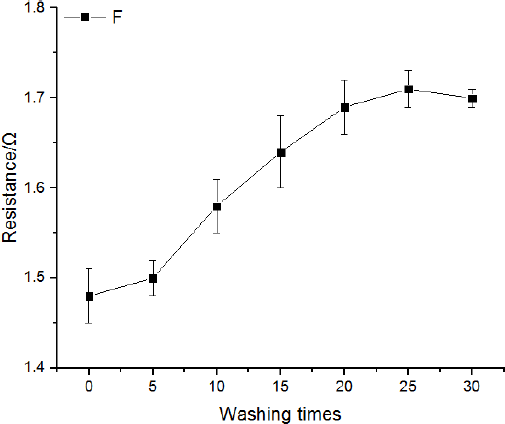
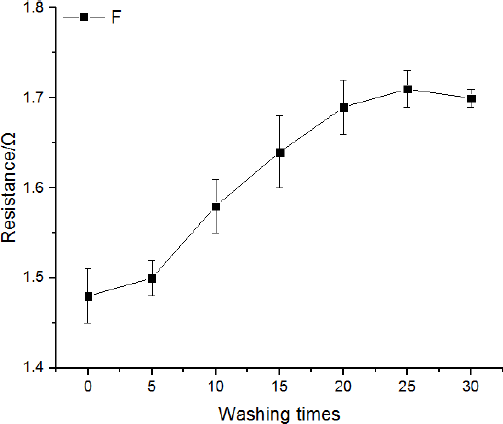
Fig. 10 shows the variation trend of fabric resistance of sample F after repeated washing under 3V voltage. With additional washes, the resistance value of sample F gradually increases. When the number of washes reaches 20, the increase of the resistance value becomes slow. Trough the error bars, we can know that the error of test results is small.
Resistance variation trend of electrically heated fabric after washing.
The reason for the above phenomenon is that the silver ion layer on the surface of the silver-plated filament in the electrically heated fabric breaks and falls of after soaking and friction in the washing solution, which leads to the increase of resistance of the silver-plated filament per unit length, the decrease of the total resistance of the electrically heated fabric, the decrease of the heat value, and the decrease of the surface temperature of the fabric.
Fig. 11 is the infrared image taken by infrared thermal imager under 3V voltage after sample F has been washed for 10, 20, and 30 times. Although sample F has been washed many times, the surface temperature distribution of the fabric is still uniform and the heating effect remains stable.
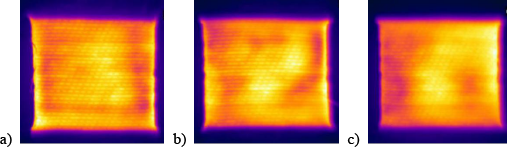
Infrared image of sample F after washing (a) 10 times, (b) 20 times, and (c) 30 times.
Bending Stiffness of Electrically Heated Fabrics
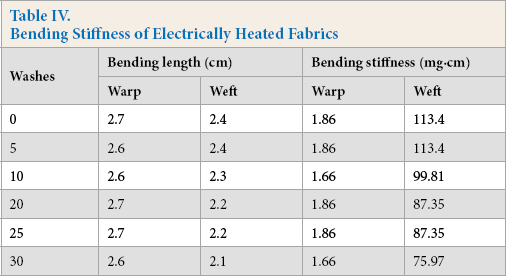
Bending Stiffness
The softness of electrically heated fabrics after washing was characterized by bending stiffness index, and the results are shown in Table IV. The greater the bending stiffness, the better the bending deformation resistance, the stiffer the fabric, and the lower the softness.
As can be seen from Table IV, with the increase of washing times, the longitudinal bending stiffness value of sample F has little change, and the fabric softness has little change. The main reason is that in the warp direction, two fine copper wires are embedded in the fabric edge. After washing, the rigidity of the fine copper wire basically does not change, so the bending rigidity of the electrothermal fabric after washing has little change. With the increase of washing times, the zonal bending stiffness of sample F decreased gradually, and the zonal softness of the electrothermal fabric decreased gradually with the continuous cycle of washing.
In summary, sample F still has certain electrothermal properties and stiffness after cyclic washing. Sample F has good washing resistance.
Conclusion
In this paper, nine kinds of electrothermal fabrics were woven with silver-plated filament and polyester yarn. The results demonstrate that the resistance value of the fabric decreases with the increase of silver coated filament content and all have good thermal stability with power on. All of nine samples have good electrothermal properties, and there is a high correlation between the input voltage and the surface temperature. Among them, sample F (satin fabric with 10% silver filament content) had the best heating performance. When the voltage is applied at 3 V, the surface temperature can reach 62.4 °C, and it has good fatigue and washing resistance. In the future, this kind of electric heating cloth can be used to electric heating clothing to develop electric heating clothing with good stability and fatigue resistance.