






Abstract
Interactive product design needs to be based on the human-centered design concept to meet the target users’ demands for affective interaction experience. Existing research on smart clothing mainly focuses on human-computer aspects of human physiological data monitoring and feedback, yet the potential emotional factors and behavioral interaction are ignored. This study adopts the somatosensory interactive hat as a carrier to explore an interactive clothing design method that reflects human emotions. The emotional semantic evaluation method is used to guide the design process of the prototype. Brain wave detection sensors and LEDs are embedded in the prototype. The results show that this dynamic interactive hat can enhance the visual attraction of the fashion accessories, and the humanistic emotional value of the smart clothing, improving the match between product attributes and users’ emotional response.
Keywords
Introduction
Artificial intelligence (AI) will become the core technology to guide the new round of industrial revolution and technological revolution. The technology, while evolving, influences the trend of consumers’ aesthetic cognition and provides a new drive for the design and aesthetics, particularly in the field of smart clothing. Different from the “Biohybrid wearable” represented by Yao and Wang, wearables fall within one of the application fields led by “information intelligence,” which integrates interdisciplinary technologies such as computer technology, communication technology, and textile engineering technology.1,2 With the sweeping trend of the wearable, the design of smart clothing has made rapid progress, but most of the research tends to focus on the intelligent and informatization, and studies on human centric clothing design by utilizing information technology to provide auxiliary support services for clothing are rarely found. The mere embedding of information technology reduces the humanistic social attribute that the clothing itself should embody.
With the increasing demand for individualized emotional aspects of products in daily life, users’ emotional needs become one of the main reference standards for product design. Zhou, published in Nature, also provided the feasibility of standard quantization of emotional relationships for intelligent interaction apparel design that reflects interpersonal relationships. 3 Therefore, the prerequisite for the integration and upgrading of humanistic art and information technology lies in adhering to the human-centered based on the user experience process, combining psychological reactions generated by the five sense organs of the human body, extracting the information needed for product development and coordinating the interdisciplinary relationships between design science, psychology, and information science.4,5
According to academic search statistics, hats, as one of the necessary apparel accessories, are rarely used as research cases for art design or smart clothing in academic circles. Therefore, this study uses somatosensory interactive hats as a research carrier to work out the design method for drawing close the emotional connection between users and products with emotional design technique, and brainwave monitoring technology through strengthening the interactive experience of clothing and users, taking into account the characteristics of young consumer groups to pursue new trends. The design effect is verified by the semantic differen-tial evaluation method.
Five hypotheses were proposed. They verified that practicality, social attribute, emotional feedback, aesthetic theory, and participation applied to interactive clothing design may have a positive impact on functional attributes, fashion attributes, emotional attributes, aesthetic attributes, and interactive attributes.
The actual results of the prototype show that the design of the dynamic interactive hat can enhance the visual attraction of fashion accessories. The design method of brain wave interactive technology also enhances the humanistic emotional value of smart clothing, which enriches the academic research of emotional exploration of the current smart clothing and improves the match between product attributes and users’ emotional response.
Research Purposes
Firstly, at the level of theoretical research, the association model of interaction design and emotional demand level is established, and the method of emotional design applied to interactive product development is explored, which provides a theoretical basis for the somatosensory interaction dynamic hat and related interactive apparel design and development. Based on emotional design theory in combination with the intercoupling relevance of sociological factors, humanistic emotional factors, and aesthetic factors, the identification points of and points of interest of target users are sought and the demands of each level are quanti-fied to provide a basis for emotional design. Meanwhile, affective identification points between designers and users are established to design the prototype from the perspective of empathy.
Secondly, in the application of information technology, the method of utilizing brainwave monitoring devices to provide interactive changes to the somatosensory interaction hats is explored to enhance users’ emotional experience of smart clothing. The integration of technological elements into fashion design is the representation of intelligent, digital, and networked life of people and part of the digitalized construction of life. However, facing the insensate technology, people need more humanistic care spiritually. 6 Such inner appeal is the inevitable result of technological, economic, and social development. For prototype development, efforts are made to present it in a relaxing and interesting way to the target users, so that the users are no longer faced with the functional operation of the wearable clothing without human feelings.
Literature Review
Research on Interactive Clothing
For the research on the form of human-computer interaction, Chen pointed out four methods: audio-visual information, biological signal recognition, tactile sense, and multi-modal-ity. 7 They depend on the physiological information collected by the detection devices to determine the emotions when users use the product and establish the interaction between parents and children. However, the research is biased towards the physiological aspects, lacking in research on the process of connecting the designer with the emotional needs of the users, which made the users passively accept.
Kapur utilized a two-way silent device to achieve human-computer interaction or human interaction via detecting the neuromuscular state, but gave little consideration to the aesthetic appearance of the product. 8 Zhang proposed interactive design to establish a mutually beneficial relationship between modern human beings and contemporary technology through exploring the deep spiritual world of users. 9 Wang advocated the interactivity research of smart clothing design in the context of sociology, pointing out that interactive clothing belongs to a branch of smart clothing, and interactive clothing focuses more on the connection among “people-clothing-life.” 10 Liu indicated that there are three principles in the interaction design of clothing products: user-centered design is the basis of interaction design of clothing products, emphasis on emotional experience is the spiritual cultural embodiment of interaction design of clothing products, and designing for time and space is the objective factor of interaction design of clothing products. 11
Research on Emotional Design
Emotional design, also known as Kansei engineering, is a technology that transforms the consumers’ perception and image of the product into a design element to seek the connection between people and design product by using the rational approach of engineering to quantify the various emotions of people. 12 Norman pointed out that emotional design includes instinct layer, behavior layer, and reflection layer.13,14 The core of emotional design is human-centered, and designers need to pay attention to people's perceptual awareness and behavior. Based on this, they can design products that satisfy users’ emotional demands. From the perspective of emotional design, instinct design focuses on the appearance and perception of the product; behavior design focuses on the functional design of the product; and reflective design focuses on the information conveyed by the product.
Ho summarized the role of emotional semantics, on which the product design style, function, form, validity, and experience model was constructed through the differences in consumer emotional semantics. 15 In addition, the result of design can feedback into the users’ emotions and emotional resonance that may make them happy, angry, excited, frustrated, etc. Wang proposed that emotional resonance and emotional feedback for product connotation would be generated to realize self-image after the interaction between product and user was established, and the realization of users’ personalized needs enable users to have a profound memory and sustained attention to the product. 16
Research on the Application of Brain Wave Signal Theory in Clothing Industry
Electroencephalograms (EEGs) detect a weak current released by the cerebral cortex, which reflect the electromagnetic wave state of human brain activity and can be used as an effective tool for detecting neural activity.17-19 Brain Computer Interface (BCI) is a manually constructed communication control system that utilizes brain signals to enable the user to communicate directly with the external environment. 20
Brainwave technology is applied in the field of clothing mainly in two ways. The first is to use brainwave technology as a tool to detect human physiological signals, thereby improving the comfort level of clothing. Mori applied brainwave detection technology to pajamas fabric to determine whether the fabric can meet the users’ requirements for sleep quality. 21 Jeong adopted an EEG evaluation method in studying the performance of outdoor sportswear, and experiments were performed to compare the difference between the pure cotton outdoor sportswear and the fast sweat-absorbent outdoor sportswear samples. 22 The second is to use the clothing as a carrier to link the psychological process of consumers with neural response to study the relationship between the target users’ emotional dimension, consumer demand, and event-related potential, and to construct the connection between the consumers’ psychological emotional dimension and physiological reaction, such as the brainwave cat-ear headdress developed by Japanese firm Neurowear.
The Current Development Bottleneck of Interactive Clothing
In summary, a complete theoretical system for the study of smart clothing is a cross-disciplinary subject involving design art, sociology, psychology, information science, etc. has not yet been formed. Although the current interaction design has achieved a certain breakthrough in the field of clothing, the development bottleneck of interactive clothing is mainly reflected in the following three aspects.
Lack of Emotional Connection between People and Clothing
The design of interactive clothing should establish a benign interaction between technical requirements, functional requirements, aesthetic needs, and user emotional needs. Designers can meet different emotional needs through emotional design and promote a new round of innovation in the fashion industry.
Insufficient Emotional Experience
The core of human-centered design is to create an efficient user experience, but user experience research in the current interactive fashion design only stays at the primary emotion, and with body reaction merely triggered by the external environment stimulus, such emotional stimulation lasts for a short time.
Function not Integrated into Daily Life
From the perspective of the existing interactive clothing on the market, it is more inclined to meet functional requirements and serve specific users, which is not widely accepted by the mass consumers.
Hypotheses
Practicality and Usability Applied to Interactive Clothing Design has a Positive Impact on Functional Attributes
Practical functional design can attract consumers’ attention, thereby increasing the frequency of use, so that consumers can have a pleasant experience, while the good functional experience can also enhance the user loyalty of the finished product. Compared to traditional clothing design, clothing product interaction design focuses more on the users’ reaction in the process of operation, emphasizing users’ comfort and usability during use. 9 If the process of operating or understanding the finished product takes too much time, it is an inefficient design and the users will be annoyed. In the usage mode, the procedural experience can be added to arouse the users’ emotional memories and deepen the emotional experience. 23
Social Attributes Applied to Interactive Clothing Design has a Positive Impact on Fashion Attributes
Part of the reason for consumers to choose smart clothing is that they value the symbolic value of the interactive clothing itself. Its symbolic content can satisfy the social emotional needs of users and help users establish a stylish and personalized self-image, as well as the stamp of identity, in the minds of others when enjoying the service of interactive clothing. 24
Emotional Feedback Applied to Interactive Clothing Design has a Positive Impact on Emotional Attributes
Users’ emotional needs feature abstractness and variety. If the users express the touching feeling and demand in the heart using the semantic vocabulary, it may have a positive impact on the emotional attributes. The users’ emotional feedback is a comprehensive evaluation of the finished product based on their own five sense organs, and the feeling after comprehensive consideration constitutes the process of the use experience. These emotional feedbacks can optimize the interactive clothing design and enhance the pleasure of the experience. 24
Aesthetic Theory Applied to Interactive Clothing Design has a Positive Impact on Aesthetic Attributes
From the aesthetic point of view, emotional design belongs to the aesthetic category, and the related results of aesthetic theory also provides theoretical support for the study of aesthetic attributes of prototypes. Several scholars have pointed out that, from the perspective of aesthetic psychology, aesthetic experience is not only applicable to artwork of visual appreciation, but also suitable for design work.25-27 The user can obtain aesthetic pleasure from the shape, color, dimensions, and material of the finished product.
Participation Applied to Interactive Clothing Design has a Positive Impact on Interactive Attributes
Interaction design can play the role of an emotional bond. If users participate in the design process, they may have a positive impact on the interactive attributes of the prototype. Due to the serious homogenization of products in the smart clothing market, it is necessary to change in the product design process. 28 Interaction design can establish communication channels between designers and users and help designers understand the emotional feedback, evaluation, and demand of users to optimize the rationality and science of the emotional design process.29,30
Prototype Design and Experiment
Design Concept
In style design, the technique of patchwork art is combined with the deconstructive technique. The patchwork technique and restructuring of cloths of different colors and different materials break through the boring feeling of monochrome clothing, creating the contrasting visual effects (Fig. 1). Tree styles of hats are designed, and visual effects are planned as follows.
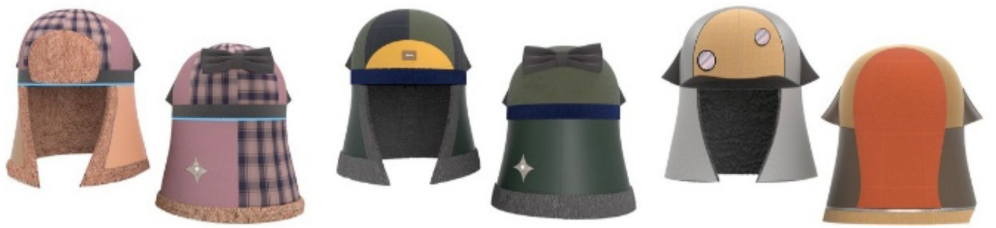
Prototype design sketch.
Somatosensory Interactive Dynamic Hat 1
As an important category of yarn-dyed fabric, plaid fabric is deeply favored by consumers. For color, the pink-purple plaid pattern and sweet roseate fabric are spliced, and the adjacent colors are contrasted to create a patchwork effect. These infuse inspiration into the basic style of winter hat; the bowknot design on the back of the hat highlights the gaiety of the young consumer group. The style models after Lei Feng hats, and the overall effect is simple and concise. The tying lace design at the rim of the hat can not only fix the hat on the head, but also beautifies the neck line. Additionally, the outer layer of the asteroidal part of the hat is made of hollowed-out fabric, and the inner layer is made of cotton to cover the LED light, giving the effect of emitting light.
Somatosensory Interactive Dynamic Hat 2
The color tone of the moss green is derived from natural moss, which is easily reminiscent of the cool verdant forest. The moss green of the hat is the main color, close to the color of the military uniform, stitched with the black crack texture, and showing a tough effect in whole and symbolizing the independence and individuality of women.
Somatosensory Interactive Dynamic Hat 3
The irregular patches of light tan, light gray, and orange are joined together on the hat, and the patchwork material is in sharp contrast, resulting in a strong color conflict. The front brim of the hat is made of transparent PVC material to show a futuristic effect, and a laser-colored leather patch on the front of the hat and cat ears on sides of the hat not only satisfy people's pursuit of individuality and interestingness, but also enriches the overall shape.
Selection of Materials and Hardware
Hat
Considering the requirements for anti-wrinkling, abrasion resistance, heat retention, soft tactility, and flexibility, the outer layer of the hat is made of Berber fleece with sheepskin, partially sewn with alpaca wool, forming sharp contrast visually. The part where the sensor is placed is equipped with a zipper for easy removal. The size of the dynamic hat is 58–60 cm according to international standards for adult women head circumference.
Brain Wave Sensor
The whole system consists of a TinkGear AM (TGAM) module, Bluetooth module, dry electrode, ear clip, power supply, and embedded motherboard based on I3HGP LED (Fig. 2). The EGG chip device of the Think Gear series developed by Neuro Sky are used as biosensors to obtain the data of bioelectrical signals. The method of brain wave acquisition used in this study is the acquisition of a single brain wave, rather than a multi-wave, based on cortical potential. The dry electrode slice is attached on the scalp and fixed with ear clips. The miniature lithium battery with a voltage of 3.7V is used as the power supply for the system.
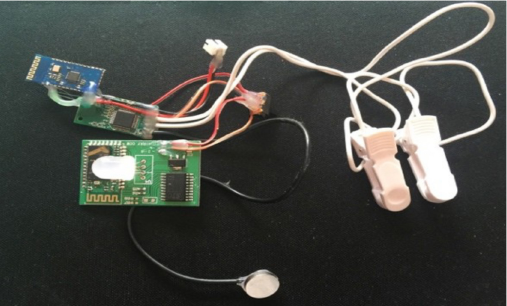
Brain wave module.
Placement of EEG Electrodes
The unipolar lead is to place the movable electrode in an appropriate position on the head of the human body, usually according to the method of placing the standard electrode of the international 10–20 lead system. The movable electrode above the eyebrows of the forehead is used as an input of the preamplifier and connected to the two reference electrodes at the postotic mastoid.
Method of Embedding Hardware
How to embed the sensor into the fabric and hardware maintenance are key parts of the craftsmanship, and also a difficult point in the production process. For the purpose of the interactive dynamic hat being easily used in daily life, the appearance of the hat should minimize the difference from the traditional winter hat. Therefore, the sensors and electronic components should avoid being exposed to the air or damaged by collision with the outside world. Since the outer fabric of the hat is soft, it is necessary to add a layer of hard fabric to part of the hat to fix the sensor and electronic components inside, thereby preventing the sliding of the electronic components. After multiple attempts, the hybrid fabric consisting of a transparent thermoplastic polyurethane (TPU) laminated fabric or a hollowed-out fabric mingled with a layer of white wool felt achieves the best effect.
Actual Effects of the Prototype
As shown in Fig. 3, a total of five effects are produced. Prototype I is shown in the first two rows corresponding to the left design sketch in Fig. 1. The subject can start the illumination of the diamond pattern on the back of the hat according to the degree of relaxation of the brain at that time. When the brain wave detection device is in standby, the color of the diamond part is yellow. When the brain is not relaxed, the color of diamond part is red. When the brain is highly relaxed, the diamond part will turn blue. At the same time, the subject can change the illumination of the LED strip at the brim via the switch button on the front of the dynamic hat. There are three variations: continuous fashing, flowing flickering, and constantly illuminating.
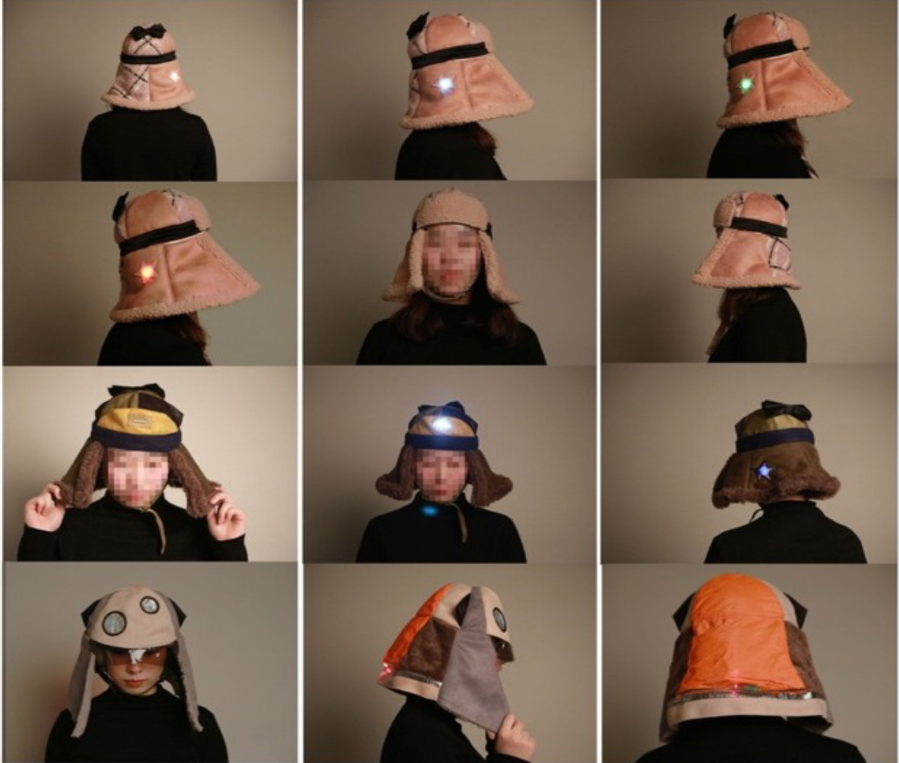
Effects of the prototypes.
Prototype II, as shown in the third row and corresponding to the center design sketch of Fig. 1. The subject can start the illumination of the diamond pattern on the back of the hat according to the degree of attentiveness of the brain at that time. When the attentiveness of the subject is distracted, the color of diamond part is yellow. When the brain is highly concentrated, the diamond part turns blue. When the attention is not relaxed, the diamond part will turn red. At night, the user can also trigger the switch button embedded in the hat to activate the LED light in the square part of the front of the hat for illumination.
Prototype III, as shown in the fourth row and corresponding to the left design sketch of Fig. 1. The subject can control the LED lights to illuminate one-by-one according to the strength of their brainwave frequencies.
The above results of the prototype show that the detected brain wave signal after the external stimulus has significant differences in brainwave patterns, which proves the feasibility and effectiveness of brain wave detection used in interactive clothing. The technical development of the prototype is successful. The emotional design can greatly expand the form of clothing interaction, increasing the relationship between user emotional response and clothing, and realizing the research purposes of applying the forms of emotional design to interactive clothing.
Comparative Evaluation of Prototypes
Forms of Evaluation
To test the actual effect of the prototype, a comparative evaluation experiment is carried out. Currently, there is no basis for research of the interactive dynamic hat in the academic world. The interactive dynamic hat belongs to the innovative form of fashion accessories combined with LED visual effects. Therefore, for comparison, 6 types of winter hats with the closest appearance and functions are selected as representative samples (Fig. 4), and the prototype is taken as Sample 7.
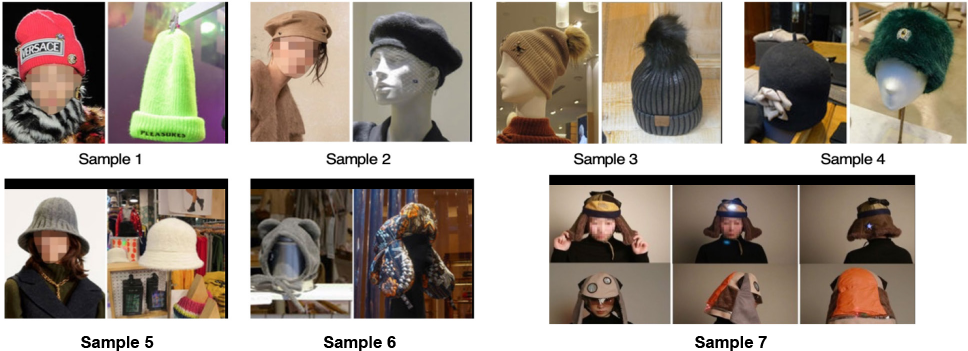
Comparative samples.
The experiment was carried out in a form of surveying the respondents to compare and evaluate the prototype of the somatosensory interaction dynamic hat and the six representative hat sample images we provided. The evaluation score of this questionnaire adopts the semantic differential emotion scale of 1–7 rating, and participants select the most accepted semantic level after viewing the representative sample pictures. The evaluation semantic vocabulary is divided into five categories: functional attributes, fashion attributes, emotional attributes, aesthetic attributes, and interactive attributes (Table I).
Vocabulary and Classification of Evaluation Semantics
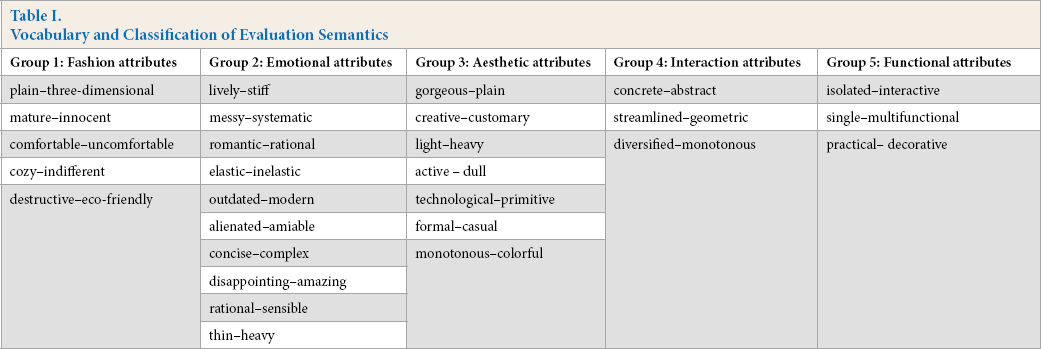
The participants include graduate students in clothing major, undergraduate students in information science engineering, and young consumers, with 107 valid questionnaires collected.
The reasons for choosing these groups were as follows. Clothing industry personnel, who are specifically engaged in clothing design, could compare clothing to make a professional evaluation. Additionally, because the prototype of this experiment used information sensing and optoelectronic technology, it is hoped that the researchers of information engineering and optoelectronic engineering could give a corresponding evaluation from the perspective of the application of intelligent technology. The target purchase group of the somatosensory interaction hat is in the young cluster based on the characteristics of them to pursue new things and trends, and thus the results will be more convincing with the help of potential purchasers.
Comparative Evaluation Data
Fig. 5 shows that the average score of the three groups for the prototype (i.e., sample 7), is significantly higher than the other six types of winter hat samples. The higher evaluation value of undergraduate students in information and young consumers is more significant. This result suggests that the prototype may have been successful and attracted great interest from participants.
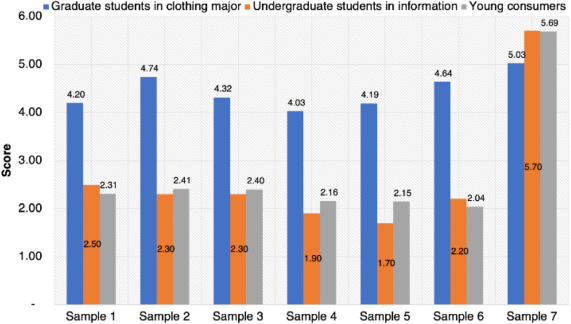
Comparison of the three groups average value.
Since the evaluation score of the prototype is the highest in the representative samples, the evaluation results of the three groups need to be analyzed separately to explore the specific strengths and weakness of the prototype.
As shown in Fig. 6, in the perceptual evaluation of the traditional winter hat by the graduate students with a fashion design major, the functional attributes, emotional attributes, and interactive attributes of the prototype were rated as optimal, and the fashion attributes and aesthetic attributes of Sample 2 were rated as the best. In the perceptual evaluation of the traditional winter hat by undergraduate students of information science electro-optics engineering major on the traditional winter hats, the functional attributes, fashion attributes, interactive attributes, aesthetic attributes and emotional attributes of the prototype are better than the other six samples (Fig. 7). In the perceptual evaluation of the traditional winter hat by the young consumer group, five attribute factors of the prototype are superior to the other six samples (Fig. 8).
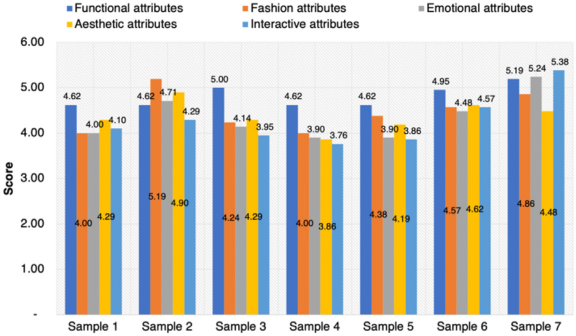
Comparative evaluation of samples by graduate students in clothing.
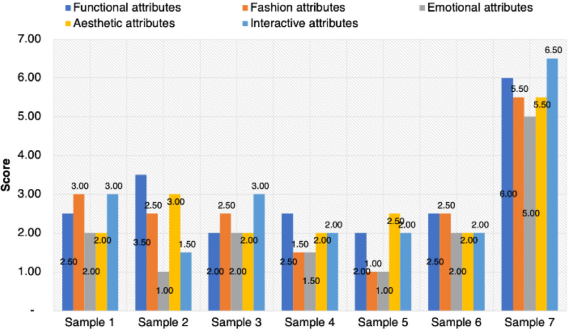
Comparative evaluation of samples by undergraduates in information science.
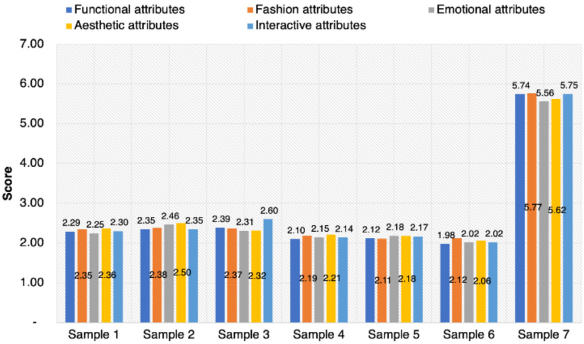
Comparative evaluation of samples by young consumer group.
Based on the evaluation results of different groups, people's expectations for the future of smart clothing are not merely focused on using high technology. These three groups have the highest satisfaction with the futurism and emotional elements of the prototype. Therefore, the point of view that affective interaction is the main development direction of smart clothing in the future is tenable.
Verification of Theoretical Hypotheses by Prototype
We analyzed the differences between the two states of the prototype by comparing the differences in turning on or turning of its interactive signal, and then analyzed whether the establishment of the hypotheses proposed previously occurs.
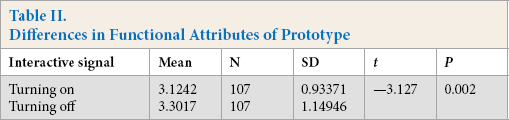
As shown in Table II, there is a significant difference in the functional attributes between the prototype hat with the dynamic device not actuated and the prototype hat with the dynamic device actuated, t = -3.127, P = 0.002 < 0.05, and the evaluation score of the interactive dynamic hat is significantly higher than the prototype hat with dynamic device not actuated, which indicates that Hypothesis 1, practicality and usability applied to the interactive clothing design has a positive impact on the functional attributes, is established.
Differences in Functional Attributes of Prototype
The results of Table III indicate that there is a significant difference in the fashion attributes between the prototype hat with dynamic device not actuated and the prototype hat with the dynamic device actuated, t = -2.041, P = 0.044 < 0.05, and the evaluation score of the interactive dynamic hat is significantly higher than the prototype hat with dynamic device not actuated, which indicates that Hypothesis 2, social attribute applied to interactive apparel design has a positive impact on fashion attributes, is well-founded.
Differences in Fashion Attributes of Prototype
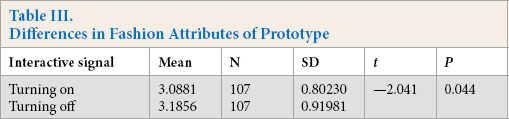
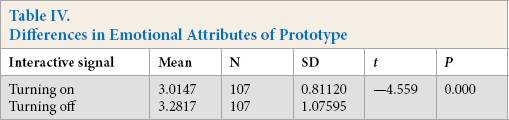
Table IV shows that there is a significant difference in the emotional attributes between the prototype hat with dynamic device not actuated and the prototype hat with the dynamic device actuated, t = -4.599, P = 0.000 < 0.05, and the evaluation score of the interactive dynamic hat is significantly higher than the prototype hat with dynamic device not actuated, which indicates that Hypothesis 3, emotional feedback applied to the interactive apparel design has a positive impact on emotional needs, is justifiable.
Differences in Emotional Attributes of Prototype
The results of Table V show that there is a significant difference in the aesthetic attributes between the prototype hat with dynamic device not actuated and the prototype hat with the dynamic device actuated, t = -2.051, P = 0.043 < 0.05, and the evaluation score of the interactive dynamic hat is significantly higher than the prototype hat with dynamic device not actuated, which indicates that Hypothesis 4, aesthetic theory applied to the interactive apparel design has a positive impact on the aesthetic attributes, is valid.
Differences in Aesthetic Attributes of Prototype
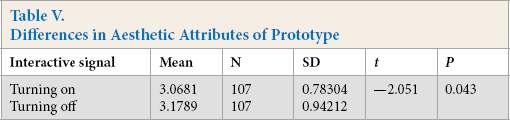
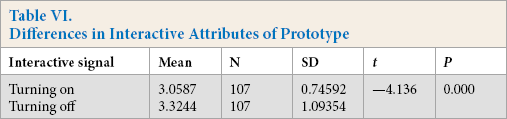
Table VI shows that there is a significant difference in the interactive attributes between the prototype hat with dynamic device not actuated and the prototype hat with the dynamic device actuated, t = –4.136, P = 0.000 < 0.05, and the evaluation score of the interactive dynamic hat is significantly higher than the prototype hat with dynamic device not actuated, which indicates that Hypothesis 5, participation applied to the interactive apparel design positively affects the interactive attributes, is wholly justified.
Differences in Interactive Attributes of Prototype
Conclusion
This study explores emotional design as the break-through point and attempts to apply a brain wave detection device to a winter hat that people can wear in daily life. This study selects the somatosensory interactive dynamic hat as the object for experiment and the interaction design as an entry point linked with daily life to seek the best form of experience to meet the different emotional expectations of young people. In the research content, sociology, humanistic emotion, aesthetic theory, and interaction design are combined to come up with a valid hierarchical model of interaction design and emotional needs, and the validity of the hypotheses based on the emotional feedback generated by the users in real scenario is verified. In terms of research methods, Kansei engineering is used as a method to carry out design research and the quantified needs of young groups as reference data to satisfy the individual needs of young people and establish connection between designers, users, and finished product of the prototype, while bringing in new research perspectives and methods for the design and research of interactive clothing.
The following conclusions have been drawn through theoretical analysis and prototyping practice. The integration of interactive technology and emotional design meets the target consumers’ psychological expectation of smart hats. The interaction design and emotional demand hierarchy association model derived from the multifactor demand characteristics transformed by the influence of sociological factors, human emotion factors, and aesthetic factors on interaction design can provide a theoretical basis for the design and development of intelligent interactive clothing
The good results of the prototype shows the research method of Kansei engineering can provide a rational and scientific basis for emotional design. Kansei engineering can transform the inner needs and feelings of young consumer groups into clear and explicit design elements to construct a product image through semantic expression and to optimize the finished product from the prototype. Analysis of emotional semantics is the key to case design and planning. Taking the somatosensory interactive dynamic hat as an example, the specific process of sensible image quantification is described through the questionnaire survey, semantic differential, and data analysis. The sensible image description vocabulary and perceptual score are obtained to construct a sensible image expression space of the prototype.
The emotional design of smart clothing helps the integration of technological elements into people's daily lives. The somatosensory interactive dynamic hat as a fashion accessory satisfies the basic function of keeping warm, and the affection interaction design can increase the user loyalty of younger groups, enhancing the competitiveness of the finished products of the prototype in the market. Users can change the color of the part of the hat automatically according to the change in the brain wave state at the moment to establish an innovative silent communication mode, meeting the desire of modern young people for innovativeness and interestingness.
Footnotes
Acknowledgments
The authors would like to thank all the volunteers for their help in these experiments. This study was supported in part by the Scientific Research Funds of Liaoning Education Department, China (Nos. J2019024 and J2020068), and the Liaoning Provincial Social Science Planning Foundation, China (No. L20BJY038).