



Abstract
Through the analysis of consumers’ attitude (ATT) and purchase intention (PI) toward parent-child smart clothing, this research reversely derives and extracts the design elements of this type of clothing. This research expands the category of Technology Acceptance Model (TAM) with clothing design attribute. Based on perceived usefulness (PU), perceived ease of use (PE) and perceived performance risk (PR), functionality (FUN), aesthetic (AES) and compatibility (COM) of clothing are added to analyze the factors affecting consumers’ ATT and PI toward parent-child smart clothing. A total of 372 volunteers participated in the test, and the results show that COM has a significant positive influence on PU, PE and PR. PU and FUN have a positive influence on purchase ATT and PI. PE positively affects PU and positively affects purchase ATT. PE positively affects PU and positively affects purchase ATT.AES positively influences purchase ATT but has little impact on PI. PR negatively influences both purchase ATT and PI but have little impact on PI. This research confirms the significance of multi-dimensional features of smart parent-child clothing, extracts and preliminarily establishes the framework model of design evaluation elements. And the results are helpful to the product design and development of parent-child smart clothing in the future.
Introduction
With the continuous development of information technology, the intelligence of mobile devices has become a general trend of future communication development. 1 Among them, the smart clothing market will grow at a compound annual growth rate of 26.2% in 2020–2024 and is expected to reach 4 billion US dollars in 2024. 2 Although smart clothing has good prospects and functions, it is still in the early stage of commercialization, and consumers’ acceptability of it is still highly uncertain. Moreover, there are few types of research on consumers’ acceptability and behavior on smart clothing.3,4 Therefore, it is very important to carry out more research to fill this gap, especially the study on consumers’ opinions and attitudes (ATT) from the perspective of the technical application of smart clothing and clothing characteristics.
The reason to choose parent-child smart clothing as the research carrier is that with the rapid development of science and technology, consumers’ demand for clothing tends to be more personalized, aesthetic, and emotional, in particular, it starts to pursue the integration of scientific and technological elements. As a representative of concept clothing and fashion lifestyle, parent-child clothing occupies an increasingly high position in the clothing market.5,6 However, many young parents are not satisfied with the existing parent-child clothes on the market due to factors such as the products are too formal, not fashionable, and lack of interest. And most existing research are focus on the design of the parent-child clothing or development of smart features of smart clothing, and there are few works of literature on the design of parent-child smart clothing and the study of consumer response. Therefore, the exploration of smart and parent-child clothing is a challenging task to the satisfaction of young parents. Technology acceptance model (TAM) was put forward in 1989. It is a model proposed by Davis when using rational behavior theory to study users’ acceptance of information systems. So, this study extends on the basis of the TAM, studies the factors influencing consumers’ ATT and PI, reversely derives and extracts the design elements of this type of clothing, and provides a reference for the future development of related products.
Review and hypotheses
Parent-child clothing
Parent-child clothing, as a branch of modern popular leisure garments, is made up of adults and children’s clothing. Parent-child clothing can convey affection care and family sense of belonging, and generally has the characteristics of the same series and style. Its advantage is to express family emotional culture through clothing, and to elevate clothing to the realm of cognitive culture and spirit. 1 The common style of parent-child clothing on the market at present has casual style, sports style, advanced style, countryside style, and national style, etc. One of the biggest proportions in the market now is casual style parent-child clothing, 7 in general, the style is relatively single.
Smart clothing
With the emergence of wearable computers (or wearable technology) in the field of computer engineering, smart clothing also arises at the historic moment. 8 As a new concept of clothing with high additional value, smart clothing is very complicated, as it is a device and also a kind of clothing, which retains the inherent social attribute of the clothing, and strengthens functions of all kinds of Internet of things. 3 As one of the most promising wearable products, smart clothing can provide more convenience and unique advantages for wearers, but the more innovative it is, the more uncertain users will be about this new feature. 9 Therefore, in order to better serve consumers, in addition to the research from the perspective of development trend and commercialization, it becomes very important for us to understand consumers’ purchase ATT and PI from the perspective of technical acceptance.
Parent-child smart clothing
Parent-child smart clothing is the combination of parent-child clothing and smart clothing, making ordinary parent-child clothing smart and interesting. So far, there are few types of research on parent-child smart clothing, and most of them focus on the development trend and commercialization possibility of parent-child clothing or smart clothing, as well as the design and development based on ease of use and wearability.10,11 Therefore, it is very important to understand consumers’ opinions and ATT toward parent-child smart clothing through clothing attributes and technical features.
Research model and hypotheses
TAM is considered as the most effective model to explain the acceptance level and use intention of information technology.12,13 This model explains consumers’ acceptance ATT and behavior toward innovative technologies such as information technology. Among which, perceived usefulness (PU), perceived ease of use (PE), perceived performance risk (PR) and other factors have been considered to be the most recognized factor influencing consumers’ ATT toward technology and innovative products and PI. At present, TAM has been widely used to evaluate consumers’ acceptance of technology-related elements in the fashion industry. 12 Such as the researches on the application of smart store technology in the retail industry and consumers’ acceptance of solar smart clothing.14,15 Therefore, this study extends the theoretical analysis scope of TAM, adds functionality (FUN), aesthetic (AES), and compatibility (COM) of the clothing based on PU, PE, and PR, and analyzes factors affecting consumers’ ATT and PI toward parent-child smart clothing.
A total of 14 hypotheses were proposed in this study. FUN, COM and AES are used as independent variables. PI is dependent variable, PU, PE, PR and ATT are mutually independent variables and dependent variables. Figure 1 is the research model presented in the form of structural equation model (SEM).
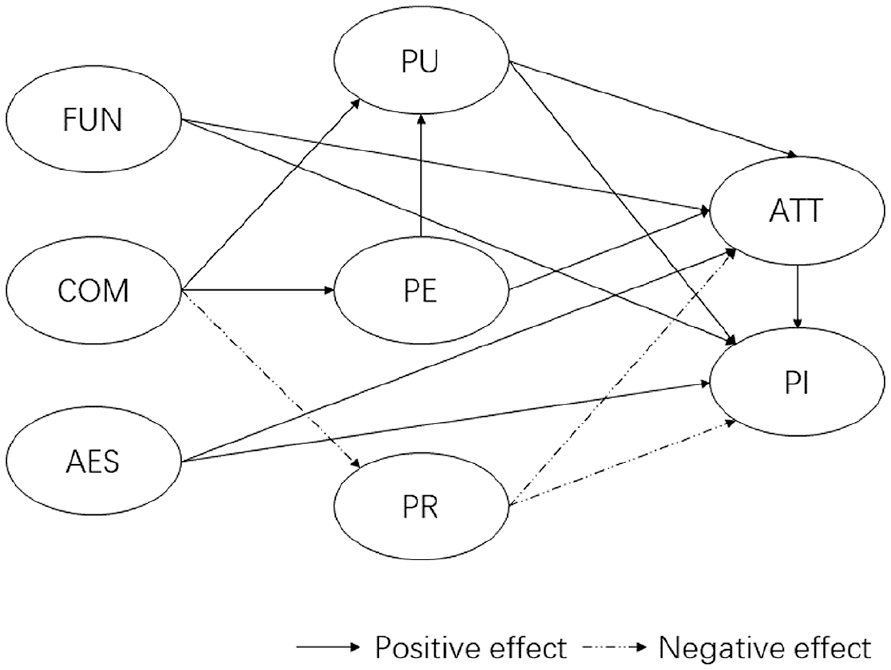
Research model.
PU
PU is defined as “a person believes that a particular system can be used to improve the level of his or her job performance.”12,16 Venkatesh believes that the usefulness of a product directly affects their ATT toward technology adoption, and PU has been regarded as the most powerful predictor of willingness to use and adopt technology, and a key variable that affects consumer ATT. 17 Chanmi and Chae et al. consider that PU gas a positive impact on purchase ATT and PI of solar clothing. 3 Based on the above research results, it shows that PU positively influences ATT and PI of parent-child smart clothing:
Hypothesis 1a: PU positively influences ATT of parent-child smart clothing.
Hypothesis 1b: PU positively influences PI of parent-child smart clothing.
PE
PE refers to “the degree to which a person thinks it is effortless to use a particular system”, in a number of relevant researches, for example, Kim et al. propose that PE is a key factor in determining the adoption of smart retail technology and positively influences consumers’ ATT toward wearable fit index technology,15,18 PE will positively influences PU. 9 However, Ko et al. consider that the relationship between the complexity and PI of smart clothing is not significant. 4 Therefore, it is expected that, PE positively influences PU and ATT of solar clothing:
Hypothesis 2a: PE positively influences PU.
Hypothesis 2b: PE positively influences purchase ATT of parent-child smart clothing.
PR
PR is defined as “the uncertainty that consumers face when they cannot foresee the consequences of their purchase decisions.” 14 Dowling and Staelin also conceptualized as consumers’ perception of the uncertainty and adverse consequences of purchasing a product or service. 19 Chen and Grewal et al. believed that performance risk and financial risk are the most commonly used assessment risks among perceived risks.20,21 Financial risk refers to the customer’s possible loss in the currency, including product repair or replacement and refund. Performance risk is defined as the potential loss caused when a product fails to meet the expectations of consumers, including the risk of innovation. Simply put, the more innovative the product, the higher the uncertainty associated with this new feature, and the more likely consumers are to hesitate to buy such a product. In short, PR means that the more innovative the product is in terms of the clothing, the higher the uncertainty associated with this new feature will be, and the more likely consumers are to hesitate to purchase such products. Therefore, innovation-related uncertainty can be conceptualized as PR, which plays an important role in the formation of new product ATT and PI for these products.22,23 Generally, PR negatively influences ATT toward the adoption of innovative technologies, and relevant researches have also proposed that PR negatively influences PI.24,25 Hence, we assume that the PR of parent-child smart clothing negatively influences ATT and PI:
Hypothesis 3a: PR negatively influences purchase ATT of smart parent-child clothing.
Hypothesis 3b: PR negatively influences PI of smart parent-child clothing.
FUN
In addition to the analysis of parent-child smart clothing as an innovative and technologically integrated product, the complex external attributes of clothing should also be discussed. Three dimensions play a crucial role in clothing design to meet consumers’ demand for innovative design, namely, FUN, COM, and AES. 26
FUN dimensions of clothing include FUN, protection and comfort, which are related to the practicability of clothing and affect the acceptance of technology by users. Because of the different needs of the audience, the multi-functional development of smart clothing is a necessary trend. At present, the relevant direction of parent-child smart clothing is mainly from the perspective of interaction design, health monitoring, and other multi-functions. Therefore, we believe that FUN will positively influence purchase ATT and PI of parent-child smart clothing.
Hypothesis 4a: FUN positively influences purchase ATT of parent-child smart clothing.
Hypothesis 4b: FUN positively influences PI of parent-child smart clothing.
COM
COM dimension refers to the symbolic communication characteristics of identity, such as values, roles, and self-esteem. Based on the socio-cultural and psychological aspects of clothing, the products should be compatible with the status and self-image of the wearer, which leads to the importance of COM. 27 The sense of innovation is also a kind of COM, which affects users’ acceptance to smart clothing. 4 An innovative product can reduce the risk of technical failure if it is simple and uncomplicated to use. In short, if the product meets consumers’ current needs and lifestyle, it will have a positive impact on users’ technology acceptance.14,28 Therefore, we suggest that COM positively influences technology acceptance variant of PU and PE, and negatively influences PR:
Hypothesis 5a: COM positively influences PU.
Hypothesis 5b: COM positively influences PE.
Hypothesis 5c: COM negatively influences PR.
AES
AES dimension refers to the use of elements involved in clothing, such as the relationship between design principles and clothing. AES standard is an important criterion for consumers to evaluate clothing because clothing is an important means of visual communication. 29 AES of clothing includes color, style, design, and other elements. AES attributes of clothing, such as color, style, and fabric, are the most important criteria for women to purchase clothing. 30 In terms of smart clothing, Malmivaara believes that the AES factor is an important factor affecting the acceptability and wearability of the final product. 31 Therefore, we propose that AES has a positive influence on ATT and PI:
Hypothesis 6a: AES positively influences purchase ATT of parent-child smart clothing.
Hypothesis 6b: AES positively influences PI of parent-child smart clothing.
ATT and PI
According to the theory of reasoned action, a person’s action is determined by his intention to perform the action, and this PI is influenced by his ATT. 32 In the context of clothing products, ATT has a positive influence on PI. 33 Therefore, we propose the hypothesis as follow:
Hypothesis 7a: Purchase ATT toward parent-child smart clothing positively influences PI.
Method
Sample and procedure
In this study, an online questionnaire and offline interview were used to test the hypotheses and SEM with the obtained data. In order to give participants a clear understanding of parent-child smart clothing, we provided an introduction to parent-child smart clothing in the questionnaire at the beginning of the survey, as shown in Figure 2.

Examples of parent-child smart clothing used in the questionnaire.
Sample profile
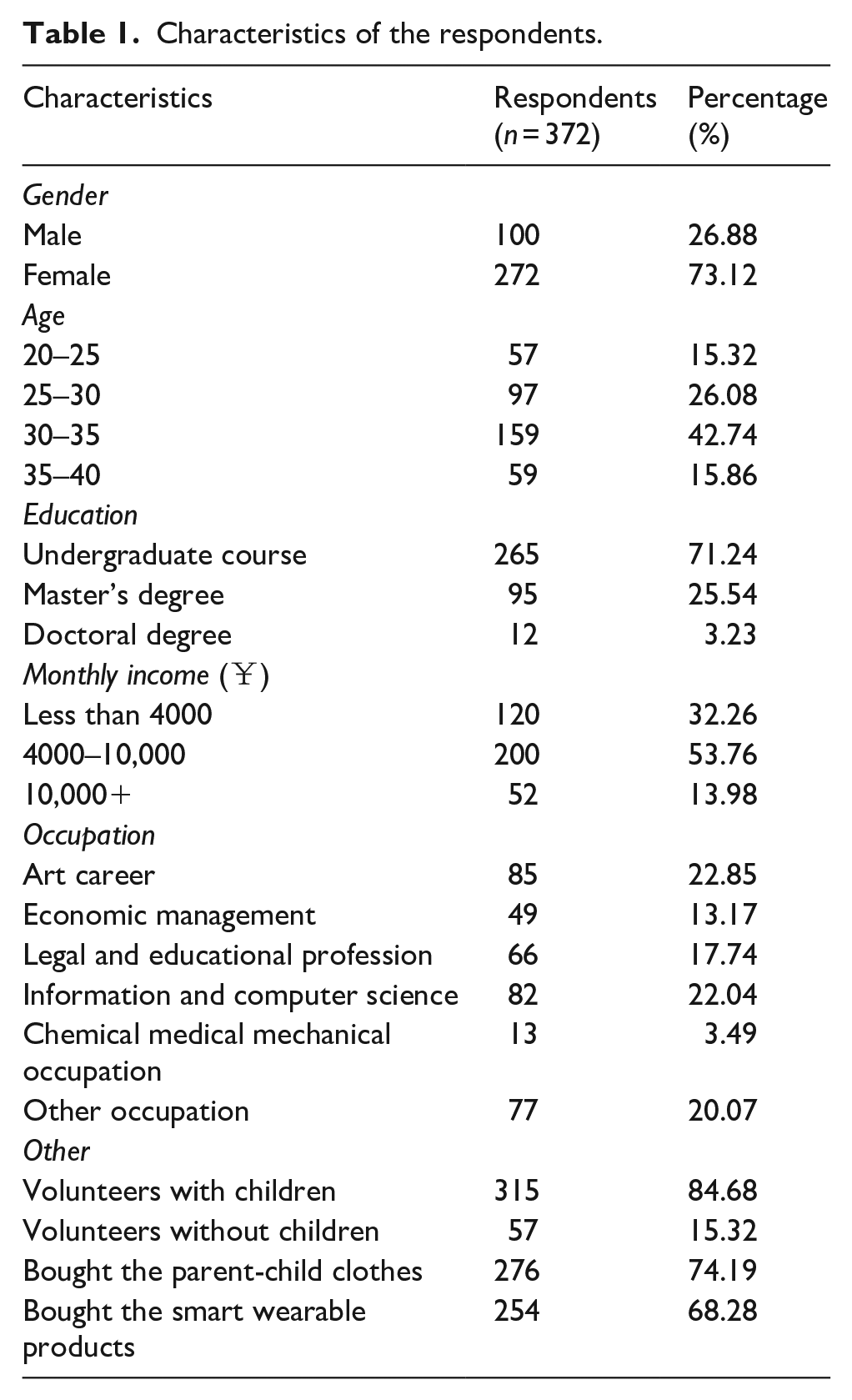
After eliminating the missing samples and incorrect data, a total of 372 samples were retained for research. Among which, 74.14% of respondents were between the ages of 25 and 35, and 84.68% were parents of children. Among 372 respondents, 276 (74.19%) said they had bought parent-child clothing, and 254 said they had bought smart wearable products (68.28%). Detailed statistics are shown in Table 1.
Characteristics of the respondents.
Instrument development
The measurement items in this research, based on previous studies, are developed and tested for reliability and validity. Eight potential components have been described in 28 measurement items, including FUN, COM, AES, PU, PE, PR, ATT, and PI. In this study, the variables, such as PU, PE, PR, FUN, COM, AES, ATT and others, are tested for reliability and factor analysis with the data obtained from the questionnaire and through SPSS software, and hypothetical model was drafted via Amos. Table 2 describes the survey items used in this study.
Survey items in this study.

Measurement model
Common factor extraction and naming
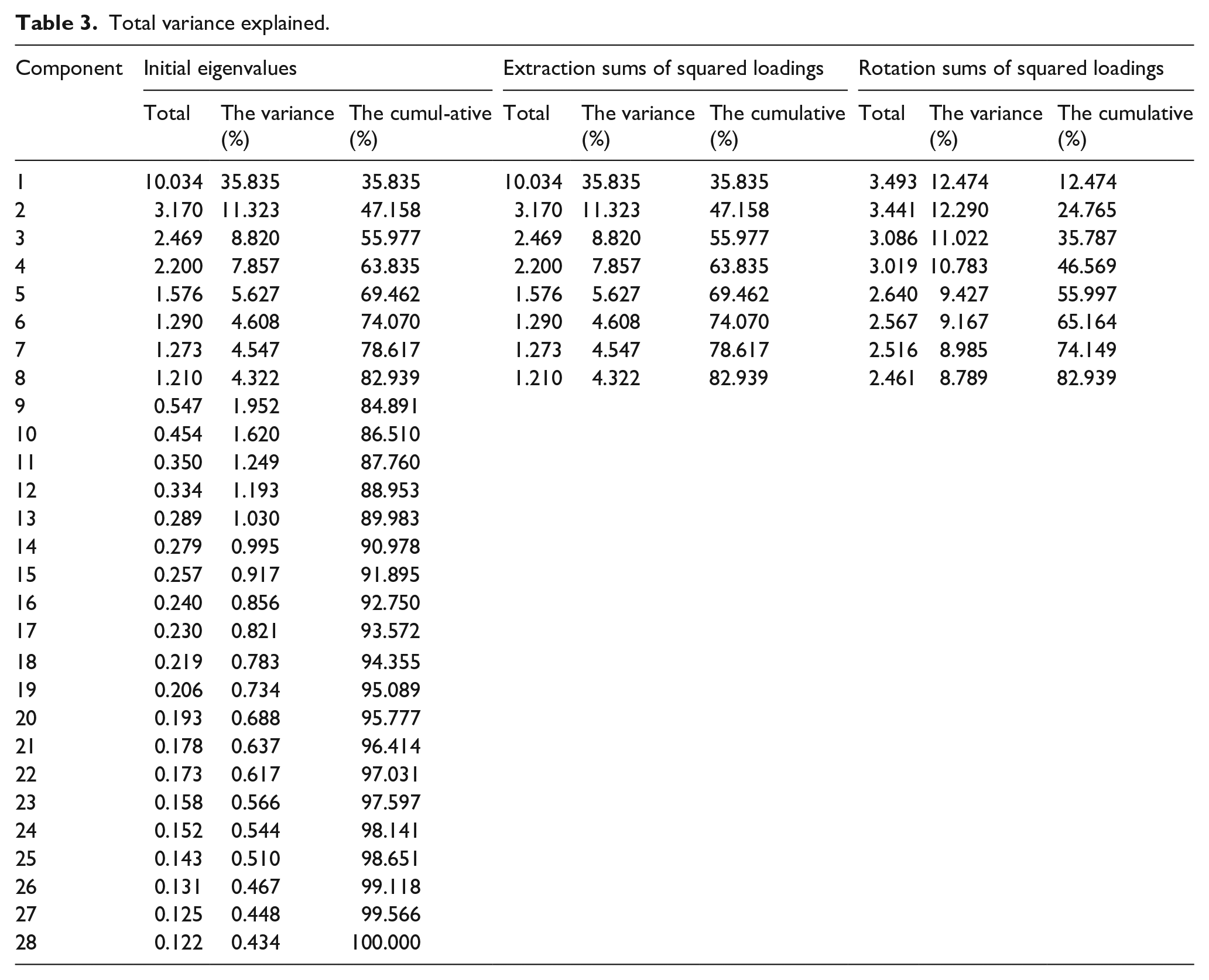
As can be seen from the list of total variance explanatory variance in Table 3, in this study, the factors with eigenvalues greater than 1 were extracted according to the system default method, and the number of factors was extracted as 8. The cumulative variance contribution rate of the first eight factors reached 82.939%, far exceeding 30%. Therefore, the extracted common factors reflect most of the information of the original variables, and it is believed that these eight factors have a very good interpretation of the scale.
Total variance explained.
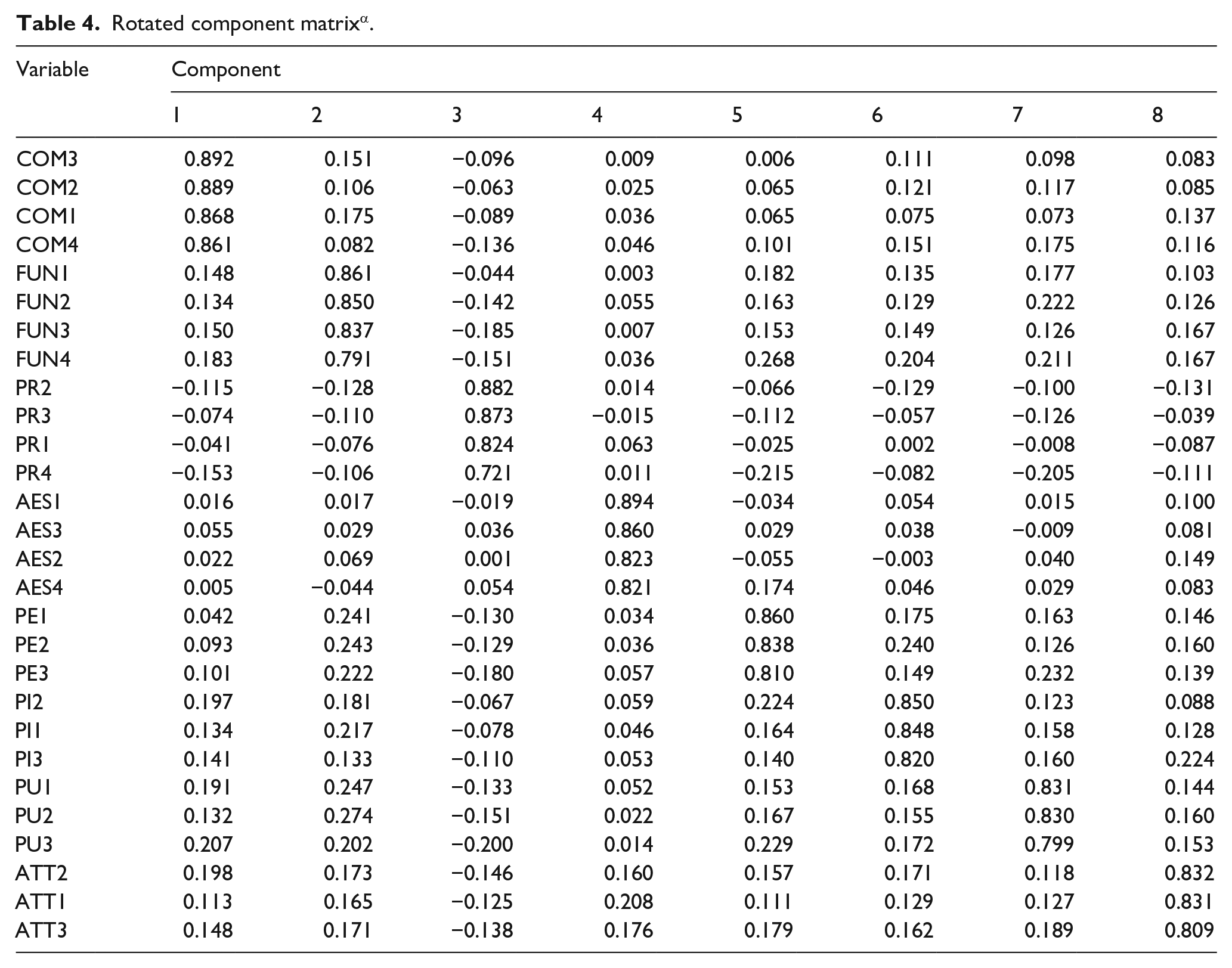
In order to ensure that the information of the original scale is extracted to the maximum extent and the extracted variables are interpreted, rotation method is adopted for analysis. Orthogonal rotation method is adopted in this paper, and the results are shown in Table 4. In the factor loading matrix, the absolute value of the factor loading indicates the degree of information overlap between the principal factor and the variable. The higher the degree of information overlap, the greater the generalized explanation ability of the principal factor is. Moreover, it is required that the common factor should be greater than 0.5. It can be seen from Table 5 that all the indicators meet the requirements. A total of 28 indicators can be classified into eight categories, and all the measurement items are clearly classified.
Rotated component matrixα.
Correlations of the constructs and square root of AVE.

Note: Square root of the AVE are the bolded diagonal values.
Measurement validity and reliability
The validity and reliability of measurement were analyzed by maximum likelihood estimation method for confirmatory factor analysis (CFA), full measurement model fits well, x2/df is between 1 and 3, and the model has a simple adaptation degree. The root means square approximation error (RMSEA) is less than 0.08, and the model fits well. The three indexes of value-added fitness, TLI, IFI and CFI, are all >0.9 indicates that the model fits well. The other two indexes of simple fitness, PGFI and PNFI, are all >0.5 indicates an acceptable model. The estimated value extracted by load and average variance of each factor (AVE) reached the recommended threshold level of 0.60 and 0.50 respectively, which provided internal consistency and convergence. The square root of AVE of each construct was great than the correlations between constructs, evidencing discriminant validity. Internal consistency for each construct was assessed using Cronbach’s α. Cronbach’s α coefficients for all eight constructs were acceptable, as they are all greater than 0.8. Results of CFA are summarized in Table 6.
Factor loading and reliability of measurement items and AVE.

Hypotheses testing and inspiration
Figure 3 shows the structural equation model results obtained by confirmatory factor analysis of variables with Amos, which reflects the causal relationship between various latent variables. The model in this paper contains eight factors (latent variables): FUN, COM, AES, PU, PE, PR, ATT, and PI.
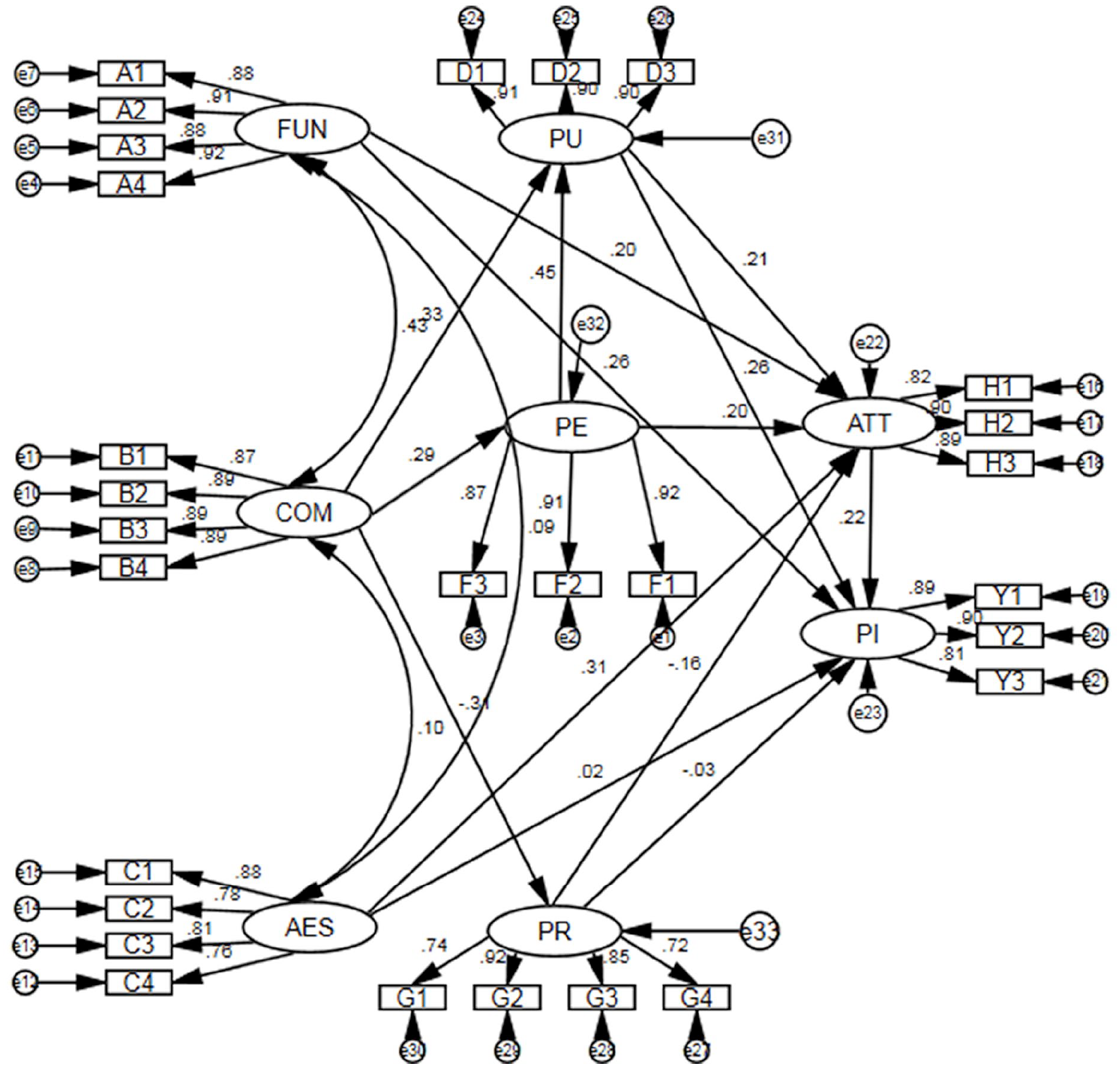
Results of the structural model.
Table 7 is a standardized regression coefficients and significance test table, the path coefficient between the indicators is estimated by the variance calculation and covariance calculation results of the variables, in the mode selection, the recursive form is generally adopted, and the observed scalars in the regression equation are generally linear, then the maximum likelihood estimation method can be used to estimate all the path coefficients. The second column is the standardized regression coefficient, the third column is the standard error of estimated parameter calculation, and the fourth column is C.R. (critical ratio), the critical ratio is the t value of the t-test. When this value is greater than 1.96, it means that the previous regression coefficient reaches the significance level of 0.05. The p value in the fifth column is the significance, if p < 0.001, it will be represented by the symbol “***,” if p > 0.001, it will directly show p value. As can be seen from Table 7, 12 of the 14 regression coefficients directly affected are significant.
Standardized latent variable path coefficient.
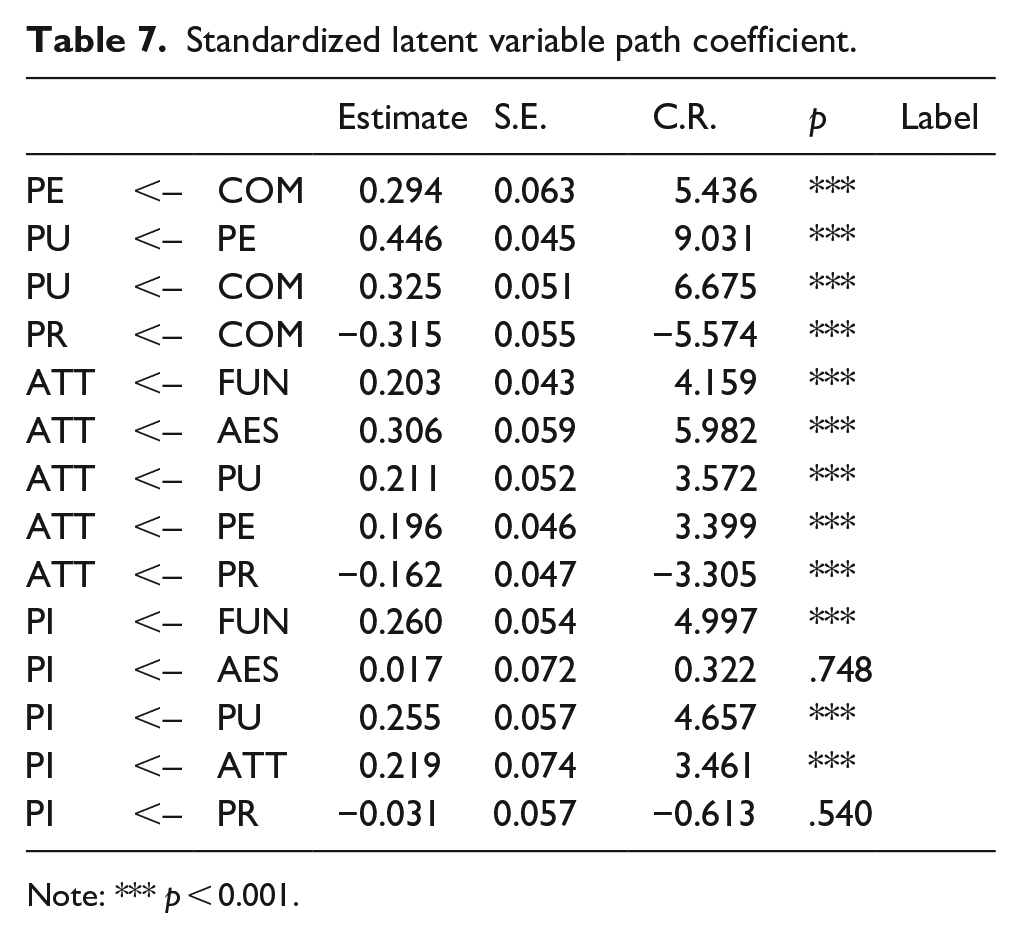
Note: *** p < 0.001.
As can be seen from Figure 3 and Table 7, in the independent variable, the p value of COM to PE is less than 0.05, reaching the significance level of 0.05, and the coefficient is positive, indicating that COM has a significant positive influence on PE, so hypothesis 5b is established.
The p value of COM and PE to PU is less than 0.05, reaching the significance level of 0.05, and the coefficient is positive, indicating that COM and PE have a significant positive influence on PU, so hypothesis 5a and 2a are established.
The p value of COM to PR is less than 0.05, reaching the significance level of 0.05, and the coefficient is negative, indicating that COM has a significant negative influence on PR, so hypothesis 5c is supported.
The p value of FUN, AES, PU, and PE to ATT is less than 0.05, reaching the significance level of 0.05, and the coefficient is positive, indicating that FUN, AES, PU, and PE have a significant positive influence on ATT. So, hypothesis 4a, 6a, 1a, and 2b are established.
The p value of PR to ATT is less than 0.05, reaching the significance level of 0.05, and the coefficient is negative, indicating that PR has a significant negative influence on ATT. So, hypothesis 3b is established.
The p value of FUN, PU, and ATT to PI is less than 0.05, reaching the significance level of 0.05, and the coefficient is positive, indicating that FUN, PU and ATT have a significant positive influence on PI. So, hypothesis 4b, 1b, and 7a supported.
The p value of AES and PR to PI is larger than 0.05, failing to reach the significance level of 0.05, indicating that AES and PR have no significant influence on PI. Then hypothesis 6b,3b are not established.
Discussion
According to the above hypotheses’ verification, both FUN and PU have a positive effect on purchase ATT and PI, because the consumers would like to purchase the product when it’s FUN meets the needs of the consumers. 14
AES positively influences purchase ATT but doesn’t work well in PI, it may be that for products such as parent-child smart clothing, AES is one of the factors influencing consumers’ purchase desire, but it will not directly lead to purchase behavior. Because other ordinary parent-child clothing can also meet AES characteristics, the parent-child smart clothing is not very dominant in emphasizing AES.32,39,40
PR negatively influences purchase ATT, however, the negative influence of PI is not significant. We believe that the technical quality, washing and care, sensing and contact of parent-child smart clothing are all purchase factors that consumers consider, 41 but they do not have a great influence on purchase decision. Its innovation, technology, and other characteristics, which are different from ordinary parent-child clothing, mainly affect PI.
COM positively influences PU and PE, and negatively influences PR. PE positively influences PU. COM includes innovation, which indicates that, when consumers think that they will have the desire to buy if the product is easy to operate, well used by children and meet the demands of the consumers. 42 It may also mean that because of the simplicity of the operation, it will not cost more time for consumers to learn how to use new technologies. Consumers who have bought similar products in the past will be less risky if they have some experience using them.
In this study, in addition to a large number of online questionnaires, face-to-face interviews were conducted offline to further understand consumers’ views on parent-child smart clothing. The participants included three college fashion design teachers, four staff supervisors of children’s clothing design companies, and three information engineering programmers. It is learned that all of the 10 participants have the experience of buying smart products and parent-child outfits. We invited participants to the clothing Lab of the university to conduct the experiment by e-mail. Based on the results of the online questionnaire survey, we ask the participants to further discuss the hypothetical factors such as interest, aesthetics and risk, and put forward some design factors that may affect consumers’ purchase. The overlapping answers discussed by the participants were listed and scored with the Likert scale.
Based on the results of previous online questionnaires, a discussion was conducted around the hypothetical factors such as FUN, AES, and PR are discussed, and some design factors that may affect consumer purchase are put forward and scored by Likert scale. The full score is 5 points, which are: very satisfied: 5 points, satisfied: 4 points, general: 3 points, dissatisfied: 2 points, and very dissatisfied: 1 point respectively. Table 8 shows the results scored by 10 participants and online volunteers.
Design element rating.

All hypotheses are established except 3b PR and 6B AES. Although the effects of AES and PR on PI are not significant, they have a positive influence on consumers’ ATT. Therefore, it is understood that compared with ordinary parent-child clothing, the technical level of parent-child smart clothing is also an important factor affecting consumers’ purchase besides the ordinary external attributes of clothing. Accordingly, it is required that parent-child smart clothing should balance design and technology to make it comfortable and fashionable and improve practicality.
We find that parent-child smart clothing can be divided into two levels: technical attribute and clothing attribute. Combining with the results of Tables 7 and 8 and relevant suggestions provided by the participants, we can deduce the framework model of design elements (Figure 4). Among them, there are three elements of clothing attribute (the left side of Figure 4): COM, FUN, and AES. It is suggested that when designing parent-child smart clothing, researchers should consider whether it can meet the needs of children and parents, conform to their lifestyle, representativeness and transmissibility in terms of COM; In terms of FUN, interaction design, monitoring and tracking, exercise and health can be considered. As can be seen from Table 8, for parent-child smart clothing, the consumers hope that practical and comfortable clothes should be worn at the same time. Among them, the average score of interaction design is 4.2, which is a favorable function for consumers and can stimulate the mutual affection of wearers, 43 so designers can consider to make more use of this function in design. Although AES has little influence, which should not be ignored by the designers. As can be seen from Table 8, the type of clothing will be the most important factor for consumers, followed by color. Therefore, we suggest that when designing parent-child smart clothing, the designer should pay more attention to the control of the version and color of the product in addition to institing on own style, and differing from the single and boring parent-child clothing in the market.

Framework model of design elements.
There are three elements of the technical attribute (the right side of Figure 4): PU, PR, and PE. Different from ordinary smart clothing, parent-child smart clothing is used by parents and children together, which should consider whether the children can master the use of the product. Therefore, the designer should consider whether the operating system of the product is complex, and try to make it easy to understand, so that young children can use it skillfully and easily. Researchers should not only work hard on the external attributes of clothing, but also make sure that the products can improve the life quality, facilitate communication between children and parents, and operate in a simple and easy way, with high quality. Additionally, common problems such as washing and care, sensing and touching of smart clothing should be seriously considered. Although PR has little influence on PI, it also affects consumers’ ATT. Therefore, this factor shall not be ignored by the designers. Through hypothesis 3b, it is learned that the technical quality, washing and care, sensing and touch of parent-child smart clothing and other issues are all factors that consumers consider to buy, but they have little influence on the decision to buy. Its innovation, science and technology and other factors that are different with ordinary parent-child clothing are the factors that affect the consumers may buy. Therefore, the designers should pay attention to the injection of technology elements to make clothing innovation more interesting. We understand and find that consumers’ concerns about parent-child smart clothing and the comfort children wear. The body quality of the children at low age is weaker and the skin is tender. Thus, the comfort of children’s clothes is a factor that parents should take into consideration before purchasing. Accordingly, the designers should add technology elements while maintaining the comfort of clothes. Since PU is also a factor affecting consumers’ PI and attitude, the designers should ensure that products are practical and meet consumers’ needs. At present, communication and interaction are what parents and children need most, so the designers can consider more interesting interaction design elements into the design. In general, the researchers should not only work hard on the external attributes of clothing, but also make sure that the products can improve the life quality, facilitate communication between children and parents, and operate in a simple and easy way, with high quality. Quality should also be guaranteed, common problems of smart clothing, such as washing and care, sensing and contact should be seriously considered.
To sum up, designers who want to be involved in parent-child smart clothing, both technical attributes and clothing attributes need to be taken into account. When we generally pay attention to smart clothing in areas such as intelligent medical and health care, very few people will be involved in interesting smart parent-child costumes. For children, the way they communicate and get along with their parents is very important. Increase the interaction time between children and parents through interactive smart parent-child clothing, and easily shorten the psychological distance between children and parents in an interesting technological way. Attempts may be made to adopt simple but interesting means of interaction for this interactive parent-child clothing such as gesture sensing, distance sensing and voice control. For example, the colored lights on the clothes will gradually light up when the father and the child come into contact with each other. Or when the mother approaches the child, the child’s favorite music will play. Surely, in addition to simple functionality, other factors which affect consumers’ purchase decision should be also taken into account i.e. comfortableness of fabric, weight of sensor, safety and whether it’s designed for daily use in terms of style.
Conclusion
By analyzing consumers’ ATT and PI toward parent-child clothing, this study confirms the importance of the multidimensional characteristics of smart parent-child clothing, and reversely derives and extracts the design elements of this type of clothing and establishes the framework model of design evaluation elements. The research results are helpful to the product design and development of parent-child smart clothing in the future.
This study extends the scope of TAM, adds FUN, AES, and COM of the clothing based on PU, PE, and PR, and analyzes factors affecting consumers’ ATT and PI toward parent-child smart clothing. Among them, COM positively influences PU and PE. PU, PE, COM, and FUN positively influence purchase ATT and PI. AES positively influences purchase ATT but has little impact on PI. PR negatively influences both purchase ATT and PI but has little impact on PI.
The main limitation of this study is that it is uncertain whether the participants really understand the parent-child smart clothing due to the lack of physical contact. Therefore, physical products should be provided at the time of the participants’ in-depth interviews to further support the research results.
Footnotes
Acknowledgements
The authors would like to thank all the volunteers for their help in the experiments. Special thanks to Prof. Yukari Nagai and associate Prof. Yuan Fang for their guidance.
Declaration of conflicting interests
The author(s) declared no potential conflicts of interest with respect to the research, authorship, and/or publication of this article.
Funding
The author(s) disclosed receipt of the following financial support for the research, authorship, and/or publication of this article: This study was funded in part by Liaoning Provincial Social Science Planning Foundation (NO. L20BJY038).
