






Abstract
The knitwear industry caters to the needs of the modern youth, whose preferences vary according to the trends and tastes of the modern age. This paper endeavors to demonstrate that active wear fabrics made of eri silk have very good physical properties. The main objective of this research is to investigate dimensional and physical properties of plated interlock, mini-flatback rib, and flatback rib structures developed with two different yarn counts (30s and 40s). The dimensional and physical properties of those samples are investigated in terms of dimensional stability, spirality, bursting strength, elongation percentage, fabric areal density, and fabric thickness. Variables such as yarn count and knit structure play a significant role on the dimensional and physical properties of the fabric.
Introduction
Eri silk is acquired from the silkworm Philosamia ricini, whose main food is castor leaves. As eri silk is one of the major preferences in the north eastern states of India, trib-als use it for the production of wraps and sweaters. The eri cocoons are open mouthed and have a discontinued filament, and thus cannot be reeled like other silk varieties. 1 Eri silk fibers are fattened, long, and more or less rectangular in shape. They possess a few streaks and voids on the fiber surface. Despite having less luster compared to mulberry silk, eri silk is observed to have better softness and comfort properties like cotton due to its higher translucency combined with a uniform cross-sectional area. The moisture properties of eri silk textiles vary from very good to excellent and indicate the quality of eri silk yarn for active wear applications. 2 The fabric areal density (grams per sq. meter) of eri silk knit structures is influenced by knitting parameters like yarn linear density, stitch length, and fabric structure. The dimensional behavior is in accordance with established knit material behavior. The thickness of the eri silk knitted materials vary with the material structure and yarn linear density. The thickness of the honeycomb structure was observed to be higher than the single pique structure. Also, the tuck stitches increase the bulkiness of the material. 3 Eri silk material has comfort properties that confirm its quality for lightweight winter active applications. Since eri silk fabric is created without killing the silk worm and possesses greater dimensional, thermal, and wicking properties, it has a great demand within the international market. 4 The wide use of knit fabrics for dress materials has also drawn the attention of the technical textile industry. Knit fabrics have become indispensable in various fields such as geotextiles, and automotive, medical, sports, agricultural, aerospace, and protective textiles. In recent times, for certain medical and automotive textile applications, the use of new and eco-friendly fibers such as polylactic acid, in knit textiles has increased. 5 Interlock fabric has a greater magnetic force shielding effectiveness compared with rib and plain knit materials. 6 Micro denier materials have shown superior properties in comparison to traditional denier materials in numerous aspects of physical and dimensional behavior. Microfiber textiles are dimensionally stable in comparison to traditional denier textiles, thanks to less loop-shape deformation, characterized by less lint shedding. 7 Synthetic fibers like polyester (PES) and polypropene aren't absorptive and thus absorb relatively less wetness. However, as a result of the hydrophilic fiber surface, they provide a high wet transfer rate. Artificial fiber yarns improve the dimensional stability of cloth. A mixture of natural and artificial fiber yarns is the best answer to style wear for leisure sports. 8 When considering their behavior, the mechanical properties of knit materials are the foremost characteristic for evaluation. Throughout use, the materials are exposed to differing kinds of strains in several directions. A very important form of strain is the explosive type (pressure applied on the material surface). The hyper physical property of knit materials is measured for material strength by the ball explosive check. 9 Cotton or viscose yarns conjointly influence other mechanical properties (bursting strength or pilling properties) of the materials. PES yarns exhibit superior mechanical properties compared to cotton or viscose. 10 By increasing cloth thickness, thermal resistance increases as well. 11 Apart from fat knits being used in geo-textile applications, they are also specifically designed and produced to suit several soil types and conditions. 12 Knit materials have also been used as advanced textile composites. 13 The dimensional stability of knit structures from most conventional yarns, together with other physical properties, has been one of the most extensively discussed subjects in this research. 14
This textile form uses bamboo fibers that are extracted from the tallest bamboo species Phyllostachys edulis that is commonly called Moso. Regenerated bamboo viscose fibers are commonly marketed. This happened mostly due to their claimed antibacterial nature, biodegradable properties, moisture absorption ability, soft feel, and UV protective capability. Recently, Tencel (lyocell) fiber is replacing cotton in spinning mills due to its properties like drape, moisture, and luster, which is superior to cotton. To acquire the merits of the parent fiber, various fibers are blended to produce yarn. The outstanding comfort qualities of knit fabrics have made it an important aspect for many kinds of clothing. Various qualities are expected from knit fabrics, as they are produced by various machines with various knit stitches and conditions. 15
Many studies have focused on double-face structures to achieve a high level of comfort. 16 Selection of the right yarn linear density is very important for the moisture management characteristics of double layer knitted materials. 17 The bi-layer fabric with micro-fiber polyester within the inner layer and modal within the outer layer exhibited smart thermal comfort characteristics compared to polyester or acrylic yarn within the inner layer. 18 The performance of layered fabric in thermo-physiological regulation is better than that of single-layer textile structures. 19 The required capabilities of sportswear fabric fluctuate under distinctive conditions involving sports, environmental situations, and leisure activities. Sportswear evolved by using unique forms of polymers, fibrous materials, changing the fiber/yarn/material structure, lamination, and production methods. 20 Double superimposed knitted materials made from totally different combinations influence the mechanical and luxury properties. Therefore, appropriate attention needs to be paid while producing double knit fabrics. 21 Bi-layer knitted structures, made up of lyocell yarn as the outer layer and acrylic/micro-fiber polyester yarn as the inner layer, have a good subjective rating on the thermal surrounding scale. 22 On the inner side of a multiple layer textile, a synthetic material with good moisture transfer properties, such as polyester, nylon, and acrylic, or polypropylene is used, whereas on the outside, material that is a good absorbent of moisture such as cotton, wool, and viscose rayon or their blends, can be placed. 23 The layered fabrics used in garments influence the thermal conductivity, air permeability, and moisture vapors. 24 The layering of fabrics used as garments has a major effect on properties such as thermal conductivity, air permeability, and moisture vapor transmittance, which together achieve a high level of comfort. 25 It is observed that synthetic sportwear exhibit better performance with remarkable improvement in the mean skin temperature and comfort sensation during exercise. 26 Excellent comfort properties like absorption, wick-ing, and rate of drying are identified in knit fabrics that use micro-fiber polyester. 27 Rapid liquid transportation is minimal with cellulosic fibers like cotton and viscose, as they easily absorb moisture and retain it. Viscose is a hydrophilic fiber that can absorb liquids into the fiber structure, thus preventing the speed of liquids like sweat. 28 The comfort properties of knit fabric are directly proportional to the filament fineness of the yarn. 29 Yarn, fabric structure, yarn loop length, and tightness factor of knit fabric have a direct influence affecting the air movement in the fabric. 30 Thermal comfort properties of knit fabrics made of cotton are greater when compared with fabric made of modal fibers. 31 Weft knit fabrics made from micro-denier polyester have better comfort properties when compared to normal denier polyester knit fabrics. 32 Knit fabric made using mono-filament spacer yarn gives greater thermal insulation. 33 Fiber, yarn structure, fabric dynamics, and finish-ing applications play a major role in deciding the comfort and handle of knit fabrics. 34
Eri silk knitwear is the latest trend because of its greater soft-ness and comfort compared to other fibers. Various studies report the dimensional and physical properties of knit materials. This study focuses on the dimensional and physical properties of eri silk with bamboo, and eri silk with lyocell bi-layer knit materials.
Experimental
Materials
The knit structures were prepared using eri silk from Eco Tasar Silk Pvt. Ltd., and bamboo, lyocell, and micro-denier polyester from the Ganapathichettiar Yarn Agency. It was found that micro denier polyester (binding yarn) influenced the fabric properties.
Fabric Development
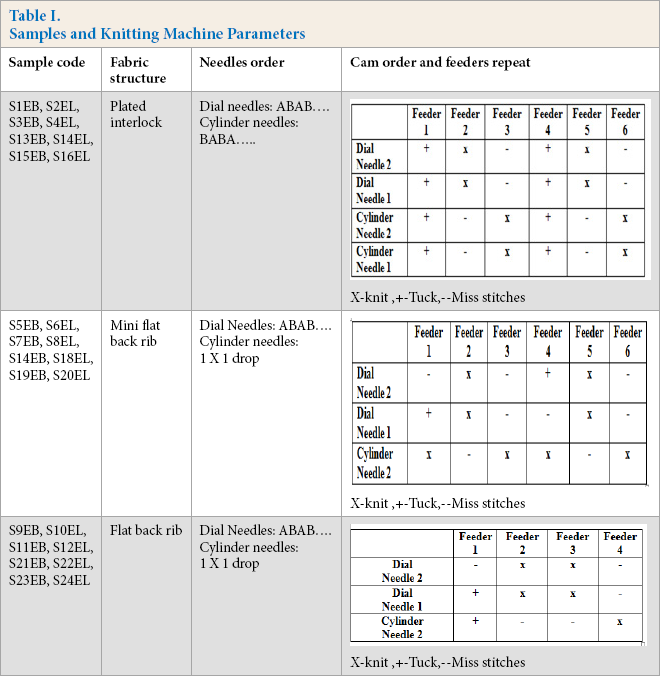
Fig. 1 shows the fabric development chart. The 24 bi-layer knit structures were prepared using eri silk, bamboo, and lyocell (30s and 40s yarn counts). All samples were produced using a circular multi-track weft knitting machine (Keumyong knitting machine) with 34 in. diameter, 82 feeders, 18 gauge, and 3840 needles. In this experimental work, the bi-layer fabrics were developed in which the inner layer (next to the skin) was made of eri silk yarn. The outer layer was made of bamboo or lyocell yarns. The yarn forming the outer layer was fed into the dial needle and an inner layer was fed into the cylinder needle. The sample designations and knitting machine parameters are given in Table I.
Samples and Knitting Machine Parameters
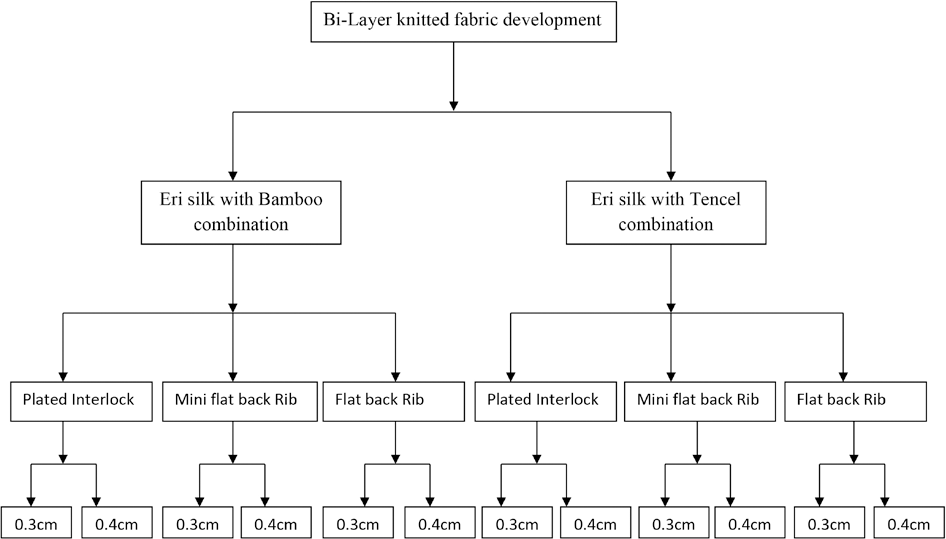
Fabric development chart
Dimensional and Physical Parameter Evaluation of Eri Silk Bi-Layer Knit Fabrics
Testing of eri silk bi-layer knit fabrics was carried out under standard atmospheric conditions (21 ± 2 °C and 65% relative humidity (RH)). The loop length, stitch density tightness factor, dimensional stability, spirality thickness, fabric areal density, bursting strength, and percent elongation were measured for the bi-layer knit fabrics. The fabric structural and physical fabric properties were evaluated according to following standards; dimensional stability and spirality (ISO 6330:2012 and ISO 16322), fabric aerial density (ASTM D3776), fabric thickness (ASTM D1777), fabric bursting strength (ASTM D3786), wales and courses per unit length (ASTM D3887:1996), and loop length (ASTM D3887). The knit fabrics were measured for areal density by cutting the sample size to 10 x 10 cm. After weighing the sample on the electronic balance, the value was then multiplied by 100. The loop length was calculated by counting 100 wales in a single course. The measured cut length was divided by 100.
Results and Discussion
Effect of Fabric Construction Properties on Eri Silk Bi-Layer Knit Fabrics
Each sample structure was developed using two different yarn counts, and loop length was selected accordingly. The developed fabrics were evaluated according to the standards, and the fabric properties are mentioned below. By altering the loop length course per unit, the length was changed due to alteration in the loop height. Yarn count plays a vital role in adjusting the weight of the fabric. Certain factors like course and wale spacing are directly related to the course and wale densities. Various plated yarns were used to indicate the change of stitch shape. 35 Yarn feeding rate is related to feeding tension, and the material tightness on physical, dimensional, and thermal comfort properties of knit fabrics. 36 From Table II, it is seen that plated interlock, mini-flatback rib, and flatback rib knit structures had very different course and wale densities. A lower porosity of knit fabrics was obtained due to yarn relaxation in plated interlock fabrics, whose knits possessed greater course and wale densities. We found that the loop length increased in plated interlock, mini-flatback rib, and flatback rib knit structures, respectively. The loop length tends to become shorter when more yarns have knit loops. Therefore, ultimately course and wale spacing were reduced due to reduced course and wale heights. Mini-flatback rib and flatback rib structure knits were looser and porosity was greater. The density of these plated interlock fabrics decreased due to the use of three knitted yarns. When the loop length decreased, the thickness of knit fabric increased and porosity decreased. 37 As the proportion of spandex (elastane) increased, loop length values remained nearly the same and the course and wale spacing values decreased. 38 The yarn's physical and mechanical properties, and knitting variables are responsible for the nature of the knitted loop. 39 Greater stretched structure yarns have shorter loop length values; the dimension of the material decreases so the thickness of the material increases. 40 In this study, the tightness factor and stitch density were greater than mini-fat-back rib and flatback rib structure knits. As the loop length became shorter, there was an increase in the density of the plated interlock structure. Hence the plated interlock fabric was tighter and heavier.
Samples and Knit Fabric Parameters a
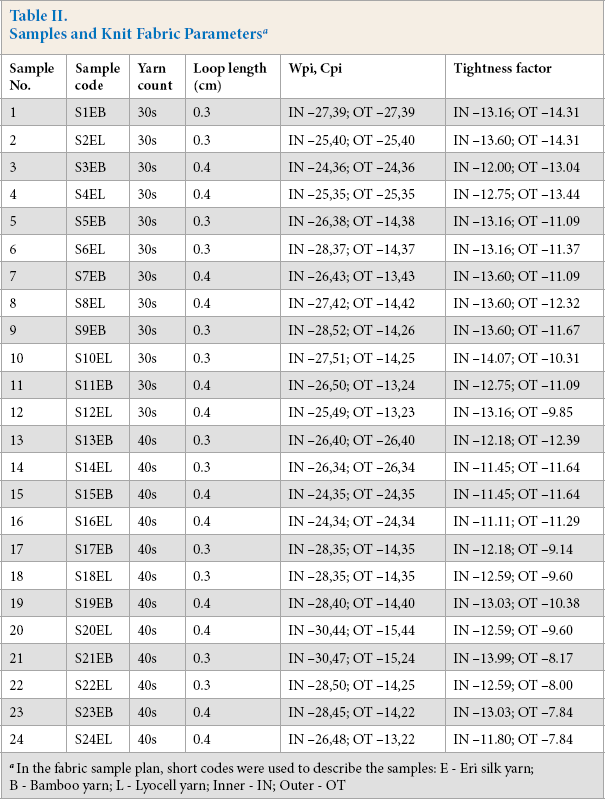
In the fabric sample plan, short codes were used to describe the samples: E - Eri silk yarn; B - Bamboo yarn; L - Lyocell yarn; Inner - IN; Outer - OT
Dimensional and Physical Testing of the Eri Silk
Bi-Layer Knit Fabrics
The dimensional and physical properties of plated interlock, mini-flatback rib, and flatback rib structures with 100% eri silk, 100% bamboo, and 100% lyocell are shown in Table III.
Fabric Testing Results a
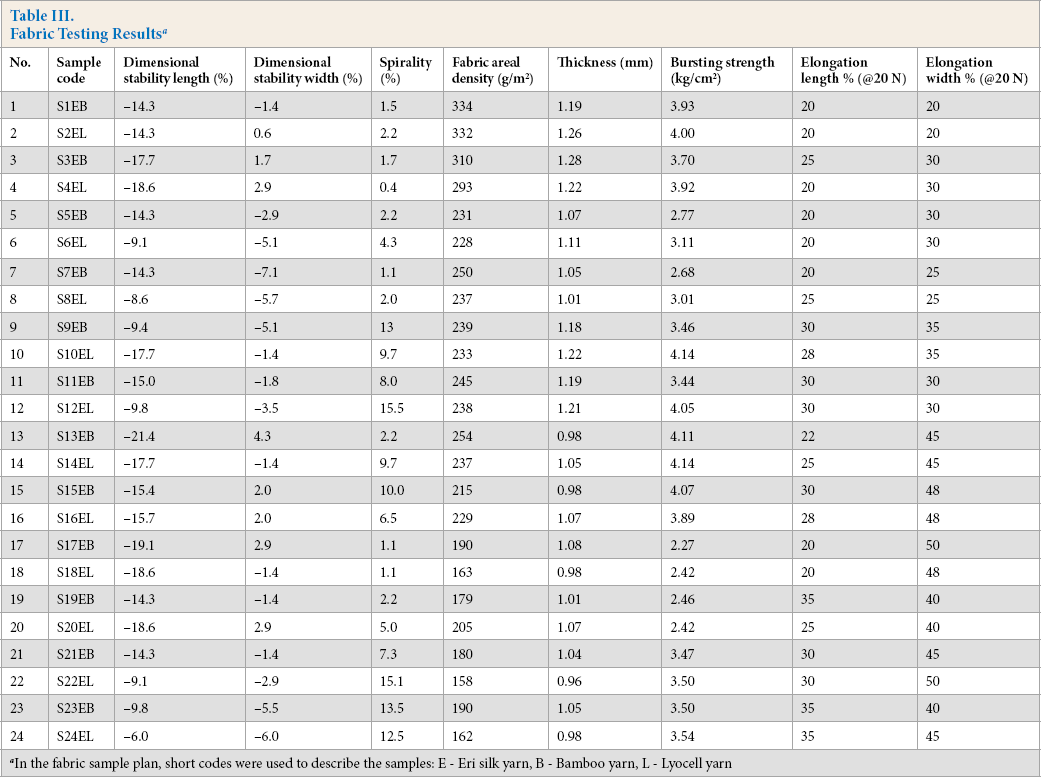
In the fabric sample plan, short codes were used to describe the samples: E - Eri silk yarn, B - Bamboo yarn, L - Lyocell yarn
Fabric Areal Density
The fabric areal density of plated interlock, mini-flatback rib, and flatback rib knit fabrics were determined and shown in Fig. 2. The standard deviation of fabric areal density was 49.5589 and the coefficient of variance was 0.2150. The knitting process parameters (i.e., yarn linear density, stitch length, and fabric length) are responsible for the fabric areal density (grams per square meter) of the eri silk knit structure. This is on par with the standard knit fabric dimensional behavior. 41 The fabric areal density is almost unique, with slight alterations for eri silk with bamboo and eri silk with lyocell. When fabric areal density was evaluated based on yarn count, the 30s yarn count comparatively had a very high fabric areal density. Similarly, results indicated that the plated interlock fabric had the greatest areal density when compared to the mini-flatback rib and flatback rib structures. Finally, the fabric areal density was almost the same for 0.3 and 0.4 cm loop lengths.
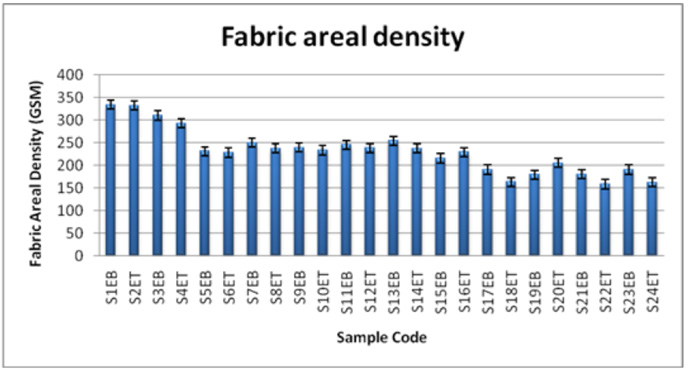
Fabric areal density values and error bars with standard error of the eri silk with bamboo or lyocell bi-layer knitted fabrics.
Fabric Thickness
The standard deviation of fabric thickness was 0.0995 and the coefficient of variance was 0.0910. The thickness of the fabrics did not vary by much, but varied with the fabric structure and yarn linear density. Fig. 3 depicts the fabric structure and yarn linear density. The honeycomb possessed a greater thickness than the single pique structure. The bulkiness of the fabric was increased by the tuck stitches. 42
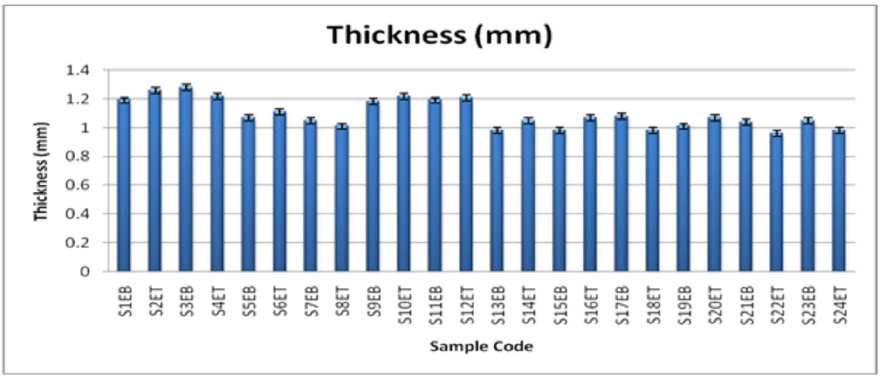
Fabric thickness values and error bars with standard error of the eri silk with bamboo or lyocell bi-layer knitted fabrics.
An analysis of thickness for the raw material combination was performed. Thickness had very minor difference in the various combinations. The yarn count 30s were the thickest. In most of the tests, the thickness was greater for the plated interlock structure than for the mini-flatback rib and flatback rib structures. Lastly, the thickness was more or less the same for 0.3 and 0.4 cm loop lengths.
Percent Elongation
The percent elongation of plated interlock, mini-flatback rib, and flatback rib knit fabrics were determined by an in-house test method. Percent elongation was measured using a Zwel-gle Elongation Tester by applying 20 N of force manually, and the length and width of the percent elongation was calculated. The elongation properties with or without elastane content and the percent elongation of the knit fabrics were satisfactory and are shown in Fig. 4. The standard deviation of fabric elongation length was 5.3363 and the coefficient of variance was 0.2055. The standard deviation of fabric elongation width was 9.6714 and the coefficient of variance was 0.2625. Eri silk with bamboo and eri silk with lyocell were studied for their percent elongation length. In most cases, the eri silk with bamboo had the greatest percent elongation length. The 40s yarn count showed a superior percent elongation length and the greatest percent elongation width. The flatback rib fabric had a higher percent elongation length when compared to the plated interlock and mini-flatback rib fabrics. But for the percent elongation width, the flatback rib and the plated interlock fabrics were the highest in a few places. The percent elongation length for the loop length was evaluated; the 0.4 cm loop length had the highest value in most tests. The percent elongation width was observed to be greater for the 0.3 cm loop length.
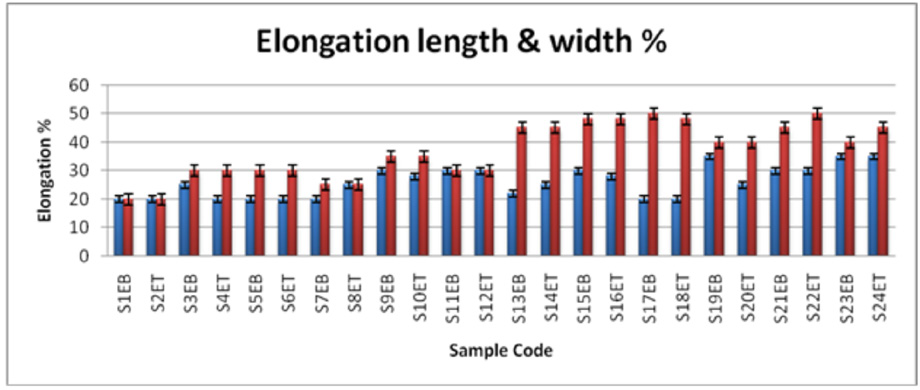
Elongation % values and error bars with standard error of the eri silk with bamboo or lyocell bi-layer knitted fabrics.
Fabric Bursting Strength
The bursting strength of the plated interlock, mini-flatback rib, and flatback rib structures were determined and shown in Fig. 5. The standard deviation of fabric bursting strength was 0.6251 and the coefficient of variance was 0.1829. The analysis strength with application of multi-directional force is called fabric bursting strength. However, the strength of materials can be influenced by fabric construction, structure, and properties of the fiber. In Fig. 5, the analysis of results indicate that most of the samples withstood their capacity above 3 kg/cm2. The raw material combination (i.e., eri silk with bamboo and eri silk with lyocell) was studied for their bursting strength. The bursting strength had only a slight variation in both raw material combinations. Similarly, the bursting strength was more or less the same with meager differences for the 30s and 40s yarn counts. The three fabric structures were tested for bursting strength and the plated interlock had the highest bursting strength. On the other hand, the bursting strength was more or less equivalent for 0.3 and 0.4 cm loop lengths.
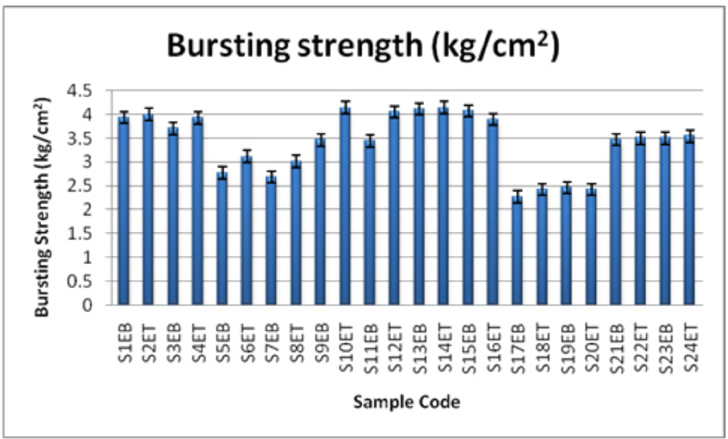
Bursting strength values and error bars with standard error of the eri silk with bamboo or lyocell bi-layer knitted fabrics.
Dimensional Stability
The dimensional stability of the plated interlock, mini-flatback rib, and flatback rib structures was determined and shown in Fig. 6. The standard deviation of fabric dimensional stability length was 4.1031 and the coefficient of variance was -0.2870. The standard deviation of fabric dimensional stability width was 3.2971 and the coefficient of variance was -2.2804. The length and width changes for the dimensional stability are given in Table III. When the percent dimensional stability length was studied for raw material combination, greater shrinkage was found in eri silk with bamboo. For the percent dimensional stability width, greater shrinkage was evident in eri silk with lyocell in most cases. Extension was observed in a few cases for both raw material combinations. But the dimensional stability length indicated the greatest shrinkage for the 40s yarn count. Similarly, for the dimensional stability width, 30s yarn count showed maximum shrinkage and 40s yarn count the most extension. The plated interlock dimensional stability length exhibited shrinkage. For the dimensional stability width, greater shrinkage was observed in the flatback rib and greater extension in the plated interlock. The dimensional stability length for loop length showed shrinkage in both 0.3 cm and 0.4 cm loop lengths. On the other hand, the dimensional stability width revealed greatest shrinkage in the 0.4 cm loop length.
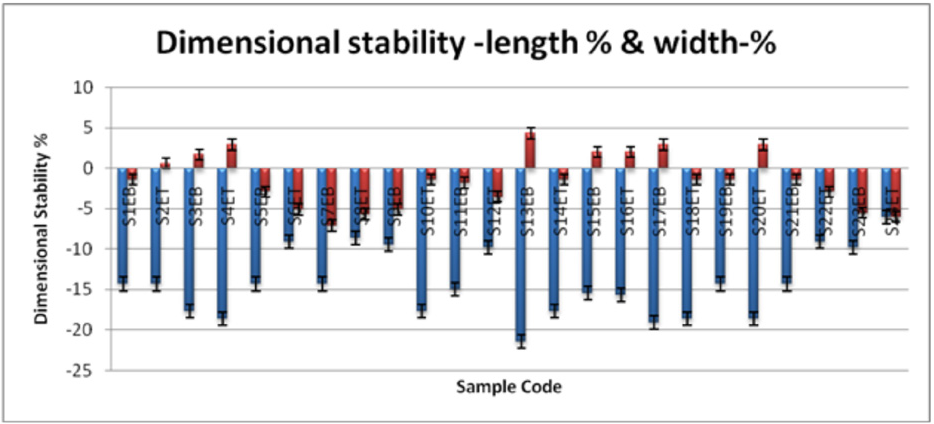
Dimensional stability values and error bars with standard error of the eri silk with bamboo or lyocell bi-layer knitted fabrics.
Spirality
The spirality of the plated interlock, mini-flatback rib, and flatback rib structures was determined and shown in Fig. 7. The standard deviation of fabric spirality was 5.0607 and the coefficient of variance was 0.8217. A study on the percent spirality for raw material combinations was performed. The eri silk with lyocell had a greater percent spirality than eri silk with bamboo. Moreover, when the yarn count was investigated for its spirality, the 40s yarn count was superior in percent spirality. The flatback rib structure possessed the highest spirality rate when compared to plated interlock and mini-flatback rib structures. When the spirality was investigated for the loop length, 0.3 and 0.4 cm loop lengths had the greatest percent spirality.
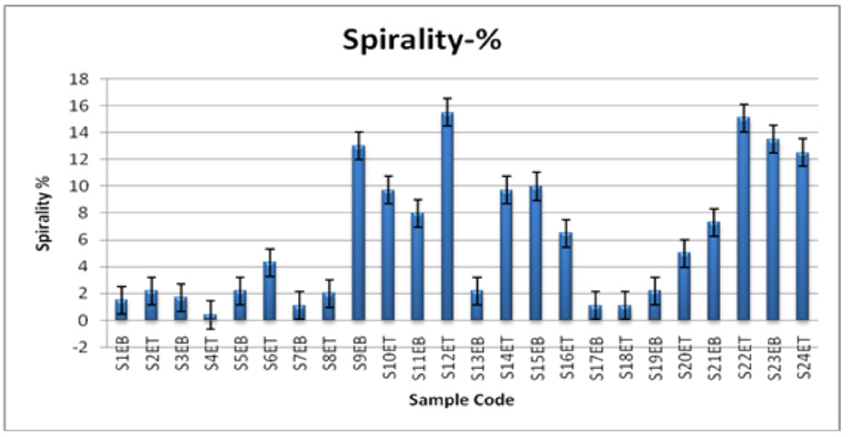
Spirality values and error bars with standard error of the eri silk with bamboo or lyocell bi-layer knitted fabrics.
Statistical Analysis
The significant differences between the mechanical and physical properties of bi-layer knitted fabrics was interpreted using the analysis of variance (ANOVA) tests using SPSS 16.0 version software. When p > 0.05, the relationship was insignificant and the parameters did not have any significant influence on each other.
In this test, a one-way ANOVA was performed, and the values were tested for 0.05 levels of significance and the degrees of freedom for analyzing the bi-layer structures. The results of ANOVA are given in Table IV.
One-Way ANOVA Analysis for Test Results
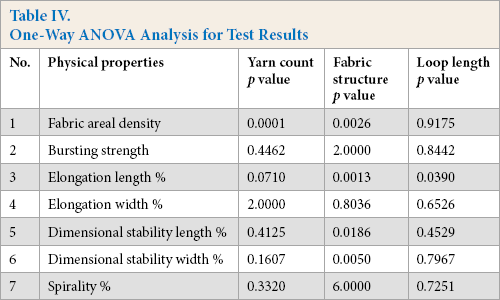
Table IV analyzes the significant difference between physical and dimensional properties of bi-layer knitted fabrics. The results of the ANOVA for fabric areal density revealed that the effect of yarn count showed a significantly greater difference based on fabric structure. There was no significant difference between the loop length and fabric areal density. The results of the ANOVA for bursting strength revealed that the effect of yarn count, fabric structure, and loop length produced no significance, they did not affect bursting strength. The results of the ANOVA for elongation length revealed that fabric structure was highly significant, and not significant for the yarn count and loop length. The results of the ANOVA for elongation width revealed that the effect of yarn count, fabric structure, and loop length showed no significant differences and did not affect elongation width. The results of the ANOVA for dimensional stability length revealed that the fabric structure was highly significant, and not significant for the yarn count and loop length. The results of the ANOVA for dimensional stability width revealed that the fabric structure was highly significant, and not significant for the yarn count and loop length. The results of the ANOVA for spirality revealed that the yarn count, fabric structure, and loop length showed no significant differences and did not affect spirality. The ANOVA analysis revealed that the fabric structure showed more significant differences compared to yarn count and loop length on physical and dimensional properties.
Conclusion
In this study, a variety of possibilities and techniques of producing plated interlock, mini-flatback rib, and flatback rib knit fabrics with different material combinations has been demonstrated. The structures with a bamboo or lyocell yarn outer layer and a eri silk yarn inner layer (next to skin) were analyzed to evaluate the dimensional and physical properties of the fabric samples. Test results indicate these knit fabrics, made of different combinations, influenced the physical properties, and hence suitable attention needs be paid while choosing combinations for functional activewear fabric production. The raw materials, yarn count, and loop length did not influence the dimensional property, bursting strength, elongation, and thickness, but yarn count significantly influenced the fabric areal density. It was observed that the fabric structure of the bi-layer knit plated interlock structure was highly significant with regard to the dimensional and physical properties. Based on the results, the eri silk, with bamboo or lyocell, plated interlock structure were the most suitable of the structures and materials tested for activewear applications.