



Abstract
Eri silk, regarded as “peace silk,” is currently one of the most prized silks because of its softness, breathability, and sustained production. In Ethiopia, where Eri silkworm sericulture is budding, poor degumming practices often result in inferior fibers. This study, then, attempts to evaluate the effect of different degumming treatments on the physical and mechanical characteristics of Ethiopian Eri silk fibers toward fiber value addition and an opportunity for eco-friendly alternatives. Alkaline, enzyme, and hot water degumming performed on harvested cocoons from Addis Ababa, Arbaminch, and Hawassa, which were then subjected to SEM, FT-IR, DSC, and mechanical testing. One of the results showed that sodium carbonate was very effective in removing sericin but altered fiber structure, while water degummed fibers had sericin and rough fibers. Enzymatic degumming efficiently removed sericin without compromising the structure. FTIR confirmed little interference to fibroin in enzymatic treatment, establishing this as a potential sustainable method for improving the quality of Ethiopian Eri silk.
Introduction
Eri silk, which is referred to as “peace silk” because of the non-violent manner in which it is harvested, is a special silk that is mainly obtained from reared Samia ricini moths. 1 Eri silk yarn can be produced without killing pupae. But for other silk varieties, silk yarn can only obtain by killing the insects present inside the cocoons through hot air drying (stifling) followed by reeling process. Some of the properties of silk include its softness, breathability and heat retention, which makes it ideal for eco-friendly fashion and other green textile industries. Economically and socially, Eri silk has a great importance in India, Thailand, and Ethiopia, where sericulture is a means of work for the locals and helps these countries develop chronically. In Ethiopia, Eri silk production is slowly on the rise as a result of the increasing global interest for green and ethical textiles.
Compared to the rest of the world, where Silk Eri of Ethiopia comes from is quite limited, nevertheless the outlook for its production is good. Recent statistics reveal that Ethiopia’s share of silk on the African continent stands at 5%–10% and there are also attempts to boost this percentage through better practices of sericulture and processing of silk cocoons. The increase of silk production in Ethiopia is consistent with what is occurring all over the world, where particular types of silk fabrics are on the rise in consumers’ spending on products that are readily available. It is also worth putting across that much of the climate and vegetation instability in Ethiopia and the presence of Eri silkworms are likely to promote overall silk production in the country.
The process of degumming is one of the most important in the processing of silk, and it entails removing the sericin, a sticky protein that surrounds the silk fibers of fibroin. 2 This makes the fibers soft, lustrous, and more amenable to dyeing, which are important for use in textiles. Various degumming procedures such as alkaline, enzymatic and acidic methods have been shown to have an effect on the physical properties of Eri silk fibers considerably. 3 For instance, the tensile strength, elongation, moisture regain, smoothness of the silk degeneration method, and the suitability of the silk for a particular end-use application are all linked to how the silk is degummed. In Ethiopia, however, the processing of Eri silk is faced with the challenge of finding appropriate degumming techniques that do not compromise fiber quality, are cost-effective, and environmentally friendly.
Currently, there are no standards for the practice of degumming, and the practice itself is inconsistent, which leads to the variable quality of the fibers, which affects the competitiveness of the silk in the world market. Melesse et al. investigate the structural, physical, mechanical, and thermal properties of Ethiopian silkworm cocoon’s filament. 4 Properties of Eri and mulberry silk fiber such as morphological structure, chemical properties, linear density, filament length, tensile strength, elongation, thermal behavior, and luster were determined by ES ISO and ASTM standard methods. Oduor et al. investigated the Eri silk cocoon of Kenya for its sericin content, moisture content, surface morphology, thermal properties, functional groups, crystallinity, and single fiber tensile strength. 5 It was shown that Kenyan Eri silk has almost similar physical attributes to those of the countries which produce commercial silks. At a degummed tensile strength of 6.81cN, Kenyan Eri silks showed a similar degree of strength even if crystallinity values were lower (29.2%). Patil et al. present a novel technique for degumming Eri silk by using Sapindus (soapnut) extract. 6 Meanwhile, Ethiopia has increased its focus on practicing sustainable silk production, it is crucial to conduct a study on the effect of degumming of Eri silk on its mechanical and physical properties. This understanding will allow producers to appropriately engineer the degumming process in a way that meets desired end-fiber performances, is commercially viable and ecologically sound.
The existing body of research on silk degumming provides a comprehensive foundation for understanding how different treatments influence fiber quality, mechanical performance, and environmental sustainability—insights that are directly relevant to the Ethiopian Eri silk industry. Early works, such as those by Gulrajani, 7 established the scientific basis of degumming by comparing conventional soap–alkali treatments and highlighting their effects on sericin removal, fiber softness, and tensile characteristics. Subsequent studies expanded this foundation by systematically investigating alternative approaches aimed at improving fiber quality while reducing environmental impact. For instance, Chattopadhyay et al. 8 conducted detailed analyses of eri silk cocoons and reported that degumming efficiency and resulting fiber attributes varied considerably depending on treatment parameters, particularly temperature and chemical concentrations. Their later study 9 further emphasized how seasonality and geographical variations influence eri cocoon characteristics, underscoring the need to align degumming strategies with the inherent properties of regionally reared silkworms—an issue that is especially pertinent for Ethiopia. Comparative research by Chopra and Gulrajani 10 provided valuable benchmarks by evaluating multiple conventional degumming methods and demonstrating their differential effects on fiber tenacity, handle, and luster.
A major shift in the literature emerged with the exploration of enzymatic degumming, aimed at mitigating fiber damage and reducing chemical effluent. The pioneering studies by Gulrajani et al. 11 showed that fungal proteases and lipase–protease combinations effectively removed sericin under milder conditions, yielding fibers with improved mechanical integrity compared to alkaline methods. These findings were strengthened by Freddi et al. 12 who demonstrated that enzymatic treatments preserve fibroin structure, enhance tensile properties, and reduce harshness—attributes crucial for high-quality Eri silk yarns. Later, Anghileri et al. 13 showed that protease-degummed yarns maintained superior elasticity and breaking strength relative to chemically treated counterparts, reinforcing the potential of enzymatic systems for producing stronger and more durable fibers. Expanding the enzymatic domain, More et al. 14 reported that microbial proteases not only ensured efficient sericin removal but also improved dye uptake due to increased fiber porosity and surface cleanliness—an important parameter for value-added Ethiopian Eri silk products.
Parallel to enzymatic innovations, researchers have refined chemical degumming through modifications in alkali concentrations and processing environments. Dou and Zuo 15 highlighted how varying sodium carbonate levels can influence both degumming efficiency and fibroin regeneration, illustrating the delicate balance required to maintain fiber integrity. Cao et al. 16 explored strong alkaline electrolyzed water as a sericin-swelling agent at low temperatures, offering an energy-saving alternative that reduces ecological burden. Collectively, these studies demonstrate that degumming significantly influences tensile strength, elongation, fiber fineness, and dyeability—key indicators for selecting appropriate treatments.
Taken together, the literature confirms that the choice of degumming method—alkaline, acidic, or enzymatic—directly governs the mechanical performance and esthetic quality of eri silk fibers, while also shaping the environmental footprint of silk production. However, despite extensive global research, there remains limited evidence concerning Ethiopian Eri silk, whose unique morphological traits and cocoon characteristics may respond differently to degumming treatments. This gap underscores the relevance of the current study, which seeks to (1) evaluate the physical properties of Ethiopian Eri fibers under varied treatments, (2) determine the most suitable method for enhancing overall fiber quality, and (3) contribute to the development of sustainable degumming strategies tailored to the Ethiopian sericulture sector.
Methodology
The Eri silk cocoons used in this study were acquired from three major silk production regions in Ethiopia, namely: Addis Ababa (Sabahar), Arba Minch (Sericulture Silk Production PLC) and Awassa. These three locations were selected because they have well-organized silk production systems which allow effective collection, degumming and evaluation of the physical parameters. The chosen locations offered established centers for cocoon stocks thus standardizing the testing process. Utilizing the random sampling technique, Eri silk cocoons were procured at the rate of 1 kg per location, maintaining uniformity and dependability of samples intended for later degumming and analysis.
The degumming procedure for Eri silk utilized several processes—alkaline, enzyme, hot water and soap degumming—in order to evaluate their effects on the fiber. Sodium carbonate (Na2CO3) was selected as the alkaline degumming agent because of its well-established ability to hydrolyze and remove sericin efficiently while maintaining the structural integrity of fibroin when used under controlled conditions. In this experiment, a concentration of 18 g/L Na2CO3 was adopted based on standard protocols reported in earlier studies on Eri silk degumming, rather than through new optimization trials. Previous research has shown that Na2CO3 in the range of 15–20 g/L provides effective sericin removal without causing excessive fiber damage, particularly when operated below 70°C. 8 Following these established parameters, 18 g of Na2CO3 were dissolved in 1 L of distilled water, and the solution was heated to 65°C, a temperature consistent with earlier recommendations for controlled alkaline degumming. Eri silk fibers were soaked in this solution for 45 min, with gentle stirring every 10 min to facilitate uniform sericin dissolution. At the end of the treatment, the fibers were washed first with warm distilled water (40°C) and then with cold water to remove residual sericin and alkali before air drying.
The procedure for enzymatic degumming was focused on the application of papain, an enzyme noted for its ability to extract sericin without damaging the fiber. A solution of enzyme was prepared by dissolving 2 g of papain enzyme powder in 1 L of distilled water. The pH of the solution was adjusted to 7.5 and the temperature was kept at 50°C during the process. Eri silk fibers were soaked in the enzyme for 90 min with mild stirring after every 30 min to aid the action of the enzyme on the sericin. The technically degummed fibers were cleaned in warm water to get rid of the slurry after which they were air dried. It was contemplated that this process would be more environmentally friendly and less chemical based in terms of treating fabric with chemicals for cleaning, lubricating or softening as such processes do not require high temperatures or aggressive chemicals. The hot-water degumming procedure was adopted based on earlier studies demonstrating that prolonged boiling at 95°C–100°C effectively removes sericin and a substantial portion of the ~2% wax present in Eri cocoons through thermal melting and surface extraction. 8 This eco-friendly method was therefore selected without additional optimization trials. For enzymatic degumming, papain was chosen due to its proven specificity in hydrolyzing sericin peptides while preserving fibroin morphology, as reported in prior enzymatic studies on silk protein processing. 17 It was contemplated that this process would be more environmentally friendly and less chemical based in terms of treating fabric for swelling and elimination of sericin as such process does not require high temperature and pressure.
The morphological characteristics of the degummed Eri silk fibers were evaluated using Scanning Electron Microscopy (SEM). Preliminary observations were conducted using a Leica biological microscope (Model 2086C), after which SEM analysis was performed to obtain detailed visualization of surface topography. Prior to SEM imaging, the fibers were mounted on aluminum stubs and sputter-coated with a thin layer of gold–platinum to enhance surface conductivity and prevent charging. SEM imaging was carried out at an accelerating voltage of 20 kV, with a magnification of 500× and a working distance of 15.5 mm. High-vacuum mode was employed to improve image clarity and reduce beam–sample interactions. The acquired 1280 × 960-pixel micrographs enabled assessment of surface smoothness and confirmation of sericin removal.
Chemical characterization was conducted using a PerkinElmer FT-IR spectrometer. For FTIR sample preparation, degummed fibers were cut into short segments, dried to remove residual moisture, and positioned in the sample holder under slight compression using an 11 N force. The FTIR spectra were recorded in the range of 400–4000 cm−1 with a resolution of 1 cm−1, allowing identification of functional groups and detection of chemical changes associated with degumming.
Thermal analysis was performed using a PerkinElmer Differential Scanning Calorimeter (DSC 4000) For DSC sample preparation, approximately 2 g of dried fiber samples were sealed in standard aluminum pans to prevent mass loss during heating. The samples were analyzed from 50°C to 450°C at a heating rate of 10°C/min under a nitrogen atmosphere flowing at 50 mL/min. The DSC curves facilitated evaluation of thermal degradation behavior, stability, and the influence of different degumming treatments on thermal resistance.
Mechanical characterization was carried out on a Favimat® single-fiber testing system. Tensile strength and elongation were measured according to ISO 5079:1995 (International Organization for Standardization, 1995). Twenty replicates were tested for each sample to ensure statistical reliability. Tests were conducted at a crosshead speed of 20 mm/min with a gauge length of 25 mm. These measurements provided insight into the mechanical performance and flexibility of the fibers following different degumming processes.
Results and discussion
SEM analysis
The SEM (Scanning Electron Microscopy) evaluation of Eri silk fibers sourced from Addis Ababa, Arbaminch, and Hawassa which have undergone three types of degumming treatments, that is, alkali, water and enzymatic has revealed the effects of each on the fibrous surface morphology and structure in detail.
Three different degumming processes were investigated for Eri silk fibers from Addis Ababa. The fibers that underwent sodium carbonate treatment (Figure 1(a)) during degumming in an alkaline medium showed no deposit or damage to the fibers. This implies that the application of the alkali solution effectively cleans the surfaces without causing damage to the fibers. Most likely, the pH and temperature used in this process are optimal, because there was no evident damage or destruction in the fiber structure. This is consistent with earlier works that propose alkali treatment for sericin removal that is gentle on the nonwoven. 18 While the fiber surface appears a little coarse since some sericin gum has probably been removed during the water degumming process (Figure 1(b)). The fibers’ structure remained more or less the same, but the roughness pointed out that water degumming does not give a hygienic finish like that of alkali degumming, and therefore sericin is not all removed. Such a way of degumming can, however, be useful where the end-use quality does not require complete removal of sericin. In enzymatic degumming (Figure 1(c)), the use of sericin degrading enzymes made the fiber surface even more roughened. This proved effective in sericin removal, but again the rougher texture implied that the fibers were damaged as a result of enzyme action due on the surface proteins. Still, enzymes are a means of sericin removal that is measurable in amount, and that may be less harmful to the environment as compared to high concentrations of alkaline solutions. The fibers treated with enzymes did not present any lumps or agglutination, which confirmed the efficiency of the degumming agent in preventing fiber entanglement.
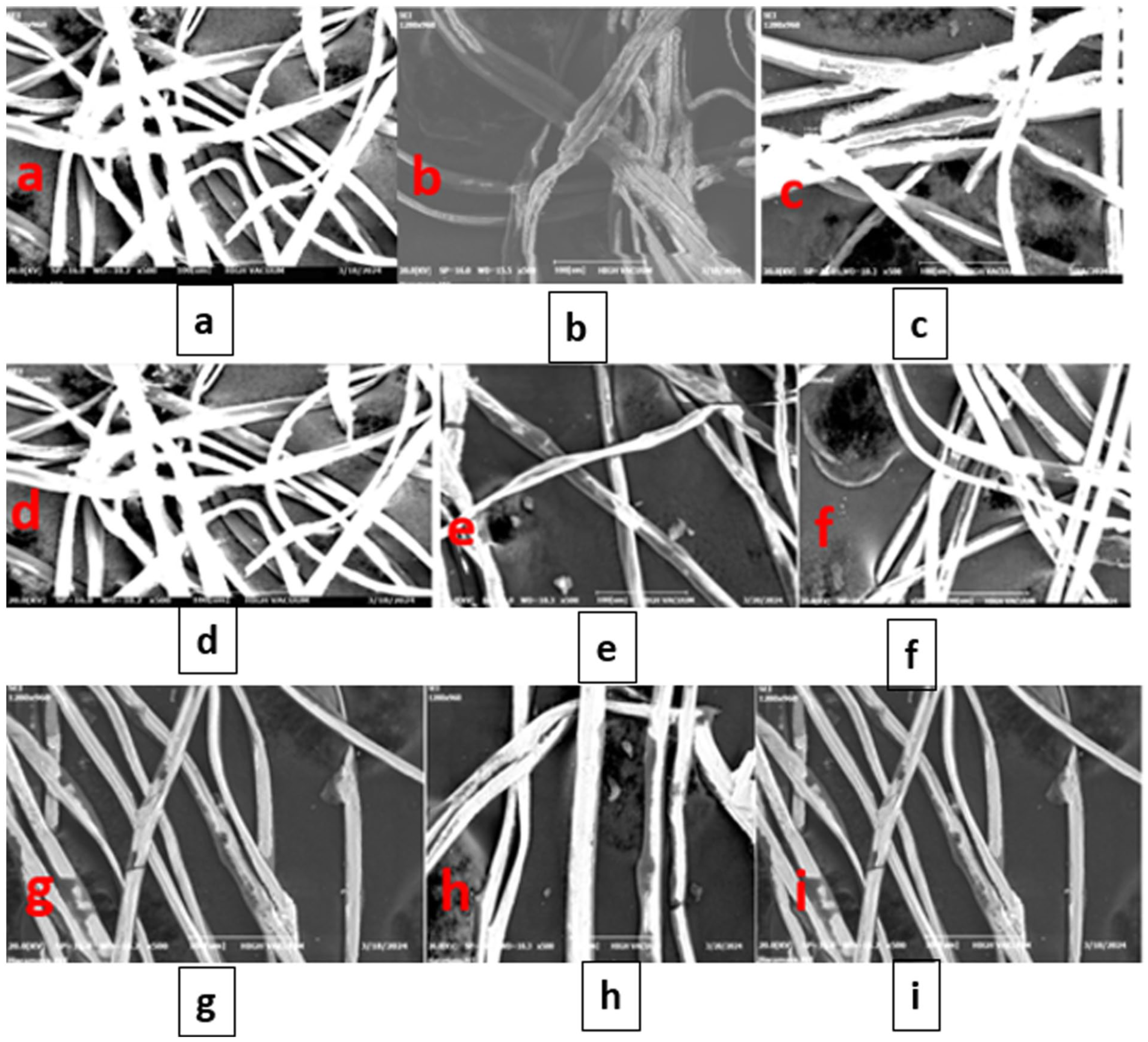
SEM images of different Eri silk fibers after degumming with sodium carbonate, water, and enzymes- Addis Ababa degumming with sodium carbonate (a), water (b), enzymes (c); Arba Minch degumming with sodium carbonate (d), water (e), enzymes (f); and Hawassa degumming with sodium carbonate (g), water (h), and enzymes (i).
The SEM examination of Eri silk fibers revealed various aspects on the effects of the degumming processes. Sodium carbonate based alkali degumming (Figure 1(d)) has yielded a smooth surface morphology indicating that sericin is effectively removed without fiber damage. This implies that the treatment with alkali is most preferable to those types of fibers which demand complete removal of sericin and do not wish to be rough. However, water degumming (Figure 1(e)) was not as effective for Arbaminch silk. The SEM images also indicate that there were undead surfaces of silk resins remaining, with filaments stuck on other filaments suggesting that the treatment was not effective. This may have been due to silk’s nature or the water’s effectiveness as the softener. Even though there were some areas of the fiber that were not coated, exposing some fibers, the incomplete draw down of the sericin would prevent usage in any context which required clean surfaces free of any gummy substances. Water degumming, however, comes in handy when mild treatment is needed so as not to harm the fibers. For enzymatic degumming (Figure 1(f)), SEM micrographs exhibited smooth and shiny surfaces following complete removal of sericin. The fibrous structure was well intact, and there was no evidence of fiber fusing, showing the effectiveness of enzyme therapy in the manufacture of quality fibers. This is in agreement others who showed that enzymatic degumming advanced both sericin removal and preservation of the fibers. Enzymes, more so proteases or lipases, can also be used due to their efficacy in rupturing sericin proteins without harming the integrity of the fibers, thus providing a green solution as opposed to the chemical methods.17,19
Moreover, the SEM analysis of Hawassa Eri silk fibers shows the effects brought by each degumming process. In Sodium Carbonate degumming (Figure 1(g)), the fibers Displayed a uniform and smooth surface without any signs of roughness or contaminants, suggesting that sericin has been completely eliminated. The major portion of the reaculated silk is also smooth, indicating the pretreatment and subsequent processing of the silk cutageless main. Studies prior to this one have remarked on the practical aspects of sodium carbonate in silk treatment within which materials and methods this study appeared. Degumming with water (Figure 1(h)) on the other hand lead to a linen output with a relatively rough finish. Residual strands of sericin are also seen in the SEM, suggesting that simply water was not enough to remove all the gum, as was the case with the Arbaminch samples. The degree of degradation from reaming is moderate and could affect the end use of the fiber in certain applications, as any existing sericin may impede the dyeing and feel of the silk. Still, water degumming has its place for its respective advantages where the extent of processing is to be kept minimal for either cost or ecological reasons. Enzymatic degumming (Figure 1(i)) for Hawassa fibers gave out surfaces with clear and translucent surfaces devoid of sericin and clear fibrous separations between the fibers. This leads to thorough degumming without any obvious fiber damage, which is why the use of enzymatic degumming is associated with low risk of damage to the fibers. This is in accordance with the works of researchers20,21 who have demonstrated that the use of enzymes is the best option when it comes to removing sericin without compromising fiber quality. The option to manipulate the amount of enzyme used in processing also means that the processes can be controlled for quality consistency and environmental preservation.
The SEM analysis on Eri silk fibers from different locations—Addis Ababa, Arbaminch, and Hawassa—clearly shows the variations in the efficiency of the different degumming techniques. Alkali degumming is proficient in the removal of contaminants from surfaces and also provides a flatter surface and hence a suitable system for applications where the fiber quality needs to be perfect. Nevertheless, the process also includes handling chemicals, and therefore this raises issues related to the treatment of the environment. Water degumming helps in maintaining the fiber structure, but introduces a problem of sericin deposits in the end product which may limit its applications. This is environmentally friendly but does not work well for total degumming. In the case of enzymatic degumming, however, it is possible to achieve very high removals of sericin while still being able to conserve the fibers and its surrounding atmosphere. This makes biochemical techniques particularly desirable in situations where there is a need for high quality fibers and processing with a minimum impact on the environment. 22
The SEM findings showed that enzymatic degumming produced a noticeably roughened and partially degraded fiber surface in the Addis Ababa Eri variety, unlike the Arbaminch and Hawassa samples where enzymes removed sericin cleanly without structural damage. This variation may stem from differences in enzyme concentration sensitivity, higher sericin–fibroin adhesion, or longer exposure time, which can accelerate hydrolysis of fibroin side chains when sericin layers are thinner.17,19 Water degumming consistently left sericin residues, likely due to the 2%–3% natural wax in Eri cocoons and the compact, plate-like sericin morphology, both of which hinder sericin dissolution at atmospheric pressure. 7 High-pressure hot-water degumming reported in earlier studies may partially overcome this limitation. Although enzymatic degumming is environmentally superior, fiber degradation can be minimized by optimizing enzyme dosage, pH, and exposure time, while cost-effectiveness compared to sodium carbonate depends on enzyme price, reuse potential, and process scale.
FTIR analysis
Following the degumming process, the Fourier transform infrared (FTIR) spectroscopy analysis of Eri silk fibers obtained from three Ethiopian regions of Addis Ababa, Arbaminch and Hawassa presents the degumming processes in order mentioned—sodium carbonate (Na2CO3), water and enzymes—influences the molecular arrangements of silk in different ways interestingly. The major objective of degumming process is to strip the silk of the coating protein, sericin, while leaving the stronger fibrous protein, fibroin, which is responsible for the strength of silk, intact. Thus, all the degumming techniques imply a difference in the removal of sericin while comic that of fibroin which will be seen in the FTIR spectra by the differences in the intensities and positions of the peaks in the wavenumber. Assessment of these spectra enables one to evaluate the comparative efficiency of the degumming techniques with regard to maintaining silk structural integrity. Figure 2 indicated FTIR spectrums of Eri silk of different locations after degumming.

FTIR analysis of Eri silk of different locations after degumming.
For all samples and treatments present, a broad absorption peak in the range of 3270–3277 cm−1 is noted, attributed to the stretching vibrations of O-H and N-H bonds, which suggests the presence of hydrogen bonds. 21 This peak is observed regardless of degumming methods used, which indicates that some sericin is retained or the form of fibroin preserves the existing hydrogen bonds. In the enzyme-treated samples (blue line), this region exhibited the highest peak intensity suggesting that enzymatic treatment is more selective for the removal of sericin without altering the fibroin architecture. The action of the enzymes is rather gentle and selective for the removal of sericin only, leaving the structure of fibroin intact. 23 The samples in control showed treated with Na2CO3 similarly intense peak for O-H stretching motion which is the lowest in comparison to enzyme treated samples indicating that alkaline treatment with sodium carbonate affected some hydrogen bonding inside fibroin structure. Water-treated samples show the least intense peak in this region, signifying lesser efficiency in sericin removal and more tolerance toward fibroin’s structure.
The amide I (1626–1629 cm−1) and amide II (1515 cm−1) bands are the most important for protein secondary structure characterization and hence for identification of treatment differences. The significance of these bands is particularly for the β-pleated sheets of silk fibers (fibroin). 24 These peaks are caused by C=O stretching vibrations and N-H bending vibrations respectively, and their intensity and sharpness is affected only slightly after the three degumming processes. Samples with enzyme treatment often have sharper amide peaks, implicating better retainment of the protein structure. The sharp amide I and II peaks in enzyme-treated samples suggest a well-preserved β-sheet structure meaning that the enzymes removed sericin from the samples without disrupting the fibrous protein mesh of fibroin. In contrast, amide I and II peaks of Na2CO3-treated samples are wider and less pronounced and slightly shifted from their original position due to changes in the fibroin layer structures owing to the strong alkaline conditions. Sodium carbonate seems to facilitate the removal of sericin adhered on fibroin, although it may alter the structure of fibroin itself, causing it to transform from β-sheet to other forms like random coils or α-helices which may change the mechanical performance of the silk. 25 Water-treated amide samples display intermediate peaks of amide which suggests that sericin was not efficiently removed but a major portion of fibroin was preserved.
A third crucial range lies in the Amide III band around 1222–1226 cm−−1, assigned to C–N stretching vibration, which is characteristic of the protein skeleton. 26 The samples treated with enzymes show the highest intensity in this band, suggesting that the enzymatic treatment ensures the structural integrity of fibroin. Na2CO3- and water-treated samples show considerably decreased peak heights in the amide III band, which may indicate partial degradation of fibroin or lower concentration of the protein due to excessive sericin removal. Interestingly, sodium carbonate treatment induces more changes within this region, thus supporting that the treatment’s efficacy in removing the sericin layer comes with its respective structural detriment effects on the silk fiber.
Focusing on the spectral region of lower wavenumbers, that is around 610 and 547 cm−1, which corresponds to the bending vibration modes, such the interactions in the region of the protein chain are reflected well. The samples treated with sodium carbonate, in this case, show stronger absorption in this region which indicates that the conditions of alkalinity might have drastic changes within the structural arrangement of fibroin. On the other hand, enzyme and water-treated samples show these bending vibrations at those ranges with lower intensity indicating that the secondary structures of the protein were not severely affected. This corroborates previous findings which showed that the enzyme treatment was the most conservative for fibroin with most of the structure remaining even when sericin was effectively removed.
Water degumming in general tends to be comparatively less effective in removing sericin due to the appearance of structures such as β-sheet indicating persistent structures, mostly around the value of 1630 cm−1. The presence of β-sheets in water-treated specimens indicates that sericin may not fully be eliminated and that the structure of fibroin will change in conditions of high thermal treatment. Such residual sericin or altered structure of the fibroin may influence the silk’s mechanical characteristics such as it’s capacity to take dye and also the tensile strength. 27 Nevertheless, water treatment is the least aggressive among the three approaches leading to the least amount of structural change to fibroin, again, despite the incomplete removal of sericin.
Among the three sources which are Addis Ababa, Arbaminch and Hawassa, enzyme degumming has been found to be the most recommended practice for maintaining the structure of fibroin, In the FTIR spectra of silk fibers treated with enzymes from these locations, a clear protein peak with few changes is evident. This suggests that the enzyme degumming process is successful in removing sericin while preserving the original state of fibroin. Degumming with sodium carbonate, while effective, tends to change the structure of fibroin more than what is desired, perhaps because of the high pH which could affect the durability and mechanical properties of the silk. Water degumming is a less aggressive method; however, it may not be as effective in removing sericin and may leave behind some residues that could affect the silk performance in certain applications.
Tensile strength
Within the tensile strength retention across the silk samples, water degumming has the highest degree of retention with the Addis Ababa silk registering the best tensile strength (TS) of 10.5 cN followed by Arbaminch at 9.3 cN and Hawassa at 9.11 cN (Table 1). These values indicate that water degumming helps in maintaining the structure and integrity of silk fiber as it does not have a drastic effect on the fibroin matrix. 23 There is a difference in the elongation behaviors of the samples under water degumming, as Arbaminch has the highest elongation at 23.16%, which signifies higher flexibility, whereas Hawassa shows the lowest at 19.41%, hinting at a structural variation of fibers from different regions.
Average tensile strength (TS) and elongation (El %) of Eri silk fibers under different degumming treatments across three locations (mean ± SD, n = 20). Values with different letters within a row are significantly different (p < 0.05, one-way ANOVA followed by Tukey’s test).
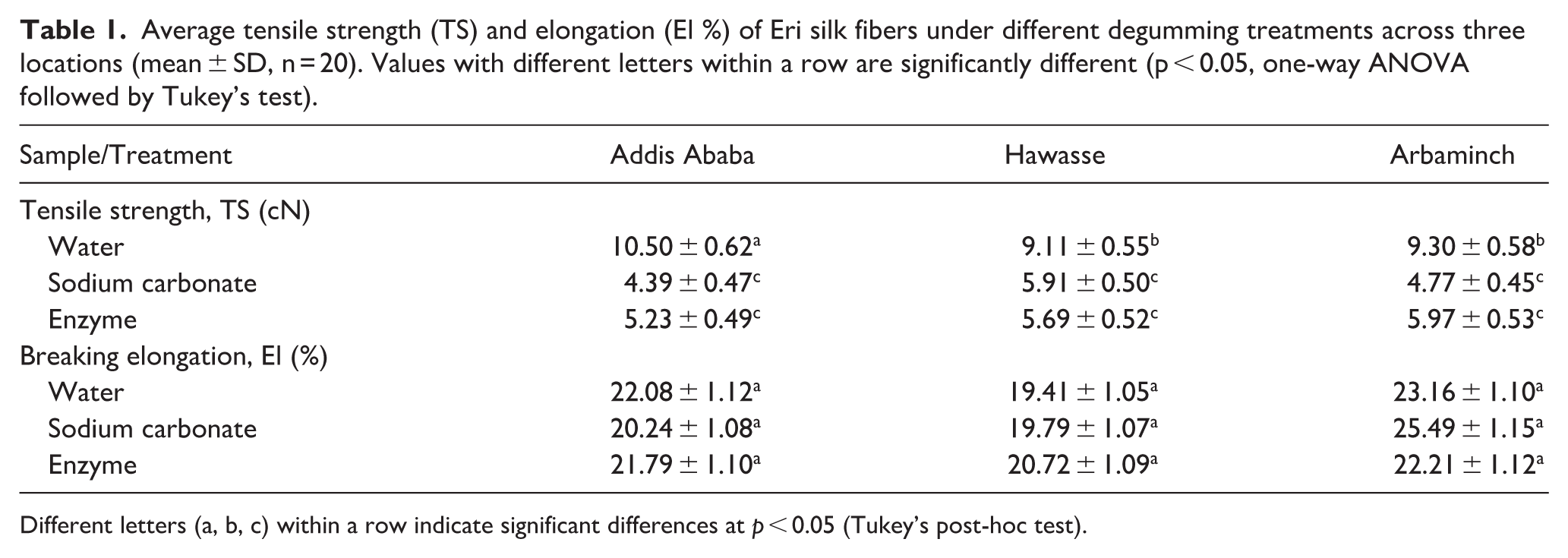
Different letters (a, b, c) within a row indicate significant differences at p < 0.05 (Tukey’s post-hoc test).
Alternatively, silk samples that are treated with sodium carbonate show a significant reduction in tensile strength at 4.39 cN for Addis Ababa and 5.91 cN for Hawassa. This reduction in strength is indicative of the severity of sodium carbonate as a treatment as it renders unsustainable the fiber structural moiety fibron and most likely breaks the hydrogen bonds in the carbonaceous polymer for instance. the β-sheets are compromised. 28 However, the Mongolian double silk specimen treated with sodium carbonate has a relatively high elongation of 25.49%, meaning that although the chemical treatment weakens the fiber, it allows more fiber movement, probably due to a change in silk molecular arrangement.
The enzyme degeneration process is less aggressive and generally creates medium elevated tensile strength values among the different samples with Hawassa silk675 reaching the highest value of 5.69 cN and Arbamench the lowest 5.23 cN. This treatment maintains the appropriate ratio between the strength and the flexibility and does not lead to extensive restructuring as sodium carbonate does. In addition, the enzyme treated samples tend to exhibit uniform values of elongation, whose ranges are between 20.72% (Hawassa) and 22.21% (Arbaminch), meaning that enzyme degumming does not compromise flexibility when it comes to silk whilst low tensile strength effect. Enzyme treatment is therefore the most preferable silk treatment for both tensile and elongation properties. Total elongation properties are well retained in braids made from solvent treated, as compared to untreated integrate systems.
Degumming with enzymes, on the other hand, permits more retention of the strength and elongation of the silk fibers than degumming with sodium carbonate, making it the better technique for preserving the structure. However, it must be noted that this decreases in girth is also on account of the decline in the molecular weight of the silk fibers as a result of sericin removal which influences the strength of the fibers as expected. The strength of silk fibers varies with the treatment employed since some treatment methods have been known to change the internal microstructure of fibroin. This is mainly because the weakening of non-covalent bonds that hold fibroin together leads to the unraveling of the relief of hydrogen bonds and the orientation of the silk polymer chain β-sheets. Moreover, the stripping of sericin which acts as a moisture barrier on the fiber surface has a negative impact on the elongation at break of the silk fibers. For this reason, the alkali-based degumming technique employed in this research paper accounts for the fiber strength reduction observed.
Furthermore, higher standard deviations of the sample measurement variances imply that the fiber layers were prepared without any segregation of the layers of cocoon. This causes inconsistency in the tensile and elongation strength. In Comparative studies, there are also aspects of geographical variations in the qualities of degummed silk: for example, the Eri silk from the North Eastern region of India is said to average about 5.4 cN strength, 29 in contrast to Eri silk in China which has been reported to have a lower degummed strength of about 4.95 cN. 24 The above regional variations are probably because of the difference in the chemical properties of the silk used and the processing technique of degumming employed which brings out the fact that both place and treatment are critical in affecting the quality of the silk fibers.
The tensile properties indicate that water-degummed fibers retained the highest tensile strength across all regions, primarily because the absence of harsh chemicals minimizes fibroin disruption while a thin layer of residual sericin may contribute to structural support by preventing over-exposure of the fibroin microfibrils. Although tensile strength varied significantly between treatments, breaking elongation (%) showed no statistically significant differences across either treatments or locations. A one-way ANOVA performed on both tensile strength and elongation—based on 20 single-fiber observations per sample, as outlined in the methodology—showed significant variation (p < 0.05) for tensile strength but no significant variation (p > 0.05) for elongation. Standard deviations for each mean value are reported in Table 1 and indicate natural variability due to heterogeneous cocoon layer composition. The observed decline in strength for sodium carbonate and enzymatic treatments suggests that certain process parameters—particularly alkali concentration, temperature, and reaction time—may have partially disrupted hydrogen bonding within β-sheet crystallites of fibroin. These findings confirm that although alkaline and enzymatic degumming reduce fiber strength, elongation remains inherently stable across processes and locations. This observation is consistent with previous reports that the elongation of silk fibers is largely determined by the molecular arrangement of fibroin β-sheet crystallites and amorphous regions, which provide elastic deformation capacity that is relatively insensitive to surface sericin removal or mild chemical treatments.29,30 While tensile strength was affected by treatment—water-degummed fibers retaining higher strength due to minimal disruption of fibroin—breaking elongation remained uniform, suggesting that fiber extensibility is governed more by intrinsic structural characteristics than by external degumming conditions. These findings highlight the robustness of eri silk elongation properties across environmental and processing variations, confirming the functional reliability of the fibers for textile applications.
Temperature and heat flow
As demonstrated in the thermograms for Eri silk samples from both Addis Ababa and Arbaminch, it can be seen that there is a moderate and smooth heat flow curve in the water degummed counter parts which signifies that the structure of the silk is not altered drastically using this technique. The enhancement in the heat flow values between the water degummed samples of approximately 100°C–120°C may be attributed to any moisture that is evaporating as these types of materials tend to absorb water as part of their natural properties. With an increase in temperature, thermal flow starts to gradually decrease suggesting that the water treated silk samples are thermally stable up to about 300°C after which it can be presumed that there is an onset of thermal degradation. DSC analysis of Eri silk after degumming shown in Figure 3.

DSC analysis of Eri silk after degumming.
On the other hand, the thermal behaviors for the sodium carbonate degummed samples are quite different. In addition, for both regions, the Na2CO3-treated samples show well-defined peaks in the 100°C–150°C range, which may suggest some level of decomposition or disturbance as a result of the degumming with the alkaline treatment. 31 Since Na2CO3 is a high strength chemical treatment, it has the potential to cleave some of the silk proteins more vigorously, therefore also losing the structural aspect. Notably, the sample of Arbaminch displays a higher peak heat flow in the Na2CO3 treated sample as opposed to the Addis Ababa sample which implies that silk from various regions may differ in the alkaline treatment in response due to an inherent factor of the composition or structure of the fibers present.
Distinct and sharp peaks are particularly noticeable on the thermograms of both Addis Ababa and Arbaminch at the enzyme-degummed silk in the range of temperatures 150°C–200°C. These may be associated with the breakdown of silk proteins in a more orderly fashion instead. Enzymatic technique of removing the gum is usually soft compared to Na2CO3 and therefore maintains the fibers structural integrity as best as possible but still some degree of changes may occur. Among the Addis Ababa, the enzyme treated silk shows distinctive thermal characteristics with a good number of peaks between 150°C and 250°C which could be due to partial breakdown or restructuring of protein as a result of the enzyme treatment. In Arbaminch however the enzyme-treated sample shows somewhat the same pattern but with a peak that is not as pronounced as that of Addis Ababa sample. Generally when the two regions are compared the samples from Arbaminch show higher heat flow than samples from Addis Ababa for all the degumming methods employed at some specific temperatures. This may suggest variations in fiber make or packing which may have implications during heat absorption and release in the DSC analysis. Water degumming seems to cause the least changes in the structure in both samples while Na2CO3 seems too active as reflects the peaks in the lower temperature range also denoting the faster destruction process. Though causing some structural changes, enzyme treatment, seems less aggressive than Na2CO3 and better maintains thermal stability when compared to alkaline treatment.
The DSC thermograms of eri silk fibers degummed by water, Na2CO3, and enzymatic treatments in Addis Ababa and Arbaminch exhibit notable variations. These differences arise primarily from regional variations in fiber composition, sericin content, and moisture regain, all of which influence thermal transitions. The alkali-treated samples, in particular, show distinct heat-flow patterns between the two regions, likely due to differential susceptibility of fibroin–sericin complexes to alkaline cleavage. Such structural and compositional variations alter decomposition onset temperatures and peak intensities, explaining why the thermal responses of Addis Ababa and Arbaminch samples are not identical despite identical treatments.
Conclusion
This research extensively evaluates the morphological and structural effects of three types of degumming processes (alkali (sodium carbonate), water, and enzymatic) on Eri silk fibers obtained triplets from Addis Ababa, Arbaminch, and Hawassa. Scanning Electron Microscopy (SEM) showed a consistently primary and smooth fibrous surface free of impurities induced by sodium carbonate treatment fibers, which indicates an effective removal of sericin but risks transforming some portion of the fibroin. Furthermore, enzymatic processing was used to degum silk led to the removal of sericin entirely while maintaining the structural integrity of fibroin clouds, as sharper defined amide peaks appeared on FTIR analysis. Water degumming, although regarded as a safe environmental process, was not as effective in terms of removing sericin as it still left behind residual gum gumming the fiber. A significant addition of this work concerns the systematic review of the effects of the various degumming processes on Ethiopian Eri silk fibers and thus offers some useful information about the local fibers and their treatments. Furthermore, the research confirms enzymatic degumming as an eco-friendly strategy against the chemical processes. There, however, are a number of caveats that are to be pointed out. The examination was carried out within a confined laboratory environment, which may not exactly be the case in an industrial environment since factors such as the duration of the treatment, concentration of the reagents and others like scaling could affect the results. Moreover, while it was possible to analyze the surface structure as well as the carried out experiments with the help of SEM and FTIR, the results could be validated by additional methods, such as testing tensile strength or analyzing the dye uptake. There is a need for further research to address these issues and to assess the impact of degumming on the longevity of silk fibers. The above notwithstanding, this work fills an important void in the literature on silk processing and even makes some recommendations on the most appropriate degumming method to use depending on the quality of fiber as well as the environmental issues at hand. This is aimed at promoting sustainable measures in the processing of textiles, especially in areas where such measures are important due to overproduction. Among the three degumming methods, enzymatic treatment is recommended for Ethiopian Eri silk due to its effective sericin removal and superior fibroin preservation, offering an eco-friendly alternative to alkali processing. Water degumming remains suitable only where minimal structural alteration is required. Future work should optimize enzyme cost and industrial scalability.
Footnotes

Author contributions
All authors contributed equally to conceptualization, methodology, writing—original draft, and writing—review and editing.
Funding
The authors received no financial support for the research, authorship, and/or publication of this article.
Declaration of conflicting interests
The authors declared no potential conflicts of interest with respect to the research, authorship, and/or publication of this article.
Data availability statement
The data supporting the findings of this study are available from the corresponding author upon reasonable request.*
AI tool usage declaration
During the preparation of this work, the authors used Grammarly to improve language clarity, grammar, and spelling. After using this tool, the authors reviewed and edited the content as needed and take full responsibility for the final version of the manuscript.