






Abstract
Inflatable cuffs of different types are used for the measurement of blood pressure using the indirect method. It is crucial to find pressure distribution and transmission underneath different types of blood pressure measurement cuffs for estimating accurate values of blood pressure. In this study, three simulation models are developed mimicking blood pressure measurement through three cuffs constructed using fabrics that have dissimilar geometric and mechanical properties. Finite element analysis (FEA) is carried out to predict pressure distribution and transmission underneath these cuffs. For validation of these models, an arm simulator was developed. The models provide good agreement with the experimental results. The pressure distribution at the interface of the selected cuffs and arm is not identical.
Keywords
Introduction
Blood pressure is one of the vital signs that can be measured by direct and indirect methods. Indirect methods of blood pressure (BP) measurement mostly use inflatable cuffs. Inflatable cuffs are pressure applicators and transducers for the indirect measurement of BP. 1 There are various cuffs available worldwide constructed from different types of fabric by various manufacturers. It is important to investigate the geometric and mechanical properties of the cuff constructing fabrics and their relative effects on pressure distribution and transmission underneath for accurate estimation of BP.
For indirect/non-invasive measurement of BP, cuffs are wrapped around limbs and then inflated to cease blood flow in the blood vessel underneath. The cuff is then deflated so that the blood flow resumes. The pressure inside the cuff at which blood flow resumes is termed as BP. In indirect measurement of BP, it is not possible to measure the arterial pressure directly. Pressure from the cuff, which is unknown in this case, transfers to the surface of the limb and then exerts over the artery.
It was demonstrated in previous studies that BP values vary greatly with the varying mechanical properties of the arm tissues, the brachial hemodynamic, the cuff size, and the cuff wrapping tightness.1–7 One of the investigations carried out using finite element analysis (FEA) suggested that the pressure transferred from the cuff to the artery is insufficient to occlude the artery completely. 8 Another investigation indicated that the cuff stretch may alter BP measurement and may lead to pseudo hypertension. 7 The effect of using various types of fabric for cuff construction and their relative effects on sub-cuff pressure distribution was not studied in detail.
It is important to investigate the relative effect of varying cuff construction, especially using various types of fabrics for estimation of BP values because the pressure exerted by fabric during inflation and deflation maneuvers may depend on its geometric and mechanical properties. In the current study, pressure distribution and transmission are predicted at the interface of three different BP cuffs and an upper arm by mimicking the indirect method of BP measurement through simulation modeling. 3D simulation models were developed in Abaqus for FEA. The geometric and mechanical properties of the constructing fabrics were evaluated using standard test methods, independent of the underlying materials unlike the past studies. It was found experimentally that each cuff had different mechanical and geometric properties.
The importance of the interface pressure (IP) measurement was recognized in a study related to humans, animal comfort, and pressure ulcer development and its treatment.9–13 Studies were conducted to determine the value of the IP for pressure ulcer treatment, footwear fitting, burns treatment, venous ulcers, and orthotic diseases to anticipate the susceptibility to ulcer development and its management. IP measurement also involves product redesign to benefit living beings. The measurement of IP for wheelchair users has become an essential activity with the increase in litigation. 13
For non-invasive BP measurement, the detection of the IP between the BP cuff and the limb could be a meaningful parameter for the estimation of the pressure exerted over an artery (i.e., arterial pressure or blood pressure). In the indirect measurement of BP, it is not possible to measure the arterial pressure directly, but the IP measurement between the arm and cuff can be determined without difficulty by using a suitable IP measurement device. The importance of IP measurement needs investigation to avoid the potential complications of wrongly estimated BP measurement, in which subjects either received medications when not desired or no medication at all. This could lead to serious health issues related to mortality and morbidity.
A previous study was carried out in which pressure was predicted at the interface of three different types of cuffs and a metal cylinder. 14 3D simulation models were validated from experimental results achieved using an in-vitro system. A metal cylinder was selected, however the pressure in the cuff was found to rise rapidly if wrapped around an arm having higher Young's modulus value.6,14 The cuff walls did not deform while in contact with the metal cylinder because of its stiffness. However, human upper arms are compliant, having soft tissues that deform under the cuff walls during BP measurement. Study of the interaction between various cuff types and the upper limb are imperative since the interface and the subsequent pressure distribution in the human body depend on the amount of the tissues and the underlying bony structure. 13
Deformation of cuff walls depends on the properties of the constructing fabrics. If the cuff deforms differently due to varying cuff materials over the limb, there is a possibility of non-identical pressure distribution and transmission at the interface. It may lead to variations in BP values of human subjects if different cuffs are used for BP measurement using indirect methods. In this study, 3D simulation models of an upper arm and various types of cuff models were constructed to predict sub-cuff pressure distribution and transmission at the interface to investigate the effects of various constructed fabrics on BP measurement.
Materials and Method
Material Properties
Tree different types of commercially-available cuffs are selected for this study. BP cuffs are of similar size and construction, packaged and unused. Identities are assigned as Cuff A, Cuff B, and Cuff C. BP cuffs are constructed in a way that one portion of the cuff is made inflatable, while the same cuff also facilitates closure once it is wrapped around the limb. These cuffs are constructed from air-impermeable coated woven (plain weave) or nonwoven fabrics by joining two layers together. Constructing fabrics are mostly made of polyester.
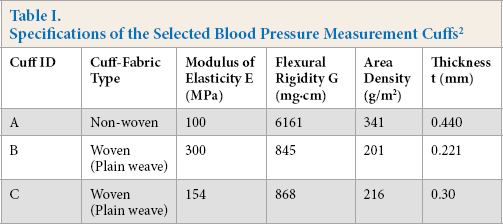
Properties of the BP cuffs construction fabrics after evaluation by standard test methods are listed in Table I. Elastic behavior of the cuff fabrics is determined according to EN ISO 1421:1998 (Grab method) 15 using a Zwick/Rowell Z050 materials testing machine (Fig. 1a). A FAST-1 compression meter (CSIRO) provides a direct measure of fabric thickness (Fig. 1b). The area density of the cuff fabrics is determined in accordance with BS EN 12127:1998. 16 The bending length of cuff fabrics is measured according to BS EN 1735:199717 using a fixed-angle Flexometer constructed at the University of Manchester.
Specifications of the Selected Blood Pressure Measurement Cuffs 2
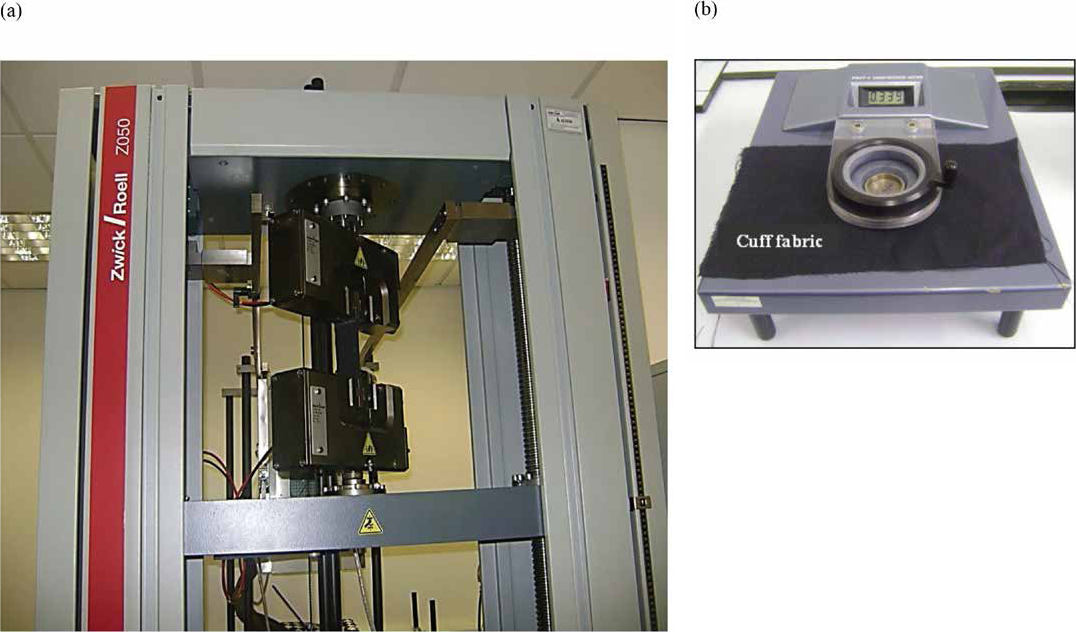
Measurement of cuff fabrics (a) elastic properties and (b) thickness using the FAST compression meter.
For development of 3D-simulation models, mechanical properties of upper arm tissues and bone (humerus) are taken from previously published literature. 6 The mechanical characteristics of the upper arm are kept fixed under each cuff type in all models.
Method
Development of BP Measurement Cuff Simulation Models
3D-simulation models are developed; one for each type of cuff. After assembling cuffs and upper arm, a uniformly-distributed pressure of 140 mmHg is applied inside the cuffs and then deflated to zero mmHg, similar to that used in actual BP measurement. The resultant sub-cuff (interface) pressure distribution and transmission around the arm is predicted and studied through visualization and then analyzed. It helps in identifying the variation in transferring pressure to the arm by the cuffs due to the dissimilar geometric and mechanical properties of the constructing fabrics.
All cuffs are built in Abaqus and are comprised of two layers—an inner wall and an outer wall— similar to the actual BP measurement cuffs (Fig. 2). Edges of the cuff walls are joined to form an inflatable structure. The cuffs are modelled so that the length of the cuff covers at least 80% of the upper arm circumference of a large adult size to meet the standard guidelines of BP measurement. 18 A large adult upper arm of 23 cm in length and 42 cm in circumference is constructed in Abaqus by assembling tissues and bone (Fig. 3).
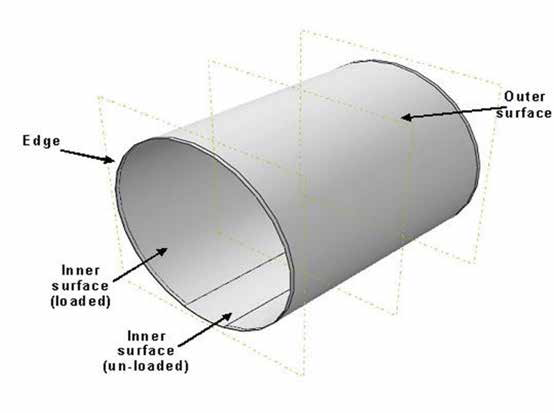
Bladderless cuff constructed in Abaqus.
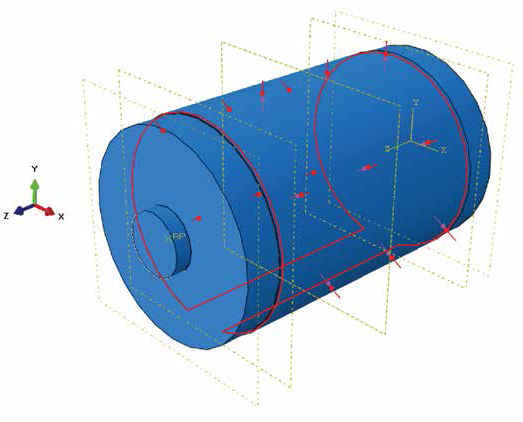
Cuff-arm model after applying pressure inside the BP cuff.
After assigning material properties to all parts; BP cuffs, arm tissues and humerus are assembled as shown in Fig. 3. Properties of BP cuff fabrics listed in Table I are assigned to their respective models.
A uniformly-distributed pressure is applied inside the cuff walls with an amplitude to account for cuff inflation followed by deflation (as per standard guidelines of BP measurement). All cuffs are inflated to 140 mmHg and then deflated back to zero mmHg. Models are then processed after meshing (Fig. 4).
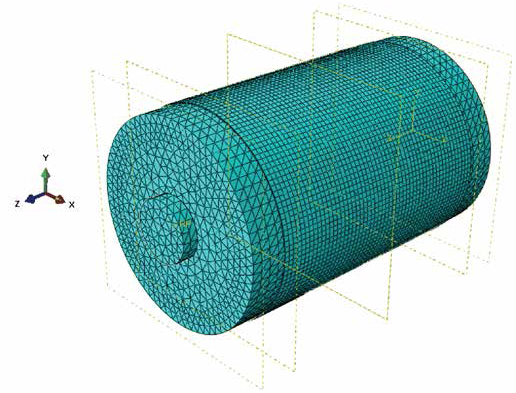
Cuff-arm model after meshing before post-process.
After processing all the models, the predicted pressure distribution at the interface of the upper arm and cuff types is shown in Fig. 5. It can be seen that the pressure distribution is highly non-uniform and non-identical among the selected BP cuffs. The areas of high and low pressure can be visualized. It is desirable to completely cease blood flow in an artery underneath the artery index (which is marked in the center of the cuffs) by applying higher pressure. However it was found that higher pressure areas are located in areas other than at the center of the cuffs (Fig. 5). Non-identical pressure distribution indicated that the pressure transmission was varying among the cuffs of different types (Fig. 6).
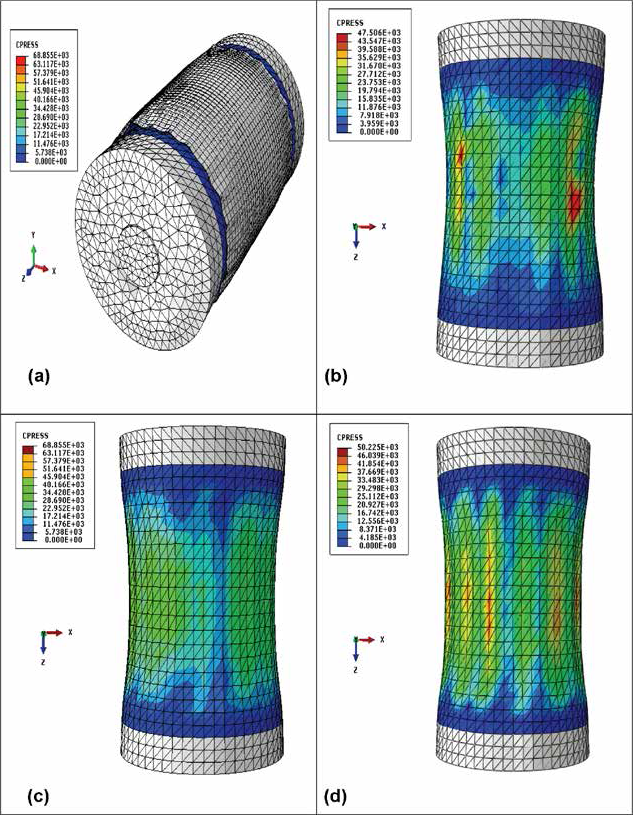
(a) Interface pressure distribution around upper arm, (b) Cuff A, (c) Cuff B, and (d) Cuff C.
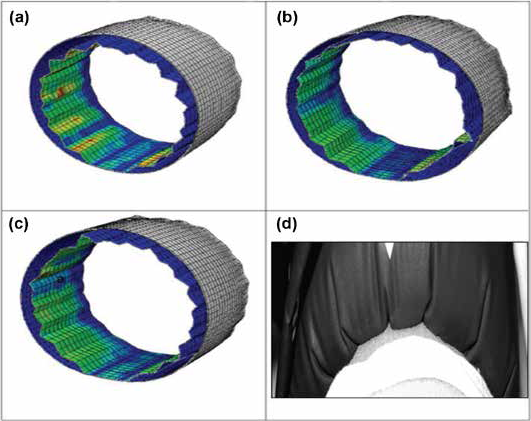
Pressure distribution on the cuff inner walls. (a) Cuff A, (b) Cuff B, (c) Cuff C, and (d) cuff around arm simulator.
Validation of 3D Simulation Models
Development of a Physical Arm Simulator
For model validation, a physical arm simulator is developed by assembling a foam mandrel (mimicking tissues) and a metal cylinder (bone) (Fig. 7). Considering the arm as an axi-symmetrical cylinder, the length and the circumference of the arm simulator is kept at 23 cm and 42 cm respectively, the same as that of the simulation models. In the selection of the foam material, it is assumed that the upper arm tissues have isotropic, linear, and elastic properties.
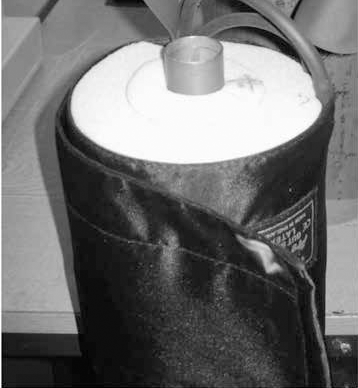
Arm simulator.
Foams of different stiffness are selected and their elasticmodulus is determined according to ISO 3386-1 using the Zwick Roell Z050 device (Fig. 8). Elastic moduli of the foam samples are calculated. One of the foam samples whose elastic modulus was found to be 0.055 MPa (the same value of elastic modulus of the upper arm tissues as selected for simulation models) is used for the development of the physical arm simulator.
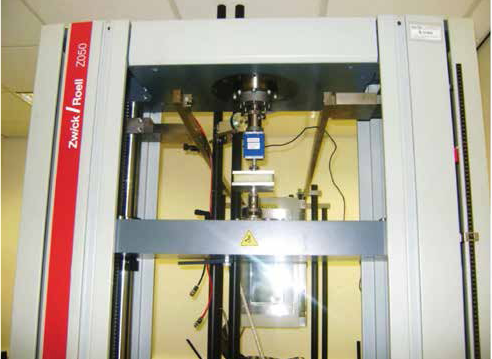
Compressibility testing.
For the measurement of IP, a calibrated Oxford Pressure Monitor (OPM) sensor is positioned between the cuffs and the arm simulator surface positioned in the center. The cuffs are then connected to a mercury manometer to measure the inside-cuff pressure.
It was ensured that the IP (between the cuffs and the surface of the arm simulator) and the inside-cuff pressure was zero mmHg before commencing inflation. The cuffs were then inflated to 140 mmHg and deflated back to 0 mmHg in steps of 20 mmHg; thus, the IP was recorded against the manometer pressure (inside-cuff pressure) at intervals of 20 mmHg. The experiments were repeated ten times with a 2 min gap between the measurements. The gap was set according to the guidelines of the BP measurement, which recommends an interval of 1–2 min between two consecutive BP measurements. 18
After post processing of the 3D-simulation models, 13 nodes were selected over the surface of the arm at the center covering the area that was similar to the area covered under the OPM sensor over the arm simulator (Fig. 9). The values of the IP predicted at these nodes were averaged and then plotted with the experimental results (Figs. 10–12).
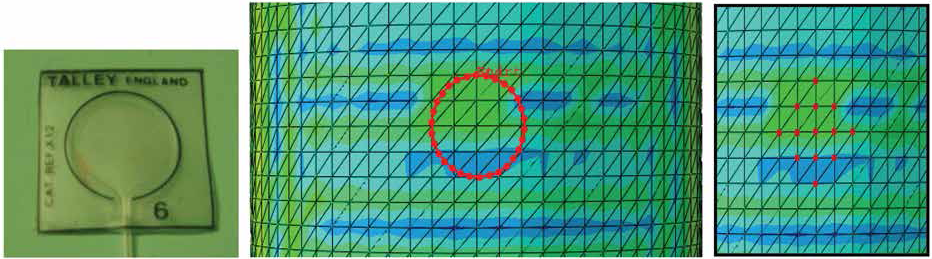
Nodes selection over the arm as per area covered by the IP sensor.
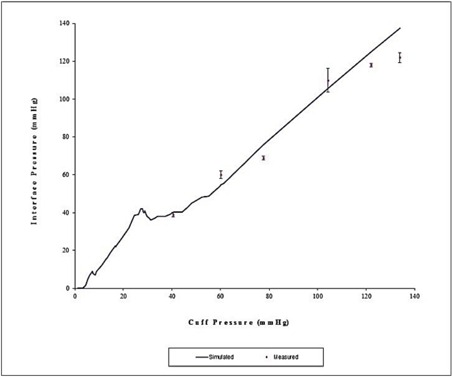
IP distribution under Cuff 1A.
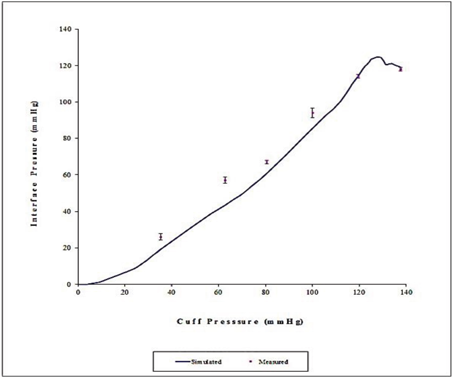
IP distribution under Cuff 2B.
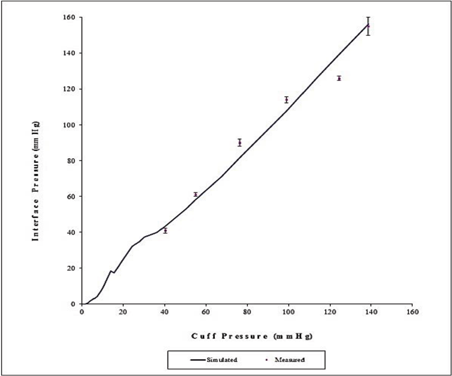
IP distribution under Cuff 3C.
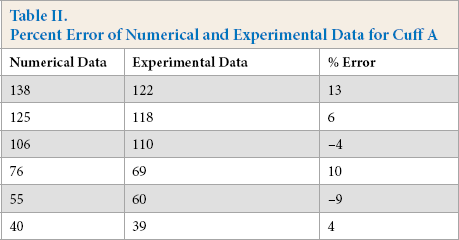
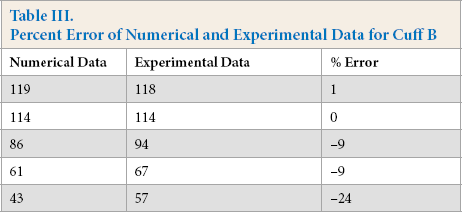
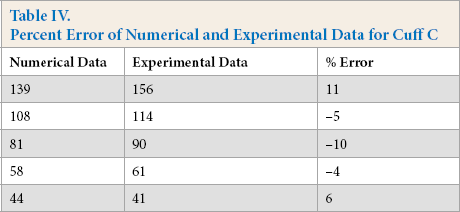
Percent error is also calculated to find variations between the results obtained through simulation modeling and experimental investigation (Tables II–IV). The models show good agreement with the experimental results. It is now possible to visualize and predict sub-cuff pressure distribution and transmission by different types of cuffs to human arms during BP measurement through simulation modeling. It will aid in the selection of the appropriate fabrics to construct BP cuffs for accurate measurements.
Percent Error of Numerical and Experimental Data for Cuff A
Percent Error of Numerical and Experimental Data for Cuff B
Percent Error of Numerical and Experimental Data for Cuff C
Results and Discussion
The detailed simulation models of the three different types of cuffs mimic BP measurement on the upper arm. Cuff models with such details were not developed before. The construction of the cuffs is similar to the original BP cuffs available commercially. The properties of the fabrics used to construct cuffs are determined independently of the underlying material using standard test methods to avoid the effect of the specific object density over the elasticity of cuff fabrics.
Validation of the models from the experimental data showed that it is possible to predict the pressure transmission under the different types of cuffs for estimation of BP values.
Models help in investigating pressure distribution under the cuffs in detail through visualization, which was not possible through experimentation. It is shown in Fig. 5 that the simulation models not only indicate high and low pressure areas, but they also reveal that different types of BP measurement cuffs are not registering identical pressure transmission and the variations are significant—to over 30 mmHg at the center of the cuff. It indicates the effect of varying properties of cuff constructing fabrics. Significant variations in IP distribution may either attenuate or augment pressure transmission to the artery, which would change the BP values and may misclassify a person's blood pressure level. As a result, subjects may either receive unnecessary or no medication at all, which may lead to serious health risks directly linked to mortality and morbidity.19–21
The most important finding was that the artery index (the center of the inflatable part of the BP measurement cuffs) was not showing the region of the highest pressure. BP cuffs are supposed to apply either uniform pressure or higher pressure through this area to stop, and then to resume, blood flow in the brachial artery to measure BP indirectly through auscultation/ oscillation. 7 It indicates one of the design faults associated with the currently-available BP cuffs. It is also important to study variation in pressure transmission and distribution due to the dissimilar fabrics mechanical and geometric properties on the estimation of the pressure acting over an artery during BP measurement.
The walls of the cuffs show severe distortion through formation of small pockets around the upper arm (Figs. 6 and 13). It was reported that the biomechanical functional performance of devices depend on their fabric mechanical properties, which can be determined by the constituting yarns and internal structural features. 22 The distortion in the cuff walls is not identical either; due to the differences in their fabrics elasticity, or due to pocket formations of various sizes, cuffs don't allow uniform pressure transmission around the arm. This may be because the fabrics selected were unable to apply the required pressure around or over the center of the arm during BP measurement. It was reported that indirect BP measurement needs more expertise and research to remove errors in estimating accurate BP values.23–25
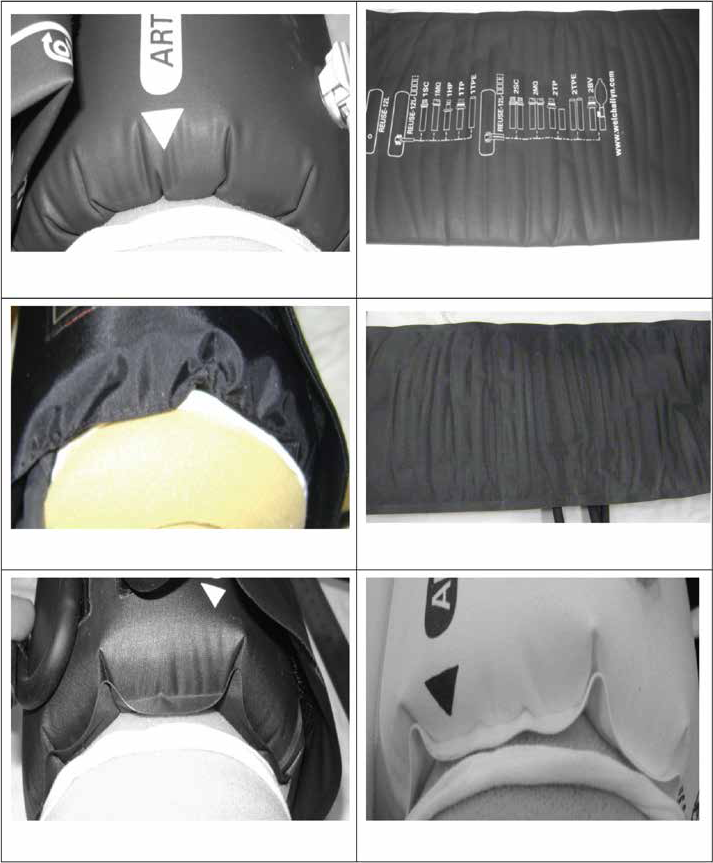
Cuffs distortion in the form of pillows upon inflation.
As already mentioned, the cuffs used in this study are constructed from woven and non-woven fabrics. Woven fabrics are constructed in a very controlled manner, as compared to non-woven fabrics, and, therefore, woven fabrics easily achieve the required properties uniformly throughout the construction. Non-woven fabrics, unlike wovens, are manufactured by laying fiber—it is difficult to keep non-woven fabric properties uniform throughout manufacturing. Non-woven fabrics are less elastic than woven fabrics. Pressure transfer to the limb is due to tension developed within the walls of the cuffs upon inflation. The pressure distribution and transmission depends on the mechanism of deformation of cuff fabrics during inflation and deflation periods of BP measurement.
Cuff C yields higher IP values compared to Cuff B throughout the deflation process. Cuff A registered different values of pressure altogether. In this case, the amount of pressure transfer inside the tissues may vary under each cuff type, which subsequently alters the pressure exerted over the artery depending on the amount of the pressure a particular cuff applies over the arm. The elastic modulus of Cuff B has the highest value, while its flexural rigidity was lowest amongst the cuffs. However, the pressure transmitted by Cuff B had the lowest value. Cuff A had the lowest elasticity and the highest value of flexural rigidity, but the IP value registered by this cuff was greater than Cuff B, while less than that of Cuff C. Cuff C registered the highest IP value, however it is less elastic than Cuff B.
There is a significant need to study pressure distribution and transmission exerted by the cuffs before their construction. The relationship between the pressure distribution under a cuff and its properties (mechanical and geometric) is a complex interplay that needs to be studied for various types of cuffs available worldwide.
Outcomes of this investigation show that the pressure inside the cuffs and measured by the manometer (considered as BP) alters when it transmits to the arm. Pressure alters (either rises or attenuates) more when it further transmits to the artery after passing through upper arm tissues. The pressure transmission ratio (i.e., the ratio of the pressure inside the cuff (140 mmHg) to the surface of the arm) is calculated for each cuff selected and listed in Table V.
Pressure Transmission Ratio
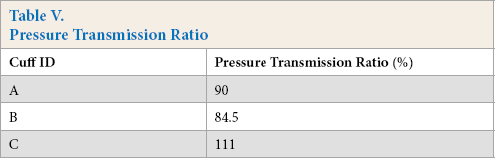
Since the pressure transmission ratio is not identical using various cuffs, blood pressure values estimated by using different types of cuffs would not be the same. Higher values than required of pressure transmission by cuffs during BP measurements may stop blood flow before the desired point, which would result in underestimation of blood pressure value. Likewise, lower pressure transmission may result in overestimation of the BP value. Since all selected cuffs are of the same size, the pressure transmission from the cuff to the artery is solely dependent on the properties of the constructing fabrics (Figs. 5, 6, and 10–12). If the pressure transmission from the cuff to the arm, and ultimately to the artery, is known, it is possible to estimate BP accurately using indirect techniques. This is possible through selection of fabrics with known properties that are able to transmit the required pressure to the limb, and eventually to the blood vessel.
Previous studies reported factors that affected the accuracy of BP measurements, however, the impact of the constructing fabrics’ mechanical properties used for the BP cuffs were not investigated for accurate measurement of BP. It is imperative to study the effects of using fabrics having dissimilar geometric and mechanical properties for the construction of cuffs on the accuracy of indirect methods.
Conclusion
Blood pressure (BP) is one of the vital signs. It is possible to predict the pressure distribution and transmission under BP cuffs of various types using detailed finite element analysis (FEA) and simulation modeling prior to their construction. It helps in the redesign of BP measurement cuffs to select appropriate fabrics having known geometric and mechanical properties, as the currently available cuffs are transmitting variable pressure to the arm. The pressure transmission ratio varies from 84.5% to 111% among the selected cuffs, which may further increase or decrease in the rest of the cuffs available commercially. This would enable application of the exact pressure desired to cease blood flow for accurate estimation of blood pressure. It would also aid in identifying the desired geometric and mechanical properties of the fabrics required for constructing cuffs to remove inaccuracies associated with indirect techniques of BP measurement. Fabrics could be developed or selected accordingly to apply a specific pressure profile around the different types of human limbs having soft tissues or muscles; similar to the development of compression stockings for the treatment of the venous ulceration and also for the selection of the materials for wheel chair use. This study identified another factor that may contribute to removing errors associated with indirect methods of BP measurement. It is now possible to predict the pressure transmission and the arterial pressures as well, using the various BP cuffs, through simulation modeling for accurate estimation of BP values.
Footnotes
Acknowledgement
We are grateful to the NED University of Engineering & Technology, Karachi, Pakistan for funding of this research project through the Higher Education Commission of Pakistan.