






Abstract
To protect military personnel's lives, the military provides, and requires personnel to wear, a military garment system, which includes a ballistic vest. In this study, three levels of a military garment system were tested to measure the thermal and evaporative resistances under the garment system. In addition, for female military personnel who wear ballistic vests designed for men, this study compared the thermal comfort values by gender through thermal manikin tests. The results concluded the need for better designed ballistic vests for improving the ventilation system.
Introduction
In combat environments, all military personnel should wear a ballistic vest, which is designed to protect wearers from serious injuries. 1 As many previous studies have indicated,2,3the ballistic vest protects military personnel from weapon attacks. According to the National Institute of Justice, since 1973, the lives of more than 2500 military personnel have been saved by wearing ballistic vests. 2
Over the years, the ballistic vest has been changed to improve performance properties and protection level. The current ballistic vest is constructed of 20 to 35 fabric layers of synthetic ballistic-resistant fibers. In addition, rigid ceramic plates, which are also called hard plates, are inserted into the internal pockets of the vest to protect military personnel from extreme weapon attacks, whereas law enforcement personnel usually wear a protective vest without hard plates. 3
Although significant improvements have been made, the effects of accumulated heat are still a serious concern, as the ballistic vest, which is multi-layered for threat protection, is significantly correlated with thermal insulation. 4 Multi-layering is susceptible to air gaps forming between the layers. Trapped air in a garment increases the thermal insulation and decreases the ability to transfer heat and perspiration from the microenvironment (body-garment) to the external environment. 4 This accumulated heat and perspiration in the microclimate causes fatigue and physiological strain for the individual.
Another serious concern is that the ballistic vests for military personnel are primarily designed based on the male body figure because of the heretofore infrequent presence of female military personnel in combat areas. 5 Over time, however, female military personnel have become increasingly involved in dangerous and physically demanding military areas, and the percentage has increased steadily over the past three decades. 6 According to a report by the US Army, approximately 18% of active duty military personnel are female. 7 Although the number of females requiring protection against gun, projectile, and shrapnel injuries has increased, female military personnel still wear the unisex-designed ballistic vest, called the Interceptor vest, for training and some military operations.5,8 They have complained that the Interceptor vest fits poorly in the chest, neckline, and armhole areas 5 —all important places that could potentially influence the wearer's performance and safety. 9
In comparison, female law enforcement personnel wear a female version of the ballistic vest that has been redesigned to fit the female body figure well. This was accomplished by making adjustments in the bust area using a streamlined stitching design that creates a bulge in the bust region. Unfortunately, this redesign is not possible for female military personnel because of the ceramic plates that must be worn.
In this study, thermal comfort—one of the major concerns in the use of protective clothing—will be studied on a female thermal manikin and a male thermal manikin wearing the unisex-designed ballistic vests. The purposes of this study are (1) to examine the thermal and evaporative resistant values of military garment systems on female and male thermal manikins, and (2) to compare these values on gender and military garment systems. Accordingly, two null hypotheses were determined:
H1: There is no significant effect on Rct (thermal resistance values) and Ret (evaporative resistance values) due to gender.
H2: There is no significant effect on Rct and Ret due to garment systems.
Experimental
The testing garment (Fig. 1) consists of an undershirt (T-shirt), a battle dress uniform (BDU), a ballistic vest, and ceramic plates to simulate the military garment system. The undershirt is a basic short-sleeve shirt made of 100% cotton. The BDU is printed in a standard disruptive pattern (camouflage) and composed of a jacket (50% nylon and 50% cotton) and pants (100% cotton). The ballistic vest, the Interceptor, is a standard military issue Outer Tactical Vest (OTV) made of a Cordura shell with a multi-layered Kevlar insert. In addition, the ceramic plates were inserted in the pockets in the front and back, covering the chest and back. Three levels of military garment systems were defined: 1) T-shirt + BDU, 2) T-shirt + BDU + Interceptor vest, and 3) T-shirt + BDU + Interceptor vest + front and back ceramic hard plates.
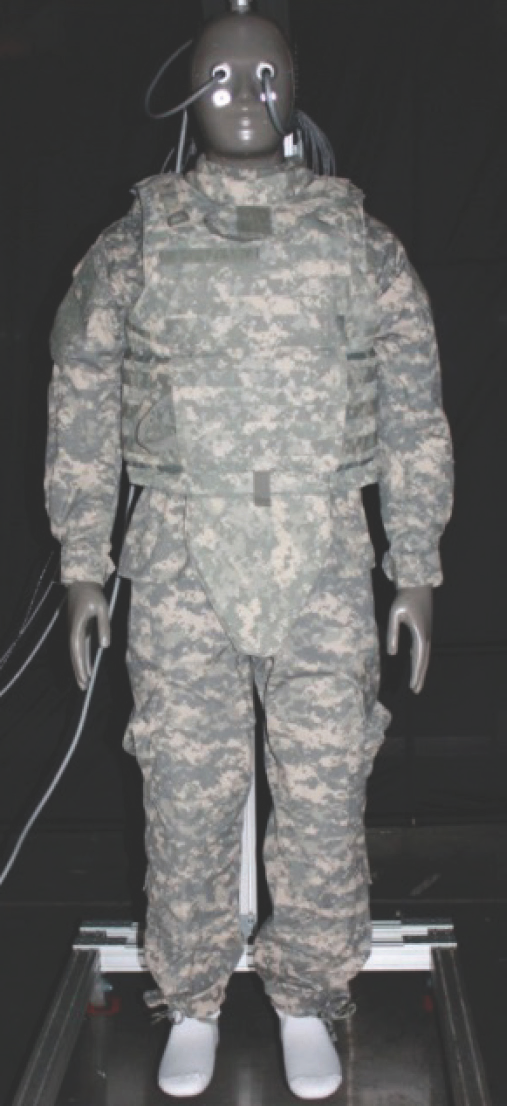
Testing garment system on thermal manikin.
A Newton (Fig. 2) thermal manikin was employed. This sweating thermal manikin is manufactured by Measurement Technologies Northwest with ThermDAC software and consists of 46 independently controlled thermal zones. Newton was housed inside a temperature- and humidity-controlled environmental chamber, manufactured by Thermotron Environmental Systems, to maintain a consistent temperature and humidity. A customized thermal breast (Fig. 3) was used to convert the male thermal manikin to the female body shape to replicate female heat and sweat patterns. The skin temperature of the manikin for both the male and female body forms was set to 35 ± 0.2 °C. The environmental chamber with ambient temperature was set to 35 ± 0.5 °C with a relative humidity (RH) of 40% ± 5%.
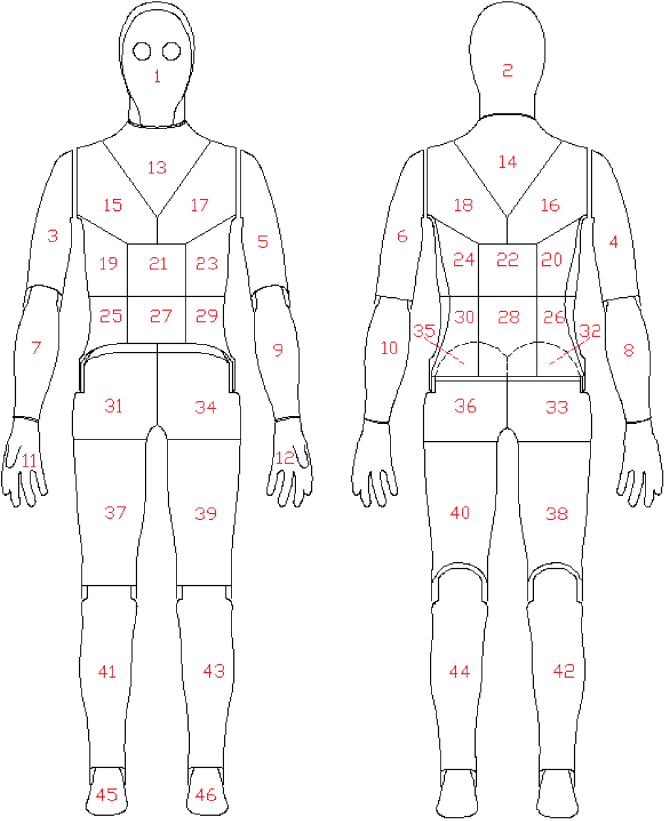
Newton with 46 independently controlled thermal zones. 1
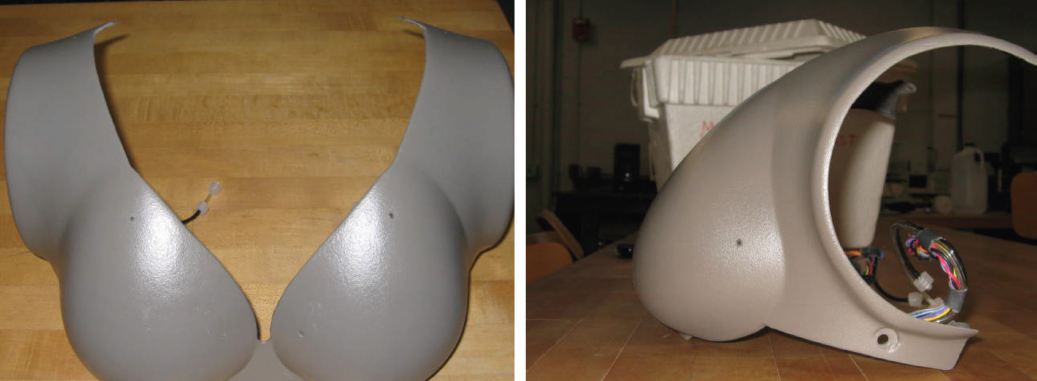
Front view (right) and side view (left) of customized thermal breast.
Before data collection, all pieces of the test garment systems were stored for a minimum of 12 h in an environmental chamber according to ASTM testing standards (F2370-10 and F1291-10). Preconditioning the military garment systems were critical for obtaining reliable test results. Data collection began once the thermal manikin reached steady state, and data were collected over an elapsed time of 180 min. The test procedure was repeated three times for each of the previously defined uniform systems and for both the male and female thermal manikin body shapes.
The experiment used a randomized complete block factorial design, incorporating the three levels of military garment systems with the different genders. The dependent variables were Rct and Ret, representing the thermal resistance values and the evaporative resistance values of the military garment systems.
Data analysis was performed using SPSS 17. ANOVA was used to examine differences in thermal resistance and evaporative resistance based on gender and levels of military garment systems because the ANOVA is a collection of statistical models used to analyze the differences between group means and their associated procedures. Although the limited sample sizes were used for this test, a non-standardized measure of effect size that has immediately “meaningful” units may be preferable for reporting purposes, while standardized effect sizes were commonly used in much of the professional literature.
11
Also, three repeated measures per each condition should have been sufficient to identify a statistically reliable difference. The significant
Results and Discussion
H1
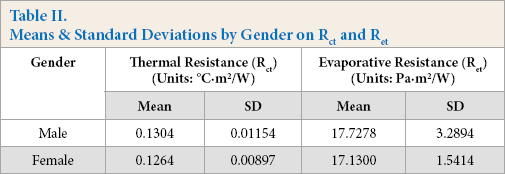
Table I presents the results of ANOVA comparing both R and Ret based on gender. Because of the non-significant results (
ANOVA Table by Gender on Rct, and Ret
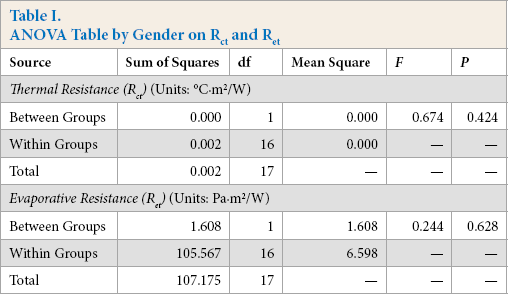
Means & Standard Deviations by Gender on Rct, and Ret
H2
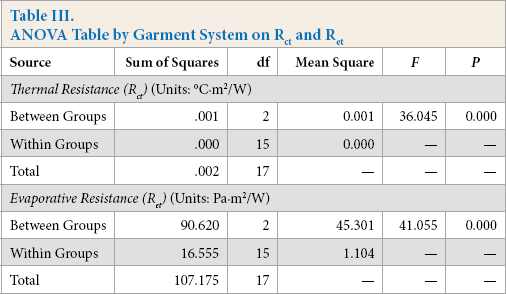
As presented in Table III, statistically significant differences in Rct and Ret among the military garment systems (Rct:
ANOVA Table by Garment System on R and Ret
For evaporative resistance values (bottom of Table IV), a significant difference in Ret occurred among the three levels of the military garment system. Each of three levels of the military garment systems was grouped individually (Garment 1, mean = 14.53167, SD = 0.893698; Garment 2, mean = 17.75667, SD = 0.0236441; and Garment 3, mean = 19.99833, SD = 0.602326). Thus, a significant difference in Ret occurred by adding the protective gears.
LSD Post Hoc Test Results by Garment System on Rct and Ret
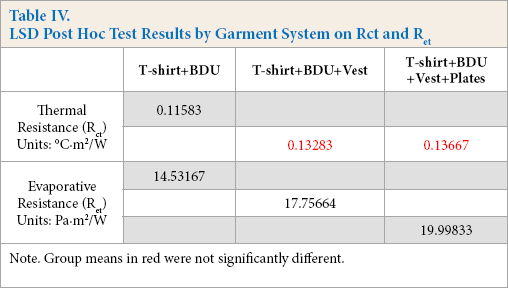
Note. Group means in red were not significantly different.
Conclusions and Limitations
This study explored two experiments (testing Ret and R) to measure the thermal comfort of a ballistic vest and to compare testing values by gender and three levels of military garment systems. The thermal resistance test (Rct) and the evaporative resistance test (Ret) reflect how heat and sweat are transported from the body to the environment throughout the military garment system.
The results indicated no differences in either Rct or Ret between thermal manikin genders while wearing the ballistic vest. While not yet conclusive, there is evidence in the literature that male and female military personnel who have similar somatotypes and proportionately similar body fat profiles will exhibit similar sweat rates after intensive exercise, although on different locations on the body. 12 However, the female thermal manikin had a slightly lower Rct and Ret in the microclimate environment than did the male thermal manikin. This might relate to the fact that the female body has more ventilation space by following the curved body shape. Another important finding is that the significant difference in the Rct and Ret emerged among the military garment systems. First, the results of Rct concluded that differences emerged between wearing the ballistic vest and not wearing a ballistic vest. The study determined that wearing a ballistic vest generated more body heat, which needed to be transported out, than when no ballistic vest was worn. However, no difference was found between wearing the ballistic vest only and wearing the ballistic vest with additional front and back hard plates. Next, the Ret values, indicating the transfer of sweat, differed based on the levels of military garment systems. By adding the piece of the protective system, the sweating conducted in the microclimate environment increased, which eventually led to increasing the heat stress and restricting performance. Therefore, military personnel tend to experience inconvenience and discomfort while wearing a ballistic vest because it restricted the transportation of heat and sweat. Consequently, personnel in combat areas provided relatively poor performance. This study suggested that vest manufacturers should consider military personnel needs, developing a specifically designed ballistic vest to improve the ventilation system in military protective gear.
Several limitations of the current study must be noted. This study used the thermal manikin, which is made of rigid plastic materials. After adjusting for the tightness of the ballistic vest, the pressure was not considered in this study. Another limitation of this study is that these results were obtained from tests conducted in a controlled ambient environment, with a constant temperature and humidity level, using a motionless sweating thermal manikin. As current research is inconclusive regarding physiological responses as a function of gender across differing levels of work intensity while wearing body armor,13,14 further testing needs to be conducted first with a thermal manikin using a range of environmental conditions, and then field tested with male and female human subjects using differing levels of physical fitness engaged in a variety of exercise intensity levels and weather conditions. In conclusion, this study further demonstrates that the interaction of protective uniform systems, the environment, and the human body is complex, requiring ongoing research.
Footnotes
Acknowledgement
This research was sponsored by the Office of Research and Sponsored Programs and the Center for Merchandising and Design Technology of Central Michigan University.