




Abstract
Twenty-eight canine mammary tubulopapillary carcinomas and 14 simple adenomas were studied by immunohistochemistry for the expressions of the tumor-associated carbohydrate antigens. Sialyl Lea was detected in 71.42% of the malignant and 92.84% of the benign tumors. Staining with anti-T and anti-Tn monoclonal antibodies revealed that 85.70% of the tubulopapillary carcinomas expressed T and Tn antigens. In contrast, 50% of the adenomas did not express T antigen, and 42.85% of them were only weakly stained for this carbohydrate structure. In the case of Tn antigen, the majority (57.14%) of samples was weakly stained, and no binding was observed in 35.71% of the analyzed specimens. Comparison of average values of reaction intensity (IRS) scale for malignant versus benign tumors by the Mann-Whitney U-test revealed a significant relationship between T and Tn antigens expression and type (malignant vs. benign) mammary tumors. Based on the results obtained, it is suggested that each of the studied antigens can be treated as a tumor-associated antigen of canine mammary tumors. However, only the T and Tn antigens seem to be associated with malignant transformation of mammary gland cells and to be of potential value as diagnostic markers.
Mammary tumors are the most frequent type of neoplasia in female dogs, accounting for approximately 50% of all tumors, which is similar to humans in that breast cancer is the most common type of tumor in women. It is well established that many human tumor-associated antigens are the result of aberrant glycosylation of cell-surface glycoproteins and/or glycosphingolipids. These so-called tumor-associated carbohydrate antigens (TACAs) can be divided in 2 major groups: 1) modified lacto-series type 1 or type 2 chains, represented by sialyl Lea and sialyl Lex structures and 2) core carbohydrate structures of O-linked mucin type, represented by T and Tn antigens. 4
Sialyl Lea, a tetrasaccharide with the structure:
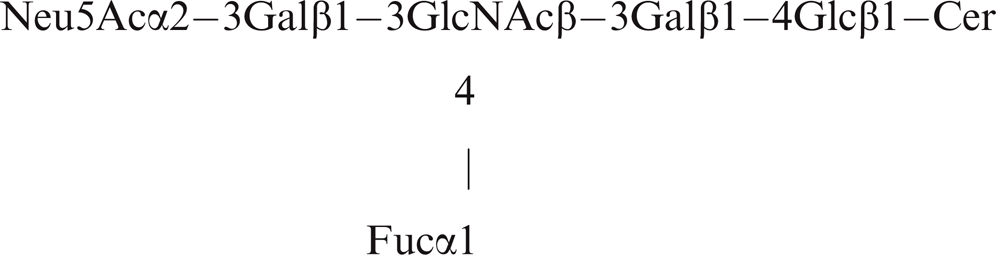
Sialyl Lea is a ligand for P- and E-selectins and plays an important role in the binding of several types of cancer cells to vascular endothelium and in the subsequent formation of metastases. 17 Similarly, it was suggested that T antigen supports the binding of cancer cells to vascular endothelium by its interaction with galectin-3, facilitating metastatic spread. 3
Of the tumor-associated carbohydrate antigens, only the expression of sialyl Lex has been studied so far in canine breast cancer cells. In 1 study, the presence of sialyl Lex was found in 47.1% of adenomas and 66.7% of adnocarcinomas. 7 There was no correlation between the expression of this carbohydrate structure and clinicopathologic features and prognosis. 7, 8 A recent study showed that sialyl Lex antigen was present in all analyzed carcinomas, regardless of histologic type. 11 A strong correlation between the level of sialyl Lea expression and the presence of lymph node metastases was found. Therefore, this study was undertaken to analyze the expressions of 3 other tumor-associated carbohydrate antigens, that is, sialyl Lea, T, and Tn antigens, in canine mammary gland tumors.
Tissue specimens were obtained from 42 female dogs of different pure and mixed breeds, aged 6 to 16 years, undergoing surgery at the Department of Surgery, Faculty of Veterinary Medicine, University of Environmental and Life Sciences, Wrocław, Poland, the Department of Pathological Anatomy, Faculty of Veterinary Medicine, University of Life Sciences, Lublin, Poland, and the Department of Clinical Sciences, Faculty of Veterinary Medicine, Warsaw, Poland. The tumors were sampled with a margin of approximately 2 cm of healthy tissues. For histologic studies the tissue specimens were fixed in 10% neutral-buffer formalin and embedded in paraffin. Paraffin sections, mounted on Superfrost slides, were dehydrated and stained with hematoxylin and eosin. The tumors were classified on the basis of the diagnostic criteria of the World Health Organization. 6 Maligant tumors were graded according to the classification of Bloom-Richardson in the modification of Elston and Ellis. 2
For immunohistochemical (IHC) detection, 4-µm-thick paraffin sections were deparaffinized in xylene and gradually rehydrated with the use of ethanol. Endogenous peroxidase activity was blocked by 5 minutes of exposure to 3% H2O2. Antigen retrieval was done by exposure of the tissue sections to boiling Antigen Retrieval Solution (DakoCytomation, Denmark) in a microwave oven (250 W) for 15 minutes. Murine monoclonal antibody (mAb) 1H4 specific to sialyl Lea was purchased from Seikagaku Corporation (Japan). Murine mAbs 22.19 16 and Tn56 1 directed, respectively, against T and Tn antigens were used as culture supernatants (the respective hybridoma were from the Collection of the Institute of Immunology and Experimental Therapy Polish Academy of Sciences, Wrocław, Poland). The antibodies were diluted with Background Reducing Antibody Diluent (DakoCytomation) (anti-sialyl Lea 1 : 100, anti-T 1 : 100, anti-Tn 1 : 50) and incubated with the sections for 1 hour at room temperature. Subsequently, the slides were rinsed in PBS (10 mM sodium phosphate buffer pH 7.2, 150 mM NaCl), incubated with biotin-conjugated swine antibodies directed against mouse and rabbit immunoglobulins for 15 minutes at room temperature, rinsed again, and incubated with streptavidin-biotin peroxidase complex (LSAB2, HRP, DakoCytomation) for another 15 minutes at room temperature. 3,3-diaminobenzidine tetra-hydrochloride (DAB, DakoCytomation) was used as a chromogen (7 minutes, room temperature). All sections were counterstained with Mayer's hematoxylin counterstain. The immunoglobulin fraction of serum from nonimmunized rabbits instead of primary antibody (Primary Negative Control, DakoCytomation) was used as the negative control.
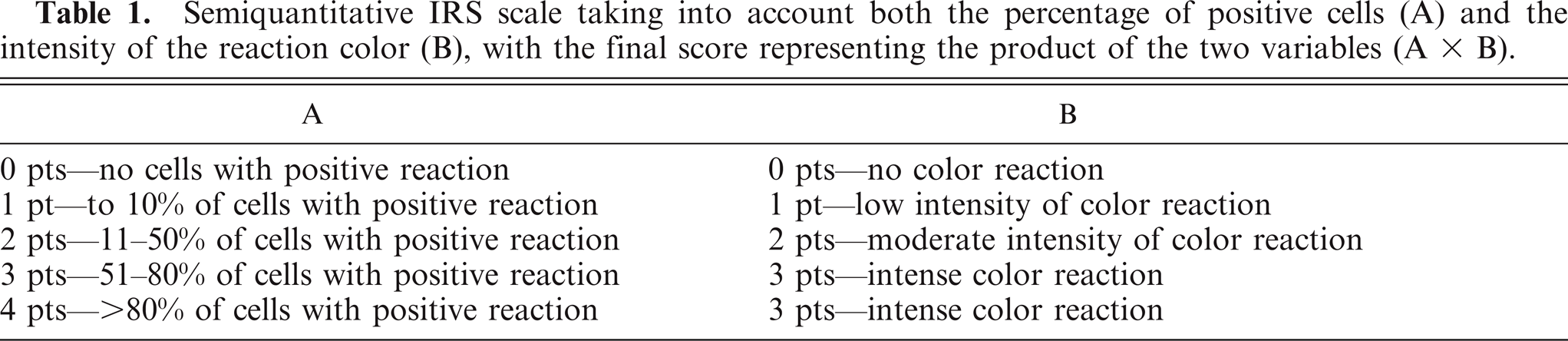
The obtained photomicrographs were subjected to computer-assisted image analysis via a computer coupled to an Axiophot optical microscope (Carl Zeiss, Germany) using MultiScanBase V 14.02 software (Computer Scanning Systems, Warsaw, Poland) The degree of TACA expression was ranked using the modified semiquantitative Immunoreactive Remmele Score (IRS) according to Remmele and Stegner (Table 1). 12 Correlation between TACA expression and the histopathologic malignancy grade was made by Spearman's correlation analysis. Mann-Whitney U-test for independent samples was used to compare the expressions of the TACAs in malignant versus benign tumors. The results were considered statistically significant when P < .05 in both analyses. Software Statistica 7.1 (STATSoft, Kraków, Poland) was used for all analyses.
Semiquantitative IRS scale taking into account both the percentage of positive cells (A) and the intensity of the reaction color (B), with the final score representing the product of the two variables (A X B).
Based on histologic examination, 28 mammary tubulopapillary carcinomas and 14 simple adenomas were included in this study. The tubulopapillary carcinomas were classified, according to the Bloom-Richardson scale in the modification of Elston and Ellis, 2 as malignancy grades, that is, G1 (8 cases), G2 (16 cases), and G3 (4 cases).
The expressions of sialyl Lea in the canine mammary tubulopapillary carcinoma specimens and normal mammary epithelium from the same animals as well as simple adenoma specimens were analyzed using the immunoperoxidase method. Sialyl Lea was detected with different intensities in 71.42% of the mammary malignant tumors and 92.84% of the benign tumors (Table 2). Therefore, no significant difference was found in the expression of sialyl Lea between malignant tubulopapillary carcinomas and benign adenomas (Fig. 1). No staining with anti-sialyl Lea mAb 1H4 was observed in normal tissue sections distant from the carcinoma lesions. Sialyl Lea antigen was present not only on the surface of tumor cells, but also in the cytoplasm as well as extracellularly in secreted form (Fig. 2A, B). No correlation between sialyl Lea expression and the histopathologic malignancy grade was found when the data were subjected to Spearman's correlation analysis.
Expression of tumor-associated carbohydrate antigens (TACAs): sialyl Lea, T, and Tn antigens in canine mammary adenocarcinomas.
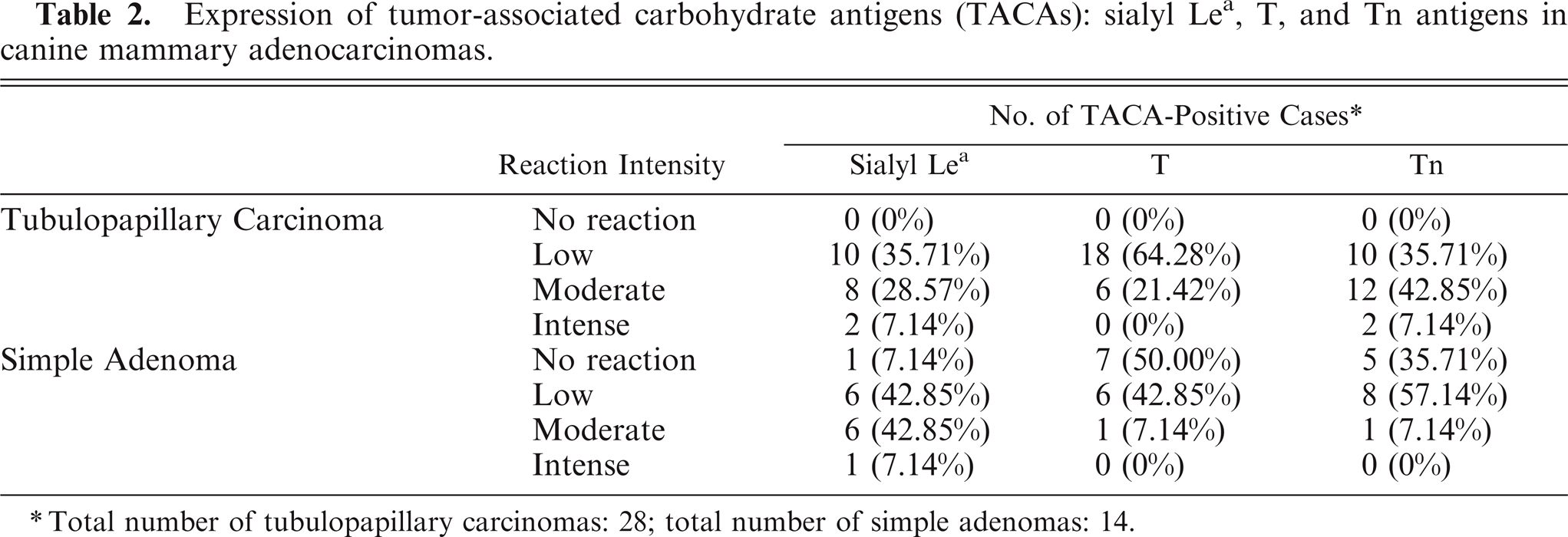
Total number of tubulopapillary carcinomas: 28; total number of simple adenomas: 14.
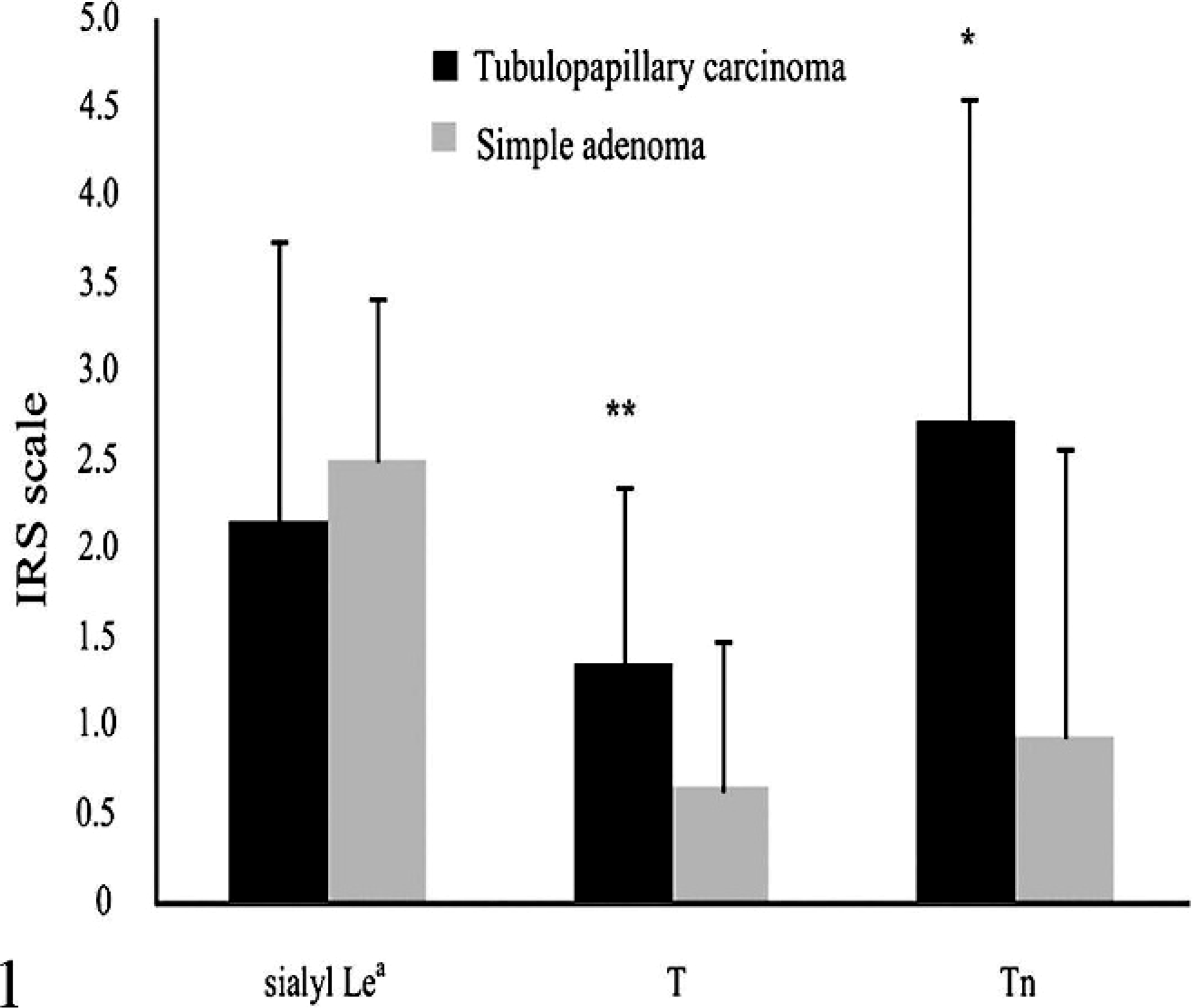
Expression of sialyl Lea, T, and Tn antigens in canine mammary tubulopapillary carcinomas (n = 28) and simple adenomas (n = 14). Reaction intensities for each TACA were calculated based on the semiquantitative IRS scale of Remmele and Stegner 18 and are presented as means. ∗P < .01 for Tn-expressing tubulopapillary carcinomas compared with Tn-expressing adenomas and ∗∗P < .005 for T-expressing tubulopapillary carcinomas compared with T-expressing adenomas (Mann-Whitney).
Of the 28 tubulopapillary carcinomas that were subjected to IHC analysis with anti-T and anti-Tn mAb, the majority of the specimens expressed T and/or Tn antigens. For T antigen, 24/28 (85.70%) of the malignant tumor sections were stained with mAb 22.19. In contrast, 50% of the adenomas did not express T antigen, and 42.85% of them were only weakly stained for this carbohydrate structure (Table 2). Comparison of the average values of the reaction intensity (IRS scale) for malignant versus benign tumors by the Mann-Whitney U-test revealed a significant relationship between T-antigen expression and type (malignant vs. benign) of mammary tumor (Fig. 1). In tubulopapillary carcinomas, the presence of Tn antigen, detected by binding of mAb Tn56, was also observed in 85.70% of samples. However, when the adenomas were stained with anti-Tn monoclonal antibody, the majority (57.14%) of samples was weakly stained, and no binding was observed in 35.71% of the analyzed specimens (Table 2). Again, using the similar statistical approach as was used for T antigen, significant relationship between Tn-antigen expression and type (malignant vs. benign) of tumor was found (Fig. 1). Spearman's rank correlation analysis showed no correlation between the expression of T/Tn antigens and histologic grade of the analyzed malignant tumors. No positive staining was found with normal mammary tissues from the same animal. As in the case of sialyl Lea antigen, the staining was not limited to the cell surface, but the antigens also were found in the cytoplasm and in secreted form (Fig. 2C, D, E, F).
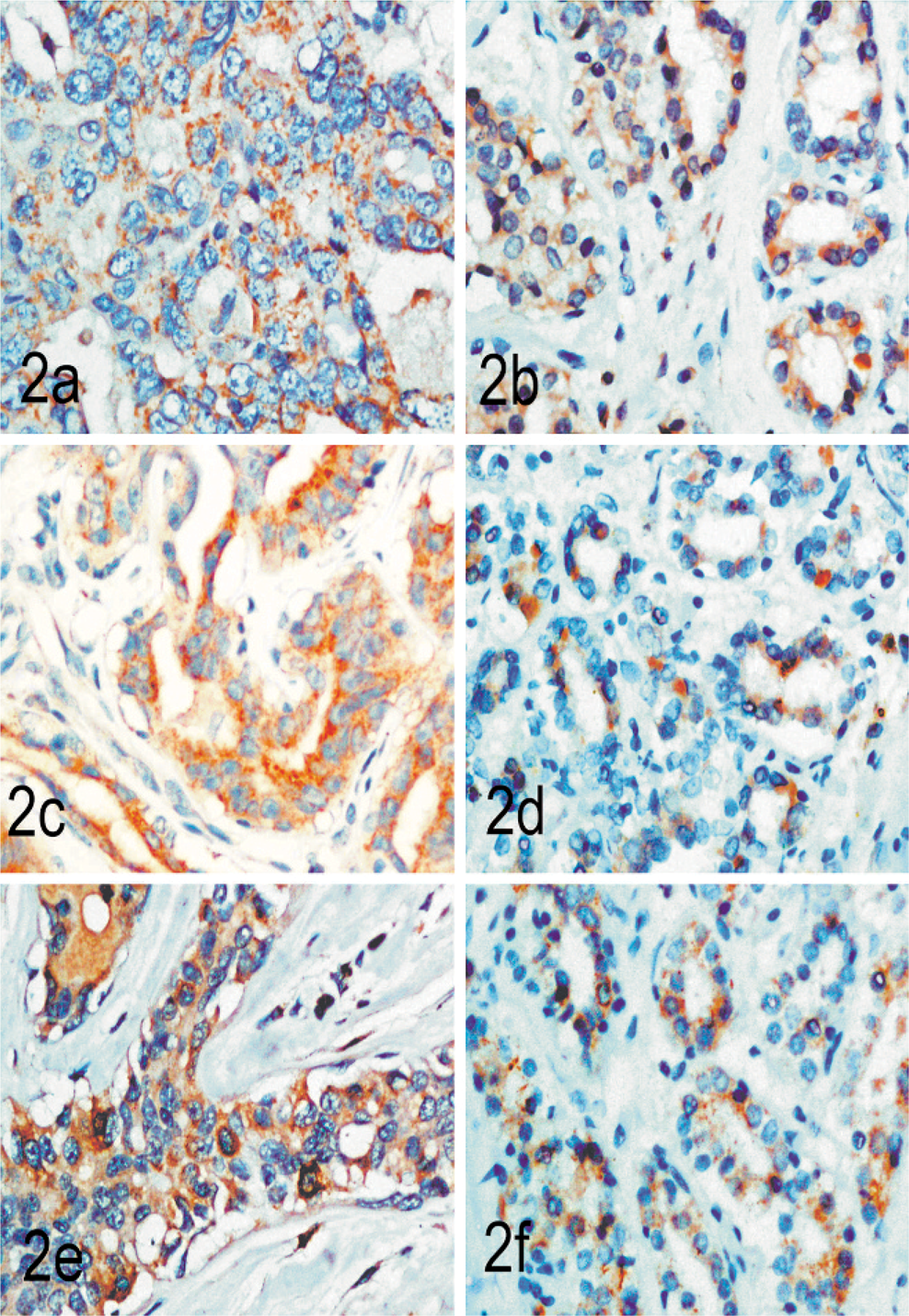
Immunohistochemical staining of canine mammary tubulopapillary carcinomas with (A) anti-sialyl Lea mAb 1H4, (C) anti-T mAb 22.19, (E) anti-Tn mAb Tn56, and simple adenomas with (B) anti-sialyl Lea mAb, (D) anti-T mAb 22.19, and (F) anti-Tn mAb Tn56. 400×.
In humans, malignant transformation is invariably associated with alterations in the expressions of cellular glycoconjugates and with structural changes of their carbohydrate moieties. These so-called TACAs are represented by sialyl Lea/sialyl Lex and T/Tn antigens. 4 In contrast to human cancers, including breast cancer, very little is known about TACA expression in canine mammary tumors. So far, only the presence of sialyl Lex antigen has been analyzed in tumors obtained by surgical resection and in established in vitro cell lines derived from adenocarcinoma. 7, 8, 11 In the present study, we showed that canine mammary gland tumors express 3 other human TACAs: sialyl Lea, T, and Tn antigens. Similarly to sialyl Lex, the carbohydrate antigen sialyl Lea was present in the majority of malignant carcinomas (71.42%), but no correlation between the level of expression of this TACA and clinical grade of tumors was found. Even more adenomas were stained with anti-sialyl Lea antibody, and the expression of this carbohydrate structure was confirmed in more than 90% of the analyzed cases. These data suggest that the expression of sialyl Lea is not directly related to malignant transformation of mammary cells, but rather is an early event associated with a precancerous stage. In contrast, 2 other analyzed TACAs, T and Tn antigens, were absent or only weakly stained in the majority of the adenomas and expressed in about 85% of the tubulopapillary carcinomas. Therefore, these carbohydrate structures seem to be directly associated with mammary carcinoma and can represent new potential markers of malignant transformation in dogs.
In summary, based on the results obtained we suggest that each of the studied carbohydrate structures can be treated as a tumor-associated antigen of canine mammary tumors. However, only T and Tn antigens seem to be associated with malignant transformation of mammary gland cells and to be of a potential value as diagnostic markers.