




Abstract
The ovaries and uterus were collected after ovariohysterectomy from a 16-month-old Labrador bitch in diestrus that never mated. Discrete swellings were found in the uterine horns, with the macroscopic appearance of normal early pregnancy. At histologic examination, the endometrium, devoid of any conceptus and chorion, showed a marked proliferation, on the basis of which a diagnosis of deciduoma was made. A remarkable population of stromal eosinophilic granular lymphocytes was present, especially in the axis of the endometrial folds. Periodic acid-Schiff and Dolichos biflorus-lectin histochemical reaction and a panel of 10 immunohistochemical markers were used to characterize eosinophilic granular cells. Our findings allowed us to compare these granular cells with the granulated decidual cells, whose presence was until now described only in primates, rodents, or a few other epitheliochorial species. On the basis of our results, the importance of eosinophilic granular cells in a decidualization process is hypothesized to occur also in the bitch.
The histopathologic features of decidua-like proliferation in nonpregnant animals of many species has been referred to as deciduoma. 7 In human medicine, “deciduoid mesothelioma” is a term described by Nascimento et al. 6 for indicating a pathologic feature that bears a remarkable cytomorphologic resemblance to decidua or decidualized tissue that is localized elsewhere.
The stromal cell infiltration of this pathology has not yet been characterized in the bitch. In carnivores, indeed, the endotheliochorial or semideciduated placentation, in the absence of a marked decidual reaction, is characterized by segmented neutrophil migration into the glandular zone of the endometrial stroma and by active proliferation of the uterine epithelium, causing an “inflammation-like” aspect of the endometrium in response to embryo implantation. 12 The aim of this work was to histo- and immunohistochemically characterize a peculiar stromal eosinophilic granulose cell population, which was present in the axis of the endometrial folds of a naturally occurring deciduoma in a diestrous bitch.
The uterus and ovaries were collected from a 16-month-old Labrador bitch undergoing a routine ovariohysterectomy. The owner reported that the bitch was confined, and no matings had occurred during the last estrus. Clinical hematology and biochemistry collected 1 day before surgery were within normal limits. At surgery, the uterus revealed 3 thumb-sized segmental swellings in one of the horns, simulating an early pregnancy. The ovaries were typically in the luteal phase, with many corpora lutea covering the surface.
Formalin-fixed, paraffin-embedded sections (5 μm thick) from each uterine enlargement were stained with HE for routine histopathology. At histologic examination, the uterine wall between the swellings showed the normal endometrial spiral appearance of the luteal phase, with a tall columnar epithelial lining (Fig. 1a). At the areas of gross swelling, endometrial proliferations with long folds protruding into the lumen and intermingled with each other were evident with a lamina propria extending into their axis, indicating that they were permanent nondistensible structures. Surface epithelium lining the folds was cuboidal to columnar, with a cytoplasmic foamy appearance and bleblike apical protrusions (Fig. 1b). The extensive branching of folds and subfolds was partially occluded and appeared to dissolve into the lumen, devoid of conceptus but containing masses of cellular debris (Fig. 1c). This structural pattern of the mucosa was shared by all the 3 uterine swellings. In some section of the swellings, hyperemic aspects were noticed, with a large quantity of blood cells in the endometrial stroma (Fig. 1d) and in the lumen of the swelling, where blood cells were mixed with debris of the mucosal folds (Fig. 1e). The macroscopic and microanatomic aspects allowed us to refer to this highly organized maternal placenta-like endometrial hyperplasia as a naturally occurring deciduoma. 5 For histochemical selective staining of neutral glycoconjugates, paraffin sections were processed for periodic acid–Shiff (PAS) reaction. The Dolichos biflorus (DBA)–lectin reactivity was tested as well, by the histochemical procedure according to Domeneghini et al. 1
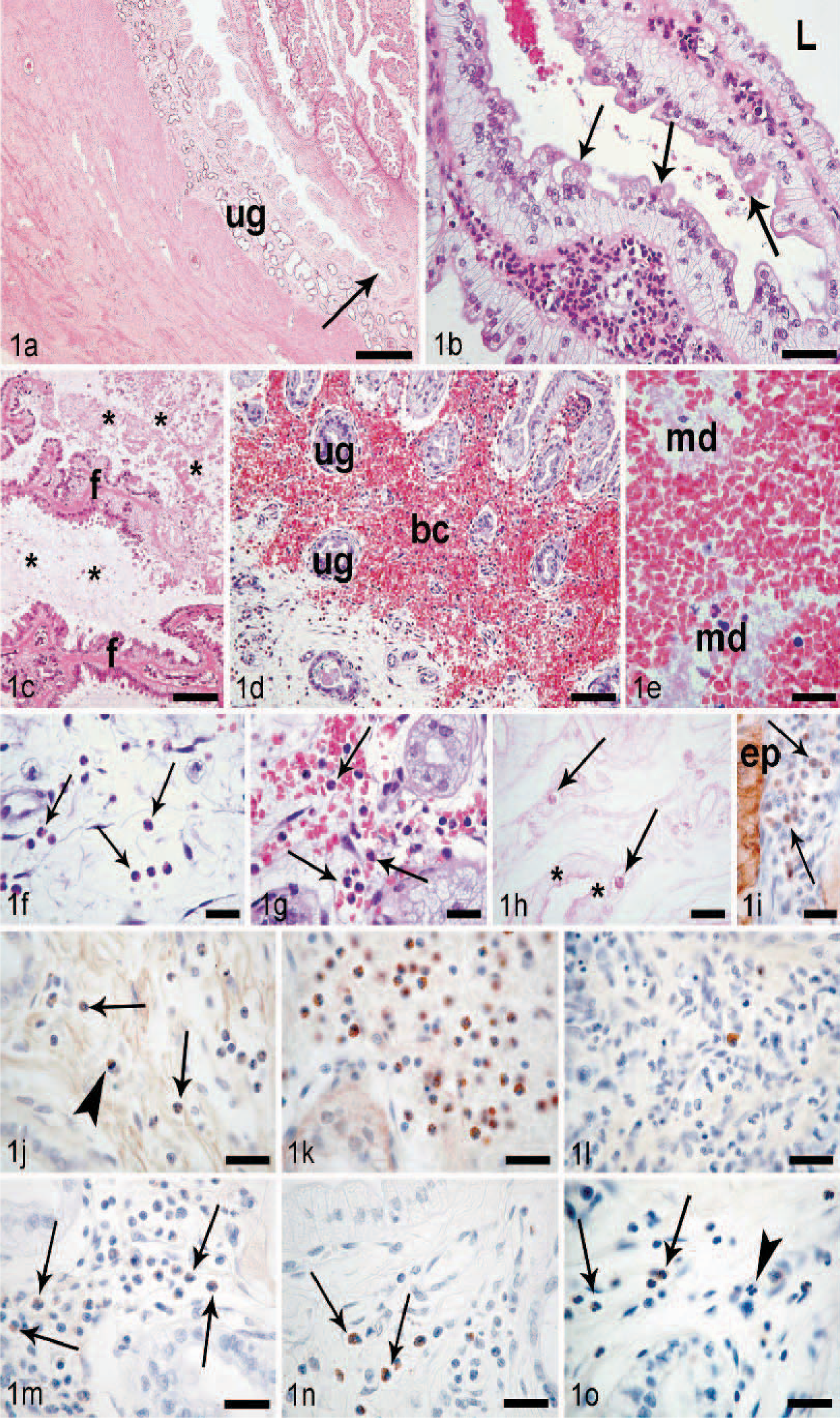
Canine deciduoma: histologic, histochemical, and immunohistochemical results obtained on serial sections.
For immunohistochemistry, deparaffinized sections were treated with hydrogen peroxide followed by incubation in 1 : 20 normal goat serum (DakoCytomation, Glostrup, Denmark) in Tris-buffered saline (TBS: 0.05 M Tris/HCl, 0.15 M NaCl) for 30 minutes to prevent background prior to incubation with primary antisera. Sections were then incubated in a humidity chamber at 4°C for 18–22 hours, using a panel of primary antisera followed by peroxidase-conjugated antibodies (DakoCytomation) (Table 1). After exposure to an appropriate chromogen, the slides were counterstained with Mayer's hematoxylin and mounted using Eukitt (Sigma, Italy).
Primary antisera tested, their sources, and working dilution conditions of antigen retrieval and immunocomplex formation.
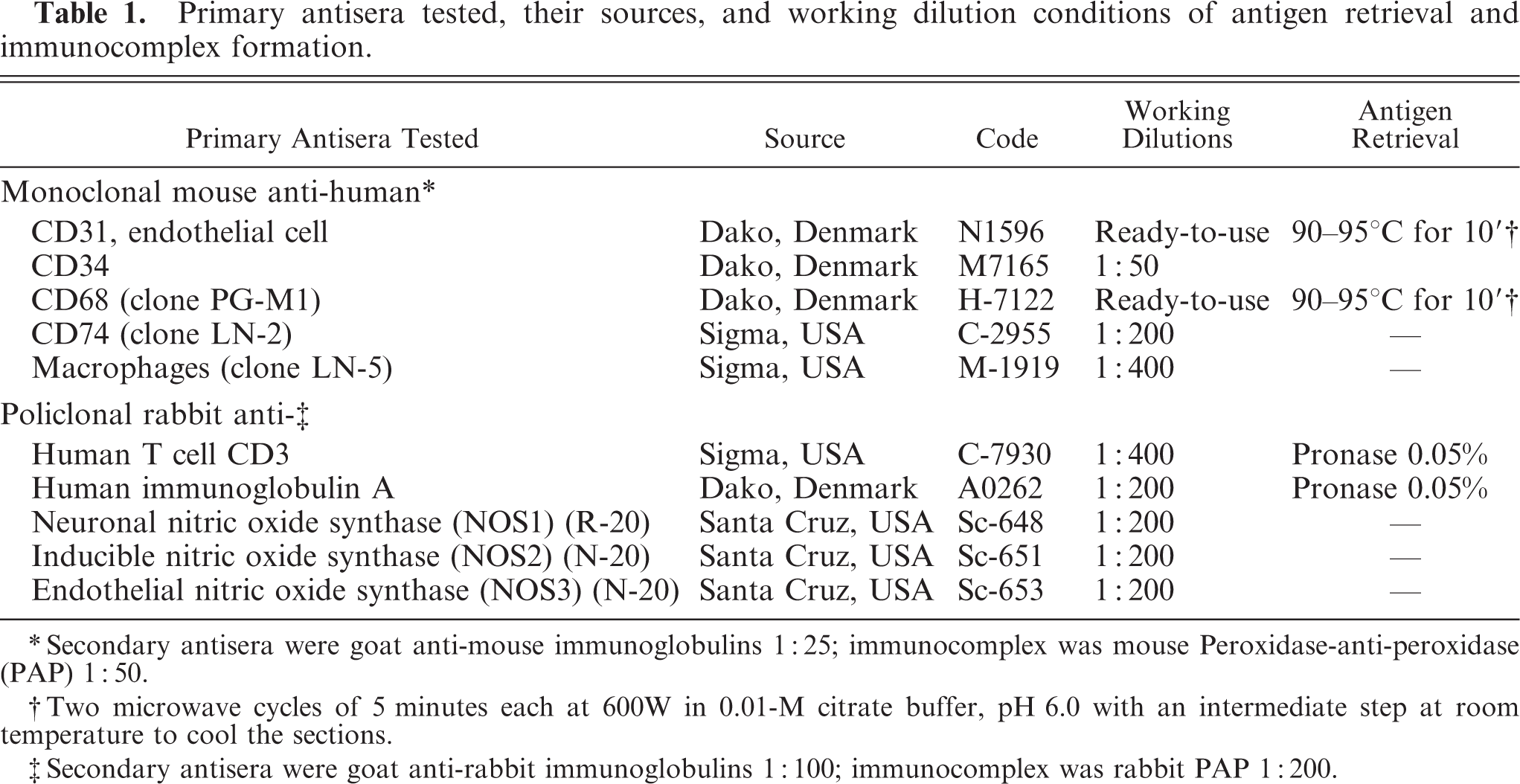
∗Secondary antisera were goat anti-mouse immunoglobulins 1 : 25; immunocomplex was mouse Peroxidase-anti-peroxidase (PAP) 1 : 50.
†Two microwave cycles of 5 minutes each at 600W in 0.01-M citrate buffer, pH 6.0 with an intermediate step at room temperature to cool the sections.
‡Secondary antisera were goat anti-rabbit immunoglobulins 1 : 100; immunocomplex was rabbit PAP 1 : 200.
A peculiar stromal quantity of leucocytes, especially lymphocytes and cells with cytoplasmic acidophilic granules and polymorphic, mostly bilobed nuclei, likely an unusual type of eosinophilic granular cells, appeared evident at histologic examination (Fig. 1f, g). Cytoplasmic granules stained positively either by PAS reaction (Fig. 1h), demonstrating neutral glycoconjugates, or DBA lectin (Fig. 1i), which has high selectivity for glycoconjugates containing N-acetyl D-galactosamine in the terminal position. DBA-lectin binding was indicated as strongly characterizing the transient lymphocyte population of uterine natural killer cells (uNK) in mice. 9 Due to its high affinity for a specific sugar, DBA lectin is able to discriminate uNK from circulating natural killer cells (cNK), which makes it suitable as antibody reagents for phenotypic identification of uNK cells. 9
By immunohistochemical examination, eosinophilic granular cell appearance was that of granulated lymphocytes, characterized by a high content of lytic molecules. Anti-CD3 immunoreactivity was present in a small number of eosinophilic granular cells and in few small cells with roundish nuclei, most likely T cells (Fig. 1j). Anti-CD74 immunoreactivity was present in all of the eosinophilic granular cells, showing a strong immunoreactivity, while blood granulocytes were negative (Fig. 1k). Anti- immunoglobulin A immunoreactivity was present only in plasma cells (Fig. 1l), while polymorphonuclear cell populations were unreactive. Anti-macrophage serum immunoreacted with the granules of a large part of the eosinophilic granular cells (Fig. 1m), as well as in connective cells identifiable as macrophages. Nitric oxide synthase I (NOS I) stained some nerve fiber bundles located among the myometrial smooth musculature, especially evident in between swollen parts of the uterine wall. This nitrergic innervation, which was principally restricted to the vessel wall, seemed to be lost at the level of the lesion. Anti-NOS II immunoreactivity was strongly present in the cytoplasm of the totality of polymorphonuclear cells (Fig. 1n), without the possibility of distinguishing among eosinophilic granular cells and neutrophils. Anti-NOS III immunoreactivity was present in cytoplasmic granules of eosinophilic granular cells, whereas neutrophil granulocytes were unstained (Fig. 1o).
Our data indicate that the peculiar lymphocyte population observed in the bitch deciduoma shows similarities with the granulated decidual cells, until now described only in primates and rodents. In rodents, it is reported that the decidualization process is closely associated with a dramatic increase of macrophages and T cells, as well as with an unusual leukocyte population. 4 The latter is described as large lymphocytes with a reniform nucleus and prominent cytoplasmic granules. They have been immunohistochemically characterized and called large granular lymphocytes or uNK. 10 Yet, few reports exist about the presence of uNK in species with epitheliochorial placentation, 3, 8, 11 showing that the sow, only, shares similarities with humans and rodents, despite the noninvasive nature of the pig placenta. 2
The etiopathogenesis of naturally occurring bitch deciduoma is unclear. It is possible that the reaction was induced by early pregnancy and resorption, but the case history strongly suggests that this was not the case. Suggestions have been put forward by Nuroma and Funahashi 7 and Nomura and Nishida 8 in search of the possible cause-effect relationships between pyometra and deciduoma. According to these authors, a possibility exists that canine pyometra is a kind of deciduoma induced by a naturally occurring infection, early during the luteal phase. In this article on the stromal cell population, we have identified the presence of an unusual type of granulated leukocytes, highly likely to be the granulated decidual cells described in humans and rodents.
On this basis, the presence and contribution of uterine-associated lymphocytes provided novel information about a process of decidualization that occurs as the mechanisms triggering the naturally occurring deciduoma in the bitch.
Footnotes
Acknowledgements
We thank Dr. John R. Whatts for critically revising the manuscript. This work was supported by grants from the University of Milan.