




Abstract
In 1858, Rudolf Virchow, the professor of pathology in Berlin University, published the book “Cellular Pathology”. A compendium of his lectures to physicians and medical students, he introduced the use of microscopy for the study of human diseases. To an astonishing extent Rudolf Virchow was helpful to the disciplines of veterinary medicine (and veterinary pathology). Considered a scientific genius in several disciplines, this essay deals exclusively with the devotion of Virchow, a scholarly physician, to the profession of veterinary medicine. He respected veterinary research, supported governmental veterinary education, and provided a role model for the veterinarians who were drafting control legislation of contagious diseases in livestock. Repeatedly, he responded in help when seemingly irretrievable problems arose. Examples of Virchow's activities in the realms of veterinary medicine and pathology are marshalled here to shed light on this pioneer “veterinary pathologist”. In celebration of 50 years of the American College of Veterinary Pathologists in 1999, it is timely to remember that Rudolf Virchow, the father of cellular pathology, also fathered veterinary pathology, whose offsprings in Canada and the U.S.A. (Osler, Clement, Williams, Olafson, Jones 26 ) had enabled them to form and foster the A.C. V.P.
Keywords
Half a century ago, or more, the average veterinary student—or the average medical student—knew who Rudolf Virchow was. They may not have known much about him, but they learned in pathology class that he was a German pathologist. In 1999, few veterinary students knew who Virchow was, and sad to say, neither did many of their teachers. During a span of two decades, I displayed a portrait of Virchow in my office, and many visitors had asked who was portrayed. Visitors who did not inquire about the portrait, were asked if they could identify the subject. I gave it up after it had been seen by about 20 veterinary pathologists, three medical pathologists, three veterinary ophthalmologists, one veterinary pharmacologist and one medical pharmacologist. Twenty six of these 28 biological scientists were unable to identify the subject of the portrait; mute evidence that even a genius like Virchow could lapse into obscurity, at least in the English-speaking world!
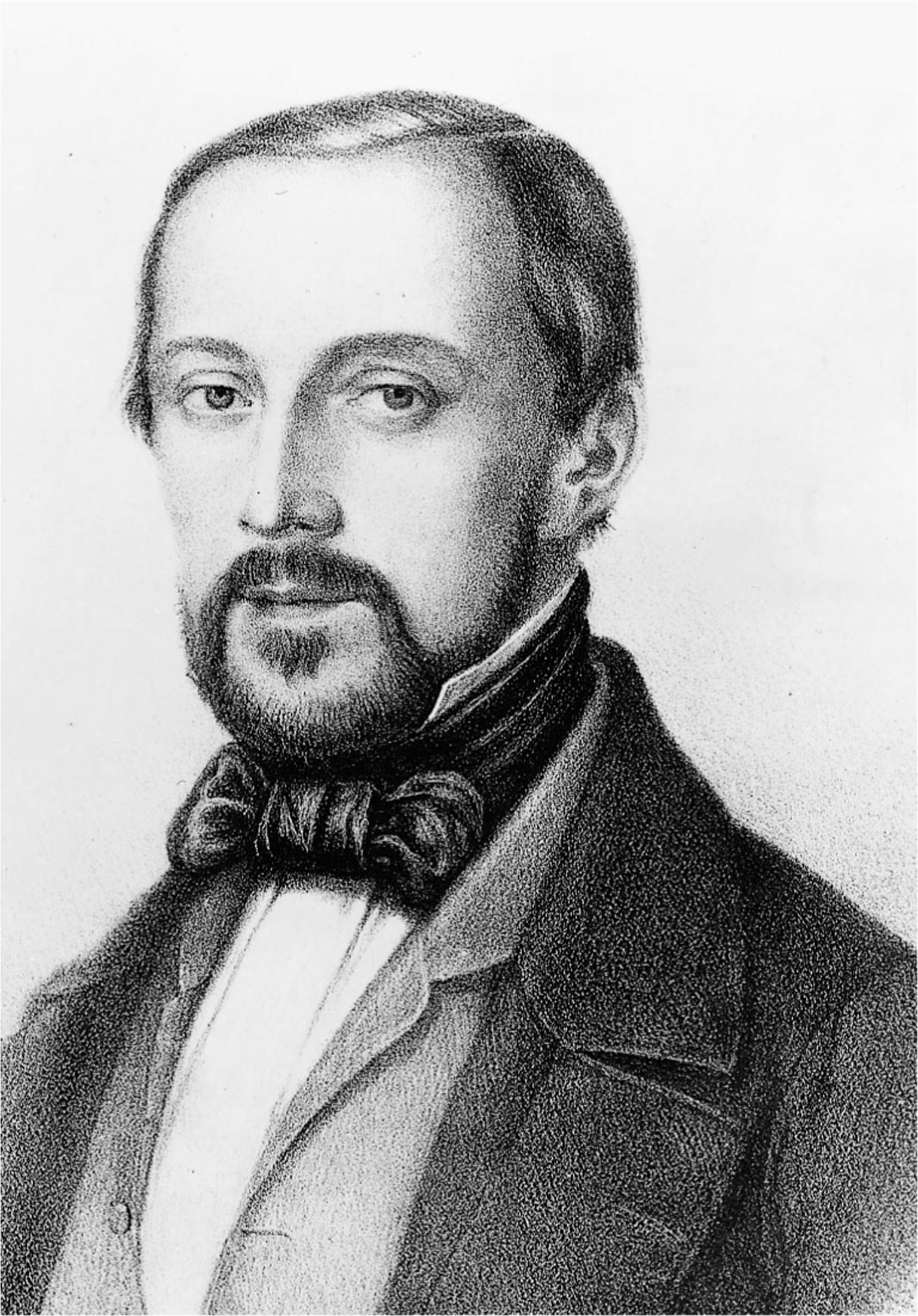
Virchow during his Würzburg tenure. Courtesy of National Library of Medicine, Bethesda.
It is not easy to explain in a brief line or two, that Virchow was the person who released medicine from 2000 years of bondage by Greek and Roman superstitions, converting it to a biological vocation based on science. He was active in medicine, anthropology, archeology and parliamentary politics; all four of these aspects of his career were described in 1953 by Erwin Ackerknecht in a scholarly biographical book 1 . That year it became a custom at the annual meeting of the American College of Veterinary Pathologists to present a copy of this book to each outgoing president. Fifteen lucky veterinary pathologists received these presents until the book went out of print in 1968. That year, I was chagrined to receive instead a walnut cigar box, hardly a present for a pathologist!
In research for the writing of a history of veterinary pathology, I encountered the name Rudolf Virchow innumerable times. 26 One might certainly expect such frequent literary encounters with a man whose chief biographer had subtitled his book “Doctor, Statesman, Anthropologist.” 1 Only a brief biographical sketch could fit the compass of my book. 26 But therein I could not do justice to Virchow's involvement with the evolution of the discipline of veterinary medicine. His contributions to veterinary medicine had been recognized by contemporary veterinarians (during the period between the 1850's to the 1890's). Sadly, more than a century later, Virchow's veterinary accomplishments were all but forgotten both by historians of medicine, and by veterinarians, even by veterinary pathologists! Exceptionally, six of the latter had alluded to Virchow in their text books: K. I. Vertinskii in Russia, 36 D. O. Slauson, 32 N. F. Cheville, 11 H. A. Smith & T. C. Jones 33 , and R. Runnels et al 24 in the United States. Smith & Jones seem to have written the only textbook on veterinary pathology cognizant that cerebral vessels were surrounded by “Virchow-Robin spaces”. 33
It is not generally known that Rudolf Virchow, born in the small town of Schivelbein, had ample opportunity to observe the butchering of livestock. His biographer, Erwin Ackerknecht, wrote of him: “It must be truthfully stated that through several generations, the majority of the Virchows and their in-laws were engaged in the honorable but plain trade of butchery”. This may sound like an irrelevant aspect of his biography, but there were important aspects of his scientific career in which his childhood observations played a significant role.
In the early nineteenth century there were no large abattoirs in Germany or North America. The slaughter houses were modest shacks on the premises on which the livestock had been grazed or fed. Rudolf's father had a very small establishment, which produced enough to support his family but not much more. It saw Rudolf through high school, but not a university education. In 1839, the impecunious Virchow was fortunate to find an opening in the medico-military academy, in which tuition was waived, with food and lodging provided by the government. In addition to the military tutelage, several top-notch professors from the faculty of medicine of Berlin University also lectured in the medico-military academy. Virchow flourished there under the tutelage of Johannes Müller, and Lukas Schönlein. He received his M.D. in 1843 and obtained a junior assistantship at the Charité Hospital in 1845. In 1848 there was a revolution in Prussia and Virchow sided with the revolutionaries. This made him persona non grata in Berlin and he was obliged to leave; moving in 1849 to the University of Würzburg as Professor of Pathologic Anatomy. He spent 7 fruitful years there, and then returned triumphantly to Berlin. These years are referred to as his first Berlin time, his Würzburg time and his second Berlin time. Thus, he worked out his theory of cellular pathology in Würzburg, but published the book on his second Berlin period.
Virchow's Interest in Veterinary Medicine
Some of it might have come from observing his paternal relatives practicing their work as butchers. As a prosector in the medical faculty of Berlin University in his first Berlin period, he attended lectures by Professor Werner Spinola at the Berlin Veterinary College to learn more about veterinary medicine. Attention at these lectures resulted in early exposure to veterinarians, and to veterinary students, who invoked in him respect and admiration for their profession. One of his uncles was a building contractor who had played a big role in erecting new buildings on the campus of the B.V.C. This too might have evoked a feeling of affinity with the veterinary faculty members and whetted Virchow's interest in this institution. This information was conveyed by R. Völker-Carpin. 46
In Virchow's early years in the faculty of medicine in Berlin University, he was eager to subject some of the theories he had postulated to experimental trials. Unfortunately for him, there were no facilities for animal experimentation in the faculty of medicine. But fortunately for Virchow, Professor E. F. Gurlt, Director of the B.V.C., foresaw a budding genius. He placed experimental animals and the space to house and feed them at Virchow's disposal; this facilitated the conduct of several historically significant experiments. This kindness and helpfulness, extended during a period of dire experimental need, evoked deep gratitude in Virchow, toward Gurlt and toward veterinarians in general. It was a gratitude that Virchow harbored until the end of his life. He seems to have missed no opportunity to reciprocate.
Meat Hygiene
Calvin Schwabe, an American veterinary historian and parasitologist, wrote that meat inspection was conducted as early as ancient Athens and Rome, and in the latter, “the meat which was condemned by the inspectors was thrown into the Tiber River!” He added that there were public abattoirs in ancient Rome “but governmental meat inspection apparently disappeared with the fall of the Roman Empire”. 30 He also alluded to meat inspection in several German-speaking states during the 13th to the 18th centuries, adding that “these systems decayed or disappeared completely during the famine which followed upon the 30 Years War.” I doubt whether this war (1618–1648) and its aftermath can account for the broad decline and fall of meat inspection in the numerous Germanic states that would later be amalgamated into a single empire.
Virchow had an interest in helminthology, with a special curiosity in the life cycle of the nematode Trichinella spiralis. He determined that the circular structures seen in porcine muscular tissue, and heretofore considered histologically to be normal, were in fact curled up larvae of T. spiralis. He conducted several experiments to determine their stages of life. During the same years, (the late 1850s), several renowned German biologists—Küchenmeister, Leuckart, Zenker and others—were also conducting experiments in attempts to determine this nematode's life cycle. 1 Virchow's experiments succeeded, whereas those of his contemporary scientists did not, although claims for priority were made for some of them. A year or two later, the other biologists confirmed Virchow's findings. A century later, Virchow's priority on this work was confirmed by a historian (Ackerknecht), and in 1986, also by a renowned helminthologist. 12
Not content with having worked out the Trichinella life cycle, in 1859–1860, Virchow used his experimental data in a practical application which would detect the larvae in raw meat. Low power microscopic examination revealed their presence. Virchow also advocated macroscopic examination of meat for detection of other parasites. He said that such inspection could be conducted by physicians, veterinarians or pharmacists. In Prussia his advocacy was at first not taken seriously, but eventually it created innumerable jobs in meat inspection for veterinarians, first in Berlin, later in Prussia, and finally in all of Germany. Eventually, meat inspection, conducted by veterinarians in sanitary abattoirs, was introduced in most of the countries in the civilized world.
Since Virchow was the outstanding scientist he was, he viewed meat inspection with a commensurately broader horizon than a search for trichinosis. He thought of it not just as a microscopic examination conducted by laymen, but a macroscopic examination, whereby the inspector—now preferably a veterinarian—sought “measly beef” as well as “measly pork”, and cysticercosis in cattle, as well as actinomycosis, tuberculosis and other diseases transmittable from animals to man. 44 Virchow's perfectionistic expectations evoked considerable resistance, because doing it right (i.e. the inspections) would cost money! Even in the early years, (1865) when Virchow was advocating inspection only for Trichinella, he was reviled at a meeting of the Association of Butchers of Berlin. 35 Virchow had been elected to the municipal council in 1859, and served until his death. In a meeting of this council in the 1860's, he prevailed against the butchers in Berlin. The council, which he had successfully cajoled into building a municipal abattoir, voted to institute meat inspection therein, persuaded by Virchow! Concurrently, he persevered at higher political levels in trying to get legislation for meat inspection passed; since he was also an MP in the parliaments of both Prussia and later Germany. On many occasions he found that his political opponents of meat inspection were formidable foes. Because of their opposition, meat inspection was not introduced in Prussia until 1875, and in imperial Germany, not until 1900!
In 1887, Virchow in his capacity of chairman of the Royal Scientific Deputation for Medical Affairs, sent a revision of the rules for meat inspection to the Minister of Health. He described in some detail the tubercular lesions in cattle. He reminded the Minister for Veterinary Matters that there had been extensive research projects on bovine tuberculosis in the B.V.C., and of the possible danger to humans who ate meat from infected cattle. Apart from the pathology of tuberculosis, Virchow showed in this document an astute practical knowledge of how farmers affect the public health. After citing the incidence of tuberculous cattle slaughtered in the Berlin Municipal Abattoir in 1885–1886, he wrote “Diese Zahl dürfte für das ganze Land nicht ganz zutreffen, da das schlechtere Vieh dem Berliner Markt in der Regel überhaupt nicht zugeführt wird”. [These figures do not quite apply to the whole country, inasmuch as cattle in poor condition were not usually brought to the Berlin Market to begin with!]. 42 Here is an excellent example of the world's leading pathologist, showing that he knows the clever dealings of the cattle farmers!
Although the U.S.A. was very tardy in adopting federal meat inspection in the 19th century, Schwabe was eventually able to write: “A major niche for veterinary medicine was thus established during this formative period of public health.” By 1927, the American historian F. W. Powell wrote that in the U.S.A. there were 2500 inspectors in the meat inspection division of the federal Bureau of Animal Industry (B.A.I.), most of them veterinarians. 21
In the United States, federal meat inspection was begun in 1890 by the B.A.I. It was restricted to pork, on which the microscopic technique devised by Virchow was used. This inspection was done solely on pig carcasses destined for export to Germany, and purely for commercial reasons; Germany would not accept pork meat which was riddled with parasitic worms. 30 However, no federal microscopic inspection of pork meat for trichinosis was done for the domestic market. This initial type of inspection was discontinued in 1906. Thus, the American public not only spent millions of dollars to inspect pork destined for overseas, but was itself exposed to the danger of acquiring trichinosis!
In 1891 an amendment was added to the original legislation; it authorized inspection (macroscopic) of cattle, sheep and swine. A later amendment in 1895 authorized the disposal of condemned carcasses. It was not until 1906 that another law was passed, giving the B.A.I. additional authority to enforce cleanliness in the abattoirs. Certain writers of various history textbooks and encyclopedias have erroneously attributed the 1906 meat inspection law to the journalistic excesses of one Upton Sinclair. Historically, he is portrayed by his protagonists as the man who was responsible for the introduction of federal meat inspection in the 20th century in the U.S.A., and is therefore considered a pioneer in public health. His strident demands that inspection be conducted in clean premises, were also attributed to Sinclair as an original idea. Antagonists of Sinclair point out that federal meat inspection in the U.S.A. had been carried out since the 19th century, rather than commenced in the 20th. Furthermore, Sinclair's protagonists did not—and do not today—inform their readers that it was Rudolf Virchow, in the late 1860s, who first proclaimed that the public health required meat inspection, conducted in sanitary abattoirs. This was proclaimed a decade before Sinclair was born! Fred Smithcors, the doyen of American veterinary historians, has written: “Upton Sinclair had shocked the public with ‘facts' later found by a federal commission to be 95% false.” 34
Willam Osler, the father of veterinary pathology in North America. 26 was a pupil of Virchow's, from whom he learned chiefly about pathology but also about meat hygiene. When Osler returned to Montreal after his sojourn in Germany in 1874, he undertook visits to an abattoir and some retail butcher shops, to look for parasitic infestation of the meat in cattle and swine. He found many specimens of parasitic lesions in the meat he examined in butcher shops, and published these findings. 18 , 19 He was, however, unable to convince the municipal, federal and provincial governments in Canada to establish meat inspection. At least he propagated the idea of his mentor Virchow, that meat hygiene was necessary for the public health.
In 1884, after Osler had left Montreal for Philadelphia, municipal meat inspection was introduced in the former city. Barker and Crowley wrote that in 1962, there was a need to expand the authority of the Canada Meat Inspection Act. 6 They did not indicate whether this was granted. The Act for Meat and Canned Food had been passed in 1907, under the aegis of J. G. Rutherford, who was the first Veterinary Director-General of Canada, and the first person to inaugurate federal meat inspection.
In Canada, Germany and the United States, federal meat inspection was commenced about the same time. In each of these countries, Virchow's ideas and the means for their implementation, contributed to the public health, and provided employment for large numbers of veterinarians. If considered on a broader geographic area, Virchow's provision of employment for veterinarians was about 3000 in North America, and several hundred in Northern Europe. Applied science, no matter where it is begun, spreads so that it becomes international. No other scientist ever provided so many opportunities for veterinarians to contribute to the public health.
Also in the 1990s are the pathology laboratories, which by 1900 had been made an integral part of abattoirs, especially in large cities. Original scientific work was done for many years in these laboratories; work of which Virchow would have been proud. Some exemplars are: Day (Chicago), Davis (Denver), Nieberle (Hamburg), Higgins (Ottawa), Markus (Utrecht), the Monlux brothers (Denver and Washington), and too many others to list here.
Prussian Parliament
Apart from science, Virchow was a statesman. He held elected posts: in the Berlin city council, the Prussian parliament and (after the unification) the German parliament. For much of Virchow's service in the two parliamentary posts, the leader of the government was Otto von Bismarck. During some of these years Virchow served as the official leader of the opposition, but in all of them he was an enemy of Bismarck, whose: conservatism, illegal misuse of power, diversion of funds despite parliamentary disapproval and martial adventures he intensely condemned. No one else in the two parliaments had the backbone to oppose Bismarck's ruling of the country. Ostensibly, the king headed the government, but as the minister-president (chancellor), Bismarck was the de facto ruler of Prussia; the king had little to say. However, when Virchow returned from Würzburg to Berlin, the king ordered that he be left alone to his scientific research. Wielding so much power, Bismarck detested Virchow because he opposed many of the government's proposals and because he insisted on revealing the truth! Virchow exposed the devious tricks to the other parliamentarians, to the newspapers and also to the public.
In May, 1862, Virchow was elected to the Prussian Parliament, and it was not long before his criticism began to irk his opponents. He attacked the government as thinking that veterinarians in the army were blacksmiths. He also attacked the proposed classes I and II—one to train veterinarians for horses only, the other for scientific veterinarians, as undermining adequate morale in the B.V.C. He resounded that the demand for a Class I veterinarian would demoralize the College. He deplored the excess of ignoramuses in the army! He named 10 European countries which employed genuine veterinarians in their armies because they pay better to enroll them. 9
Numerous proposals of all kinds were discussed in the Prussian parliament. I estimate that the debates about veterinary medicine, its proper teaching and its practice, occupied less than 1% of them. There is mention of the debates about veterinary medicine in two books: one by G. Schneidemühl 29 published in 1890 and one by R. Schmaltz 28 in 1932, but the latter had very little information. I found no allusion at all to these debates in the book-length Virchow biographies by Simon & Krietsch 31 and Vasold 35 and scant mention by Ackerknecht. 23 These authors either felt that Virchow's political support for veterinary medicine was not worthy of mention, or perhaps they were unaware of it. It seems timely, 125 years after these political debates took place, to shed some light on Virchow's fights for veterinary medicine in Prussia. This is an important part of our professional heritage, of which Virchow's interests helped greatly in the evolution of veterinary education not only in Prussia, but elsewhere in Europe and in North America.
From his election as an M.P., transcriptions of stenographic copies of the debates revealed an intellectual genius jousting with numerous politicians either morons, criminals or both. These historical documents of Virchow's debates are best found in these records of the parliamentary proceedings, (counterparts of Hansard in the British Parliament, or the Congressional Record in Washington). These can be studied in the records, or in a collection of them in a book which focuses on Virchow's speeches. 29 They show Virchow at his best, e.g., condemning the bureaucrats who are diverting funds to the War Department which should be going to the B.V.C. These transcriptions are too numerous to deal here individually; thus a few examples must suffice. From 1868, Virchow castigated M.P.'s from those representing farmers, who claimed they didn't need veterinarians. He was well acquainted with the agricultural world and once sarcastically spoke that they should use their shepherds instead. In the 1870's he advocated intensely in the Parliament that the curriculum for veterinarians should be a four-year one. This was done at a time in Europe and North America when the curriculum was only two or at most three years in duration. 29
At the session of January 27, 1873, Virchow complained that there had been no adequate support by the government as he had asked for the previous April.
He also demanded that the B.V.C. should be under the Ministry of Culture as was the Faculty of Medicine at Berlin University. He castigated those M.P.'s who wanted veterinary education under the Ministry of Agriculture, or under the War Department, or who were too ignorant to understand that veterinary medicine was a science. Virchow was not always successful in parliament in his fight for governmental support for veterinary education. Since he was adept at attacking enemies, Virchow did not always encounter success, but over a number of years, he persisted in his attempts to educate the M.P.'s. In a session on June 24th, 1873, he reiterated what he had said in debate in 1872: “I can only emphasize once more that there is no scientific barrier, nor should there be, between veterinary medicine and human medicine; the experience of one must be utilized for the development of the other” 9 , 10 (italics mine).
Virchow's speeches to his parliamentary audience were of two kinds. Most dealt with spending money rationally to improve veterinary teaching, (in Berlin and in Hanover), or were admonitions not to squander money on harebrained schemes. Other lectures dealt with the essence of scientific veterinary medicine, which needed better fiscal support to better serve the public. These “sermons” were aimed at an audience containing many belligerent military supporters and some equally hostile agricultural M.P.'s who didn't want to hear them. Virchow offended many of these parliamentarians because he was astute enough to discern falsifications in the budgets, and he told the truth as he saw it, a forthrightness that upset their tranquility. Worse, he also exposed the numerous untruths spoken by Bismarck's cabinet ministers. Virchow did this with impunity, but not just because he enjoyed parliamentary protection. M.P.'s and cabinet ministers alike feared to take Virchow on in a debate. Virchow enjoyed friendship with some newspaper reporters, who would print what he had done in parliamentary debates the previous day. His political enemies, i.e. Bismarck and his cronies, bribed a Berlin newspaper to print untruths. Nevertheless they were afraid to open their morning newspapers lest they find therein articles which exposed their ignominious defeats in parliament the previous day! M.P.'s who had the audacity to argue with Virchow found themselves targeted by a barrage of sarcastic and derisive ripostes.
Deputations
The name of this group to which Rudolf Virchow was appointed is the Königliche wissenschaftliche Deputation für das Medicinalwesen [Royal Scientific Deputation for Medical Affairs]. Its purpose was to act as a consultative committee, to answer questions sent to it by the Ministry of Culture. Why culture? Because the medical faculties of the Prussian universities, and the responsibilities of public health were all assigned to this ministry. The members of the Deputation ranked higher than the highest civil servants; they had the privilege of direct contact with the Minister, without having to deal with the cumbersome layers of bureaucrats in the Ministry. Despite his numerous enemies in the parliament and in the government, Virchow wangled an appointment to this deputation. He was known always to become the chairman of every group he joined, and this one was no exception! He gave good advice to the Minister on numerous questions. But Virchow was not satisfied with a passive role in merely answering questions, so he aimed questions of his own for the Minister to answer!
A few years later, Virchow was appointed to a newly-created similar Deputation for Veterinary Affairs drawn from the senior professors of the B.V.C.; Virchow soon became chairman. Some of the reports to the Minister of Agriculture were sometimes published to reassure the public that all was well. 32–34 Once Virchow was on the Veterinary Deputation, he was in an excellent position to determine the needs of the B.V.C., the Hanover Veterinary College, and to create academic chairs, e.g. that of pathology. If one has read the Ackerknecht biography, with its description of Virchow, he seemed always to have time for something veterinary.
Virchow's Participation in Epizootic Control
By the end of the 1880's, there had been numerous outbreaks of contagious diseases of livestock in most of the European countries. 16 , 45 No set rules which had teeth in them had been promulgated in any of the affected countries. The government of Prussia decided to draft a law that would be in force in all of the other German states. They commissioned Wilhelm Schütz, professor of pathology in the B.V.C., to compile the regulations because many of its clauses would require scientific knowledge of the various diseases. Schütz included instructions for how to conduct autopsies in farm animals, and he decided to modify Virchow's instructions for autopsies of human beings. Virchow participated in the post mortem paragraphs of the law, which was bound like any good book and published by a well known publisher for the federal ministry of agriculture. The text of what to do with contagious diseases turned out to be the best one which had been written on the subject anywhere, and it remained so for several decades. It was adopted voluntarily in countries outside of Germany.
The rather long-winded title of the document was: Reichs=Gesetze und Preussiche Landes=Gesetze über die Abwehr und Unterdrücking von Viehseuchen, nebst den zur Ausführung derselben ergangenen Fortschritten und anderen die Handhabung der Veterinär=Polizei betreffenden Bestimmungen. Berlin, Verlag von Paul Parey, 1881. The author is not mentioned on the title page or elsewhere in this book, but there is ample evidence of the participation of both Schütz and Virchow. This is one more example of Virchow's interest in a set of animal diseases, and his willingness to help veterinarians with their diagnoses and other veterinary responsibilities.
Virchow as Editor
During his Würzburg years, Virchow and two colleagues from the university faculty of medicine edited an abstracting journal; it was set up on a section of general medicine and sections for specialties. The rather long-winded title of this journal was Constatt's Jahresbericht über die Fortschritte in der gesammten Medicin in allen Ländern, and one section of it was titled Thierheilkunde [Canstatt's Annual Report on the Advances of the entire Field of Medicine in all Countries; (one subsection was titled Veterinary Medicine)]. This periodical was published in Würzburg. In 1857, when Virchow relinquished his chair in Würzburg and returned to Berlin, he sought out a local professor of medicine to serve as co-editor; in 1866 they published a very similar abstracting journal in that city.
The new one had a similar title: Jahresbericht über die Leistungen und Fortschritte in der gesammten Medicin [Annual Report of the Accomplishments and Advances of the Entire Field of Medicine]. By this time the proliferation of medical journals had become so great that the editors could no longer cope with it, let alone in “all countries”! Because Virchow wanted it there, coverage of veterinary articles continued in the new abstracting journal, but on a smaller scale, since the medical papers had increased so greatly. Nevertheless, the very existence of abstracts of veterinary articles, in the midst of an otherwise medical publication, is indicative of Virchow's wish to further the veterinary literature. This was not the first nor would it be the last time that he would be in a position to help veterinarians; he acted by whatever means it took to be helpful. Furthermore, his inclusion of veterinary literature cheek by jowl with medical literature, showed action to his words that scientifically, there should be no hindering boundary between veterinary medicine and human medicine.
Virchow's Coining of Medical Terms
As he made one discovery after another, Virchow was faced with a lack of appropriate terminology, and proceeded to rectify this situation. 24 Alfred Plaut wrote: “Enumerating Virchow's discoveries in pathology would be tedious; we take most of them for granted. Who remembers that he coined words like thrombosis and embolization, mycosis, amyloid, leucocytosis, leukemia, infectious diseases and the still current designations for many tumors? 20 We talk Virchowian in pathology and probably will continue to do so for a long time to come.”
Virchow's Orations
Almost all of the partisan orations given by Virchow on behalf of the profession of veterinary medicine, were made in debates on the floor of the Prussian Parliament. In the lower house, M.P.s were “immune”, i.e. they could say whatever they wanted to with impunity. Officially, no backlash was supposed to ensue from disgruntled members of either the government or the judiciary, (modelled on the British Parliament). In two orations on veterinary education which Virchow gave outside of the Parliament, he extolled the status of the (B.V.C.) and the accomplishments of its faculty members.
The two orations were: (1) an eulogy in 1886 at the funeral for Professor Friedrich Roloff, Director of the B.V.C., and (2), an oration in 1890 at the celebration of the centennial of the B.V.C. Although the latter speech was not published by Virchow, it was reported by Professor Reinhold Schmaltz, founding editor of the Berliner thierärztliche Wochenschrift. 27 Because this oration was not published under Virchow's name, but under Schmaltz's, it has remained relatively forgotten for more than a century. A high ranking bureaucrat who had been scheduled to speak at the centennial celebration became ill and was unable to attend; he asked Virchow to speak for him. It enabled Virchow to have the floor for twice the time he would have been allotted otherwise! This circumstance provided public evidence of Virchow's affection and support for veterinary education.
“I first met Roloff at the B.V.C. in 1862” [Virchow said], “and observed his role in upgrading veterinary practice to a veterinary science. I was permitted by Roloff, and also by his excellent predecessor, to exercise some fruitful efforts to permeate medicine and veterinary medicine with each other.” Virchow gave a detailed narrative of the outstanding service Roloff gave to the B.V.C., but one does not need these details to see that he had a considerable interest in veterinary education, and by 1886 was still an ardent “fan” of the B.V.C.; if anything, it had increased his interest in the veterinary profession in all its aspects. 41 This is borne out by Virchow's mention in the eulogy for Roloff, that the two of them had served together on the Technical Deputation for Veterinary Affairs. Inaugurated in 1872, it advised the Minister of Agriculture, and indeed it was an effective “launching pad” for ideas that would further the fortunes of veterinary research and of the veterinary profession.
Like all successful statesmen, Virchow knew how to stroke a cabinet minister, and practiced such flattery whenever he deemed it useful, including Roloff's eulogy! He spoke there of the development of veterinary medicine “Durch die weise Initiative des vorgesetzten Ministeriums”, a phrase which hardly needs translation, and which cannot be read without a smile! Does anyone reading the text of this eulogy doubt that the veterinary profession was receiving affectionate, fatherly care from Rudolf Virchow? A member of a prestigious deputation was unlikely to be appointed from the political party in opposition. Nevertheless, Virchow, a Liberal, succeeded in obtaining such membership in two deputations, one veterinary and the other medical! One surmises that this success came because (1) he wanted these appointments and went after them, and (2) his reputation as a scientist was worldwide by the 1870's, and the Minister of Agriculture, a Conservative, wanted people—even Liberals—on his Technical Deputation for Veterinary Affairs who would make him look good. He succeeded, as did the Minister of Hygiene.
Conclusion
Virchow studied the tumors, benign and malignant in human beings and published a large book on these topics. In view of his proclivities some of this book contained data on the pigmented tumors in the skin of grey horses. 26 He never excluded his veterinary colleagues when it came to distributing data. He also welcomed veterinarians to conduct research in his laboratory, by other Germans, Russians, 7 , 8 , 17 Britons and North Americans, identified in details elsewhere. 25 , 26
Medical historians have attempted to analyze his discoveries, but the plethora of data that he generated made this difficult. This essay was deliberately aimed at a single target. It has provided the information to support the contention that Rudolf Virchow was the father of veterinary medicine and also of veterinary pathology. His work of 125 years ago should no longer be forgotten in our domain. 4
Thanks to Rudolf Virchow, the first half century of our A.C.V.P. has evolved as an association to rejoice about. Virchow contributed much to our past and present; and with such a forerunner the future augurs well for the A.C.V.P.
Footnotes
Acknowledgements
I thank Professor Bernd Hörning, of the University of Berne, for his time spent in discussing nineteenth century veterinary history. I am grateful also for his providing photocopies of parliamentary records unaccessible to me.