



Abstract
Veterinary pathology credentials serve as a concise means attesting to educational attainments and experiences indicating a readiness for professional practice. Given the cost, time, and stress associated with obtaining different qualifications, pathologists must consider what credentials enhance their readiness. In this commentary, the authors describe how their various degrees and certifications have facilitated their individual and organizational success. The minimum credentials for proficient veterinary pathology practice are a veterinary medical degree (DVM or equivalent) and advanced pathology training (residency and/or on-the-job “apprenticeship”) ideally culminating in board certification in pathology (American College of Veterinary Pathologists [ACVP] diplomate status or equivalent). Graduate degrees (MS, PhD, MPH, etc) and/or other qualifications in allied biomedical fields (eg, board certification in internal medicine, laboratory animal medicine, poultry medicine, preventive medicine, or toxicology) may improve employability by affirming specialty knowledge in another complementary discipline. The authors note that pathology positions may be obtained without a long list of degrees or certifications, and that more credentials may provide occupational flexibility for some employers. However, a good work ethic, experience in the field, ability to adapt to changes, job satisfaction, good attitude, and demonstrated productivity are also important, and indeed, they are often the paramount criteria for career success as a veterinary pathologist.
Keywords
The path to proficiency as a veterinary pathologist requires years of training and a wide range of experiences. These training and experiences are necessary for acquiring the skills needed to perform the many tasks expected of practitioners in this field. The major attainments along the way provide an opportunity to add new professional credentials, where “letters” after one’s name concisely attest to completed educational milestones indicating preparation for professional practice. Individuals will encounter unique and often complex costs (financial and time limits, stress, various concurrent opportunities) in obtaining these credentials, so aspiring pathologists should focus on relevant qualifications in their desired field of practice. No standard exists for what credentials are needed for a given career in pathology to guide veterinary pathology trainees or early-career and mid-career professionals in choosing their desired qualifications, so the importance and relevance of various credentials are a matter of independent perspective, personal circumstances, career aspirations, and individual preference. 1
This commentary seeks to shed light on which “letters” may matter most in crafting a rewarding and enjoyable career by providing a range of individual perspectives from a panel of mid-career and late-career veterinary pathologists who hold a variety of credentials. These insights were discussed at a half-day Career Development session at the annual combined meeting of the American College of Veterinary Pathologists (ACVP) and American Society for Veterinary Clinical Pathology (ASVCP) in Chicago, Illinois, on October 31, 2023. The session was designed to provide guidance for veterinary pathologists (especially aspiring junior professionals and trainees), training program coordinators and other mentors, and hiring managers regarding credentials that are “required” vs those that are “helpful” in launching and sustaining a viable veterinary pathology career in a diverse array of professional settings. The pathologists/panelists (current authors) hold various degrees and certifications as part of their career journeys and as such have a wealth of personal experience regarding the potential value of various credentials (Table 1). All 10 panelists and both session co-chairs have postgraduate careers of up to 3 decades in length in diverse settings including academia, contract research organizations, diagnostic laboratories (corporate and governmental), industrial firms, and private consulting (Table 1). Factors affecting the panelists’ choices of which other qualifications to obtain include personal areas of scientific or professional interest, the presumed utility of additional certifications or credentials in highly specific fields related to or outside of veterinary pathology, and the availability of funding options for higher education (eg, residency positions and master’s of science [MS] or doctor of philosophy [PhD] degrees) at institutions. These additional qualifications may involve certification by credential review or examination, and they may be relevant to specialized aspects of pathology practice in different or international geographies.
Examples of credentials held by veterinary pathologists with long-term successful careers.
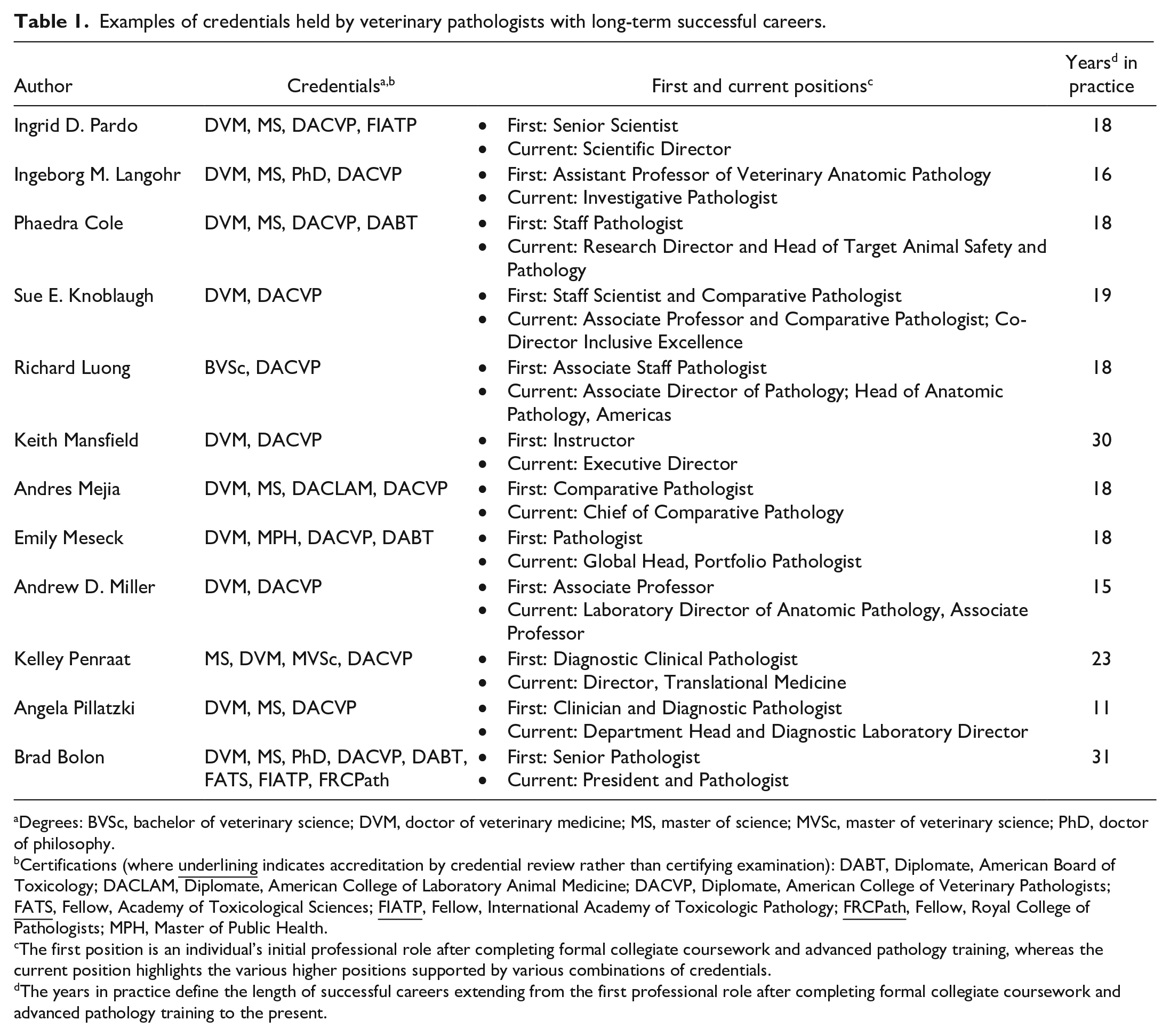
Degrees: BVSc, bachelor of veterinary science; DVM, doctor of veterinary medicine; MS, master of science; MVSc, master of veterinary science; PhD, doctor of philosophy.
Certifications (where
The first position is an individual’s initial professional role after completing formal collegiate coursework and advanced pathology training, whereas the current position highlights the various higher positions supported by various combinations of credentials.
The years in practice define the length of successful careers extending from the first professional role after completing formal collegiate coursework and advanced pathology training to the present.
Panelists agreed that the minimum credentials needed to assure entry into the veterinary pathology profession are a veterinary medical degree (DVM or equivalent) and completion of in-depth pathology training (an intensive formal residency training program and/or equivalent on-the-job training and experience). A veterinary medical degree is an essential foundation of basic biology and applied comparative biomedical sciences whereas several years of hands-on pathology training with one or more experienced mentors provide training that yields skills in pattern recognition and comparative pathology and the practical background needed for acceptable performance as an entry-level pathologist (ie, a pathologist who has started a new role with minimal experience in a specific pathology field). A residency training program that provides exposure to wide depth and distribution of species and high case numbers is ideal as this is often the most accessible and appropriate way to prepare for a career as a veterinary pathologist. These 2 basic credentials, a veterinary medical education and in-depth advanced pathology training, are a reliable route to a career in pathology, providing ample scope for pathology employment and subsequent advancement. Rarely, other pathways, such as an advanced degree in comparative or experimental pathology or a physician degree in lieu of a veterinary medical degree, can provide an “alternate track” for veterinary pathology work, but these pathways are less commonly followed now than they were in the latter half of the 20th century.
Pathology certification in anatomic or clinical veterinary pathology (eg, diplomate of the ACVP [DACVP] or equivalent) offers evidence by formal examination that essential basic and applied knowledge in medicine and pathology has been acquired to permit day 1 competency or entry-level proficiency as a pathologist. Moreover, formal certification in pathology typically provides the possessor with additional flexibility in selecting among varied positions when designing a career path. Comparable pathology certifications by examination are offered by similar organizations in other parts of the world (eg, European College of Veterinary Pathologists [DECVP], European College of Veterinary Clinical Pathology [DECVCP], Japanese College of Veterinary Pathologists [DJCVP], Royal College of Pathologists [Member of the RCPath]). Credentials are also available to veterinary pathologists in various pathology subspecialties. For example, individuals who practice toxicologic pathology may obtain national certifications by examination (eg, Indian Board of Toxicologic Pathology [DIBTP], Japanese Society of Toxicologic Pathology [DJSTP]) or seek a global accreditation via credential review by experienced peers (Fellow of the International Academy of Toxicologic Pathology [FIATP]).
The educational path to a pathology career is both long and arduous. Veterinary medical degrees usually take from 5 years (bachelor of veterinary science [BVSc]) to 8 or more years (DVM with prerequisite bachelor’s degree). Thereafter, individuals may choose to obtain one or more additional credentials beyond their initial veterinary medical degree and pathology certification. Graduate degrees in science (MS, master’s of public health [MPH], and/or PhD or their equivalents) may be pursued to develop specific expertise and/or to formally affirm scientific research expertise. Some who want additional experience in a pathology specialty niche such as comparative pathology may also obtain a 1-year or 2-year fellowship. For some employment settings, pathologists need to obtain a graduate degree (MS or ideally PhD) as many academic institutions and some companies require pathologists to have advanced biomedical research training to fill research-centric positions, although 1 current panelist proved the exception to this “rule.” Research-centered degrees (MS and/or PhD) are required for investigative and/or academic positions in several countries around the world, especially in Latin American countries. In general, MS degrees take 2–3 years to complete whereas PhD degrees take 3–5 years if not longer in some instances. Completion of formal residency training programs that are required to qualify for the ACVP certifying exams in clinical or anatomic pathology generally necessitates 3 years of training. The ACVP requires 36 months of training in the “classical” residency route as one of the main qualifications for the phase II exam (48 months of training are required for the alternate track). When undertaking a program that combines residency training and a PhD, an individual’s pathology training may be a commitment of 6 or more years.
Board certification credentials in allied fields like laboratory animal medicine (eg, diplomate of the American College of Laboratory Animal Medicine [DACLAM]), poultry medicine (eg, diplomate of the American College of Poultry Medicine [DACPV]), preventive medicine (eg, diplomate of the American College of Veterinary Preventive Medicine [DACVPM]), or toxicology (eg, diplomate of the American Board of Toxicology [DABT] or American Board of Veterinary Toxicology [DABVT]) might be attained to deliver additional flexibility and opportunities in choosing among career options, incorporating, but not limited to, veterinary pathology activities such as positions in drug development, program management, or specialized aspects of pathology education. In particular, American Board of Toxicology (ABT) certification provides a special asset to pathologists working as study directors, project managers, or drug safety representatives in drug development teams. Following initial credentialing by examination, individuals holding ACVP 2 (beginning in 2016), American College of Laboratory Animal Medicine, and American Board of Toxicology 3 certifications require periodic renewal of their credential through maintenance tasks such as continuing education, professional service, presentations and publications, and other required activities. In contrast to attaining a credential by examination, certain qualifications may be achieved by credential review (eg, FIATP) and, as such, require time and due care to engage in career-building opportunities (consistent continuing education, institutional leadership roles, professional society membership, etc) that would fulfill the required qualifications.
The pursuit of additional credentials depends on other factors besides career flexibility. Key considerations in this regard include cost (such as funding to pursue a graduate degree, which can be cyclic), fatigue (scholastic “burnout”), and work–life harmony. Educational endeavors are expensive, and the cumulative financial debt incurred when pursuing undergraduate and veterinary medical degrees is a substantial impediment to pursuing additional credentials that might compound and/or add to existing debt, especially if the credentials do not offer a high likelihood of better-paid positions in the intermediate (and ideally short) term. Similarly, educational endeavors needed to obtain credentials might impose extended financial and other stressors that impact the individual’s health and transiently diminish hope of enjoying a vibrant personal life and/or achieving other major life milestones (eg, purchasing a home, starting a family). This latter point is especially true of those credentials in which the proof of educational success involves passing a comprehensive certifying examination (eg, DACVP, DACLAM) rather than obtaining accreditation by credential review (eg, FIATP) or by examination that requires professional experience (DABT). Pathology credentials from other parts of the world are sometimes preferred to support ex-US activities as such regional qualifications might be more familiar to local regulatory or health authorities.
The impact of credentials beyond veterinary pathology board certification may be enhanced or even superseded by an individual’s scientific curiosity and pursuit of professional continuing education opportunities. For example, developing expertise through self-study followed by targeted presentations and publications in a specific field or organ system may result in professional recognition that extends the value of one’s degrees and credentials. Behavioral attributes such as friendliness, good work ethic, collaboration and teambuilding, excellent skills in communication (written and oral) and leadership, and a positive attitude as well as intellectual attributes like critical thinking and problem-solving are highly desirable traits for all employers. As such, these qualities should be honed by all pathologists so that they can be demonstrated readily during both casual networking events and formal interviews. One panelist (KM) noted that individuals should remain curious, embrace scientific and technical advances while keeping an appropriate level of skepticism, and above all seek fun in everyday work activities. In the end, the panelists agreed that these above qualities that illustrate one’s character in association with proven productivity (ie, a demonstrated ability for hard and meaningful work) are the most important criteria for career success as a veterinary pathologist, regardless of one’s other credentials.
In summary, the list of letters after one’s name provides an easily recognizable shorthand regarding an individual’s prior education and training in pathology and affiliated fields. The letter string need not be long to gain entry to initial positions as employability is still mainly tied to such factors as formal education, experience, interviews, and references. More letters may provide additional flexibility and opportunities in charting a multifaceted career that is likely to change course over one’s professional life. That said, a lifelong commitment to education, integrity, and productivity (personal and communal) are the surest predictors of an enjoyable, flexible, and fruitful pathology career.
Footnotes
Acknowledgements
We thank Dr Rachel Peters (Sanofi) and Dr Jim Fikes (Biogen Inc) for critically reviewing and providing comments on this manuscript. We also want to thank our family members for patiently supporting us while we were pursuing our different degrees and certifications.
Declaration of Conflicting Interests
The author(s) declared no potential conflicts of interest with respect to the research, authorship, and/or publication of this article.
Funding
The author(s) received no financial support for the research, authorship, and/or publication of this article.
Disclaimer
The views and opinions expressed in this Commentary are those of the authors and do not necessarily reflect the perspective of their employers or of the American College of Veterinary Pathologists.
