




Abstract
The first continental European association for veterinary pathologists was founded in 1951 as the Arbeitsgemeinschaft der Veterinärpathologen (AG-Vetpath), bringing together veterinary pathologists from Germany, several European countries, and the United States. Yearly meetings were held in conjunction with the Deutsche Gesellschaft für Pathologie (DGP). Although the majority of DGP members were human pathologists, veterinary pathologists had been using the DGP as a forum for scientific exchange since the early 20th century. Renamed in 1969 as the Europäische Arbeitsgemeinschaft für Veterinärpathologen, and in 1974 as the Europäische Gesellschaft für Veterinärpathologie, the AG-Vetpath finally received its present name, the European Society for Veterinary Pathology (ESVP) in 1994. In parallel, national organizations for veterinary pathologists in European countries have also evolved over the years, the earliest being in Germany with the Fachgruppe Allgemeine Pathologie und pathologische Anatomie of the Deutsche Veterinärmedizinische Gesellschaft (DVG). AG-Vetpath represents the parent organization for further specialty organizations like the Gesellschaft für Toxikologische Pathologie (GTP) or the Arbeitskreis Diagnostische Veterinärpathologie (AKDV). Even the European College of Veterinary Pathologists (ECVP) was founded by members of ESVP.
Keywords
In 2021, the European Society for Veterinary Pathology, founded in Hannover as the Arbeitsgemeinschaft der Veterinärpathologen, will celebrate its 70th anniversary. Although the first veterinary school was founded in Lyon in 1762 to be followed by schools established in other European countries, veterinary education only became a university faculty during the early 20th century. Veterinary pathology, which consisted mainly of the dissection or zootomy of animals, was included in the curriculum of early veterinary schools in order to train students to better diagnose epidemic diseases harmful to humans and animals and to enable them to deal with forensic cases. 6,25
The first chairs in veterinary pathology were created in Berlin (1870) for Wilhelm Schütz, in Munich (1874) for Otto von Bollinger, in Hannover (1875) for Christian F. Rabe (1837–1898), in Dresden (1876) for Albert Johne (1839–1910), in Zurich (1886) for Erwin Zschokke (1855–1929), and in Giessen (1901) for Adam Olt (1865–1955). Thus, at the turn of the 20th century veterinary pathology as an academic discipline was rather young compared to human pathology. When, in 1897, the Deutsche Pathologische Gesellschaft (DPG) emerged as a scientific society independent from the Gesellschaft Deutscher Naturforscher und Ärzte (GDNÄ; Society of German Scientists and Physicians founded in 1822), Rudolf Virchow was elected as the first chairman and acted in this capacity up to his death in 1902. He strongly promoted the cooperation of human and veterinary pathology under the rubric later called “One Health—One Medicine.” For example, in speeches given before the Prussian parliament in 1872 and 1873, he stated: “I can only emphasize that there is no scientific barrier, nor should there be, between veterinary medicine and human medicine; the experience of one must be utilized for the development of the other.” 22,30 And indeed, at meetings of the DPG, veterinary pathologists found the only forum for interdisciplinary scientific exchange with human pathologists until 1951.
The aim of the present report is to provide details on the history of organizations for veterinary pathologists.
Sources of Information
One of the earliest sources for this review of the history of veterinary pathology organizations in Europe are the annual proceedings of the DPG meetings, published as hardcover books, as required by the DPG by-laws. Called Verhandlungen der Deutschen Pathologischen Gesellschaft (1898–1944) and Verhandlungen der Deutschen Gesellschaft für Pathologie (1948–present), respectively, they contain the meeting programs, full texts of the keynote lectures, and abstracts of the other presentations including summaries of the discussions following the presentations. In addition, minutes of the yearly business meetings, obituaries of deceased members, and an index of members with their affiliation were published. These volumes are an invaluable record of the history of the DPG/DGP (Deutsche Gesellschaft für Pathologie) and their members.
Although the DPG/DGP by-laws required yearly meetings, no meetings took place due to war and postwar recovery from 1915 to 1920, from 1939 to 1943, and from 1945 to 1948. No detailed minutes of the foundation meeting of the Arbeitsgemeinschaft der Veterinärpathologen (AG-Vetpath) in 1951 have been passed down by early members. Thus, the history of the foundation and the early days of the AG-Vetpath have to be based on reports of the first meetings edited by Harro Köhler (1918–2005, Hannover and later Vienna), the first secretary of the AG-Vetpath, and published in the Berliner und Münchner Tierärztliche Wochenschrift, Zentralblatt für Allgemeine Pathologie und Pathologische Anatomie, Deutsche Tierärztliche Wochenschrift, Monatshefte für Veterinärmedizin, Schweizer Archiv für Tierheilkunde, and Wiener Tierärztliche Monatsschrift. 16 –21
Situation Prior to the Foundation of Arbeitsgemeinschaft der Veterinärpathologen (AG-Vetpath)
Rudolf Virchow strongly encouraged veterinary pathologists to join the newly founded DPG in 1897. Robert von Ostertag (1864–1940) 11 and Wilhelm Schütz (1839–1920) were both professors at the Tierärztliche Hochschule Berlin, Otto von Bollinger (1843–1909) was professor for comparative pathology at the Universität München, and Friedrich Lüpke (1835–1929) was professor at the Tierärztliche Hochschule in Stuttgart. 10 These leading veterinary pathologists followed Virchow’s advice and were among the 129 participants of the first DPG scientific meeting in Düsseldorf, Germany, in 1898. However, Theodor Kitt (1858–1941) never joined the DPG although he was professor at the veterinary school in Munich and at the turn of the 20th century one of the best known and respected veterinary pathologists in the German-speaking world. Somewhat later, but before World War I, more veterinary pathologists like Ernst Joest (1873–1926), professor for veterinary pathology in Dresden, Germany, and August Eber (1865–1937), director of Tierseucheninstitut (Institute for Animal Plagues) in Leipzig, Germany, also joined the DPG. 33
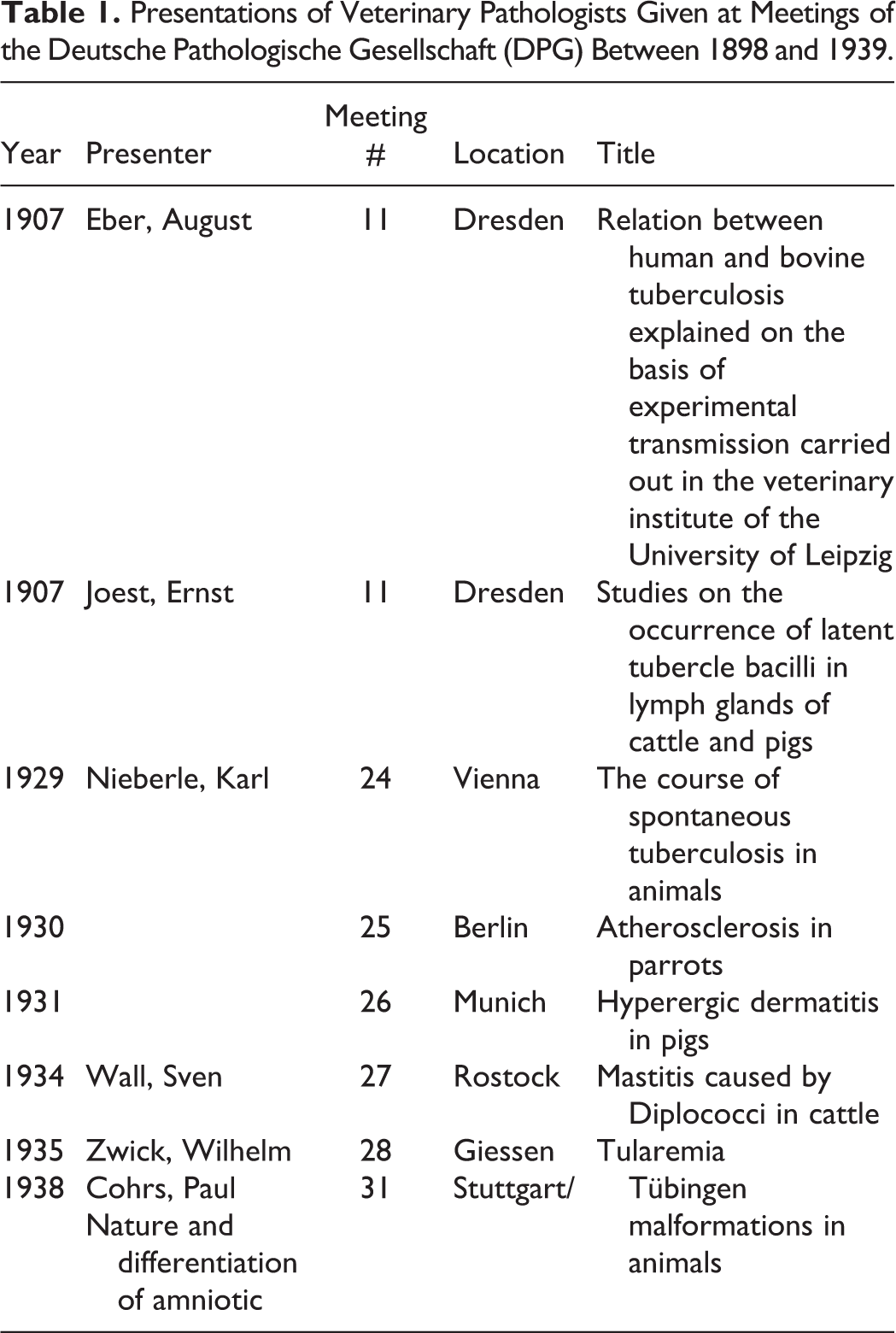
From the 1920s until 1939, a number of German and European veterinary pathologists became DPG members (Supplemental Table S1) and presented their research as oral communication at DPG meetings between 1907 and 1938 (Table 1). They predominantly contributed on topics dealing with infectious diseases and inflammation; no oncologic research was presented.
Presentations of Veterinary Pathologists Given at Meetings of the Deutsche Pathologische Gesellschaft (DPG) Between 1898 and 1939.
The National Socialist regime in Germany in 1934 forced the DPG to revise its by-laws, and as a consequence, elections and resolutions were subject to government approval. Under this directive the Nazi government enforced its anti-Semitic policy. This implied that during the following years a total of 89 DPG members, 67 of them for anti-Semitic reasons, were either evicted from the DPG or forced to leave the society “voluntarily.” Seventy percent of them decided to emigrate to various countries, mainly the United States or the United Kingdom. Of the 24 DPG members who decided not to leave Nazi-Germany, 5 were later killed in a concentration camp and 2 committed suicide. No veterinary pathologist belonged to this group. 7,9,15 Philipp Schwartz (1894–1977), one of the early-exiled DPG members, founded an organization called Notgemeinschaft deutscher Wissenschaftler im Ausland (Emergence Association for German Scientists Abroad). Its goal was the placement of job seekers in exile. Coincidentally, the Turkish president Kemal Ataturk (1881–1938) had started implementing far-reaching reforms aiming at westernizing society in Turkey. In 1933, Turkish universities were reformed, opening up chances for exiled DPG members. Schwartz and others were referred to the University of Istanbul. Furthermore, during the mid-1930s Rudolf Baumann (1897–1961), later one of the early members of the AG-Vetpath (Supplemental Table S2) and professor for veterinary pathology at the veterinary school in Vienna, simultaneously acted as professor for veterinary pathology at the pathology department of the newly established veterinary faculty of the Agricultural College in Ankara, Turkey, from 1936 to 1937. He helped organize the department and demonstrated methods for teaching his discipline. 31
World War II brought a further development of the DPG and European veterinary pathology to a halt.
Foundation of Arbeitsgemeinschaft der Veterinärpathologen (AG-Vetpath) at Hannover in 1951
The DPG underwent a reset at its 32nd meeting, held in Düsseldorf in 1948. By changing the by-laws and renaming itself Deutsche Gesellschaft für Pathologie (DGP; German Society for Pathology) it instantaneously shed its Nazi image.
At the same time, Paul Cohrs was left to pick up the pieces of veterinary pathology in the postwar era. 4 During the 33rd DGP meeting, held in Kiel in 1949, he started to discuss a plan for establishing separate meetings for veterinary pathologists among others with his Swedish colleague Sven Rubarth (1905–1996), who happened to have presented a talk on a newly recognized viral disease in dogs. 28 Rubarth, who had described this disease for the first time in 1947, called it hepatitis contagiosa canis (HCC). 29 As reported in the Verhandlungen Deutsche Gesellschaft Pathologie, Rubarth's presentation was received with great interest, with the importance of his findings being discussed with respect to viral etiology and relevance for comparable human diseases by the human pathologists Franz Büchner, Richard Bieling, and Herbert Siegmund. 28
At the DGP meeting in Kiel, Cohrs probably contacted the acting DGP president Georg Benno Gruber, who, having worked as a postdoc researcher with Otto von Bollinger in Munich, fully understood and supported veterinary pathology and Cohrs’ ideas. As a result Cohrs invited German and international veterinary pathologists to hold a satellite meeting at the Institute of Pathology of the Tierärztliche Hochschule (Veterinary School) in Hannover in connection with the 35th DGP meeting in 1951.
He opened this first meeting of veterinary pathologists and welcomed participants from East Germany and West Germany and from neighboring European countries. Expressing special thanks and a warm welcome to Georg Benno Gruber as acting DGP president and greeting Professor Julius Hallervorden (1882–1965), the chairman of the association of neuropathologists, and a number of other human pathologists attending the meeting.
No detailed list of participants of the first meeting is available. However, a minimum number of 27 active participants (19 veterinary and 8 human pathologists) can be calculated from the published conference report, where speakers (n = 11) and debaters (n = 19) are listed. The majority of them (n = 21) came from Germany including East Germany, 3 from Austria, and 3 from Sweden.
The main topic on the agenda of the meeting, in addition to the scientific presentations, was the proposal to found an association of veterinary pathologists to be called the Arbeitsgemeinschaft der Veterinärpathologen (AG-Vetpath) with the following goals: To organize regular (yearly) meetings in connection with the DGP for the exchange of practical knowledge, scientific findings, and to discuss unsolved problems. To find a basis for statistical and scientific management. To encourage and promote veterinary students to choose a career in veterinary pathology as well as to optimize career tracks for them and for already established veterinary pathologists.
The participants adopted the proposal and its goals, and then elected Paul Cohrs as chairman of the AG-Vetpath. He accepted his elected office on condition that this duty would be restricted to a 1-year period. Later, the members of the AG-Vetpath convinced Cohrs to serve for a total of 3 terms. In this way he was able to finish the process of forming the AG-Vetpath. The attendees asked Harro Köhler (Hannover) to act as secretary/treasurer. Cohrs invited the attendees to apply for membership and encourage other veterinary pathologists to do the same until the next meeting. In addition, he asked the attendees to advertise the next meeting and send proposals for any topics to his institute’s address.
The scientific program of the first meeting of the AG-Vetpath covered diseases of a wide range of species including dogs (8), cattle (3), horses (1), birds (2), pigs (2), and other species (1). The following topics were discussed: infectious diseases (6); degenerative diseases (4); inflammatory diseases (3); statistics of pathologic findings (1), and central nervous system disease (1). Case demonstrations were presented on degenerative (4) and inflammatory diseases (3).
Köhler, acting as secretary, prepared a report on the meeting containing a short account of the discussions accompanying the foundation of the group and abstracts of the scientific presentations. To advertise the formation of the AG-Vetpath as widely as possible, identical reports were published in the veterinary journals mentioned above. 16 –21
At the general DGP meeting held during the 35th meeting in Hannover in 1951, members agreed to hold future meetings of the DGP jointly with AG-Vetpath, as proposed by the acting DGP president Georg Benno Gruber. 26 This agreement lasted until 2007.
The official foundation of the AG-Vetpath took place during the second meeting in Freiburg/Breisgau, Germany, in June 1952. Cohrs was formally elected president and Köhler secretary/treasurer.
A total of 51 members (3 females, 48 males) from Germany (37 including 11 from the DDR), Yugoslavia (1), the Netherlands (1), Austria (1), Sweden (2), Turkey (2), and the United States of America (1) had followed Cohrs’ invitation to apply for membership (Supplemental Table S2).
One of the international members of the AG-Vetpath deserves special attention. Mashar Üveis (1900–1982) from Turkey studied veterinary medicine at the Military Veterinary Academy in Istanbul and received postgraduate training in veterinary pathology, studying with Theodor Kitt in Munich and Ernst Joest in Dresden/Leipzig. Finally, he received a degree of Dr. med. vet. from the Tierärztliche Hochschule, Berlin, submitting a thesis titled “Zur Kenntniss des Lanzettegelbefalles der Schafleber(On the infestation of the sheep liver with the lancet liver fluke (Dicrocoelium dendriticum)” (summa cum laude) in 1928. 2 Having left the Turkish military veterinary service, he joined the Cancer Research Institute at the University of Istanbul. 3 The head of this institute was Siegfried Oberndorfer (1876–1944), one of the exiled Jewish human pathologists from Munich. Oberndorfer, who had studied with Otto von Bollinger in Munich, thought highly of veterinary pathologists. 7,9 The working environments of the majority of AG-Vetpath members were universities (27), veterinary diagnostic laboratories (9), research institutions (7), and the chemical-pharmaceutical industry (2) (Supplemental Table S2).
No photographs of the first or second meetings of the AG-Vetpath are available; however, there is a group picture taken at the 3rd meeting in Marburg in 1953 (Fig. 1) and a series of others taken at the 4th meeting in Hamburg 1954 (Figs. 2, 3); all photos taken by Erwin Dahme, Munich.
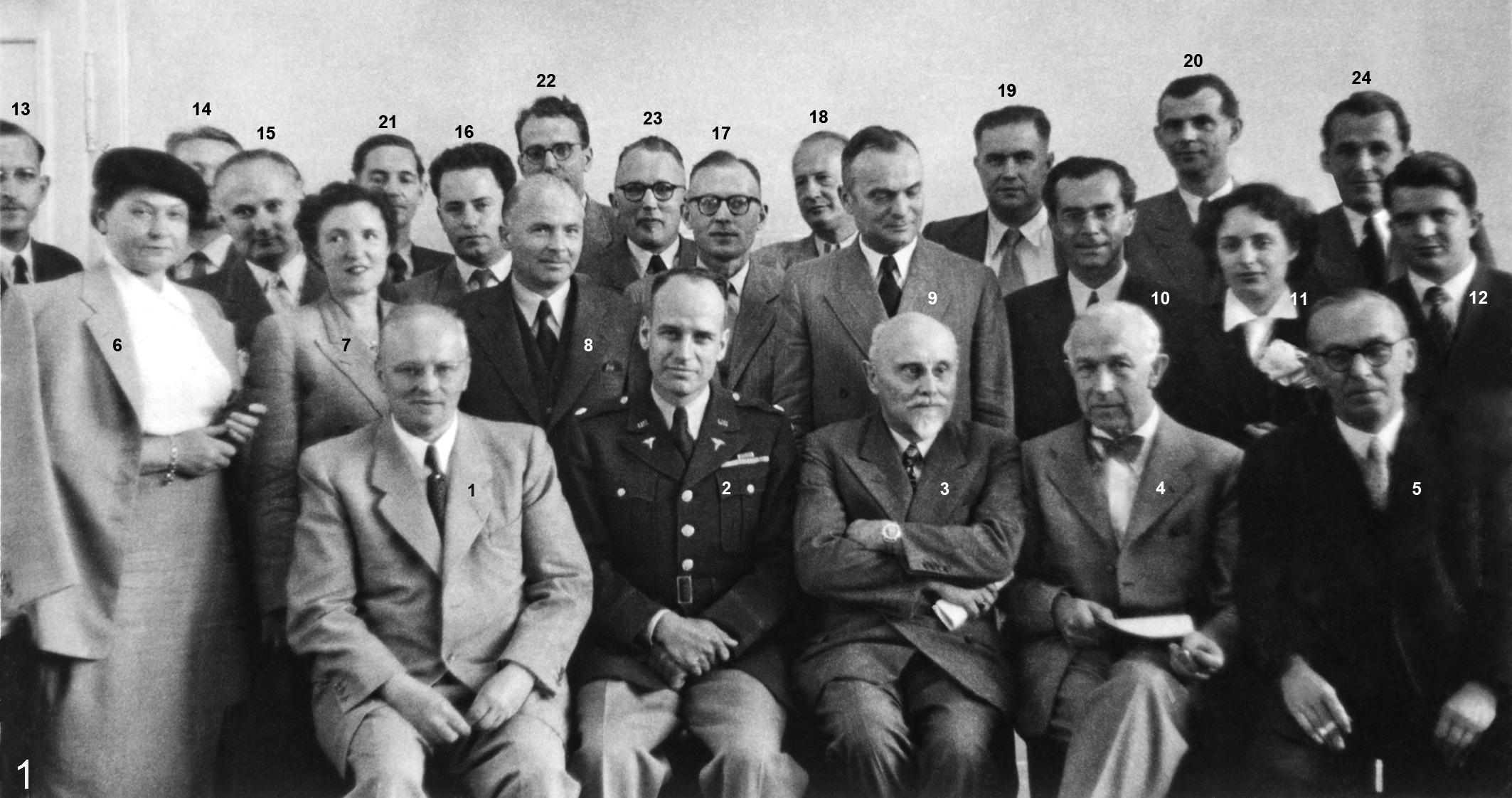
Group picture taken at the 3rd meeting of Arbeitsgemeinschaft der Veterinärpathologen (AG-Vetpath) in Marburg, Germany (1953). 1: Cohrs, P., Hannover; 2: Jones, T. C., AFIP; 3: Frei, W., Zurich; 4: Hjärre, A., Stockholm; 5: Dobberstein, J., Berlin; 6: ?; 7: ?; 8: Oettel, H., BASF Ludwigshafen; 9: Sedlmeier, H., Munich; 10: Kretzschmar, ?; 11: ?; 12: Messow, C., Berlin; 13: König, H., Bern; 14: Fankhauser, H.-R., Bern; 15: Godglück, G., Berlin; 16: Flir, K., Berlin; 17: Lüpke, F., Tübingen; 18: Jakob, H., Berlin; 19: Renk, W., Berlin; 20: Potel, K., Leizig; 21: Schulte, F., Bonn; 22: Löliger, H. C., Celle; 23: Fritzsche, K., Koblenz; 24: Köhler, H., Hannover.
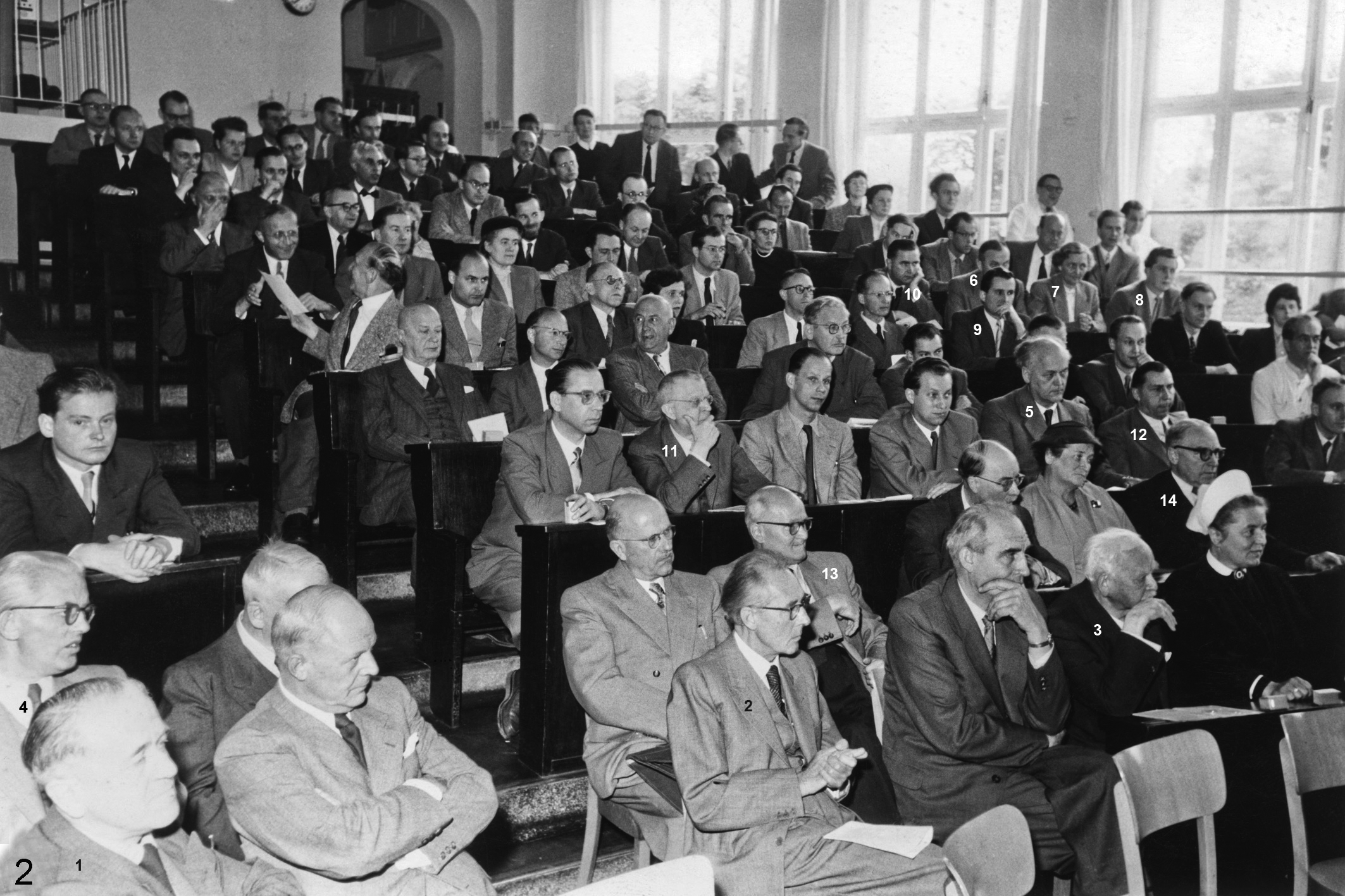
Opening of the 38th DGP meeting in Hamburg, Germany (1954). 1: Krauspe, C., Hamburg; 2: Froboese, K., Berlin Spandau; 3: Nonne, M., Hamburg; 4: Boehmig R., Strassburg; 5: Frauchiger, E., Bern; 6: Sedlmeier, H., Munich; 7: Gylstorff, I., Munich; 8: Dahme, E., Munich; 9: Köhler, H., Hannover; 10: Renk, W., Berlin; 11: Hallervorden, J., Giessen; 12: Liebegott, G., Wuppertal; 13: Bredt, H., Leipzig; 14: Pette, H., Hamburg.
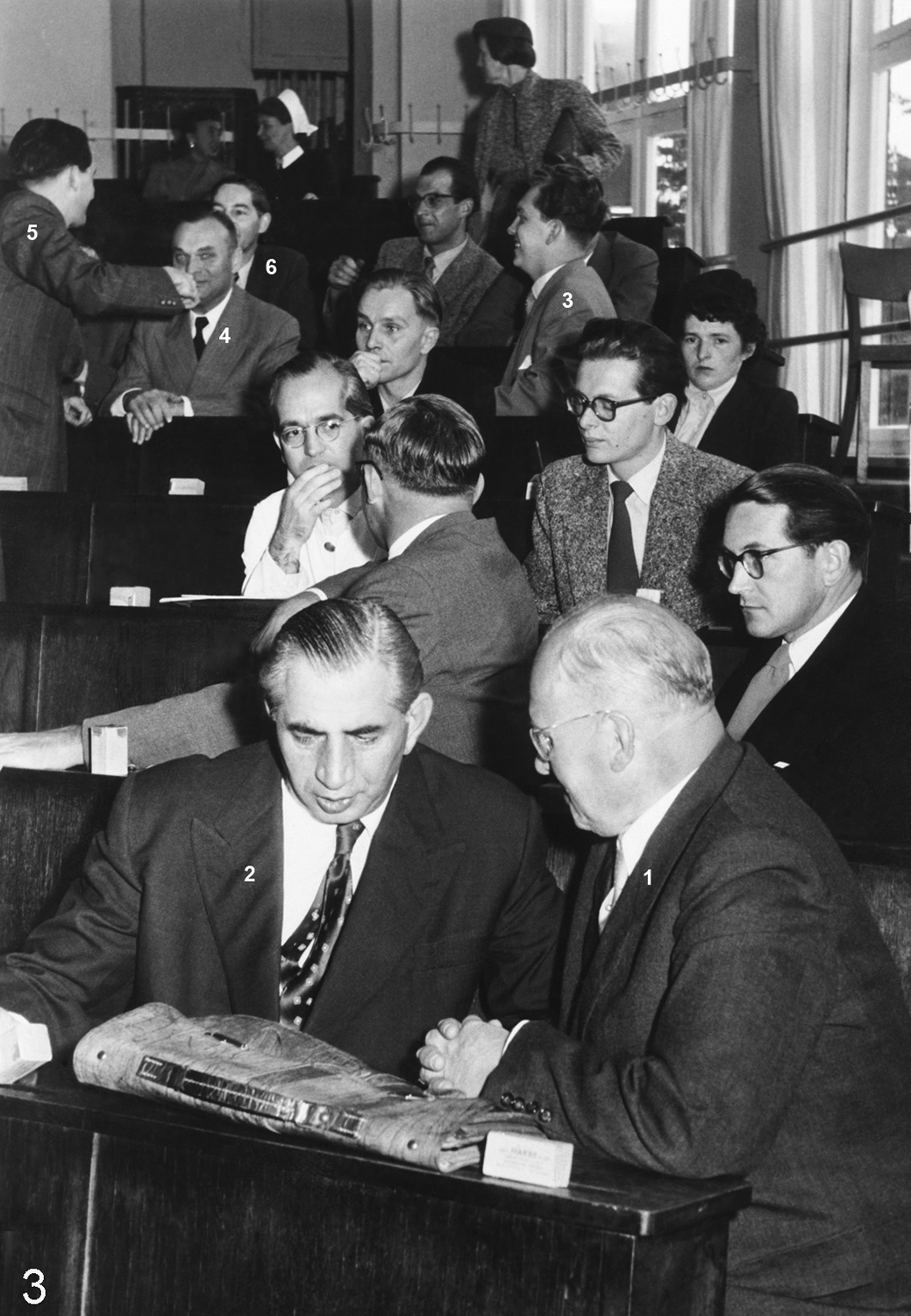
4th meeting of Arbeitsgemeinschaft der Veterinärpathologen (AG-Vetpath) in Hamburg, Germany (1954). 1: Cohrs, P., Hannover; 2: Sengir, E., Ankara; 3: Dahme, E., Munich; 4: Sedlmeier, H., Munich; 5: Köhler, H., Hannover/Vienna; 6: Schulte, F., Bonn.
Discussion
The foundation of the Arbeitsgemeinschaft der Veterinärpathologen (AG-Vetpath) appears to have been the first European association for veterinary pathologists independent from a professional and scientific human pathology association.
The first meeting of the AG-Vetpath in 1951 took place only 6 years after the end of World War II and brought veterinary pathologists with interesting biographical differences together. There were former members of the NSDAP, such as Paul Cohrs, 32 Hans Sedlmeier, 1 and Georg Pallaske 37 who met with, among others, T. C. Jones, a high-ranking officer of the victorious US Army; Jan Hendrik ten Thije, a Dutch veterinary pathologist who as a member of Dutch resistance saved Jewish students from being caught by Nazi police during the German occupation of the Netherlands; and Walter Frei from Zurich who never concealed his strong anti-Nazi opinions (P. A., Koolmees, personal communication, 2020). 24 Additionally, there were members from East Germany, where in 1949 the communist DDR had been established. According to the records, these different backgrounds did not interfere with their collaboration on veterinary pathology.
From 1951 the newly founded association for veterinary pathologists (AG-Vetpath/ESVP) proved to be successful, the membership steadily increased from n = 53 in 1952 to n = 602 in 2000 (Supplemental Table S3). Over the years AG-Vetpath/ESVP became attractive to veterinary pathologists from several European countries. As consequence, the number of non–German speaking members of the AG-Vetpath increased from 13% in 1952 to 43% in 1993. In consideration of the changes in membership nationalities Ag-Vetpath first change its name to the Europäische Arbeitsgemeinschaft für Veterinärpathologen in 1969, and later, in 1974, to the Europäische Gesellschaft für Veterinärpathologie (EGVP). However, the conference language remained German and was only changed to English in 1994 after a test with a series of biannual ESVP autumn meetings starting in 1970 and held in English (Fig. 4). Subsequently, in 1994 the name was changed to the European Society for Veterinary Pathology (ESVP). As a consequence, the number of members increased from 383 in 1992 to more than 600 in 2000 (Supplemental Table S3).
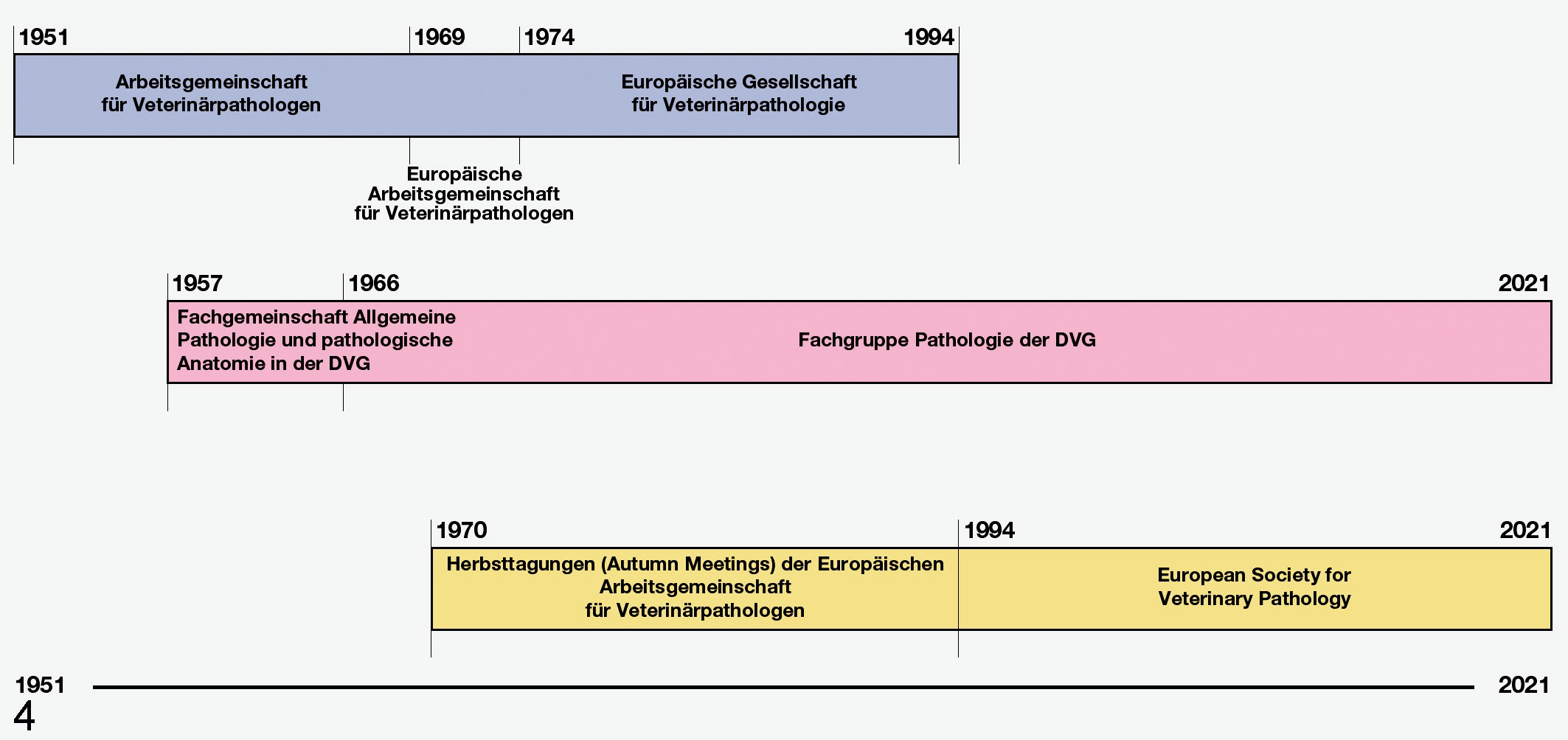
Development of Arbeitsgemeinschaft der Veterinärpathologen (AG-Vetpath) to European Society for Veterinary Pathology (ESVP) and Fachgemeinschaft Allgemeine Pathologie und pathologische Anatomie (DVG) from 1951 to 2021.
Since the early days of the AG-Vetpath, the demands of the different working environments of veterinary pathologists (university, research institution, veterinary diagnostic laboratory, and chemical/pharmaceutical industry; Supplemental Table S2) grew as shown by increasing numbers of AG-Vetpath/ESVP members employed by chemical/pharmaceutical companies rising from 13% in 1952 to 25% in 1985. These members requested more presentation time during the yearly meetings. However, the maximum meeting time available due to the cooperation of the AG-Vetpath with the DGP was limited to one and a half days. As a consequence, a number of specialty organizations evolved from the AG-Vetpath like the Gesellschaft für Toxikologische Pathologie (finally the European Society of Toxicologic Pathology, ESTP) in 1986 and the Arbeitskreis Diagnostische Veterinärpathologie (AKDV) in 1993, which was rooted in an earlier organization of diagnostic veterinary pathologists in the DDR (G. Königsmann, personal communication, 2019; W. Thiel, personal communication, 2020).
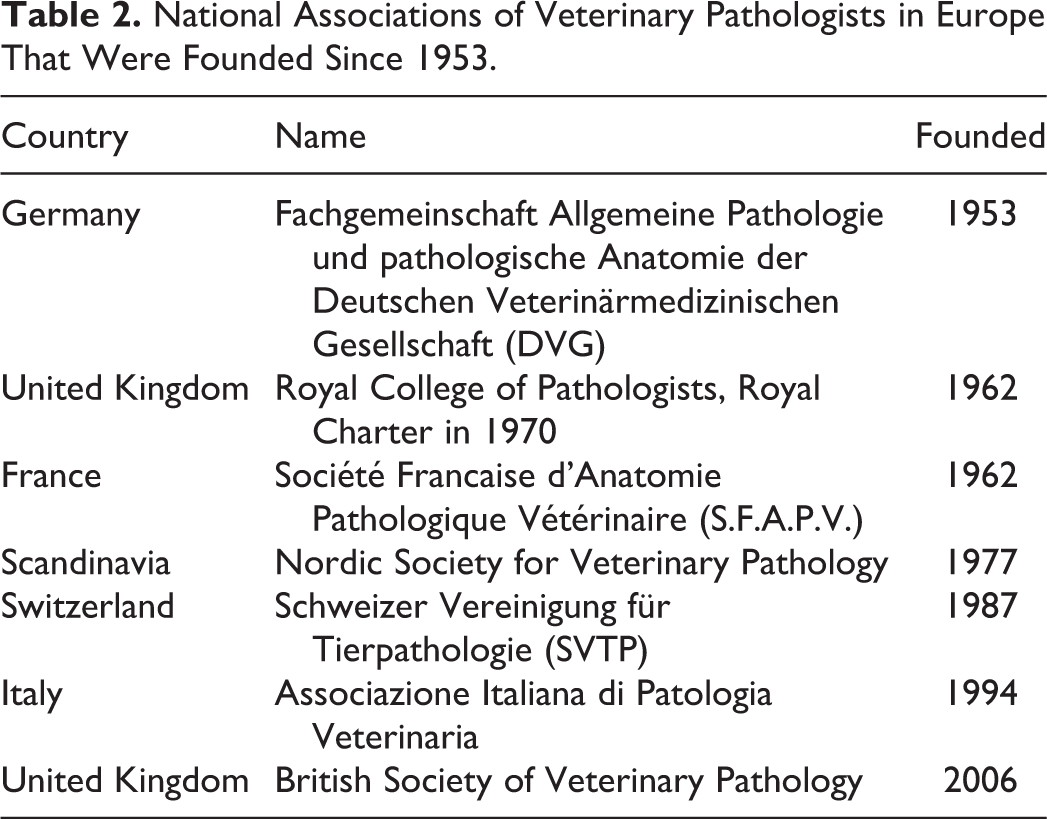
Currently, there are a number of national European societies for veterinary pathology (Table 2). The oldest, the Fachgruppe Allgemeine Pathologie und pathologische Anatomie of the Deutsche Veterinärmedizinische Gesellschaft (DVG), was established as the Fachgemeinschaft Allgemeine Pathologie und pathologische Anatomie, a branch of the DVG in 1953. 8 In 1956, several of the German members of the AG-Vetpath holding a DVG membership joined the Fachgemeinschaft. Only in 1956 did AG-Vetpath decide to hold future meetings as joint events with the Fachgruppe Allgemeine Pathologie und pathologische Anatomie (now called Fachgruppe Pathologie) in collaboration with the DGP. The collaboration of AG-Vetpath and ESVP finished in 1994, whereas the Fachgruppe (DVG) continued its collaboration with the DGP until 2007.
National Associations of Veterinary Pathologists in Europe That Were Founded Since 1953.
No European special qualification for veterinary pathology existed until the late 1960s when a specialist title became more and more important. A growing number of veterinary pathology postgraduates with a year-long in-depth professional training left universities and found positions in chemical-pharmaceutical companies. The companies on one hand increased their research and development activities into new substances and on the other hand were since the early 1970s required to extensively test new and existing substances and compounds prior to official licensing. The number of necessary animal experiments followed by postmortem examination of the experimental animals required large numbers of histopathologic examinations to establish no effect levels of substances. This opened a market niche for veterinary pathologists. However, to be internationally compatible to ACVP diplomates and to prove their special veterinary expertise as an advantage compared to human pathologists and biologists, veterinary pathologists had to have a formal certification of their specialization which did not exist.
Discussions among ESVP members between 1991 and 1994 at the yearly AGMs finally motivated ESVP to start the process of founding the European College of Veterinary Pathologists (ECVP) in 1995. The ECVP followed the example of the American College of Veterinary Pathologists (ACVP) founded in 1948/1949 by Thomas Carlyle (TC) Jones and colleagues, 14 and the Japanese College of Veterinary Pathologists founded in 1991. Today ACVP, ECVP, and JCVP today are the 3 internationally accepted certifying bodies for veterinary pathologists.
Anecdotally, Lt. Colonel TC Jones, while stationed at Landstuhl, West Germany, to serve as Chief of the US Veterinary Department of the Fourth Medical Field Laboratory, became a member of the AG-Vetpath (Fig. 1) and participated in the AG-Vetpath conferences in 1952 and 1953. 12 At the 2nd meeting of the AG-Vetpath, held at Freiburg im Breisgau, Germany, in 1952, he informed members and colleagues about the Registry of Veterinary Pathology attached to the US Armed Forces Institute of Pathology (AFIP), one of the pillars of the foundation of the ACVP. In his presentation, later published in German, Jones elaborated on the role, goal, and importance of the ACVP. 13 However, it took over 40 years until the European Society for Veterinary Pathology (ESVP) finally decided to follow the US example in founding the ECVP.
Supplemental Material
Supplemental Material, sj-pdf-1-vet-10.1177_03009858211002195 - A Short History of the Origins of the European Society of Veterinary Pathology in the Arbeitsgemeinschaft der Veterinärpathologen
Supplemental Material, sj-pdf-1-vet-10.1177_03009858211002195 for A Short History of the Origins of the European Society of Veterinary Pathology in the Arbeitsgemeinschaft der Veterinärpathologen by Andreas Pospischil and Walter Hermanns in Veterinary Pathology
Footnotes
Acknowledgements
The authors are greatly obliged to a number of now deceased colleagues (except for Erwin Dahme) for compiling the extensive documentation of the history of AG-Vetpath and providing it to the authors. In particular, Hans König’s (Bern) extensive compilation proved to be most valuable. A special tribute goes to Marion Hewicker-Trautwein (Hannover) who gave access to Gerhard Trautwein’s (†) (Hannover) meticulously kept archive. Additional information was retrieved from the archives of Walter Frei and Hugo Stünzi, both of Zurich. Joachim von Sandersleben, Munich, and Viggo Gylstorff also contributed valuable documents. Erwin Dahme, Munich, also deserves special mention for supplying photographs of the early history of AG-Vetpath.
Declaration of Conflicting Interests
The author(s) declared no potential conflicts of interest with respect to the research, authorship, and/or publication of this article.
Funding
The author(s) received no financial support for the research, authorship, and/or publication of this article.

References
Supplementary Material
Please find the following supplemental material available below.
For Open Access articles published under a Creative Commons License, all supplemental material carries the same license as the article it is associated with.
For non-Open Access articles published, all supplemental material carries a non-exclusive license, and permission requests for re-use of supplemental material or any part of supplemental material shall be sent directly to the copyright owner as specified in the copyright notice associated with the article.
