






Abstract
An unusual complication of intrathecal broken rod migration into the dural sac following spinal instrumentation is reported. The clinical and radiographic records were retrospectively evaluated for a 49-year-old, morbidly obese woman who presented with walking difficulty and pitching forward posture 11 years after posterior spinal fusion. The radiographs demonstrated a foreign body consistent with a broken spinal rod that had migrated to the midline behind the L6-S1 disc. Because of the persistent symptoms and suspected implant failure, the patient was taken to the operating room for exploration and posterior spinal instrumentation from L1-S1. A round hole in the thecal sac measuring 6 mm in diameter was identified medial and proximal to the L6 pedicle screw. The mobile, broken rod measuring 23 x 5.5 mm inside the thecal sac was removed after durotomy following localization by C-arm fluoroscopy. After removal of the rod and re-instrumentation, the patient’s neurologic symptoms resolved and her back pain was resolved.
Spinal instrumentation has become prevalent to provide stability and allowed improved spinal fusion. Instrumentation failures have been reported as broken rod(s) or screw(s) or implant dislodgement. 1 We report a very unusual complication of intrathecal broken rod migration following lumbosacral spinal instrumentation.
Case Report
A 49-year-old woman visited the orthopaedic office due to severe intermittent back pain of 8 years duration. She had posterior spinal decompression and unilateral instrumented fusion at L5-L6-S1 with posterior lumbar interbody fusion (PLIF) at L5-L6 and L6-S1, which had been performed in 2001 at another institution. Assessment of her pain revealed that 90% was located in the lower back with approximately 10% radiating to her right lower extremity. Her right lower extremity symptoms included migratory and intermittent radiating pain, tingling, and numbness. Physical examination revealed an obese female who could not stand straight and had difficulty walking due to back pain. Motor groups had normal strength except 4/5 in both ankles and extensor hallucis extension bilaterally. Sensation was intact to light touch except for hypoesthesia on the right L4 distribution.
Radiographs demonstrated coronal and sagittal imbalance (C7 plumb: 4.4 cm left to S1 in coronal plane and +17.1 cm in sagittal plane) and lumbar scoliosis of 28° at L1-L5 above the previous instrumented fusion. The right side pedicle screws at L5, L6, and S1 were in good position without halo or breakage. The broken proximal rod at L5-L6 was seen in the midline of the L6-S1 disc. Minimal evidence of posterior bony fusion mass was observed, and the PLIF cages were in a good position (Figs. 1 and 2).

AP and lateral preoperative standing scoliosis radiographs demonstrating L5 to S1 instrumentation with broken hardware and showing a28° coronal curve and a sagittal vertical axis that is 10 mm positive.

Preoperative standing lumbar spine anteroposterior and lateral radiographs.
Intraoperative imaging after prone positioning the patient confirmed the presence of a migratory broken rod at the level of the L4 vertebral body (Fig. 3). A 6 mm dural defect was identified in the area of L6. A durotomy was performed to remove the migratory intradural rod. The 23 x 5.5 mm rod fragment with a small amount of intrathecal hematoma was identified and removed along with the rest of the retained hardware (Figs. 4 and 5). The sac was repaired with a 6-0 Prolene® suture (Ethicon Inc., Bridgewater, NJ). DuraGen® graft matrix (Integra LifeSciences Corp.,Plainsboro, NJ) and DuraSeal™ spine sealant (Covidien, Minneapolis, MN) were applied over the repair. Posterior spinal instrumentation and fusion was performed from L1 to S1 with additional TLIF at L3-L4. The wound was closed in the appropriate fashion and two deep drains were placed.

Radiograph of the lumbar spine after prone positioning in the operating room showed proximal migration of the broken rod.

Durotomy held open with sutures while removing intrathecal rod.
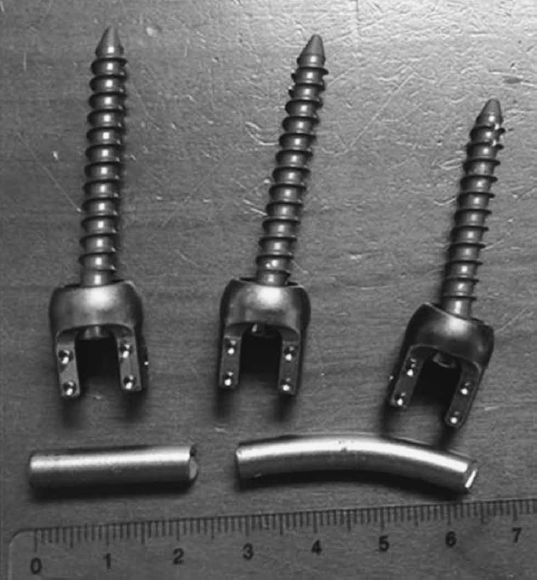
Broken rod after removal.
The patient was kept supine for 48 hours, and the incisions remained clean and dry. She was discharged home with services on postoperative day 7 with no changes in her neurological status but with decreased radicular pain. At her postoperative visits, the patient was doing extremely well. Six months postoperatively she reported minimal lower back pain and no radiating pain to her right lower extremity. Her neurological exam had improved, and she had 5/5 strength in both her lower extremities. Lumbar spine x-rays demonstrated adequate hardware position and visible fusion mass (Fig. 6).

Six months postoperative anteroposterior and lateral lumbar radiographs.
Discussion
Migration of spinal implants to distant sites is rare; there have been several case reports detailing the migration of spinal rods to the lower extremity,2-4 to the pelvis or retroperitoneal space, 5 , 6 and into the cerebellum. 7 , 8 There have been reports of migration of caudal laminar hooks into the spinal canal; some of them causing dural tears. 9 Generally the amount of migration is minimal resulting in proximal and distal movement within the paraspinal soft tissues. 10
Two studies demonstrated the effectiveness of the unilateral instrumentation technique. 11 , 12 Both studies were performed in Asian populations, which in general have lower body mass indexes. This patient had a BMI of 36.7 and could be considered to be morbidly obese. It is interesting to note that unilateral instrumentation might not be strong enough to resist all the mechanical stresses imposed by obese patients.
Conclusions
Intrathecal migration of a broken rod can occur. This rod fragment can be safely removed after a controlled durotomy. Surgeons should be aware of potential migration of a broken rod into the thecal sac.
Footnotes
Conflict of Interest Statement
None of the authors have a financial or proprietary interest in the subject matter or materials discussed, including, but not limited to, employment, consultancies, stock ownership, honoraria, and paid expert testimony.