






Abstract
The use of dried blood spots (DBS) in preclinical studies has seen an enormous increase over the past two years. Despite its positive impact on the 3Rs (reduce, replace and refine), its uptake in exploratory drug discovery has been limited due mainly to protracted method development time in bioanalysis but also the need for small volumes (<20 μL) to be sampled manually. Automatic blood sampling technology such as the DiLab® AccuSampler® is widely used in drug discovery to facilitate exploratory rodent-based pharmacokinetic and pharmacokinetic/pharmacodynamic studies with minimal animal handling. Propranolol was orally administered to a Han-Wistar rat attached to either a standard DiLab® AccuSampler® or a retrofitted unit designed to directly collect the DBS samples. In all, 50 or 20 μL blood samples were then collected via the standard or retrofitted unit, respectively, at six timepoints over a 7 h period. After drying and storage the DBS samples were analysed for propranolol via liquid chromatography-mass spectrometry. In this report we demonstrate that a standard DiLab® AccuSampler® can be easily retrofitted to facilitate automatic dried blood spot sampling and that time–concentration data generated from these samples are equivalent to that from manually spotted samples.
The application of dried blood spots (DBS) in the pharmaceutical industry has seen notable growth in recent years. 1–4 The driving force behind this technology is the desire to not only reduce animal numbers in pharmacokinetic (PK), pharmacokinetic/pharmacodynamic (PK/PD) and toxicokinetic (TK) studies but in addition, refine the methods in which blood is collected for exposure determination. Rodent-based PK studies are a pivotal assay in exploratory drug discovery as it is invariably the first in vivo study that is performed in the project's lifetime and as such often determines a go/no-go decision for a particular compound. This go/no-go decision will usually be based around whether said compound exhibits desirable PK parameters (CMax, area under the curve [AUC], t 1/2, etc), which are calculated from the time–concentration profiles. Traditionally, these profiles are performed by bioanalytical extraction and measurement from plasma (acting as a surrogate for whole blood) as plasma is generally considered to be easier to store and handle; however examples in the literature have demonstrated that analysis of whole blood, collected as DBS, is a viable alternative to plasma in discovery PK 2,4 and in the case of compounds that suffer from enzymatic or chemical instability can be a distinct advantage. 5
The use of automated blood sampling (ABS) using technology such as the DiLab® AccuSampler® has been established for a number of years within the pharmaceutical industry with literature examples demonstrating the reduction in stress observed by animals during the sampling process (corticosterone measurement as a biomarker of stress) and highlighting the improvement in animal welfare. 6–8 The automated sampling refines animal use as the animals do not need to be handled after initial dose administration. Blood volumes are collected via cannulation of the carotid artery and aliquoted into individual tubes that are stored at reduced temperature (typically ca. ∼4°C) for the duration of the study. Stabilizing agents can be added to the tubes in advance to reduce any chemical or enzymatic instability associated with the analytes of interest and then the plasma can be liberated from the blood via centrifugation. The disadvantages of this approach however are that certain stabilizations are more effective in plasma than whole blood (e.g. pH adjustment for stabilizing phase II metabolites such as acyl glucuronides 9 ) and as a result samples can end up being stored unstabilized as whole blood for extended periods of time before the blood can be processed to plasma. This can be a particular problem if sampling occurs overnight.
We have previously reported a method for performing serial microsampling (∼20 μL per timepoint) in mice, collection of samples as DBS, and demonstrated that superior data can be collected with 66% reduction in animal burden and a refined method of blood collection. 2 This technology has proved invaluable in our hands (particularly with PK/PD studies that use knock-in/knock-out mice); however, the mainstay of exploratory PK in our laboratories is still based on the rat model used in conjunction with ABS via the DiLab® AccuSampler®. In order to facilitate the use of DBS in conjunction with ABS, we retrofitted one of our standard AccuSampler® models in order to collect DBS samples directly to our chosen media, FTA Elute™ Microcards (Figure 1). A single study was designed to compare the time–concentration profile collected from the automated dried blood spot sampling (ADBSS) system to that collected from a standard ABS system from which DBS samples were then manually spotted.
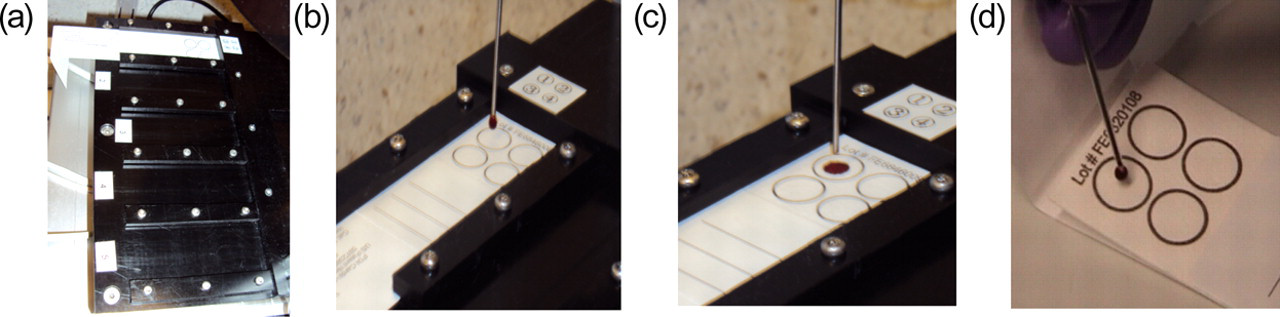
The retrofitted DiLab® AccuSampler® and manual dried blood spot (DBS) preparation. (a) Layout of the modified bed on the AccuSampler®, which allows the automatic collection of up to 20 DBS samples (4 samples per FTA Elute™ Microcard; 5 Microcard capacity). (b) The automatic dried blood spot sampling system about to dispense a 20 μL blood sample into a Microcard. (c) The DBS sample after dispensing. (d) Manual DBS preparation technique from the automatic blood sampling system
All in vivo procedures and studies were performed in compliance with Pfizer Worldwide Research & Development's internal ethical board's guidelines and recommendations. Two wild-type male rats (CRL:WI [Han] Wistar Han IGS [International Genetic Standard], Charles River Laboratories, Margate, UK) weighing approximately 300 g were allowed to acclimatize for five days prior to carotid artery cannulation surgery. After surgery each rat was housed individually with their body weight monitored for seven days with food and water available ad libitum (intake was observed throughout the recovery period). Surgical placement of the cannula was performed under antiseptic techniques by the internal veterinary team. The systemic analgesic carporfen (Rimadyl; Pfizer Internal Purchasing, Sandwich, UK) was administered subcutaneously (1 mL/kg – after dilution 1 to 10 with water) at surgery and again the following morning. Wet mash was given immediately after surgery and then daily until the presurgery body weight had been achieved. Postsurgical recovery was for a period of at least two days.
After surgical recovery, each rat's cannula was checked for patency and flushed with ∼0.25 mL of heparin (50 units). Subsequently, a single rat was attached to the standard ABS AccuSampler®, while a second was attached to the ADBSS AccuSampler®. Both units employed heparinized locking solutions. Each rat was dosed orally with 0.1 mg/kg propranolol (Sigma-Aldrich, Dorset, UK) as a solution in 10% dimethyl sulphoxide in saline and both units were programmed to collected blood samples at 0, 0.25, 0.5, 1, 2 and 7 h time intervals. Propranolol was chosen as the test substance as its pharmacokinetic profile is well understood and as such compound quantification across the 24 h time cross was more likely. 10 During this time each animal had free access to food and water at all times and the light, temperature and humidity were regulated. Upon completion of the study both animals were sacrificed by terminal anaesthesia and cervical dislocation. The ADBSS unit collected 20 μL blood spots direct to FTA Elute™ Microcards (GE Healthcare, Buckinghamshire, UK) while the ABS unit collected 50 μL to individual plastic tubes (pre-treated with K2EDTA). After collection into plastic tubes 20 μL aliquots from the ABS samples were manually spotted onto FTA Elute™ Microcards using 20 μL glass capillaries (Figure 1). All cards were allowed to dry for 2 h under ambient conditions after which time a 3 mm sample punch was taken from each DBS, spiked with 5 μL of 300 ng/mL of propranolol-d3 (as an internal standard) and extracted with 300 μL methanol (10 min, 1000 rpm, ambient conditions). The methanol was evaporated to dryness under nitrogen (40°C) and reconstituted in 100 μL of water/methanol 90/10 v/v. A measure of 40 μL was then analysed by liquid chromatography-mass spectrometry using a ‘fit-for-purpose’ assay to determine the concentration of propranolol in all DBS samples. Samples were quantified against a 10-point calibration line covering the range of 1–500 ng/mL and to demonstrate control during analysis, quality control (QC) samples at three levels (3, 50 and 400 ng/mL, n = 2 at each level) were distributed throughout the analytical run. All calibration standards and QCs were quantified within 20% of their nominal concentration and as such the data were deemed accurate and precise within a non-regulatory environment.
The time–concentration profiles of propranolol for both ABS and ADBSS collection units can be seen in Figure 2. This clearly demonstrates that the quality of DBS spots collected by the retrofitted ADBSS unit is equal to that of DBS prepared manually and that the unit can successfully be used for rat based PK studies collecting low volume 20 μL DBS samples direct to the card. The use of this technology positively impacts in the 3Rs as automated blood sampling refines animal use by removing the need to warm animals and manually handle them in order to collect the blood sample. In addition, sampling as low as 20 μL per timepoint reduces the overall blood volume drawn to as little as 200 μL (for a 10-point PK study over 24 h). These total volumes are well within the recommended guidelines (∼1% of total circulating volume assuming 58 mL/kg) 11 and as such facilitate the re-use of animals in subsequent studies (after an appropriate wash-out period). Additionally, this application allows pharmaceutical projects to start with DBS and remain in this matrix throughout the course of the study, which would result in further welfare benefits in later stage toxicological studies. 3 Immediate collection of samples as DBS also increases the confidence in data interpretation as analytes likely to be chemically or enzymatically unstable are immediately stabilized and as such are less likely to deteriorate. 5 With this increase in confidence surrounding data, studies are less likely to be repeated and hence further reduces animal burden in project progression.
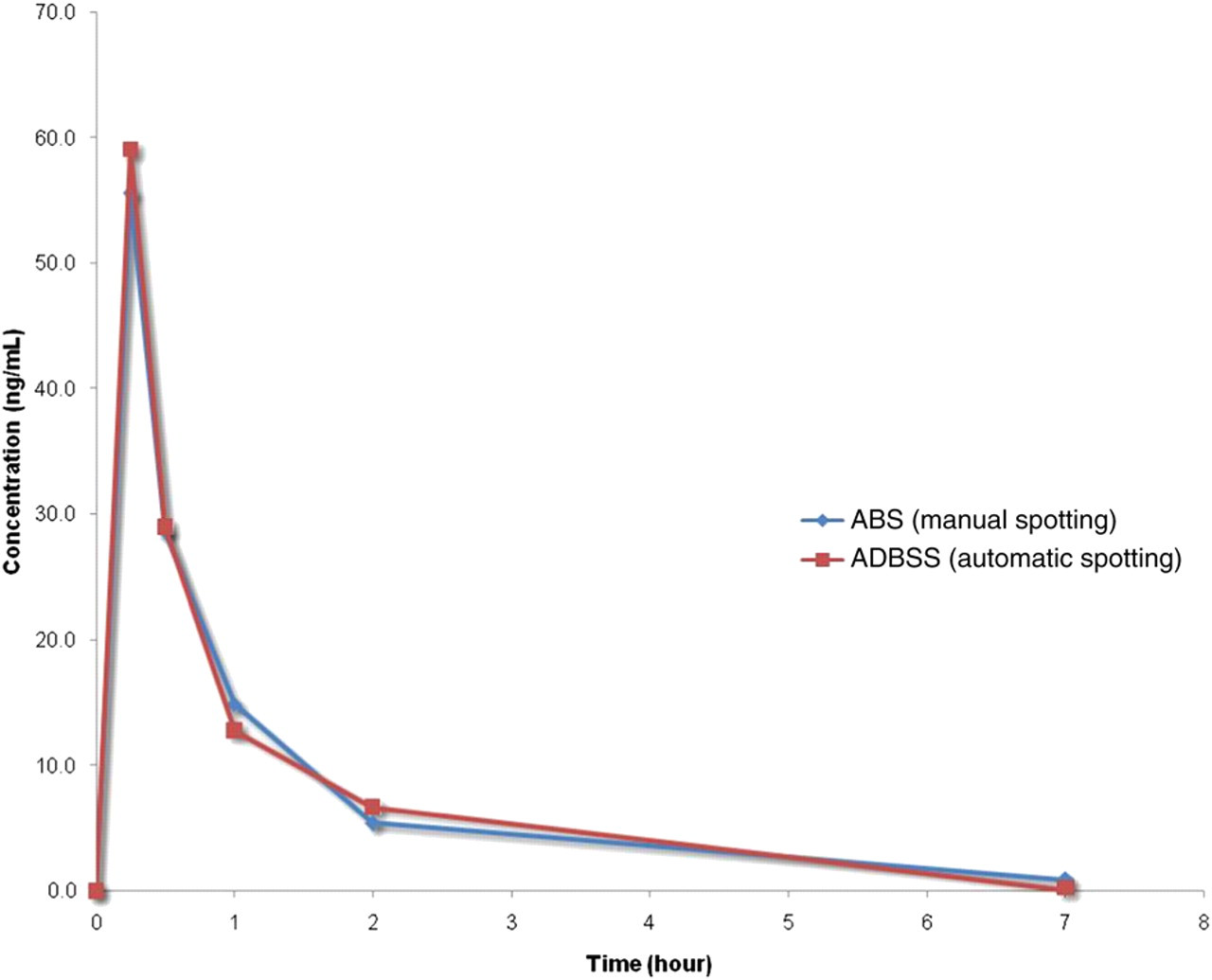
Time–concentration profiles of propranolol. Both sets of dried blood spot (DBS) samples provide very similar profiles demonstrating that the quality of DBS samples collected by the automatic dried blood spot sampling (ADBSS) unit is equivalent to that of manually prepared DBS samples