






Abstract
The grey short-tailed opossum (Monodelphis domestica) has been used in biomedical research for over three decades. It is normally housed in standard rat cages and appears to have adapted well to captivity. Owing to their aggressive behaviour towards each other, adult males are normally housed singly and may spend considerable periods of time in social isolation. We wanted to carry out a preliminary study on the behaviour of singly-housed male short-tailed opossums in two different settings: a standard rat cage and an enriched floor pen. Five male opossums aged between 10 and 12 weeks were housed for seven days at a time in the two settings and their behaviour was filmed during the dark phase. Recordings were carried out on the first and the last night of housing, from 19:00 to 07:00 h, and all behaviours quantified according to an ethogram. All five males in this study showed stereotypic behaviours while housed in standard rat cages, but no such behaviours were seen when the animals were in the floor pen. In both cases, but very especially in the pen, animals spent less time active as the week came to an end. Some activities such as sniffing the air, manipulating the nest and, especially, interacting with the floor tube occupied the animals' time in the cage considerably more than in the pen. Conversely, the opossums spent considerably more time walking when inside the floor pen than when they were in the cage. The general trend with other activities such as eating, drinking or grooming was one of more time being devoted to them inside the cage than inside the floor pen, but the differences did not approach statistical significance. These findings suggest that single housing of short-tailed opossums in standard rat caging is detrimental to their welfare.
The grey short-tailed opossum, Monodelphis domestica, is a popular laboratory animal that has been used in a variety of biomedical applications. It is a nocturnal pouchless marsupial, native of South America. 1 Since the first wild-caught pairs were introduced in the USA in 1978, the species has proved hardy and has bred readily in captivity. 2
In the wild, M. domestica is reportedly a solitary, nomadic animal, intolerant of other conspecifics, which likes building fully enclosed nests in hollow logs, in fallen trees or among rocks. 3 In captivity, it is common practice to house animals individually, particularly after four months of age, in order to prevent injuries from aggressive behaviour. The only contact between animals after that age will normally be at the time of pairing females and males for breeding purposes. 1 After successful mating, the males are usually separated and the female is left alone during the gestation period (approximately 2 weeks) and subsequent rearing of the young (approximately 8 weeks).
Due to the aforementioned problems with aggressive behaviour, short-tailed opossums – particularly males – are kept in isolation within standard rodent cages for long periods of time. As far as we know, the impact of this type of housing on the welfare of M. domestica has never been evaluated. Making use of a few available animals that were not on study, we wanted to carry out a preliminary investigation on the behaviour of singly-caged laboratory opossums during the dark phase, when they are most active, and compare it with their behaviour in large, novel, enriched floor pens. The enriched floor pen (described below) was designed with the idea of providing the animals with greater environmental complexity and choice, two fundamental aims of enrichment. 4
Materials and methods
Animals
The small colony of grey short-tailed opossums comprised 60 adults, of which half were males. They were housed and used in accordance with the Home Office Animals (Scientific Procedures) Act 1986 and with approval from the local ethical review process. They were housed in a conventional animal facility, in a room kept at 23–27°C with a relative humidity of 35–55% and with a 12 h light: 12 h dark cycle. Room air changes were 12–15/h. Animals were fed on a commercial powder diet (Feline Carnivore Diet, Mazuri Zoo Foods, DBM Scotland Ltd, Broxburn, UK). The daily ration was prepared by mixing the powder with water and a capful of sunflower oil, according to the manufacturer's recommendations, and letting the mix settle overnight in the refrigerator. The following morning, the mixture was cut into cubes of approximately 2.5 cm2 and offered to the animals inside a ceramic bowl once a day. Cool, untreated tap water was supplied in standard polycarbonate bottles with rubber stoppers and stainless-steel sipper tubes, and changed every second day.
Husbandry
We studied the behaviour of a cohort of five male grey short-tailed opossums aged between 10 and 12 weeks. The animals had been born of different parents and had been kept singly after weaning at eight weeks of age in a standard rat cage (described below). Their behaviour was recorded in two different settings. One was a standard polypropylene rat cage 56 × 38 × 20 cm (length × width × height) with a stainless-steel top, containing pine wood shavings as bedding material (DBM Scotland Ltd), shredded soft tissue paper for nesting (Paper Wool; Datesand, Manchester, UK) and a single cardboard tube measuring 15 × 8 cm (length × diameter) (DBM Scotland Ltd). This cage did not differ in anyway from the one that the animals had experienced since weaning, it was the standard holding cage for all adult opossums in our colony and therefore it could give us a baseline measurement of the animals' behaviour in their normal setting. The second setting, which was totally novel for the animals, was a floor pen measuring 145 × 83 cm (length × width), enclosed by four walls of clear acrylic plastic 100 cm high (Perspex®, Lucite International Ltd, Southampton, UK). The floor of the pen was covered with the same bedding material as used in the cage and the same cardboard tube. However, in addition, the pen contained the following items (Figure 1): a sand bath (S) made by means of a white plastic rat litter tray (North Kent Plastic Cages, Rochester, UK) filled with fine grain playground sand (Natural Play-Pit Sand; B&Q, Erskine, UK); two cardboard boxes (H1, H2) connected by a cardboard tube and with different entry/exit openings firmly held together with polypropylene packaging tape and containing a handful of nesting material (Paper Wool), equivalent to the amount the animals were offered in the cage setting; a suspended tunnel (ST) made by attaching several cardboard tubes with packaging tape and suspending it in the air by means of two pieces of gauze passed through a hole at each end of the tunnel and secured to the walls of the pen; two cardboard platforms (P1, P2) at either end of the suspended tunnel and a third (P3) located on one side of the pen, all of them secured to the walls of the pen by packaging tape; a ‘curtain’ (C) made of strands of nesting material (Paper Wool), with one end of the strands attached to packaging tape and the other end hanging freely towards the floor of the pen; four thin, leafless grey poplar (Populus canescens) branches (B), placed in a curved fashion diagonally from one corner to another of the pen; a ceramic bowl (W) containing water placed on the floor of the pen, in case animals did not find their way to the water bottle, which was placed just above platform P3.
Floor pen used in this study (see the text under ‘Husbandry’ for an explanation of items inside the pen)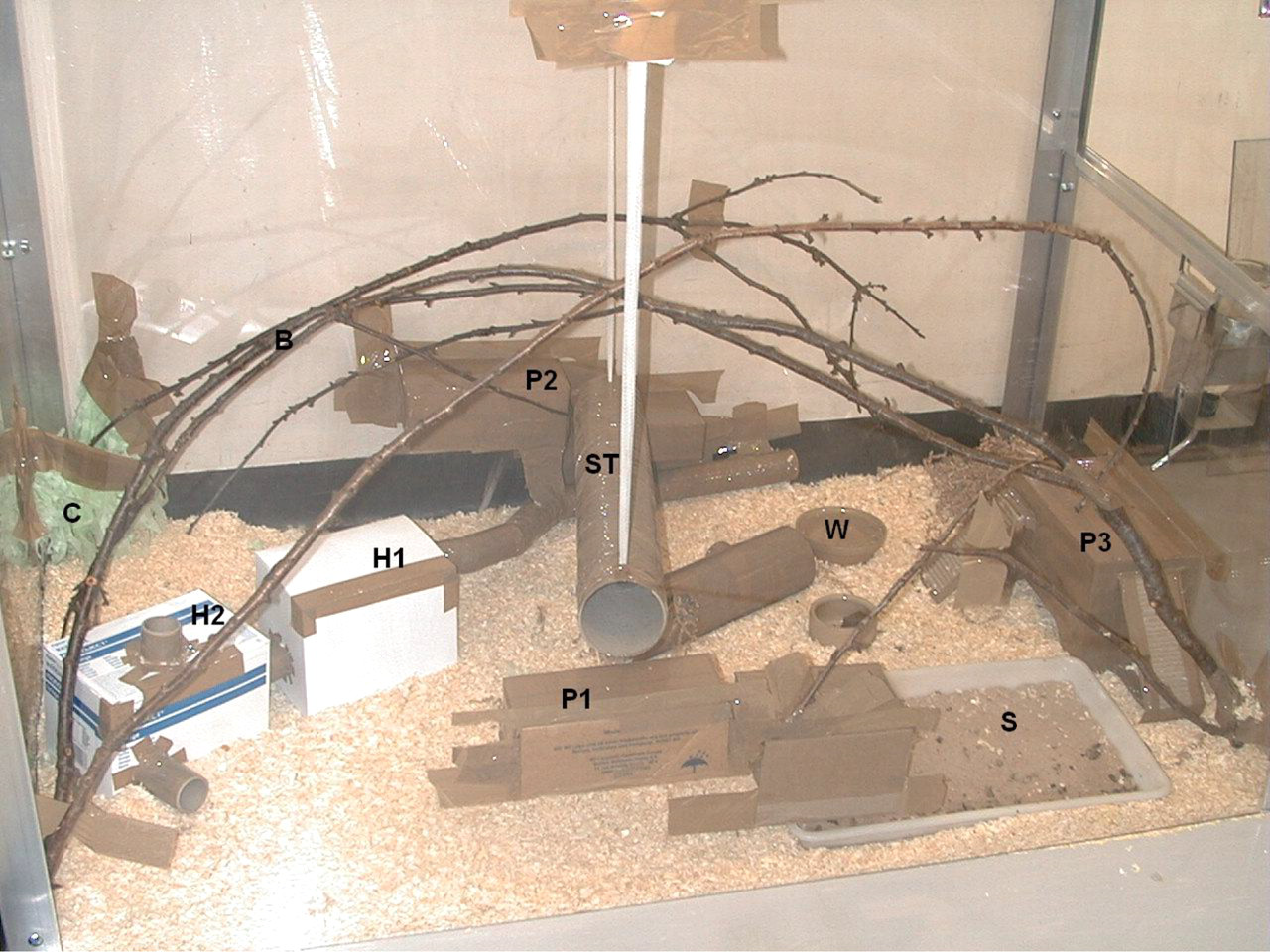
Video recordings
Ethogram of recorded behaviours
Statistical analysis
The data were not normally distributed, so comparisons between five pairs of observations in different settings at any particular time period after placing the animal in that setting were made using the non-parametric paired Wilcoxon test. Given that only five pairs of observations were compared for each test, the smallest P value possible was 0.0625, in the case where all pairwise differences were either positive or negative. Thus, no single test could give conclusive evidence of a difference between settings. Nevertheless, by considering the evidence for differences between settings across a range of activities it was possible to draw inferences about differences in behaviour. As mentioned above, it is worth noting that most behaviours were measured in time units (seconds), but some were counts (number of times the behaviour was displayed). In addition, some behaviours applied to one setting but not to the other, e.g. interaction with sand bath or branches could only apply to the floor pen, whereas bar chewing could only apply to the cage setting.
Results
Activity levels
The percentage of overall activity of the five opossums in the two settings (cage versus pen) is shown in Figure 2. Although in both cases, animals spent less time active as the week came to an end, this drop only approached significance (P = 0.06) in the case of animals in the floor pen but was barely noticeable in the cage.
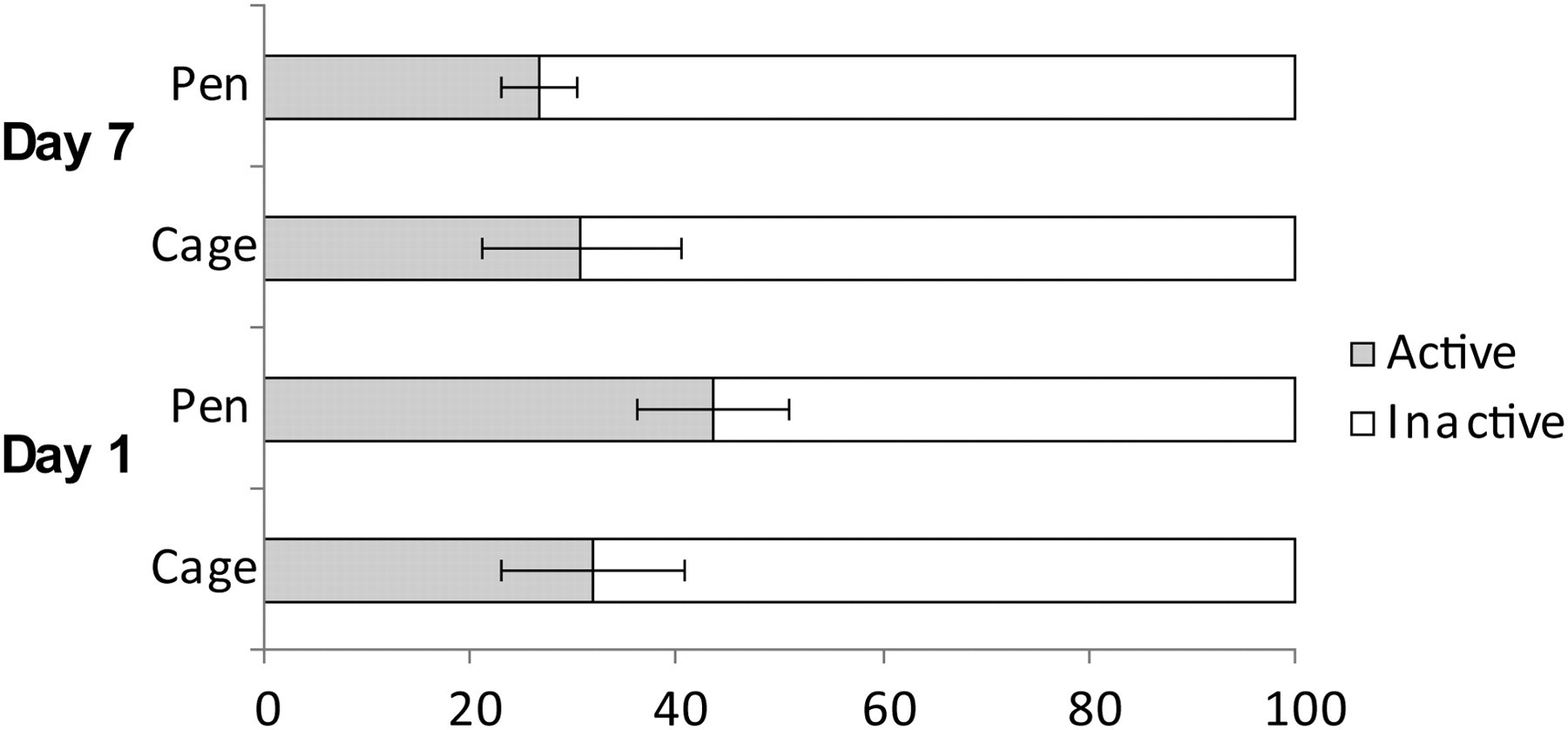
Percentage of time spent active in the two settings (cage/pen) with standard error bars
Stereotypic behaviours
Inside the cage, all five animals displayed one or more stereotypic behaviours, including bar-chewing, tail-chasing, rolling on their back and head spinning (Figure 3). By contrast, not only did the same animals not show any of these abnormal behaviours when housed in the floor pen, but they actually displayed natural behaviours, such as running and jumping, which were not or could not be displayed in the cage setting (see Figure 3).
Mean number of times count activities were performed, with standard error bars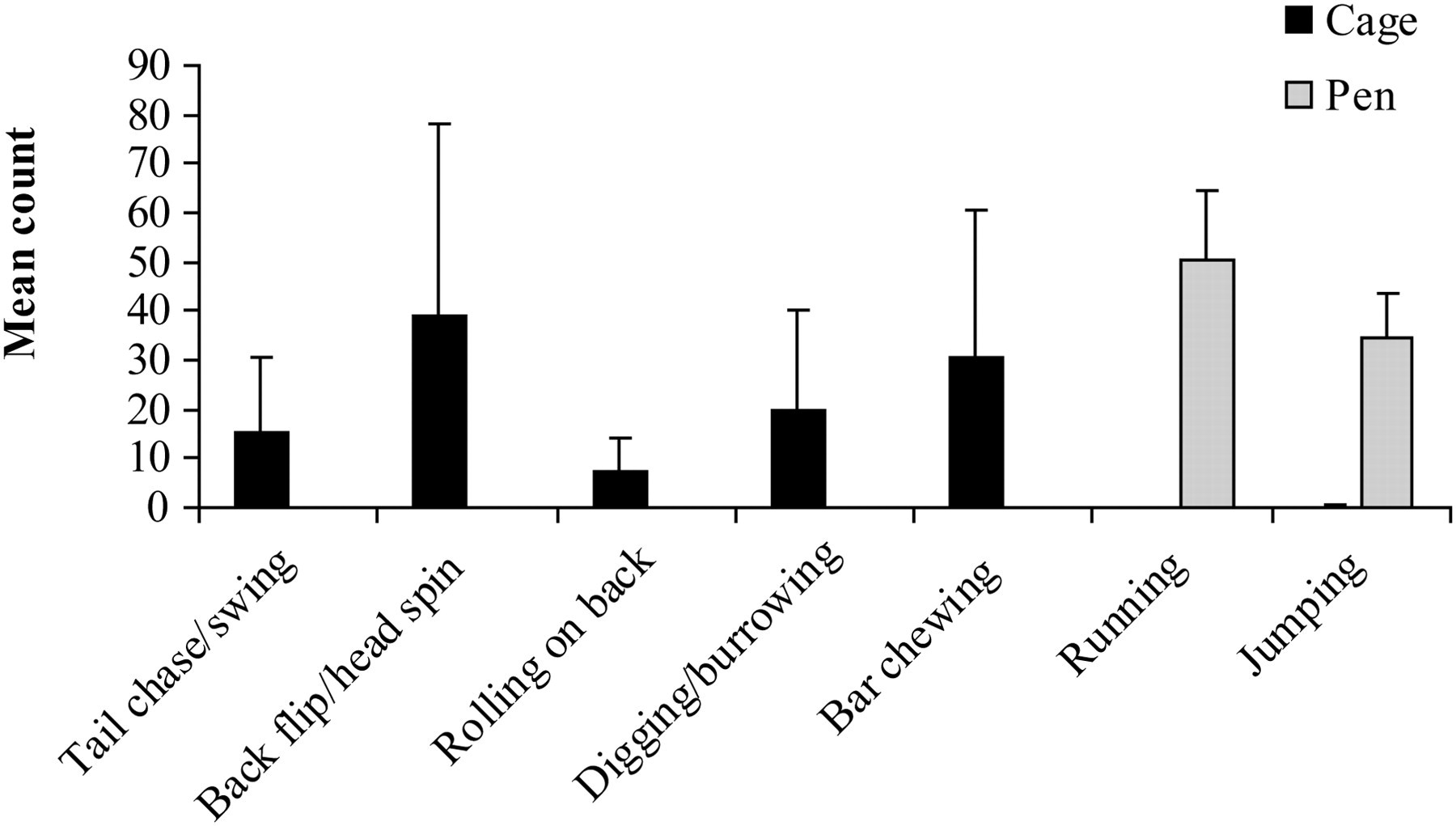
Other behaviours
The time spent by the five animals in the two husbandry settings is shown in Figure 4. Some activities such as sniffing the air, manipulating the nest and, especially, interacting with the floor tube occupied the animals' time in the cage considerably more than in the pen (P = 0.06). Conversely, the opossums spent considerably more time walking when inside the floor pen than when they were in the cage (P = 0.06). The general trend with other activities such as eating, drinking or grooming was one of more time being devoted to them inside the cage than inside the floor pen, but the differences did not approach statistical significance.
Mean time spent on each activity, with standard error bars (*indicates largest difference [P = 0.06] using Wilcoxon paired test)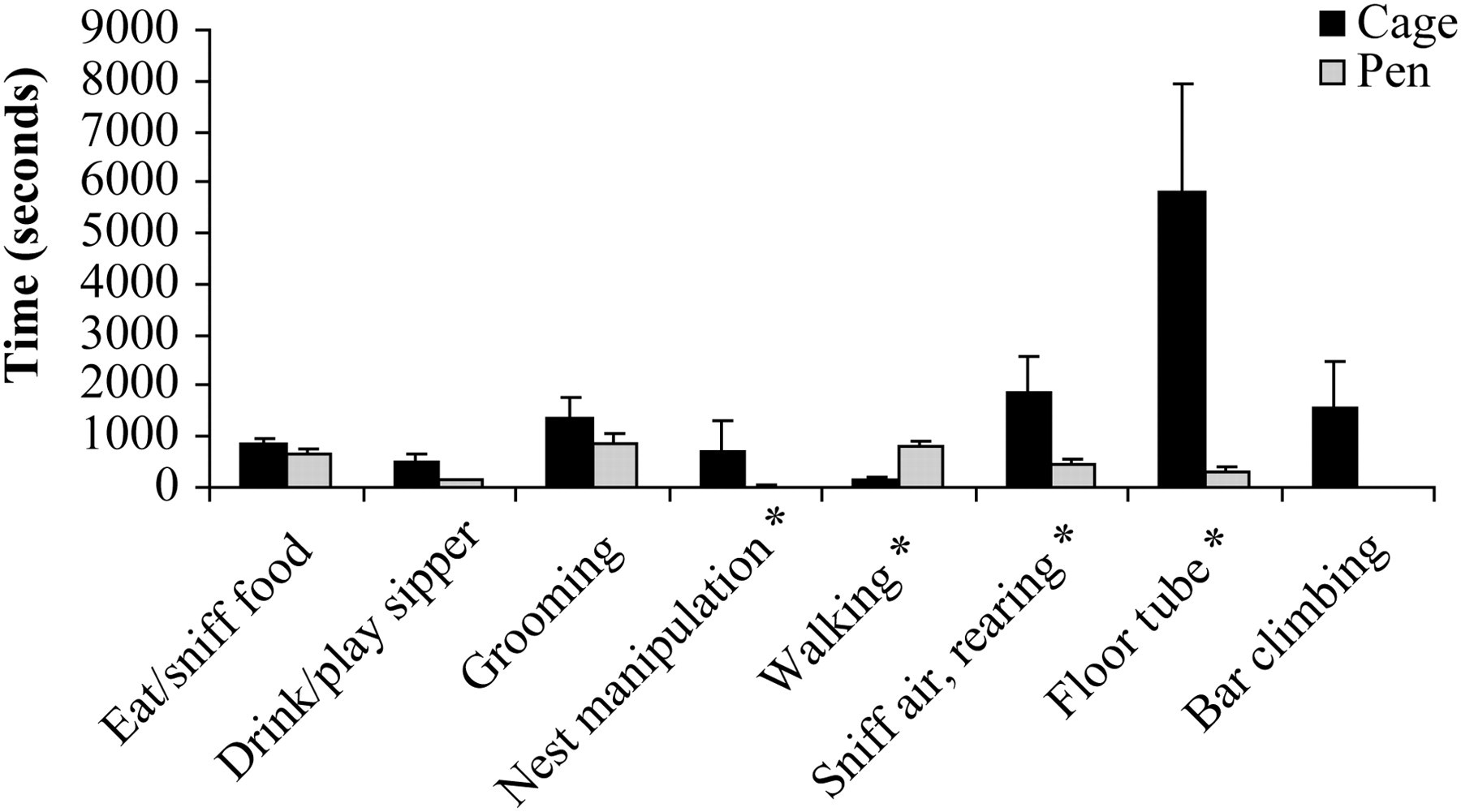
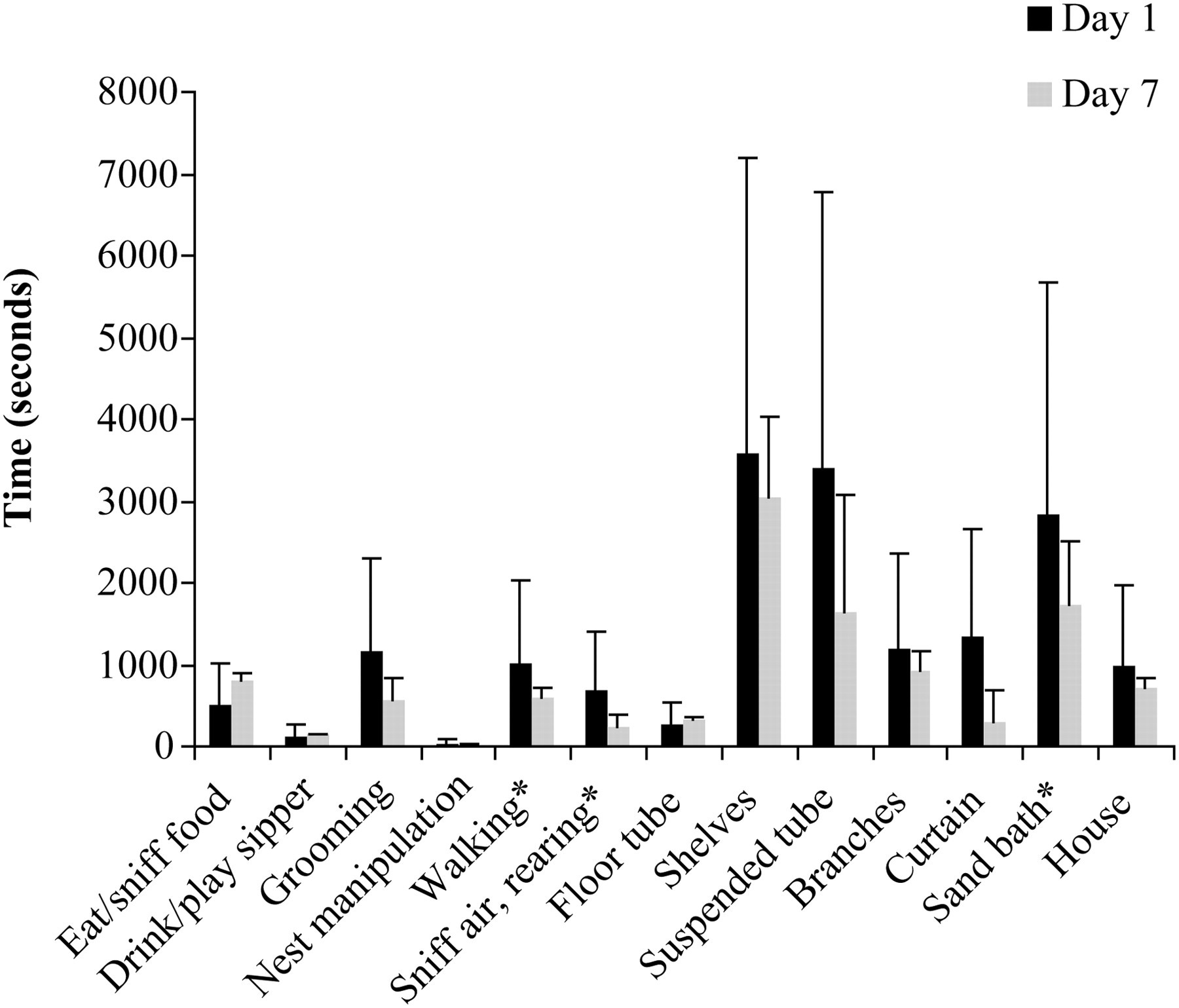
The comparison of time budgets between days 1 and 7 in the two husbandry settings is shown in Figures 5 and 6. In the cage setting, with the exception of nest manipulation, there appeared to be little difference in the way the animals spent their time on day 1 when compared with day 7 (Figure 5). In the pen, however, there were some notable trends: animals generally showed decreased levels of activity at the end of the study period, with considerable decreases in times spent sniffing the air around the enclosure, inside the sand bath and walking (P = 0.06), although one count activity (running) increased as the week wore on (data not shown).
Mean time spent on each activity in the cage, with standard error bars Mean time spent on each activity in the pen, with standard error bars (*indicates largest difference [P = 0.06] using Wilcoxon paired test)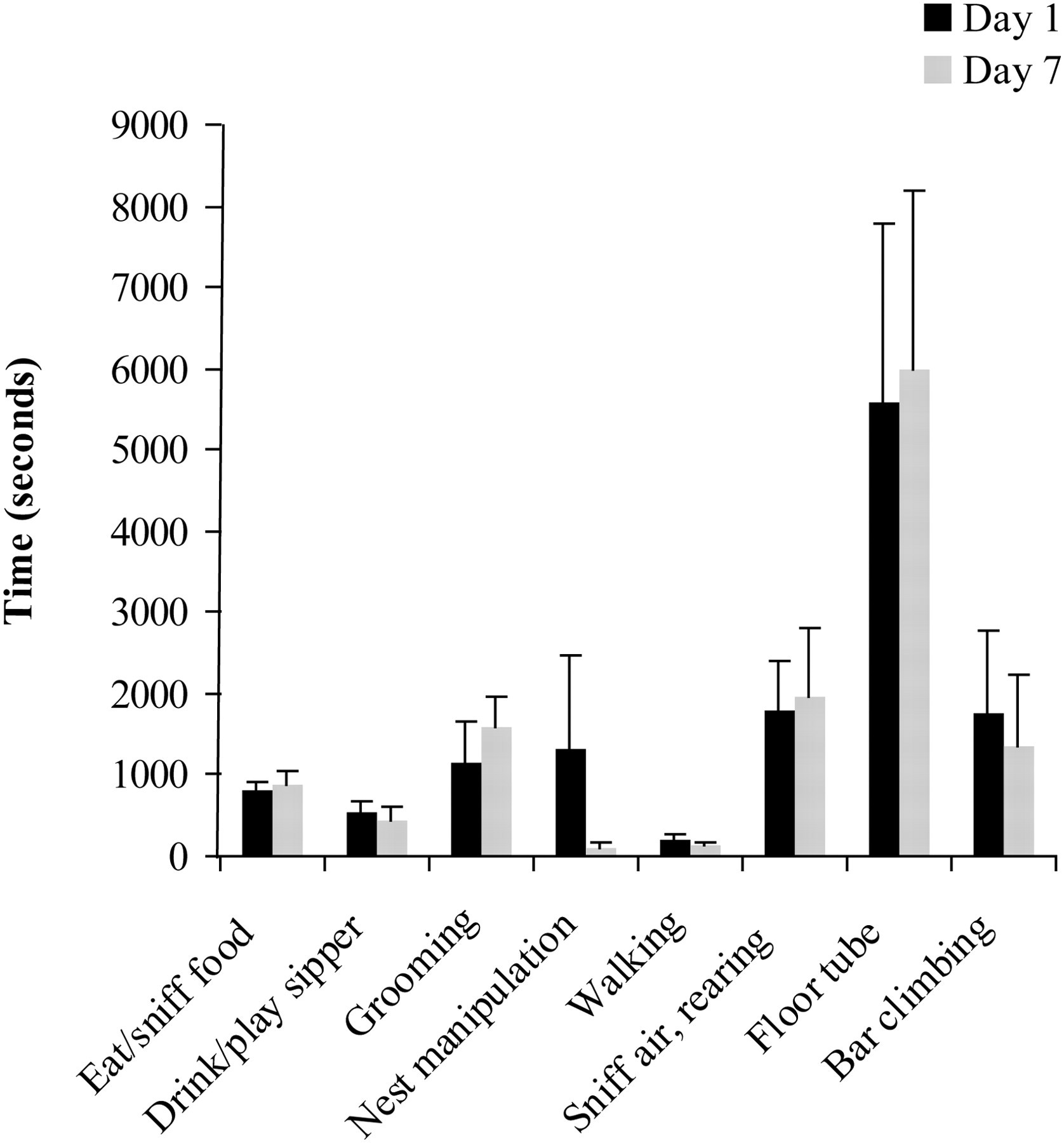
Discussion
The most striking difference in the behaviour of our opossums, when compared between the two husbandry settings described above, was in terms of stereotypies. All five animals displayed one or more types of repetitive, invariant, seemingly purposeless behaviours when filmed inside the cage setting, but not in the floor pen. Similar stereotypic behaviours to those encountered in these opossums have been well documented in laboratory rodents and are widely accepted as indicators of frustration and poor welfare. 5–8 In a laboratory setting, additional to the constraints of little space and few opportunities to interact with the environment, social isolation should also be considered. In other laboratory species such as primates, there is a well-established link between social isolation and an increased frequency of stereotypic behaviours. 9 In the case of more common laboratory species such as mice and rats, this link is widely suspected but possibly not as clearly defined as in primates. 10,11 Monodelphis are reportedly solitary, nomadic animals that are generally intolerant of other opossums, 3 and it is certainly ours and others' experience that aggressive behaviour is often displayed when conspecifics are housed together. Hence, the stereotypic behaviours seen in the five animals in this study are more likely a result of the reduced space and lack of environmental stimuli than of social isolation.
In any case, it was not just the fact that no stereotypies were seen when the animals were in the floor pen, but also the fact that a number of hitherto unobserved behaviours were seen in that particular setting. As mentioned above, with greater available space the animals frequently ran and jumped and a greater complexity of the environment also elicited interesting behaviours, such as climbing. This behaviour was all the more fascinating to observe because Monodelphis is reportedly the least well adapted of the Didelphidae for arboreal life, although they are said to be reasonable climbers. 3 We found that the animals walked up the branches with ease and some of them actually moved along them at great speed – almost running – without falling. In addition, all the opossums consistently made the sand bath their latrine area and did not defecate or urinate anywhere else in the pen. Although some authors have indicated that the laboratory opossum is usually quite hygienic, utilizing a single corner of the cage as their toilet area, 1 this had not generally been our experience.
A further unexpected behaviour that the animals displayed inside the pen was the use of the paper-wool ‘curtain’ as nesting material. To all appearances, the animals did not have a need for the extra material since they had been given ample supplies inside the houses (H1, H2) and on the floor of the pen. Mostly on the first night, they were observed grabbing the paper wool with their mouths and repeatedly pulling hard until strands of the material dislodged from the base. They then manipulated the nesting material by a rapid movement of their hands and feet, passing it underneath the body and grabbing it with their prehensile tail, to be carried off to their nest. The only comparable behaviour observed in the cage setting was with one particular animal (opossum number 4) that used the limb and tail movement described above to repeatedly move bits of nesting material around the cage and then back where he started. His activity did not appear to be an exercise in nest building but rather a repetitive behaviour.
In terms of other behaviours, the small sample size together with variation between individuals meant that only some of the differences noted when comparing animals' time budgets in cage versus floor pen settings approached statistical significance. Nevertheless, we were able to note some interesting findings. For example, like other nocturnal and crepuscular species kept in the animal unit, 12–15 short-tailed opossums appear to spend a very significant part of the time resting. Apart from resting, there were more or less clear trends in the ways in which the animals spent the time in the two settings. For instance, certain behaviours such as interacting with the floor tube and sniffing the air, which were frequently practised while in the cage, were noticeably less so when the animals were in the floor pen (P = 0.06).
In both settings the animals tended to be less active on day 7 when compared with day 1, but whereas this drop was negligible in the cage, the difference approached statistical significance (P = 0.06) in the case of the floor pen. The finding is not surprising, given the well-known phenomenon of increased activity in new surroundings or with novel objects followed by habituation which is seen in many laboratory species, the so-called ‘novelty effect’. 16–19 Given that the opossums had, until the time of the trial, only experienced a cage as a home setting, it is not surprising that they showed more activity on their first day inside the completely novel floor pen when compared with the last day. Interestingly, the one behaviour that increased from day 1 to day 7 in the number of times it occurred was running (data not shown). Although the difference did not reach statistical significance, the trend was for the animals to perform a greater number of runs as the week came to an end. In an interesting study by Olsson and Sherwin, 20 mice housed in larger, enriched cages were found to perform much fewer stereotypic behaviours and to be more active than in standard cages. In their mice, the increased levels of activity were largely accounted for by the time spent by the animals running on an exercise wheel. In any case, the mere fact of observing running behaviour in our opossums, combined with the finding that animals spent considerably more time walking in the floor pen than inside the cage, would seem to indicate that they did derive benefits from the extra space (e.g. greater performance of natural behaviours and greater physical exercise). In other common laboratory species, many authors have found that animals either showed a clear preference for extra space or were prepared to work hard to gain access to it. 17,21,22 The question is by no means settled and more empirical research into cage area and conformation is needed. 23 Be that as it may, some have already been able to demonstrate the benefits of greater space and increased physical activity in rats housed in floor pens 24 or larger cages 25 and in mice housed in large, enriched cages. 20
In summary, singly-housed male short-tailed opossums used in this study showed various stereotypic behaviours when housed inside a standard rodent cage. By contrast, no such abnormal behaviours were seen when the animals spent a week inside an enriched floor pen. The provision of extra space and greater environmental complexity was shown to trigger the performance of hitherto unobserved natural behaviours. Unfortunately, we were not able to explore the potential long-term benefits of such improved housing because our colony was soon transferred to another institution. But this preliminary study will hopefully help other researchers to look into these potential benefits.
Footnotes
Acknowledgements
The authors gratefully acknowledge the staff at the Department of Human Anatomy, University of Glasgow, for lending their filming and recording equipment; Dr Joyce Ferguson and the staff of Biological Services, for technical support; and Dr E Cheek, University of Brighton, for assistance with preparation of the graphs.