



Abstract
The European Federation of Pharmaceutical Industries and Associations’ Research and Animal Welfare group members reflected on the concept of a Culture of Care in relation to animal care and use and on differences in its understanding and application across European pharmaceutical companies. The term ‘Culture of Care’ is used across different regions and organizations but rarely with any defined indicators to support working practice.
The European Federation of Pharmaceutical Industries and Associations’ Research and Animal Welfare group has developed a framework to help organizations identify gaps or potential areas for improvement in support of a positive Culture of Care.
The framework is a tool that identifies five areas of focus for a Culture of Care: company values; strategic approach at establishment level; implementation structures; staff support; and animal care and procedures. The framework is intended as an aid for continuous improvement, highlighting where indicators of good practice are present. We expect it to provide points of reflection and ideas for those looking to implement a Culture of Care in a structured way, while facilitating a professional and strategic approach. To prevent it supporting a ‘tick-box’ exercise, the framework must not be used as an auditing tool, but as a starting point for consideration and discussion about how care manifests within the context and constraints of individual establishments.
Introduction
The European Federation of Pharmaceutical Industries and Associations (EFPIA) represents the pharmaceutical industry operating in Europe.
The EFPIA Research and Animal Welfare (RAW) group’s remit includes:
Horizon scanning of animal research including the political, legal and regulatory environment. Promoting implementation and good practice sharing of the Replacement, Reduction, Refinement (3Rs) and Culture of Care to support Directive 2010/63/EU and Commission reports. Communication about the pharmaceutical sector’s 3R activities.
The term Culture of Care in the context of using animals in scientific research describes the culture in an organization that provides support to all staff to strive for continuous improvement in:
animal care and welfare; care and welfare of staff involved in the animal care and use programme; scientific quality; and openness and transparency.
The European Union Directive 2010/63/EU 1 (referenced as the Directive hereafter) on the protection of animals used for scientific purposes does not mention Culture of Care specifically; however, there is a need for an animal welfare body (AWB) to foster a ‘climate of care’ (Recital 31). However, other guidance documents produced by the European Commission along with member states and stakeholders do refer to a Culture of Care. For example, the Education and Training Framework 2 includes the responsibility to champion a ‘Culture of Care’ among staff at all levels in the section on person(s) responsible for overseeing the welfare and care of animals in Article 24(1)(a). Furthermore, the guidance on inspections and enforcement 3 includes a Culture of Care in other functions of the inspection programme, providing guidance on factors to consider in determining the Culture of Care in an establishment and using inspectors or inspections to promote a Culture of Care.
The European Commission has produced a guidance document that has been endorsed by the national competent authorities, called ‘A working document on Animal Welfare Bodies and National Committees to fulfil the requirements under the Directive’. 4 In the introduction to this document it states National Committees play a fundamental role in ‘establishing and maintaining an appropriate climate of care, often called in practice, and subsequently referred to in this document as a “Culture of Care”.' AWB’s also play a fundamental role in establishing and maintaining an appropriate Culture of Care. There is a section later in the document entitled ‘Fostering a Culture of Care’. Fostering or promoting a Culture of Care is recognized as one of the benefits of an effective AWB.
A Culture of Care goes beyond adhering to legal requirements. It refers to an organizational culture that supports and values caring and respectful behaviour towards animals and co-workers. A Culture of Care is the responsibility of everyone involved with animal studies, from those directly working on the studies and beyond to include animal facility management, sample analysts, study planners, engineers, biologists, chemists, statisticians, project leaders, managers and senior leaders. The culture should instil responsibility and accountability in those planning and implementing research programmes and those caring for animals, so they do the right thing ethically and strive for continuous improvement. A number of these structural and behavioural attributes are well described in The Guiding Principles on Good Practice for United Kingdom (UK) Animal Welfare and Ethical Review Bodies. 5 However, having a practical framework underpinning these attributes would be beneficial for those striving to understand and further develop a Culture of Care. Greenhough and Roe interviewed several animal technicians in UK universities to ascertain and describe the behavioural characteristics and challenges of these staff who often ‘bear the burden of care’. 6 However, this also gives limited practical guidance and focuses on direct care of animals, which is only one aspect of Culture of Care. The focus of the EFPIA work relates to the values and behaviours of organizations and individuals as our view is that providing a structured framework that can support staff in a positive culture will lead to better outcomes for animals.
As scientific knowledge and our understanding of animal welfare are constantly evolving, so are societal concerns regarding the use of animals for scientific purposes. Therefore, it is essential to challenge ‘we have always done things this way’ to improve animal housing, care and procedures and reduce any negative impact they can have on welfare.
EFPIA RAW group considerations on what Culture of Care means and how this might be assessed
The EFPIA RAW group members have been reflecting on the concept of a Culture of Care and how it is understood and applied across research institutions and companies in Europe. The phrase ‘Culture of Care’ is used in different contexts but rarely with any defined indicators of what it might look like in practice. The EFPIA RAW group reflection process was initially facilitated by a survey of 16 questions (Appendix 1). If the concept of Culture of Care is new within your organization, we recommend the survey questions (or modified set of questions that could also include questions relating to outcomes and impacts for animals) as a good way to initiate a discussion about what Culture of Care means to your staff. 7 In our survey respondents were asked from their personal view of defining a Culture of Care. Appendix 2 illustrates a selection of the responses.
Following on from the survey, EFPIA RAW hosted a workshop on Culture of Care in February 2017. A summary of the workshop is provided in Appendix 3. The key conclusion from the workshop was the need for EFPIA RAW to develop a framework to help organizations across Europe move towards a greater understanding of what a Culture of Care might look like in practice. The framework that has been developed is intended to facilitate continuous improvement by highlighting indicators of good practice. It is not intended to act as a tick-box exercise and should be used within the context and constraints of an individual organization. The framework has been developed with the commercial sector in mind but many of the principles and practices can be applied in any user establishment. Any Culture of Care is dynamic and continuously evolving and organizations that have an established Culture of Care should consider how they can enhance and develop their existing culture.
Culture of Care framework
The EFPIA RAW group considered how best to develop practical support for companies to assess their own Culture of Care and concluded a simple framework with several categories and indicators of good practice would be effective. Within each category there are also potential challenges described with possible solutions outlined.
The framework has been split into five categories that support the top-down and bottom-up approaches necessary for a good Culture of Care. The five categories start with the values of the company as this is critical in ensuring a Culture of Care permeates across the whole organization. The remaining four categories are strategic approaches at the establishment level, implementation structures, staff support, and animal care and procedures.
Company values
Company values: Indicators of good practice.
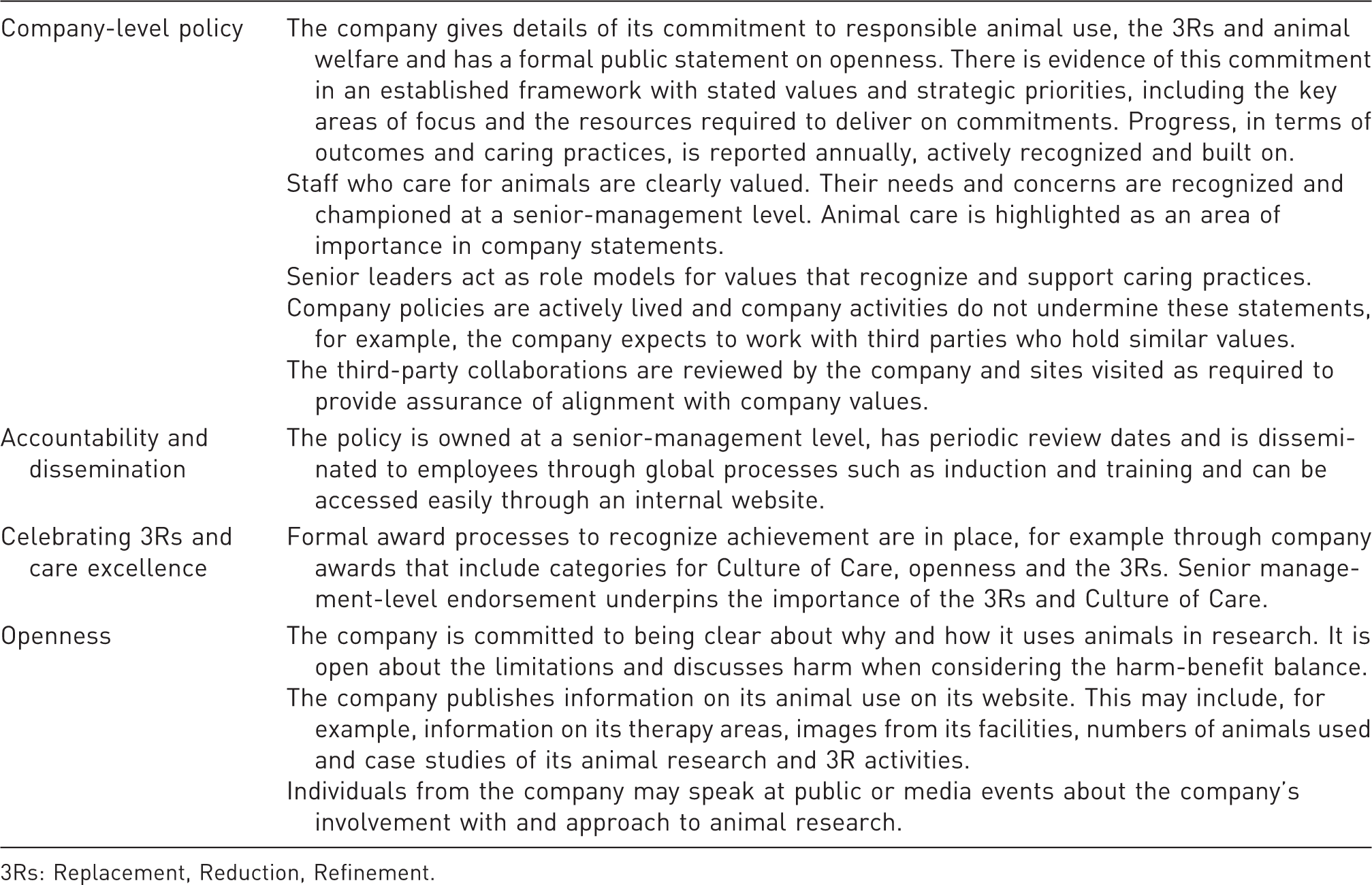
3Rs: Replacement, Reduction, Refinement.
Multinational organizations incorporate a wide range of cultures and values that may differ in their views of human-animal relationships. They may also differ in understanding good animal welfare, the relationship between improved welfare and science output, and the willingness or ability to devote resources and budget to animal welfare and the 3Rs. This can be addressed by having a global oversight or governance group within the company for managing company strategy and policies on animal use including developing global values such as supporting caring attitudes in animal research. For example, the global group could agree a set of ‘minimum expectations’ aligned with the organization’s values that can be applied in all regions regardless of laws or culture; for example, in addition to complying with local laws and regulations, it may be a requirement that internal animal care and use programmes follow the principles of the Guide for the Care and Use of Laboratory Animals 8th Edition, Institute for Laboratory Animal Research 8 or the Directive. 1 Making the expectations ‘outcomes’ based means they can be achieved in different ways in different cultures, for example using a performance approach promoted through organizations such as the Association for Assessment and Accreditation of Laboratory Animal Care International (AAALAC). 9
Animal research can be an emotive topic and this can engender caution and concerns about openness, especially in organizations where many staff members are not connected to animal work. The global group may raise awareness and educate leaders and staff on the benefits of openness. Signing up to activities such as the ‘Concordat on Openness’
10
(or European equivalent) can help demonstrate that being open about why and how animals are used in research is a positive thing. There may need to be an acceptance that greater openness, for example engaging with the media, may not be achievable in some corporate environments. It must be considered that animal work within large companies is a relatively small part of the overall company activities and thus is unlikely to have a prominent profile in company communications. In addition, there are limitations in that speaking to the media is usually confined to one or two individuals with clear understanding of company messaging in this area. The qualities of a media spokesperson may include:
knowledge about the regulations, the need for animals in research, the 3Rs and the nuances of animal care and welfare; empathy for public concerns about animal wellbeing, be able to communicate the emotional context of this work; and ability to tailor their communications to the context and audience appropriately.
Strategic approach – establishment level
The local AWB and other oversight bodies in collaboration with senior management should support a Culture of Care and empower staff working with animals. In this context the person responsible for ensuring compliance with the provisions of the Directive (e.g. Named Person Responsible for Compliance in the UK) has an important role as a senior manager to be visible in promoting a Culture of Care or in nominating another senior manager to do this. It is expected that all persons responsible for ensuring compliance with the provisions of the Directive and the person or persons referred to in Article 24(1) and in Article 25 (Named People) have a critical role in developing and supporting staff and a Culture of Care and are empowered to do so.
Care can be seen to have intangible qualities that can be unrecognized, overlooked and considered low priority at senior management levels. The AWB has a role in preventing this, for example, one approach might be to articulate that care and welfare underpin scientific excellence and that good care supports staff wellbeing. Buy-in at senior level can be supported by articulating with examples that good care reduces risks around welfare compliance.
In a global organization, the establishment vision should ideally align with the company values to support leadership buy-in and help staff feel aligned with the company’s values, for example some global organizations may have values aligned to the staff and the company being a good or great place to work. An establishment vision on Culture of Care could be seen to tie into this type of value for the staff working with animals.
Working across management lines with different priorities can be a challenge. It requires active engagement and management at all leadership levels. Effective teamwork and two-way support to and from senior leadership with a clearly articulated visions can help. A Culture of Care is a way of working and should be emphasized in all discussions, rather than treated as a separate standalone ‘activity’.
Strategic approach – Establishment level: Indicators of good practice.
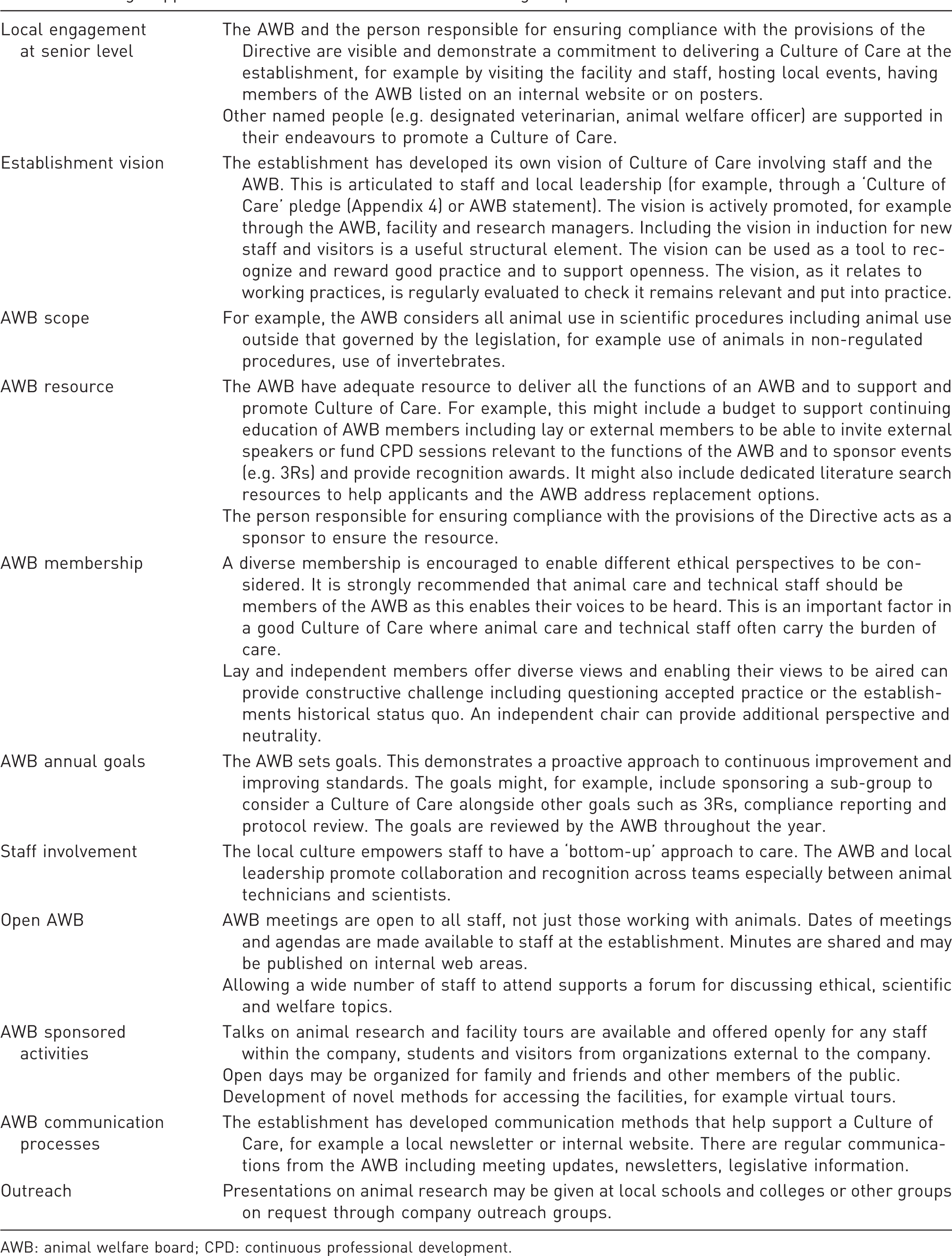
AWB: animal welfare board; CPD: continuous professional development.
Implementation structures: Indicators of good practice.
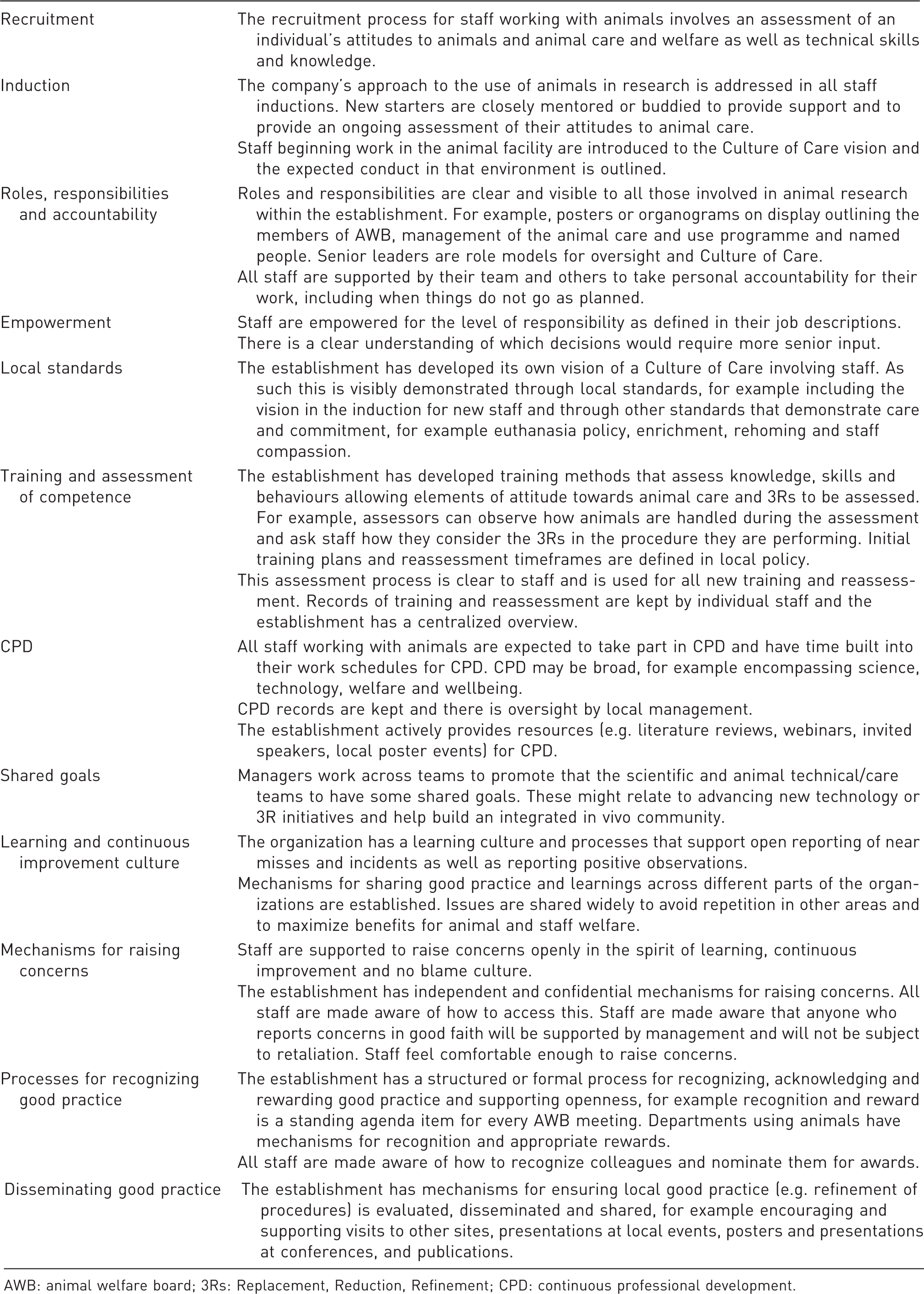
AWB: animal welfare board; 3Rs: Replacement, Reduction, Refinement; CPD: continuous professional development.
Implementation structures
The establishment has clear structures that support and facilitate a Culture of Care.
The assessment of individual attitudes to animals and animal care can be difficult during the recruitment process. Care needs to be taken to ensure that potential new recruits are caring and empathetic with a good attitude towards animals and animal care and welfare and understand the rationale for the use of animals in research. Expert training of interviewers to ask appropriate questions and to enable identification of ‘red flags’ is beneficial. It should also be understood that attitudes based on care and empathy are reliant on a supportive organizational culture that nurtures them and that recruitment practices alone cannot provide ‘caring attitudes’.
Changes to established working practices in the light of new methods can challenge staff and, if handled badly, can imply criticism of existing approaches. Expertise in change management can be useful to ensure everyone understands and embraces new ways of working.
Although the company’s approach to using animals in research may not be considered as important or relevant for non-animal staff, it is essential there are processes that enable all staff to have an awareness of and feel comfortable with the company’s approach to animal care and welfare and its standards in relation to animal research. Staff can be the best advocates for a company’s approach to animal care and their advocacy can support the positive reputation of the company.
Staff can be uncomfortable in raising awareness when something does not go as planned or could be improved. Encouraging staff to fully own their work can be championed, so that successes and errors become shared. Developing a culture of openness and learning requires time and commitment to develop trust and this trust is essential. Senior managers are ideally placed to promote a culture of learning from mistakes rather than looking for blame. In addition, the AWB is ideally placed to support open and transparent processes that enable learning to be shared from things that go well and things that do not. This will maximize the derived benefits and support animal and staff welfare. This could include mechanisms for visibility of small as well as significant successes, for example regular AWB rewards that encourage and promote caring behaviour and thank staff for small improvements in care and welfare.
Good training and assessment processes that include assessments of skill, knowledge and behaviour take time to develop and embed, especially if there are many procedures to be assessed/reassessed. This time investment can be promoted through the fact that staff feel more invested and these approaches support staff if compliance issues arise.
Staff support: Indicators of good practice.
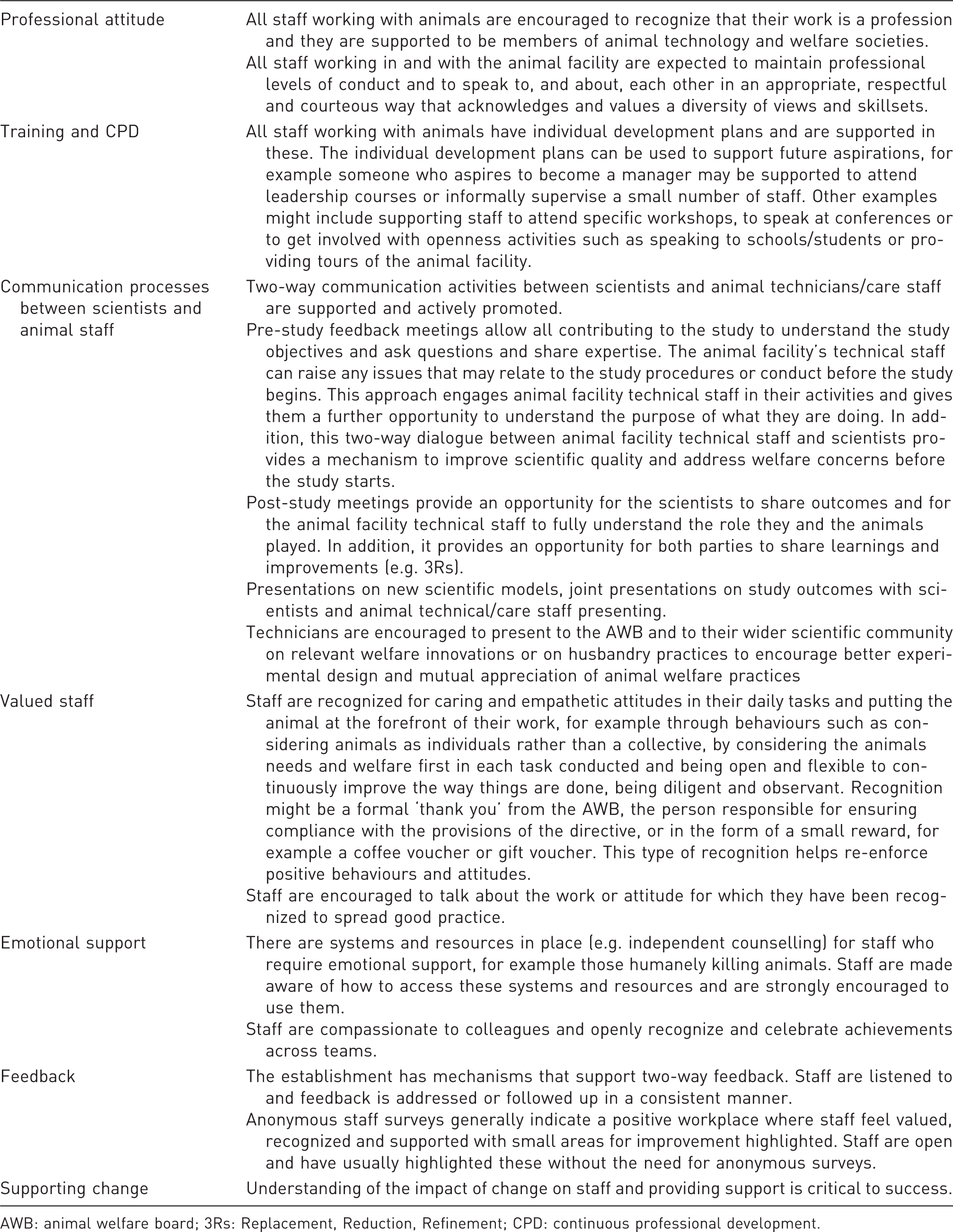
AWB: animal welfare board; 3Rs: Replacement, Reduction, Refinement; CPD: continuous professional development.
Animal care and procedures: Indicators of good practice.
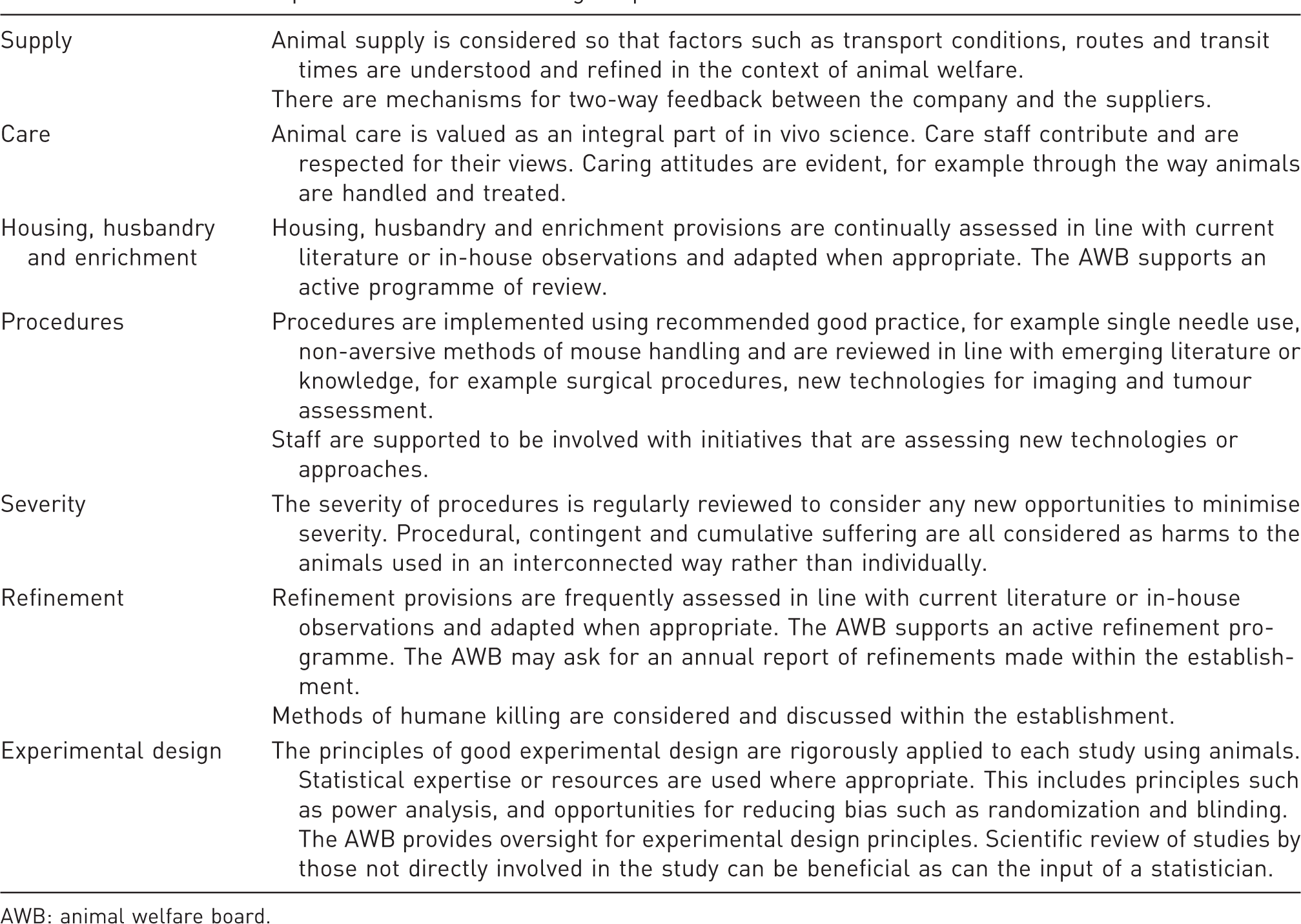
AWB: animal welfare board.
Staff support
The establishment has local leadership that supports and develops mechanisms demonstrating care and commitment to staff who work with and care for animals.
Conducting procedures on and caring for animals needs to be recognized as a competence and expertise that is a prerequisite for good science. This will help provide the rationale to support membership of animal technology societies and individual development planning in the same way scientists are expected to be members of scientific societies and have individual development plans.
Opportunities for professional development require well-developed training programmes and the identification of relevant skills by managers.
Local management and/or the AWB have a role in promoting two-way interactions between scientists and animal technicians and care staff. This can include ensuring processes are in place before individual studies start where it is expected there would be a discussion and handover between the scientists and animal technician or care staff. The AWB may also request or sponsor scientific presentations that are pitched at an appropriate level for animal technicians to appreciate. Raising awareness of why this is important is critical to the success in outlining the benefits of having engaged animal technicians and care staff to deliver high-quality studies from both a science and welfare perspective. Boden and Hawkins provide good advice for animal care and technical staff on communicating refinements to scientists. 11 The animal technician or care staff role should not be, or be perceived to be, a service that delivers tasks without a full understanding of the goals and what might be expected.
Animal care and procedures
The establishment has processes that support continuous improvement in the 3Rs and that when animals are used, there is appropriate experimental design and refinement in care and welfare practices.
Understanding of animals’ needs and the impact of housing, husbandry and procedures continue to evolve. There is often a concern of the potential impact of enrichment on scientific outcomes and therefore it is important that there is a collaborative approach to assessing new approaches. The evidence base may focus on animal welfare alone and the impact on science and data quality is slower to gather. A good example illustrating this is the work of Hurst on alternative handling methods in mice published in 2010, 12 additional papers on the impact on science have started to be available 13 and training resources available through the UK National Centre for Replacement, Refinement and Reduction of Animals in Research (NC3Rs) website 14 and as the evidence base has grown so has implementation. The AWB has an important role to act as a sponsor of new initiatives supporting implementation and outcomes.
Changes to methods and procedures are more likely to succeed when they have a compelling evidence base and can demonstrate a clear animal welfare benefit, particularly as significant changes may involve increased operating costs either in terms of equipment or resource. However, there are examples of methods that even without an evidence base cause minimal harm to animals and should be adopted (e.g. single needle use) 15 unless there is a scientific rationale for a different approach. It is beneficial to manage change by, for example, spending time introducing the rationale for any changes and related benefits before full-scale adoption; the use of pilot activities and ‘champions’ can be helpful in overcoming resistance. The designated person responsible for animal care and welfare and the designated veterinarian are likely to play a key role in implementing changes. Collaboration with other establishments that have already made a change may also clarify the benefits and inform any training required. Staff are encouraged to share changes by presenting either at internal meetings or at external laboratory animal events. Assigning experienced staff as mentors will support this activity.
Statistical support is not always accessible; however, there are several key resources that support good experimental design and reporting that AWB members should be aware of.16,17,18
Conclusion
A Culture of Care is an important factor in how animal care and use programmes operate considering both the staff and the animals used. Despite its importance and the available guidance on high-level principles underpinning Culture of Care, the concept remains somewhat subjective and has a different understanding across European countries. The EFPIA RAW framework has been developed by considering good practice indicators that can be applied objectively in European companies operating across a variety of different cultural backgrounds. An example of how the framework might be used comes from AstraZeneca, which has five animal facilities across its global organization. Each facility has used the framework to assess their own Culture of Care and to identify improvement areas. At sites outside Europe terminology was defined, for example, the Institutional Animal Care and Use Committee (IACUC) instead of AWB and attending veterinarian instead of named veterinarian. The chief veterinary officer has completed the assessment against the ‘company values’ part of the framework. Through global discussions these assessments will be reviewed to share good practice across the five animal facilities and develop global goals and resources where there are common themes for improvement.
Although the framework focusses on human-centric elements, future work in this area could assess a correlation between an improved Culture of Care and animal-centric indicators (e.g. staff-animal ratios, time allocated for animal checking, mortality rates, practice with respect to asepsis and post-operative analgesia).
The AWB has a key role in sponsoring or promoting many of the good practices and processes within an establishment. Although developed with the commercial sector in mind, several of the good practice indicators can be applied more widely.
Supplemental Material
LAN887998 Supplemetal Material - Supplemental material for The European Federation of the Pharmaceutical Industry and Associations’ Research and Animal Welfare Group: Assessing and benchmarking ‘Culture of Care’ in the context of using animals for scientific purpose
Supplemental material, LAN887998 Supplemetal Material for The European Federation of the Pharmaceutical Industry and Associations’ Research and Animal Welfare Group: Assessing and benchmarking ‘Culture of Care’ in the context of using animals for scientific purpose by Sally Robinson, Sue Sparrow, Bella Williams, Thierry Decelle, Thomas Bertelsen, Kirsty Reid and Magda Chlebus in Laboratory Animals
Footnotes
Acknowledgements
The authors acknowledge the EFPIA Research and Animal Welfare group, contributors to the EFPIA workshop and Susanna Louhimies (Directorate General Environment, European Commission) for discussions and review comments.
Declaration of Conflicting Interests
The author(s) declared no potential conflicts of interest with respect to the research, authorship, and/or publication of this report.
Funding
The author(s) received no financial support for the research, authorship, and/or publication of this report.

References
Supplementary Material
Please find the following supplemental material available below.
For Open Access articles published under a Creative Commons License, all supplemental material carries the same license as the article it is associated with.
For non-Open Access articles published, all supplemental material carries a non-exclusive license, and permission requests for re-use of supplemental material or any part of supplemental material shall be sent directly to the copyright owner as specified in the copyright notice associated with the article.
