






Abstract
As the production of transgenic mice increases, the need for vasectomized mice also increases. Currently, there is no accurate method of identifying pain in these mice which can be used routinely and therefore no acceptable analgesic regimens can be established. Sixteen male CBA/CaCrl and 16 male DBA/2JCrl mice were randomly allocated to one of four treatment groups (saline, low, medium and high dose oral paracetamol) and then underwent abdominal vasectomy. Their behaviour was videotaped (filmed) preoperatively and at one hour postoperatively and the data were analysed using an automated system – HomeCageScan. HomeCageScan detected significant changes in 16 behaviours following vasectomy. Such behaviours included twitching, rearing and grooming with varying levels of significance between the strains. No significant effects of drug treatment in any of the behaviours analysed by HomeCageScan were detected in the postoperative observation period. Strain-specific changes do occur in behaviour following abdominal vasectomy and HomeCageScan is capable of detecting these changes. The use of orally administered paracetamol was deemed to be an ineffective analgesic for CBA/CaCrl and DBA/2JCrl mice undergoing vasectomy.
Concern that analgesic use may compromise the data obtained from particular models is a significant factor in the apparent under-use of analgesics to control postprocedural pain in rodents. 1 This problem can be avoided by selection of analgesic agents that are unlikely to cause such interactions; however in some circumstances opioids, non-steroidal anti-inflammatory drugs and local anaesthetics may be considered unsuitable. Paracetamol (acetaminophen) has a mode of action different from these other classes of analgesics, and hence a different profile of effects on body systems. It is currently considered to be a selective COX-3 inhibitor 2 and also shows weak anti-inflammatory activity 3 although the exact mode of action is still unclear. It has a plasma half-life of 52–98 min, 4 and when administered orally peak plasma concentrations are found after 120 min in mice. 4 A previous study has shown orally administered paracetamol to have profound analgesic effects on bone cancer pain in mice when administered alone and when administered with a subanalgesic dose of morphine. 2 It may therefore represent a useful addition to the range of agents that could be used to prevent postprocedural pain in mice. Vasectomized males are commonly used in the production of transgenic mice; therefore rapid and accurate pain assessment in this model is essential. In order to adopt effective analgesic regimens, we must be able to accurately assess pain following surgery. To date, few studies have been carried out on the behavioural signs of pain in mice. These have shown that behavioural signs of postsurgical pain are identifiable in mice 5 and this is likely to be the most practical measure for widespread application of pain assessment.
HomeCageScan (CleverSystems Inc) is an automated video analysis system that can perform detailed and objective analysis of mouse or rat behaviour. Using information from the full body of the mouse, rapid analysis of over 30 separate routine behaviours can be carried out from within the home cage. HomeCageScan software was originally designed for phenotyping rodents; however, it has wider applications as a useful method for automating behaviour-based pain assessment. As animals do not need to be handled or restrained for data collection, stress levels should not become elevated 6 leading to a more accurate picture of potential pain-related behaviours. As there is no human observer, the criticism of subjectivity influencing the assessment can be bypassed. 7 In contrast to manual methods of analysis, which are extremely labour-intensive, automated systems such as HomeCageScan enable prolonged periods of behaviour to be assessed, and this may increase the sensitivity of behavioural scoring systems. A preliminary study 8 has indicated that the system can discriminate between mice likely to be experiencing different degrees of postsurgical pain as successfully as a manual scoring system. Initial validations of this system have given promising results, indicating its potential in the assessment of analgesics postsurgery. 9
The present study had two objectives: to further develop the use of an automated behaviour analysis system to assess its utility in detecting the behavioural effects of surgery and to assess the efficacy of paracetamol as a postoperative analgesic in mice. To avoid surgery specifically for this project, the mice in this study were scheduled to undergo vasectomy for use in our institute's transgenic mouse breeding programme. The unit agreed to use two different inbred strains, rather than the normal single outbred strain, to allow additional information on the effects of strain on pain behaviour to be obtained.
Materials and methods
Animals
Sixteen male CBA/CaCrl and 16 male DBA/2JCrl mice (Charles River Laboratories Inc, Margate, Kent, UK) weighing 23.1–26.9 g (CBA/CaCrl) and 20.3–28.7 g (DBA/2JCrl) at the start of the study were used. All mice were singly housed upon arrival in plastic cages (North Kent plastic cages Ltd, Kent, UK) for a 14-day acclimatization period prior to the study. The animal room was maintained at 23 ± 1°C, 35% humidity and on a 12/12 h light/dark cycle (lights on at 07:00). Food (CRM (P), SDS Ltd, Essex, UK) and tap water were provided ad libitum. Sawdust bedding (Aspen, BS and S Ltd, Edinburgh, UK) was provided along with nesting material (Shredded paper, DBM, Broxburn, UK). All procedures were carried out in accordance with the Animals (Scientific Procedures) Act 1986 and approved by the local ethical review process.
Presurgery filming
The day before vasectomy mice were placed individually in clear plastic cages (Techniplast UK Ltd, London, UK) that contained only bedding (Aspen). The behaviour of each individual was recorded for 40 min using a videocamera (Sony DCR-HC96, Sony, Japan) positioned at a fixed distance from the cage. During filming the mice were observed to gain knowledge of their presurgery behaviour. Following filming the mice were returned to their home cages.
Treatment groups
Four mice of each strain (n = 8) were randomly assigned to a treatment group (A–D as shown in Table 1). Group A acted as a control for the effect of paracetamol administration. On the morning of surgery, all mice were weighed and the correct volume of paracetamol (Calpol Infant Suspension strawberry flavour, Pfizer Consumer Healthcare Ltd, Surrey, UK) or saline calculated and administered orally 30 min before surgery commenced. Husbandry conditions such as handling times and movement from the holding room to theatre were the same across the groups. A randomized blocked design was implemented in order to control for the effect of group, surgery, day and time.
Analgesic treatment groups to which the mice were randomly assigned
Surgery
Surgery began at 09:00 h, with the same surgeon operating on all mice. Anaesthesia was induced in a perspex anaesthetic induction chamber (VetTech Solutions Ltd, Cheshire, UK) with isoflurane in oxygen (induction 5%, 2 L/min) for approximately 2 min. The mice were then placed on bedding (VetBed, Kennel Needs and Feeds, Morpeth, UK) on a heating blanket (Harvard Apparatus, Edenbridge, Kent, UK) to maintain body temperature and anaesthesia was maintained using a facemask at 2.5%, 0.5 L/min. The lower abdomen was shaved and the skin sprayed with chlorhexidine (Hydrex Derma spray, Adams Healthcare, Leeds, UK) when loss of the pedal reflex was confirmed. Surgery involved a 1 cm transverse incision made through the skin and abdominal wall. The testes were exteriorized, vas deferentia were located and a small piece removed using cautery, the testes were then returned to the abdomen. The incision in the abdominal wall was closed with Vicryl 5.0 (Johnson & Johnson, Belgium). Tissue glue (Nexaband, Abbott Laboratories, Chicago, IL, USA) and sutures (Vicryl 5.0) were used to close the skin. Anaesthesia lasted 10 ± 2 min, following which the mice recovered in an incubator maintained at 35 ± 1°C for 30 min. They were then returned to their home cages and transferred to a quiet room for filming. No intraoperative complications were reported and all mice recovered from anaesthesia uneventfully.
Postsurgery filming
One hour postsurgery, the mice were placed in the clear cages (Techniplast UK Ltd) and filmed as described above. During filming, animals were observed and assessed using behavioural criteria considered to indicate postoperative pain. 5 Animals considered to be in more than mild/moderate pain were to be removed from the study and given intervention analgesia, criteria was based on previous study of post-vasectomy pain in mice. Following filming each mouse was given 5 mg/kg s.c. of carprofen 10 (Rimadyl 50 mg/mL, Pfizer plc, Germany) and then returned to its home cage. The mice were assessed again to ensure recovery from the procedure and that adequate pain relief had been administered.
Data collection
The videotapes were digitized (Canopus EMR100) in MPEG1 format and transferred to a PC. The videos were analysed, for the full 40 min of observation, using HomeCageScan software (Version 3.0, CleverSystems Inc). Slight changes were made to the systems default settings to decrease the maximum duration of a twitch to allow consecutive twitches to be recorded. Frequency and duration data of the various behaviours detected by HomeCageScan were exported to Microsoft Excel. From the behaviour list, those behaviours that had been registered as occurring were considered useful for analysis. These behaviours are shown in Table 2.
Descriptions of the HomeCageScan behaviours chosen to analyse
Identifying unknown behaviour
If HomeCageScan detects a mouse to be carrying out a behaviour that it is not preprogrammed to recognize, it records this behaviour as ‘unknown’. Following automated analysis using HomeCageScan, each case of ‘unknown’ was manually scored in order to determine exactly which behaviour(s) the programme cannot recognize to identify current deficits and areas requiring further development.
Statistical analysis
Data were analysed using SPSS software (Version 12.0 for windows, SPSS Inc, Chicago, IL, USA). All data were tested for normality and homogeneity of variance. As data were not normally distributed and could not be transformed, they were analysed using non-parametric statistics. A Wilcoxon test was used to compare the pre- to postoperative behaviours. Kruskall-Wallis tests were used in order to compare between the postoperative treatment groups and to compare between the two strains.
Results
On visual inspection of the data, it was decided to combine the walk left, walk right, walk slowly and circle behaviours as they followed the same pattern and were considered similar enough behaviours to be combined (referred to as walk circle combination). Additionally, the durations of some of the individual behaviours in this group were considered too short to analyse individually. The CBA/CaCrl and DBA/2JCrl mice were considered independently when analysing the effect of surgery and treatment.
Effects of surgery
Of the 17 behaviours analysed, 16 exhibited a statistically significant difference between pre- and post-vasectomy scores for both strains. All P values are shown in Table 3. The only exception was in the duration spent grooming at one hour postsurgery in the DBA/2JCrl mice. In both strains, the duration of pause and sleeping was significantly increased following surgery, as was the frequency of twitching (see Figure 1). In both strains it was found that there were significant decreases following surgery in the duration of the walk circle combination, remain hanging, remain low, remain in a reared position, duration in a stationary position, duration in a stretched position and in the time spent displaying an unknown behaviour. The duration of grooming was found to be statistically shorter postoperatively compared with preoperatively in the CBA/CaCrl mice (P = 0.023). The frequency of the following behaviours was found to be significantly lower at one hour post-vasectomy compared with pre-vasectomy in both strains: sniff, rear up (see Figure 2), come down from a reared position, jump and turn.
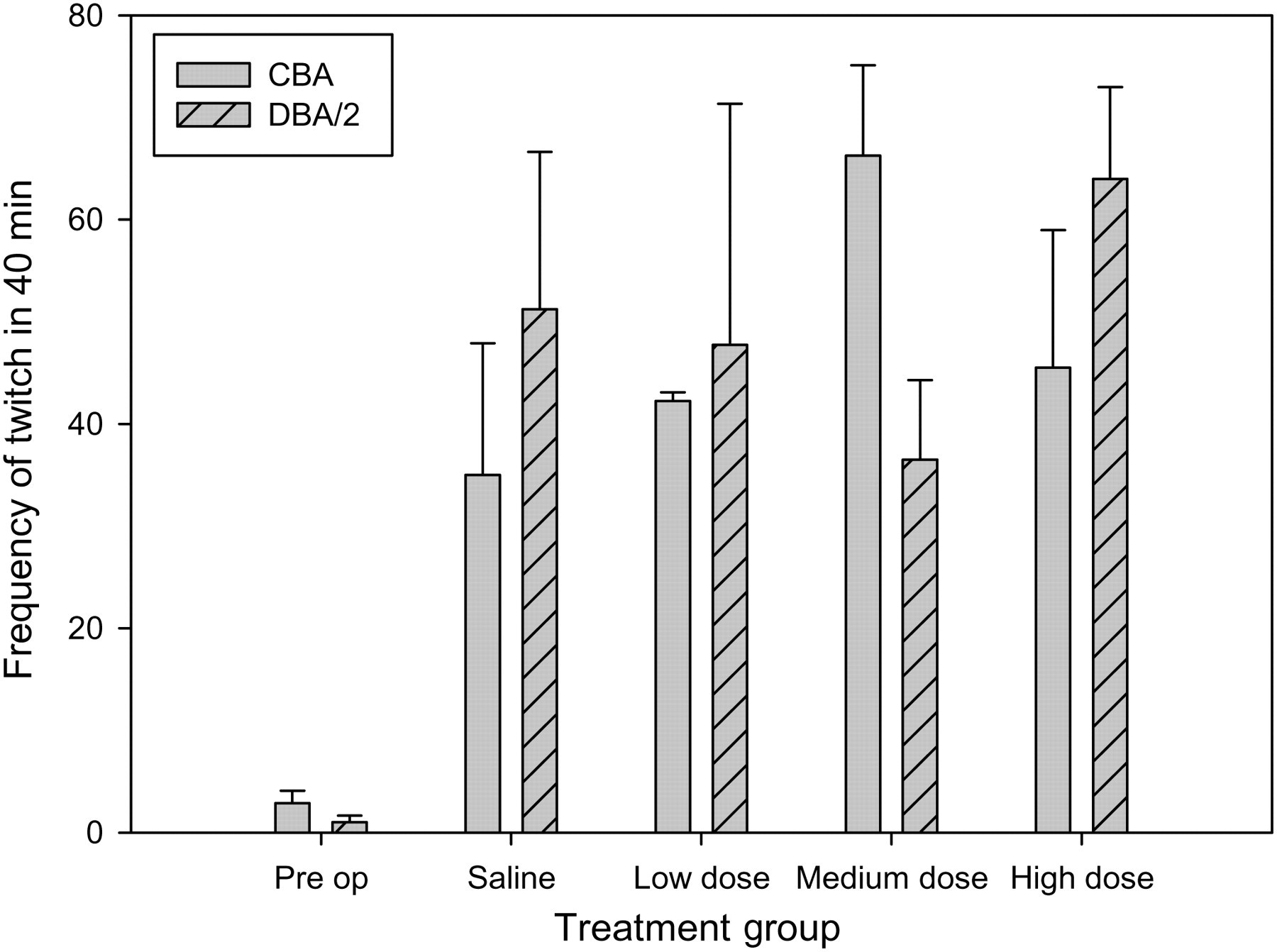
The mean frequency (±SEM) of twitching in CBA and DBA/2 mouse strains during 40 min preoperatively and at one hour postoperatively
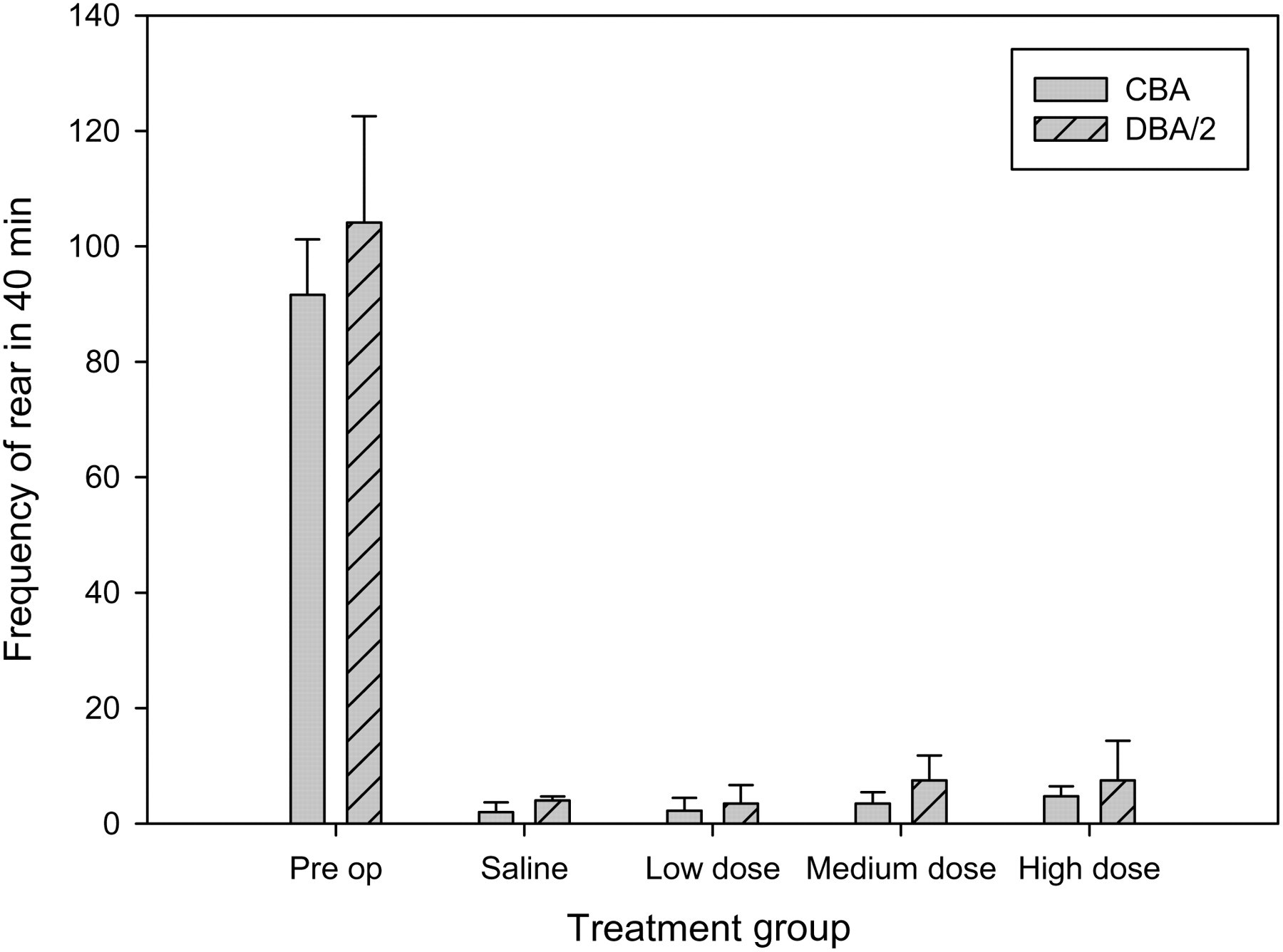
The mean frequency (±SEM) of rearing in CBA and DBA/2 mouse strains during 40 min preoperatively and at one hour postoperatively
P values of those behaviours with statistically significant effects of surgery on behaviour
Effects of treatment
No significant effect of paracetamol treatment was seen for any of the 17 behaviours analysed in either of the strains. In a few of the behaviours, trends were seen indicating a return to the pre-vasectomy score as the dose of paracetamol increased but these were small changes and not statistically significant. For example, the frequency of rearing increased as the dose of paracetamol increased and as the dose of paracetamol increased the duration of pause decreased.
Effect of strain
Of the 17 behaviours, six behaviours were found to differ between the two strains preoperatively and three behaviours were found to differ between the strains postoperatively. Preoperatively the frequency of jumping was found to be significantly higher in the DBA/2JCrl compared with the CBA/CaCrl mice (P = 0.001). The duration of pausing, remaining low, sleeping, stretching and turning were all found to be significantly higher in the CBA/CaCrl mice (P = 0.033, 0.001, 0.040, 0.005 and 0.008, respectively). Postoperatively the duration spent grooming was significantly longer in the DBA/2JCrl mice compared with the CBA/CaCrl mice (P = 0.001) (see Figure 3), whereas the duration spent turning or walk circle combination was significantly longer in the CBA/CaCrl compared with the DBA/2JCrl mice (P = 0.042 and 0.001, respectively).
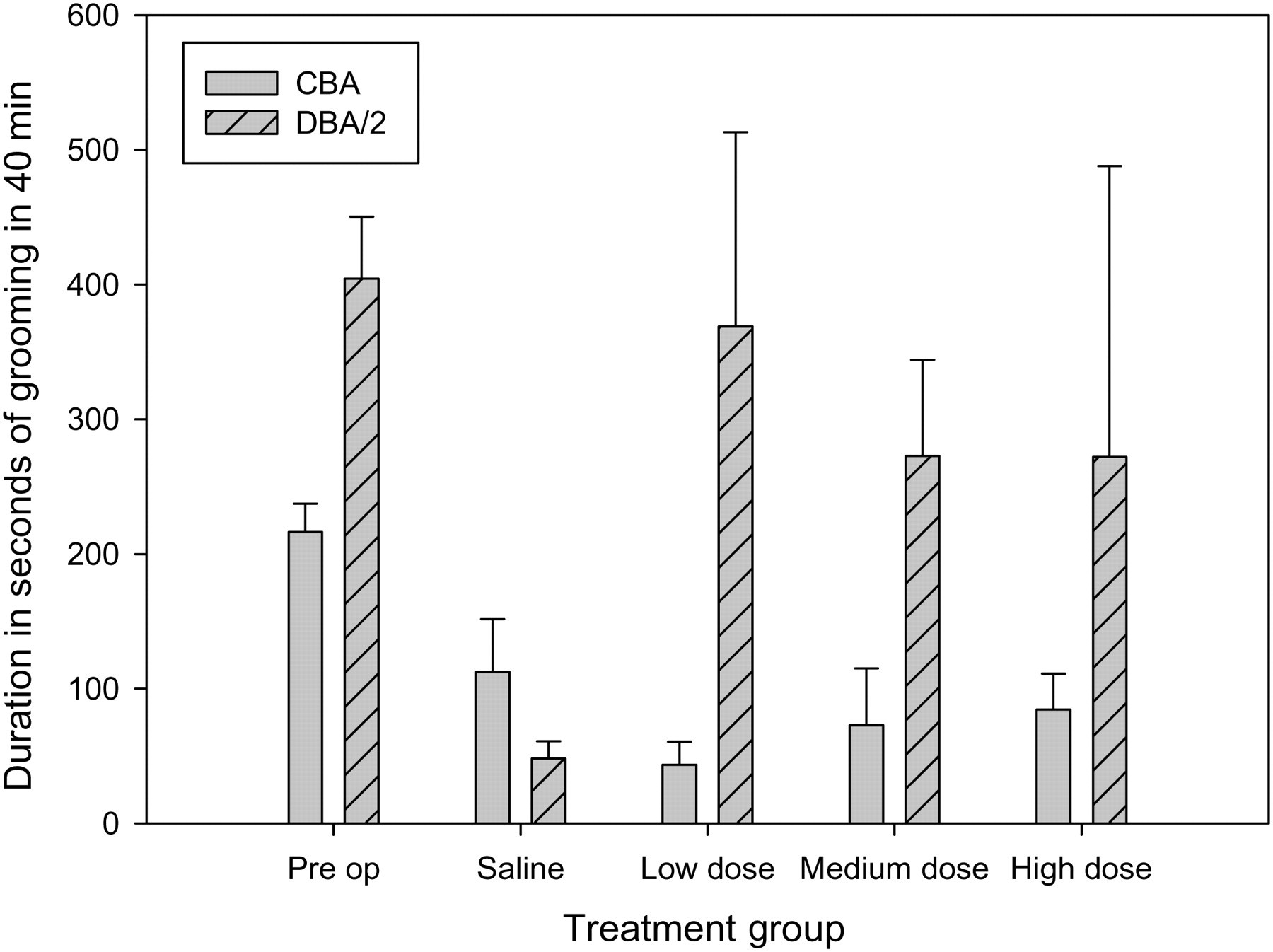
The mean duration (s) (±SEM) of grooming in CBA and DBA/2 mouse strains during 40 min preoperatively and at one hour postoperatively
Discussion
This study has shown that marked changes in behaviour occur in both CBA/CaCrl and DBA/2JCrl mice following abdominal vasectomy, and that the HomeCageScan (Version 3.0, CleverSystems Inc) software has the capacity to identify these changes.
Following surgery an increase in the frequency or duration of a range of behaviours was identified in both strains of mice using this automated behavioural analysis method. Such behaviours included twitch, sleep and pause. A decrease in frequency or duration of other behaviours was also noted in both strains including come down, rear up, sniff and the ‘unknown’ behaviour. This shows a possible range of behaviours that could be used in order to create an accurate pain scoring system. The use of pre-emptive oral paracetamol at any of the doses tested appears to be unsuitable for the management of pain following abdominal vasectomy in either the CBA/CaCrl or DBA/2JCrl mice. No significant differences were observed between the three groups receiving paracetamol for any of the behaviours analysed. It may be that an insufficient dose of paracetamol was administered, but as the highest dose used represents the effective dose (ED) 75 in an acute nociceptive test (246 mg/kg), 11 it is more likely that oral paracetamol does not provide sufficient analgesia for this type of pain in these strains of mice. For a small number of behaviours, the duration or frequency of the behaviour returned toward preoperative levels as the dose of paracetamol was increased, but these changes were not significant. For example, the duration of pause and frequency of rearing (see Figure 2). Therefore, a different analgesic or higher dose of oral paracetamol is required to control and alleviate pain in CBA/CaCrl and DBA/2JCrl mice following abdominal vasectomy. The use of a sham (saline) control group in this study raises important animal welfare concerns. Whenever possible, a positive (analgesic treated) control group should be used; however this can make interpretation of the results of the study difficult, particularly when investigating a particular mouse strain for the first time, or when using novel methodology. In this study, as in others we have conducted, an intervention protocol was used, so that animals showing signs of pain that were apparent to a human observer were withdrawn from the study and given rescue analgesia. To avoid prolonged postoperative pain or discomfort, all animals were given a presumed ED of carprofen.
This study showed that the frequency or duration of a range of behaviours was altered following vasectomy in both CBA/CaCrl and DBA/2JCrl mice. Previous studies in the laboratory have shown that such changes in behaviour do not occur as a result of the period of anaesthesia which the mice underwent, 8 indicating that the surgery is the source of the change. It was found that the changes in behaviour had varying levels of significance between the strains. This may be due to a difference in sensitivity between strains to this type of pain, a difference in the way pain is exhibited between the strains, or that some behavioural indicators of pain and distress are easier to identify than others, which may vary across the strains. As many laboratory rodents undergo surgery, as part of routine research practices, pain alleviation is essential. Reports of decreased feeding when pain is present 12 is an example where effects such as weight loss following surgery could lead to a decrease in health and welfare of the animal, increase the recovery time and have implications for data collected during studies. It is also important that administration of analgesic agents does not compromise research studies. Ensuring that a wide range of analgesic treatments are available makes selection of an appropriate agent less problematic in those instances where significant interactions could occur. Hayes et al. 13 used telemetry-derived locomotor activity to assess the analgesic efficacy of paracetamol administered in drinking water. They showed the marked reduction in water consumption that occurred postoperatively resulted in estimated consumptions of approximately 64 mg/kg of paracetamol over 24 h. This is well below the ED for paracetamol in antinociceptive tests, 4,11,14 and may account for the lack of efficacy. However, the present study suggests that, even at doses that would be predicted to be effective, paracetamol is unable to provide sufficient postsurgical analgesia to significantly reduce the behavioural effects of vasectomy surgery.
Successful pain control requires that analgesics are administered at the appropriate dose; however, this can only be achieved if the efficacy can be assessed in individual animals. Behavioural assessment of pain in mice is not straightforward and so a ‘standard’ dose of analgesic may be administered on the assumption that this will provide effective analgesia in the majority of animals. However, strain differences have been detected both in nociceptive thresholds and in the antinoceptive effects of analgesics. 15 Genotype can significantly influence the behavioural response of mice to a noxious stimulus 16 and, as shown in this and previous studies 5 , also influences postoperative behaviour and the response to analgesic treatment. It is therefore important that strain variation must be anticipated, and ideally assessments made of the individual animals involved in a potentially painful procedure. This makes the task of developing a practical pain scoring system even more challenging; however, HomeCageScan appears to have great potential for use in developing such systems due to the speed and accuracy with which it can analyse rodent behaviour.
Footnotes
ACKNOWLEDGEMENTS
The authors thank Charles River UK for supply of the animals, the staff of the Comparative Biology Centre for technical support and Jon Gledhill for his assistance with filming. Amy Dickinson continues to be funded by the BBSRC and Pfizer Global Research & Development.