






Abstract
A structured literature review was carried out to assess recent trends in the administration of analgesics and anaesthetics to laboratory rats and mice undergoing surgical procedures. The ScienceDirect database was used to systematically identify studies published in peer-reviewed journals over two periods (2000–2001 and 2005–2006), 86 studies from each time period were included in the review. The total number of animals that underwent surgery, species used, type of procedure, anaesthetic regimen and analgesic administration were noted for each study. There was an increase in the reported administration of systemic analgesics from 10% in 2000–2001 to 20% in 2005–2006. Buprenorphine was the most commonly reported analgesic in both periods (2000–2001: 78%, 2005–2006: 35%) and reporting the use of non-steroidal anti-inflammatory drugs increased from 11% to 53%. There was also a change in reported anaesthetic practices, notably a decrease in the use of pentobarbital and an increase in the use of isoflurane and ketamine/xylazine. Although reported administration of analgesics has increased and there has been some refinement in the selection of anaesthetic agents used, the findings of this review suggest that there is still significant scope for improvement with respect to the perioperative care of laboratory rodents.
It is widely accepted that when animals are used in experimental procedures, then measures should be taken to minimize pain and distress. 1–3 Pain and distress in animals undergoing surgical procedures can be alleviated by providing appropriate perioperative care, which includes the administration of effective anaesthetic and analgesic agents. Although there is a general consensus that one should attempt to alleviate the pain that may be associated with experimental surgery in animals and some studies suggest that analgesics are routinely administered, 4,5 the administration of analgesics to laboratory rodents is often not reported in peer-reviewed journals. In an earlier literature review carried out by our group we found that the administration of a systemic analgesic agent was reported in only 14% of studies published between 2000 and 2002 that involved laboratory rodents undergoing potentially painful experimental procedures. 6 In this previous study, we concluded that in the majority of cases, analgesics were withheld rather than analgesic administration being under-reported based on follow-up email inquiries to study authors and institutional veterinarians.
A criticism of this earlier study was that the search strategy was unbalanced and therefore certain areas of research, for example transplantation research, could have been over-represented. In this review, a more structured search strategy was used to identify areas of research where rodents may undergo recovery surgical procedures. Here, 86 studies published between 2000 and 2001 have been identified from a wide range of fields including pharmacology, surgical research, physiology, neuroscience, immunology and cancer research. Eighty-six papers from these fields published between 2005 and 2006 have also been reviewed to examine changes in the perioperative care of laboratory rodents over these 5 years.
Materials and methods
Search strategy
The ScienceDirect online database (
Once potential journals were selected, the ScienceDirect database was again used with the key terms ‘rodent’ and ‘surgery’ to search the full text of articles published within the journals. The target for each time period was to find 10 papers from each journal that met inclusion criteria (see below). If 10 papers could not be found using these key terms, the terms ‘rat’ and ‘surgery’ and the terms ‘mice’ and ‘surgery’ were used. If a single journal contained less than the target of 10 relevant papers, the key terms were used to search multiple journals within a field of research (e.g. immunology).
Where more than 10 appropriate papers in a single journal were identified from the database, each paper was given a number (based on the ScienceDirect display either by date or by relevance) and a random number generator was used to select 10 of these papers. Similarly, when there were less than 10 relevant studies in one period and over 10 in the other time period, a random number generator was used to select an equal number of papers from the time period with more relevant papers.
Inclusion criteria
A paper was eligible for inclusion if it involved the use of rats or mice undergoing experimental surgical procedures under general anaesthesia with a postoperative recovery period of at least 24 h. All papers included in this review had methods that were described in detail. Papers that: (i) described multiple studies on different species of animals; (ii) described fetal surgery; (iii) described neuropathic models of pain and (iv) stated the efficacy of analgesia following surgery as the purpose of the study was excluded. Review articles, abstracts, letters and meta-analyses were also excluded.
Classification
The classification of the severity of the experimental procedure was based on criteria used in our earlier literature review, 6 also similar to the classification of the pain potential described by the American College of Laboratory Animal Medicine (ACLAM) Analgesic Task Force. 7 Each paper was classified into one of the five categories: craniotomy, skin incision, laparotomy, thoracotomy or orthopaedic study. Thoracotomies and orthopaedic procedures were considered to be the most potentially painful procedures, laparotomies were considered to be slightly less potentially painful and skin incisions and craniotomies were considered to be the least potentially painful.
The number of animals that underwent surgery in each study (‘study size’), anaesthetic and analgesic regimens were noted. Classification of systemic analgesics was based on Lamont and Matthews 8 where opioids and non-steroidal anti-inflammatory drugs (NSAIDs) were classified as systemic analgesic agents. The dose rate, duration, frequency and time of analgesic administration were noted when specified. The use of local anaesthetic agents was also noted. Anaesthetic agents were also classified according to whether they contained an analgesic component. Animals anaesthetized with a dissociative anaesthetic agent (ketamine or tiletamine) and/or an alpha2 agonist (medetomidine or xylazine) were classified as having ‘an anaesthetic regimen with an analgesic component’. Similarly, animals anaesthetized with an anaesthetic combination that included a fentanyl component were also considered to have received an analgesic component in their anaesthetic. Fentanyl was not classified as a systemic analgesic because of its short-acting effect, 8 and therefore it is typically given as a component of an anaesthetic regimen, rather than as a systemic analgesic in rodents.
Statistics
All statistical analyses were conducted using SPSS software (SPSS 14.0 statistical package for Windows, SPSS Inc, Chicago, IL, USA). Chi-square analyses were used for all comparisons except a Mann-Whitney test was used to compare ‘study size’. A value of P < 0.05 was considered statistically significant.
Results
One hundred and seventy-two papers, 86 from each time period (2000–2001 and 2005–2006) were selected from 10 journals/fields of research for inclusion in this review (Table 1).
Journals included in review classified by species and time period
*Annals of Thoracic Surgery, European Journal of Cardio-Thoracic Surgery, Journal of Cranio-Maxiofacial Surgery, Journal of Gastrointestinal Surgery, Journal of Pediatric Surgery, Journal of Vascular Surgery, Surgery
† Cardiovascular Pathology, Experimental and Molecular Pathology, Experimental and Toxicological Pathology, Oral Surgery, Oral Medicine, Oral Pathology, Oral Radiology and Endodontology
‡ Cellular Immunology, Developmental and Comparative Immunology, Transplant Immunology
Species and number (‘study size’) of animals
More studies describing procedures involving rats compared with procedures involving mice were included in this review for both time periods (Table 1). The median number of animals that underwent a surgical procedure in each study was 40 with a minimum and maximum ‘study size’ of 5 and 300. The number of animals used in the study was not reported in 26 papers. Median ‘study size’ did not vary significantly with either time period or species (Table 2).
Median number of animals used in study classified by species and time period
The minimum and maximum ‘study size’ are indicated in parentheses n: number of papers that specified ‘study size’
Analgesic administration
There was an increase in the reported administration of systemic analgesics from 10% in 2000–2001 to 20% in 2005–2006. When systemic analgesia was not reported, there was an increase in the use of anaesthetic regimens with an analgesic component between the time periods from 28% to 34%. There was a decrease in the use of local anaesthetic agents between the time periods. Five papers from 2000–2001 specified the application of a local anaesthetic to the surgical site (3 rat craniotomies, 1 rat laparotomy and 1 mouse laparotomy), however, none of the papers from 2005 to 2006, reported the use of a local anaesthetic agent. Neither reported systemic analgesic administration nor total analgesic administration varied significantly between time periods. Table 3 shows analgesic administration classified by the species that underwent surgery.
Number of papers included in survey specifying analgesic administration classified by species and time period
Percentages of papers specifying analgesic administration are given in parentheses. n: number of papers included in survey
Buprenorphine was the most commonly reported systemic analgesic both in 2000–2001 (78%) and in 2005–2006 (35%) (Table 4). There was a large increase in the reported use of NSAIDs between the two time periods: only one paper reported the use of a NSAID in 2000–2001 (flunixin meglumine was administered), whereas 53% of papers that specified the use of an analgesic in 2005–2006 used NSAIDs (Table 4).
Reported systemic analgesic administration classified by agent
Range of reported doses of systemic analgesics when specified
All information is for rats except buprenorphine where dose ranges for mice are also included
When administration of a systemic analgesic was reported, the dose rate administered was specified in the majority of papers (78% in 2000–2001 and 76% in 2005–2006) (Table 5). The duration of systemic analgesic administration was specified less frequently (Table 6). In 2000–2001, four papers specified the duration of systemic analgesic administration (for 1–5 days) and three papers from 2005–2006 specified the duration of analgesic administration (for 1–2 days). The frequency of analgesic administration was also infrequently specified. When frequency of analgesic administration was specified, it varied from a single dose to repeat administration every 24 h with a dose interval of every 12 h being the most commonly reported (Table 6). Only three papers in the survey, all published between 2005 and 2006, specified the time of systemic analgesic administration. One paper specified postoperative administration and two papers (1 mouse thoracotomy and 1 rat orthopaedic study) specified preoperative administration of systemic analgesia.
Duration, frequency and timing of analgesic administration (if specified) in rats
Multimodal analgesia
There were no papers in the study that described the use of more than one systemic analgesic agent or that described the use of a local anaesthetic agent combined with a systemic analgesic or a general anaesthetic regimen with an analgesic component. Ten papers (9 describing procedures in rats, 1 describing a procedure in mice) included in the survey described the use of a systemic analgesic and an anaesthetic regimen with an analgesic component (2 in 2000–2001 and 8 in 2005–2006).
Classification of procedures
The distribution of procedures included in the review varied slightly between the time periods (Figure 1), but the difference was not statistically significant. In the 2000–2001 papers, systemic analgesics were most commonly administered to laboratory rodents undergoing the most potentially painful procedures (thoracotomies and orthopaedic procedures) compared with less potentially painful procedures (skin incisions and craniotomies). The reported administration of systemic analgesic drugs in the 2005–2006 papers was similar for all procedures and analgesic administration varied from 17% to 27% (Figure 1). The papers included in the survey did not differ significantly between rats and mice when classified according to the potential of the procedure to be painful.
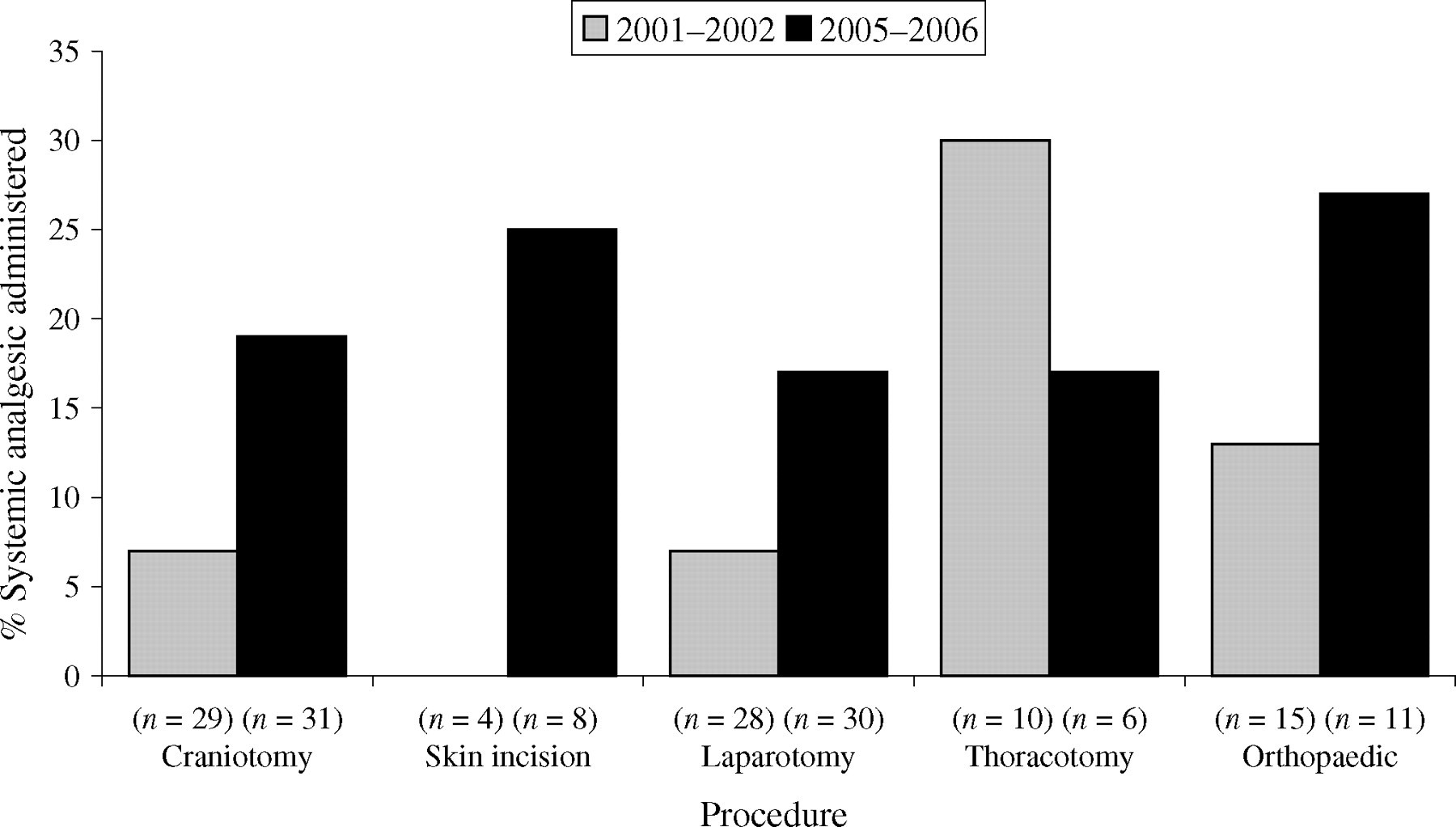
Reported use of systemic analgesics classified by category of procedure. n: number of papers included in literature review
Anaesthetic administration
Pentobarbital was the most commonly used anaesthetic agent in 2000–2001 (Table 7). The use of pentobarbital decreased from 33% in 2000–2001 to 16% in 2005–2006. There was an increase in the use of isoflurane (from 2% to 16%) and in the use of the ketamine/xylazine injectable anaesthetic combination (from 15% to 31%) between the time periods.
Reported anaesthetic regimens
n: number of papers included in the survey. Percentages of papers reporting anaesthetic regimens are given in parentheses. Number of papers included in survey is classified by species and time period
*Methohexital, thiopental, tribomoethanol, chloral hydrate/pentobarbital, pentobarbital/atropine or methohexital/pentobarbital
†Ketamine/xylazine/acepromazine, ketamine/diazepam/atropine or medetomidine/tiletamine/zolazepine
‡Pentobarbital/methoxyflurane, pentobarbital/sevoflurane, chloral hydrate/methoxyflurane, penobarbital/ether, ether or pentobarbital or chloral hydrate/pentobarbital/isoflurane
Discussion
The reporting of the administration of systemic analgesic drugs to laboratory rodents undergoing surgical procedures is increasing. In 1990–1992, only 3% of studies published in peer-reviewed journals reported analgesic administration. 6 Here, we report that in 2000–2001 analgesics were administered in 10% of studies and by 2005–2006, analgesics were reported in 20% of studies. Unfortunately however, the majority of papers that describe potentially painful procedures on laboratory rodents still do not report systemic analgesic administration.
Although more studies involving laboratory rats were included in this survey, compared with studies involving laboratory mice (Table 1), this does not reflect the actual use of laboratory rodents as more mice than rats are used in scientific procedures in the UK 9 and worldwide. 10 Because of their size, rats may be preferable to mice for certain surgical procedures 11 and our search strategy may also have resulted in the inclusion of more rat studies compared with mouse studies, because of the large proportion of murine studies that involve the production of genetically-altered animals. In 2006, 47% of all mice used in scientific procedures in Great Britain were genetically modified. 9 The production of transgenic mice typically involves the use of standardized surgical procedures that would not be normally described in peer-reviewed journals, for example embryo transfer and vasectomy procedures, which are likely to be painful. 12,13
Analgesic administration did not differ significantly between species, however this may have been due to the relatively small sample size of papers describing surgical procedures in mice in this study and therefore a different search strategy would be necessary to identify species differences. Similarly ‘study size’ did not differ significantly with either time period or species (Table 2), but this may also have been due to the small sample size of murine papers in the survey and the short interval (5 years) separating the two time periods. Previous studies that examined papers over a longer time period have reported a decrease in the number of animals used per published paper (for example Carlsson et al. 14 ).
It was encouraging to note that when administration of a systemic analgesic was reported, most papers specified a dose rate (Table 5) and reported dose rates were typically within the range recommended for rodents (see for example Flecknell et al. 15 ). Buprenorphine was the most commonly used systemic analgesic in both time periods (Table 4) as had been previously reported in a survey of laboratory animal veterinarians 16 and in an earlier literature review. 6
Unfortunately, several of the findings from this survey suggest that analgesic administration in laboratory rodents is still not optimal. With the exception of combining a systemic analgesic with an anaesthetic regimen with an analgesic component, none of the papers included in the survey reported the use of administration of multimodal analgesia. Similarly, only two of the papers in the survey specified the administration of preoperative analgesia. Recommendations for improving the management of pain in rodents based on the existing literature are presented in Table 8.
Recommendations for the alleviation of pain in laboratory rodents
Footnotes
ACKNOWLEDGEMENT
CR was supported by a 3Rs Liasion Group Research Studentship from UFAW.