






Abstract
Summary
The aim of this study was to determine the changes in minimal alveolar concentration (MAC) of isoflurane after treatment with medetomidine and tiletamine/zolazepam (MTZ), epidural morphine or systemic buprenorphine in 11 healthy crossbred pigs. The first part of this study was to measure the baseline values in pigs induced with isoflurane (5%) by face mask and maintained with isoflurane in air and oxygen for 2 h (ISO). Baseline isoflurane MAC was determined using mechanical stimulation. Thereafter, each pig was randomly chosen for a crossover test in which the same animal received three different treatments with at least one week in between treatments. The three treatments were as follows: induction of anaesthesia with medetomidine (0.05 mg kg–1) and tiletamine/zolazepam (2.5 mg kg–1 each) given intramuscularly (MTZ); MTZ followed by epidural morphine (0.1 mg kg–1; MTZ/M); and MTZ followed by intramuscular buprenorphine (0.1 mg kg–1; MTZ/B). All pigs were maintained with isoflurane in oxygen and air for 2 h and their lungs were mechanically ventilated. The end-tidal isoflurane concentration, respiratory rate, inspiratory and expiratory O2 and CO2 concentrations, heart rate (HR) and arterial blood pressure were recorded every 10 min. Arterial blood gases were analysed every 20 min. Among the treatment groups, differences in isoflurane MAC were tested using GLM and Tukey's method for further comparison; P < 0.05 was adopted as significant. Isoflurane MAC was 1.9 ± 0.3%. MTZ reduced isoflurane MAC to 0.6 ± 0.1%. Additional morphine or buprenorphine reduced the MTZ isoflurane MAC further to 0.4 ± 0.2 and 0.3 ± 0.1%, respectively. During MTZ, MTZ/M and MTZ/B mean arterial blood pressure was higher and the alveolar-arterial oxygen tension difference was lower compared with ISO. In conclusion, induction of anaesthesia with MTZ reduced the isoflurane MAC in pigs by 68%. Additional epidural morphine or systemic buprenorphine decreased MTZ isoflurane MAC by 33 and 50%, respectively.
Pigs are commonly used as research animal models, but they are considered to be difficult to restrain and anaesthetize when compared with other animals (Ko et al. 1993, Nishimura et al. 1993, Henrikson et al. 1995). To promote an easy and smooth induction of anaesthesia in pigs the use of injectable agents is generally required (Ko et al. 1993, Nishimura et al. 1993).
It is well known that premedication with sedative drugs reduces stress both during induction and maintenance of anaesthesia (Ewing et al. 1993, Muir III et al. 1999, Benson et al. 2000). Also, in other animal species it has been reported that analgesics administered as anaesthetics adjuncts decrease the requirement of volatile anaesthetics and thus reduce the dose-dependent cardiopulmonary depression (Ewing et al. 1993, Bettschart-Wolfensberger et al. 2001, Greene et al. 2003). Medetomidine is an α2-adrenoceptor agonist that has been reported to provide potent analgesia, muscle relaxation and anxiolysis in dogs (Thurmon et al. 1994), cats (Smith et al. 2004), ponies (Bettschart-Wolfensberger et al. 2001) and pigs (Nishimura et al. 1993, Tendillo et al. 1996). Tiletamine/zolazepam are available in a drug combination of 1:1 for intramuscular (IM) or intravenous (IV) administration and produces sedation and anaesthesia in many species e.g. in dogs (Jang et al. 2004), cats (Hellyer et al. 1988), calves (Lin et al. 1989), goats (Doherty et al. 2002) and pigs (Henrikson et al. 1995).
It has been suggested that combining drugs used to induce anaesthesia with potent analgesics such as opioids enhances the reduction of the volatile anaesthetic requirement and decreases the postoperative recovery time (Vaida et al. 2000). Morphine and buprenorphine are opioids that are often used in research involving pigs. Furthermore, these opioids have been reported to decrease minimum alveolar concentration (MAC) of the volatile anaesthetic when given preoperatively in many species (Valverde et al. 1989, Steffey et al. 1994, Doherty et al. 2002). For instance, epidural morphine has been reported to reduce MAC of halothane in dogs (Valverde et al. 1989), ponies (Doherty et al. 1997) and the requirement of isoflurane in pigs (Malavasi et al. 2006). Treatment with IM buprenorphine has been reported to reduce the MAC of halothane in humans (Inagaki & Kuzukawa 1997).
The hypotheses tested in the present study were: first, whether induction of anaesthesia with medetomidine and tiletamine/zolazepam (MTZ) reduces isoflurane MAC; and second, whether the addition of either epidural morphine or systemic buprenorphine to growing pigs anaesthetized with medetomidine plus tiletamine/zolazepam causes a further reduction on isoflurane. Thus, the aims of this study were to determine and compare the changes in MAC of isoflurane in pigs after treatment with MTZ, epidural morphine or systemic buprenorphine, as well as to evaluate the cardiopulmonary effects of these drugs.
Material and methods
Animals
The study was approved by the Ethics Committee for Animal Experiments, Uppsala, Sweden. Determination of MAC values was performed in 11 crossbred pigs (Swedish Landrace × Yorkshire) purchased from a conventional herd. On arrival, the pigs were five weeks old and clinically healthy, and there were five male and six female pigs. They were divided into two groups and housed at the Department of Obstetrics and Gynaecology, in two large pens (~10.5 m2 each) with a solid concrete floor and with straw as a bedding material. The pigs were fed twice daily (08:00 and 15:00 h) with 3 kg/day of a commercial finisher diet (Singel Flex®, Odal, Sweden) and had free access to water. The pigs were allowed a two-week acclimatization period before the start of the experiment.
Experiment was performed with pigs weighing 26 ± 3 kg. The first part of this study consisted of measuring the baseline values of MAC by inducing the animals with isoflurane by face masks and the anaesthesia was maintained for 2 h (ISO). Afterwards, the pigs were randomly chosen for a crossover test in which the same animal received three different treatments: induction with MTZ; induction with MTZ with epidural morphine (MTZ/M); and induction with MTZ with IM buprenorphine (MTZ/B).
After the conclusion of the experiment all animals were euthanized. The protocol for this procedure was the IM injection of MTZ, at the same dosage given above; afterwards an IV administration of potassium chloride was given until no vital signs were detectable.
Anaesthesia and analgesia
Before anaesthesia, the pigs were fasted for 12 h, but had free access to water. The total duration of the experiment was seven weeks and there was at least one week of washout between anaesthetic events.
Each pig was induced with both medetomidine (0.05 mg kg–1; Domitor®vet 1 mg mL–1; Orion, Espoo, Finland) and tiletamine/zolazepam (2.5 mg kg–1 each; Zoletil forte vet; Virbac, Carros, France) IM in groups MTZ, MTZ/M and MTZ/B or using isoflurane alone in group ISO (IsoFlo vet; Orion Pharma Animal Health; Sollentuna, Sweden) delivered via a face mask at 5%. After tracheal intubation, anaesthesia was maintained with isoflurane in oxygen and air (inspired oxygen 50%; vaporizer Isotec 5; Datex-Ohmeda, Helsinki, Finland) using a small animal anaesthetic circle system. Ventilation was controlled to maintain the end-tidal CO2 between 5.5–6.0 kPa. All pigs were placed in ventral recumbency during instrumentation and anaesthesia was maintained with 2% isoflurane.
A 22-gauge catheter (BD Venflon; Helsingborg, Sweden) was placed in one ear artery, for blood sampling and monitoring and another was placed in the opposite ear vein, for administration of IV fluids. An electrolyte solution (Rehydrex with glucose 25 mg mL–1, Fresenius Kabi AB, Uppsala, Sweden) was administered at a rate of 5 mL kg–1 h–1. The epidural morphine in the MTZ/M treatment was given, immediately after stabilization of anaesthesia, at a dose of 0.1 mg kg–1 (Morfin epidural 2 mg mL–1, Pharmacia & Upjohn, Stockholm, Sweden) according to the technique recommended by Strande (1968). The dosage of anaesthetic drug administered to the pig was related to the length of the vertebral column. The vertebral length was measured with a standard measuring tape from the external occipital protuberance to the first coccygeal vertebra. To administer the drug, a needle of 6–8 cm length and 1.2–1.3 mm diameter was utilized, and applied on the large interarcute space between vertebrae L7 and S1. The needle was applied at a 90° angle to the back of the animal for injection of the analgesic. For maximal distribution of the drug into the spinal channel, the anaesthetic agent was diluted with saline to a final dosage of: 1mL of solution in a pig up to 40 cm of vertebral length; and an additional 1.5 mL of solution for every additional 10 cm of vertebral length (Strande 1968). The final volume was applied slowly at an interval of 1–2 min. For treatment MTZ/B, buprenorphine was administered at the dose of 0.1 mg kg–1 (Temgesic® 0.3 mg mL–1; Schering-Plough, Brussels, Belgium), immediately after stabilization of anaesthesia, injected intramuscularly in the neck. Ten to fifteen minutes after the instrumentation and administration of additional treatment, all pigs were placed in dorsal recumbency. Anaesthesia was then maintained with an end-tidal concentration of 1.5% isoflurane in the groups MTZ, MTZ/M and MTZ/B and with an end-tidal concentration of 2% isoflurane in the ISO group for 20 min before starting MAC determination.
The anaesthetic recovery of the pigs was not evaluated because it was not the objective of this study.
Physiological monitoring
The pigs were weighed before each treatment and monitored continuously and recorded every 10 min throughout the general anaesthesia. When noxious stimuli was evoked (i.e. every 20 min) the physiological parameters were then recorded afterwards. The parameters included: respiratory rate (fr); tidal volume (VT); expired minute ventilation (VE); inspired oxygen fraction (FIO2); end-tidal carbon dioxide concentration (ETCO2); end-tidal isoflurane concentration (ETiso) (Capnomac Ultima; Datex-Ohmeda, Helsinki, Finland); oxygen saturation of haemoglobin (O2-sat Hb); HR (Cardiocap II; Datex, Helsinki, Finland); and invasive arterial blood pressure, which was measured through an auricular catheter (mean pressure, ABPm) connected to a transducer (Sirecust 730; Siemens-Elema, Solna, Sweden).
Every 20 min, immediately before the provocation of noxious stimuli, blood samples were collected from the auricular artery for analysis of arterial carbon dioxide tension (PaCO2), oxygen tension (PaO2) and pH (ABL™ 5; Radiometer Medical A/S, Copenhagen, Denmark). Rectal temperature was measured with a digital rectal thermometer at the same time as the blood sampling.
The following calculation for alveolar oxygen partial pressure (PAO2) was made using values from blood gas analysis collected during the experiment (Lentner 1990).
PAO2 [kPa] = PIO2 [kPa] – PaCO2/0.8 (respiratory exchange ratio), where PIO2 is a partial pressure of inspired O2.
Afterwards, it is possible to calculate the alveolar-arterial oxygen tension difference (P(A–a)O2) by subtracting PaO2 from PAO2.
MAC determination
The isoflurane MAC was evaluated by observing the responses to noxious stimuli (i.e. response versus no response) obtained by application of a digital caliper square (Digimatic caliper; Mitutoyo Corporation; Kanagawa, Japan). The caliper square was applied, randomly at each moment, to a claw just below the coronary band or to an interdigital space from the hindlimbs of the pigs. To provoke noxious stimuli the caliper square was closed tightly to decrease the total thickness by 20% of the claw and 55% of the interdigital space. The noxious stimulus was applied to a different claw or interdigital space after a 20 min equilibration period. The claw and interdigital space were stimulated for a maximal time of 60 s or until a purposeful movement occurred. A purposeful movement was defined as a retracting movement of the leg or shaking of the head.
For the MAC determination, the isoflurane concentration was recorded by observing the end-tidal concentration (ETiso) of each animal. During the determination of the baseline isoflurane, MAC (ISO) ETiso was increased by 0.1%, from the initial 2% isoflurane, if a purposeful movement was observed. Otherwise, with the absence of such movements the ETiso was decreased by 0.1%. Based on earlier observations of the requirement of isoflurane concentration during surgery the stepwise increase or decrease in isoflurane concentration was 0.2%, from the initial 1.5% isoflurane, at treatments MTZ, MTZ/M and MTZ/B. Therefore, after observing the ETiso that permitted a purposeful movement during these groups the isoflurane concentration was then increased by 0.1% to determine the lowest concentration preventing the response. The determination of isoflurane MAC was performed during 2 h of general anaesthesia in all animals. The ETiso value midway between these determinations was recorded as the isoflurane MAC for each pig.
Statistical analysis
All results were analysed with statistical software (Minitab, Inc, State College, PA, USA; and SAS Institute Inc, Cary, NC, USA) and the results are given as mean ± SD. Differences were considered significant when P < 0.05. Isoflurane MAC values (ISO) and cardiovascular and respiratory variables were compared with those obtained during MTZ, MTZ/M and MTZ/B anaesthesia using the general linear model. When significant effects were detected, pair-wise post hoc comparisons were made, using Tukey's honestly significant difference method. The cardiorespiratory effects of each treatment were also analysed at isoflurane MAC (over 2 h of general anaesthesia) using repeated measures analysis of variance.
Results
Physiological parameters
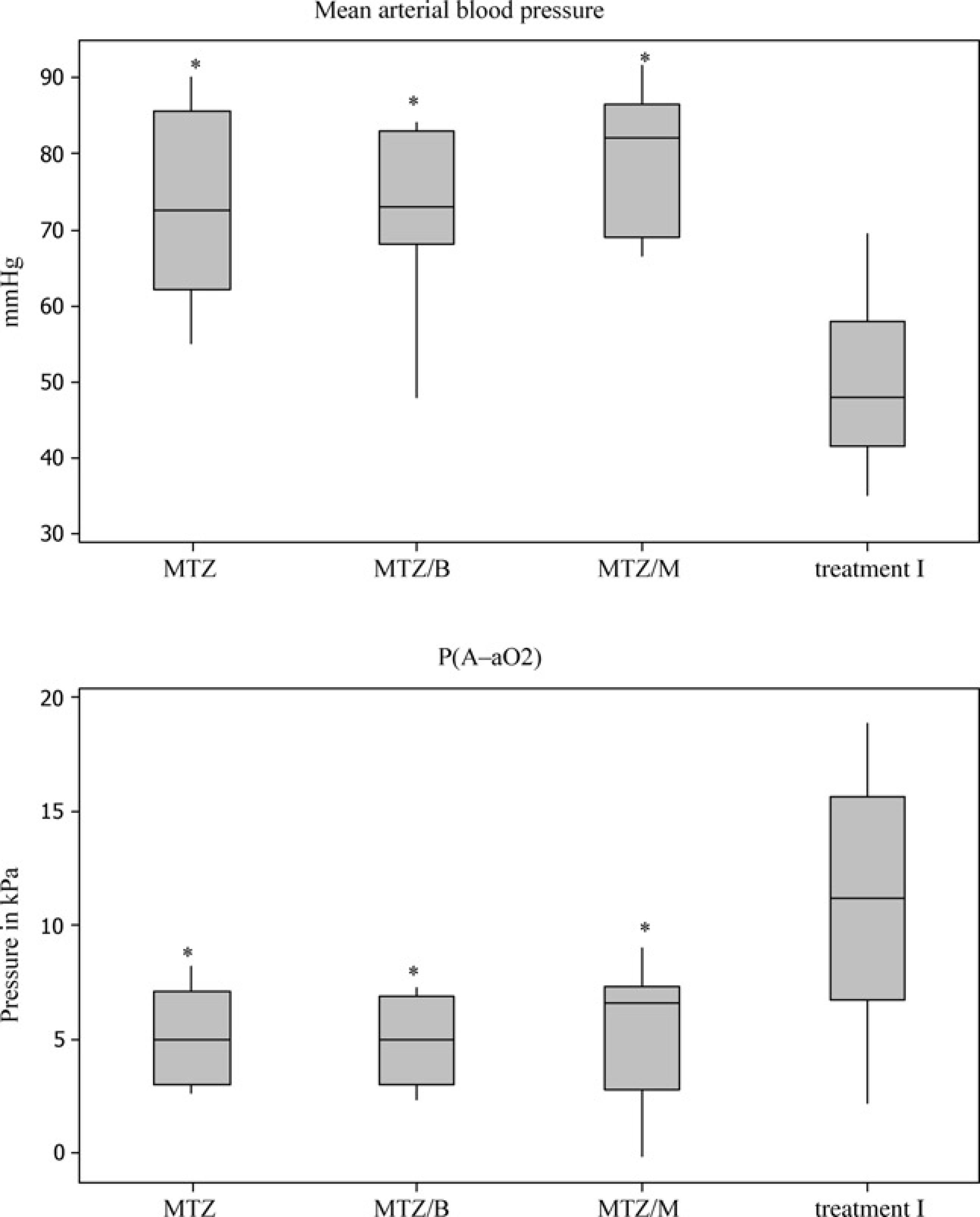
Mean arterial blood pressure was significantly lower (Figure 1) and alveolar-arterial oxygen tension difference was significantly higher (Figure 1) when isoflurane was used alone (ISO). At group ISO, mABP was 51 ± 12 mmHg whereas treatments MTZ, MTZ/M and MTZ/B resulted in mABP of 73 ± 12 mmHg, 79 ± 9 mmHg and 72 ± 10 mmHg, respectively. In the group ISO P(A–a)O2 was calculated to 11.2 ± 5.3 kPa compared with 5.2 ± 2.1, 7.4 ± 5.0 and 6.1 ± 4.5 kPa for treatments MTZ, MTZ/M and MTZ/B, respectively. During the 2 h of general anaesthesia HR changed significantly over time (Figure 2). The HR decreased significantly after treatment with an additional morphine in combination with MTZ. The other cardiovascular and respiratory variables did not differ significantly between treatments.
Individual isoflurane concentration (%) at minimal alveolar concentration (MAC) for treated pigs after induction of anaesthesia produced by isoflurane via face masks (treatment I) or with medetomidine and tiletamine/zolazepam (MTZ) given intramuscularly. The isoflurane concentration (%) at MAC after induction by MTZ given intramuscularly (MTZ), MTZ followed by epidural morphine (MTZ/M) and MTZ followed by intramuscular buprenorphine (MTZ/B) Box plots on mean arterial blood pressure (mmHg) and arterial oxygen pressure (kPa) in pigs after induction of anaesthesia produced by isoflurane via face masks (treatment I), medetomidine and tiletamine/zolazepam (MTZ) given intramuscularly, MTZ followed by epidural morphine (MTZ/M) and MTZ followed by intramuscular buprenorphine (MTZ/B). (*) indicates a significant difference from baseline when minimal alveolar concentration was determined (treatment I)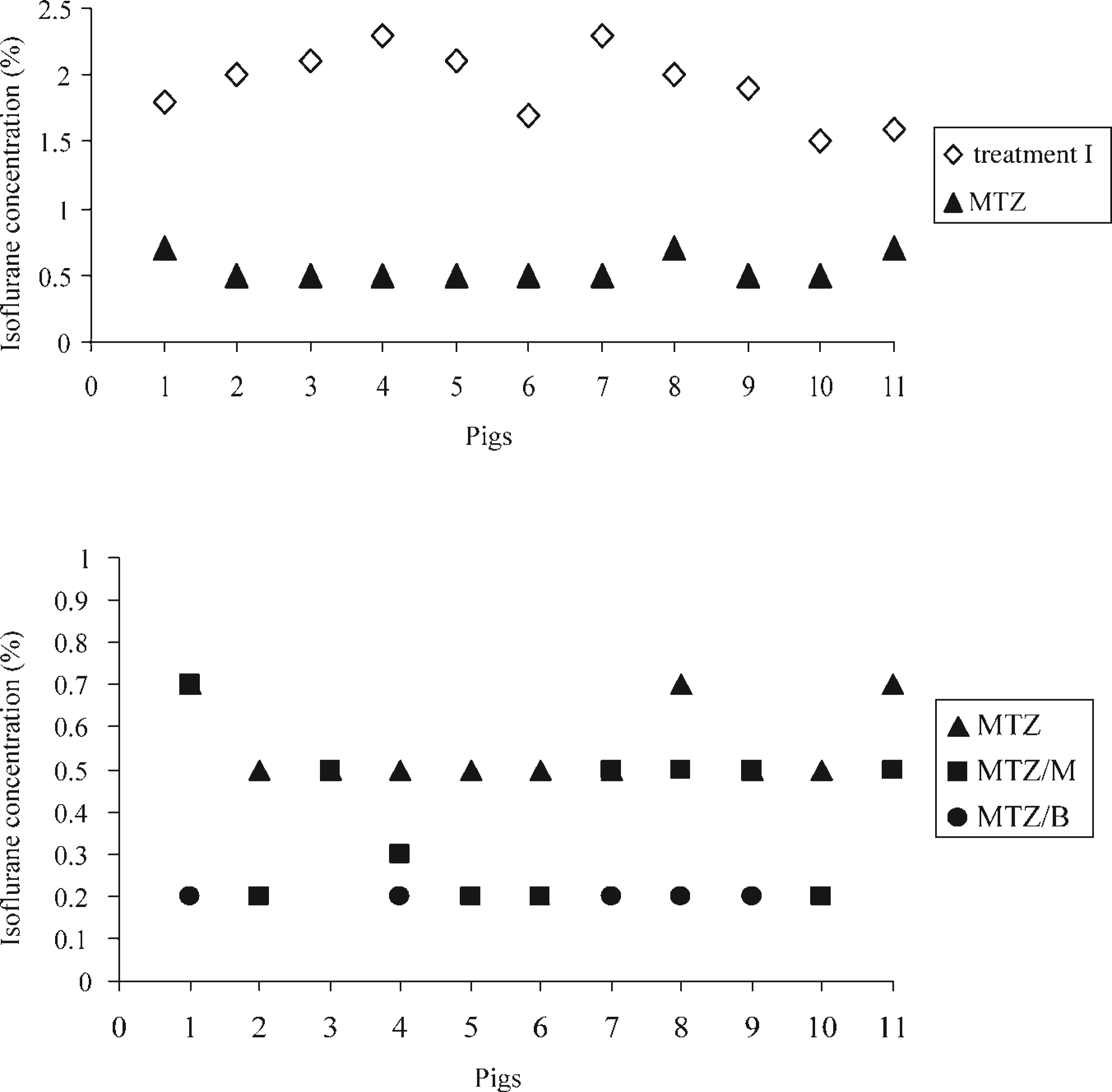
MAC determination
During the measurement of isoflurane MAC (ISO) the mean value in pigs was 1.9 ± 0.3% (Figure 3). Induction of anaesthesia with the IM combination of MTZ significantly reduced the isoflurane MAC to 0.6 ± 0.1% (Figure 3). In pigs treated additionally with epidural morphine isoflurane MAC was reduced to a mean of 0.4 ± 0.2%. Also, IM buprenorphine reduced isoflurane MAC to 0.3 ± 0.1%.
The changes in heart rate (beats/min) and mean arterial blood pressure (mmHg) over time in pigs after induction of anaesthesia produced by isoflurane via face masks (treatment I), medetomidine and tiletamine/zolazepam (MTZ) given intramuscularly, MTZ followed by epidural morphine (MTZ/M) and MTZ followed by intramuscular buprenorphine (MTZ/B)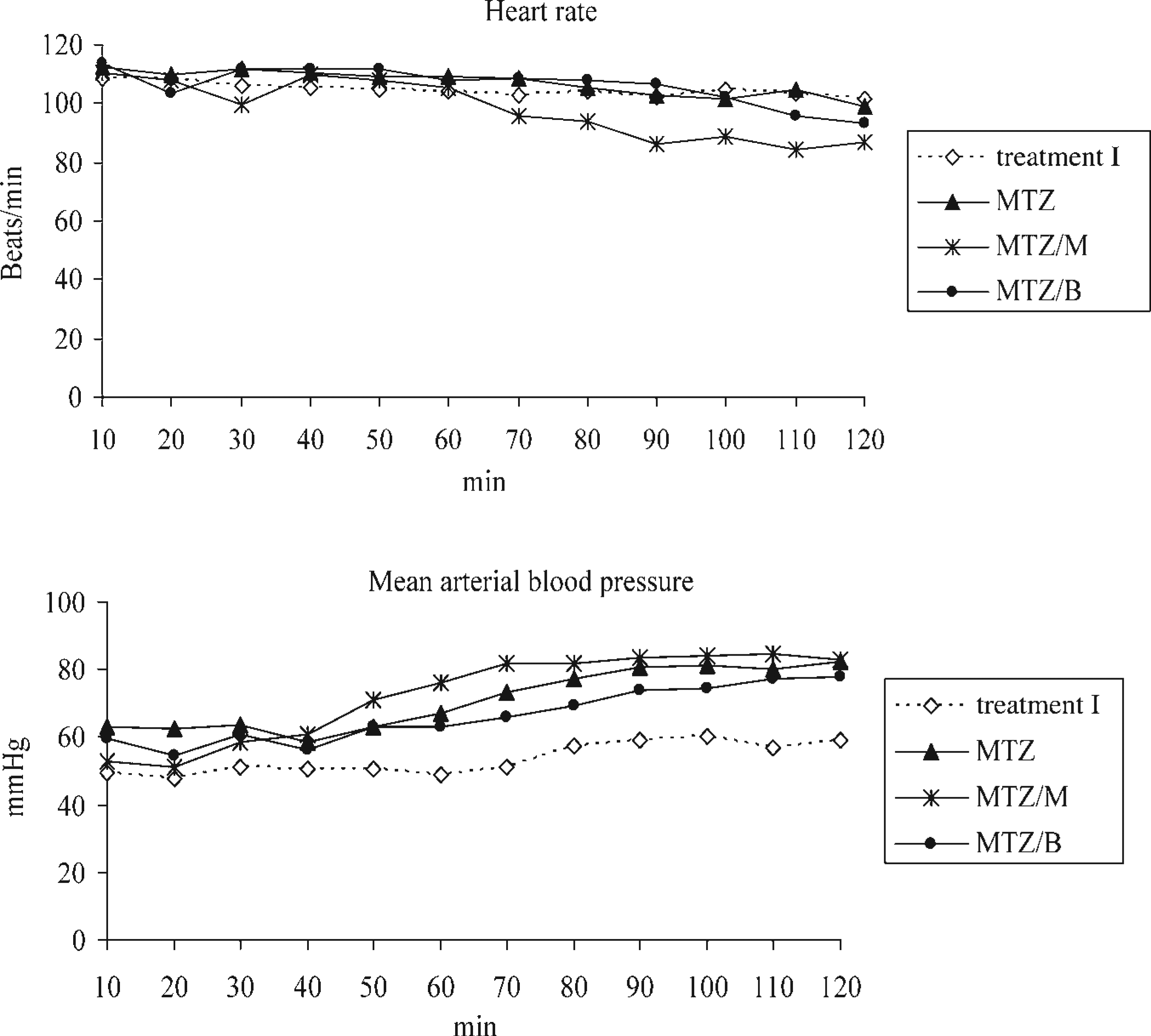
Discussion
In the present study, the isoflurane MAC was reduced by 68% when anaesthesia was induced with the combination MTZ compared with face mask induction and maintenance of anaesthesia with isoflurane as a unique anaesthetic. Furthermore, epidural morphine (0.1 mg kg–1) and IM buprenorphine (0.1 mg kg–1) reduced the isoflurane MAC of MTZ by 33 and 50%, respectively. Medetomidine (0.03 mg kg–1) alone has been reported to reduce the isoflurane MAC by 47% in dogs (Ewing et al. 1993). Tiletamine/zolazepam has also been described to reduce the isoflurane MAC by 29% (0.55 mg kg–1) and 77% (8.8 mg kg–1) in goats (Doherty et al. 2002). Combining these drugs as induction agents, especially with higher doses, was expected to have a sparing effect on the volatile anaesthetic agent. Reduction of isoflurane MAC by epidural morphine has been observed in other studies. For example, epidural morphine reduced halothane MAC by at least 33% in dogs (Valverde et al. 1989) and 14% in ponies (Doherty et al. 1997). In humans, it is reported that epidural morphine reduces the halothane MAC by 28% (Schwieger et al. 1992) and isoflurane MAC by 14% (Kashyap et al. 2003). However, neither epidural morphine nor buprenorphine MAC sparing effects have been described in pigs according to the cited references.
HR and mean blood pressure were higher in pigs when anaesthesia was induced with MTZ compared with ISO. It is reported that medetomidine causes marked vasoconstriction and marked decrease in HR in cats (Golden et al. 1998), dogs (Keegan et al. 1995) and pigs (Tendillo et al. 1996). However, tiletamine/zolazepam have been suggested to be safe and have a clinical use as an anaesthetic in dogs (Hellyer et al. 1989) and calves (Lin et al. 1989) due to its absence of cardiovascular adverse effects. In these reports, the haemodynamic changes were found to be minimal. Interestingly, Pascoe et al. (1997) documented that analgesics, such as opioids, are able to reduce isoflurane MAC, which provide beneficial haemodynamic effects. In the current investigation, it was shown that induction of anaesthesia with MTZ produced isoflurane MAC reduction without major physiological effects.
In the present study, we found that pigs treated with MTZ had a better gas exchange compared with pigs induced with isoflurane by face masks. Volatile anaesthetics are well known for impairing the pulmonary gas exchange and respiratory mechanism (Hedenstierna 1995), which can result in decreased arterial oxygenation (Eisenkraft 1990; Kleinsasser et al. 2001). Thus, when pigs were treated with isoflurane as the only anaesthetic drug the pulmonary gas exchange was impaired.
Because pigs are considered difficult to handle and easily stressed (Ko et al. 1993, Nishimura et al. 1993) it is important that the drug administration is easy to perform and that the induction is smooth and produces analgesia (Henrikson et al. 1995). The IM administration of the combination between MTZ was considered easy to administer and allowed good sedation prior to endotracheal intubation in pigs. In conclusion, induction of anaesthesia with MTZ substantially reduced the isoflurane MAC in pigs. Both epidural morphine and systemic buprenorphine further decreased the MTZ isoflurane MAC. The use of MTZ improved blood pressure and the pulmonary gas exchange during inhalation anaesthesia in growing pigs. Therefore, the combination of MTZ can be recommended for inducing drugs for anaesthesia in pigs.
Footnotes
Acknowledgements
The Swedish Research Council (VR) and the Swedish Research Council for the Environment, Agricultural Sciences and Spatial Planning (FORMAS) supported this study financially.