




Abstract
Objective:
The purpose of the study was to determine whether emotional intelligence (EI) changes after completion of 1 year of courses for diagnostic medical sonography (DMS) or radiography (RAD) students.
Materials and Methods:
The participants of this study were 26 imaging undergraduate students. The convenient sample included 10 DMS and 16 RAD students, enrolled in an Associate Degree in Applied Sciences program, within a community college. The study was conducted by administering the Trait Emotional Intelligence Questionnaire (TEIQue) that collected EI data and demographic data of the participants in both programs. These data were gathered at the beginning of each respective program, as well as 1 year later.
Results:
The analysis of the findings determined that there was no significant change in global EI and four factors such as wellbeing, self-control, emotionality, and sociability of EI among this cohort of DMS and RAD students after 1 year. However, one of the three trait EI subscales “Optimism” revealed a significant increase after 1 year for this cohort of RAD students. Interestingly, this cohort of DMS students did not show the same outcome.
Conclusion:
The results of this study provide limited empirical evidence that one of the three trait EI subscales “Optimism” increased after completion of 1 year of courses in this RAD student cohort. This is an important finding that should be carefully considered. This outcome shows that RAD students in this cohort felt significantly more optimistic after 1 year, which reflects their emotional state. However, DMS students in this cohort did not demonstrate the same results.
Keywords
The aim of this study was to determine whether student’s emotional intelligence (EI) changes after completion of 1 year of courses in diagnostic medical sonography (DMS) or radiography (RAD). The EI skills or soft (aka noncognitive) skills are defined as critical thinking skills, problem-solving skills, social skills, persistence, creativity, and self-control. Such skills enable individuals to contribute meaningfully to society and to succeed in their public lives, workplaces, homes, and other social settings. 1 According to Kyllonen, 1 behavioral science research in psychology and economics suggests that noncognitive soft skills such as motivation, work ethic, teamwork, organization, cultural awareness, and effective communication play a more important role in determining success in school and in the workplace, compared to cognitive abilities.
The concept of EI can be traced all the way to the 1920s. 2 Salovey et al. 3 were the developers of the first ability-based EI model, in 1990. Later, Goleman, 4 a psychologist and science writer, claimed that EI might be the best predictor for success in life. As a result, more in-depth research on EI was conducted, including various EI models were developed such as mental ability, trait, and mixed models. 5 O’Connor et al. 6 emphasized that trait EI tests offer a good prediction of actual behaviors in a range of situations because they measure typical behavior rather than best performance. Some researchers, such as Collins, 7 proposed that in addition to cognitive “hard data” such as grade point average (GPA) as an admission criterion, there should be a way to measure a candidate’s level of “sensitivity to feelings and needs” of the people around them. Collins 7 suggested that perhaps in the future, an EI tool can be potentially used as an additional instrument in the admission process.
Students in health care programs must possess a certain set of skills that are required for taking care of sick patients and serving them with love, dignity, and respect. Rankin 8 determined that there is a significant predictive relationship between EI and practice performance, academic performance, and retention in the nursing programs. Therefore, Rankin 8 recommended considering EI as part of recruitment and selection procedures as an additional entrance criterion for nursing students. Furthermore, Chew et al. 9 reported that medical students with higher EI scores perform better in continuous assessments and professional examinations. In addition to academic abilities, it is beneficial for health care students to possess non-academic abilities necessary to be successful employees in the medical field. Vandewaa et al. 10 stated that nurses’ abilities such as empathy, problem solving, interpersonal relationships, and emotional self-awareness were correlated with professionalism, performance level, and intuition. These abilities are some of the EI components and are beneficial to have for nurses at the workplace. For instance, the results of Vandewaa et al. 10 found that emotionally intelligent nurses demonstrate increased levels of conscientiousness in performing nursing duties, participation in hospital activities as well as altruistic affairs, and voluntary organizing efforts at the workplace. According to Fernández-Berrocal and Ruiz, 11 studies showed that college students with higher EI show fewer physical symptoms, less social anxiety, depression, rumination, and greater use of active coping strategies for problem solving. Many scholars and researchers attempted to determine whether EI can be improved over time with age, increased education, or EI training. There is a positive relation between EI and age. The literature shows that EI develops or increases with age and experience.12–14 Sharma 15 emphasized that some studies discovered that EI increases with age at least up to fourth or fifth decade in life. However, there are still some contradictory and inconsistent data in the literature that have been gathered regarding these topics. For example, Fariselli et al. 16 found that some parts of EI do increase with age, although the effect is small. They discovered that there are elements of EI that do not increase with age, indicating some competencies must be developed with training. However, their study reinforces that EI can be learned.
Materials and Methods
This proposed study received institutional review board (IRB) approval to conduct educational research in May 2020. The participants were students who actively attended a DMS or RAD program that culminated in an Associate Degree in Applied Sciences. The research followed a longitudinal quantitative correlational research design. This study allowed the researcher to evaluate the clinical success of the same cohort of students over 1 year. The data collection took place over the semesters that comprised the school year of 2020–2021. All data gathered remained anonymized throughout the study. The program curriculum for both DMS and RAD programs included didactic and clinical education. The EI concepts were not intentionally taught or discussed throughout the year for either the DMS or Radiography Technology (RT) programs. Due to COVID-19 pandemic, students had virtual theory lectures via MS Teams and in-person laboratory skills training throughout this study. The professors who taught the DMS and RAD programs were different for each program and did not have any special EI training or certification.
The Participants’ Geographic Area
This study was conducted at a community college located in Chicago, Illinois area. The college’s district spans seven counties and covers 1442 square miles, as well as serves students from 44 zip codes. In 2019, the district had a population of 734 761 residents with 370 626 women and 364 315 men. Within the college district, out of 24 public feeder high schools, 3 showed significantly lower income than others. The college enrollment consisted of 56.6% female students and 43.4% male students. 17
The Study’s Participants
The participants of this study were enrolled in a DMS or RAD Associate Degree in Applied Sciences program in a community college. The sample included 10 DMS and 16 RAD students. A total of 26 students participated in this study.
Participant Selection
The research sample was a convenient sample of students enrolled in the DMS and RAD programs. Therefore, all students were asked to voluntarily participate in the study. The selection process did not include randomization. All members of this student cohort were included in the study. The sample consisted of the students who were accepted into the programs using a point-ranking system via an anonymous selection process.
Research Design
The study followed a longitudinal quantitative correlational research design. According to Creswell, 18 a longitudinal research design is a design in which the researcher collects data about trends with the same population and changes in a cohort, over time. A correlational research design can help to predict or explain relationships among variables. 18 Quantitative data were gained from the EI and student demographic survey of the same cohort of students over the course of 1 year. The Trait Emotional Intelligence Questionnaire (TEIQue) was used to collect data that measured students’ EI. The questionnaire was administered online due to the COVID-19 pandemic. A SurveyMonkey link to the questionnaire was emailed to the students, along with the consent form. The rate of questionnaire return was 100% for the DMS students and 72.7% from the RAD students.
Data Analysis
EI was measured by administering the TEIQue full-form questionnaire at the beginning of the first semester and at the end of the third semester or 1 year for both groups of students. At the completion of three consecutive semesters, the EI scores were analyzed to examine if there was a change in the scores over time in both groups of students. The TEIQue consisted of 153 questions using a 7-point Likert scale and included 15 subscales, four factors, and global trait EI score. In all, 13 out of 15 intelligence subscales were grouped into four factors: well-being, self-control, emotionality, and sociability. O’Connor et al. 6 emphasized that trait EI tests offer a good prediction of actual behaviors in a range of situations because they measure typical behavior rather than best performance. One of the factors for choosing this test was that the TEIQue test is available free of charge for academic and clinical research. 19 In addition, the TEIQue has internal consistency or Cronbach’s alpha of 0.89 for the global trait EI score and has superior predictive validity as well as psychometric properties. 6 All data from the TEIQues were entered by the researcher in an Excel spreadsheet template which was downloaded directly from the London Psychometric Laboratory website. 19 Once the template was uploaded, their scoring engine produced a fully scored Excel file that included the Cronbach’s alphas, which is a measure of internal consistency for all TEIQue variables. The London Psychometric Laboratory analyzed the data automatically online via their scoring engine.
For the purposes of analysis, data were divided into two main groups: DMS and RAD students. Global EI score was calculated by averaging all responses of the questionnaire. The global trait EI, four EI factors, and three EI subscales before and after three consecutive semesters were gathered to triangulate data analysis. The independent variables were two data collection times which are prior to the start of the program and at the completion of three consecutive semesters. The dependent variables were EI scores. All variables provided nominal data. The Statistical Package for the Social Science (SPSS) Version 27 was used for data analysis. Statistical analysis required the use of the Shapiro-Wilk test, paired-samples t test, and Wilcoxon signed-rank test to evaluate the student sample. The Shapiro-Wilk test was used to determine if data were normally distributed. The Shapiro-Wilk test was selected due to the small sample size (n < 50 participants). The parametric paired-samples t test was used to determine whether the students’ global trait EI, four factors, and three subscales of trait EI prior to the start of the program were different from their EI scores at the completion of three consecutive semesters. The paired-samples t test is the right statistical tool because it allows the researcher to answer research questions by comparing sample means of one group at two different times for scores that were normally distributed. The paired-samples t test uses means from groups of scores in a dataset and the variance among those scores to see whether the differences in mean group scores are statistically meaningful. 20 The Wilcoxon signed-rank test is the nonparametric test that is used to compare two sets of scores that come from the same participants. This test is the equivalent to the dependent t test for parametric data, but it does not assume normality of data. 20
Results
The sample included 10 DMS and 16 RAD students. The total cohort consisted of 38.5% of DMS students and 61.5% RAD students. Nine (90%) of the DMS students were female and one (10%) was male. Twelve (75%) RAD students were female and four (25%) were male. The gender bias was likely due to a female dominance of these imaging professions. The participants were of mixed racial backgrounds. Racial demographic data among the DMS students were 8 (80%) white, 1 (10%) Hispanic, and 1 (10%) Asian ethnicity. Racial demographics among the RAD students were 10 (62.5%) white, 5 (31.25%) Hispanic, and 1 (6.25%) Asian student. 17
DMS Students
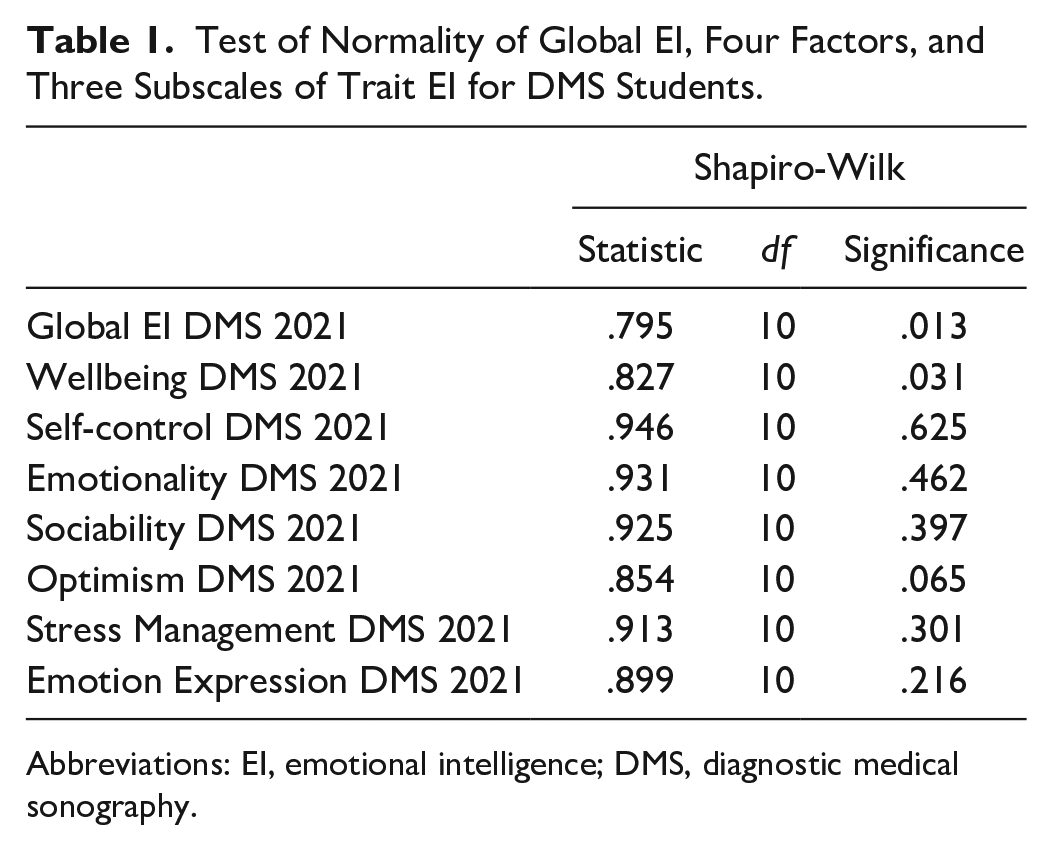
The test of normality was used to determine whether the data were normally distributed for DMS students. Normality of data distribution was determined using the Shapiro-Wilk test. The results of this test are shown in Table 1.
Test of Normality of Global EI, Four Factors, and Three Subscales of Trait EI for DMS Students.
Abbreviations: EI, emotional intelligence; DMS, diagnostic medical sonography.
Table 1 showed that the Shapiro-Wilk statistic has the significance level more than .05 for three of the factors of trait EI (Self-control DMS 2021 P = .625; Emotionality DMS 2021 P = .462; Sociability DMS 2021 P = .397) and three subscales (Optimism DMS 2021 P = .065; Stress Management DMS 2021 P = .301; Emotion Expression DMS 2021 P = .216) which means that there is statistical significance for these EI variables for DMS students. These findings indicate that the EI data are normally distributed. Therefore, the paired-samples t test was used for all EI variables for DMS students.
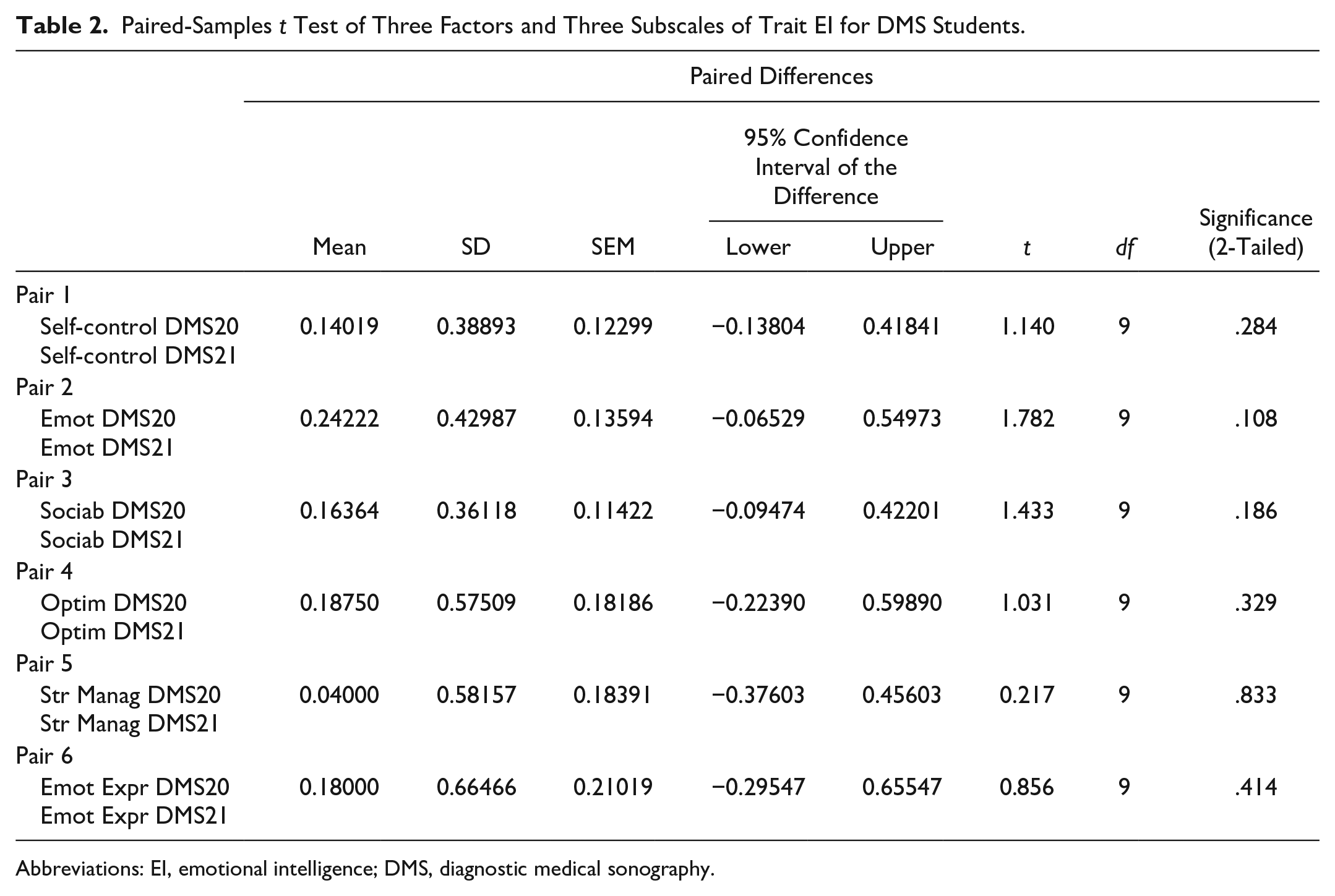
Since three factors and three subscales of trait EI in 2020 and 2021 for DMS students demonstrate normal data distribution, the paired-samples t test was used to determine whether a significant change in scores has occurred in 1 year. The results are shown in Table 2.
Paired-Samples t Test of Three Factors and Three Subscales of Trait EI for DMS Students.
Abbreviations: EI, emotional intelligence; DMS, diagnostic medical sonography.
Table 2 showed that paired-samples t-test analysis resulted in the P value >.05 for all three EI factors (Self-control DMS 2020-Self-control DMS 2021 P = .284; Emotionality DMS 2020-Emotionality DMS 2021 P = .108; Sociability DMS 2020-Sociability DMS 2021 P = .186) and three subscales of trait EI (Optimism DMS 2020-Optimism DMS 2021 P = .329; Stress Management DMS 2020-Stress Management DMS 2021 P = .833; Emotion Expression DMS 2020-Emotion Expression DMS 2021 P = .414), which means that there was no significant change between them for DMS students after 1 year being in the program.
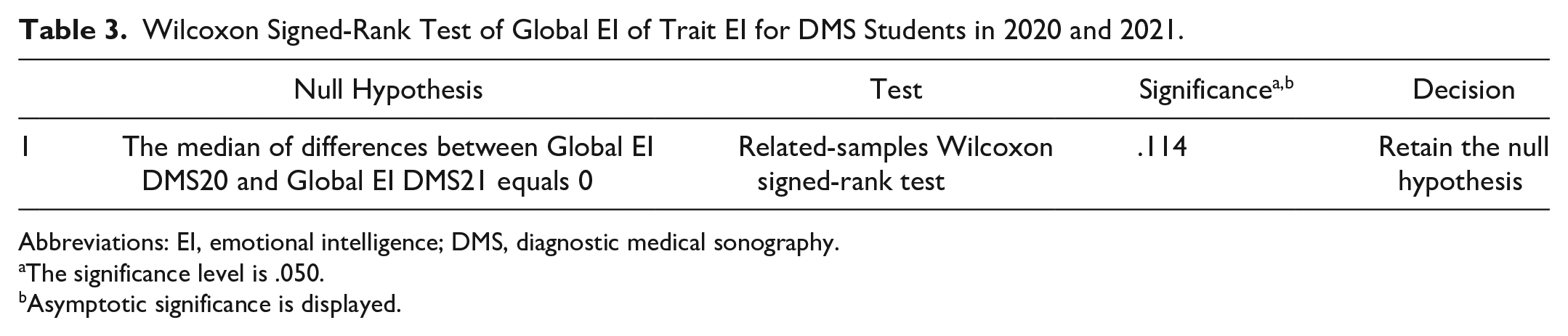
Since the Shapiro-Wilk statistic in Table 1 shows significance level of less than .05 for global EI (P = .013), it demonstrates statistical significance for DMS students. This finding indicates that global EI data are not normally distributed. Therefore, the nonparametric Wilcoxon signed-rank test was used to compare distributions of Global EI in 2020 and 2021 for DMS students. The results of the Wilcoxon signed-rank test for global EI are shown in Table 3.
Wilcoxon Signed-Rank Test of Global EI of Trait EI for DMS Students in 2020 and 2021.
Abbreviations: EI, emotional intelligence; DMS, diagnostic medical sonography.
The significance level is .050.
Asymptotic significance is displayed.
Table 3 showed that the Wilcoxon signed-rank test resulted in the significance level more than .05 (P = .114) for global EI which affirms the null hypothesis. These findings confirm that the change in global EI scores was not significantly different after 1 year being in the program for DMS students.
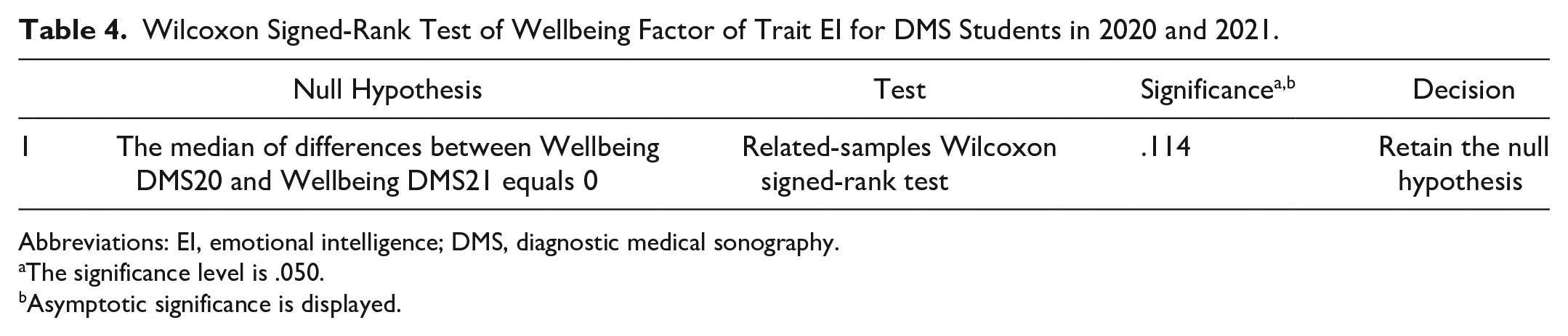
Since the Shapiro-Wilk statistic in Table 1 showed a significance level of less than .05 for one of the factors of the trait EI “Wellbeing” (P = .031), it demonstrates a statistical significance for DMS students. This finding indicates that the “Wellbeing” data are not normally distributed. Therefore, the nonparametric Wilcoxon signed-rank test was used to compare distributions of “Wellbeing” in 2020 and 2021 for DMS students. The results of the Wilcoxon signed-rank test for global EI are shown in Table 4.
Wilcoxon Signed-Rank Test of Wellbeing Factor of Trait EI for DMS Students in 2020 and 2021.
Abbreviations: EI, emotional intelligence; DMS, diagnostic medical sonography.
The significance level is .050.
Asymptotic significance is displayed.
Table 4 showed that the Wilcoxon signed-rank test resulted in a significance level more than .05 (P = .114) for the Wellbeing EI factor. These findings confirm that the change in the Wellbeing EI factor scores was not significantly different after 1 year in the program among DMS students.
RAD Students
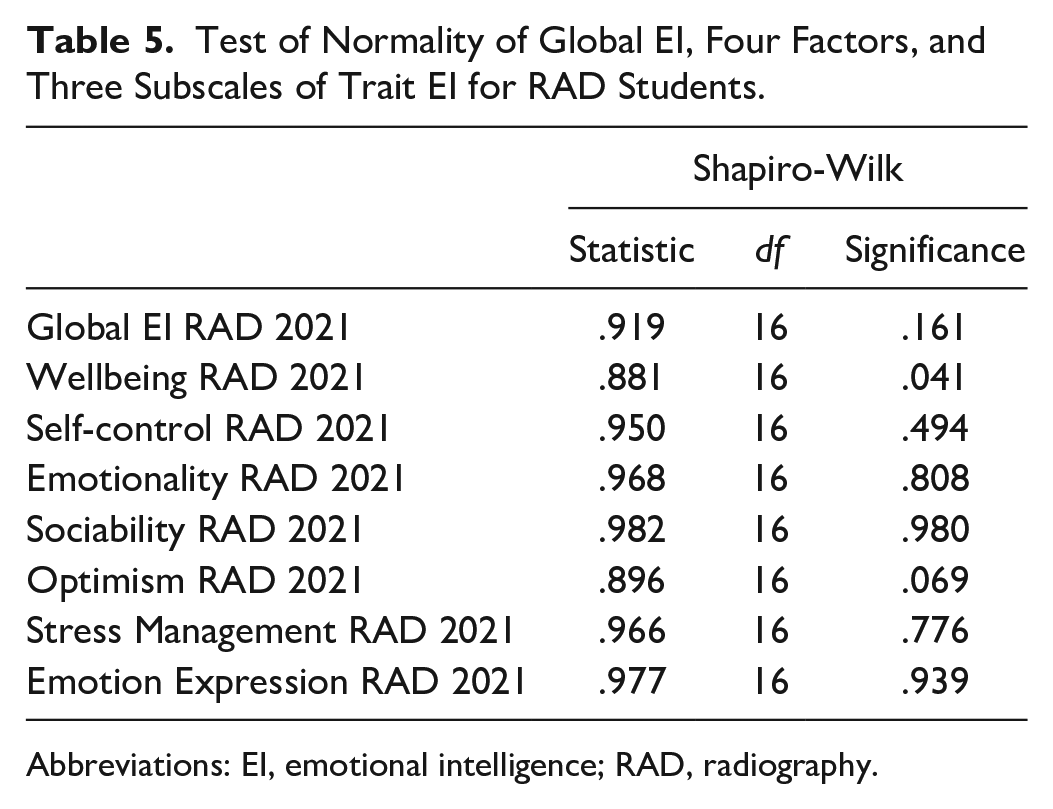
The test of normality was used to determine if the data were normally distributed for RAD students. Normality of data distribution was determined using the Shapiro-Wilk test. The results of this test are shown in Table 5.
Test of Normality of Global EI, Four Factors, and Three Subscales of Trait EI for RAD Students.
Abbreviations: EI, emotional intelligence; RAD, radiography.
Table 5 showed that the Shapiro-Wilk statistic is not significant for global EI (P = .161), three factors (Self-control RAD 2021 P = .494; Emotionality RAD 2021 P = .808; Sociability RAD 2021 P = .980), and three subscales of trait EI in 2020 and 2021 (Optimism RAD 2021 P = .069; Stress Management RAD 2021 P = .776; Emotion Expression RAD 2021 P = .939) for RAD students which means that the data are normally distributed. Therefore, the paired-samples t test was used.
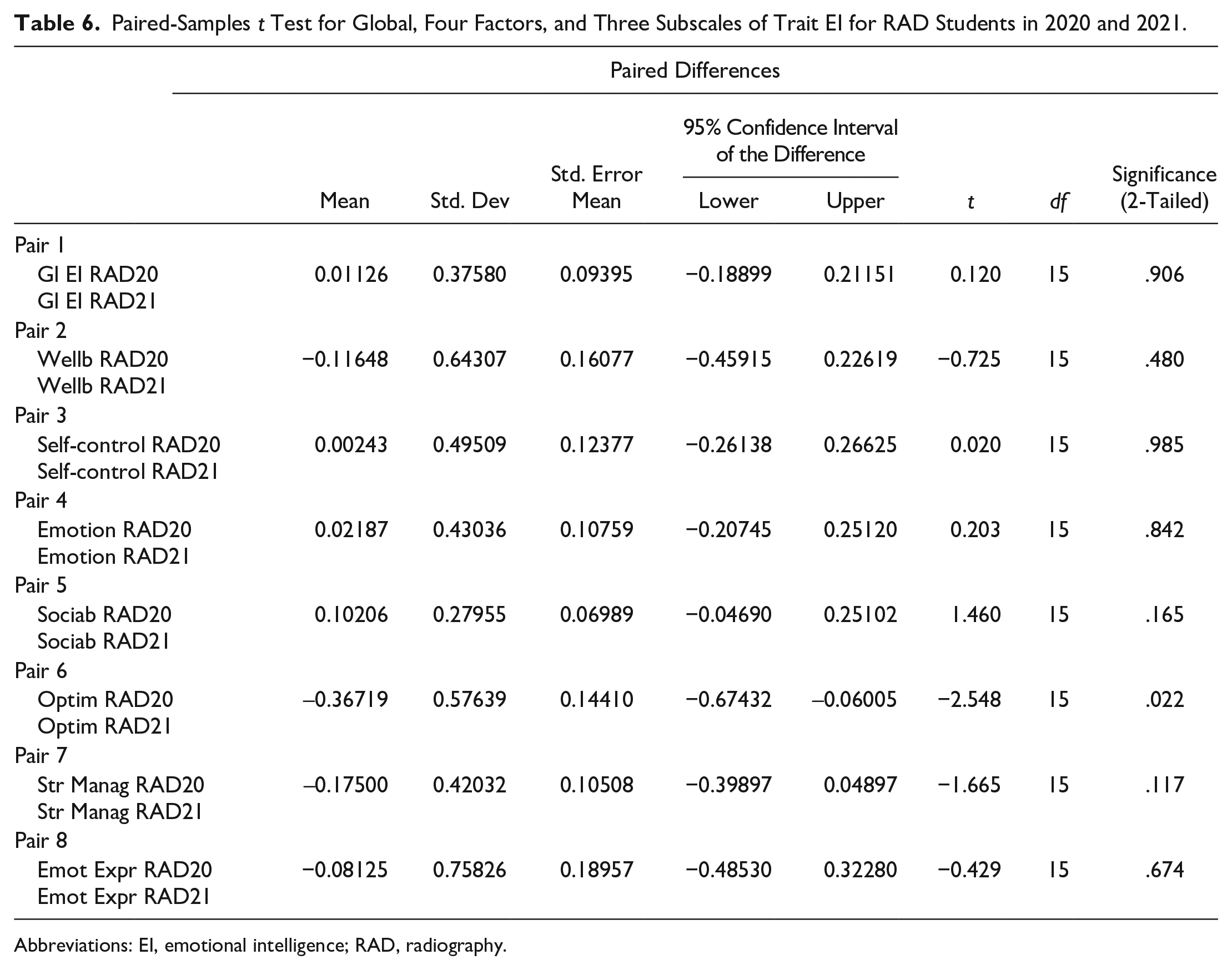
Since the global EI, three factors, and three subscales of trait EI in 2020 and 2021 for RAD students demonstrate normal data distribution, the paired-samples t test was used to determine that a significant change has occurred in 1 year. The results are shown in Table 6.
Paired-Samples t Test for Global, Four Factors, and Three Subscales of Trait EI for RAD Students in 2020 and 2021.
Abbreviations: EI, emotional intelligence; RAD, radiography.
Table 6 showed that the paired-samples t test analysis resulted in the P value <.05 (P = .022) for one of the subscales of trait EI “Optimism” for RAD students after 1 year in the program. This finding indicates that the “Optimism” subscale of trait EI was significantly increased from 2020 to 2021. None of the other variables show significance for RAD students after 1 year in the program.
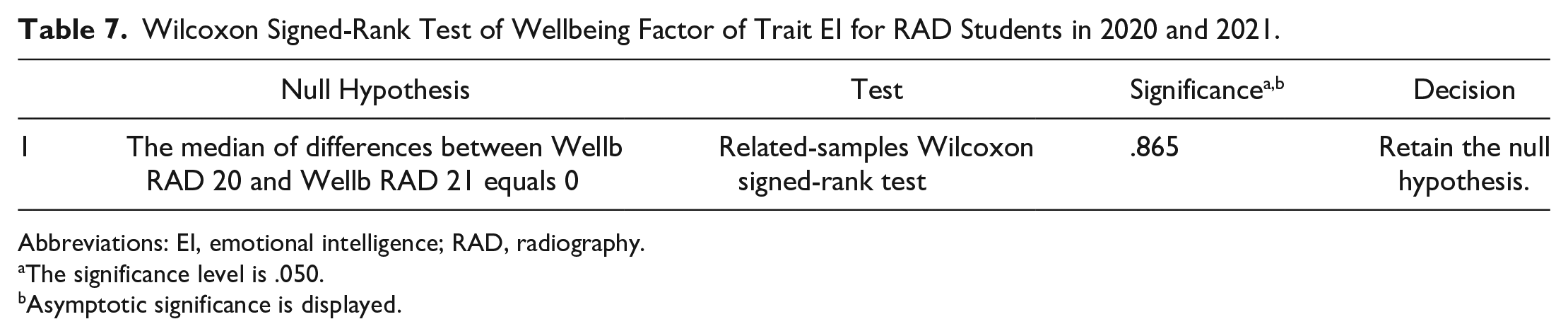
Since the Shapiro-Wilk statistic in Table 5 shows statistical significance for one of the four factors of trait EI “Wellbeing” (P = .041) for RAD students, it means that the data are not normally distributed. Therefore, the Wilcoxon signed-rank test was used. The results are shown in Table 7.
Wilcoxon Signed-Rank Test of Wellbeing Factor of Trait EI for RAD Students in 2020 and 2021.
Abbreviations: EI, emotional intelligence; RAD, radiography.
The significance level is .050.
Asymptotic significance is displayed.
Table 7 shows that the Wilcoxon signed-rank test resulted in the significance level more than .05 (P = .865) for the “Wellbeing” factor which affirms the null hypothesis. These findings confirmed that the changes in the Wellbeing EI factor scores were not significantly different after 1 year in the program for RAD students.
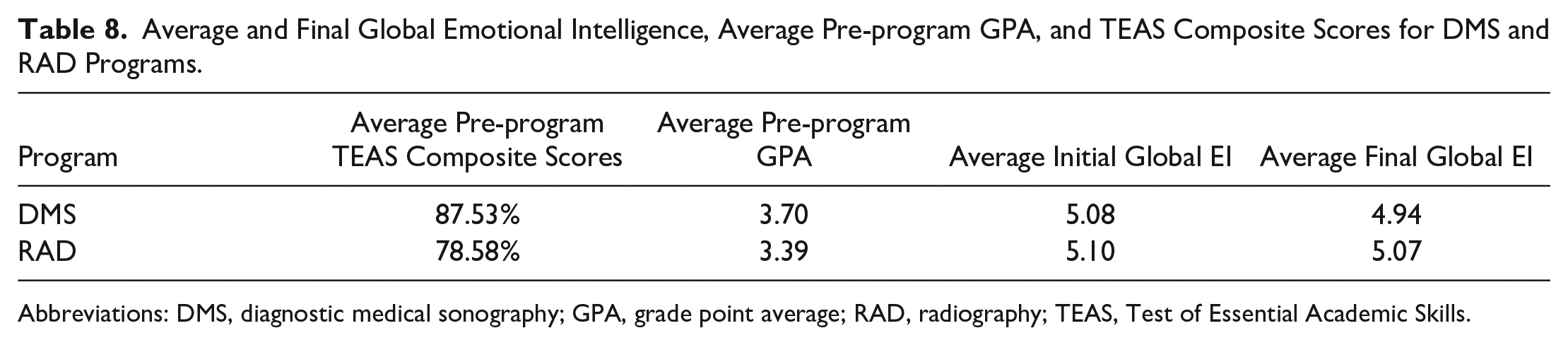
It is important to note that in this study, the average pre-program GPA and Test of Essential Academic Skills (TEAS) scores were significantly higher for the DMS students compared with the RAD students prior to the beginning of the program. Initially, the average global trait EI scores were almost the same for both groups. Surprisingly, 1 year later, there was a slight decrease in the average global trait EI scores for both programs but a little more for the DMS students. The TEAS scores, global trait EI scores, and pre-program GPA are shown in Table 8.
Average and Final Global Emotional Intelligence, Average Pre-program GPA, and TEAS Composite Scores for DMS and RAD Programs.
Abbreviations: DMS, diagnostic medical sonography; GPA, grade point average; RAD, radiography; TEAS, Test of Essential Academic Skills.
Discussion
To determine whether global trait EI, four factors, and three subscales of trait EI were significantly different prior and at the completion of three program semesters, the paired-samples t test and Wilcoxon signed-rank test were used. The findings showed that there was no significant change (P > .05) in global EI and four factors (wellbeing, self-control, emotionality, and sociability) of EI among this cohort of DMS and RT students after 1 year. However, one of the three trait EI subscales “Optimism” revealed a significant increase (P = .022) after 1 year for this cohort of RAD students. This is an important finding that should be carefully considered. This outcome shows that this cohort of RAD students felt significantly more optimistic after 1 year, which reflects their emotional state. Kanoy et al. 21 described an optimist to be a positive individual who focuses on possibilities instead of obstacles and one who is determined to face challenges and problems. In addition, Sliter et al. 22 suggested that older adults have higher EI due to lifelong learning and accumulating knowledge. The finding of this cohort of RAD students substantiated that the existing research found in the literature indicates that EI can be improved with time or age, working experiences, or training.10,12–16,22–25
Furthermore, some authors argue that EI might be a more accurate predictor of performance in professions that require social, emotional, and motivational skills.1,4,26,27 For example, Leedy and Smith 26 stated that there is a link between EI and student success in college. In addition, Watson and Watson 28 discovered supportive evidence that there is a relationship between academic stress, coping self-efficacy, and EI. Kyllonen 1 emphasized that behavioral science research in psychology and economics suggests that noncognitive soft skills such as motivation, work ethic, teamwork, organization, cultural awareness, and effective communication play a more important role in determining success in school and in the workplace than cognitive abilities. Furthermore, the literature review conducted by Dugué et al. 24 concluded that having a high level of EI is beneficial to students. 24 They revealed that emotionally intelligent students or health care professionals are more efficient and better manage stress as well as their emotions. Such individuals have better health and relationships with patients, families, as well as with health care teams. In addition, Zoromski 29 asserted that employees with high EI skills may experience better general well-being and experience less emotional exhaustion and burnout in service positions. As a result, Sliter et al. 22 recommended that service industries investigate using EI instruments for hiring selections to improve customer service performance and reduce health care expenses. O’Connor et al. 6 confirmed that people who possess high trait EI tend to have high levels of self-efficacy regarding emotion-related behaviors. These individuals are competent at managing and regulating their own emotions and emotions of others. Moreover, the results of the study conducted by Gutiérrez-Cobo et al. 30 demonstrated that an improvement in the ability to manage emotions can improve the capacity for cognitive control in undergraduate students.
Interestingly, the findings of this DMS cohort of students differ from the RAD student cohort. The inconsistent findings between these DMS and RAD cohorts are potentially due to various styles of teaching and curriculum, as well as the differences in the admission requirements and clinical education between the two programs. It is important to note that these DMS and RAD programs had a different number of clinical courses throughout their clinical rotations. The DMS students completed 163 clinical hours more than RAD students throughout the two clinical semesters. In addition, each program had different students’ daily clinical schedules throughout their clinical rotations. These differences may be contributing factors explaining the inconsistencies between the results of the two cohorts of students. In addition, there are number of contradictory research articles existing in literature regarding changes of EI with increased education, age, or over time as well as working experience.1,12–14,23 For example, Chen et al. 31 discovered that EI had a positive relationship with life satisfaction and affective well-being. Also, their results showed that individuals with higher EI are more likely to have higher life satisfaction. However, Phillips and MacLean 32 claimed that there is no evidence of an age improvement in emotional understanding due to increased experience in interpreting emotional cues. They did not see any evidence of age-related change. Another study conducted by Shipley et al. 23 determined that EI was found to be positively associated with work experience. Despite this finding, EI was not significantly associated with age. It is critical to understand that the majority of the EI research studies in the United States have been conducted among the nursing students.8,29 Furthermore, virtually no literature exists to ascertain EI and EI changes in the imaging health care programs such as DMS and RAD students.9,33
Limitations
This study has four internal validity threats that must be discussed such as the interactions with selection, maturation, mortality, and testing. The interactions with selection internal validity threat exists because although the participants are an “imaging professionals” student cohort, they belong to two different professions, DMS and RAD. The maturation internal validity threat is an issue because the participants’ maturation level may change throughout the length of the study. Some of the participants withdrew from the program for various reasons which resulted in the mortality internal validity threat. It is worth noting that the RAD programs’ attrition rate was about 22.7% compared with the DMS programs’ average attrition rate of 0%.
This study has external validity threats such as the interaction of setting and treatment because it limits the generalization of the sample. This threat lies in the fact that students in this sample have different personalities, learning styles, and so on and may not necessarily represent the same sample, if replicated at another college. In addition, it is important to note that the DMS students were mostly female, and the RAD students have a more even distribution of gender. Furthermore, this study was completed at a large community suburban college, and therefore, the findings of this study may not apply to a small suburban community college or a large 4-year institution elsewhere. Since the data were collected based on a convenient sample of respondents, small sample size is another important limitation.
Conclusion
The findings of this study provided limited evidence that one of the three trait EI subscales “Optimism” increased after completion of 1 year of courses in this RAD student cohort. This is an important finding that should not be overlooked. This outcome shows that RAD students in this cohort felt significantly more optimistic after 1 year which reflects their emotional state. However, this cohort of DMS students did not show the same results. Goleman emphasized that soft skills in the service field are significant, and therefore, it is important to determine whether students’ EI skills can be measured and improved throughout their studies in health care programs to better prepare them for the workforce. 9 Therefore, further research should be conducted to investigate whether these findings are similar in other imaging programs. This research could lead to further studies exploring changes in EI with increased education and over time in various imaging and health care programs. Dugué et al. 24 stated that improving EI is beneficial for nursing students, and EI training programs have proven to be effective in nursing education. Furthermore, Goleman 34 affirmed that courses in social and emotional learning make sense because of neuroplasticity and the fact that repeated experiences shape the brain. Therefore, implementation of dedicated EI education in the college curriculum or providing EI training for health care students and its implications is another area that needs comprehensive research in the future.
Footnotes
Declaration of Conflicting Interests
The author declared no potential conflicts of interest with respect to the research, authorship, and/or publication of this article.
Funding
The author received no financial support for the research, authorship, and/or publication of this article.
Ethics Approval
This study was approved by the Institutional Review Board of the University of St. Francis, Joliet, IL under IRB # 2019-20-081.
Informed Consent
Written consent was obtained from all participants after they were informed of the objective and design of the study, and they were free to leave the study at any time if they wished.
Animal Welfare
Guidelines for humane animal treatment did not apply to this study.
Trial Registration
Not applicable.
