




Abstract

Lower Extremity Venous Nomenclature
Communication is key for most professions, and medical sonography is no exception. Diagnostic medical sonographers and vascular technologists have to provide clear documentation, often in the form of a worksheet or technical report. This documentation contributes to good patient care and quality outcomes. It is vital that this communication is well defined and expressed with appropriate terms.
Terminologia Anatomica 1 (TA) provides the international standard on human anatomical terminology. As venous ultrasound developed and was increasingly utilized, the standard venous anatomic terms that had been in use appeared to be insufficient. Clinicians began learning more about venous physiology and pathophysiology and along the way began expanding venous terminology. Unfortunately, names were introduced that were not part of the TA and in some cases led to confusion as nonuniform nomenclature appeared in the clinical literature. It became clear that knowledge of venous anatomical terminology was essential in correctly sharing findings throughout the medical community.
During the World Congress of the International Union of Phlebology (IUP) held in Rome in 2001, a consensus document was drafted with input from the IUP, the International Federation of Associations of Anatomists, and the Federative International Committee on Anatomical Terminology. Additional input was obtained from venous experts from multiple countries. This document was published in the Journal of Vascular Surgery in 2002. 2 Following the initial publication, the committee developed a refinement of the nomenclature, publishing an additional paper in the Journal of Vascular Surgery in 2005. 3 These papers resulted in the change in the name of some veins, the naming of previously unnamed veins, and the discontinuance of the use of most eponyms. These papers also went on to clarify the compartments of the limb and which veins are present within those compartments.
Both papers go into extensive detail about the veins of the leg. Clinically, one of the most significant changes in the terminology for the deep system was to change the name of the superficial femoral vein to simply the femoral vein. The name superficial femoral vein was never the name designated by the TA, and this vein is not a superficial structure. Unfortunately, the use of superficial femoral vein presented a significant safety issue for patients. Patient care providers who were less familiar with vascular anatomy incorrectly identified the “superficial femoral vein” as part of the superficial venous system, and as such, they did not anticoagulate those patients with thrombus present in this deep venous structure. The Patient Safety Network reported one such incidence of an error in treatment. 4 The clinical significance of an error of this nature could be dire. Because of the potential for improper patient treatment, the IUP consensus document removed superficial from the name of this vessel.
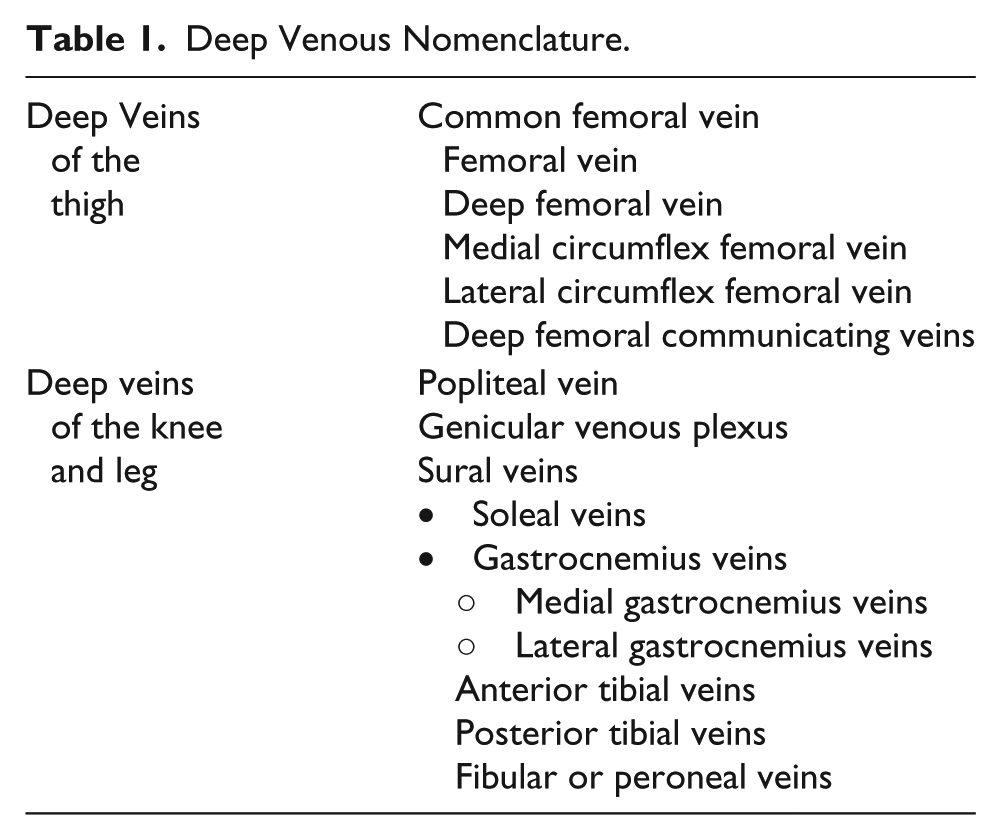
While the vein that courses from the popliteal vein terminating into the common femoral vein should be referred to as the femoral vein, no change was made in the companion arteries. The name superficial femoral artery is still the accepted standard for the vessel that courses from the common femoral artery to the popliteal artery. Table 1 is an abbreviated summary of the nomenclature for the deep venous system.
Deep Venous Nomenclature.
In the past, multiple terms were used to describe the superficial veins in the leg. The great saphenous vein is the appropriate name to be used and not greater or long saphenous vein. The small saphenous vein is the appropriate name to be used and not the lesser or short saphenous vein. This clarification allowed for better communication between medical personnel in different countries. Some countries outside the United States referred to the great saphenous vein as the long saphenous vein and would abbreviate this vein as the “LSV.” Those within the United States would confuse this abbreviation with “LSV” used as an abbreviation for the lesser saphenous vein. Obviously, both veins are superficial veins but in very different territories.
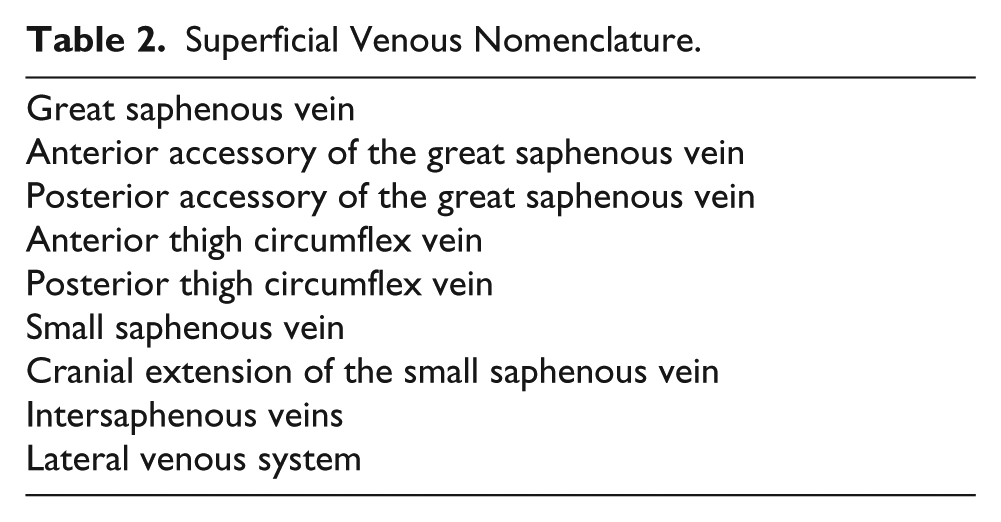
An extension above the popliteal fossa of the small saphenous vein is often observed. This vein has been called the femoropopliteal vein in the past. If this cranial extension of the small saphenous vein communicates with the great saphenous vein via the posterior thigh circumflex vein, it was often called the vein of Giacomini. The current accepted terminology for this vein is the cranial extension of the small saphenous vein. Table 2 is an abbreviated summary of the nomenclature that should be used for the superficial venous system.
Superficial Venous Nomenclature.
Numerous perforating veins are present, and their location, size, and arrangements are quite variable. Clinically, many referred to the perforating veins by eponyms, although they may have often been incorrect from a historical point of view. Descriptive terms using the location of these veins are now preferred. Nomenclature such as anterior ankle, lateral ankle, paratibial, anterior leg, lateral leg, or posterior leg perforating veins are just a portion of the currently accepted names for the perforating veins. By using the new terminology for the perforating veins, greater clarity of specific location can be easily ascertained.
The nomenclature papers published by the international interdisciplinary consensus committee are thorough descriptive documents for lower extremity and pelvic veins. For a complete list of the nomenclature set forth by this group, one should refer to the Journal of Vascular Surgery references at the end of this article. For clinicians with an interest in venous disease, ultrasound evaluation of veins, and venous treatment, it is important to consistently use the internationally accepted anatomical nomenclature. Confusion can be avoided, patient safety maintained, and relevant information can be easily understood as it is shared.
Footnotes
Declaration of Conflicting Interests
The author declared no potential conflicts of interest with respect to the research, authorship, and/or publication of this article.
Funding
The author received no financial support for the research, authorship, and/or publication of this article.