




Abstract
A professional society, organization, or association offers members the opportunity to advance their knowledge and skills and to maintain their certification through organizational activities. By definition, professional societies are formed when a group of individuals with shared interests collaborate to achieve professional goals. Cited benefits of membership in a professional society include being a key resource for maintaining professional values and standards; providing opportunities for continuing education, professional development, networking, and collaboration; providing support for challenging issues; and promotion of the profession. A PubMed search found that some health care education programs report the benefits of student membership in their professional societies, although there are little published data on student membership in professional societies for medical imaging programs.
Professionalism is an integral part of sonography practice standards. 1 Maintaining a workforce consisting of knowledgeable health care professionals promotes patient health and well-being. 2 Professional societies, organizations, or associations offer sonographers and sonography students opportunities for mentoring, learning, and networking to improve skills and professionalism and to ensure a steadily qualified workforce.3,4 Professional societies or organizations are formed when professionals gather as a group to share interests and work together toward common goals. 5 A number of professional sonography societies are open to student membership, including the Society for Diagnostic Medical Sonography (SDMS), 6 American Institute of Ultrasound in Medicine (AIUM), 7 American Society of Echocardiography (ASE), 8 and Society for Vascular Ultrasound (SVU). 9 In addition, students can join state ultrasound societies for local networking and education opportunities.
Most students have little knowledge about professional society opportunities. Educators can help introduce students to the advantages of membership in professional organizations through engagement in activities such as seminars, annual conferences, online continuing education, and access to a society’s publications. 10
Early involvement in a professional society can encourage competence, confidence, and awareness of and access to lifelong learning.3,11,12 In addition, joining professional societies gives students personal professional development opportunities, such as networking, job searches, or learning about unexplored specialties within their field. 13 Studies involving nurses have shown that joining a professional nursing society enhances the mentoring experience by enriching interactions between new nurses and experienced colleagues. 13
In general, the literature reports on the many benefits of professional organizations for practicing professionals and students.14–16 In addition, despite ample professional opportunities for sonography program students, it is less certain whether students are exposed to professional society membership opportunities as part of their sonography curriculum and if they take advantage of these opportunities. A PubMed search regarding sonography student membership in a professional society or the impact of professional organizations in the education of sonography students revealed little data in the current literature.
The purpose of this study was to survey program directors of Commission on the Accreditation of Allied Health Education Programs (CAAHEP)–accredited sonography programs to gather data regarding the number of educational programs that require student membership in a state and/or national professional society, organization, or association. The information gathered from this survey will provide current data to better understand the role that being a member of a professional society plays in a sonography student’s education.
Methods
To determine the number of educational programs that require student membership in a state and/or national professional society, an email invitation with a link to SurveyMonkey software was sent to all directors of CAAHEP-accredited sonography programs across the United States. The list of email addresses of program directors surveyed was compiled from the CAAHEP website 17 and included all learning concentrations. The study was approved by the University of Nebraska Medical Center Institutional Review Board (IRB 320-15-EX).
The survey consisted of 10 total questions (Appendix), but a skip pattern was used to separate schools not requiring membership in professional organizations from those that require membership. The first question for all respondents was “Are students in your sonography program required to be a member of a professional, society, organization, or association?” As a result of the skip pattern, those programs not requiring participation answered only two other questions: whether the respondent’s state has a professional sonography society and whether the program offers a bachelor’s degree or higher in sonography. Participants who answered “yes” to the first question were asked to answer the remaining nine questions in the survey.
The remaining questions for directors whose programs required student membership in a professional organization were designed to obtain more detailed information about the professional society or organization with which their students are affiliated, the point during their course of study that students join professional societies, how long this requirement had been in the curriculum, and how membership dues were paid.
A number of questions sought to determine how many and what type of professional organization activities the students participate in and if students’ participation in professional societies affected course grades. Additional data were gathered about the directors’ professional membership, the availability of a state ultrasound professional society, and the program’s terminal degree.
Results were evaluated using descriptive statistics such as frequencies and percentages. This included evaluating results for each question and cross-tabulation of responses to the three initial questions from all participating educational programs.
Results
A total of 223 program directors were sent email survey links, and a total of 89 responses were received from 35 states with accredited sonography programs. Of the 15 states not identified in the study, seven did not have programs listed on the CAAHEP website when the invitations for surveys were emailed in May 2015, indicated by a black star in Figure 1. The initial email invitation to participate in the survey was followed up 10 days later with a reminder email; ultimate overall response rate was 40%. More than half (58%) of responding sonography program educators answered that they do not require their students to be a member of a professional organization, and slightly less than half (42%) reported that they require membership. Of those who do not require professional society membership, 60% responded that there is no professional society for sonographers in their state. Conversely, of programs requiring membership, 33% have a state society. Of all respondents, 21% reported their program offers a bachelor’s degree or higher in sonography. More (30%) respondents who require professional society membership were likely to offer a bachelor’s degree or higher, compared with 15% of programs not offering a bachelor’s degree or higher (Table 1). In total, most (79%) sonography educators reported that they do not offer a bachelor’s degree or higher program (Table 1).
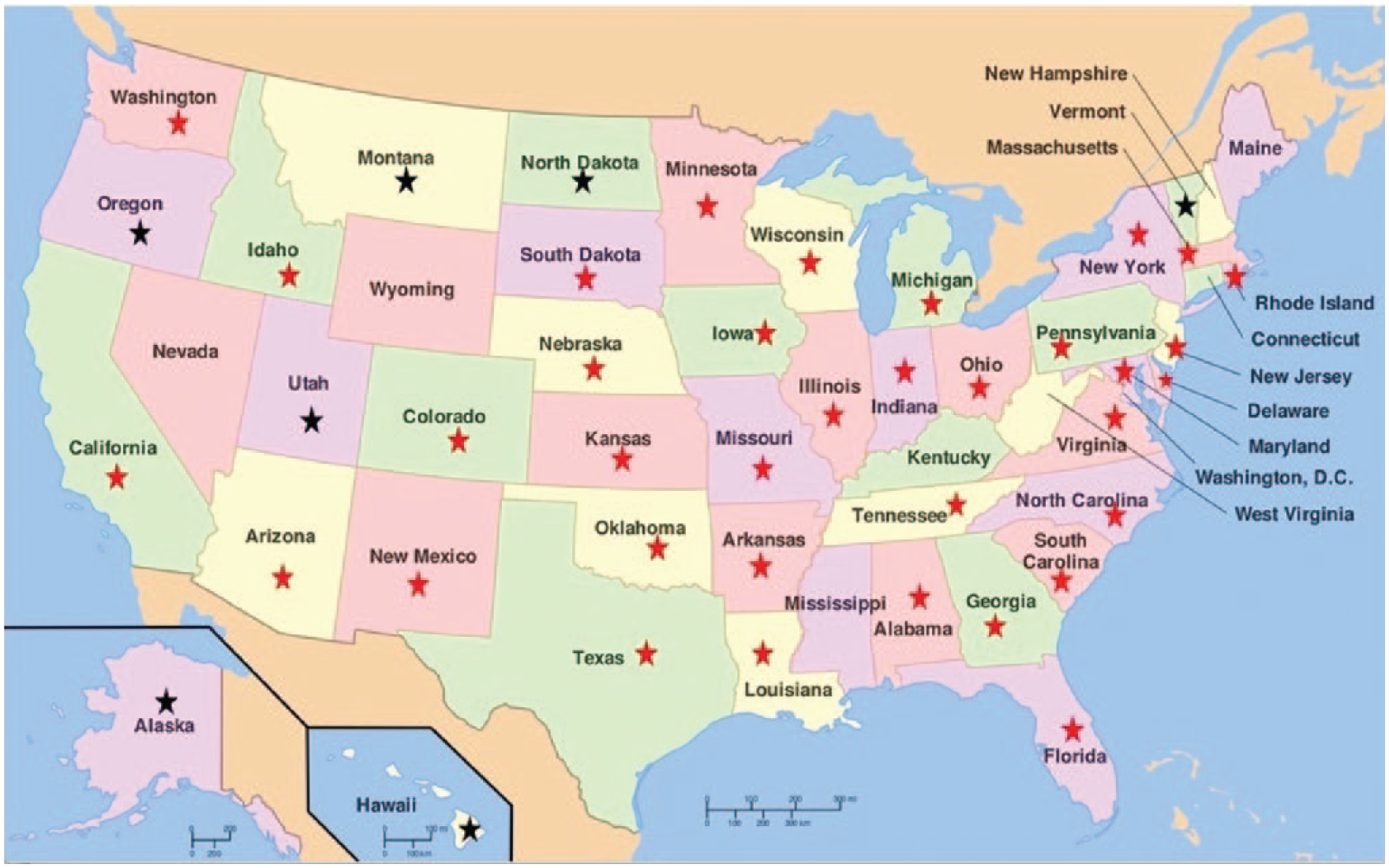
Map of the United States showing the states from which responses to the survey were received (red star) or were not received (no star); a black star indicates a state that did not have a Commission on the Accreditation of Allied Health Education Programs (CAAHEP)–accredited program listed on its website at the time the survey was taken.
Professional Society Membership Requirement Cross-Tabulation.
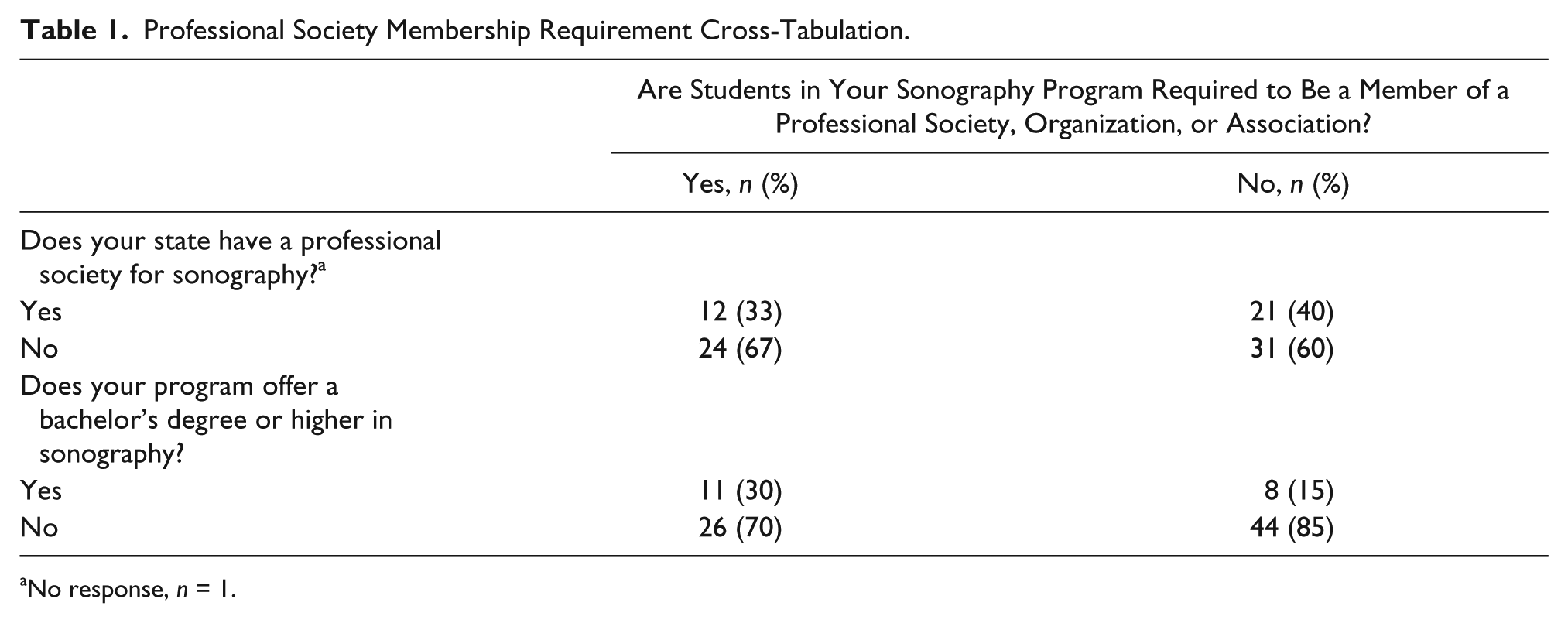
No response, n = 1.
Educators from sonography programs who answered that the program requires students to join a professional society answered several additional questions. When asked which society the programs require, most (84%) indicated membership in the Society of Diagnostic Medical Sonography (Table 2). Six programs selected “other” and reported specific names of state or regional societies, raising the total number of programs requiring membership in a state society to 32%. Six respondents (16%) chose two societies, two (5%) selected three societies, and one respondent (3%) selected four responses.
Professional Societies That Sonography Programs Require Students to Join.
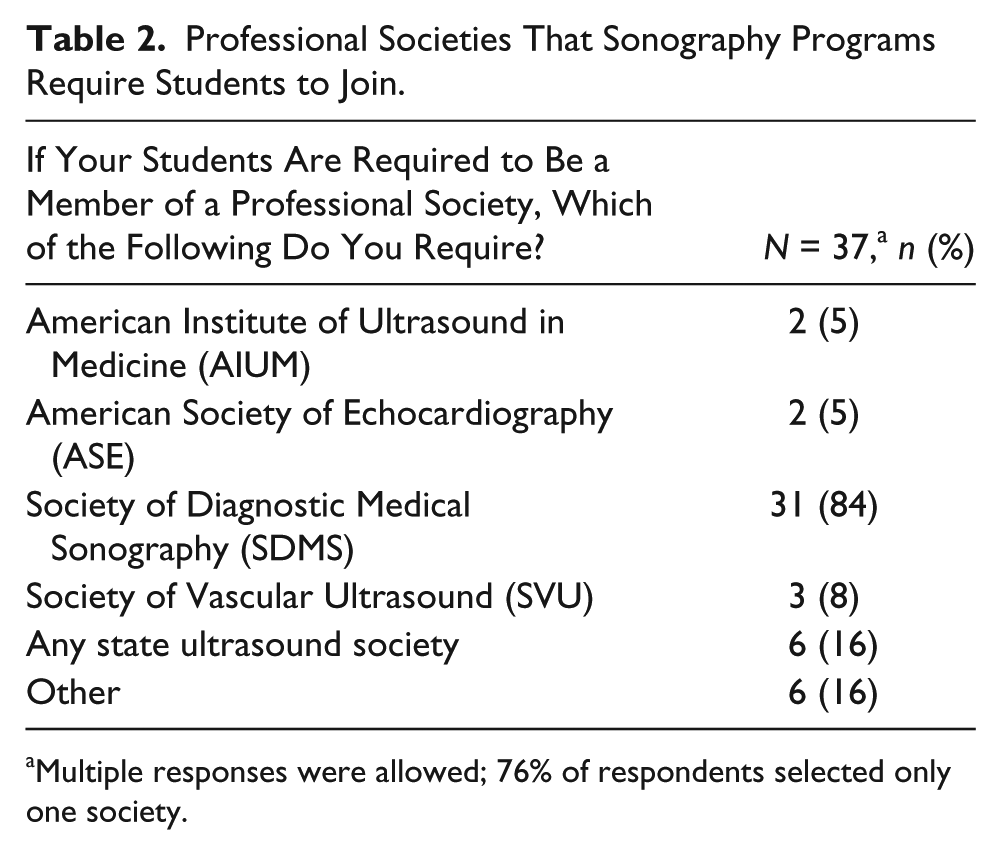
Multiple responses were allowed; 76% of respondents selected only one society.
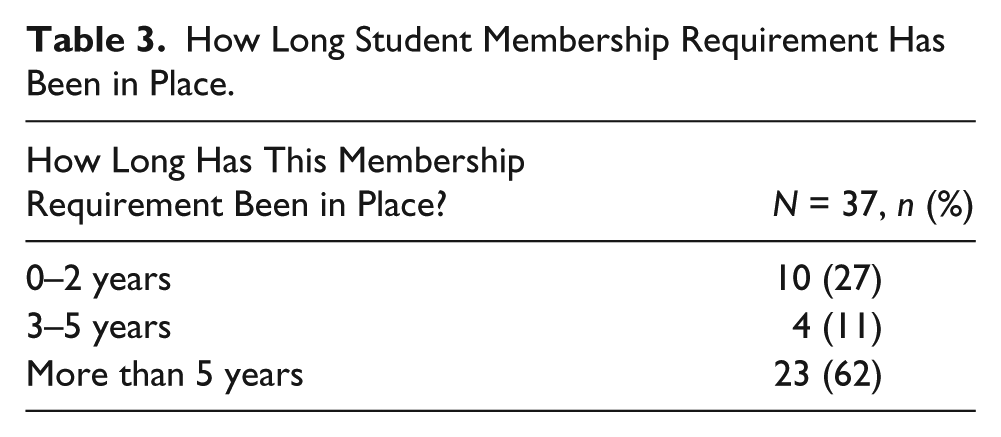
To understand timing of society membership for sonography students, respondents were asked at what point during their program students join a professional society. Most (81%) reported that students join before three months into the program, and 16% said their students join mid-program. The length of time the membership requirement has been in place varies, although most (62%) have had their requirement for at least five years (Table 3).
How Long Student Membership Requirement Has Been in Place.
In most cases, students pay for their own professional society memberships, either by having the student join directly or by the program collecting the student fees and in turn paying the society. Only two sonography programs (6%) pay for student memberships in professional societies.
The survey also addressed organization participation once students join a professional society. Considering the responses “all, most, or about half” of students, approximately one-fourth (28%) of respondents said that this fraction of students participate in annual conferences held by professional societies, while nearly three-fourths of the programs (73%) had that level of student participation in the completion of online continuing education (CE) quizzes (Figure 2). The highest program participation (84%) was student use of supplemental learning resources in professional societies; the lowest participation was in the presentation and/or display of scientific exhibits at 17%. An additional 54% responded that their students participate in other activities with professional societies, including scholarships, job boards, salary surveys, and webinars.
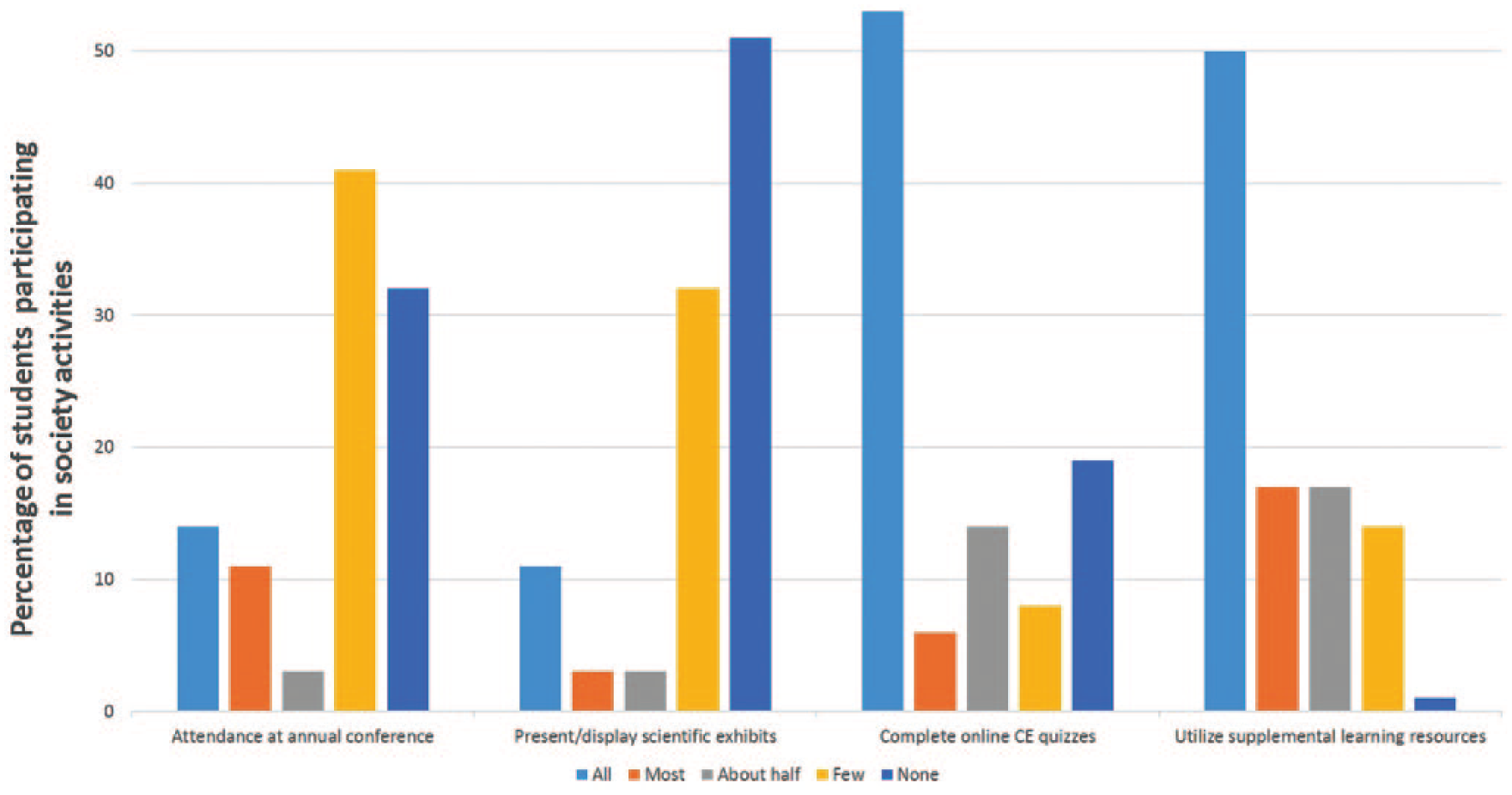
Survey responses showing the percentage of programs with students participating in professional society activities based on the level of participation and type of activity.
When educators were asked whether student participation in professional societies affected course grades, 20 (54%) responded “yes.” Slightly less than half (46%) indicated that professional society activities have no influence on a student’s grades.
In assessing educator membership in professional societies, nearly all (97%) reported that they belong to SDMS (Table 4). About half (19) of educators belong to two professional societies, five (14%) belong to three societies, and three (8%) belong to four professional societies. All (100%) respondents belong to at least one professional society.
Sonography Educator Professional Society Memberships.
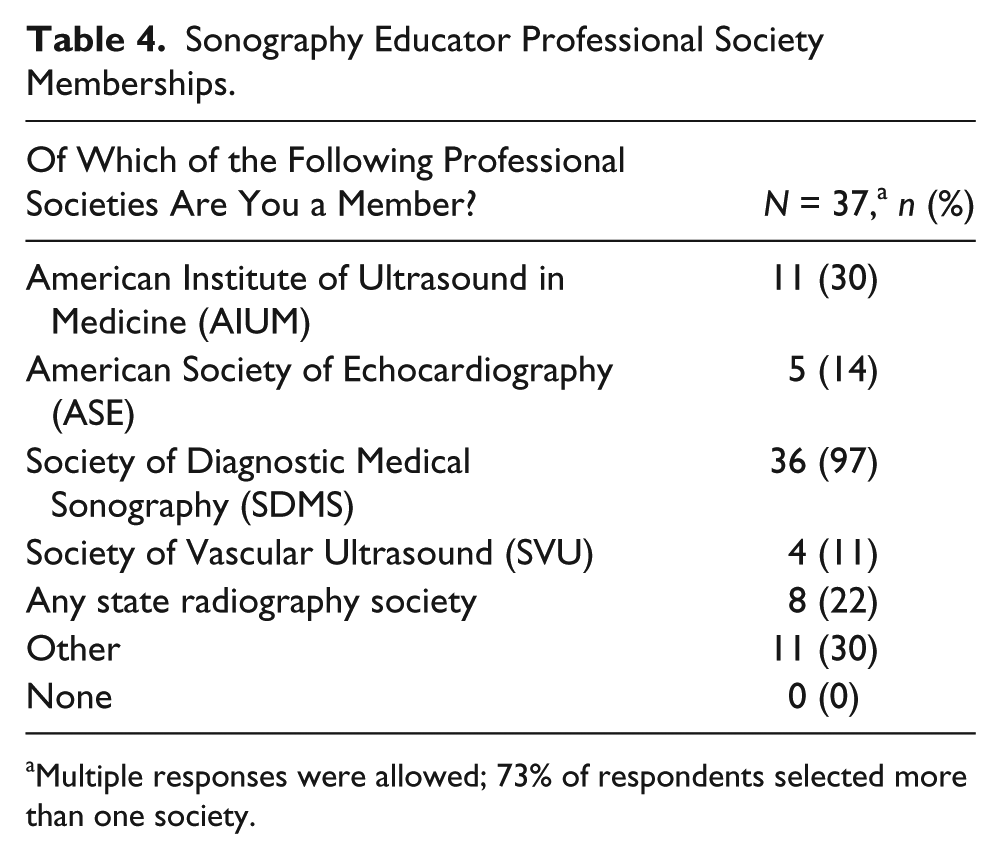
Multiple responses were allowed; 73% of respondents selected more than one society.
Discussion
There is value for health care professionals in being a member of their professional society or organization. Continuing education, networking opportunities, and staying current with industry trends are just a few membership benefits. In addition, these organizations provide a foundation for a profession and play an important role in the growth and evolution of a profession. According to published data, professions such as nursing, public health, physical therapy, medicine, and dental hygiene promote the benefits of professional organization membership to their students and encourage membership. A literature search found no information related to sonography student membership in a professional organization. Data collected from this study seek to provide baseline information about student membership in professional societies with regard to CAAHEP-accredited sonography programs.
Survey data showed that 100% of the responding program directors are members of at least one professional society, but slightly less than half (42%) of the directors responding to the national survey say that their sonography program requires students to join a professional society. Comments from survey participants might explain the difference between director membership and that of their students. Many directors selected a “no” response to the first survey question because they cannot “require” student membership due to either institution or accreditation policies. Instead, they “strongly encourage” or “recommend” participation. According to one respondent, “I provide membership information, I discuss the benefits, and I have class assignments that encourage membership.”
Many educators specifically mention to students the benefits of professional society membership such as access to webinars and information about the profession. Interestingly, the data found that sonography programs requiring professional society membership were twice as likely to offer a bachelor’s degree or higher than those not requiring membership. This might reflect a more comprehensive educational experience for students who complete a bachelor’s degree program versus an associate-level program; further research is needed to explore this finding.
Although not previously reported in the literature, there is evidence of longevity to sonography programs requiring student membership in a sonography professional organization; more than 60% of the responding CAAHEP-accredited programs have had this membership provision in place for more than five years. In addition, there appears to be a trend toward sonography programs requiring student membership in professional societies, as evidenced by more than one-fourth of sonography programs adding the requirement in the two years prior to the survey. Most (81%) also require that students join within the first 3 months of beginning their sonography education program, which suggests that educators recognize the benefits of society membership to students throughout their study versus the benefits of joining just before graduating.
Enrollment at the beginning of a program’s curriculum also allows educators to maximize participation in professional society activities over the duration of the program, and more than half of the responding programs said activity participation influences course grades. Many (84%) of the programs reported “all, most, or about half” of students use supplemental learning resources, followed by completion of online CE quizzes at 70%.
Participation in “other” activities was reported at 63%, and responses included scholarship application, access to job postings and salary surveys, participation in writing and quiz bowl competitions, field trips to society’s national headquarters, viewing webinars, and manuscript submission to the professional journal. Most of these activities are accessible online at any time. Activities that require travel and have additional costs associated with them, such as attending annual conferences and presenting scientific exhibits, had considerately lower participation. Almost 75% of programs reported that few or no students attended an annual conference, and more than 80% reported few or no student participation in presentation of scientific exhibits. These data may be important to professional organizations trying to increase student membership by recognizing that students predominantly use activities accessible through the organization’s website. Matriculation into a professional organization early in the curriculum allows students to get the most from their membership dues.
The final consideration of the study was how programs approach payment of student membership fees. All four national professional organizations mentioned above offer student discounts, and some extend membership discounts into the first years of employment; some state societies offer free student memberships. Most of the programs (69%) require the student to pay fees directly to the society; 25% collect money from the student and pay the fee. Only two programs (6%) pay all or part of the membership fee. All national organizations require verification of student enrollment in a sonography program.
This study had some limitations. Use of the term required in the first question might have affected results. Strongly encourage or strongly recommend as selections might have provided more accurate data to student membership in professional organizations based on comments received in the survey and by email. The wording of question 7 could have been more specific. The authors were attempting to determine if educational activities offered by a professional society were part of a graded course requirement. As the question is written, possible participant interpretations could include the following: students who are a member in a professional society achieve better grades in a course than nonmember students, membership in a professional society is part of a student’s grade for a course, or educational activities available only to members are a required component of the course grade. Overall, the response represented information from CAAHEP-accredited programs across the United States with participation from certificate, associate, and baccalaureate programs. Although this information was not collected in the survey, early exposure to and involvement in a professional organization could support continued membership after graduation and increase the awareness of what a professional society can do for its members. Future studies could focus on how membership as a student influences membership after graduation and whether the type of program (certificate, associate, or bachelor) has an effect on the level of participation.
Conclusion
In general, survey data showed that sonography educators and programs support professional society participation both personally and for their students. However, more could be done to promote the benefits of society membership to students and to incorporate professional society activities into the curriculum. Most educators in sonography programs recognize the value of student membership in professional societies and require or encourage their students to join. In addition, sonography educators demonstrate the value of professional society activities by example; all sonography educators surveyed belong to at least one professional sonography society, and nearly three-fourths belong to more than one. However, more could be done to promote the benefits of society membership to students and to incorporate professional society activities into the curriculum. Survey findings from programs requiring student membership show that most have been in place for at least five years, membership occurs within the first three months of program matriculation, and online activities have the highest participation rate. Programs are split almost evenly on including professional organization activities as a course grade. It is possible that more student participation in professional organizations would be realized if programs could invest in student participation in professional societies and if societies took a more active role in recruiting students and explaining the values of membership.10,14
Footnotes
Appendix
Acknowledgements
We thank Teresa G. Odle, BA, ELS, for assistance with manuscript preparation. Special thanks to all program directors for their time in completing the study and those who provided additional clarifying comments in the survey and by email.
Declaration of Conflicting Interests
The authors declared no potential conflicts of interest with respect to the research, authorship, and/or publication of this article.
Funding
The authors received no financial support for the research, authorship, and/or publication of this article.