




Abstract
Background:
Premarital sexual practices are increasing among adolescents worldwide, particularly in developing countries like Ethiopia. This study aimed to estimate the pooled prevalence and identify factors associated with such practices among Ethiopian adolescents.
Methods:
A meta-analysis was conducted using the Cochrane Q and I2 statistics to assess study heterogeneity. A random-effects model was applied to estimate the pooled prevalence.
Results:
The pooled prevalence of premarital sexual practices among adolescents in Ethiopia was 35.04% (95% CI: 22.80-47.29). Significant associated factors included being male (POR = 2.57), having pocket money (POR = 2.87), alcohol consumption (POR = 3.73), and peer pressure (POR = 13.62).
Conclusion:
Over one-third of Ethiopian adolescents engage in premarital sex. Key contributing factors are male gender, access to money, alcohol use, and peer pressure. These findings highlight the need for targeted interventions to address risky sexual behaviors among adolescents.
Background
The World Health Organization defines adolescents as someone between the ages of 10 and 19. This period marks the transition from childhood to adulthood and is characterized by substantial physical, mental, and behavioral changes, which can increase the risk to their well-being.1,2
Premarital sexual activities among adolescents are on the rise globally, particularly in developing countries such as Ethiopia. 3 These activities are often unprotected, leading to various sexual and reproductive health issues. 4 For example, approximately 45% of all new HIV infections worldwide occur among adolescents aged 15 to 24 years. In Africa, 60% of new HIV infections are found in adolescents aged 15 to 9 years.5 -7 Annually, around 15 million adolescents aged 15 to 19 give birth, with many of these pregnancies being unwanted. Additionally, up to 4 million of these adolescents undergo unsafe abortions, and as many as 100 million are affected by sexually transmitted diseases (STDs).8 -10
According to a WHO report, sexual violence is a common issue among adolescents in developing nations. 11 In Ethiopia, approximately 54% of adolescents aged 15 to 19 experienced sexual violence in the past year, while in Bangladesh, the figure stands at 48% for the same age group. 11 Additionally, a study in Kenya revealed that 40% of sexually active adolescent girls and 65% of boys had multiple sexual partners, with a low percentage of them using condoms. 12
Various studies conducted in developing countries have identified several factors associated with premarital sexual activity and its complications. These factors include substance use, peer influence, living arrangements, age, possession of pocket money, viewing pornographic videos, and misconceptions about sexual risk behaviors.4,13 -16
In this study, literature on premarital sexual practices among adolescents in Ethiopia was reviewed. However, the Studies have reported inconsistent findings regarding premarital sexual practices among adolescents, and to the knowledge of the investigator concerned, the literature has not been examined systematically. Therefore, this systematic review and meta-analysis aimed to estimate the pooled prevalence of premarital sexual practices and to identify associated factors among adolescents in Ethiopia. The findings of this meta-analysis will help for policy-makers and other stakeholders to effectively implement the prevention and control of premarital sexual practices.
Methods
This systematic review and meta-analysis were conducted by the Preferred Reporting Items for Systematic Reviews and Meta-Analyses (PRISMA) checklist, 17 as outlined in Supplemental file S1. Additionally, the study was registered with the Prospective Register of Systematic Reviews (PROSPERO) under the unique identifier CRD42024563900.
Search Strategy
A thorough and methodical review of the literature was conducted across various electronic databases, including PubMed, HINARI, Global Health, Scopus, EMBASE, Web of Science, African Journal Online (AJOL), and Google Scholar, spanning the period from May 1, 2024, to June 17, 2024. The search utilized a combination of keywords and Medical Subject Headings (MeSH) terms. Specifically, the search strategy included the following terms: “premarital” AND “sexual practices” AND “factors” OR “Determinants” OR “predictors” OR “Adolescents” AND “Ethiopia.” The focus was on identifying epidemiological studies concerning premarital sexual practices and their associated factors among adolescents in Ethiopia.
Inclusion and Exclusion Criteria
Original research studies reporting on premarital sexual practices and/or associated factors among adolescents in Ethiopia were included in the study. Published articles written only in the English language were considered for inclusion. All publications without restricting the year of publication reported up to June 7, 2024, were considered. Studies that did not report premarital sexual practices in Ethiopia were excluded. In addition, articles without full texts, abstracts, editorial reports, letters, reviews, and commentaries were excluded from the study.
Study Selection
All studies identified through various databases were imported into EndNote X7. After removing duplicate entries, 2 authors separately reviewed the abstracts and full texts of each article and then assessed all articles for eligibility.
Data Extraction
Following the screening of titles, abstracts, and full texts of each selected original study, data extraction was carried out using a standardized tool adapted from the Joanna Briggs Institute (JBI). Two independent reviewers performed the data extraction process and thoroughly reviewed all included articles. Any disagreements between the reviewers were resolved through discussion. Various study characteristics, including the first author’s name, study region, publication year, study design, participants, sampling technique, and sample size, were extracted. Additionally, the prevalence of premarital sexual practices and associated risk factors, along with their corresponding 95% confidence intervals, were also extracted.
Risk of Bias (Quality) Assessment
The assessment of study quality was conducted using the Joanna Briggs Institute (JBI) critical appraisal checklist for analytical cross-sectional studies, which comprises 9 criteria. 18 These criteria included (1) appropriateness of the sample frame for addressing the target population, (2) appropriateness of participant sampling, (3) adequacy of sample size, (4) detailed description of study subjects and setting, (5) thoroughness of data analysis covering the identified sample, (6) utilization of valid methods for condition identification, (7) measurement of the condition in a standardized and reliable manner for all participants, (8) appropriate statistical analysis, and (9) adequacy of response rate. Each criterion was scored as 0 for “not reported or not appropriate” and 1 for “yes.” The scores across these items were then aggregated to obtain a total quality score ranging from 0 to 9. Subsequently, studies were categorized as low, medium, or high quality based on the total points awarded: 0 to 4 for low quality, 5 to 7 for medium quality, and 7 to 9 for high quality.
Outcome Measurement
This review focused on 2 main outcomes. The primary outcome addressed in this systematic review and meta-analysis pertains to premarital sexual practices. The primary outcome variable for the study was measured by the answers to the question: “Have you ever had sexual intercourse?” The adolescents were free to respond either “Yes” or “No.” Those who responded “Yes” and were never married were regarded as having premarital sexual practice. 19 The second outcome variable of interest in the study was the identification of factors associated with premarital sexual practices in Ethiopia, assessed in terms of the odds ratio (OR). The odds ratio for each identified factor was calculated based on the binary outcome data reported in each primary study.
Data Synthesis and Analysis
The data extraction process involved utilizing a Microsoft Excel spreadsheet, followed by importing the data into STATA version 11 for subsequent analysis. To describe and summarize the primary studies, tables, figures, and forest plots were used. The pooled estimate of premarital sexual practices was calculated using a random-effects model, along with a 95% confidence interval (CI). For the assessment of factors associated with premarital sexual practices among adolescents, associations were estimated using odds ratios with corresponding 95% CIs. A random-effects model was employed during the meta-analysis due to the demonstrated heterogeneity among the included studies. The assessment of heterogeneity among the included studies was conducted using Cochran’s Q statistic and I2 statistics. Additionally, visual inspection of asymmetry in funnel plots and Egger regression tests was performed, with a P-value of less than .05 serving as the cutoff point to indicate the presence of publication bias.
Results
Study Selection
Out of a total of 51,200 articles retrieved on premarital sexual practices and associated factors among adolescents, 11,125 duplicates were identified and removed. Following this, 39,982 articles were excluded after their titles and abstracts were evaluated based on predetermined criteria. After reviewing the full texts of the remaining 93 articles against the qualifying criteria, 86 studies were further excluded, primarily because they were published outside of Ethiopia or due to differences in the study population. Consequently, 7 studies met the inclusion criteria and were included in the final meta-analysis (Figure 1).
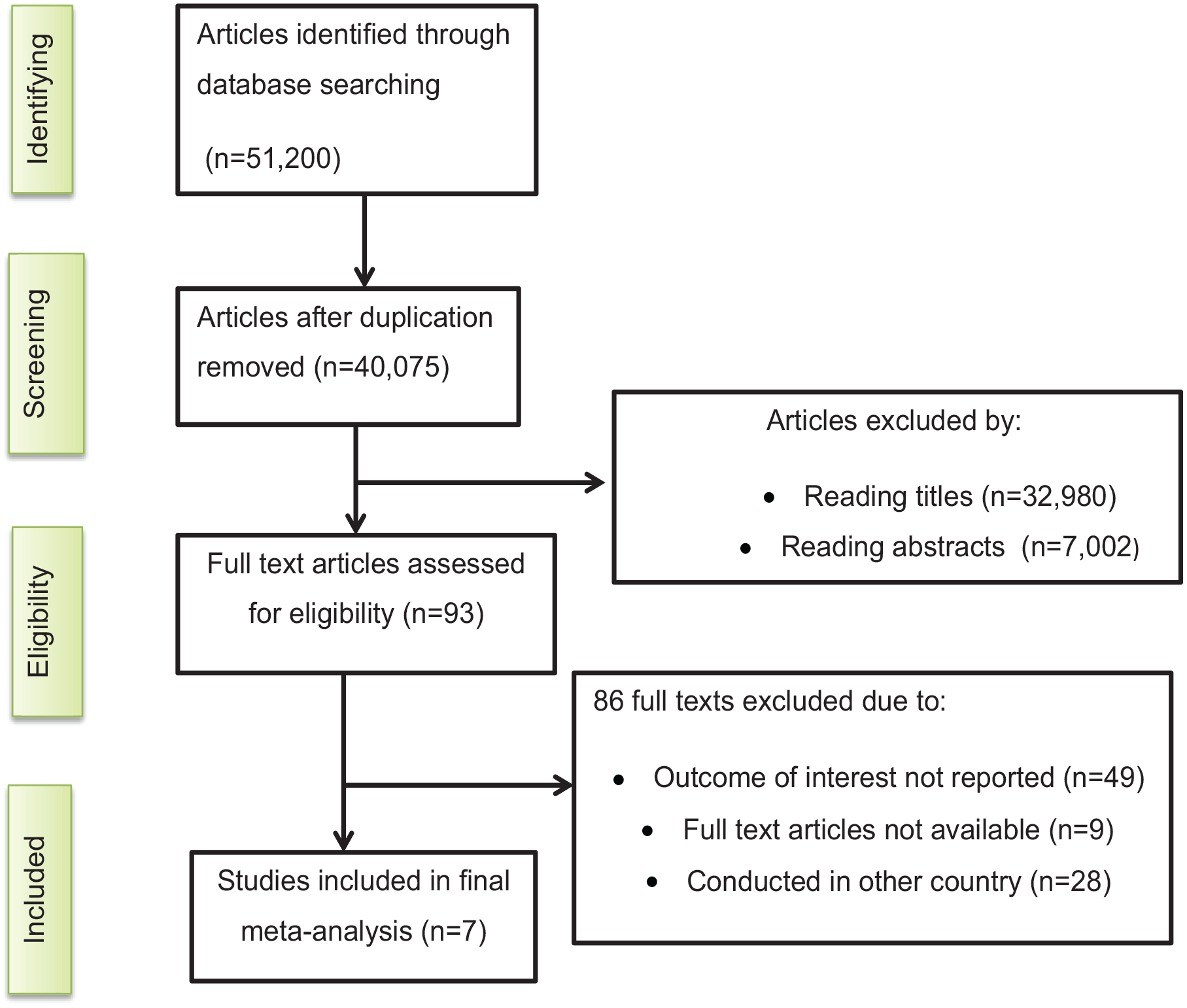
Flow chart of study selection for systematic review and meta-analysis of premarital sexual practices and associated factors among adolescents in Ethiopia, 2024.
Characteristics of the Included Studies
All of the included studies were institutional-based and cross-sectional. All studies that were included in this evaluation were published between 2008 and 2019. Among the papers included in this review, 3 involved simple random sampling, 3 involved multistage sampling, and the remaining 1 study involved a stratified sampling technique. There were 3807 participants from an estimated 3927adolescents, with an estimated sample size ranging from 284 to 843. 20 According to the included research, the prevalence of premarital sexual practices ranged from 21.1% 21 to 61.1%. 20 The Oromia region was the focus of three of the studies included in this review20,22,23; 2 investigations were conducted in the Amhara region,24,25 and the remaining 2 were conducted in the Tigray region19,21 (Table 1).
Descriptive Summary of Primary Studies Included in the Meta-Analysis of Premarital Sexual Practices and Associated Factors Among Adolescents in Ethiopia, 2024.

Meta-Analysis
Risk of Bias Assessment for the Included Studies
The critical evaluation checklist was developed by the Joanna Briggs Institute (JBI) and adjusted for cross-sectional studies. The quality evaluation summary showed six-sevenths (n = 6, 85.7%) of the included studies had high quality, while the remaining one-seventh (n = 1, 14.3%) of the studies had medium quality. Supplemental file S2.
Premarital Sexual Practices
In this study, the pooled estimate of premarital sexual practices among adolescents was 35.04% (95% CI: 22.80-47.29). In estimating the pooled premarital sexual practices among adolescents, heterogeneity through the included studies was exhibited (I2 = 76.8%; P < .001). Therefore, a random effects model was used in the meta-analysis to calculate the pooled prevalence of premarital sexual practices (Figure 2).
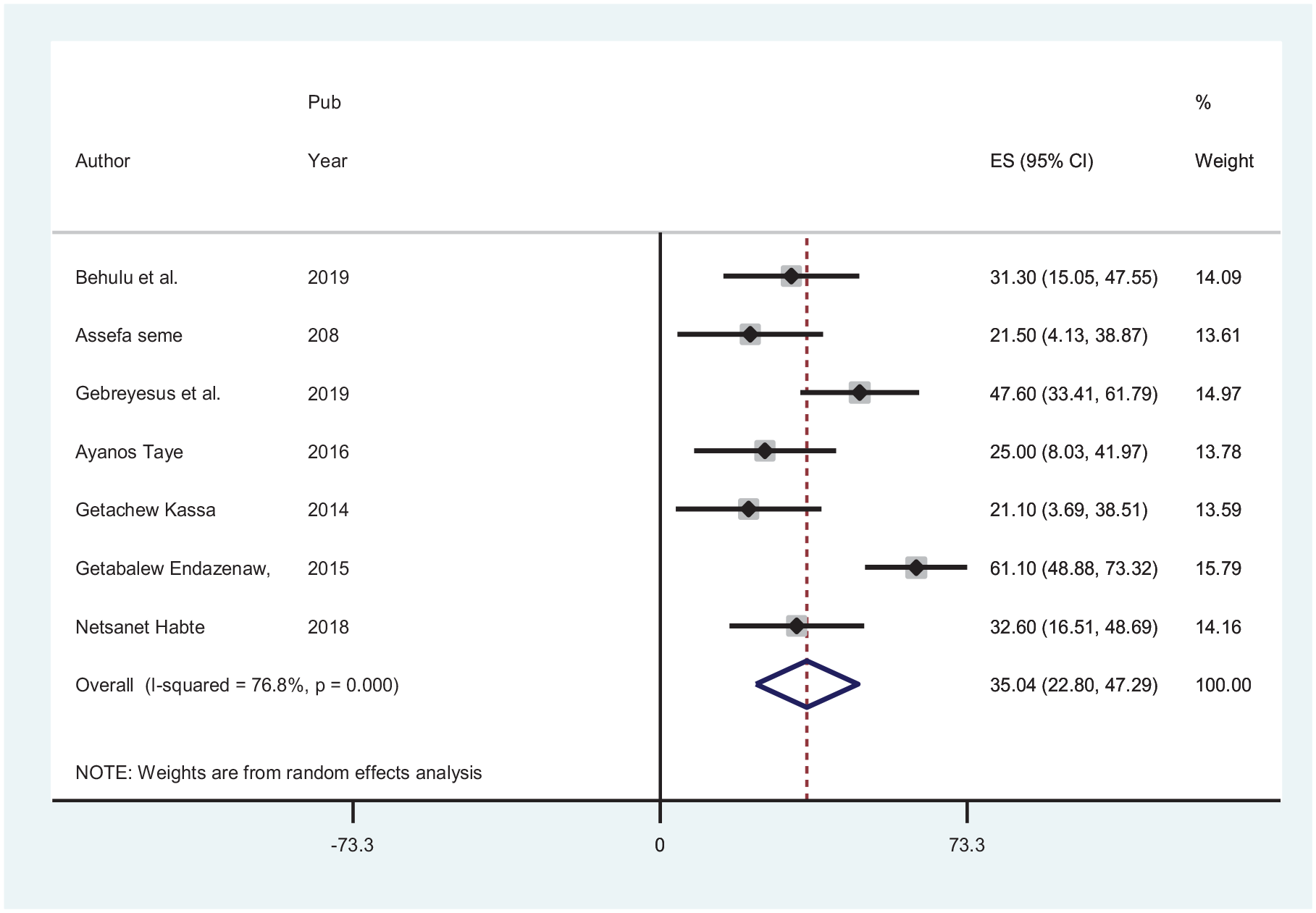
Forest plot of the pooled premarital sexual practices among adolescents in Ethiopia, 2024.
Subgroup analysis: Subgroup analysis was conducted based on the regions where the primary studies were carried out. The Oromia region exhibited the highest prevalence of premarital sexual practices among adolescents at 36.44% (95% CI: 9.31-63.56), whereas the Amhara region showed the lowest prevalence at 31.96% (95% CI: 20.52-43.39; Figure 3).

Subgroup analysis of premarital sexual practices among adolescents in Ethiopia, 2024.
Publication bias: To determine if publication bias existed, a visual examination of the asymmetry in funnel plots and Egger regression tests was used. As a consequence, the results of Egger’s tests and funnel plots indicated that publication bias existed in the included papers. Egger’s test revealed the existence of publication bias with a statistically significant result (P < .001). Additionally, an examination of the funnel plots visually revealed an uneven distribution of the study (Figure 4).

Graphic representation of publication bias using funnel plots of all included studies, 2024.
Sensitivity analysis: Due to the presence of publication bias indicated by Egger’s test (P = .000), a sensitivity analysis was performed, which showed that no single study had a disproportionate influence on the overall results (Figure 5).

Graphic representation of sensitivity analysis using metaninf of all included studies, 2024.
Associated Factors
In this study, certain factors associated with premarital sexual practices were examined statistically, while others were not examined due to inconsistencies in classifying or grouping independent variables related to the outcome.
Two studies found a significant association between being male and engaging in premarital sexual practices. Male adolescents had 2.57 times higher odds of participating in premarital sexual activities compared to their counterparts (POR = 2.57; 95% CI: 1.97-3.35). Two studies identified a significant correlation between having pocket money and engaging in premarital sexual practices. Adolescents with pocket money had 2.87 times higher odds of engaging in premarital sexual activities compared to those without pocket money (POR = 2.87; 95% CI: 2.20-3.74). Additionally, 2 studies demonstrated a significant correlation between alcohol consumption and premarital sexual practices. Adolescents who consumed alcohol had 3.73 times higher odds of engaging in premarital sexual activities compared to those who had never consumed alcohol (POR = 3.73; 95% CI: 2.10-6.65). Furthermore, 2 studies showed a significant association between peer pressure and premarital sexual practices. Adolescents experiencing peer pressure had 13.62 times higher odds of engaging in premarital sex compared to those who did not experience peer pressure (POR = 13.62; 95% CI: 7.39-25.11). Due to the observed heterogeneity in these studies (I² = 88.9%, P < 0.001), a random-effects model was applied for the analysis (Figure 6).
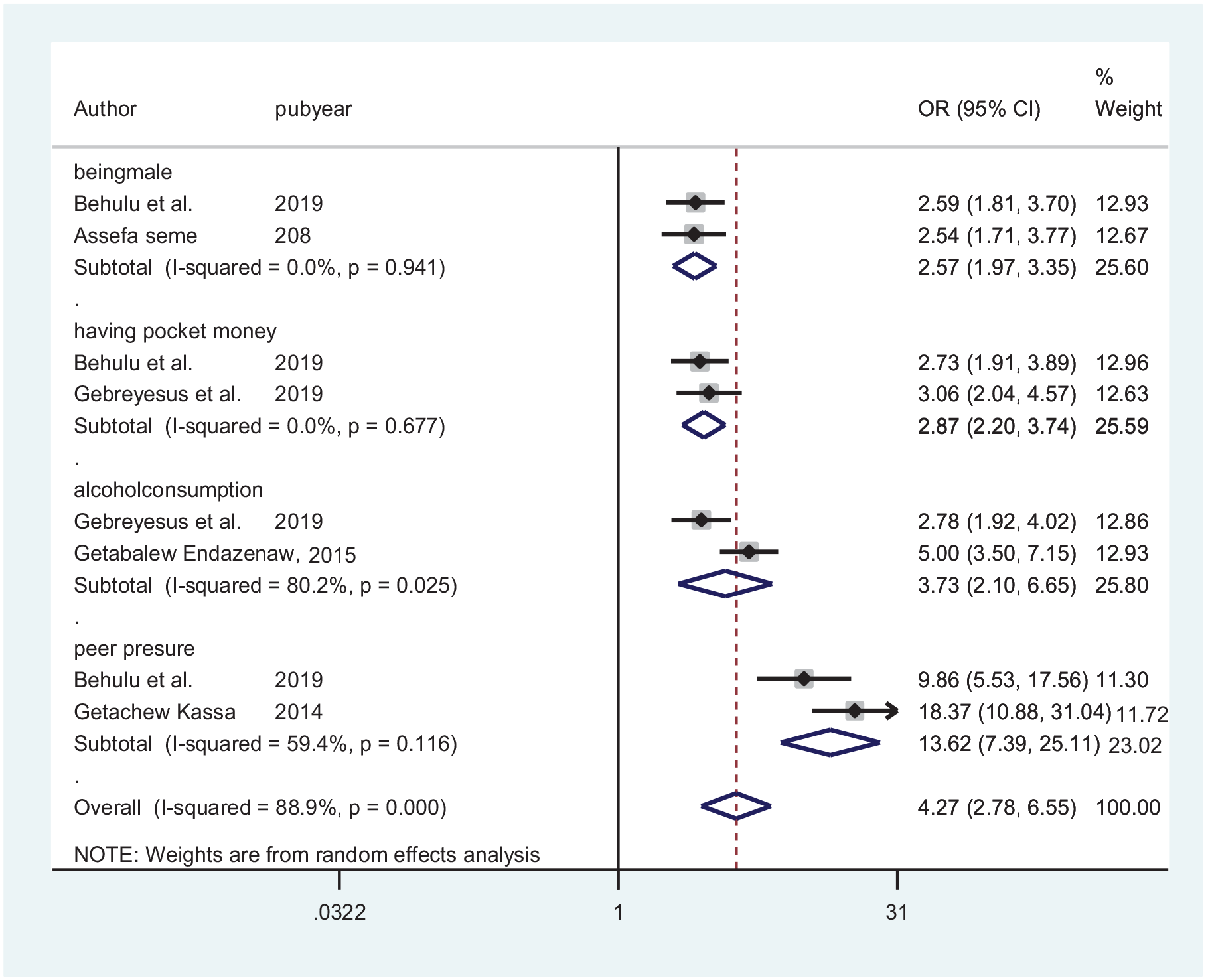
Showing the forest plot of the association between factors and premarital sexual practices among adolescents in Ethiopia, 2024.
Discussion
This meta-analysis aimed to evaluate the premarital sexual practices across Ethiopia and identify the factors influencing it. As far as we know, this is the first meta-analysis endeavoring to determine both the overall premarital sexual practices and the factors associated with it among adolescents in Ethiopia. From the collected data, it is evident that premarital sexual practices in Ethiopia vary significantly, ranging from 21.1% 21 to 61.1%. 20 Combining these findings, the pooled prevalence of premarital sexual practices among adolescents in Ethiopia is calculated at 35.04% (95% CI: 22.80-47.29). This finding aligns with a study conducted in Nepal, which reported a prevalence of 36.5%. 26 This study reported a lower prevalence compared to a study conducted in Kenya, which found a rate of 64%. 27 This difference may be attributed to Ethiopia's more conservative cultural and religious norms that discourage premarital sex, in contrast to Kenya's potentially more permissive attitudes. Additionally, stronger social taboos and stigma surrounding premarital sex in Ethiopia might contribute to the lower reported rates compared to Kenya.
One of the primary predictor variables identified in this study was sex, showing that male adolescents were significantly more likely to engage in premarital sexual intercourse, with pooled odds ratio (POR) of 2.57 (95% CI: 1.97-3.35). This trend aligns with findings from studies conducted in Malaysia. 28 The underlying reason for this gender disparity could be that males often experience greater social freedom and less restrictive norms regarding sexual activities compared to females. Societal attitudes and expectations typically allow males more liberty in exploring and expressing their sexuality, while females may face stricter cultural and familial constraints that discourage such behavior.
Additionally, adolescents who received pocket money were 2.87 times more likely to engage in premarital sex compared to those who did not receive pocket money (POR = 2.87, 95% CI: 2.20-3.74). This finding is consistent with other research indicating that various social factors significantly influence adolescents' attitudes towards sexual practices. These factors may include the financial independence provided by pocket money, which can create more opportunities for engaging in sexual activities. 29
The study found that respondents who consumed alcohol were significantly more likely to engage in premarital sexual practices, with Pooled odds ratio (POR) of 3.73 (95% CI: 2.10-6.65), meaning they were 3.73 times more likely to do so compared to non-users. The increased likelihood can be attributed to the fact that alcohol consumption often lowers inhibitions, impairs judgment, and increases risky behaviors, including sexual activities. 30
The study identified peer pressure as another significant predictor of premarital sexual intercourse. Adolescents who faced pressure from their friends were substantially more likely to engage in premarital sex, as indicated by a pooled odds ratio (POR) of 13.62 (95% CI: 7.39-25.11). This high likelihood can be attributed to the significant role peers play during adolescence, a critical period for personality development and behavioral changes. During this time, adolescents are highly susceptible to peer influence, often prioritizing the acceptance and approval of their friends. This can lead to engaging in behaviors, including premarital sex, that align with peer group norms and expectations, highlighting the powerful impact of social dynamics on adolescents’ decision-making.
Strengths and Limitations
This study is the first systematic review and meta-analysis to assess the prevalence and associated factors of premarital sexual practices among adolescents in Ethiopia, providing a comprehensive synthesis of existing evidence. The use of rigorous methods aligned with PRISMA guidelines enhances the credibility and reproducibility of the findings. Furthermore, subgroup analyses and quality assessments of the included studies were performed to ensure robustness.
However, several limitations should be noted. First, the review included only full-text articles published in English, which may have led to language bias. Second, Due to the variability in definitions and outcome measurements across the included studies, the meta-analysis was unable to compute pooled odds ratios for several important associated factors. Key variables were operationalized differently from 1 study to another. These inconsistencies in categorization, measurement tools, and reporting formats made it methodologically inappropriate to aggregate and compare the effect sizes, thereby limiting the ability to draw comprehensive conclusions about the full range of determinants influencing premarital sexual practices among adolescents in Ethiopia. Third, all included studies were facility-based cross-sectional designs, which may limit the generalizability of the findings to the broader adolescent population. Lastly, the geographic scope was restricted to studies conducted in only 3 regions of Ethiopia, which significantly limits the generalizability of the findings. As a result, the pooled estimates may not accurately reflect the prevalence and associated factors of premarital sexual practices among adolescents at the national level, particularly in regions with different cultural, socioeconomic, and educational contexts.
Conclusion
This study reveals that a significant proportion of adolescents in Ethiopia engage in premarital sexual practices, influenced by factors such as gender, access to money, alcohol use, and peer pressure. These findings call for urgent, coordinated, and evidence-based interventions to address the complex social, behavioral, and environmental factors driving adolescent sexual behavior. Institutionalizing comprehensive sexuality education across schools, communities, and digital platforms, while promoting open family communication and youth empowerment, is essential. In parallel, policies must be strengthened and effectively implemented to create a supportive environment that protects adolescents and promotes their sexual and reproductive health. Ultimately, an integrated and collaborative multi-sectoral strategy involving families, teachers, healthcare providers, policymakers, and young people is vital to mitigate risky sexual behaviors and support the growth of informed, resilient, and healthy adolescents across Ethiopia.
Supplemental Material
sj-docx-1-gph-10.1177_30502225251363690 – Supplemental material for Prevalence and Associated Factors of Premarital Sexual Practice Among Adolescent in Ethiopia: Systematic Review and Meta-Analysis
Supplemental material, sj-docx-1-gph-10.1177_30502225251363690 for Prevalence and Associated Factors of Premarital Sexual Practice Among Adolescent in Ethiopia: Systematic Review and Meta-Analysis by Yeshiwas Ayale Ferede, Agerie Mengistie Zeleke and Worku Chekol Tassew in Sage Open Pediatrics
Supplemental Material
sj-docx-2-gph-10.1177_30502225251363690 – Supplemental material for Prevalence and Associated Factors of Premarital Sexual Practice Among Adolescent in Ethiopia: Systematic Review and Meta-Analysis
Supplemental material, sj-docx-2-gph-10.1177_30502225251363690 for Prevalence and Associated Factors of Premarital Sexual Practice Among Adolescent in Ethiopia: Systematic Review and Meta-Analysis by Yeshiwas Ayale Ferede, Agerie Mengistie Zeleke and Worku Chekol Tassew in Sage Open Pediatrics
Footnotes
Acknowledgements
The authors would like to thank the authors of the included primary studies, which were used as a source of information to conduct this study.
Authors’ Note
Agerie Mengistie Zeleke is now affiliated with Department of Midwifery, Health Science College, Debark University, Debark, Ethiopia.

Ethical Considerations
Not applicable.
Consent for Publication
Not applicable.
Author Contributions
YAF: Conceptualization, Formal analysis, Investigation, Methodology, Writing – original draft, Writing – review and editing. AMZ: Formal analysis, supervision, writing – original draft, writing – review and editing. WCT: Methodology, supervision, writing – original draft, writing – review and editing. Prevalence and associated factors of premarital sexual practice among adolescents in Ethiopia: systematic review and meta-analysis.
Funding
The author(s) received no financial support for the research, authorship, and/or publication of this article.
Declaration of Conflicting Interests
The author(s) declared no potential conflicts of interest with respect to the research, authorship, and/or publication of this article.
Data Availability Statement
All data are fully available without restriction.
Supplemental Material
Supplemental material for this article is available online.
References
Supplementary Material
Please find the following supplemental material available below.
For Open Access articles published under a Creative Commons License, all supplemental material carries the same license as the article it is associated with.
For non-Open Access articles published, all supplemental material carries a non-exclusive license, and permission requests for re-use of supplemental material or any part of supplemental material shall be sent directly to the copyright owner as specified in the copyright notice associated with the article.
