




Abstract
Background:
The use of alcohol is an alarmingly growing public health concern worldwide, and it has an impact on younger generations. There are a few large scale and comprehensive nation-wise surveys conducted on the subject matter and study groups. Hence, the purpose of this study was to render strong evidence for policymakers and researchers on the prevalence of alcohol consumption and its associated factors among school adolescents and youths in Ethiopia.
Methods:
Systematic searching was conducted using electronic (Medline, EMBASE, PubMed, CINAHL, Web of Science, Scopus, PsycINFO, and Science direct), and grey literature sources. Cross-sectional studies conducted among adolescents and youths (12–24 years old) were included. Joanna Briggs Institute critical appraisal tool was used to assess the quality of studies. Heterogeneity was examined by using forest plot and I2 heterogeneity tests. Publication bias was also assessed by inspecting the funnel plot and Egger’s regression test. Stata/M16.0 for windows was used for the analysis.
Results:
A total of 26 studies were included in the final analysis with a total of 17,880 participants. The pooled prevalence of current alcohol consumption was 27.0% (95% CI = 22.0–32.0). In the subgroups, the prevalence of current alcohol consumption among high school, college, and university students was 23%, 27%, and 29%, respectively. The pooled data revealed that being a male (odds ratio = 1.93; 95% CI = 1.24–2.99), khat chewing (odds ratio = 6.65; 95% CI = 2.52–17.52), family members alcohol consumption behavior (odds ratio = 3.20; 95% CI = 2.08–5.17), and peer pressure (odds ratio = 3.79; 95% CI = 2.64–5.42) were significantly associated with alcohol consumption.
Conclusion:
The pooled analysis of 26 studies indicate that over a quarter of school adolescents and youths consume alcohol in Ethiopia. Hence, we recommend designing and implementing community and school-based intervention programs to tackle the growing problems of alcohol consumption and its multifaceted impacts.
Keywords
Background
Drinking alcohol-containing beverages is a common behavior practiced by school adolescents and youths and it remains a prominent public health problem worldwide. 1 In 2018, the World Health Organization (WHO) 2 reported that more than 26.5% of adolescents aged 15–19 years are current alcohol drinkers. A study conducted in four sub-Saharan African countries showed that the magnitude of adolescent alcohol consumption is 9%, 3 and the prevalence of current alcohol consumption in east Africa is 26%. 4 In Ethiopia, the prevalence of current alcohol consumption among university and college students is 26.65% 5 and 32.4%, 6 respectively.
Previous study findings reported that alcohol consumption is implicated in a wide variety of disorders and it contributes to over 200 diseases and injury-related health conditions.7,8 The most recurrently reported problems include chronic non-communicable diseases such as liver disorders, cancer, stroke, renal damage, diabetes,8,9 and increased risk of infectious diseases like HIV/AIDS and tuberculosis (TB). 8 Besides, alcohol consumption significantly increases the crime rate, risky sexual behavior, disability, unemployment, and decreased productivity. 10
Alcohol consumption is a strong contributing factor to the mental and behavioral disorders of school adolescents and youths. It is attributable to increased depressive signs and symptoms accompanied by drinking as a coping mechanism, 11 suicidal behaviors, deliberate self-harm, and develop antisocial behavior (domestic violence). 12 About one in four college students report academic consequences from drinking, including missing class, falling behind in class, doing poorly in exams or papers, and receiving lower grades (poor academic performance). 13 In a vicious cycle, students with lower grades are more likely to engage in alcohol and other drug use behaviors.14–18
Although the minimum legal drinking age across Ethiopia is 18 years, recent studies indicated that alcohol consumption increases dramatically among school adolescents and youths. 19 Some of the most studied risk factors for alcohol consumption among school adolescents and youths include low self-esteem, academic workload, 18 being a male, 20 peer pressure, having family members who drink alcohol, sensation seeking, living alone, and psychopathology. 5 The problem is believed to be on the rise, and it has become a source of concern to various stakeholders, especially due to its adverse impact on students’ education and well-being. 21
Given that alcohol consumption is an imminent danger to the overall well-being of school adolescents and youths (high school, college, and university students) in Ethiopia, there are few nationally representative studies conducted.6,20,22 Hence, we have conducted this systematic review and meta-analysis to provide conclusive and comprehensive evidence on the prevalence of current alcohol consumption and its associated factors among school adolescents and youths in Ethiopia and to formulate recommendations for policymakers, programmers, researchers, and clinical practitioners.
Materials and methods
Study protocol and registration
The protocol for the systematic review and meta-analysis has been registered in the International Prospective Register of systematic reviews (PROSPERO) with ID: CRD42018108887. The methodology of this systematic review and meta-analysis was developed per the Preferred Reporting Items for Systematic Review and Meta-analysis (PRISMA) 23 (see Additional File 1 in the Supplemental Material).
Sources of studies and searching strategies
An electronic search was performed on electronic databases and directories including PubMed/ Ovid-MEDLINE, PsycINFO, EMBASE (Ovid), Google scholar (advanced search), WorldCat catalog, CINAHL (EBSCOhost), Web of Science, Scopus, and Science direct. Also, a hand (manual) search was made to retrieve unpublished studies (PhD dissertation and master’s thesis) from the official website of Addis Ababa University institutional repository and grey literature. 24 We used indexed terms, key terms, and search strings, which were extracted from the review questions to search in the databases mentioned above independently. The searched string was derived from the keywords ((((prevalence OR magnitude OR epidemiology) AND alcohol OR substance OR Substance Abuse OR alcohol use OR alcohol use disorder OR psychoactive substance use Oral[Mesh]) OR Substance-Related Disorders[Mesh]) OR Alcohol Drinking[Mesh]) AND (factors OR risks OR risk factors OR determinants OR deterrents OR contributing factors) AND Adolescents[Mesh]) OR Youths) AND High school OR College OR University) AND Ethiopia[Mesh]) were applied for advanced search in each database. The detail of searching strategies was presented as an additional file (see Additional File 2 in the Supplemental Material). The overall search results were imported to EndNote X8 citation manager software.
Eligibility criteria
During the initial screening and eligibility assessment of full texts, there was predefined inclusion–exclusion criteria to arrive at the final inclusion. Observational studies (Case–control, cohort, or cross-sectional) addressing the prevalence and factors associated with current alcohol consumption among school adolescents and youths, written in English and conducted in Ethiopia were considered for inclusion. Also, studies (published or unpublished) conducted between 2000 and 2019 were eligible for inclusion. Studies with irretrievable full texts (after requesting full texts from the corresponding authors via email and/or ResearchGate) and articles with missing or insufficient outcomes were excluded. Also, studies conducted in nonhuman subjects, reviews, commentaries, editorials, and case series/reports were excluded.
The selection process of studies
The authors (T.A. and T.W.) did data extraction using a structured data extraction checklist. We used PICOS (participant, interventions/exposure, comparison, outcome, and study setting) criteria to review the studies. The terms that were included in the extraction checklist were: Name of the author & publication year, Aim of the study, Study design and participants, Sample size, Data collection methods, Prevalence of current alcohol consumption (Events), and associated factors. All search results (studies) were exported to the EndNote X8 citation manager and duplicate studies were removed. Then studies were screened by a careful reading of the title and abstract by the authors (T.A. and T.W.) autonomously. The titles and abstracts of studies that mentioned the outcomes of the review were considered for further evaluation. The authors independently collect full texts and evaluate the eligibility of them for final inclusion by considering study subjects, study designs, quality, and outcome. Finally, the full texts of the selected studies were reviewed. The overall study selection process is presented using the PRISMA flow diagram 25 (Figure 1).

PRISMA flow diagram showing the selection process of retrieved studies.
Data extraction and recording
The included studies were abstracted into a structured data extraction checklist in the MS excel sheet (Table 1). The findings such as quantitative data (the number of participants who consumes alcohol (event) and total sample size (n)) were extracted by the authors independently and stored using a data extraction template prepared in Microsoft Excel (2016) for meta-analysis. We used unconverted proportional data to calculate the prevalence and associated factors of current alcohol consumption using Stata/M16.0 for Windows.
Description of studies included in the systematic review and meta-analysis.

Critical appraisal of studies
The methodological reputability and quality of the findings of the included studies were critically evaluated using the Joanna Briggs Institute (JBI) quality assessment tool (checklists) for cross-sectional studies. 26 To ensure quality, a comprehensive strategy was employed (using both electronic databases and manual search) to include published and/or unpublished studies. Retrieved studies were screened by T.A. and T.W. independently using clear objective eligibility criteria. The authors independently evaluated the quality of the studies (see Additional File 3 in the Supplemental Material). The mean score of the two authors was taken for a final decision. The differences (disagreements) in the inclusion of the studies were resolved by consensus. The included studies were evaluated against each indicator of the tool and categorized as high, moderate, and low quality. High-quality scores were above 80%, moderate quality between 60% and 80%, and low-quality scores below 60%. Studies with a score greater than or equal to 60% were included.
Outcome(s) description
The primary outcome variable was the prevalence of current alcohol consumption. The outcome variable was measured either by a direct report from the included studies or indirectly based on the statistics reported in the individual studies.
Data processing and analysis
Data synthesis and statistical analysis were carried out by the authors (T.A. and T.W.). The findings of the included studies were first presented using a narrative synthesis. Meta-analysis was carried out using Stata/M16.0 for Windows software to compute the pooled prevalence of current alcohol consumption and associated factors in the percentage and odds ratio (OR), respectively. The meta-analysis results were presented using a forest plot. Heterogeneity among studies was examined using forest plot and I2 heterogeneity tests. The I2 values were interpreted as 25% (low), 50% (medium), and 75% (high) heterogeneity. For this study, I2 ⩾ 75% and p < 0.05 (two-tailed) heterogeneity was declared and justified. To minimize heterogeneity; subgroup analysis and sensitivity analysis were done. The subgroup analysis was done with the assumption that exposure to alcohol use was different in high school, college, and university. Also, random effect models were used by 95% confidence interval (CI) in the analysis. The DerSimonian and Laird 27 random-effects models were employed for the final analysis. Publication bias was explored using visual inspection of the funnel plot and Egger’s regression test. 28 To confirm, Egger’s regression test was done and the result showed publication bias (the intercept (B0) is −4.982 (95% CI = −13.1288 to 3.1633), with t = 1.262.52, DF = 24.000. The p-value (one-tailed) was 0.109, and the p-value (two-tailed) was 0.2189).
Results
Description of retrieved studies
We identified 1,982 articles from the electronic databases and 1,621 studies were found from other grey literature sources. Of these, 2,221 were removed due to duplication, and the remaining 1,382 articles were screened by title and abstract. Following the screening by title and abstracts, 1,301 studies were excluded. The full texts of the 81 studies were reviewed for eligibility and 56 of them were excluded because the studies did not present main study outcome(s), absence of full article, and methodological difference. Finally, 26 studies were critically appraised and included in the final analysis (Figure 1 and Table 1).
A total of 26 studies were included in computing the pooled prevalence of current alcohol consumption with a total of 17,880 participants.14,17,29–52 The prevalence of current alcohol consumption among students ranges from 0.9% 45 to 41%. 49
Prevalence of current alcohol consumption
In our meta-analysis, the pooled prevalence of alcohol consumption among school adolescents and youths was 27.0% (95% CI = 22.0–32.0). In subgroup analysis (university, college, and high school), around 29.0% (95% CI = 22.0–36.0) were from the universities and 23.0% (95% CI = 14.0–32.0) were from high schools. The heterogeneity test for the pooled estimate was (I2 = 98.7%, p = 0.000). To minimize heterogeneity, random effect models were used. The DerSimonian and Laird random-effects models were used (Figure 2). Even though we identified and included similar studies, because of differences in the study settings, the included studies were found to be highly heterogeneous and publication bias was detected (Figure 3). Therefore, the random effect models were employed for analysis. Besides, sensitivity (Figure 4) and subgroup analyses were conducted to minimize heterogeneity.

Prevalence of alcohol consumption among school adolescents and youths in Ethiopia, 2019.

Funnel plot and Egger’s regression tests showing the possible bias of included studies.

Sensitivity analysis with random effect model.
Factors associated with current alcohol consumption
Eight studies29,30,33,35–38,50 reported different factors that have a significant association with current alcohol consumption were included in the analysis. Among these factors, alcohol use among the family members, peer pressure, khat chewing, being male, availability of alcohol, academic performance, detachment from the family (living alone), and monthly pocket money (income) were the main driving factors for current alcohol consumption of school adolescents and youths.
Family members who consume alcohol
Six included studies30,35–38,50 pinpointed that alcohol use among the family members was a driving factor for alcohol consumption of school adolescents and youths. Our meta-analysis result showed that school adolescents and youths who had alcohol-consuming family members were 3.20 (OR = 3.20; 95% CI = 2.08–5.17) times more likely to drink alcohol than those who did not (Figure 5).

The association between family alcohol use and alcohol consumption among school adolescents and youths, 2019.
Sex
Five studies30,33,35,37,38 with a total of 2,271 participants were included in the meta-analysis. Of these, four studies30,35,37,38 reported that there was an association between being male and current alcohol consumption. On the contrary, one study pinpointed that being female was a predictor of alcohol consumption. 33 Our meta-analysis finding showed that male adolescents and youths were 1.93 times at greater risk for alcohol consumption in comparison with females, (OR = 1.93; 95% CI = 1.24–2.99). The heterogeneity is high (I2 = 84.32%, p < 0.00001). So, the investigators assume to employ a DerSimonian and Laird random-effects model (Figure 6).

The association between sex and alcohol consumption among school adolescents and youths in Ethiopia, 2019.
Khat chewing
The association between khat chewing and current alcohol consumption among school adolescents and youths were reported by four studies29,30,33,37 involving 1,155 school adolescents and youths. All the included studies revealed that khat chewing was positively associated with current alcohol consumption (OR = 6.65; 95% CI = 2.52–17.52; Figure 7).
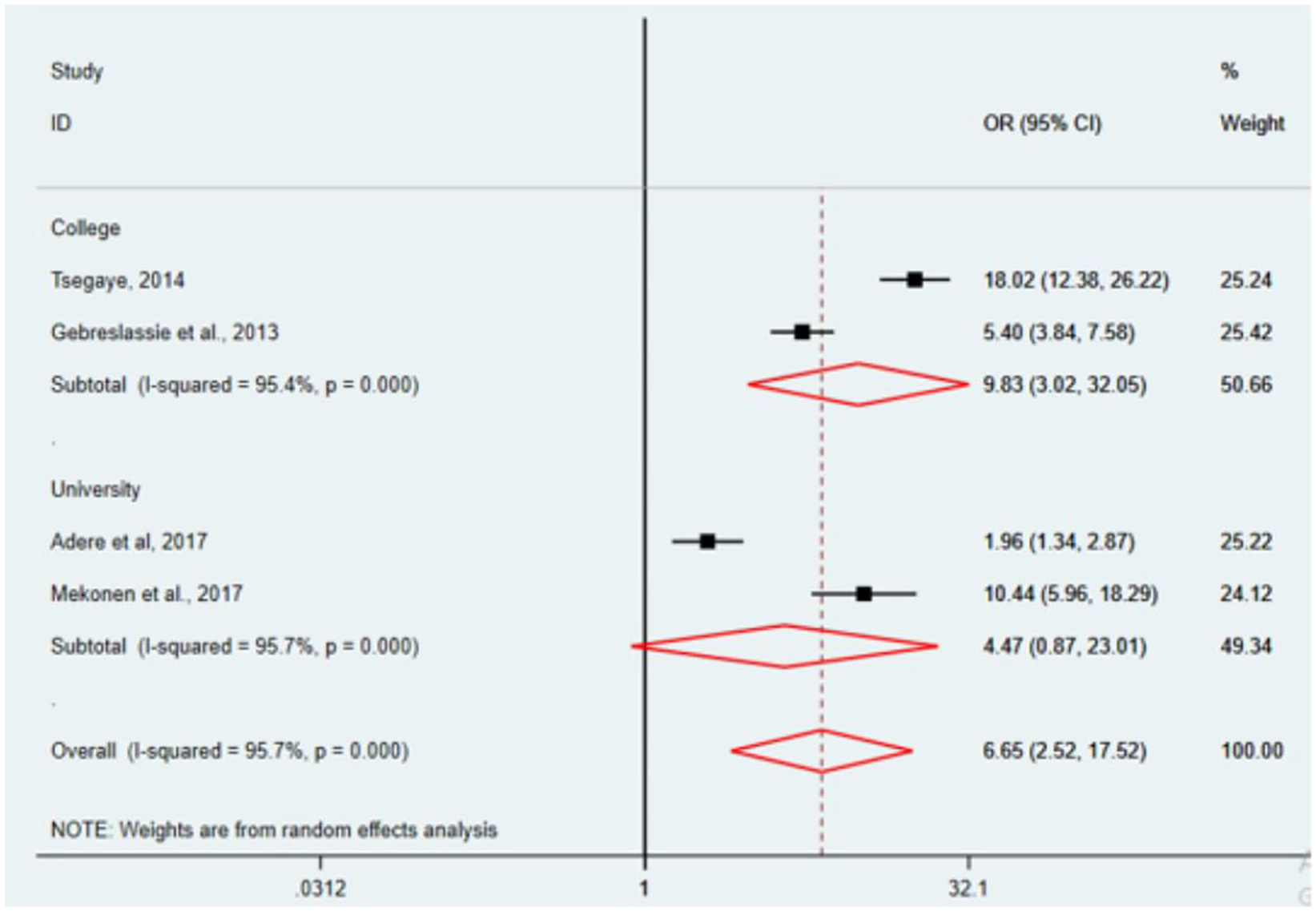
The association between khat chewing and alcohol consumption among school adolescents and youths in Ethiopia, 2019.
Peer pressure
In seven studies, the association between peer pressure and current alcohol consumption among school adolescents and youths was reported.29,30,35–38,50 All the included studies revealed that peer alcohol use was significantly associated with current alcohol consumption among school adolescents and youths. In this meta-analysis, those who had friends/peers who drink alcohol were 3.79 (OR = 3.79; 95% CI = 2.64–5.42) times more likely to drink than those who did not (Figure 8).
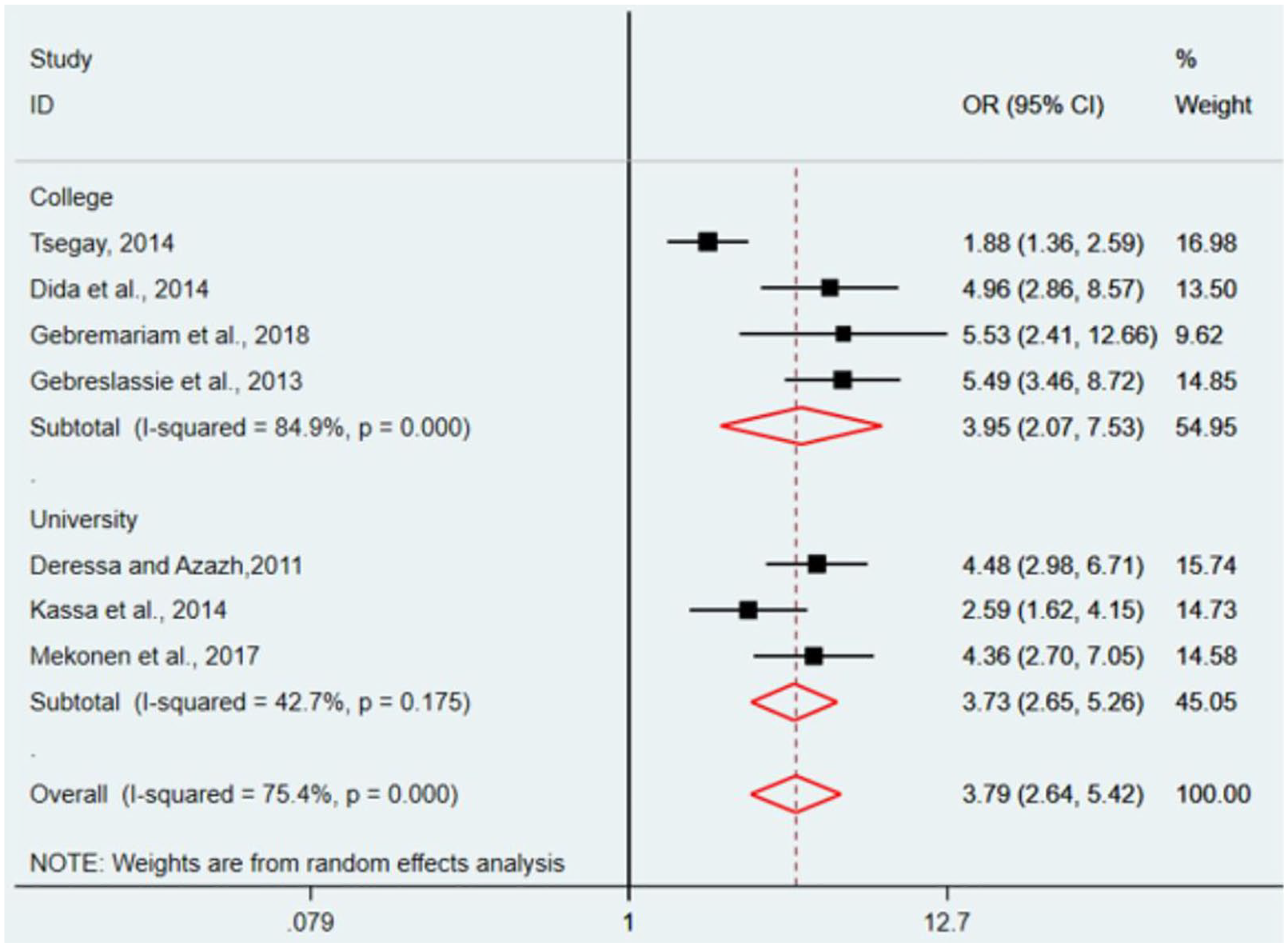
The association between peer/friend alcohol use and alcohol consumption among school adolescents and youths in Ethiopia, 2019.
Other factors associated with current alcohol consumption
There were additional significantly associated factors with current alcohol consumption that were not included in the analysis (due to a small number of studies reporting on these factors). Some of the factors were availability of alcohol, academic performance, detachment from the family (living alone) that makes them free to do whatever they like, and monthly pocket money (income).31,33,36,49
Discussion
To the best of our knowledge, this is the first comprehensive systematic review and meta-analysis on the current alcohol use and associated factors among school adolescents and youths in Ethiopia, which was conducted across 26 studies. In this meta-analysis, we investigated the pooled prevalence of current alcohol consumption and associated factors among school adolescents and youths in Ethiopia. The pooled current alcohol consumption estimate revealed that the prevalence of alcohol consumption was significantly higher in the study participants. Further subgroup analyses based on university, college, and high school samples indicated that studies from university samples showed a statistically significant difference.
The results of the meta-analysis revealed that the pooled prevalence of current alcohol consumption was 27.0% (95% CI = 22.0–32.0). Moreover, being a male, peer pressure, alcohol use among family members, khat chewing, availability of alcohol, academic performance, detachment from the family (living alone), and monthly pocket money (income) were found to be significantly associated with current alcohol consumption.
The risk-taking behavior of adolescents and youths is crucial to decide their future fate. Their productivity status in this age group determines where they will be in the future. The mental health of adolescents and youths, mainly affected by drug/substance misuse and alcohol consumption, is the leading one in Ethiopia. According to this study finding, alcohol consumption was a rising threat for adolescents and youths with limited effort to tackle the problem. The consumption of alcohol by university adolescents and youths (29.0%) was meaningfully higher than high school (23.0%) and college (27.0%) adolescents and youths. The reason for the high prevalence at the university might be related to peer pressure 53 and detachment from family control. 54 The other reason for the high prevalence of alcohol consumption among all the study participants is the recent increment of brewery beverage factories with their advertisement (expansion of the alcohol industries in Ethiopia).55–57 In this study, the identified contributing factors for current alcohol consumption were peer pressure, family member alcohol use behavior, khat chewing, and being a male.
In this meta-analysis, the pooled prevalence of current alcohol consumption among university students was found to be 29.0% (95% CI = 22.0–36.0), which is in line with a systematic review and meta-analysis done among university students in Ethiopia. 51 And it is also in agreement with a systematic review and meta-analysis that was conducted among adolescents in sub-Saharan Africa (SSA), which reported the prevalence of current alcohol consumption as 32.80%. 58 Another study conducted in 20 African countries reported 23.80% of Ethiopians were current alcohol users. 59 The findings of our meta-analysis were also in agreement with a systematic review done on Ethiopian university students (26.65%) 5 and Brazilian adolescents, according to the National Adolescent School-based Health Survey (26.1%) (PeNSE 2012). 60
Our study finding was lower than the national average for current drinking by participants aged 15–29 years in Ethiopia (40.70%). According to the 2015 NCD STEPS survey, this involved nationally representative participants aged 15–69 years and excluded students in higher learning institutions. 61 A possible reason for the discrepancy might be under-reporting by the students because most studies of alcohol use in adolescents and youths use self-report. This finding was also slightly lower than studies done among school adolescents (33% and 31%) of university youths in Eastern African countries, 4 50.70% in Kenya, 62 39.10% in South Africa, 63 41.80% in the USA, 64 China,65,66 and other western countries. 67 The primary reason for the comparatively lower alcohol drinking level in this study could be due to differences in the study setting, access, socioeconomic, and cultural reasons across the countries.
Our study finding was higher than studies done on adolescents in Morocco,68,69 Algeria, 70 Zimbabwe, 71 and Thailand. 72 The probable explanation for this discrepancy may be the current expansion of alcohol industries and massive alcohol advertisements73,74 in Ethiopia, and another reason may be that Muslim countries belonging to the Mediterranean region such as Morocco and Algeria have lower prevalence rates of alcohol consumption among adolescents compared to other regions in the world because of the religious prohibition of alcohol drinking as reported by WHO. 2 In addition, many Arab countries forbid alcohol use by law.
Current alcohol consumption among school adolescents and youths was significantly associated with multiple factors. In this systematic review and meta-analysis, being male was associated with current alcohol consumption, which is supported by other previous studies conducted in Ethiopia, 6 South Africa, 75 Tanzania, 76 and four sub-Saharan African countries. 3 This could be due to more exposures to alcohol in males; more tolerant social attitude toward male alcohol consumption; and cultural influences such as alcohol-related norms, values, and constraints, which may interact with biological factors (men had greater dopamine release than women) may be some of the cited reasons for the higher prevalence of alcohol consumption in males. In addition, it could be due to the fact that being male is associated with higher risk of substance use.
The other significantly associated factor with current alcohol consumption among the study participants was family member alcohol use behavior. This could be justified by the fact that sharing the behaviors and learning from families, which increases social interaction.77,78
Similarly, peer pressure was the other significantly associated factor with current alcohol consumption. This could be justified by the fact that sharing the behaviors from friends, which increases social interaction. Peers can encourage friends to use alcohol or tease them for being afraid to try them, which can lead to the initiation of drinking alcohol.79–84
This study also revealed that khat chewing was significantly associated with current alcohol consumption. There are also similar findings, which supported that khat chewing might be a gateway to other psychoactive substances such as alcohol.37,85,86 Therefore, khat is an antidote for alcohol and can counter drunkenness.
Strength and limitations
All efforts were made to include both published and unpublished (grey literature) articles. In addition, the use of predefined search strategies, conducting data extraction, critical appraisal, screening, careful exclusion of studies, and quality evaluation by two reviewers independently to minimize the possible reviewer bias.
The limitations of this systematic review and meta-analysis were the inclusion of a small number of studies that were used in our subgroup analysis, which reduces the precision of the estimate. The included studies were highly heterogeneous and publication bias was detected. Only cross-sectional studies were included in this study and might be subjected to recall bias.
Conclusion
The pooled analysis of 26 studies indicated that over a quarter of school adolescents and youths consume alcohol in Ethiopia. The most important factors that worsen the problem were peer pressure, the family member culture of alcohol consumption, concurrent use of psychostimulants such as khat, and being a male. Currently, there are no organized guidelines or standards implemented to protect adolescents and youths from long-term effects of alcohol consumption. Therefore, policymakers and other stakeholders should design and implement strict binding regulations to curb the widespread use of alcohol around educational institution premises at the national level. Besides, the issue warrants regular national-level educational institution–based studies focusing on the prevention of alcohol misuse, magnitude, trajectory, and consequences of alcohol consumption among students. In addition to that, school and community-based interactive programs that specifically target alcohol consumption are effective methods for reducing substance use.
Supplemental Material
sj-docx-1-smo-10.1177_2050312120974154 – Supplemental material for Current alcohol consumption and associated factors among school adolescents and youths in Ethiopia: A systematic review and meta-analysis
Supplemental material, sj-docx-1-smo-10.1177_2050312120974154 for Current alcohol consumption and associated factors among school adolescents and youths in Ethiopia: A systematic review and meta-analysis by Tilahun Ali and Teshager Worku in SAGE Open Medicine
Supplemental Material
sj-docx-2-smo-10.1177_2050312120974154 – Supplemental material for Current alcohol consumption and associated factors among school adolescents and youths in Ethiopia: A systematic review and meta-analysis
Supplemental material, sj-docx-2-smo-10.1177_2050312120974154 for Current alcohol consumption and associated factors among school adolescents and youths in Ethiopia: A systematic review and meta-analysis by Tilahun Ali and Teshager Worku in SAGE Open Medicine
Supplemental Material
sj-docx-3-smo-10.1177_2050312120974154 – Supplemental material for Current alcohol consumption and associated factors among school adolescents and youths in Ethiopia: A systematic review and meta-analysis
Supplemental material, sj-docx-3-smo-10.1177_2050312120974154 for Current alcohol consumption and associated factors among school adolescents and youths in Ethiopia: A systematic review and meta-analysis by Tilahun Ali and Teshager Worku in SAGE Open Medicine
Footnotes
Acknowledgements
We would like to address our deepest gratitude to the authors of the included studies for this systematic review and meta-analysis. Also, our deepest heartfelt gratitude goes to the staff of Haramaya University, College of Health and Medical Sciences who gave us technical support.
Author contributions
T.A. and T.W. conceived and designed the review; prepared the search strings, screened, and selected the studies; rigorously reviewed the manuscript; and also did the analysis and interpretation. T.A. prepared the draft of the manuscript and is the guarantor of the review. The final version of the manuscript was approved by the two authors.
Declaration of conflicting interests
The author(s) declared no potential conflicts of interest with respect to the research, authorship, and/or publication of this article.
Funding
The author(s) received no financial support for the research, authorship, and/or publication of this article.

Availability of data and materials
The datasets used and/or analyzed during the current study are available from the corresponding author on reasonable request.
Supplemental material
Supplemental material for this article is available online.
References
Supplementary Material
Please find the following supplemental material available below.
For Open Access articles published under a Creative Commons License, all supplemental material carries the same license as the article it is associated with.
For non-Open Access articles published, all supplemental material carries a non-exclusive license, and permission requests for re-use of supplemental material or any part of supplemental material shall be sent directly to the copyright owner as specified in the copyright notice associated with the article.
