




Abstract
In this article, we aim to highlight the importance of practices of commoning as a way to rethink politics, particularly in the context of the Capitalocene. Specifically, we argue for greater attention to the spatial dimension of commons by emphasising the collective practices of commoning. We suggest that commoning can offer a promising way to approach the existential crises we face through a process of reterritorialisation. This approach highlights the importance of space for cultivating collective values, ways of seeing, being, and acting in solidarity and care, challenging the capitalocentric logic that spatially dominates our times.
Keywords
Introduction
Deleuze and Guattari (2013) argue that at the heart of capitalism lie the logics of deterritorialisation and reterritorialisation. That is a capitalocentric logic that reshapes space, institutions, systems, and practices, detaching them from their ‘territorial’ framework, implying a disruption and change of established complex relationships and cultural meanings, complemented by a process of reterritorialisation. Reterritorialisation refers to an emergent socio-spatial reconfiguration that allows a specific form of governance, assemblages of relations and values to flourish (Kaithwar, 2025). It includes social, material, political and affective processes that (re)configure the image of space in particular time frames. In this light, capitalist reterritorialisation directs the formation of new structures, urban and rural infrastructures and relationships oriented to serve perpetual capital accumulation while disregarding, suppressing or sidetracking relations, practices, and structures that resist the capitalocentric logic (Collinge, 2020; Opanga, 2025). Deterritorialisation and reterritorialisation reshape space, creating socio-ecological monocultures serving an economy oriented towards endless economic expansion (Heynen et al., 2006). For example, when mining affects human and more-than-human relationships in sites of extraction, including the drainage of mountain waters, the removal of farm animals and agricultural production and dispossessing communities to create the conditions that are suitable to extractivism (Rigkos-Zitthen et al., 2024). The mining space is reterritorialised and re-organised in a way that aims to solely serve a particular developmental and productivist monoculture, that of mining while dismantles multispecies relations that preceded the extraction process. In urban settings we observe similar procedures with the housing crisis occurring due to extensive financialisation of property with the consent and accommodation of neoliberal state governance (Çelik, 2024). In this light, capitalist reterritorialisation creates spaces of enclosure oriented to the infinite accumulation of economic growth for the sake of growth regardless of the socio-ecological damage (Vasudevan et al., 2008).
Capitalist reterritorialisation also transforms individual and collective identities, culture, values, and ideas and orients them towards the equations and dynamics of capital flows and accumulation, smoothening spatial and temporal diversity across different geographies (Al-Hammadi, 2023). Individualism and competition dominates over solidarity, mutual aid, and democratic management of resources (Nightingale, 2019). A restorative balance between the two value systems is missing.
Similarly, the same process of de- and reterritorialisation is responsible for subject formation, meaning a mechanism that creates particular modes of being, normalises particular practices and encourages cultural habits (Schwarz and Streule, 2024). This capitalist process discards all materialities that do not serve capitals’ purpose, with these contributing to the emergence of multiple and overlapping crises, from economic inflation and pandemics to geopolitical instability and climate change, is often named the period of polycrisis (Cole, 2024) or the capitalist-driven epoch (Moore, 2018). The Capitalocene is a suggested new geological epoch (Crutzen and Stoermer, 2017; Houston, 2013; Moore, 2018), characterised by the ability of the industrial capitalist complex to destabilise the sum of the planetary ecosystems (Rockström, 2017). Consequently, the formation of the Capitalocene is the outcome of a process of capitalist enclosures, dispossession and reterritorialisation for the interest of global capital vis-à-vis the complex, multilayered and more-than-human relations unfolding across space, urban and rural (Ernstson and Swyngedouw, 2019; Tzaninis et al., 2021). The rich intellectual tradition of urban political ecology highlights how power unfolds and weaves relations, dependencies and contestations across space (Gabriel, 2014). From spatial arrangements of neighbourhood marginalisation and infrastructural segregation, to unsustainable water management, urban infrastructural designs of racial and class exclusions to the development of uneven green spaces and top-down designed participation in green transitions, the city has been characterised as a hotbed of challenges and tensions amidst polycrisis (Rekacewicz et al., 2025; Rigkos-Zitthen, 2025a).
With the development of the urban space as the dominant territorial ground upon which power relations evolve, we experience the intensification of capitalist reterritorialisation processes, the unmaking and the remaking of spaces which are all more deemed to be responsible for the emergence of the Capitalocene via the neoliberal globalisation (Gabriel, 2014; Swyngedouw, 2025)
To respond to the monoculture of capitalist goals and values, which has been facilitated by neoliberal globalisation (Kobayashi, 2020; Yang, 2019), critical scholars have started talking about the importance of commons and commoning as tools to approach the existential challenges of our times, such as climate change (Euler, 2018). Commons are often presented as spatial formations within which resources are managed collectively and democratically (De Angelis, 2017). The concept of commons has been elaborated, including a variety of different resources: material, such as irrigation systems (Ostrom, 2015), social housing (Huron, 2018); immaterial, such as language (Doerr and McGuire, 2023; Hardt and Negri, 2011) and knowledge (Richardson et al., 2024); and global, including the atmosphere and oceans (Gibson-Graham et al., 2016). Commoning, then, pertains to the relations and practices that allow and reproduce the collective management of resources (Huron, 2015).
With this conceptual article, we aim to contribute to the discussion about the role of commons for democratic politics of our times by highlighting the significance of commoning as collective practices for reterritorialising space in ways that challenge neoliberal globalisation, while reclaiming politics that nurture collective identities and values other than those oriented to the monetisation of life. The article adds to the efforts to emphasise the significance of space for democratic politics by seeking to provide ideas and insights on the interlinkages between commons, commoning, reterritorialisation of space. The way that commons and commoning operates can allow for challenging neoliberal forms of territorialisation, offering a new way to discipline, produce and disrupt hegemonic ways of doing and being, contributing to the cultivation of a democratic ethos (Kaithwar, 2025). We respond to calls from scholars such as Piketty and Sandel (2025) for exploring a new commonality that can connect people beyond the dominant capitalist logics, the culture of competition and capitalocentric value systems. To achieve this, first, we delve into the relation of commons to space through time. We then continue by presenting our approach to the role of commons in the reterritorialisation process, while placing a greater emphasis on the commons’ approach that focuses on relations rather than on resources. We conclude by arguing about the significance of commoning for the politics of our times.
Contextualising the discussion about commons and commoning across space
The evolution of commons and commoning should be seen in the wider context of the longstanding process of deterritorialisation has led to the formation of spaces that are used as vital elements of the capital accumulation process and are under the heavy influence of market power, meaning a domination of capitalist values and priorities. Despite being heavily criticised and debunked (Ostrom, 2015), Garrett Hardin's (1968) thesis about the ‘tragedy of the commons’ still plays an influential role in behavioural economics and the dominant neoclassical dogma that shapes hegemonic modes of governance (Locher, 2013; MacLellan, 2016).
Values such as competition and individualism amongst individuals and collectives have been perceived and associated as elements of progress and collective wellbeing (Piketty and Sandel, 2025; Puig de la Bellacasa, 2017). This extensive and globally expansive logic of deterritorialisation for capitalist accumulation has created new forms of understanding the world, while creating technologies that justify the unlimited and unequal exploitation of the resources of the finite planet and unequal national development (Dahinden, 2023). From colonialism to the green transition, the global development process has always been based on an unequal distribution of economic benefits, ecological footprint and social offsets (Bogojević, 2024). The logic of deterritorialisation scales up and uplifts the power and values of the market as simultaneously a politically desirable global abstraction, culturally relevant material realities are embodied into policy responses to particular social problems (Swyngedouw, 2025). For example, the efforts of the European Union to become a geopolitically competitive actor are reflected through particular policy implementations across different policy sectors, from food safety to education and healthcare, through extensive privatisations of public and common infrastructures, such as transportation, universities and hospitals (Miller, 2022).
Commons have been argued to follow another political trajectory than the one described above, particularly when we focus on the transformative dimension of commons with a potential to forge more democratic and pluralistic spatial formations through the cultivation of relations of care and solidarity (Rigkos-Zitthen and Kapitsinis, 2025a).
On this occasion, the relation of commons to space could follow a radically different logic from the one described with deterritorialisation due to the way materialities and subjectivities in commons are related to each other. While the discussion about commons is not new, it became very popular through Elinor Ostrom’s (2015) seminal thesis about how to govern the commons space. In the first tradition of the commons, often described as the ‘common-pool resources’ approach (Agrawal, 2003), space is understood as a bounded physical territory within which a community collectively manages specific material resources (Dawney et al., 2016). These resources include not only ecological materialities such as plants, trees, and animals, but also socio-technical infrastructures like irrigation systems. From this perspective, commons can be seen as an alternative to the dominant political ecology of urban metabolism (Meerkerk, 2024), since collective formations reorganise power in ways that shape how shared resources are transformed into infrastructures governed through care (Power and Mee, 2020; Zapata Campos et al., 2026).
Housing offers a clear example: commoners may occupy or squat vacant buildings (Ruiz Cayuela and García-Lamarca, 2023), or mobilise collective resources to influence policy-making by advocating for social housing for vulnerable populations in cities (Guisan et al., 2025; Huron, 2018).
Commons space, however, is often portrayed as vulnerable to appropriation and enclosure for capital accumulation (Blomley, 2008). From this viewpoint, capital continually seeks new resources and frequently targets commons, co-opting them in order to convert shared resources into assets with exclusive value for market production (De Angelis, 2017). In doing so, capital tends to impose a value monoculture in which exchange value dominates, while other forms of value – symbolic, affective, or use value – are marginalised or erased (Fournier, 2013).
Yet beyond romanticised interpretations of urban commons (Sevilla-Buitrago, 2022), we argue that the relationship between commons and capital is better understood as complex, messy, and dialectical. Rather than viewing them as mutually exclusive or defined solely through domination, we conceptualise commons as embedded within assemblages of uneven power relations that both shape and are shaped by competitive modes of governance. At the same time, we recognise the profound social, political, and ecological harms generated by processes of capital accumulation (Malm, 2021).
Simultaneously, capital is necessary for the social reproduction of the commons (Gibson and Dombroski, 2020). Successful in time commons formations learn to metabolise capital into the infrastructures that maintain the operational domain of commons (Bauwens et al., 2024; Huron, 2015). The difference with capital lies in how investment is oriented. Capital must continually generate economic growth in order to sustain itself, whereas commons invest resources toward the sustainability and wellbeing of those who maintain them. In this sense, commons and capital paradoxically share a formal goal – their own reproduction – but diverge fundamentally in what that reproduction is for (Gibson-Graham et al., 2016). While capital presents itself as a vehicle for collective wellbeing, it functions primarily as a mediating structure through which value must circulate before reaching society. Commons differ in that they distribute produced value directly among participants, thereby linking wellbeing to shared production rather than to market mediation (Gibson and Dombroski, 2020). In this sense, the commons’ reclamation of space implies a pragmatic and mundane engagement with capital, treating it as a necessary means for the social reproduction of the commons themselves.
With the rise of the city as the dominant space of social transformation in the last decades, commons literature started paying attention to geographically specific places, and particularly, to urban environments and saturated city spaces (Huron, 2015; Verheij et al., 2024). The urban commons became a valuable ground for research on how tight spaces, scarce resources and social infrastructures are often managed collectively through care and caring practices of commoning (Chatterjee et al., 2023; Verheij et al., 2024). Within the literature about urban commons, we have also seen a growing interest in social movements and green mobilisations including citizen climate assemblies (Bisello et al., 2024; Nielsen and Sørensen, 2023). In this light, social movements operate primarily within urban spaces, for example the indignados in Spain, the revolutionary spirit in Tahrir square in Egypt and Gezi park in Turkey as well as the Aganaktismenoi in Syntagma square in Greece and the Fridays for future, are all struggles fitting within the narrative of the commons as efforts to articulate an alternative to the global economic orthodoxy vision spreading within particular spatial formations (Villamayor-Tomas et al., 2022). Those movements experiment with different forms of governance of resources across space. For example, the rise of health clinics in Athens during the economic crisis. Those commons infrastructures occupied particular spaces in the city framework providing primary health to those fallen outside social welfare schemes (Evlampidou and Kogevinas, 2019). Others claimed public space, commoned it and turned it into a political arena for reconfiguring alternatives to the mainstream neoliberal political landscape (Pettas and Daskalaki, 2022; Rigkos-Zitthen et al., 2024).
Commons’ scholarship was enriched with the introduction of immaterial commons as the second wave of commons in literature. Immaterial commons include collective resources managed and produced through language (Hardt and Negri, 2011) and knowledge (Richardson et al., 2024) as well as the design of software languages, such as Linux and Ubuntu (Holman and McGregor, 2005). Immaterial commons have changed the perspective on commons since the perception of space expanded beyond concrete and well-defined physical territory, towards a more abstract conceptualisation of governing resources. Commoners can communicate while being in two different geographical locations, using online tools. In this light, both space and community may have become fluid, but are still significant when analysing entities. Space is argued to come to the forefront based on its interaction with technology, as social actors on the local and global scale strongly interact (Koster and Kapitsinis, 2015). Geographically sensitive aspects, such as local norms, beliefs and amenities, become crucial factors in shaping the new digital world order (Dicken, 2015). On these grounds, the spatial fixity of commoners should be accounted for, as they are spatially bounded in geographically specific socio-economic contexts that largely affect their agency, behaviour and practices (Kapitsinis, 2018). The radicality of immaterial commons concerns the range of resources that have now become unlimited. In other words, resources collectively managed in immaterial commons are not bounded by the laws of spatial scarcity (Dyer-Witheford and De Peuter, 2021). For example, the use and programming of a software language have no spatially defined limitations. The commons community now has endless possibilities to (re)programme and evolve immaterial commons resources. However, this tradition remains important since immaterial resources are still bound in materially grounded resources such as the hardware that is necessary for the reproduction and expansion of immaterial commons.
The third and most recent tradition of commons, the relational one, shifted the focus from commons as spaces where resources are managed to the relations and practices that are essential for a commons to come to life and reproduce (Williams, 2020). As Peter Linebaugh (2014) puts it: …to speak of the commons as material or immaterial resources is misleading at best and dangerous at worst. The common is an activity and it expresses relationships in a society that are inseparable from relations to nature.
The historian encourages us to use the term as a verb, meaning commoning, as a way to show that commons as spaces of different value systems come to existence by performing caring practices and relations between humans and more-than-humans (Bresnihan, 2016a; Dengler and Lang, 2022; Tummers and MacGregor, 2019). Under this light, space manifests the values produced for the commons when a community performs commoning (Grear, 2020). Focusing on commoning brings to the forefront feminist political ecology and care ethics. Within this frame, with commons being constituted upon relations and caring practices, commons space materialises as long as commoning is performed within it. In other words, focusing on commoning means understanding space as performative and relational constituted and reproduced through collective caring practices (Glass and Rose-Redwood, 2014; Power et al., 2022).
The exceptionality of thinking about de- and reterritorialisation via commoning is that collective practices become the focal point of analysis. Commoning has the potential to common space and not the opposite. The commons space does not pre-exist the community which sets the rules of governance and co-existence (Arbell, 2023; Verheij et al., 2024). If commoning occurs in an open access regime, private or public space then the conditions for challenging the dominant form of territoriality and governance open up. It is then the caring activity that contests established spatial relations, reshapes and influences the values and the modes of governance of that particular territory. Gibson-Graham et al. (2013) show how commoners can common everything through commoning. From privatised lands to open access regimes such as the atmosphere. For example, indigenous communities in Australia utilise their knowledge to protect wild animals fleeing the destruction of their natural environment within privatised lands. Others seek to safeguard local fisheries through the collectivisation of ownership and the imposition of limits on capital accumulation, as documented in Ireland (Bresnihan, 2016b). A further configuration involves individuals – initially strangers to one another – who coalesce into collective formations, organise public assemblies, occupy shared spaces, and channel investment into local enterprises, thereby promoting community-oriented values and production in deliberate opposition to global extractivist corporations and antagonistic state authorities (Rigkos-Zitthen and Kapitsinis, 2025c).
By performing commoning, the community develops relations of care for what it is commoned (Clement et al., 2019). Those practices can be small gestures of kindness, from volunteering, offering shelter and food (Williams, 2020). They can also be caring practices essential for social reproduction such as taking care of the elderly and the kids, creating infrastructures that support local communities and the most vulnerable in society. From health clinics, to cultural institutions that sustain traditions and roots alive to the influence of the welfare policies (Vercellone, 2015) and social struggles for political emancipation (Della Porta, 2020), all those commoning practices highlight how caring with (Tronto, 2010) creates the political possibility of radical social change. For example, the autonomous municipalities established by the Zapatistas in Chiapas are developed upon caring practices that reorganise land, production, education, and governance around communal decision-making rather than capital accumulation (Trzeciak, 2024). Yet, the community utilises capital to promote and distribute artefacts while also using social media to accentuate its message about alternative modes of governance as necessary for a social fair and ecologically sustainable transition (Rigkos-Zitthen and Kapitsinis, 2025b). More than that it allows for relating differently to the ecologies and materialities that support social reproduction (Rigkos-Zitthen and Kapitsinis, 2025c). For example, studies have analysed spaces like community forestry on public and private lands, such as in Nepal (Paudel, 2016), India (Meinzen-Dick et al., 2021), Chile (Ibarra et al., 2023), or New Zealand (Gibson-Graham et al., 2016) highlighting how they create new understandings about our relation to the more-than-human world and the spaces that sustain those relations. Once space is understood beyond its monetary value towards a more caring ontology it allows for doing, practising and contesting what minimises the complex valuation of space (Houston et al., 2018). Thus, it opens up possibilities of reterritorialisation beyond capitalist relations.
What is also important in this discussion is to prevent romanticising caring relations. Thinking of commoning through care does not mean disregarding the fact that care is embedded in unequal power relations (Noterman, 2022). Some people are overburdened with care much more than others. Women, people of colour, undocumented immigrants can be simultaneously primary care givers and overexploited even when practising commoning (Power, 2019). Contesting capitalist territoriality does not mean eliminating uneven power relations. As feminist political ecologist argue, to practice commoning means reorganising space in ways that challenge the dominance of relating to each other challenging monetaristic, productivist and cost-benefit analysis framework that promotes competition and individualism while discarding patterns of care and solidarity (Clement et al., 2019; Nightingale, 2019).
Moreover, understanding commoning through a caring lens provides us with valuable information concerning commons’ relation to space, the active role of resources in the making of the commons, culturally coherent and materially robust and the way that commoning forges new individual and democratic and caring collective identities (Rigkos-Zitthen et al., 2024).
The role of commons in a democratic and pluralistic reterritorialisation process
The relational understanding of commons challenges the idea that appropriation or enclosure of commons spaces terminates the existence of commoning as practices. Since commons are perceived as essentially constructed in space through social relations and by performing collective practices, then, while commons space might be absent, the legacy of commoning practices can continue being reproduced within public and private formations.
Despite the alternation in the use of space, including deterritorialisation processes, relations cultivate ethics essentially related to values produced in the commons (Power, 2019). Therefore, while commoning as practices are essentially a necessary condition for creating commons spaces, the opposite is not a necessary precondition (Gibson-Graham et al., 2013). For example, processes of commoning can occur when a community sets controlled fires in a privatised land as a way to protect the city during the peak season of bushfires in Australia (Country et al., 2016). In this light, locally grounded and indigenous knowledge is shared and contributes to the protection of legally private space as a means for taking care of a broader community of humans and more-than-humans beyond a particular space. In that sense, commoning can infest spaces appropriated by capitalism and deterritorialised formations with caring practices and collective values that are necessary for the social reproduction of space beyond legally claimed privatised formations.
Commoning, as relations, creates value detached from commons spaces. Caring practices create the condition for commonising space. In that sense, the value of commoning can be transferred, contribute to and affect politics beyond the commons’ territorial delimitations in many ways. Rigkos-Zitthen and Kapitsinis (2024) argue that commoning and developing caring relations produces legacies, collective identities and ethics that affect spatial relations no matter the dominant governing mode of a particular space. The household, the state institutions, and the private company are all potential spaces where commons values can flourish (Gibson-Graham et al., 2016). Here we follow the logic that commoning and commons are spaces of education in the sense that once you learn a mode of behaviour, once you learn to govern your life in a particular way, you can transfer elements of these patterns to other spaces (Rigkos-Zitthen and Rigkos-Zitthen, 2024). Let's think of immigration. The values of the motherland are transferred, evolved, challenged and re-adapted in the new territory in ways that comply and challenge the existing structure of space (Agustín and Jørgensen, 2025). Under this light, commoning allows us to focus on practices that are simultaneously grounded and independent from particular territorial formations, having the potential to contribute to a broader spectrum of politics related to the challenges we face today which are highly associated with deterritorialised spaces of capitalist accumulation (Harvey, 2005).
Focusing on commoning enables our understanding of how commons can affect deterritorialised spaces, scaling down to particular relations across space. Those relations might be messy, gendered and unequal, yet are not always oriented towards competition, and individual increase of benefit over the others (Power, 2019; Rigkos-Zitthen and Kapitsinis, 2024; Williams, 2020). For example, practices of care, solidarity and mutual aid can enrich spaces clearly defined by capitalist values with foreign to the logic of capital, while potentially limiting capital accumulation (Conradson, 2003; Nicholls et al., 2013). Refugee camps are a great example towards that front (Frazer, 2022). Spaces that have been designed to control, monitor and separate foreign people from local communities also become spaces of political contestation, solidarity and care from communities, which at the same time as sceptical to the influx of foreign subjects and of the capacity of local communities to care for those (Tsavdaroglou and Kaika, 2022). In that sense, it challenges the logic of deterritorialisation by contesting capitalist values and priorities, highlighting the performative elements in commons while allowing for the conditions of pluralistic reterritorialisation to emerge.
Second, commoning can allow for a deeper and different understanding of the role of resources in the process of pluralistic reterritorialisation. Thinking through commoning, resources can be understood as active entities in the (re)production of commons space (Bresnihan, 2016a). This understanding does not imply that the resources, or better, the more-than-humans participating in the commoning are consciously and actively forming the commons (Latour, 2005). However, it implies that the more-than-human environment is vibrant and responsive to human activity and the ways things take shape through commoning (Rigkos-Zitthen and Kapitsinis, 2025c). That is, commoning creates relationalities and collective identities that enable seeing the environment as an active co-constructor of our social realities and our spatial frames. For example, the affective relationships between local communities in India and the forest allow for sustainable forms of management of resources (Singh, 2013). In indigenous stories of commoning, the land becomes the great mother, the one which provides without territorial limits and legal status that narrows the values that apply on space (Agustín and Jørgensen, 2025). Commoning as care brings a pluriverse of ways of thinking, being and doing that challenge the capitalist monoculture of defining space and its values (Escobar, 2020). Thus, spaces driven by processes of capitalist deterritorialisation become contested and embroiled with practices that allow for the pluralisation of values and collective identities beyond individualism and competition.
Third, commoning as practices, also contributes to the formation of individual and collective identities as well as new links among commons’ participants, thus strengthening spatial relationships that can open possibilities for pluralistic reterritorialisation. The ones participating in commoning often develop relations of solidarity, care and mutual aid, despite the fact that power within these relationships is responsible for an unequal distribution of the burdens and responsibilities within a commons (Williams, 2016). Studies have shown that commoning forges collective relations and identities between people that might not be connected prior to commoning (Nightingale, 2019; Williams, 2018). This ability of commoning to produce new forms of relations, culturally collective values and identities amongst commoning participants also enables the strengthening of spatial relations amongst them. For example, commoning can facilitate the formation of new collective spaces, after a community has explored and forged new relationships and utilised collectively resources to achieve common goals.
On top of the above discussion about the relation of commoning to space, the parameter of time should not be neglected. Commoning does not only affect spatial relations but also temporal ones. Scholars have highlighted the intergenerational importance of commons and commoning for politics and the socio-political legacies that commoning creates (Berlant, 2016; Rigkos-Zitthen, 2025b). In this frame, commoning that occurred in the past has affected behaviours and stances of life in the following years, indicating the evolutionary element in commons, helping different generations to build stronger community connections and solutions to spatially grounded problems (Caillaud and Cohen, 2000). Having said that, one should also point out the dark side of time concerning commoning. Time can also operate negatively in the reproduction of commoning, as a result of the nature of commons in space. It is often observed that needs, understandings and interests change across time and generational patterns, leading to modifications in commoning reproduction, entailing possible loss of the values accompanying it (Fischer et al., 2004). This problem is inherently attributed to commons and commoning, being a crucial topic for further and more comprehensive future exploration.
Shifting back to the importance of space for commons and commoning, we argue that while recognising the limitations of the relational commons’ tradition, we further discuss it. As abovementioned, it provides a more vibrant, detailed and rich overview of the relation between commons and space, through the lens of commoning. In the next section, we contextualise commons and commoning within the Capitalocene context, seeking to highlight how space plays a fundamental role for commons in our times. Below we visualise the relationship of commons and capital across space.
Commoning, reterritorialisation and crisis
The importance of considering and defining space through commoning in the context of permanent and often overlapping crises is based on our need to find ways to approach the problems of our times in nuanced and often more complex ways than previously. That is, the definition of commons as spaces operating exclusively antagonistically to processes of deterritorialisation limits our understandings and ways of collectively approaching the global challenges we face. As geographers, we understand space as performative and dynamic: a place where power relationships meet and forge new material and immaterial realities and metabolism of resources in a collective and direct democratic way (Grear and Bollier, 2020). What we argue is that global-scale processes of deterritorialisation and reterritorialisation in ways that serve capitalist accumulation are not absolute and definitive. Instead, we understand that there are always openings and cracks within which resistance spurs not only as a means of contestation to capitalism but as an existential mechanism to social reproduction (Tsing, 2015). That is a socio-ecological mode accumulated through commoning and practices of care that simultaneously challenge and reproduce the conditions upon which capitalism flourishes.
When contextualising the discussion about space and commons within the Capitalocene frame, the issue of scale emerges unavoidably. We understand global space as construed upon and from a mosaic of places, and that ‘not only is the local constructed out of the global, but the global is constructed from the local’ (Massey, 2005: 99).Within this frame, we argue that the problems of our times and the emergence of a whole new period of existential crises are related to the way political institutions are treating space, commons and resources. In their alliance with the Market in the search for economic growth and capital accumulation, space and resources have become integral elements in the capitalist production process, ontologically devoted to treating the planet as a place of infinite resources (Butler, 2017; Kallis, 2019). To serve this kind of logic, political institutions have to disrupt and change spatial relations as well as disregard territorial and ecological complexities, peoples’ caring attachments, and non-human processes (D’Alisa et al., 2015). In other words, political institutional commitments to serve the goals of capital accumulation force them to treat space as an essential aspect of capitalist productive activities that serve the monoculture of producing economic growth and capital accumulation. For instance, drawing on historical evidence, when Australian settlers moved to the new territories for the first time, they had to declare the land as empty (terra nullius) as a way to justify the imposition of particular modes of production by exploiting indigenous communities and local ecologies as external to this purpose (Giannacopoulos, 2017). In this light, what political institutions are able to see is a matter of power relations reflected in space (and time).
As a result, to be able to approach the problems of our times, we argue that we need a strategy that allows us to change the equilibrium of power, making place-based politics and spaces visible for their importance, fragility and complexity. Towards that goal, we put forward the importance of commons and commoning for making space visible and useful for progressive social change. Commoning can make space visible and highlight it as a socially useful tool, not necessarily only in territorial terms but also relationally and performatively. Showing that resistance to exploitation and capital accumulation for the sake of limitless accumulation has (to have) limits. Not just for making statements of resistance but as a means of survival and living well on a planet characterised by the ruins of capitalism (Tsing, 2015).
Practices of commoning can bring to light a world of differentiations, a universe of different practices and ways of being and doing across space and geographical latitudes (Escobar, 2020). This allows for new collective identities as well as new relations between humans and the more-than-human world to be forged. Commoning practices finally show that one cannot apply across space and different places one-size-fits-all solutions that serve the purposes of capital, alien to the needs and demands of local communities and their ecosystems. In that sense, it is an exercise of democracy. Thinking through the lens of commoning provides us with the ability to consider how to include in democratic procedures the ones affected by the process of capital accumulation and endless economic growth, while putting limits on how much of this growth makes sense for the people and the land affected by it.
Drawing on framing commoning as relational practices, we have reached the point of recognising that there are some specific spatial requirements for the constitution of a commons. The material element is always present. Social relations do not occur in a vacuum. There are always material conditions that shape the image of commoning, reflected on a socioeconomically variegated space (Kapitsinis, 2018). This process can be slow (Bresnihan, 2019), and restoration can occur through intergenerational forms of collective care (Gibson-Graham et al., 2016). For example, the relations formed across space and time through commoning might not create the required conditions for radical change in an instant. Spaces of contestation emerge through the cracks of the dominant systemic forces brewing and forging relations of care and solidarity amongst commoning participants, humans and more-than-humans in the long durée of time, while also being in a dialectical relationship with the forms of exploitation they aim to challenge. Even when we refer to immaterial commons, we often disregard the material equipment that is necessary for online processes to emerge. Material equipment is place-based, geographically bounded, connecting local struggles within networks of communication across different spaces around the world. In addition, we should not neglect the energy requirements of these processes, contributing to our broader concerns about the ecological footprint of immaterial commons processes (De Angelis, 2017). Figure 1 below highlights the relation between commoning and capital in the transformative process of (re)territorialisation.
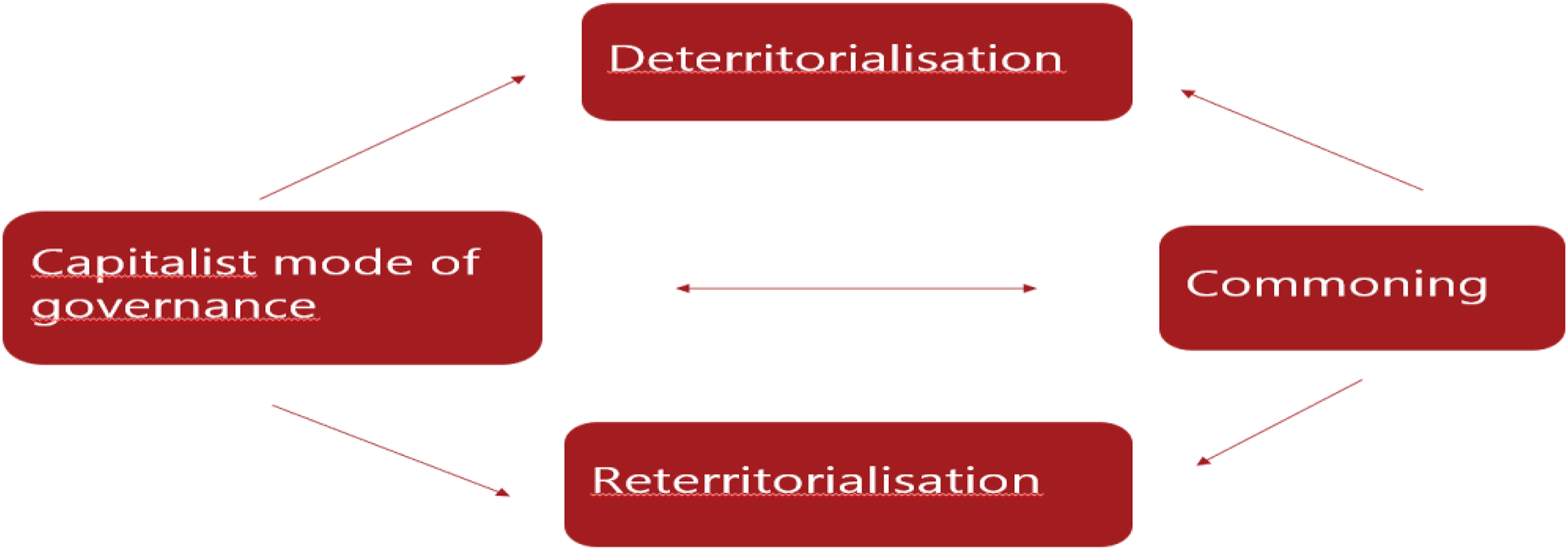
Authors’ conception of the relation between the de- and reterritorialisation between commons and capital.
In other words, the spatial element of the commons is always present, regardless of its form, whether material or immaterial. Chiefly, the physical space within commons points to the fact that a commons community is always dealing with the factor of scarcity of resources, the messiness of negotiations with capital, and control of public regulatory frameworks (Power et al., 2022). While some forms of collective action might be based on the infinite accumulation of resources such as language, knowledge, or software programming, the subjects and the materials contributing to the immaterial commons (re)production are based on geographically bounded relations that are always socially informed and grounded (De Angelis, 2017). For example, an immaterial commons can be a network of offices in which a distant community of programmers utilises their material resources to produce a collective programming language, such as Linux software. Commoning can teach a collective to think about the limitations that should be taken into consideration or to be legally introduced to protect the scarcity and vulnerability of material resources (Lane, 2019). Under this light, commoning creates an ethos among its participants that is antithetical to the (il)logics of the market, where limitations in the use of resources go against the existential purpose of eternal capital accumulation.
The element of space becomes more prominent but also clearer when we talk about the relational commons that emphasise the caring practices of commoning. What becomes better defined when focusing on commoning is that relations and practices performed across space attain a qualitative power that exceeds the limits of a particular place. In other words, while space plays a significant role in allowing commoning to develop and evolve, the products of commoning and governing procedures have the potential to exceed the boundaries of a particular territory, transferring commons values, patterns and ways of being beyond the grounded limits of a commons space (Stavrides, 2023; Varvarousis, 2020). Under this light, we argue that the values, modes of being and doing within a particular commons space open up possibilities of enriching political institutions beyond the governing jurisdictions of a commons. This is important to keep in mind when we conceptualise commons in the Capitalocene where there are open calls for institutional change as a means to approach the challenges of our epoch and the sustainable governance of resources (Dryzek and Pickering, 2019; Tønder, 2025).
While we often talk about resources, we do not necessarily describe passive materialities. Instead, we use the term only schematically. To our understanding, commoning allows a form of governing and management that considers the vibrancy and agency of the nonhumans who responsively interact with the human community in the making of commons space. In this light, resources are considered as an element of the sustainability and reproduction of a commons, while the depletion of them will also mean the change of character of the space where commoning develops and evolves.
Overall, we argue that commons and commoning can be a powerful tool for re-politicising and reterritorialising space, projecting the importance of geographical specificity through resistance to the monoculture of capital accumulation and enrichment of political institutions in a process of challenging capitalist values, while also contributing to the mitigation of our existential problems, such as climate change. We believe that highlighting the relation of space to commons in the Capitalocene marks an effort to fill in an essential gap in our endeavour to democratically approach the challenges of our times (Lawrence et al., 2024). It does that by pluralising the ways we value, manage, and eventually decide about what the ways we want to pursue our collective well-being, accounting for the limits to nature and an alternative way of connecting with its multifaced more-than-human materialities.
That is, it is crucial to discover ways to overcome the limitations that contemporary liberal institutions face in their alliance with the goals of the Market. With our above line of argumentation, we have sought to provide ideas and insights on the conceptualisation of the interlinkages between commons and space, focusing on the importance of commons space through the lens of commoning. Thinking more carefully about one of the fundamental elements of commons and commoning, that of space, we argue that we contribute to a better understanding of the contributions of commons in the discussion about how to approach Capitalocene-related problems.
Conclusions
This article has argued that commoning is best understood as a caring collective practice through which space is continually reterritorialised beyond capitalocentric logics towards formatting commons. Moving beyond resource-based definitions of the commons, we conceptualised commoning as relational, performative, and materially concept that generate alternative values, identities, and modes of governance. We showed that commoning pluralises spatial value by foregrounding care, supports social reproduction and ecological interdependence; that it exceeds territorially bounded sites, allowing collective practices to reshape capitalist spaces from within; and that it unfolds through infrastructures, temporal legacies, and pragmatic engagements with capital. Reterritorialisation therefore emerges not as a fixed institutional outcome but as an ongoing political process. In the context of the Capitalocene, the importance of commoning lies in its capacity to re-politicise how space, resources, and collective life are organised for the collective wellbeing of humans and the more-than-human world.
Footnotes

Funding
The authors received no financial support for the research, authorship, and/or publication of this article.
Declaration of conflicting interests
The authors declared no potential conflicts of interest with respect to the research, authorship, and/or publication of this article.