




Abstract
This article considers the potential of public–common partnerships (PCPs) to act as a new municipalist intervention against the privatisation and financialisation of land in the UK. In previous publications, we have presented PCPs in abstract terms as a municipalist organisational form that could help communities eschew the disciplinary effects of finance capital to pursue alternative democratic forms of urban development. Here, we start to examine what this process looks like in practice. The article draws from ongoing participatory action research in two contrasting case studies, Wards Corner in Haringey and Union Street in Plymouth. We find that by establishing enduring organisational structures where collective decisions can be made about who owns and manages land and assets, PCPs could bolster already existing efforts to democratise urban development in both cities. As an organisational form, PCPs reframe the ‘local’ as a politics of proximity, decentre and reimagine the role of municipal institutions and foreground a politics of the common. This makes them an archetypal new municipalist strategy, well-suited to contesting the enclosure of urban landscapes. The article concludes by considering the development of PCPs within the broader new municipalist tendency.
Introduction
Although many of the Spanish electoral platforms associated with the emergence of the new municipalist discourse have now waned, the broader new municipalist agenda is continuing to be defined through an emergent process of collaborative experimentation and theory building, characterised by ‘the bridge it builds between alternative economic spaces that prefigure post-capitalist futures and the institutional supports at the municipal or city-regional scale required to nurture and sustain them’ (Thompson, 2021: 337). More broadly, this new municipalist politics has been characterised as animated by a set of underpinning principles that include ‘the reframing of the local as a politics of proximity, the attempt to transform institutions and distribute power, and its manifestation as a ‘becoming common of the public’ (Russell, 2019: 1000) along with the ‘feminisation of politics’ (Roth et al., 2020).
This has given rise to a breadth of new practices orientated towards the emergence of ‘new political subjectivities, strategies and organisational forms’ (Thompson, 2021: 325). Whilst recent contributions on new municipalist practices have focused on a wide range of themes – including technopolitical participatory innovations (Charnock et al., 2021), municipal energy democracy (Angel, 2021), water remunicipalisation (Popartan et al., 2020), participatory governance (Bua and Bussu, 2021), care regimes (Kussy et al., 2023), urban food policy (Morley and Morgan, 2021), refugee reception (Garcés-Mascareñas and Gebhardt, 2020) and electoral platforms (Blanco et al., 2020) – there has been little focus on the issue of land, and the role that alternative approaches to land ownership and stewardship may play in municipalist strategy.
Land has taken on particular significance in the functioning of a financialised capitalist economy. In the UK in particular, the past 40 years have seen vast swathes of public land transferred into private ownership (Christophers, 2019a, 2019b). The acquisition of land has been integral to processes of financialisation and assetisation, where the extraction of rent and the promise of rising asset prices have accelerated the expansion of the debt economy. Whilst British local authorities have played a functional role in the privatisation of land, only more recently have we started to see them as active agents in the development of ‘financialized municipal entrepreneurial’ approaches (Beswick and Penny, 2018). Whilst this represents a form of ‘innovation’ in municipal strategies, it simultaneously reflects the ‘degraded state of municipal economic programming (and imaginaries)’ (Peck, 2017: 16), with local authorities remaining wedded to strategies of economic development that prioritise growth in asset prices (most obviously in housing) over the needs of inhabitants.
Whilst the legislative capacity of national governments is necessary for substantial reforms in areas such as taxation or renationalisation, what scope is there for specifically municipalist interventions? If we are advocating the replacement of private land ownership with alternative models of decommodified ownership and stewardship, what exactly do these models look like? And what about these models qualifies them as enablers of alternative models of development that allow us to push back against these new urban enclosures (Hodkinson, 2012)?
Drawing on an ongoing process of participatory action research in two contrasting cases – Wards Corner in Haringey and Union Street in Plymouth – this article explores the potential for public–common partnerships (PCPs) to act as an alternative model of urban development rooted in the common ownership and stewardship of land. Building from our earlier theorisation of PCPs as ‘an alternative institutional design that moves us beyond the overly simplistic binary of market/state’ and that must necessarily ‘emerge as an overlapping patchwork of institutions that respond to the peculiarities of the asset concerned’ (Russell and Milburn, 2019: 13), in each case we have collaborated with community-led initiatives to develop place-based models of a PCP.
Offered as examples of ‘different formulae of citizen involvement and public-community collaboration’ (Blanco and Goma, 2020: 393), and through reframing the ‘local’ as a politics of proximity, decentring and reimagining the role of municipal institutions and foregrounding a politics of the common, we argue that PCPs are an archetypal new municipalist strategy. Contrary to conventional models of public ownership, we argue that PCPs have the potential to contribute to a democratised model of urban development grounded in collective agency, functioning as ‘a self-expanding circuit of radical democratic self-governance’ with potential to ‘bypass the need for private financing and sidestep the mechanisms through which finance capital exercises its discipline and structures the economy’ (Russell and Milburn, 2021: 140). The article concludes by considering the development of PCPs within the broader new municipalist tendency, reflecting on their potential in contributing to the strengthening of a broader politics of the common.
Framing new municipalist strategies
Despite the fact that ‘engagement with institutions and elections should be understood as a component of broader strategic approaches, rather than the defining feature of the new municipalism’ (Russell, 2019: 997), the dominant tendency of new municipalist research has been to focus on either the policies and practices of the local state or the experiences of those initiatives looking to ‘transform’ institutions from within. Such contributions are undoubtedly valuable in developing our understanding of new municipalist practice; however, they belie a tendency (even if unintended by individual authors) to misrepresent new municipalism as solely concerned with existing political institutions, the scope for transforming their internal processes (including attempts to ‘open them up’) and efforts to implement somewhat poorly defined ‘radical’ local government policy. Without being situated in a wider agenda, these interpretations arguably align with what Barnett et al. (2020: 507) have called ‘municipal pragmatism’, an approach which ‘privileges the generation of alternative visions that are grounded in the everyday work of local government’.
Yet what underpins the wider agenda of new municipalism is not the everyday work of local government, but the proposition that ‘our relative proximity in our towns and cities – to one another, to flows of capital, to instances of both crisis and opportunity – makes it a privileged starting point for building a new landscape of power’ (Russell, 2020: 109). As Bookchin (1992: 227, 245) argues, it is through the municipal scale that the ‘political’– understood as ‘a participatory dimension of societal life and the activity of an entire community’– can begin to be reconstituted through the ‘municipal association of people reinforced by its own economic power, its own institutionalisation of the grass roots and the confederal support of nearby communities’.
Recognising that critical geographic and urban scholarship has much to contribute here (e.g. Escobar, 2001; Featherstone et al., 2012; Purcell, 2013; Russell, 2019), there is considerable work to be done in theorising this transformative scalar thinking. 1 Yet for the purposes of this article, the intention is to clarify that new municipalist strategies ought to be interpreted more broadly as the ‘explor[ation of] what forms of social power, institutions and processes – both existing and not yet born – would allow us to collectively govern our territories in our common interest’ (Russell, 2020: 99). This is not to foreclose engagement with existing public institutions, but rather to deprivilege and disaggregate them both conceptually and in practice, focusing on those aspects that can be harnessed, hacked and recombined into new institutional forms and processes. Understood through this lens, new municipalist strategies focus on ‘different formulae of citizen involvement and public-community collaboration’ (Blanco and Goma, 2020: 393), where local institutions are approached and mobilised not simply as a traditional provider of services or a (largely limited) node of power, but as multi-faceted entities with the potential for points of collaboration in new public–community institutions.
Contrary to the prevalent forms of participatory statecraft predicated on the ‘active incorporation of the citizenry into the work of government’, new municipalist approaches to citizen participation are concerned with ‘replacing that bureaucracy with an empowered community’ (Baiocchi and Ganuza, 2017: 40). This necessitates formulae of citizen involvement that both conceptually and practically decentre the role of the state in the production of urban life; contribute to the development of new assemblages of social power across the fabric of society; and embody a politics of the common defined by ‘the opportunity [for people] to participate in creating the rules that affect them, and in the governance of the institutions they create and in which they live and work’ (Dardot and Laval, 2019: 313–314).
There are striking similarities here with what Erik Olin Wright termed the ‘strategic vision of eroding capitalism’, which: imagines introducing the most vigorous varieties of emancipatory species of noncapitalist economic activity into the ecosystem of capitalism, nurturing their development by protecting their niches and figuring out ways of expanding their habitats. The ultimate hope is that eventually these alien species can spill out of their narrow niches and transform the character of the ecosystems as a whole … As a strategic idea, eroding capitalism combines using the state in ways that sustain spaces for building emancipatory alternatives with a wide range of initiatives from below to fill those spaces. (Wright, 2019: 61, 64)
For Wright (2019), such initiatives demand ‘vigorous democratic experimentalism with high levels of citizen involvement’ to create forms of ‘democratically empowered decentralisation’, noting therefore that ‘struggles over the democratic quality of the local state may be especially important in terms of thinking about ways in which state initiatives can enlarge the space for noncapitalist economic initiatives’ (Wright, 2019: 113, 100). This aligns closely with the broader new municipalist agenda, and makes clear that the ‘nurturing’ of emancipatory alternatives needs to be considered as part of a wider repertoire of interventions. What is less established in Wright’s proposition of eroding capitalism is how the ‘hope that these alien species can spill out of their narrow niches’ will come to manifest. What is it about these initiatives that will enable them to ‘take the step beyond being small prefigurative lifeboats of “otherness”, and instead orientate themselves as part of a self-expansive dynamic capable of coalescing into the kind of broader project of transformation that the situation demands’ (Russell and Milburn, 2021: 138)?
One of the major shortcomings of much propositional literature on the commons is that it ‘remains relatively fuzzy in its approach to the practical issues of constructing political and economic institutions and structures that might seriously challenge existing capitalist social relations’ (Cumbers, 2015: 62–63). This creates strategic blind spots in our thinking about ‘the institutional forms of ownership and governance that are most appropriate to a radical project of social transformation’ (Russell and Milburn, 2019: 2). Introduced initially in a schematic form and then later refined in relation to debates on autogestion and the right to the city (Russell and Milburn, 2018, 2019, 2021), PCPs were developed as one possible response to these broad concerns.
Drawing on initiatives such as the co-owned energy company in Wolfhagen, Germany, PCPs were proposed as ‘an alternative institutional design that moves us beyond the overly simplistic binary of market/state’, instead conceived of as ‘models of joint ownership and governance, in which the two principal parties are a state agent (such as a municipal council) and a Common Association (such as a mixed cooperative or community interest company)’. At their core, they are proposed as: a method for ‘taking back control’ of the infrastructures and resources that underpin our collective well-being – from food markets to water basins – while increasing our collective ability to fight for the wider changes in our society and economy that are so urgently needed. (Russell and Milburn, 2019: 3)
Although the conceptual framework had been established through this previous work, PCPs cannot be approached as a one-size-fits-all model. The development of PCPs requires identifying and responding to a series of place-specific concerns. Further-more, it is only through the construction of these proposals in place that we can move beyond the ‘relative fuzziness’ of more conceptual work, helping us to concretely envisage how such new municipalist forms of intervention can successfully act as ‘a strategic entry point for developing broader practices and theories of transformative social change’ (Russell, 2019: 991).
The privatisation and financialisation of land in municipal Britain
Land has taken on particular significance to the functioning of a financialised capitalist economy, contributing both to the intensification of social and ecological crises and a comparative lack of capacity to address them. In Ward and Swyngedouw’s (2018: 1078–1081) account, the rendering of land as a financial asset has been ‘a crucial component of the finance-led accumulation strategies that became dominant during this period of the last half century’, where ‘speculation on land has been central to the inflation of asset-values, which has driven both the frenzied expansion of global financial markets and the emphasis on property markets in the shift to asset-based societies’. Whilst land has always been a determinant of power, its ‘accumulation by dispossession’– which some consider a permanent character of capitalist accumulation (De Angelis, 2007) – through contested processes of privatisation and assetisation has been a central feature of the contemporary economy (Harvey, 2003).
As Christophers (2019a: 18, 323) has argued, nowhere is this ‘more strikingly evident than in Britain, even if, following Britain’s example, privatisation eventually became a signature feature of neoliberalism around the world’. Whilst around 8% of the entire landmass of the UK has transferred from public to private hands since Thatcher was in power, the landholdings of local authorities have in particular ‘been decimated, with around 60% of the local government estate having been “rationalised”’. Although vast quantities of land, and the assets that sit upon them, have been disposed of by local authorities looking to plug financial shortfalls (through raising funds or reducing liabilities) created by a decade of ideologically driven austerity, this is a continuation of a much longer trend. Consecutive Conservative, Labour and coalition governments perpetuated a discourse of the ‘inefficient’ use of ‘surplus’ public land that ought to be ‘released’ for ‘productive’ use by the private sector. Most recently, the Government’s One Public Estate and Land Release Fund programme promises ‘to create better places by using public assets more efficiently, creating service and financial benefits for partners and releasing land for housing and development’ (LGA, 2020).
Local governance institutions have themselves become increasingly ‘reliant on asset-based growth’ (Ward and Swyngedouw, 2018: 1093). Developers are courted by local authorities, with land often gifted or sold at below market value, in the hope that private investment will help local authorities meet their nationally mandated obligation to deliver housing units whilst simultaneously increasing the council tax base (Gillespie and Silver, 2021). Yet even those policy levers (such as planning gain agreements) which function to ‘top up’ local government finances or oblige developers to contribute to the delivery of (radically scaled back) public provisions such as transport infrastructure or ‘affordable’ housing are often waived or worked around.
Whilst local authorities have thus played an important role in the privatisation of public land, until recently ‘the state’s role in financializing public land has been largely indirect, it being left to other actors to treat that land first and foremost as a financial asset’ (Christophers, 2017: 79). The last few years, however, have seen local authorities becoming more directly embroiled in processes of land financialisation (Christophers, 2019b). As Beswick and Penny (2018: 613, 612; emphasis in original) demonstrate through their research on the London Borough of Lambeth’s approach to housing development, there is a recent emergence of a ‘new mode of financialized municipal entrepreneurialism’ defined by ‘the state-led, speculative development and financialization of public land’. In such cases, the local state ‘is no longer merely the enabler … but financializes its practice in a reimagined commercialized interventionism, as property speculator’. Not only must the gains made through such financialised endeavours ‘be set against longer-term financial, democratic and political risks’ (Beswick and Penny, 2018: 630), they must also be evaluated by their immediate social and democratic effects.
The net effect of the dual processes of privatisation and financialisation is that ‘land rents and land value gains’ have become ‘critical to rapidly growing levels of inequality, in terms of both income and wealth, during the neoliberal era’ (Christophers, 2019a: 53). This is most obviously manifest in the emergence of ‘generation rent’ (Byrne, 2020), where investment in property and the land it sits on has, through the extraction of rent and speculation on rising asset prices, contributed to a significant generational fissure (see Milburn, 2019). The capacity of the state to pursue major infrastructure projects necessary in the decarbonisation of the economy is vastly curtailed due to the concentration of private land ownership, and further compounded by the right of landowners to be compensated for speculative future planning permissions. Likewise, any major efforts to protect existing carbon sinks (such as peatlands) or more ambitious efforts at rewilding and regenerative community-led agroecology are radically limited by private interests (Olwig, 2016). Whilst frequent calls are made to address the ‘death of the high street’ through repurposing them into places of diverse employment or expanded social space, there is little recognition that ‘existing models of ownership fail to deliver the benefits of stewardship to the wider public’ (Dobson, 2015: 216), and that fundamental changes to the use of high streets and urban centres is predicated on addressing the ownership of land and the buildings that sit on it.
Whilst local authorities can be criticised for their role in the privatisation and financialisation of land, this must be done with an awareness of the highly constraining structural conditions – both financially and in terms of imposed and shifting responsibilities with relation to national government – within which they act. Both privatisation and financialised municipal entrepreneurialism are nominally undertaken as a way of generating revenue for cash-strapped local authorities, where profits accumulated through these schemes can be captured with the intention of supporting the wider responsibilities of the local authority (Christophers, 2019b). Furthermore, in lieu of significant capital funding to pursue ‘traditional’ forms of public-led development, privatisation and financialisation have become central to contemporary urban economic development strategies, posing a major democratic deficit as towns and cities become overwhelmingly shaped to meet financial interests rather than the needs of inhabitants.
2
Indeed, as Peck (2017: 16) notes, the: telling measure of neoliberal hegemony in the urban realm is the degraded state of municipal economic programming (and imaginaries), where a battery of weak policy tools is now deployed in a predominantly low-expectations environment, the mainstream consensus managing to appear both saturated and washed out at the same time.
Against all this, what scope is there for alternative ‘imaginaries’– and municipal economic programming? Evidently there need to be forms of state intervention across scales. The Labour Party’s recently commissioned Land for the Many report (Monbiot et al., 2019) makes an extensive and bold list of proposals, including the socialisation of ground rent through a Common Ground Trust, the revision of the Land Compensation Act to remove the obligation to compensate for speculative future value, and the drafting of new rules to facilitate community ownership. Yet what alternative imaginaries and economic programming can specifically emerge at the municipal level? Moreover, what would it mean to conceptualise these not simply as a set of local government interventions that remain radically constrained, but as a set of new municipalist practices? And how, if at all, could such municipalist strategies mobilise local loyalties whilst simultaneously transcending the trappings of a ‘particular localism’ (Swyngedouw, 1997)?
This article approaches such questions through our efforts to realise PCPs in two contrasting locations: Haringey (North London) and Stonehouse (Plymouth). PCPs are one of several community-empowering institutional forms that are seeking to reverse the enclosure and privatisation of urban land in the UK. A growing body of research, for example, considers the potential for Community Land Trusts (CLTs) and Limited Equity Cooperatives (LECs) to democratise urban land ownership, reduce barriers to accessing housing and retail property and rebuild the urban commons in the process (Anderson and Huron, 2021; Choi et al., 2018; DeFilippis et al., 2018, 2019; Huron, 2015; Thompson, 2020). This article is not a comparative study of PCPs, CLTs and LECs. Rather, it seeks to deepen understandings of PCPs and consider their potential as a new municipalist strategy. Nevertheless, a brief note about what distinguishes PCPs is needed. Whereas CLTs and LECs hold land to ensure homeowners and retailers can access housing and retail properties at affordable rates (Huron, 2015; Thompson, 2020), PCPs are orientated towards creating a ‘self-expanding circuit of the commons’ that is not bounded to a particular geographic location, CLT or LEC. Surpluses realised through one PCP can be used to seed a separate PCP in the same city, a different city or in rural and coastal communities.
This leads to PCPs’ second distinguishing feature. This article studies the establishment of PCPs on common urban land, but unlike CLTs, their political horizon is not limited to land ownership. PCPs could in principle be used for common services such as energy, water and transportation. They could also be used beyond the urban context to bring agricultural land, forests, fisheries or coastlines under common ownership (Heron and Heffron, 2022). This article focuses on the commoning of urban land for two reasons. First, because of the renewed interest and importance of urban land ownership and enclosure discussed above. Second, as an intervention into new municipalist strategies and debates in the UK and beyond, which have so far tended to approach the urban ‘land question’ as a question of housing access. As Tichelar (2019) argues, this shift from land to housing – at least in the UK – is a product of a series of defeats imposed on progressive governments in the 20th century. One of our intended contributions, then, is to renew ‘the land question’ as such in new municipalist projects.
Exploring PCPs as a new municipalist strategy
The remainder of this article explores our efforts at articulating PCPs in two contrasting locations of Haringey (North London) and Stonehouse (Plymouth). Drawing on processes of participatory action research conducted through the end of 2020 and the first half of 2021, our research studied and supported these situated and specific interventions into asset management and ownership. We borrow our understanding of participatory action research from Koen Bartels, who has explored how participatory action research can co-produce transformative change in urban contexts. As Bartels (2020: 2873) writes, action research aims at ‘transforming relational dynamics by co-producing immediately usable insights, experiences and artefacts … By addressing immediate emergent needs … researchers are instantly woven into its relational dynamics, encountering resistances and unearthing ways to promote change.’ In our case, this meant working closely with community members and organisers in Haringey and Plymouth to co-encounter and collaboratively resolve resistances they encountered to instituting municipalist forms of democratic ownership. Our research and related outputs were guided by the needs of key community decision makers at each site. Through iterative conversations and exchanges of knowledge, we worked with participants to produce diagrams, presentations and policy documents to advance their (and our) understanding of PCPs. Co-produced knowledge and documents were also used by participants to acquire the support of local government and other stakeholders. This way of thinking with, from and alongside the problems of our participants, to ‘enable action’, structures our findings (Baum et al., 2006: 854).
Our research initially encompassed two further cases, including partnerships with the Liverpool City Region Combined Authority (LCRCA) and a commons-based organisation in Hastings. The former was in the process of completing its first ‘land commission’, whilst the latter was a community organisation that owned a number of buildings. Alongside the Haringey and Stonehouse cases, these represented four distinct contexts in terms of the institutional nature of our partners, the extent to which assets were already owned (and by whom) and the degree of pre-existing mobilisation and political contention of the case. We saw these different contexts as requiring very different ‘pathways’ towards establishing PCPs. Understanding what shaped these ‘pathways’ was not intended to be the basis of a comparative research process, but rather reflected our strategic hypothesis that PCPs are not off-the-shelf governance arrangements, but rather must be borne out of and shaped by their contexts.
Due to our own lack of capacity, challenges specific to each case (such as local elections and purdah restricting access) and the additional challenges of building trust and rapport in the context of remotely conducted research during a period of COVID-19 restrictions, we narrowed our research focus to the cases of Haringey and Stonehouse. Most notably, this narrowing restricted our ability to pursue a ‘pathway’ that began from the perspective of a municipal (city-regional) authority, which would have posed very different processual challenges to working with social enterprises or development trusts.
Our personal histories of political organising (in a separate context) meant we had relationships with individuals involved in the Wards Corner campaign in Haringey, who subsequently invited us to collaborate with the Development Trust. In the case of Plymouth, we were introduced to Nudge community builders by a mutual contact within the UK’s nascent ‘new economy’ movement, who asked us to join a process for collectively visioning new land and asset governance arrangements. In both cases, we were approached primarily because of our positionality as action researchers with a history and experience of working outside of the academy. That one of the researchers was funded by the non-academic Rosa-Luxemburg-Stiftung, a German political foundation, reflects this ‘boundary-crossing’ role. 3
As we show below, there are significant differences between Wards Corner (Haringey) and Union Street (Stonehouse). Most obviously, the former is located in a city notorious for hyper-inflated land and asset prices, the latter in a de-industrialised former naval town characterised by deflated asset prices and struggling high streets. As the following two sections outline, there are also significant differences in terms of the politicisation of the two cases, the initial ownership of assets and the character of the communities that were forming/formed. The research does not attempt to establish an extensive comparative assessment between the cases, but rather to use these differences to conduct two parallel processes of conceptual development. Indeed, within the context of this article, the focus is on demonstrating (at least conceptually) the viability of PCPs as a new municipalist strategy that could be pursued in spite of, yet also reflective of, the differences between the cases.
Wards Corner (Haringey, London)
Opened as an Edwardian department store and row of residential terraces in 1901, Wards Corner sits at the busy intersection and railway station at Seven Sisters Junction in Tottenham, Haringey. The department store closed just three years after the opening of the Victoria underground line in 1969, whilst the freehold of the land was acquired by Transport for London (TfL) via a Compulsory Purchase Order in 1973. TfL’s long-term interest in the site reflects its concern with the structural integrity of the surrounding transport infrastructure, including the Victoria line, which runs directly underneath Wards Corner. The building sat disused for more than a decade, until 1985 when TfL began leasing the ground floor to independent operators, leading to its development into an indoor market. Initially serving the local Afro-Caribbean community, the market became increasingly important in serving Latin American traders and customers, becoming established as an important cultural site for the wider diaspora.
Designated for regeneration in a ‘New Deal for Communities’ area in 1999 (Lawless et al., 2010), Wards Corner (along with an adjacent council office building and the Seven Sisters underground station) was earmarked by Haringey Council (2004: 4) for redevelopment in 2003 with a stated vision of creating ‘a landmark development that acts as a high quality gateway to Seven Sisters’. In 2007, a development agreement was signed between Haringey Council and the UK-based developer Grainger PLC, followed by the granting of planning permission for Grainger’s proposed redevelopment in 2012. In 2015, the local authority approved the use of a Compulsory Purchase Order (CPO) to acquire the property interests for the development, which includes the Wards Corner building along with all of the residential and commercial properties bounded by Suffield Road and West Green Road.
Grainger’s plans – which included 196 build-to-rent flats at market rate, commercial restaurant and cafe units and a smaller replacement market – were opposed from the outset by many of the market traders, local businesses and community groups. The threat posed to this community by Grainger’s development plans was underlined by a 2017 review by the UNHCR, which condemned the plans on the basis that ‘the destruction of the market and scattering of the small businesses to other premises would not only seriously affect the economic situation of the people working there, but it would also make this cultural life simply disappear’ (UNOHC, 2017). The Wards Corner / Seven Sisters indoor market is one of the last remaining hubs for the Latin American diaspora in London.
As Taylor (2020: 11) notes, ‘the threat of demolition at Wards Corner/Seven Sisters Market mobilised multiple overlapping and evolving campaigns and initiatives from a wide range of groups and interests’, functioning as a ‘community coalition’ with the aim of challenging the Grainger plan and pursuing an alternative community plan. Starting in 2007, this coalition of actors led on the iterative development of four alternative community plans. The most recent plan sets out to restore the three-storey steel-frame building, revitalising and expanding the market and cafe on the ground and first floor, adding around 400 m2 of office space and introducing two new community spaces totalling 235 m2. The application also incorporated a detailed business plan that forecasted an £880,000 annual turnover for the market alone and included a housing study that demonstrated the potential for between 52 and 120 affordable housing units that could feature as part of a longer-term development of the wider site. Whilst the plan did not set out details of its ownership model, it explicitly framed this development as part of ‘new approaches to community wealth building and bottom-up local economic development’ (Wards Corner Community Plan, 2019: 4). The plan received planning permission in November 2019, proving the practical viability of the community-led alternative.
Despite a crowd-funded legal challenge led by the Seven Sisters Market Traders Association, the local authority CPO was finally approved by the Secretary of State in October 2019 (see Haringey Council, 2020), marking what looked like the end of more than 15 years of campaigning. Yet in March 2020 – just as the COVID-19 pandemic triggered a national ‘lockdown’ in the UK – Grainger circulated an investor presentation detailing that the development would be pushed back until at least 2024. Simultaneously, a major electrical fault rendered the market unsafe for use. Whilst Grainger stalled on their development, advocates for the Community Plan met with representatives of the Mayor’s Office in October 2020, petitioning the Mayor to support the immediate development of a temporary replacement market and to further intervene in favour of the delivery of the Community Plan via a PCP approach.
On 7 April 2021 – more than 12 months since the UK entered its first national lockdown, and with average London rents having reportedly fallen by 6.9% by October 2020 (Hammond, 2020) – Grainger PLC wrote to all the market traders informing them that ‘an in-depth review of the wider Seven Sisters regeneration project … has identified significant challenges to the project’s viability’. With the deliverability of Grainger’s plan now in significant doubt, the Community Plan appears to be the only viable plan for the redevelopment of Wards Corner.
Our participatory action research, conducted during this period, aimed to fill out the general commitment to a PCP and ‘bottom-up local economic development’ that the Community Plan already contained, into a more detailed, place-specific model for the governance of the site in its relation to the wider development of the area. Following a process of interviews and discussions with key actors, including the board members of the West Green Road / Seven Sisters Development Trust (established in 2008 to pursue a community-led approach to the regeneration of the area), and attendance at meetings between the trust and TfL, we drew up an initial diagram of the governance and financial flows for the proposed Wards Corner PCP. This went through a series of iterations in consultation with the trust, resulting in the diagram reproduced in Figure 1.
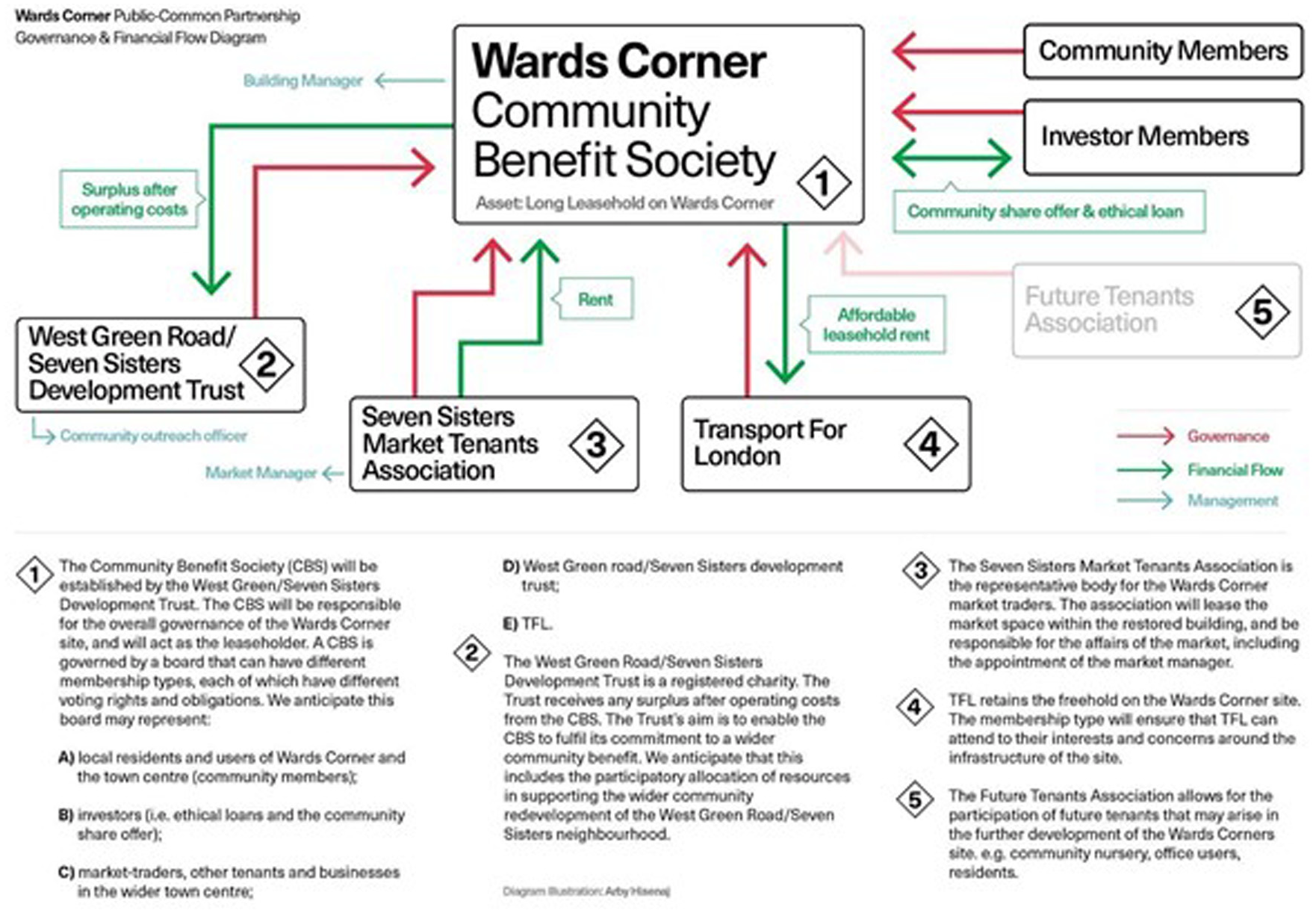
Wards Corner PCP governance and financial flow diagram.
During the research process, it became clear that participants in the West Green Road / Seven Sisters Development Trust highly valued the forms of participative community decision making they had developed during their long campaign and which had roots in the traditions of many indigenous groups in Central and South America. The design of the Wards Corner PCP takes this into account by insulating the development trust from various pressures which might constrict and determine the decisions they take. To do so, the Wards Corner Community Benefit Society (BenCom) is constructed as an interface between different interests and institutional logics. This is achieved through the BenCom having different membership types with different rights and obligations. For instance, TfL’s primary interests are guaranteed by their freehold of the land and decision-making powers over the infrastructure of the site, ensuring they fulfil their responsibility to maintain adjacent transport infrastructure. In return, access to otherwise unobtainable ethical loans to support the redevelopment (an estimated £10 m) is facilitated through TfL acting as loan guarantor. In turn, the Seven Sisters Market Traders Association has firm control over the affairs of the market by appointing and managing the market manager.
The aim is for the development trust, a registered charity, to become the participatory democratic body that enables local community members to have a direct say in how the profits from the Wards Corner development can be used in the regeneration of their local area. As the development trust is the recipient of the initiative’s surplus after operating costs, the decisions it takes receive a certain level of insulation from the disciplining effects of finance capital, allowing a different logic of development to take place. In addition, the development trust is free to follow the community’s own mode and temporality of decision making because the interface with other interests and institutional logics is conducted in a separate body, the BenCom. The development trust’s ambitions do not stop at the Wards Corner site. It is anticipated that the surplus will be initially used to capitalise new PCPs in the wider West Green Road / Seven Sisters area. The surpluses after operating costs of those PCPs would also feed back into the development trust, producing a self-expansive dynamic for the extension of economic democracy. In this way, the Wards Corner PCP forms a potential nucleus of an alternative model of development which would attend to the needs of inhabitants rather than financial interests.
The diagram now forms the basis upon which the trust wishes to proceed with the development of the site. Further progress is now dependent on TfL recognising the Community Plan as the preferred plan. This is a timely reminder that new models of ownership are always an outcome of, and shaped by, the struggles that surround their implementation. As the hitherto contested history of the Wards Corner site shows, the realisation of the Community Plan is evidently not a predetermined outcome, and the continued development and composition of an active and visible community will likely be essential to it. Establishing the BenCom and developing its community membership could play a key role here, not least in further legitimising the plan and pressuring decision makers, whilst simultaneously making the site a less attractive proposition to any developers that may be looking to take advantage of Grainger’s withdrawal. However, COVID-19 restrictions and the closure of the market have posed a real barrier to such a mobilisation over the past 24 months, with the Development Trust restricted to holding a series of online meetings. Any further research on the case most likely will place emphasis on understanding (and contributing to) such processes of community composition within the messy realities of the case. Quite what the prospects are for the implementation of a PCP at Wards Corner thus remains unclear, although we remain hopeful.
Union Street (Plymouth)
Union Street in the Stonehouse district of Plymouth links the city centre to Devonport, the site of the dockyards and naval base. Running east to west, it separates residential areas to the north from more mixed, but predominantly light industrial and commercial areas to the south. Originally built as a location for upmarket residences, the street’s proximity to the dockyards led it to become first a centre for entertainments such as theatre and cinema, and later the focal point for the city’s nightlife. The long-term decline of the street was accelerated in the mid-2000s when the closure of several nightclubs displaced the night-time economy from the area. As a result, the street is in considerable disrepair with many vacant privately owned properties, a large number having been empty for over 15 years (Nudge Community Builders, 2019).
Previous efforts to revitalise the area have followed regeneration models familiar to many other cities over the last 30 years. Like Haringey, the nearby Devonport area was the location of a New Deal for the Community project in 1999. The subsequent local development plan for Stonehouse adopted by Plymouth council in 2007 and intending to run until 2021 aimed at ‘using the redevelopment sites around the water as a catalyst to further regeneration throughout the area. This will lead to the creation of a unique high quality environment attractive to investors’ (Plymouth City Council, 2007: 30). The key waterside development in question is Royal William Yard in nearby Millbay. The developers, Manchester-based Urban Splash, represent a mode of development previously favoured by the council, who for instance sold Plymouth’s Civic Centre to Urban Splash for a nominal £1 (Telford, 2020). Yet, despite decades of ‘action plans’, the Stonehouse area continues to be underdeveloped, with parts of it in the 4% most deprived areas of the UK (Ministry of Housing, Communities & Local Government, 2019).
An alternative, bottom-up model for the development of the area began to emerge in 2016 when a community group called Stonehouse Action bought 96 Union Street, commonly known as Union Corner, and developed it into a community centre. The purchase of Union Corner was preceded by many years of community-building events, most notably the annual Union Street Party, which has been running since 2009 and involves closing off Union Street for an afternoon to host a series of activities and a parade. These community-building activities provide a point of comparison with the development of the Wards Corner project. The latter emerged as the propositional component of a social movement campaign to prevent a proposed development. As such, the Latin Village campaign had a clear primary antagonist with the developers Grainger and a pre-existing set of immigrant communities to draw upon to create communities of struggle. While the Union Street project emerged out of community activism, the lack of an antagonistic development proposal to defeat resulted in a campaign quite reliant on the initiative of a number of key members, two of whom went so far as to remortgage their houses to fund the first purchase.
In 2017, the now-experienced alumni of Stonehouse Action established Nudge Community Builders to buy a former pub on Union Street called the Clipper and develop it into a community market and cafe. In December 2019, Nudge took over an additional site at 80–84 Union Street. Renamed the Plot, the site has been developed into an alternative shopping arcade and a site for small community businesses and services. Most recently, in September 2020, Nudge bought the Millennium building on Union Street in partnership with the development group Eat Work Art. This much larger building, which has previously been a cinema, a nightclub and a bingo hall, was purchased with support from the National Lottery-funded Power to Change and the philanthropic Rank Foundation.
Nudge Community Builders (2019: 5) is a community benefit society (BenCom) with an eight-person board elected by members who have joined BenCom through the purchase of community shares. The constitution states that at least two-thirds of the board must live within Stonehouse. Their first community share offer, which closed on 25 September 2018, raised £205,000 from 165 investor members. A second community share offer, which helped to finance the purchase of the Millennium building, closed in January 2022 having raised more than £300,000 from over 450 investor members. Their stated aim is to turn Union Street into the ‘first street in the country with more than 50% of buildings being community owned and 75% of businesses being social enterprises or purpose led businesses – a national example of what a future high street can achieve’.
This ambitious aim presents Nudge with the classic problem of community regeneration, which: often displaces the community it set out to support … As Nudge and others invest in the street, the people who stand to benefit as land values increase and the market improves are the people who have left their buildings empty and neglected for so long. (Nudge Community Builders, 2019: 3)
To address this, Nudge began investigating the idea of a land bank or land exchange aimed at de-commodifying the land on the street to make it affordable for the community to develop it for themselves. In this way, any increase in value brought about by community-led regeneration would be banked for the community.
In early 2021, Nudge established a group of interested parties and advisors to investigate the feasibility of, and potential structure for, a Union Street land bank. Following introductions from a mutual contact, we were invited to participate in this process and run our participatory action research alongside it. Much like the Wards Corner case, this included attending land bank meetings, interviewing and discussing with key participants, including the Nudge core team, and conducting desk research into the wider background and context of the project. From this, we iteratively produced a diagram of the governance and financial flows of a proposed Union Street PCP (see Figure 2).
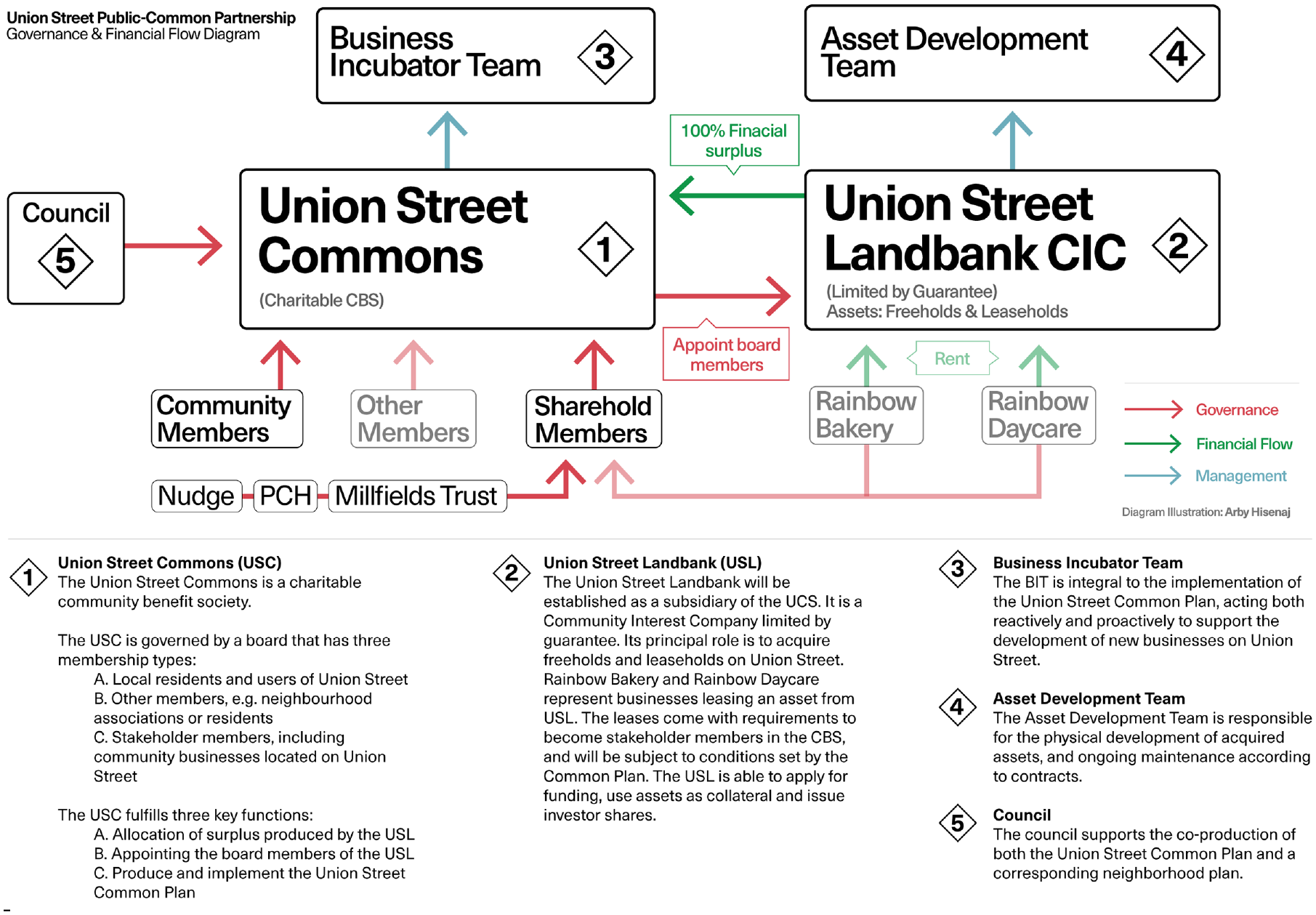
Union street PCP governance and financial flow diagram.
Initially, Nudge favoured a land exchange rather than a land bank, with the idea that while assets needed to be purchased as they become available, ownership could be quickly passed on to others, with community use ensured through freehold covenants. Such a model is one way of addressing the problem of Nudge’s limited capacity to develop and run more buildings. It would, however, leave several problems unresolved. The first is the difficulty of deciding who gets to own those assets passed on by the land exchange if the decision is not mediated through the market. The second is the question of who gets to decide how assets are used. Yet even more problematic is the possibility that the assets will move out of common ownership and back into private ownership. Indeed, even community usage of the assets cannot be guaranteed over the medium to long term as the positive covenants guaranteeing this will lapse when those assets are resold. With a land exchange, the displacement of the community through rising asset prices could be merely delayed rather than counteracted.
In contrast, a land bank based on a PCP would aim not just to build and retain wealth within a community while avoiding its displacement, but also to capture some of the increase in wealth, using it to trigger a self-expansive dynamic of common ownership in which the value and income from one asset can support further purchases. This form of democratised common ownership of assets prevents the benefits of that development falling to landowners who have banked and underdeveloped adjacent assets, and it also helps inoculate the community against the extraction of wealth through rentier business models more generally. In addition, a PCP approach aims to build the capacity to govern assets by involving community members in democratic processes for which, due to the related asset ownership, there is a lot at stake.
While there are similarities in the problems faced in the development of Union Street and Wards Corner, there are large differences in the context within which the projects operate and to which the specific PCP must be adapted. Wards Corner is owned by TfL, a public or pseudo-public body, whereas the assets on Union Street, outside those already acquired by Nudge, are privately owned. This gives a quite different and less predictable temporality to the project because properties must be acquired as they come onto the market. The role of the public body in a Union Street PCP is therefore less immediately obvious. Indeed, despite Plymouth council’s adoption of an action plan aiming to double the size of the cooperative sector in the city by 2025, Nudge has, until recently, found the council a reticent interlocutor (Plymouth City Council, 2018). It is only since Nudge took on the Millennium building, a much larger undertaking than previous projects, that the council has appeared to be more open to partnership. These factors mean that the role of the public body features less centrally in our design for a Union Street PCP than in the design for the PCP at Wards Corner.
The proposed Union Street PCP is designed around the perceived need to separate the function of acquiring assets from the function of deciding the use to which those assets should be put. In this model, the Union Street Landbank (USL), a community interest company (CIC), functions as an operating arm of the Union Street Commons (USC), a community benefit society, which appoints its board. The USL is tasked with acquiring assets on Union Street as they become available and is given the leeway to act quickly in that regard. The USC, by contrast, functions in a participative and democratic manner. In similar fashion to the Wards Corner BenCom, the USC will use different membership types, conferring different rights and obligations, to ensure that the variety of specific interests involved are attended to. These are used to structure the operation of democracy within the commons.
The USC is tasked with developing, in a participative manner, a common plan for the development of the area. The USC would also work with the local council to draw up a neighbourhood plan, which would align with the common plan and be lodged with the council to guide its planning decisions. The council would therefore play a key role in ensuring the general conformity of the neighbourhood plan with the council’s Local Development Plan. The common plan sets out the planned usage of the assets the PCP controls or anticipates control of, and situates that usage within a wider vision for the development of the area. We expect that this control over assets, along with the legitimacy gained from the participative methods used to draw up the plan, will provide significant leverage during subsequent reviews of the local plan. 4 We hope this degree of leverage, along with the ability to directly participate in designing the evolution of the neighbourhood in a cohesive and strategic manner through the collective ownership of assets, will attract the level of community participation that the project’s credibility depends on. Nudge are currently considering the Union Street PCP diagram as they decide on their future steps.
Towards a politics of the common
PCPs cannot offer a comprehensive strategy for returning vast swathes of private land to public ownership, nor one to directly bring a halt to the ongoing tide of local authority land disposals. Addressing this accumulation of land by developers and speculators will need multi-scalar strategies of intervention. Yet such interventions are predicated upon quite fundamental shifts in the moral economy (Sayer, 2020) or popular ‘commonsense’ of the role land plays in the realisation of wider social, economic and ecological goals. As Hardt and Negri (2017: 295) have argued: Just as neoliberalism involves not only a set of economic and state policies but also the production of a neoliberal subject, homo economicus, that sustains and animates these policies, so too a postneoliberal society will not emerge until alternative subjectivities are created.
Furthermore, and as Doreen Massey routinely argued, it is not the public ownership of land per se that must be fought for, but that this land is put towards socially useful ends – that land is liberated from its enclosure as a fictitious commodity and instead harnessed for collective good (Massey and Catalano, 1978). Whilst in many cases public ownership can be understood as an enabling condition (as in the case of Wards Corner), it is evidently insufficient in itself and – as the current tendency towards financialised municipal entrepreneurialism demonstrates – is no guarantee that land is utilised for collective good nor that it escapes treatment as a fictitious commodity. It is here that we argue that PCPs are capable of meaningfully contributing to a radically different approach to the politics of land.
Embodying ‘different formulae of citizen involvement and public-community collaboration’ (Blanco and Goma, 2020: 393), PCPs have the potential to reconfigure the role of public authorities in the emergence of an ‘alternative imaginary’ and approach to municipal economic programming. With varying degrees of prominence, both cases explored in this article conceive public bodies as contributing place-specific functions, yet the ‘alternative imaginary’ isn’t implemented by the public bodies themselves. Rather, they act as contributors to new assemblages of social power premised on hybrid associations of ownership and governance, where the focus is not on bringing land into public ownership per se but on processes that enable land and assets to be held in common. Whilst ownership evidently matters in these processes, the divergences in approach between the two cases demonstrates that it is not a prerequisite that land is held by a public institution.
This is not an argument for further scaling back public institutions in favour of a politically ambiguous concept such as community power. PCPs could be characterised as an interventionist approach to economic programming in which properly resourced public institutions (both in terms of finance and capacity) are in a stronger position to act. Yet to recall Wright’s (2019: 64) vision of eroding capitalism, we can interpret this as an effort at ‘using the state in ways that sustain spaces for building emancipatory alternatives with a wide range of initiatives from below to fill those spaces’. What fills these ‘spaces’ is a project of the common and of commoning, characterised by new institutional processes through which assets are governed democratically by those communities in proximity to the asset.
Whilst Christophers (2019a: 326) has previously highlighted the role for such ‘innovative ideas’ in addressing the land question, he raises important concerns regarding their potential for ‘scaling into a meaningful, extra-local, widely visible and influential counter-movement’. Similarly, Cumbers (2015: 63) has noted that much work on the commons ‘is particularly silent on some important questions of spatial politics, namely, in theorising how important and inspiring local commons projects … become connected to broader movements and projects that can represent a more systematic challenge to global capitalism’.
Although an insufficient response by itself, it is worth recounting that land privatisation has been a process of ‘enclosure by a thousand cuts’, and that any counter-project can reasonably be expected to proceed not via a single heroic act but through a similarly variegated (yet necessarily faster) set of processes and actors. Nonetheless, the efficacy of any initiative needs to be assessed according to not only its immediate effects but also its capacity to make a substantial contribution to a wider politics of the common. As we have argued elsewhere: we cannot make sense of the commons simply by looking at an individual institutional form such as the cooperative. We rather need to look at how value is produced, captured and circulated, and how different institutional forms could contribute to the creation of different circuits of value. (Russell and Milburn, 2019: 11; emphasis in original)
It is the scope for PCPs to ‘exceed’ their role as a local intervention, and instead act as entry points for the development of a wider politics of the common, that characterises them as an archetypal model of new municipalist strategy.
Further cycles of research will be required to understand how (and if) these processes of excess unfold in practice. Whilst some learning on this may be drawn from other experiments in economic democracy (most obviously, but certainly not limited to, community land trusts), empirical research is largely premised on the establishment of functioning PCPs. Committed forms of research militancy, scholar activism and participatory action research are thus less a choice but rather a precondition for creating new knowledge in this field (Bartels, 2020). Nonetheless, we hypothesise three different modes through which PCPs have the potential to be generative of a wider politics of the common: immediate, directional and solidaristic.
Immediate contributions come through the accumulation and redistribution of finance and knowledge, utilised to expand existing initiatives or forge new ones. For both Wards Corner and Union Street, this is integral to their immediate goals of implementing an alternative form of economic development in their respective areas. It is the profit generated through the PCP, coupled with the drawing down on public funding streams and mixed approaches to financing, that enables the expansive dynamic necessary to bring further assets into common stewardship. This is coupled with the development of both expert and tacit knowledge, ranging from quantity surveying and market management to inclusive facilitation methods, integral to an initiative’s successful functioning. Such knowledge and skills become all the more important when supporting the establishment of further initiatives, with many of these skill sets (such as quantity surveying) typically absent in non-private sectors. Whilst the limits to scaling and extending the circulation of the common through such direct efforts are unclear, initiatives such as the Champlain Housing Trust in Burlington, Vermont – which now owns the underlying land of an estimated 2800 residential units and 112,000 sq ft of commercial space amounting to US$290 m of assets (Davis, 2015) – suggest that there is real scope for the generation of both knowledge and finance that would allow for such expansive projects.
The directional contribution to a politics of the common anticipates the limits of how far such immediate processes can take us, recognising that broader interventions (such as those suggested in the aforementioned Land for the Many report) will also be necessary in achieving comprehensive land reform. The broader point here is that any wider political mobilisation around significant land reform will not emerge spontaneously but must take root in response to a wider shift in the moral economy or popular common sense of land stewardship (see Russell and Milburn, 2018). Initiatives such as PCPs might play an important role in helping to forge this shift, offering opportunities for the experiencing and practising of collective agency, and the subsequent emergence of new collective sensibilities about the rights, expectations and possibilities of citizens and governments. Following García López et al. (2017: 89), this directional contribution can be thought of as a process of ‘performative counter-hegemony’, where ‘commoning – as a habitual performance in the everyday – can be a key to counter-hegemony, generating new common sense(s) which are materially and symbolically articulated around commons’. It is precisely the development of such ‘new coalitions and socio-political identities around economic democracy [that] is critical in fostering a broader narrative’ (Cumbers et al., 2020: 692) of collective action that goes beyond the ‘local-ness’ of the initiatives themselves, something which distinguishes a municipalist strategic orientation from progressive localisms.
Finally, whilst the propagation of this common sense provides the moral foundation for broader political interventions, the latter will nonetheless face significant opposition from vested interests, and such interventions will invariably have to be fought for. Put in the simplest terms, these fights will need to be resourced, and PCPs are well placed to act solidaristically to sustain these struggles. An illustrative example here is the essential role that Women’s Support Groups played in the 1984/1985 British miners’ strike, where regular street collections, fundraising activities and food kitchens were fundamental in enabling miners to maintain the strike (see Salt and Layzell, 1985). A ‘meaningful, extra-local, widely visible and influential counter-movement’ is something that must be cultivated and resourced, where the expansion of democratic control of resources in the present simultaneously enhances our capacity to push for change that goes beyond the limits of what is currently politically possible.
Conclusion
This article has proposed the ‘PCP’ as an archetypal new municipalist intervention. Building on previous publications in which the PCPs were outlined in broad conceptual terms, we have considered how PCPs might be implemented in practice in two cases: Wards Corner in Haringey, London, and Union Street, Plymouth. Despite notable differences between our cases, we suggest that in both contexts PCPs could create the organisational space needed for a new democratic common sense to emerge around urban development. We have shown that PCPs could make two decisive contributions. First, they stand to reconfigure the role of public authorities. Rather than acting as the arbitrators of urban development, councils and public bodies become contributors to place-specific reorganisations of power, ownership and governance. This creates space for the interests of communities living in proximity to the assets in question to shape the course of their development. Second, by adjusting who controls how value is produced, how it circulates and how it is utilised, PCPs could establish the conditions for the ‘self-expansion’ of the commons. In such an imagined scenario, the surpluses created by one PCP can be used to seed new PCPs elsewhere, avoiding falling into a ‘particular localism’ through both resourcing new models of ownership and contributing to a ‘performative counter-hegemony’ of the commons.
As PCPs begin to expand in this way, they have the potential to encroach on the power of finance capital and call into question what has passed for common sense in urban development. It is this that makes the PCP an exemplary new municipalist strategy capable of contesting enclosure of land and assets. This will depend, however, on how successfully the formal model of PCPs can be implemented within the messy realities of new municipalist struggles in the future. Further research in this area is needed to consider the potential for PCPs to be implemented as a new municipalist intervention into the politics of land and urban development in the UK and beyond. There is evidently potential to explore the intersection between PCPs and alternative ownership models including CLTs and LECs, and to further our understanding of how a diverse set of interventions could help to actualise a municipalist politics of land in the UK. In addition, it should be acknowledged that the issues of transcending and working across political scales remain critical irrespective of whether these are approached through municipalist politics. Whilst this participatory action research has taken place at a certain point in struggle, and therefore has enabled us to open up insights about how such models can be implemented in practice, further research must develop a more technical understanding of the relationship between place-based interventions and struggles and how they can realise wider system change.
Footnotes
Declaration of conflicting interests
The author(s) declared no potential conflicts of interest with respect to the research, authorship, and/or publication of this article.
Funding
The author(s) disclosed receipt of the following financial support for the research, authorship, and/or publication of this article: The research was supported by funding from the Economic and Social Research Council, grant number ES/S012435/1.
