



Abstract
Conventional political thought and practice continue to be stifled by a dilemma of choosing between the ideal imaginaries of State and/or Market solutions. Widely presupposed as the only valid possibilities in both theory and practice, this stale dilemma covers up a real multitude of actually existing alternative approaches to governance practiced in civil society. State/Market approaches are identical in the way that they construct a ‘spectator’ role for communities, who are left to choose between their preferred set of rules and norms developed elsewhere. The concept of commoning governance offers an opportunity to break free of this stalemate. It creates a new role for citizens and their communities as ‘sparring partners’; who although they operate within the limits of current State/Market institutions, create new norms and rules against and beyond them. In the paper, we first expand on our understanding of commoning governance: re-designing governance arrangements to serve the common good. That is here understood in terms of (radical) democracy, solidarity and sustainable ecological relationships. Second, we illustrate how commoning efforts on the ground contribute to the reclaiming of the democratic imaginary as a political arena by zooming in to a case study of the three cities involved in civic-led network of German Food Policy Councils. Finally, we reflect on the empirical barriers that communities of commoning endure, and call on policymakers, planners and scholars to interrogate their own normative understandings of citizenship and democracy, and begin to recognize theoretical and latent possibilities by enabling commoning with new or re-designed institutions of governance.
Introduction
‘The commons are back … if they were ever gone.’
(Vivero-Pol et al., 2019: 3)
The commons, indeed, are back. In the face of urgent social and ecological issues, commons have increasingly re-emerged as an important concept for scholars and activists around the globe (Brinkley, 2020; Cumbers, 2015; Gibson-Graham et al., 2013; Harvey, 2012; Huron, 2018). Commoning has also gained traction as a central part of the “return” of the commons. Instead of looking at the commons as a noun, or a ‘thing’ with innate properties, commoning is seen as a verb, or a ‘process’ in which institutions are (re-)designed to serve the common good (Gibson-Graham et al., 2016; Martorell and Andrée, 2019). As a particular form of politicising how governance takes place, commoning foregrounds (radical) democracy, solidarity, and re-embeds resource management into local ecology. At its core, commoning claims the right for people to have more of a direct say in governance; not only in choosing their preferred mix of conventional policies deemed acceptable by political and corporate elites for them to decide upon, but in co-determining the very norms and rules to which they (the people) are subject (cf. Tully, 2008a). In doing so, it makes space for radical and emancipatory political imagination.
While theoretical work on the commons is important, several authors have called for more empirical perspectives that analyse actually existing commons and processes of commoning as they take place on the ground, and move across different scales (Cumbers, 2015; Gibson-Graham et al., 2013; Huron, 2018). There is a lack of empirical perspectives on commoning, as theoretical work often sees commons as mutually-exclusive to ubiquitous states and capitalist markets. In such work, the commons are defined by their contrast to a seemingly all-powerful capitalist imaginary (Gibson-Graham, 1996), in which the radical content of commons is inherently co-opted or neutralized in interactions with conventional state and market institutions (Cumbers, 2015). While the danger of co-option is undoubtedly pervasive, a number of scholars have encouraged a more open approach to recognizing transformative practices and radical possibilities that emerge in everyday political praxis (e.g. Cumbers, 2015; Gibson-Graham et al., 2013; Huron, 2018). Such scholars identify the task as bringing budding possibilities to light: making them ‘more real and more credible as objects of policy and activism’ (Gibson-Graham, 2008, p. 613), and ‘add[ing] gravitas to […] emerging imaginaries’ (Kaika, 2018, p. 1722). Taking on this task, we combine a macro-political, zoomed out ‘perspective of the eagle’, with an on-the-ground, zoomed in empirical ‘perspective of the frog’. Guided by this approach, we ask the question: how do civic initiatives attempt to common governance?
The paper begins with the eagle’s perspective in which we make a case for going beyond the stale State/Market dilemma (Kaika, 2017) and centring governance around commoning and self-determined notions of the common good. The perspective of the frog follows with a case study of three German Food Policy Councils (FPCs, called an Ernährungsrat in German) in Berlin, Cologne, and Frankfurt where citizens are actively engaged in struggles to transform local and regional food systems toward sustainability and justice. FPCs are civic networks which bring various actors (from civil society, government, food producers, local retailers/restaurants, etc.) who are involved in local/regional food systems together. In addition to organizing practical food initiatives in cities (like public procurement of local/organic food, or urban gardening projects), FPCs also provide ‘spaces of deliberation’ (Moragues-Faus and Morgan, 2015), where groups can give body to their political thoughts and create governance alternatives based on self-determined narratives.
The FPCs in Germany were selected as a case study for two main reasons. First, other than recent work by Sieveking (2019), Doernberg et al. (2019), and Hoffmann (2019) there has been no published research on the German FPC network. This is significant as the FPCs have ignited new political dialogues about food, which have been markedly absent from planning and policy discourse in Germany (Stierand, 2014). While the FPC is still in the beginning stages of developing a coherent organizational model, especially in Germany (Hoffmann, 2019; Sieveking, 2019), many have celebrated the potential of FPCs to scale up and out, and bring more radical forms of democratic control to food systems at the local level and beyond (Harper et al., 2009; IPES-Food, 2019). Second, the German FPCs are unique in their political and community-led character as they organise around a discourse of ‘Food Democracy’ that spells out an active role for citizens in governance. This presents an opportunity to evaluate the viability of a bottom-up pathway to transforming food policy as a ‘real utopian’ possibility (Wright, 2010). Real utopias explore institutional designs or theoretical models that may not exist fully in practice, but as a latent and feasible alternative for doing things differently. In this regard, the case study documents several FPC actions that fit in with various ‘domains of transformation’ to agroecology as a fundamentally different way of organising food systems and making food policy (Anderson et al., 2021). We highlight the budding potential German FPCs display across key areas of intervention, including (1) networks, (2) knowledge, (3) systems of economic exchange, and (4) discourse. Our case study does not intend to make the claim that FPCs have achieved the commoning of governance in German cities. What we do intend to show, however, is their achievement in contributing to a reclamation of the democratic imaginary as a political arena – in which the language of democracy and the common good are mobilised by citizens in pursuit of more sustainable and just futures. In a time of urgent social and ecological crises, we contend that such thinking on the edge of what is currently possible and imaginable is increasingly necessary (Wright, 2010). Our discussion in the latter part of the paper aims to provoke public and academic debate, examining the barriers that keep commoning efforts marginalised, and levying the challenge for states to re-centre their claims to legitimacy around enabling practices of commoning.
The tragedy of the state/market dilemma
Throughout the twentieth-century, two ideal forms of organizational governance have dominated political thought and practice: on the one hand a centralised and bureaucratic State; on the other a decentralised and self-regulating Market (Cumbers, 2012). This dualism – of state vs. market; command-and-control vs. market-based; public vs. private; hierarchy vs. network; representative leadership vs. individual choice – continues to dominate the spectrum of conventional political thought and practice today (Palumbo and Scott, 2005). So much so, in fact, that governance is often conceptualized as a zero-sum game between states and markets. In this line of thinking ‘any extension of the market is necessarily at the expense of the state’ and vice-versa (Palumbo and Scott, 2018: 3).
The critiques of both State and Market approaches to governance, which presuppose the ideal form of the other, are well rehearsed, and we draw on several critical discussions (for some key texts, see Cumbers, 2012; Palumbo, 2015; Swyngedouw, 2018). Yet these approaches, along with their proponents and critics, often presuppose each other as the only possibilities. In turn, the State and the Market have also come to be valued in and of themselves. Rather than being used as tools to serve the common good in a generative relationship (i.e. states and markets are used to create and maintain commons), institutions of governance and their political and corporate elites can also form an extractive relationship with the commons (i.e. states and markets are used to exploit the commons) (Bauwens et al., 2019; De Angelis, 2017). We see these as twin possibilities that exist within each approach. In other words, our argument for commoning rests on the understanding that state bureaucracies and market systems are only legitimate to the extent that they serve the common good (cf. Palumbo and Scott, 2005). Although the common good cannot be universally defined, it is a ‘vanishing point’ concept that must be constantly referred to and mobilised when designing and legitimising relationships of governance (Mouffe, 1992). We contend that it is through the process of commoning that a common good can be articulated and constituted, as communities are dialectically formed around (conditionally) shared needs and desires (Gibson-Graham et al., 2016; Huron, 2018).
To paraphrase Paidakaki et al. (2018), if the larger political economic framework (of neoliberal and financial market logics) is challenged in interactions with hegemonic institutions, real social innovation is possible (cf. Leitheiser and Follmann, 2020). In other words, if counter-hegemonic actors engage with existing institutions, transformative potential is determined by their political underpinnings and ability to resist co-option into the status quo. On the one hand the power of states to address general and comprehensive problems, and institutionalize (i.e. scale up and out) alternative practices should not be overlooked (Mitchell and Fazi, 2017); on the other, extractive capitalist markets should not be seen as overbearing monoliths that alternative economic production and exchange cannot circumvent (Gibson-Graham et al., 2013). We argue that the tragedy of the State/Market dilemma does not stem from these institutions as such, but rather from the normative dismissal of real democracy that underpins their dominant forms in theory and practice – that is, democracy in its traditional sense of self-governance by and for the people. For example, this dismissal formed the foundation of Garret Hardin’s (1968) famous tragedy of the commons.
In Hardin’s tragedy, externally-governed authorities and systems – the State and the Market – were prescribed to restrict the agency and decision-making power of the people, who if left to manage their own affairs would give rise to ecological catastrophe. While we do not dispute that tragedy is one possible outcome of a commons, we do strongly dispute the notion that tragedy is the inevitable outcome of commons. We argue, instead, that Hardin’s prescriptions have contributed in part to their own tragedy: that of the State/Market dilemma he proposed. This is most evident in the prevalence of unaccounted externalities and myopic and zero-sum rationalities (e.g. short-term competitive election cycles, careerism, and extractive profit) that run rampant in hegemonic practices of governance today. The tragedy of the State/Market dilemma is the result of exploitation of the commons by the (crony) capitalists, politicians, and bureaucrats who have used the power of the State and set the rules of the game in the Market to maintain the status quo, or serve their own narrow self-interests (De Angelis, 2017).
Even if moral arguments for democracy are put to the side, there are grounds to support the claim that the State/Market dilemma gives way to tragedy by covering up possibilities for more effective approaches to governance. On the one hand, we can look to the Nobel-prize winning work of Elinor Ostrom (1990). Ostrom, and many others since (see the Digital Library Of The Commons, n.d.), have displayed rigorous empirical evidence that societies around the world have functioned successfully for millennia, and continue to function, with institutional organizations that resemble self-governed commons – not bureaucratic states or technocratic market systems. On the other hand, we can look to the extensive theoretical work of James Scott (1998), who has demonstrated that centralised planning failures often result from the rigid institutional homogeneity that is associated with state bureaucracies and large-scale capitalist markets. In order to cover a broad scale, highly-centralised authorities must apply a simplified logic that often results in contradictions and failure on the ground. Scott convincingly argues that this could be averted if more attention were given to plasticity, distributed and de-centralised capacities to adapt, and the use of practical and tacit local knowledge in the institutional design process.
Nevertheless, despite the diligent insights of Ostrom and Scott, among many others, elite State/Market modes of governance remain hegemonic in both theory and practice. Repudiation of self-governance, like that of Hardin’s and more recently populism (see e.g. Frank, 2020), continues to be prevalent. Citizens and their communities, in turn, remain spectators: more subjects – to bureaucratic (State) and/or systemic (Market) rule – than they are agents who democratically co-determine their own destinies (Tully, 2008a). If we recognize that this subordinating approach to democratic citizenship may be embedded into the structural norms and rules of the institutions of the state as it currently exists, we can then attempt to develop new norms and rules that could support new capacities for citizens and communities.
Keeping the rabble in line with liberal theory: Communities as spectators
Democratic deficit and participation are increasingly problematized in light of recent developments, exemplified by the multi-scalar restructuring of governance-beyond-the-state (Swyngedouw, 2018). Yet, democratic deficit is hardly new. Liberal theory – which underpins conventional understandings of State and Market institutions – has always been wary of democracy in its historical sense of the self-governing rule by the people (Barber, 1988; Palumbo, 2015). Indeed, a fear of the “common people”, a demos-phobia, is deeply embedded in liberal philosophy (Barber, 1988).
Despite the virtues of liberal citizenship (e.g. civil rights and liberties, universal suffrage, etc.) (see Mouffe, 1992 for an outline), there are many critics who argue that its philosophical foundations form a mere baseline of ‘low intensity’ democracy (Marks, 2000; Tully, 2008a, 2008b). In the liberal tradition, citizenship is defined primarily in a passive sense, as a legal status for individuals, not in an active sense, as the civic/community participation in public affairs. In other words, the prevailing liberal understanding of democracy is as a thing that is already achieved – a formal set of existing procedures and institutions – not an activity, or an ongoing process of defining the ethico-political ideals of liberty and equality and designing institutions that reflect those ideals (Purcell, 2013). In societies with extreme inequalities (of e.g. power, time, wealth and other resources) these ‘low intensity’ understandings of democracy run the risk reducing democracy to a façade; a ‘veneer of formal equality and procedural correctness’ (Marks, 2000: 64). As such, systems of governance that are formally democratic may conceal their antidemocratic tendencies (Wolin, 1992).
Looking through the veneer reveals that the capacity for citizens to exert political influence is, in most purportedly democratic societies, limited at best (Miller, 2020). Dissenting from the status quo, and organising to effect change involves a great deal of risk and high-cost barriers to entry (namely resources like time, knowledge, and capital). This is especially the case in societies where lobbying has become more a professional than civic activity (Bitonti and Harris, 2017). The outcome of this professionalisation is displayed in the grossly uneven capacities of influence in setting political agendas and controlling policy. The prevalence of private interests who often exercise tyrannical control, leaving citizens with a feeling of powerlessness. Just as the “common good” is not fixed and pre-given, the will of the people is, in part, articulated through the process of deliberation (Landemore, 2020). Representative leaders, big-budget think tanks, and profit-driven media outlets play a significant role in constituting the will of the people, and in giving credibility to certain political imaginaries while discrediting others (Herman and Chomsky, 1988; Laclau, 2005). As such, representation does not merely embody an aggregate of bottom-up wills. It also, in part, delimits from the top-down what is considered to be a “realistic” or “reasonable” will in the first place. In order to address democratic deficit and participation, it is, therefore, important to interrogate, on the one hand, the very rules and norms of democratic institutions and procedures that may foreclose certain forms of participation; and on the other the material capacities of influence that constrain certain possibilities and enable others.
One distinction that is useful here is between ‘invited spaces’ of participation and ‘invented spaces’ of participation (Miraftab, 2004). The two are different in their degrees of freedom. The former (invited spaces), are restricted; their scope and limits predetermined by existing ideologies or ways of doing things. Invited spaces imply a passive role for citizens, which needs to be affirmed from the top-down. Citizens are invited to participate, provided that they stay within the bounds of the norms established from above. In contrast, invented spaces imply agency for people to create their own forms of self-organisation based on self-determined notions of the common good.
Toward the commoning of governance: Citizens as sparring partners
There are many different schools of thought on what is meant by a commons (see Vivero-Pol et al., 2019 for a more detailed discussion). Instead of seeing the commons as having any intrinsic ontological properties that can be “discovered” by social theorists, here we develop a political perspective of the commons as an institution, and commoning as a democratic process of negotiating institutional rules and norms to serve the common good and foster solidarity and ecological sustainability (Gibson-Graham et al., 2013; Ostrom, 1990). This view does not see the designation of a particular resource as a commons as based on anything innate – like conventional economic theory which seeks to objectively determine whether or not a resource is rival or excludable. Nor does it necessitate a particular type of ownership (e.g. public, private or collective). The designation of commons is rather based on the ethical and political considerations of a community, and the institutional rules and norms that they decide to organise (Vivero-Pol et al., 2019). Put simply, commoning is an ongoing process of designing institutions to serve the common good.
Commoning emerges when the people of a community claim the right to define the common good. As Foucault (2007) has underscored, ‘the people are those who, refusing to be the population, disrupt the system’ (cited in Swyngedouw, 2014: 171, emphasis added). Applied to commoning, the community is made up of those, who when their unmet needs and desires become so great, refuse their role as spectators and claim an agentic role as sparring partners. It is different from conventional State/Market approaches in (1) the way that decisions are made (i.e. in organisational form, procedures, and processes designed to foster solidarity and radical democracy), and in (2) the way that value is defined (i.e. in epistemology, or form of reason that is used to make decisions). If we follow the definition of commoning laid out here, we can see that many practices of commoning are already occurring. Despite operating within existing institutions and the wider State/Market dilemma that frames mainstream political discourse, many practices – for example, cooperative enterprise, land trusts, community supported agriculture, mutual aid, etc. – actually go against the ideal norms and rules of State/Market approaches to governance (cf. Tully, 2008b). These practices may, and often do, develop better methods for meeting people’s basic needs (Kaika, 2017). However, more often than not, these practices remain marginalised.
A new raison d’être for state institutions could be seen as a tool for amplifying commoning. While co-option of counter-hegemonic movements by the state is always a danger, the state (with a small ‘s’) is merely an assemblage of heterogenous organizations and individuals; a political arena where the forces of civil society meet to struggle for hegemony (Wright, 2010). With this perspective, state institutions are not inherently mutually exclusive to commoning. Rather they can be generative to commons if new roles and relationships are institutionalised (Angel, 2017; Pazaitis and Bauwens, 2019), and invited spaces of governance are open to integration with invented spaces. We see two concepts as being useful in this regard: the Public-Common Partnership (PCP) and new municipalism.
The Public-Common Partnership (PCP) offers a way to radically rethink the role of the state and its relationship with commons (Milburn and Russell, 2021). The PCP stands in contrast to the Public-Private Partnership (PPP), which can be critically understood as often resulting in elite-driven policy making (Béal, 2012; McCann, 2001), or using the state to create new markets for private capital accumulation. Instead, the PCP sees commoners partner with the state to create new commons. Investment risks are assumed by the state in the PCP, while communities take control over ownership and governance and accumulate their own capital. Rather than facilitating and expanding the reach of corporate power and financial capital, the PCP can enable new forms of democratic possibility through the centrifugal expansion of community ownership and direct participation in governance. The enrichment of democratic subjectivity among the community, along with the accumulation of community-owned capital, creates a basis on which further commoning projects can be built (Milburn and Russell, 2021). PCPs can, in other words, create ‘self-expanding circuit[s] of radical democratic self-governance’ (Exner et al., 2021, p. 15). Empirical examples of PCPs are few and far between, as such governance innovations carry a stigma of political risk (see Russell (2019b) for a case study). In other words, for such projects to be initiated in the first place, the public half of the partnership needs to be willing to engage and cede control. Openness to take on such political risks will likely require that sufficient social force is mobilised (Angel, 2017), or that commoning movements engage more with electoral politics. This brings us to the next concept, ‘new municipalism’, a growing grassroots approach to electoral politics that has seen civic social movements across the world attempt to enter into local politics (Russell, 2019a) – a move from occupying squares to ‘occupying institutions’ (Thompson, 2021). In this sense, the urban or municipal level can be viewed as a strategic scale in which electoral politics can be more effectively engaged in ways that are not possible at other scales, and in which the logic and practice of the commons can be extended (cf. Bianchi, 2019). Such a framework poses a direct challenge to dominant understandings of citizens as spectators in democracy.
The task for policy makers, spatial planners and scholars, in response is to recognize commoning as a right (both formally and informally), and develop creative ways of integrating ‘invented spaces’ of commoning into the ‘invited spaces’ which are currently available in existing institutions (cf. Miraftab, 2004). The task for activists and social movements is to take the state seriously as a vehicle for facilitating commoning, and attempt to engage more with electoral politics towards those ends. We contend that the concept of commoning can (1) call upon institutions re-centre their legitimacy around serving the common good (rather than abstractions such as GDP or the Market); (2) help scholars, activists, and policymakers to think in this process-oriented and integrated way, recognise citizens as agents and leaders with the ability to self-organise, and re-design existing institutions in the pursuit of more just and sustainable futures.
Data collection and methods
Our case study looks at the rapid spread of FPCs in Europe’s German-speaking region, which began in Germany in 2016 and has since become a network of more than 40 cities throughout Germany, Austria, the Netherlands, Luxembourg, Switzerland and South-Tyrol. 1 All empirical data – including interviews, document analysis, and observation at two FPC events – was collected and analysed by the first author using over the period of 2018–2020. In order to get a contextual picture of the German FPC movement as a whole, a document analysis of media publications and FPC self-publications was conducted. An interview was also conducted in 2018 with a German FPC expert who has been active in inspiring the formation of FPCs in Germany, and in researching and documenting German FPCs ever since. Document analysis included secondary source interviews, and publications released by FPC leaders such as books (see Thurn et al., 2018 and Wißmann, 2019), letters of correspondence with local government, policy recommendations, and a magazine article (see Hoffmann et al., 2019).
Leaders from FPCs were also met with at the 2018 FPC networking congress (Vernetzungskongress) in Frankfurt. After meeting in person at the congress, several FPC leaders were asked to participate in one-on-one interviews. Semi-structured interviews were then conducted with six FPC leaders from Cologne, Berlin and Frankfurt (two leaders from each city). These three cities were chosen as they have been influential in the movement as a whole. Berlin and Cologne were the first cities to found FPCs in 2016, and Frankfurt was the host of the 2018 networking congress. These cities are also the only three German cities that have signed the Milan Urban Food Policy Pact (MUFPP). By signing the MUFPP, the governments of these cities had already committed in 2015 to generating policies that transform food systems towards sustainability. These commitments in turn provide a further opportunity to reflect in our discussion on the contrast between policy promises and practice (Cretella, 2019) that contribute to citizens taking matters into their own hands. Interviews were conducted in either English or German, and translations from German were done by the first author. All interviewees have agreed to use of their names in accordance with informed consent. The empirical section proceeds as follows: first, we outline the positions of FPCs in Germany as a movement to common governance with a new muncipalist strategy. Next, we document FPC actions in various domains of transformation to an agroecological food system. A discussion of the barriers and opportunities follows.
Forming communities of commoning
Since the first FPC was founded by a group of citizens in Knoxville, Tennessee in 1982, there have been countless iterations of FPCs emerging in towns, cities, and regions all over the globe. Despite local diversity, FPCs are similar in that they are platforms to coordinate collective action among territorially-based stakeholders who are interested in changing policy and building new institutions in the food system. Whether members motivations to enact change stem from concerns of sustainability, local economic development, climate change, social justice, or health, all of these individuals and groups share a vision for a de-commodified food system. In principle, de-commodification means that governance decisions are not based purely on speculative profit making. Instead other socio-environmental values are brought to the fore. In other words, FPCs are organized to pursue ‘food democracy’, which means normal people (whether food eater or growers) move beyond a role as passive consumers, and into a role of active citizens who co-determine the values and economic structures that shape, for example, more sustainable agricultural practices and just supply chains (Hassanein, 2003; Renting et al., 2012; Wald, 2015). Food democracy is here seen as a process of commoning governance in the sense that existing state and market institutions are the target of (re-)design and transformation. As such it can be seen as a politics that aims to work within and against the state with the goal of extending democracy beyond that which is currently offered in invited spaces.
Anna Wißmann, a leader in the FPCs in both Cologne and Bonn, has been involved in the formation of food policy councils in Germany since the beginning. She explained the need for creation of the FPC as a new institution in Germany, as there are simply no existing formal structures, or invited spaces, in place to meet these desires: You’re not supposed to be doing this […] If you have a farm you’re supposed to apply for funding to convert it to organic. If you’re a local citizen’s initiative you’re supposed to run little projects and get funding maybe for two years and then the project is done and everyone’s happy and everyone goes home. That’s not what an FPC is at all. It is an institution that wants to be built […] Because, yeah – what are you trying to do? You’re trying to change some of the very basic ways of operating. You’re going well beyond tweaking.
As the FPCs have spread throughout Germany, they have taken on locally variegated forms. Each city is a bit different – as Janina Steinkruger, a leader in the Frankfurt FPC explained, ‘From its citizens, to its politics’. This can be seen in the way that the organisational models of German FPCs vary from city to city. For example, Berlin’s FPC has a direct democratic structure, in which members of a plenary assembly elect a speaker’s circle. The Berlin FPC is an independent, purely civic organisation that attempts to operate with consensus decision making, and actively attempts to seat women, immigrants, refugees, and non-academic members into leadership roles. In Cologne, the FPC is more closely connected with the city government, and tries to also involve more members from “industry” (small retailers and farmers, but even some super markets). A coordination team is elected by the active members of the working groups, and ten members from government are appointed by the sitting mayor. Each FPC has a “core group” who are consistently active in attending meetings and working groups. This can range anywhere from 10 to more than 100 members, depending on the time and place. General meeting attendance also varies, but can reach several hundred, again depending on time and place. The membership base also varies by city. Participants include activists, to those involved in previous or ongoing food initiatives, to concerned parents, to farmers and small business owners. Many FPC leaders and members would be considered “experts” even within mainstream institutions (e.g. universities, think tanks, NGOs) . Some have graduate and post-graduate degrees in food policy and agricultural sciences; others have experience working with international NGOs and at the European Union level in Brussels. However, all have developed a theory of change that understands the transformative potential of civil society and grassroots initiatives.
FPCs as platforms for food democracy
Charting actions in key areas of intervention
Here we highlight various FPC initiatives in several ‘key areas of intervention’ that Anderson et al. (2021) have identified as ‘domains of transformation’ to agroecology. These areas of intervention are overlapping and non-linear, but are loosely grouped into categories of networks, knowledge, systems of economic exchange, and discourse (Figure 1).
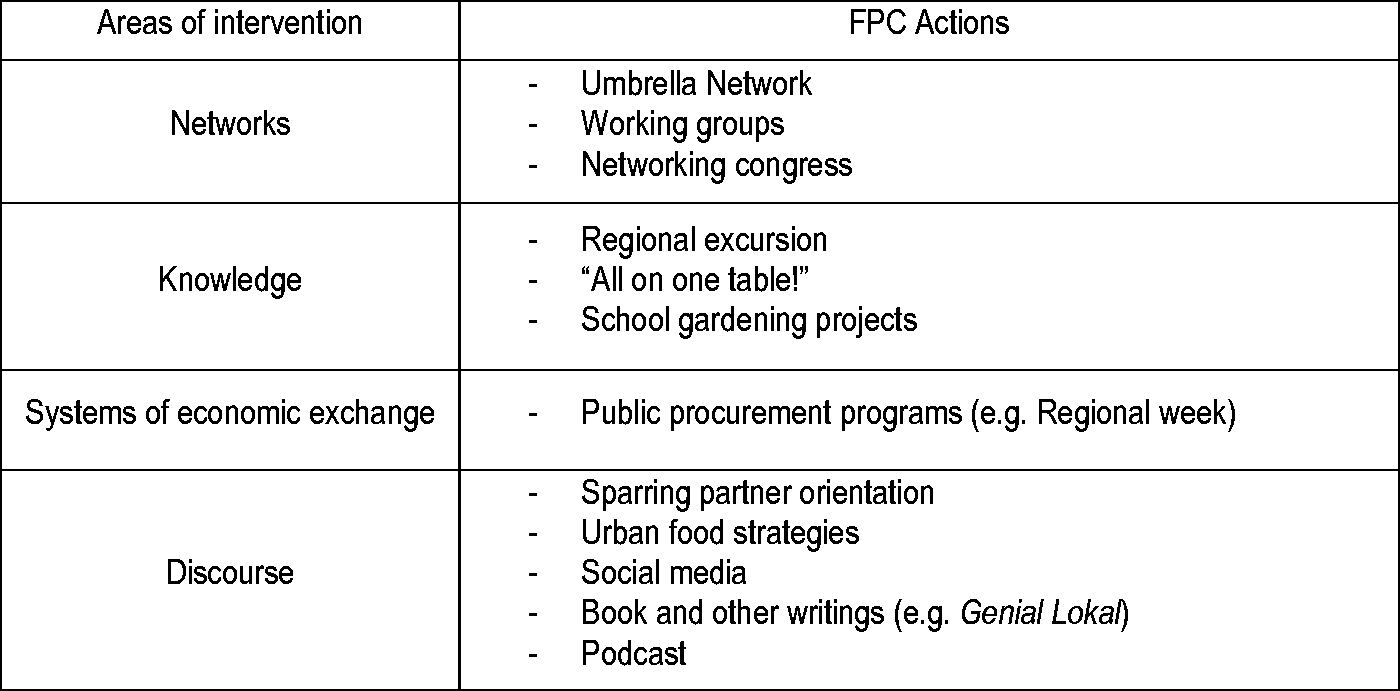
FPC actions in key areas of intervention for food systems transformation.
Networks
The FPCs in Germany can be best understood as a networking of various networks. An overarching FPC network serves as an “umbrella” organization for bringing together a variety of groups focused on food systems change, which themselves have also organized into local FPCs. At the local level FPCs are organized into various working groups that focus on a particular concrete project, including themes from communication, to food education, to public procurement. This difference from city to city can be seen in many facets of the FPCs including member base and working group themes. Despite local differences FPC members have recognized that as a network coalition they have a greater capacity to build a resource and knowledge base, and generate political will for change at regional, national and EU scales. To this end, the network office, which is led by Anna Wißmann in Bonn, aims to serve as a figurehead for the FPC movement, and represent the network to the outside world in media communication and lobbying projects. While the network is still in formation at present, its members have plans of growing beyond the context of Germany alone. One FPC working group, made up of members from across the network, aims to develop a manifesto in order to articulate the common policy aims of the German FPCs. The FPC manifesto will draw on international inspiration including, among others, the Voedsel Anders manifesto (Food Otherwise, a movement in the Netherlands and Belgium), the U.K.’s ‘People’s Food Policy’, 2 Sustain’s Manifesto for a Better Food Britain, 3 and the Italian Network for Local Food Policies manifesto. 4
FPCs have an annual networking congress to foster exchange among the various initiatives. Beginning in 2017, three of these events have brought FPC participants together in Essen, Frankfurt, and Bonn, to discuss strategies, theoretical underpinnings, and highlight best practices – not only from the German context, but from all over the world. At each congress, the host city signs up to organize speakers, but the flexible BarCamp schedule and content format leaves plenty of room for spontaneous exchange.
Knowledge
FPCs act as facilitators of knowledge processes, and provide a civic alternative to those of mainstream institutions like agricultural universities and policy think tanks (Anderson et al., 2021). Knowledge that is produced and shared is not only in regard to agricultural practices, but also governance practices and democratic citizenship. The Berlin FPC has been exemplary in this regard. One example can be seen in their Regional Excursion program. In this program, the Berlin FPC rents a bus and bring together canteen operators from the city (including representatives from municipal water, transport, and cleaning authorities) to visit regional producers and learn about their practices and working conditions.
The Berlin FPC has also facilitated horizontal learning through its “All at one table!” program, which organizes community dinners for people with a migration background. Here they aim to reach people that would not normally attend their meetings, and learn about their experiences in the food system. Christine Pohl explained, We tried to interview people a bit about what they want from the food system, or what they want from food, or what matters to them. […] the idea is to make that into a report or a basis for advocacy work as well. […] we want to make other people’s voices heard. So first we are trying to hear them ourselves and find them! […] because we think that democracy is not just always the same people talking.
Systems of economic exchange
Helping to facilitate market access for small, regional, and organic farmers is viewed as a major focus for all FPCs. In particular, public procurement is seen as a political instrument that can be used to create a more regular and constant demand for seasonal, regional and organic produce, which can in turn create a demand for more regional organic farmers, and an infrastructure network to connect them to the city. In all three cities, the main targets so far have been schools.
One example comes from Berlin, where the FPC organized a “Regional Week”, which provided more than 60,000 students in 275 Berlin schools with organic and regional meals for one week in 2018. The FPC also developed educational modules for the students to learn about the food and where it came from, and coordinated with media to report about the pilot project that aimed to demonstrate the transformative potential of public buying power. Cologne’s StErn Kita program and Frankfurt’s Main Mittagessen working group also target the procurement methods of schools and other public facilities, and develop educational programs to teach children about food and agriculture.
Discourse
FPCs have created a public space in which citizens can come together to formulate a civic framing of policy debates and action in food systems change. Contrary to top-down framing of policy that views citizens as passive consumers who need to be nudged or coerced into making “better” choices (Gumbert, 2019), FPCs claim a role as citizens who contribute to public discourse and shape governance practices, not merely consumers who can “vote” with their purchases. In other words, as counter-hegemonic actors they engage with mainstream institutions as ‘sparring partners’ rather than ‘spectators’. Christine Pohl, a leader in the Berlin FPC’s speaker circle, exemplified the sparring partner role when she added: I think our role is to, whenever the Senate comes forward with something, it’s our role to say, “That’s great. But now you have to do this and that. We want to prevent them from just leaning back and saying, “Ah, we did something great. This is it.” We keep pushing, because we’re still not where we want to be. [The FPC] can carry the political ambition of our ideas into politics and policy […] It offers a platform. It gives the voices a space where we can come together and bring our message to politics. So we can work on translating these demands into reality. So they are reacted to by politicians and can be actualized. So that they don’t say, “We can’t do it.” On the contrary! Yes we can.
One example of this sparring partner role can be seen in the Berlin Senate’s development of a “Canteen Future Berlin” project, which aims to advise and support public canteens in procuring more organic, regional and seasonal foods. The Berlin FPC had been an early advocate of a project for transforming public procurement of food in the city, and had provided the initial impetus for the city to commit to developing such a project in the first place (a so-called “House of Food”, based on the model of Copenhagen). Consulting work and the training of cooks that work in urban canteens is an important intervention in transformation, as Copenhagen has showed (see Martinez (2015) for an overview). Yet the Berlin FPC had envisioned a holistic approach that would go above and beyond the Copenhagen model, and urged the Senate to focus on the city’s food system as a whole. The FPC vision viewed the project as an open space of learning which would focus on facilitating regional and organic food provision for all people in the city, not just those who cook and eat at canteens. They wished to create additional institutions that would assist small farmers in accessing land, develop a logistics network to enable regional and organic farmers to sell their produce in the city at a price affordable for all, and educate people of all ages and backgrounds about food, cooking, and procurement. However, when it came time to choose to project leader, the Senate decided not to cede control of the project to the FPC, but rather to a private developer. In this case, the private developer took a more narrow approach that according to Pohl, did not offer many real possibilities for public participation and only effected those who cooked or ate in city canteens. While the Senate’s Canteen Future Berlin provided an important contribution, interviewees from the Berlin FPC expressed that they would have liked to see more courage from the Senate. In particular, they could have formulated the call for the project much more openly, and opened up space for thinking more broadly about what a House of Food could accomplish, beyond just being a place to train cooks. Although the FPC’s vision ultimately lost out in the end, this example displays the possibility that FPCs create for developing a conscious sparring partner role: a critical voice outside of existing institutional channels that seeks to both hold institutions to account, and push them to go further in achieving goals.
FPCs continue to build their own discourse about food system transformation through various mediums including social media, magazine articles, a book (see Thurn et al., 2018), and a podcast. This has also begun to influence policy discourse through the development of Urban Food Strategies (UFSs). UFSs are comprehensive vision documents that aim to coordinate various urban actors towards measures and policies that lead towards more desirable food futures (Smaal et al., 2020). Although UFSs have been designed all over Europe in recent years, many have been critiqued for being merely rhetorical – existing in promise, but not in practice (see also Cretella, 2019). For example, mayors in Cologne, Frankfurt, and Berlin have signed the MUFPP in 2015, which clearly states in one of its commitments: We will review and amend existing urban policies, plans and regulations in order to encourage the establishment of equitable, resilient and sustainable food systems.
5
[…] it wasn’t the city calling for participation, it was the FPC […] the municipality, they have all sorts of models and formats and rules for how citizens can participate in their processes, and they are often not so successful. They are very limited in their scope.
Discussion: Empirical barriers, theoretical possibilities
Our case study gives a snapshot of the painstaking efforts that citizens have gone to in their attempts to common food governance in German cities. While we have shown that FPCs have managed to organize a number of diverse and promising interventions based on self-determined notions of the common good, we have also observed a process of struggle. In particular, interviewees outlined how FPC members have been subject to the burnout that is often associated with precarious civic initiatives. As Florian Sander, a leader in the Cologne FPC, explained, Some of the founding members of the working groups are gone now, because […] yeah, doing volunteer work for four years and you don’t see any results? That’s quite tough.
Our case study also indicates that state actors actively reinforce the role of citizens as spectators. Returning to Berlin and the Senate’s “Canteen Future Berlin” project, we can see that although a bottom-up pathway for the project was possible, state officials remained stuck in the State/Market dilemma that gave control to a private developer, which maintained a more narrow focus. In turn, the FPCs more holistic and deeply transformative vision was foreclosed. In this regard, as the state became involved, the radical or transformative content of the project was held in check, as the State/Market dilemma covered up alternative possibilities for community control.
Anna Wißmann corroborated that the role of citizens as spectators is reinforced as politicians defend inaction with appeals to ‘no alternative’ logics. In discussions with state actors in North-Rhine Westphalia, she reported that: People just get on the stage and they say, “Well yeah, we see all these problems, but we really can’t do anything about it, it’s all up to the consumer.” They are very much stuck in that discourse. They even enforce that discourse.
Conclusion
Major social and ecological problems are urgent and widespread. Yet institutions continue to approach these problems with the tired solutions of the State/Market dilemma (cf. Kaika, 2017). In this paper we have argued that the tragedy of the State/Market dilemma can be seen in the covering up of alternative possibilities for organisation, and underpinning the anti-democratic idea that citizens and communities cannot be trusted in self-governance. However, we have also argued that State/Market institutions can be commoned – that is (re-)designed to facilitate the creation and maintenance of commons, based on self-determined notions of the common good. We have stressed, in particular, the importance of democracy in (re-)claiming the commons, which we see as a pre-condition for other aspects of commoning practices, including the generation of collective benefits and de-commodification.
Policymakers and spatial planners are, in turn, called to re-centre their responsibility around generating commons and enabling such practices of commoning (Brinkley, 2020). That means both revisiting normative understandings of citizenship and democracy, and creating or re-designing formal institutions organized around principles of de-commodification and collective benefit. Inspiration can be taken from the many examples of commoning that already occur within and against the norms of conventional State and Market, and from innovative concepts like the Public-Common Partnership and new municipalism that detail a new raison d’être for state institutions. These examples can in turn provide encourage new and radically democratic imaginaries for solving urgent social and ecological issues.
Our paper began by arguing that the concept of commoning can help in finding creative solutions to widely acknowledge problems. Our case study of German FPCs detailed the formation of a translocal civic network, which has struggled to organise interventions focused on transforming food systems at the municipal level and beyond. We showed that existing institutional ideologies, including normative understandings of citizenship and democracy, often act as constraining barriers to commoning. However, we have also argued that FPCs have contributed to a reclamation of the democratic imaginary as a political arena where more sustainable and just futures can be developed. Additionally, we have shown that real, albeit theoretical, possibilities for commoning do exist at municipal scales, provided that officials are open to a shift in perspective and enough social support is mobilised. This suggests that civic initiatives should more strategically engage with electoral politics in order to open up opportunities for new roles and relationships, e.g. the Public-Commons Partnership. Further research is needed to continue to document and recognize the emergence of commoning; including the institutional barriers that keep efforts marginalised, and the opportunities for amplification.
Footnotes
Declaration of conflicting interests
The author(s) declared no potential conflicts of interest with respect to the research, authorship, and/or publication of this article.
Funding
This research was funded by the RECOMS project within the European Union’s Horizon 2020 Research and Innovation programme under the Marie Sklodowska-Curie grant agreement No 765389
