



Abstract
The Heart Valve Society Young Professional Network Board Initiative was established to foster the professional development, scientific engagement, and leadership potential of early career clinicians and researchers in the field of heart valve disease. Building on our previously published mission and vision, the initiative serves as a dynamic and inclusive platform for mentorship, interdisciplinary collaboration, and scientific engagement. It envisions a future where emerging leaders drive innovation and excellence in patient care, research, and education, strengthening the global heart valve community.
Introduction
The Heart Valve Society (HVS) Young Professional Network (YPN) Board Initiative was established to foster the professional development, scientific engagement, and leadership potential of early career clinicians and researchers in the field of heart valve disease. Building on our previously published mission and vision, 1 the initiative serves as a dynamic and inclusive platform for mentorship, interdisciplinary collaboration, and scientific engagement. It envisions a future where emerging leaders drive innovation and excellence in patient care, research, and education, strengthening the global heart valve community.
Since the launch of the Initiative, there has been a notable increase in young member participation at HVS annual meetings and affiliated conferences (Figure 1A and B). Recent years have demonstrated a steady upward trend in both abstract submissions and session attendance by early career professionals, reflecting the growing impact and relevance of the Initiative's programming. This engagement has been further supported by targeted networking events, dedicated scientific sessions, and social media presence, which have collectively enhanced the visibility and influence of young members within the Society.
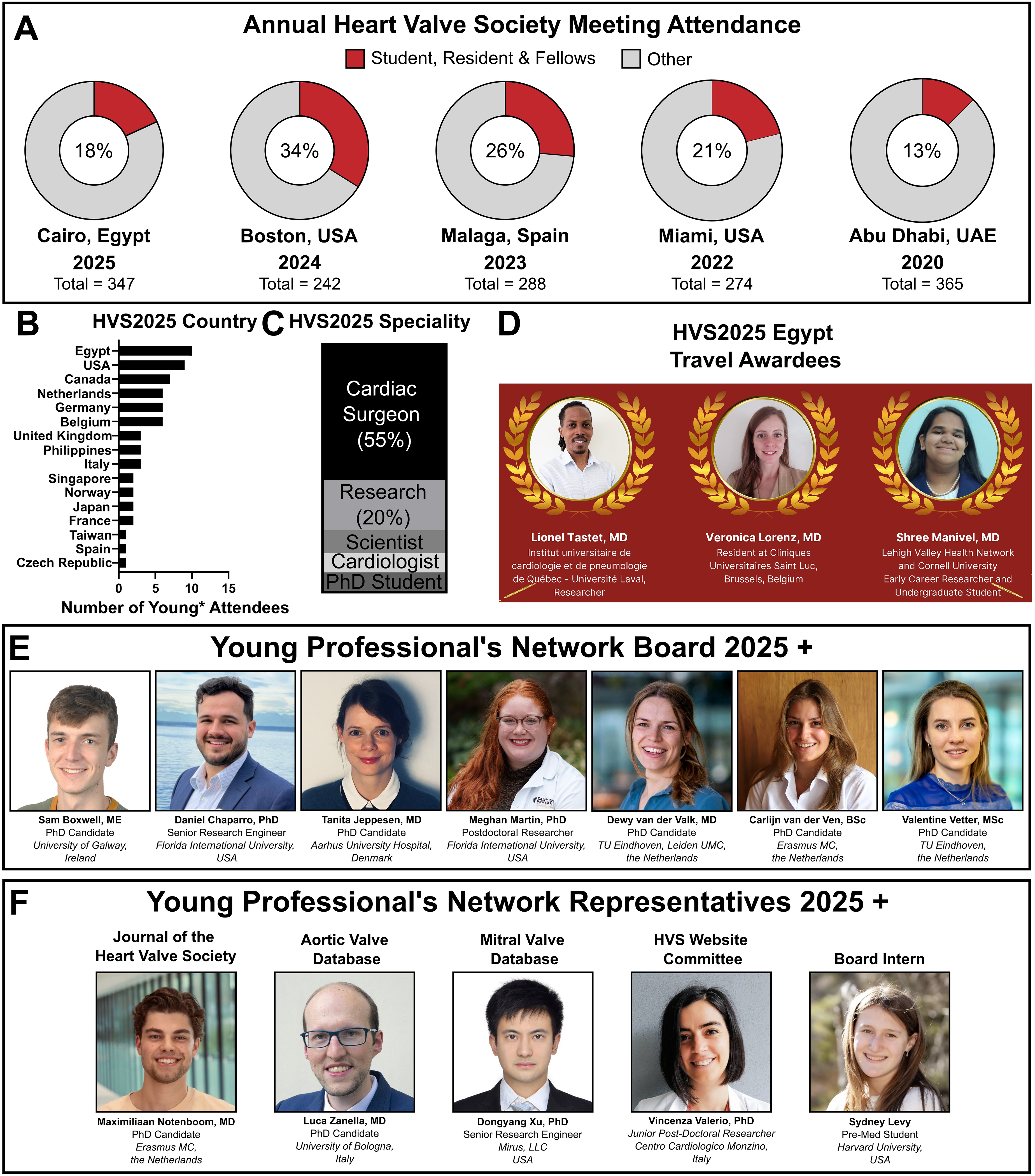
Heart Valve Society (HVS) Young Professional Network (YPN) Update 2025. (A) Annual HVS Meeting Attendance 2020–2025 (2021 Virtual Meeting Omitted). *Young = Students, Residents & Fellow. HVS2025 Meeting Young* Attendees (B) by Country and (C) by Self-Declared Specialty. (D) HVS2025 YPN Travel Awardees. (E) HVS YPN Board Members 2025/2026. (F) HVS YPN Representatives: Journal of the Heart Valve Society Editorial Board, Aortic Valve Database, Mitral Valve Database, HVS Website Committee, and Board Intern 2025/2026.
Looking ahead to 2025 and 2026, the Young Member Board anticipates expanding its portfolio of activities to include structured mentorship programs, international research collaborations, and enhanced digital engagement platforms. These efforts are designed to address evolving educational needs, facilitate global knowledge exchange, and support the professional trajectory of young clinicians and scientists. By building on recent successes and responding to emerging trends, the Initiative remains committed to its foundational mission and vision, ensuring sustained growth and meaningful contributions to the field of heart valve disease.
HVS 2025 Statistics
The HVS 2025 conference exhibited a relative decrease in student, resident, and fellow attendance, comprising 18% of total participants. This marks a decline compared to HVS 2024 (34%) and HVS 2023 (26%). Notably, overall attendance at HVS 2025 was significantly higher, with 347 attendees, compared to 242 in 2024 and 288 in 2023 (Figure 1A).
One potential factor contributing to the reduced proportion of student attendees is the change in conference location. In 2024, 52% of student participants were from the United States, whereas in 2025, the student demographic was more geographically diverse, with 16% from Egypt and 14% from the United States.
Additionally, HVS 2025 saw a notable shift in the academic background of student attendees. A majority (54%) were affiliated with cardiac surgery programs, while 21% were engaged in research. This represents a reversal from HVS 2024, where 46% of student attendees were research-focused and 23% were from cardiac surgery disciplines (Figure 1C).
It is important to note that some discrepancies in demographic data may stem from self-reporting or self-declaration, which could influence the accuracy of participant categorization.
Activities 2024/2025
The 2024/2025 cycle marked an important year of growth for the HVS YPN. A key highlight was the successful launch of the YPN Travel Award program, which supported students and early career professionals in attending HVS 2025 (Figure 1D). This initiative was well-received and will serve as a model for future awards. Additionally, the YPN strengthened its communication and outreach efforts through the introduction of a dedicated LinkedIn page to complement the existing Slack workspace, creating a more structured digital hub for networking, collaboration, and event promotion. The appointment of the first YPN representative to the Journal of the Heart Valve Society Editorial Board, as well as the HVS Website Committee, further expanded the visibility of young professionals in scholarly publishing and online presence and opened a pathway for early career members to shape the journal and website's content and editorial direction.
Young Professional's Network Board Update
In 2025, the YPN announced the newly appointed 2025/2026 Board (Figure 1E), which reflects a diverse group of early career clinicians, scientists, and engineers from across the globe. This board will focus on expanding opportunities for professional involvement within the HVS, including formal representation on the Aortic Valve Database, Mitral Valve Database, and HVS Website Committee (2025–2027 term) (Figure 1F). The Board also aims to deepen engagement by contributing to the design of the HVS 2026 scientific program across all tracks—surgical, interventional, imaging, and basic research and engineering. These efforts, combined with new initiatives such as the quarterly virtual journal club “Keeping Up with the Heart Valves” and mini-collaborative project funding/encouragement, position the YPN as a central driver of mentorship, collaboration, and scientific exchange within the HVS.
Immediate Anticipated Activities
Building on the successful launch of the HVS YPN in 2024 and the momentum gained from our in-person meeting in Cairo in 2025, our focus for 2025–2026 will be on expanding opportunities for early career involvement across HVS initiatives and enhancing engagement within the network. A major priority will be the expanded representation of YPN members within HVS committees, with formal roles now established to ensure that the perspectives of early career professionals are fully integrated into the Society's work. These positions include representatives for the Aortic Valve Database, Mitral Valve Database, and HVS Website Committee, serving from 2025 to 2027 (Figure 1F). In addition, YPN members will play a key role in shaping the scientific program for HVS 2026 by serving as representatives across the surgical, interventional, imaging, and basic research and engineering tracks.
Beyond committee representation, the YPN Board will also create new editorial opportunities by taking on guest editorship roles at the Journal of the Heart Valve Society, giving early career professionals a chance to contribute content and shape scholarly dialogue in the field. To further promote knowledge sharing, we are launching “Keeping Up with the Heart Valves,” a quarterly virtual journal club starting in 2025. Each quarter, YPN members will nominate recently published, high-impact manuscripts, with the top 3 papers selected for an informal seminar where invited authors will present and discuss their findings with the YPN community. Recognizing the importance of collaboration, the YPN Board aims to introduce mini-collaborative project funding opportunities designed to stimulate cross-institutional and interdisciplinary research among early career investigators.
Finally, we are proud to support the launch of the HVS Career Center, a valuable resource for posting job openings and sharing curriculum vitae to help connect employers with qualified candidates. While still in its developmental stages, the Career Center requires active participation from both employers (academic, clinical, and industrial) and potential employees to become a robust hub for career development. These initiatives are designed to further integrate young professionals into the Society's infrastructure, expand career development pathways, and foster a culture of collaboration and shared learning within HVS.
Conclusions
The activities and developments of the HVS YPN over the past year demonstrate continued progress toward its mission of fostering a collaborative and interdisciplinary community for early career professionals. Key milestones—including increased visibility through digital platforms, editorial representation, and recognition of Travel Awardees—reflect growing engagement and integration within the broader HVS structure.
Looking forward to 2025/2026, the expansion of YPN representation across the HVS scientific program committees, the Society's journal editorial board, the website committee, and the valve research networks is expected to enhance opportunities for professional development, interdisciplinary collaboration, and scientific exchange.
In addition, this year's novel initiatives, such as the Career Center, Quarterly Virtual Journal Club, and collaborative funding mechanisms, aim to support the intellectual growth and career advancement of young professionals, while contributing to the Society's overarching goals in valve research and clinical innovation.
By embedding early career perspectives into the Society's core activities, the HVS YPN seeks to contribute meaningfully to the advancement of heart valve science and to the engagement of future leaders in the field.
Footnotes

Funding
The authors disclosed receipt of the following financial support for the research, authorship, and/or publication of this article: RC has received funding from the European Union's Horizon 2020 research and innovation program under the Marie Skłodowska-Curie grant agreement No. 101023041. CLC has received funding from the American Heart Association Postdoctoral Fellowship (24POST1196620) and NHLBI (K99HL175119). DvV and VCV were supported in part by the Gravitation Program “Materials Driven Regeneration,” funded by the Netherlands Organization for Scientific Research (024.003.013).
Declaration of Conflicting Interests
The authors declared no potential conflicts of interest with respect to the research, authorship, and/or publication of this article.