




Abstract
How does partisan identity shape perceptions of guilt? In this paper, we examine whether a hypothetical defendant’s perceived political party identification influences jurors’ beliefs about guilt. Among both Democrats and Republicans, we find a striking pattern of bias in favor of copartisan defendants and against out-partisan defendants, with the greatest effects among those that are most affectively polarized. In explaining their decisions, both Democrat and Republican respondents utilize similar themes, but employ them differently by the perceived partisanship of the defendant. Our results shed new light on the significance of partisan bias in American society, demonstrating how partisan allegiances distort jurors’ evaluations of guilt and innocence.
In March 2023, after an extensive investigation, the Manhattan District Attorney’s office announced that former President Donald Trump was indicted by a Manhattan grand jury on charges of falsifying business records to conceal crimes. On receiving the news, Trump took to his TRUTH Social platform to attack the indictment, claiming that “they know I cannot get a fair trial in New York! (emphasis added)” - an implicit allegation of partisan bias on the part of New York jurors. Trump’s assertion that juries exhibited partisan bias against him came on the heels of years of accusations by the former president that his supporters, charged in connection with the January 6 attack on the Capitol, were likely to face politically biased juror pools in the Democratic stronghold of Washington, D.C.
Although self-serving, Trump’s claim that jurors may exhibit partisan bias in evaluating the guilt or innocence of defendants deserves serious consideration. After all, several decades of research show that jurors exhibit biases of various types. For example, it is well established that jurors demonstrate racial and gender biases in assessing guilt and innocence (Mazzellla & Feingold, 1994; Mitchell et al., 2005). Additionally, research shows that juror ideology (Levine, 1983; Giner-Sorolla et al., 2002) and authoritarianism (Bray & Noble, 1978) significantly influence juror behavior in both criminal and civil cases. Yet these careful studies do not directly address the question raised by the arguments of former President Trump and many January 6th defendants: does partisanship influence juror decision-making?
Answering this question is of paramount practical and theoretical importance. American courts are shaped by a political “tug of war” (Bonica & Sen, 2020), and partisanship is the most broadly distributed and consequential political identity in contemporary American society (Green et al., 2004). In an era of extreme partisan sectarianism (Finkel et al., 2020), partisan bias in juror decision-making could threaten to undermine the integrity of the legal system. It is therefore essential to know whether and how much partisanship may be distorting juror decision-making. The study of partisan bias among jurors also provides insights into the overall severity and pervasiveness of partisan bias in American society. While researchers have found that partisan bias affects social assessments such as perceptions of physical attractiveness (Nicholson et al., 2016) and common humanity (Martherus et al., 2021), as well as consumer behavior (Panagopoulos et al., 2020), important recent research (Broockman et al., 2022) shows that experimentally manipulating partisanship does not influence explicitly political outcomes such as party loyalty in voting, the reflection of partisan cues, or support for bipartisanship. Juror decision-making occupies a liminal space between primarily social judgments (e.g., about attractiveness) and explicitly political decisions (such as candidate choice): although juror decisions should be apolitical, jury service is a civic duty and intimately tied to political membership (Gastil et al., 2010). Thus, an assessment of partisan bias among jurors provides a unique opportunity to determine just how much partisanship distorts social relations in the United States.
In this study we use two survey experiments, which build on previous work (Mazzellla & Feingold, 1994; Sommers & Ellsworth, 2009; Rice et al., 2022) assessing the influence of racial bias on juror decision-making, to investigate whether and how partisan bias influences the decisions of jurors in a hypothetical criminal trial. In Study 1, we find that partisans are more likely to perceive outpartisans as guilty, and that affectively polarized individuals are much more likely to do so (however, we do not find effects of partisanship on sentencing). Then, we examine the respondents’ open-text explanations of the reasoning behind their decisions using large language models for thematic analysis. We find that Democrats and Republicans employ many of the same legal themes in assigning guilt or innocence, but do so with variation across whether the defendant is a perceived co- or counter-partisan. These patterns provide further evidence of the ways in which partisan bias may operate in the legal arena.
Although Study 1 provides experimental evidence that jurors may exhibit partisan bias, it lacks important features of real-world jury trials (cross-examination, instructions from judges to jurors, and juror deliberations) that might promote impartiality. Thus, in Study 2, we use a survey experiment to investigate whether providing jury instructions intended to induce impartiality-a key process in real-world jury trials-reduces the prevalence of partisan bias among jurors. Our findings suggest that juror instructions do not reduce partisan bias among jurors, and may actually exacerbate it.
We conclude that jurors do exhibit partisan bias, though this manifests primarily in rendering verdicts and the reasoning employed by individuals rather than in how punitive they are. The magnitude of partisan bias in shaping perceptions of guilt or innocence, and its persistence in the face of instructions intended to encourage impartiality, raise troubling questions about our system of justice in an era of extreme partisan polarization.
1. Polarization & Behavior
Partisan polarization influences both political and social behavior in the United States. In the former case, research consistently demonstrates that heightened affective polarization - characterized by intense in-group favoritism and out-group animosity - affects political choices, creating environments where bipartisanship and compromise are rare (Iyengar & Westwood, 2015). Americans are deeply affectively polarized (Iyengar et al., 2019), with individuals expressing strong negative emotions toward opposing partisans (Mason, 2018), and even viewing them as subhuman (Martherus et al., 2021). The division reifies identity-based partisanship, where party identification becomes a core aspect of a person’s identity (Mason, 2018).
Unsurprisingly, then, this permeates social behavior, with partisan polarization influencing societal norms and interpersonal relationships. Prior work demonstrates, for instance, how partisan identification impacts social interactions, as individuals are more likely to form relationships within their ideological groups (Mutz, 2006). Beyond social relationships, partisan bias extends to other non-political domains, affecting perceptions of people’s competence and trustworthiness (Iyengar et al., 2019). The biases extend yet further into a host of nonpolitical areas, including ratings of attractiveness (Nicholson et al., 2016), family relationships (Stoker & Kent Jennings, 1995; Iyengar et al., 2012; Chen & Rohla, 2018; Iyengar et al., 2018), friendships (Bakshy et al., 2015; Huber & Malhotra, 2017), economic choices (McConnell et al., 2018), health care decisions (Hersh & Goldenberg, 2016), responses to the COVID pandemic (Gadarian et al., 2021), and many others. This entrenchment of partisanship makes clear the stark challenge of bridging divides in an increasingly polarized society.
More deeply, partisan bias is widely viewed as more socially acceptable compared to other forms of bias because political affiliation is perceived as a matter of choice. This perception is reinforced by the normalization of political polarization in contemporary society, with expressions of disdain for opposing partisans viewed as legitimate free speech and expressions of deeply held values (Iyengar et al., 2019), and as a reasonable response to the threat posed by the outgroup (Crawford & Pilanski, 2014). Indeed, social norms tolerate and even encourage exclusion and criticism of political outgroups, as demonstrated in the prevalence of partisan rhetoric in media and everyday conversations (Mason, 2018). In all, partisan bias operates in a unique space; it is both widespread and socially sanctioned.
However, there may be limits to the influence of partisan bias. In recent research, Broockman et al. (2023) use a series of unique experiments to show that experimentally manipulating affective polarization does not influence participants’ attitudes with respect to critical political issues such as support for democratic norms, willingness to engage in electoral accountability, or support for legislative bipartisanship. More recent research by Holliday et al. (2024) reinforces these findings by showing that both Democrats and Republicans overwhelmingly and consistently oppose norm violations and partisan violence - even when their own representatives engage in antidemocratic actions. Finally, a recent analysis (Holliday et al., 2024) of the effect of the attempted assassination of Donald Trump on public opinion found that the violence did not lead to increased support for partisan violence among either Republicans or Democrats. Thus, while partisan bias is real and important in many domains, it is not all-pervasive, and its outer limits remain unclear.
2. Juror Decision-Making
Given uncertainty about the domains in which (and the extent to which) partisan bias operates, further research is needed. Here, we aim to shed light on whether partisan bias may influence jurors’ verdicts, sentences, and reasoning. Understanding the impact of partisan bias on juror behavior is particularly compelling for two primary reasons. First, jury service is one of a citizen’s most important civic duties (Gastil et al., 2010). Second - and perhaps more interestingly - jury service is a rare opportunity where ordinary citizens are temporarily transformed into quasi-governmental actors (Abramson, 2000). This unique position provides a critical opportunity to examine the extent to which partisanship extends through behaviors to influence the ostensibly impartial administration of justice. By examining juror behavior, we aim to shed light on the broader implications of partisan bias, contributing to a deeper understanding of how political identities influence behaviors in contexts where they are supposed to be irrelevant.
There is good reason to expect that partisan bias could impact juror decision-making, as extensive research has documented both the effect of partisanship on judicial behavior (e.g., Segal & Spaeth, 2002; Epstein & Knight, 2022) and various other forms of bias infiltrating juror decisions. Racial bias, for example, has been shown to significantly affect verdicts and sentencing, with black defendants receiving harsher judgments in comparison to white defendants (Sommers & Ellsworth, 2009), with differences greatest when jurors exhibit the highest levels of racial resentment (Rice et al., 2022). Similar dynamics emerged in other comparisons between racial and ethnic groups (Esqueda et al., 2008). Gender bias is also evident in juror decisions, with evidence that juror gender relates to perceptions of culpability in at least some types of cases (Foley & Pigott, 2006; Hoekstra & Street, 2021). Likewise, prior work demonstrates that socioeconomic status influences mock juror decisions, including perceptions of liability (Bornstein & Rajki, 1994). Compounding these effects, these and other biases often interact rather than operating in isolation (see, e.g., Mitchell et al., 2005).
We root ourselves at the intersection of the rich literatures, outlined above, on partisan polarization’s effect on behaviors and bias in juror decision-making, and turn our attention to the effect of partisan bias on juror decision-making. In the same way that perceptions of the same event can be colored by group-level attributes (Hastorf & Cantril, 1954), and given the compelling evidence that racial, gender, socioeconomic, and other biases can significantly impact juror behavior as well as the extensive evidence of polarization’s impact on political and social behavior, we expect that partisan polarization will likewise influence juror behavior. We therefore specify a Partisan Juror Hypothesis as follows:
This hypothesis posits that partisan bias operates similarly to other well-documented biases, but here influencing juror evaluations of guilt based on political alignment between juror and defendant.
Building from this, we specify a second hypothesis, the Polarized Juror Hypothesis, as follows:
This hypothesis draws on the literature on affective polarization to argue that the intensity of partisan loyalty and aversion to out-party members exacerbates the tendency to favor co-partisans and disfavor counter-partisans in mock juror settings.
Together, these hypotheses aim to clarify the ways in which partisan identity may shape the civic duty of juror participation.
3. Study 1: Data
To test these hypotheses, we employ a survey experiment (Study 1) included in a module of the 2022 Cooperative Election Study (CES). 1 The survey module, fielded by YouGov (a highly respected survey research firm), was delivered to a sample of 1000 American adults from YouGov’s opt-in online panel. 2 The survey experiment builds on a substantial research tradition that experimentally investigates the influence of race on mock juror decision-making (see, e.g., Mazzellla & Feingold, 1994; Sommers & Ellsworth, 2009; Mitchell et al., 2005; Devine & Caughlin, 2014; Rice et al., 2022), but adapts the experimental conditions to implicitly prime partisan attitudes rather than racial attitudes. We randomly assigned survey respondents to receive one of two conditions: a putatively Democratic defendant or a putatively Republican defendant. Specifically, respondents were presented with the following scenario. 3 The 18-year-old defendant is the starting point guard for their high school basketball team, but is benched in favor of the victim. In the weight room, the players fight and the victim is injured. The prosecution argues the defendant was upset about being benched and intentionally assaulted the victim. The defense, however, argues that the defendant acted in self-defense, noting that the defendant “did not get along with many members of the basketball team due to his [liberal/conservative] political beliefs.” The defense holds that the incident occurred after the victim turned “off the [MSNBC/Fox News] program the [defendant] was watching” and called the defendant [“a crazy liberal”/“a crazy right-winger”]. When the defendant yelled at the victim in response, teammates grabbed them, and in the process of trying to escape, the defendant accidentally knocked into the victim.
We refrained from explicitly stating the party affiliation of either the victim or the defendant. Instead, we used other cues to signal partisan identities. In the vignette, the ideological (liberal/conservative, “crazy liberal”/“crazy right-winger”) and news choice (MSNBC/Fox) cues readily enable respondents to identify the victim’s and defendant’s partisanship. Previous research shows ordinary Americans understand the strong relationship between ideology and partisanship in contemporary American politics (Goggin et al., 2020; Mason, 2018). Moreover, news choices exhibit a stark partisan divide (Peterson et al., 2021; Tyler et al., 2022), with Democrats much more likely to view MSNBC and Republicans much more likely to use Fox (Jurkowitz et al., 2021). 4 In all, though the vignette cues of partisan identity are conspicuous, these serve our primary goal of priming respondents’ partisan identities and encouraging them to view the facts of the case through a partisan lens.
When respondents completed reading the vignette, they were asked three questions. First, they were asked to assess whether the defendant was guilty or not guilty. Second, they were asked to identify an appropriate sentence for the defendant. Third, they were asked to describe, in at least two sentences, why they believed the defendant deserved the sentence they were assigned. Similarly to Rice et al. (2022), each question investigates the influence of partisanship on a different facet of the decision-making process of the jurors. The first question aims to understand the influence of partisanship on perceptions of guilt. The second assesses the influence of partisanship on preferences over punishment; though juries do not typically determine sentencing, the question allows us to examine whether partisanship influences punitiveness. Finally, the third evaluates the influence of partisanship on legal reasoning.
It is important that the vignettes intentionally presented limited and ambiguous information about the circumstances surrounding the incident. Given that a criminal conviction requires proof beyond a reasonable doubt, an ideal mock juror should render a “not guilty verdict” and assign no sentence. Systematic deviations from this ideal that correlate with partisanship thus provide indications that mock jurors exhibit partisan bias.
We recognize that the experimental vignettes lack some of the features of a real criminal jury trial, such as cross-examination of witnesses, summative statements from legal counsel, or deliberation among jurors. However, the vignettes follow the designs of previous research on juror bias (see, e.g., Mazzellla & Feingold, 1994; Mitchell et al., 2005; Sommers & Ellsworth, 2009; Devine & Caughlin, 2014; Rice et al., 2022) to provide a rigorous experimental assessment of how partisanship may influence individuals’ perceptions of the guilt or innocence of accused persons. We thus view the experiment as sacrificing some external validity to increase our ability to assess the causal influence of partisanship on individual perceptions of the culpability of the accused. Because individual perceptions and reasoning undoubtedly inform downstream legal processes (such as jury deliberations and verdicts), understanding how partisan bias affects them is an important task. To this point, in Study 2 below, we incorporate one element of a real criminal jury trial - jury instructions - and find that rather than mitigate partisan bias, if anything the instructions exacerbate it.
Finally, respondents were asked a series of demographic and attitude questions, including measures of party identification and feeling thermometers for the Republican Party and the Democratic Party, respectively. 5 For party identification, respondents who indicated they were independent were asked whether they “lean” Republican or Democrat; respondents who did not indicate any lean were excluded from the analysis that follows. For the feeling thermometer, respondents were asked to rate their “warmth” towards the respective party on a scale of zero to 100, with higher values indicating stronger attachment to the party. As a measure of affective polarization, we take the difference of the feeling thermometers for the respondent’s self-identified party and their feeling thermometer for the opposing party; higher values indicate greater levels of affective polarization.
4. Study 1: Results
In this section, we assess whether and how partisan identity affects jurors’ decisions.
6
As a point of reference, 47.6% [0.44–0.51] of all respondents return a guilty verdict, while the average sentence length was 8.9 [7.9–9.9] months. How do these vary across treatment conditions? To see this, in Figure 1 we plot a simple difference in means across treatment conditions. In the top panel, we plot the mean and associated 95% confidence interval for respondent verdict across treatment conditions. For ease of presentation, we refer to the Democratic defendant condition as the MSNBC treatment and the Republican defendant condition as the Fox treatment. Because the effect of the conditions varies by the partisan identity of the survey respondent, all of our analyses are done by the respondent grouping (Republicans or Democrats). Difference in Means by Treatment Condition for Verdict (top panel) and Sentence (bottom panel). Mean and 95% confidence interval for indicated category of respondents. Full results available in Section A3 of the Appendix.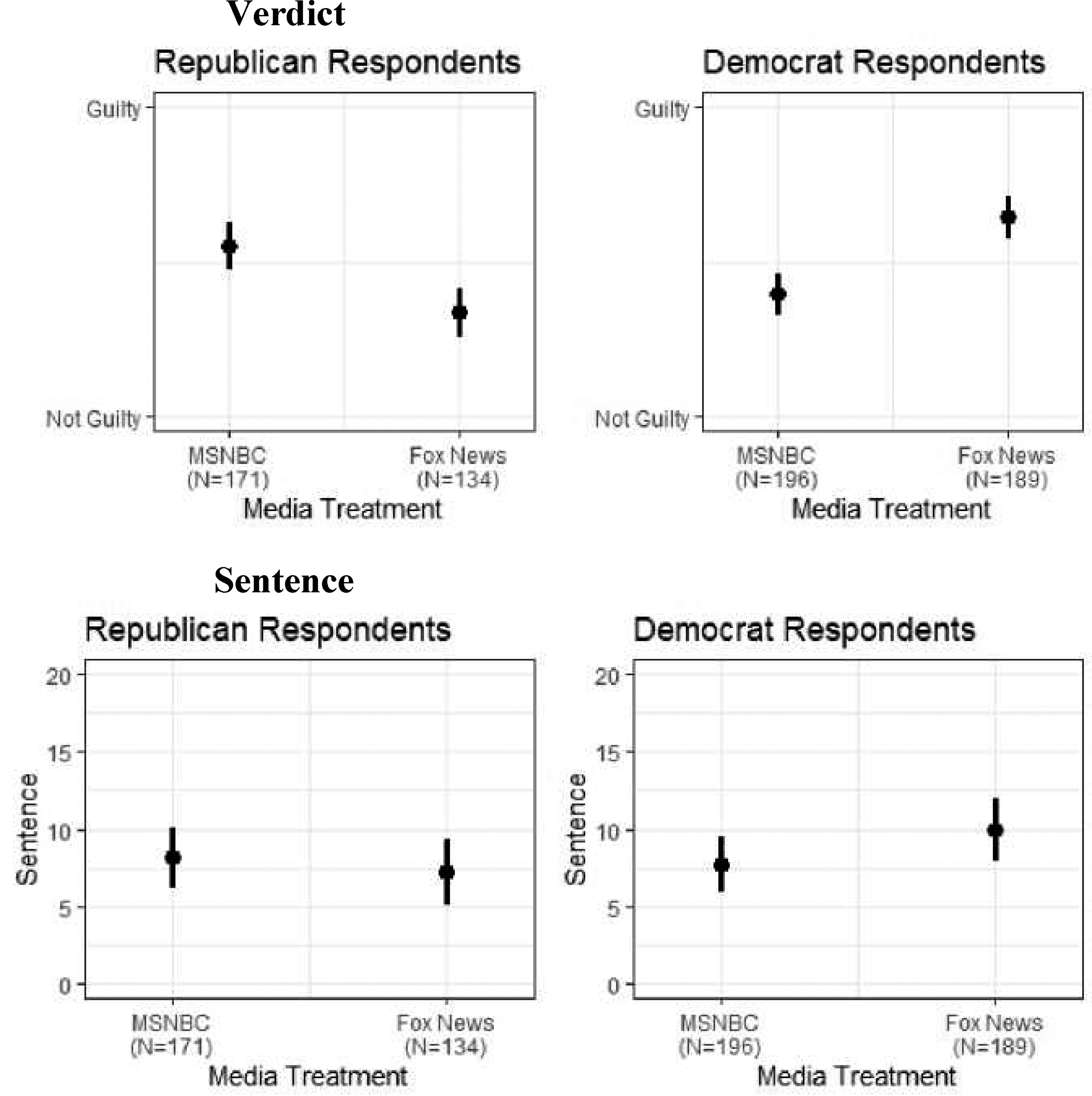
Beginning with Republican respondents and their perceptions of guilt, we find large differences. Of Republican respondents assigned to the Fox treatment condition, 33.6% [29.5–37.7] identify the defendant as guilty. In contrast, of Republican respondents assigned to the MSNBC treatment condition, 55.0% [51.2–58.8] identify the defendant as guilty. Turning to Democrat respondents and their perceptions of guilt, we find a very similar pattern. Democrat respondents assigned to the MSNBC treatment find the defendant guilty 39.5% [36.0–43.0] of the time, while Democrat respondents assigned to the Fox treatment find the defendant guilty 64.4% of the time [60.9–67.9].
In both cases, respondents are substantially less likely to find co-partisans guilty, and substantially more likely to judge opposing partisans guilty. The results provide strong initial evidence that partisanship influences perceptions of guilt.
Turning to punishment, we find no evidence of significant differences. In the bottom panel of Figure 1, we plot differences across conditions by respondent party. Republican respondents in the Fox treatment recommend an average sentence of 7.2 [5.0–9.4] months for the perceived co-partisan defendant while they propose an average sentence of 8.1 [6.2–10.0] months for opposing partisan defendants in the MSNBC condition. Among Democrat respondents, the average sentence length is 7.7 [5.9–9.5] months for co-partisan defendants and 9.9 [7.9–11.9] for out-partisan defendants.
The observed pattern, with partisanship influencing perceptions of guilt but not sentencing behavior, may be explainable by the different dynamics each introduces in legal decision-making, and their order in decision-making. Verdict decisions happen first, and are dichotomous choices with no room for nuance, leaving respondents more susceptible to motivated reasoning where they subconsciously interpret the available evidence in light of their underlying partisanship. In contrast, jurors typically are not responsible for sentencing at all. Moreover, by providing for a continuous range of outcomes, sentencing enables jurors to make more nuanced decisions. We might expect the effect of partisanship to be stronger in relation to a blunt choice (verdict) compared to a nuanced one (sentencing). Further, the choice comes after the verdict; if the decision on verdict has already helped to satisfy the respondent’s underlying predisposition against counter-partisans and for copartisans, the effect of partisanship may be more muted in sentencing. In all, there are a number of theoretical reasons that might help to explain this pattern.
So far, the results of Study 1 suggest that partisanship biases mock jurors’ perceptions of guilt, but not their punitiveness in assigning sentences. These findings point to both the scope and limits of partisan bias in mock juror behavior.
5. Study 1: Partisan Affect
In this section, we extend our analysis by examining how partisan affect influences the behavior of jurors. This analysis builds on important research examining the influence of affective partisan polarization in American politics (Iyengar et al., 2012; Iyengar & Westwood, 2015; Iyengar et al., 2019) by examining whether and how partisan affect distorts the impartiality of jurors in criminal trials.
We measure partisan affect by combining two feeling thermometers: one toward the Democratic Party, and the second toward the Republican Party. The thermometers range from zero to 100, with higher values indicating greater warmth toward the indicated party. For Democrat respondents, our measure of partisan affect is the Democratic Party feeling thermometer minus the Republican Party feeling thermometer (such that higher values indicate relatively more warmth toward the Democratic Party), while for Republican respondents our measure of partisan affect is the feeling thermometer toward the Republican Party minus the feeling thermometer toward the Democratic Party (such that higher values indicate relatively more warmth toward the Republican Party).
With the two dependent variables (verdict and sentence length) as well as two sets of respondents (Democrats and Republicans), we estimate four models that incorporate partisan affect. We start with the models of verdict; because the dependent variable is dichotomous with zero indicating not guilty and 1 indicating guilty, we estimate a logistic regression model. In these models, we include the appropriate measure of partisan affect (e.g., higher values indicate warmer toward Democrats in the Democrat respondents model), an indicator for the Fox treatment (which takes on the value of zero if the defendant was watching MSNBC, and the value of 1 if the defendant was watching Fox News), and the interaction of the two.
For ease of interpretation, we plot the predicted probabilities from the estimated models in Figure 2. In the left panel, we plot the results of the verdict model for Democrat respondents, and in the right panel we plot the results for Republican respondents. In both plots, higher values on the y-axis indicate a higher probability of a guilty verdict. Values of partisan affect are plotted along the x-axis, with higher values indicating more warmth towards the Democrat (left panel) or Republican (right panel) party relative to the opposing party. The lines and shaded regions in each plot provide the predicted probability and associated 95% confidence interval for a guilty verdict at that level of partisan affect, with blue indicating the respondent read the vignette featuring a putatively Democrat-identifying defendant and red indicating the respondent read the vignette featuring a putatively Republican-identifying defendant. Starting with Democrat respondents, we find no significant difference between the treatments at low levels of partisan affect toward the Democratic Party; as relative warmth toward the Democratic Party increases, however, we find a stark divergence. Democrat respondents with high relative affect toward the Democratic Party are much more likely to find the defendant guilty when the defendant is a Republican (i.e., in the Fox treatment), and much less likely to find the defendant guilty when the defendant is a Democrat (i.e., in the MSNBC treatment). At the highest levels of affective bias toward the Democratic Party among Democrat respondents, we find that the probability of voting guilty if the defendant is a putative Republican is about 0.74, whereas the probability of voting guilty if the defendant is a Democrat is about 0.32. Predicted Probabilities of Verdict by Party, Partisan Affect, and Treatment. Predicted probability of guilty verdict (y-axis) by partisan affect (x-axis) for Democrat (left-panel) and Republican (right-panel) survey respondents across treatment conditions. Full results available in Section A4 of the Appendix.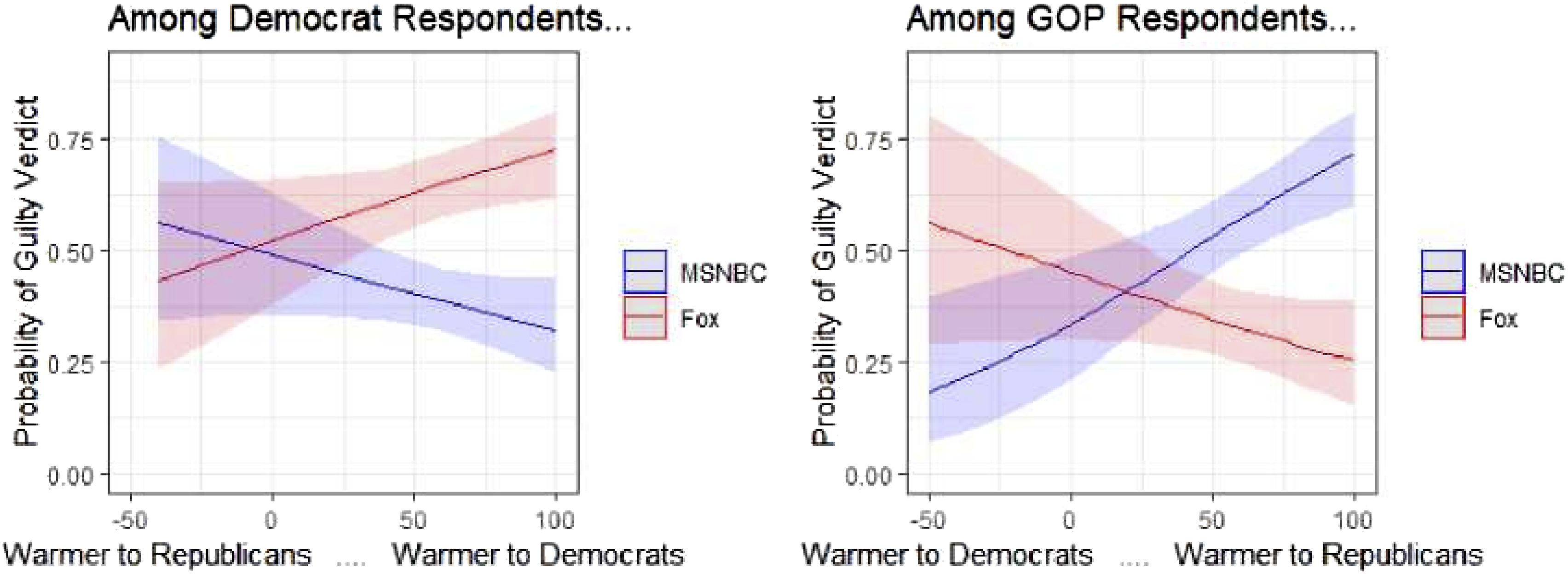
As the right panel makes clear, we find almost identical patterns among Republican respondents. Among those who are least affectively polarized, Republicans are actually somewhat more likely to find the putative Republican defendant (i.e., in the Fox treatment) guilty than the putative Democrat defendant (i.e., in the MSNBC treatment), though the difference is not statistically significant. However, among those high in relative warmth toward the GOP, Republican respondents were much more likely to find a putative Democrat (i.e., in the MSNBC treatment) defendant guilty (predicted probability of approximately 0.74) than a putative Republican (i.e., in the Fox treatment) defendant (predicted probability of approximately 0.26).
Turning to the model of punishment, we estimate two separate linear regression models of sentence length (which ranges from zero to 60 months), one for Democrat respondents and one for Republican respondents. We include the same covariates as before, but also add one additional covariate, a dichotomous variable to indicate whether (1) or not (0) the respondent provided a guilty verdict. We plot the results in Figure 3. Strikingly, and in contrast to perceptions of guilt, we find little to no difference in punishment preferences across treatment conditions. While both Democratic and Republican respondents are more likely to see members of the opposing party as guilty, they do not punish differently. Predicted Values of Sentence Lengths by Party, Partisan Affect, and Treatment. Predicted value of sentence length (y-axis) by partisan affect (x-axis) for Democrat (top-panel) and Republican (bottom-panel) survey respondents for respondents giving not guilty (left-panel) and guilty (rightpanel) verdicts across treatment conditions. Full results available in Section A5 of the Appendix.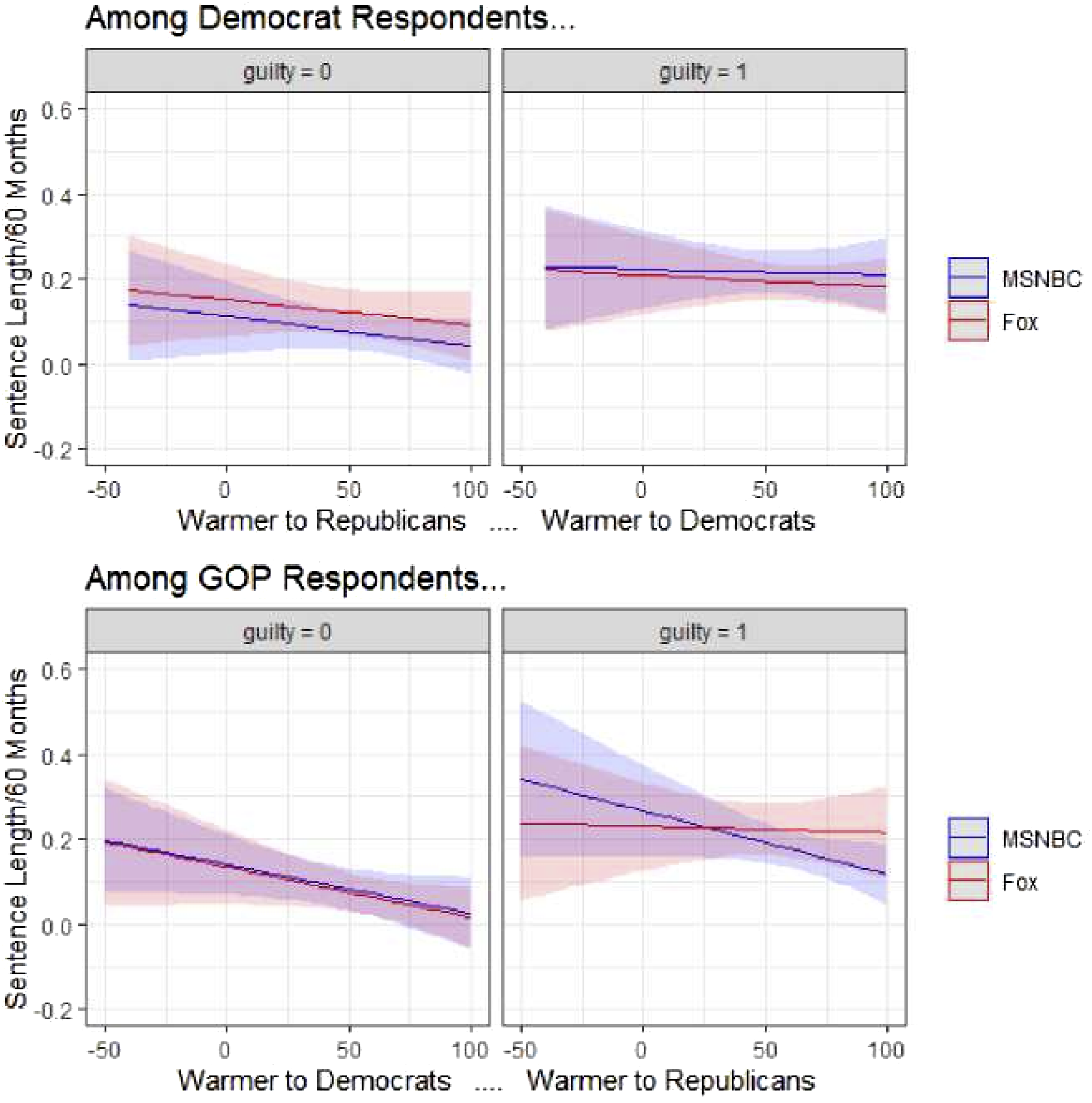
These results are very similar to those reported in the previous section. Affective polarization, like party identification, appears to influence perceptions of guilt, but not punitiveness.
6. Study 1: Explaining the Verdicts
In all, we have strong evidence that partisanship, whether in terms of partisan identity or affective orientation toward the parties, colors perceptions of guilt for both Republicans and Democrats. Still unexamined, however, are the questions of whether and how partisanship influences individuals’ reasoning about their verdicts. To investigate these questions, we asked survey respondents to explain their verdicts in an open-ended text box. Of the 1000 survey respondents, 821 offered a written response, and we use these responses in the analyses that follow.
With these explanatory texts in hand, we leveraged the capabilities of large language models (LLMs), specifically ChatGPT 4o, to systematically analyze the differences in content by self-identified party, perception of guilt, and treatment condition. Our use of ChatGPT for this task builds on recent evaluation studies showing that this LLM performs as well or better than crowd workers and trained annotators on text annotation tasks such as topic and frame detection, even without being trained on annotated data (e.g., Gilardi et al., 2023; Tornberg, 2024; Le Mens & Gallego, 2024), as well as recent work demonstrating the potential utility for much more complicated legal tasks (e.g., Ash et al., 2024; Engel & McAdams, 2024).
We submitted the responses and associated metadata (whether the respondent was a Democrat or Republican, whether they indicated a guilty or not guilty verdict, and whether they received the MSNBC or Fox News defendant treatment) to ChatGPT.
7
The submission of the text responses and metadata allows us to use GPT-4o to analyze differences in explanations for verdicts across the treatment conditions within each of the four categories defined by party identification and verdict. We use a zero-shot, role-based prompt, orienting the GPT with context based on expertise in law, political science, and political communication. Then, we provide step-by-step guidelines for the task, akin to chain-of-thought prompting. As part of these steps, we asked GPT-4o to rank the differences in thematic focus on a scale of 1–5, where 1 is a minor difference in thematic emphasis between the treatment conditions, and 5 is a theme almost entirely in one set and not the other. In all, we submitted four unique prompts to ChatGPT based on the combinatorials of respondent partisanship and verdict. Thus, for example, the prompt to ChatGPT for self-identified Republican respondents with a guilty verdict was: Among Republican respondents voting guilty, do the following. First, identify three to five common themes across the responses. Second, identify whether there are significant differences in the focus on these themes in responses between those who received the MSNBC Defendant versus those who received the Fox Defendant? In describing the differences in thematic focus, rate each difference on a scale of 1–5, where 1 is a very minor difference with only a few additional mentions in one set of responses, and where 5 is a very large difference where the theme is only present in one set of responses and not in the other. In assigning scores from the scale of 1–5, you may assign the same score to different themes.
Summary of Differences in Republican Respondent Reactions to MSNBC and Fox News Defendants by Respondent Verdict.
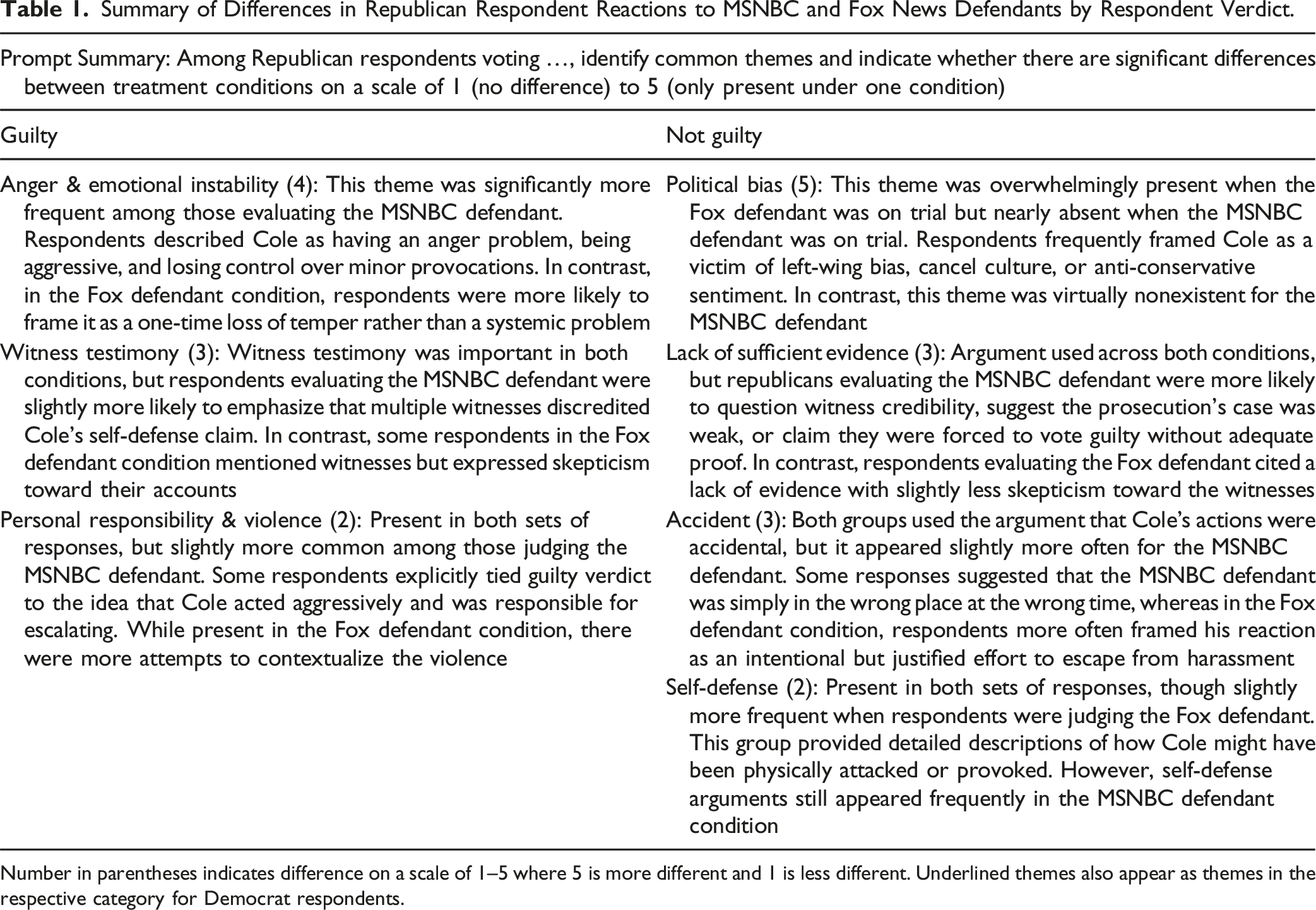
Number in parentheses indicates difference on a scale of 1–5 where 5 is more different and 1 is less different. Underlined themes also appear as themes in the respective category for Democrat respondents.
Summary of Differences in Democrat Respondent Reactions to MSNBC and Fox News Defendants by Respondent Verdict.
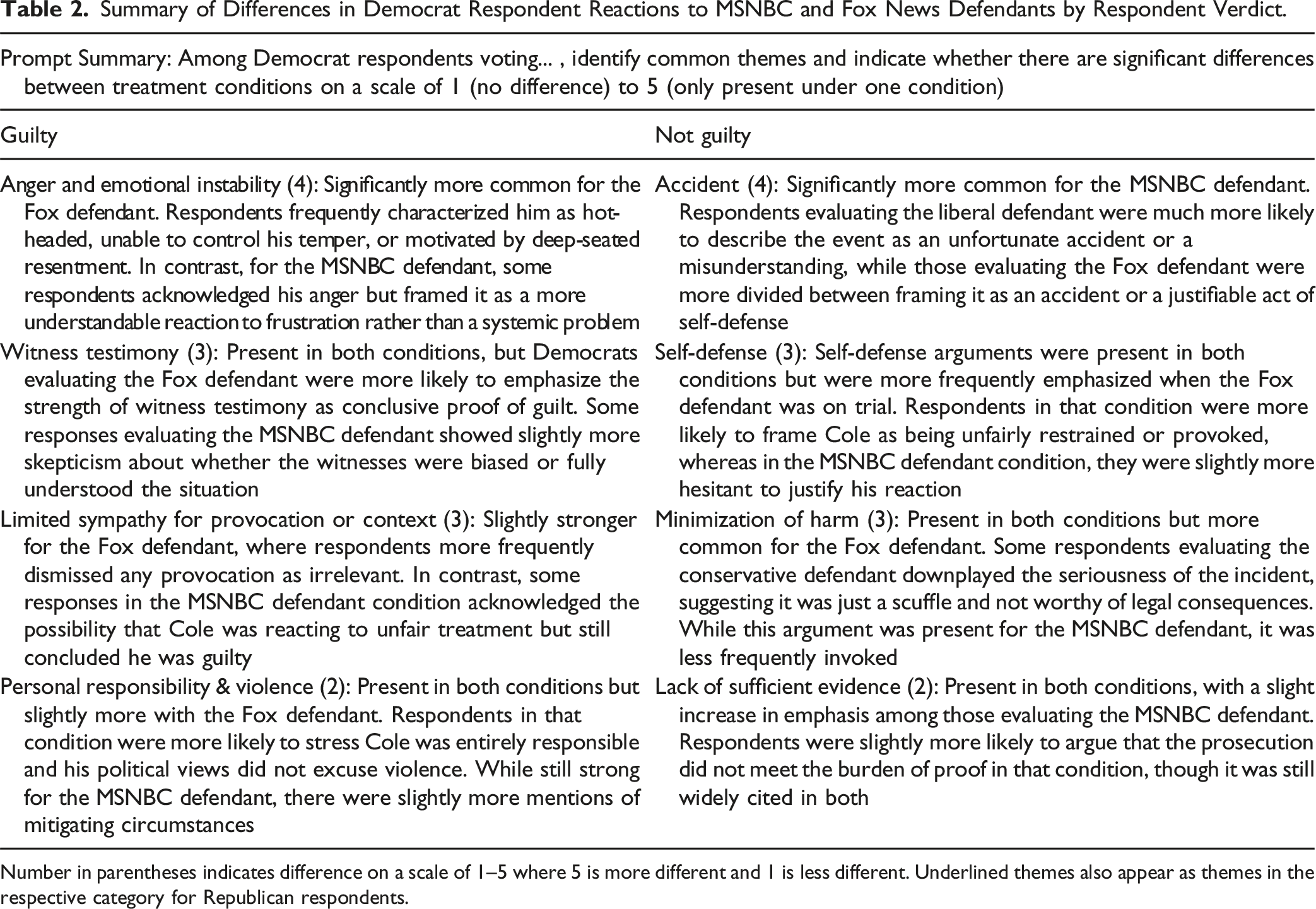
Number in parentheses indicates difference on a scale of 1–5 where 5 is more different and 1 is less different. Underlined themes also appear as themes in the respective category for Republican respondents.
The results are striking. In the first place, the thematic emphases are markedly similar by verdict type for Republican and Democrat respondents. Republican and Democrat respondents returning a guilty verdict are both more likely to emphasize Anger and Emotional Instability, Witness Testimony, and Personal Responsibility & Violence. Moreover, as the summaries in the table make clear, each emphasized the theme more when discussing a counter-partisan defendant. For instance, the top theme for each, Anger and Emotional Instability, was emphasized more by Republican respondents when evaluating a putatively Democratic defendant, while the theme was emphasized more by Democrat respondents when evaluating a putatively Republican defendant.
A similar pattern holds for survey respondents explaining why they returned a Not Guilty verdict for co-partisan or counter-partisan defendants, though with a bit more variation. Again, there is significant overlap in thematic focus across Republican and Democrat respondents, here covering Accident, Self-Defense, and Lack of Sufficient Evidence. Democratic respondents returning a guilty verdict were much more likely to see the incident as an Accident if the defendant is putatively Democratic, and were likewise slightly more likely to question the Lack of Sufficient Evidence if the defendant was Democratic. Republicans were more likely to emphasize Self Defense for a copartisan defendant. Republican respondents returning a guilty verdict deviated from the pattern by emphasizing slightly more the Accident frame for the MSNBC defendant, and also were slightly more likely to point to a Lack of Sufficient Evidence for MSNBC defendants.
What might explain this variation? Turning to the areas where there is no overlap, we find important variation in thematic focus in both sets. Most critically, Republican respondents returning Not Guilty verdicts emphasized Political Bias, with the theme “overwhelmingly present when the Fox Defendant was on trial but nearly absent when the MSNBC defendant was on trial.” On the other hand, the theme of Political Bias was absent in the thematic emphases among Democrat respondents, reflecting the extent to which polarization impacts decision-making for Republicans.
Further, two unique themes emerge among Democrat respondents. Among those returning a Guilty verdict, they were slightly more likely to emphasize Limited Sympathy for Provocation or Context when they had a Fox News defendant, reflecting a unique manifestation of affective polarization among Democrat respondents. Contrasting this, though, Democrat respondents returning a Not Guilty verdict were actually more likely to emphasize a Minimization of Harm theme for the Fox News defendant, a theme which downplayed the harm and suggested it was inappropriate for legal punishment.
Comparative Summary of Thematic Patterns for Republican Respondents by Affective Polarization.
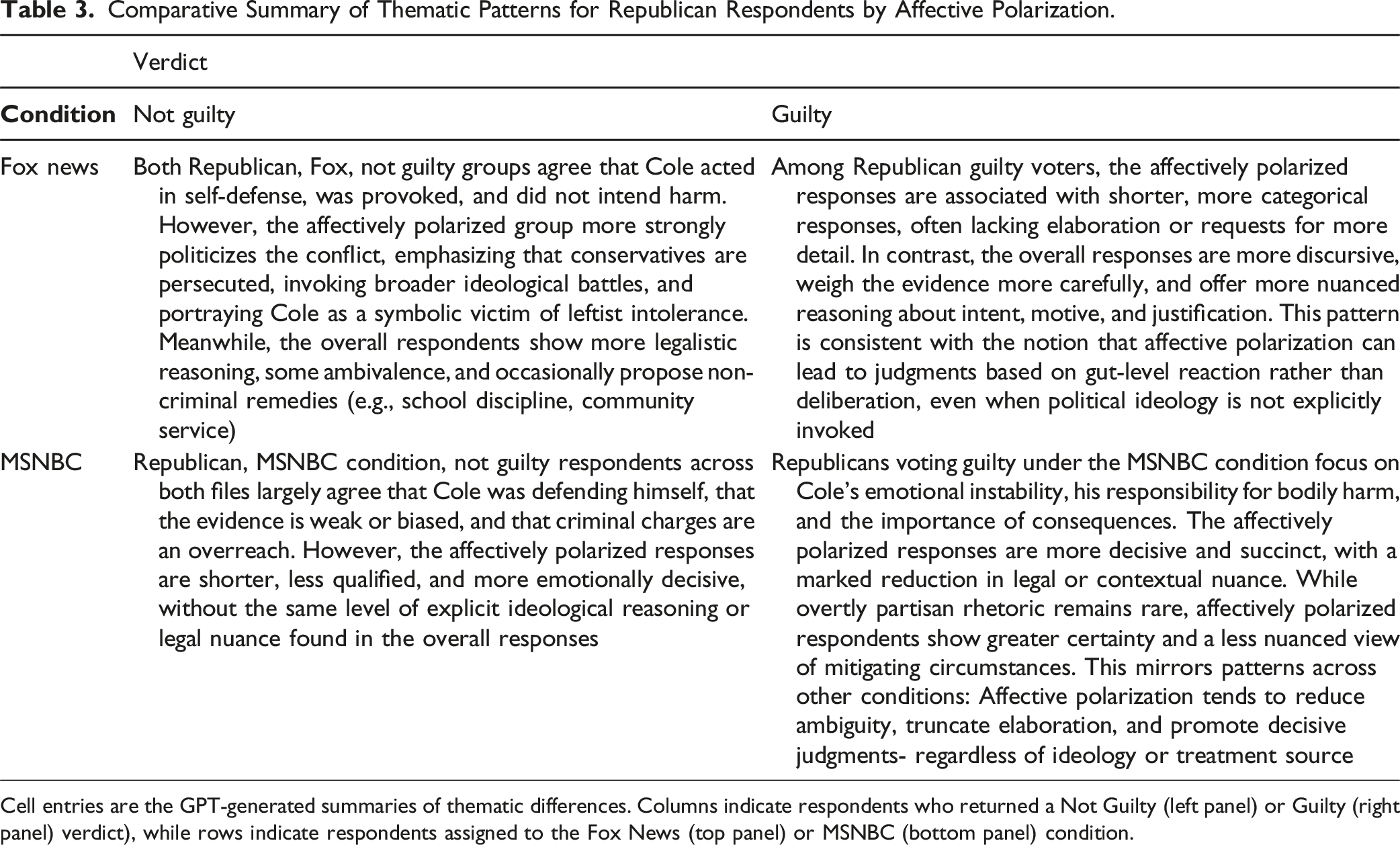
Cell entries are the GPT-generated summaries of thematic differences. Columns indicate respondents who returned a Not Guilty (left panel) or Guilty (right panel) verdict), while rows indicate respondents assigned to the Fox News (top panel) or MSNBC (bottom panel) condition.
Finally, to better understand whether and how affective polarization influenced the justifications survey respondents provided in the open-ended responses, we created new subsets of the open-ended responses for only those respondents who scored in the upper quartile of affective polarization among Democrat and Republican respondents respectively. For both groups, this meant creating subsets of responses for those with an affective polarization score greater than 78. Then, we asked GPT for direct comparisons of the previously uploaded files with the responses generated only by the most affectively polarized. 9 We did this by each combinatorial; for example, for Democrat respondents who received the MSNBC treatment and voted guilty, we uploaded both the original file with all open-ended responses, and a new file with only the open-ended responses from the most affectively polarized respondents, and prompted GPT to compare differences in thematic emphases of the two sets.
We start with an analysis for Republican respondents, which we present in Figure 3. Starting first with Republican respondents who returned a Not Guilty verdict for the Fox News-watching defendant, the more affectively polarized respondents were more likely to emphasize politics and portrayed the defendant as a victim based on their political identity. Throughout each of the other conditions, the affectively polarized responses were shorter, more categorical, and lacked elaboration. That is, among Republican respondents, those who are more affectively polarized are more likely-in this experiment-to demonstrate certainty in their reasoning, elaborating and equivocating less.
Comparative Summary of Thematic Patterns for Democrat Respondents by Affective Polarization.
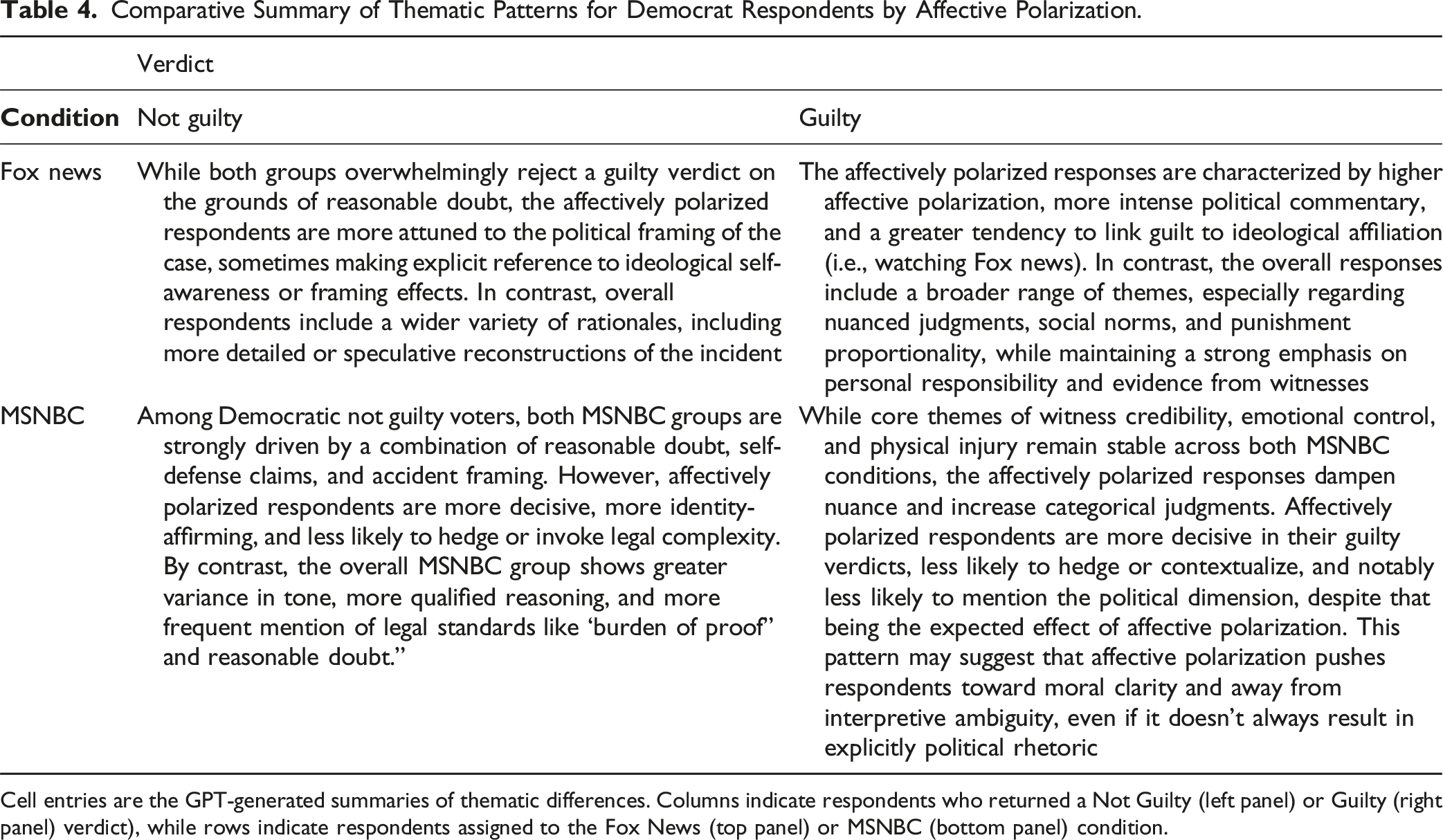
Cell entries are the GPT-generated summaries of thematic differences. Columns indicate respondents who returned a Not Guilty (left panel) or Guilty (right panel) verdict), while rows indicate respondents assigned to the Fox News (top panel) or MSNBC (bottom panel) condition.
In all, we find consistent patterns in the differences in the thematic structure of responses between affectively polarized respondents and other respondents. More affectively polarized respondents express greater certainty in verdicts and less hedging, writing and elaborating less in their open-ended explanations of the verdicts they have returned. This pattern dovetails with the broader scholarly understanding of affective polarization, which provides evidence of associations between affective polarization and a respondent’s willingness to discriminate (Mason & Wronski, 2018) as well as a respondent’s overconfidence in their own judgments (Stapleton & Wolak, 2024).
7. Study 2: Can Jury Instructions Mitigate These Effects?
Study 1 demonstrates that partisanship influences juror decision-making in the stylized environment of a mock juror experiment. However, Study 1 lacks several elements of a real jury experience-for example, there is no cross-examination of witnesses, instructions to jurors, or deliberations among jurors.
Although we cannot replicate the full experience of a jury trial in an experiment, one element we can approximate is the judge’s instructions to jurors prior to their deliberations. While the precise instructions given to jurors can vary across states, the American Bar Association’s “Principles for Juries and Jury Trials” (American Bar Association, 2005) recommends that judges provide plain and understandable instructions on the applicable law following the final argument and before deliberations. As the Association’s “Principles” makes clear, jury instructions are intended to promote jurors’ understanding of the facts and impartial application of the law. These considerations lead us to develop the following hypothesis:
8. Study 2: Data
To explore how such instructions may alter the impact of partisan bias, we conducted a follow-up mock juror experiment (Study 2) in which the design and vignette were identical except respondents were randomly assigned either to a condition receiving standard jury instructions or to a control condition without instructions. Thus, in Study 2, there are four experimental conditions: a Democratic defendant without jury instructions; a Democratic defendant with jury instructions; a Republican defendant without jury instructions; and a Republican defendant with jury instructions. With this design, we gain analytical leverage on whether emphasizing legal standards and responsibilities - one important element of an actual jury experience - attenuates the partisan effects observed above.
We administered the survey experiment in a module of the 2024 Cooperative Election Study (CES), once again fielded by YouGov to a sample of 1000 American adults. Once respondents completed reading the survey vignette, half were randomly assigned to receive jury instructions. The jury instructions were as follows: The Honorable Geoffrey Martin, the judge in this case, reminds you that, as a juror: • You must consider the evidence objectively, without sympathy or prejudice. • Defendants are presumed innocent until proven guilty beyond a reasonable doubt by the prosecution. • The law recognizes a right of self-defense. Persons have a right to defend themselves, including by force, if they reasonably believe they are in imminent danger of harm. • You must base your verdict and sentencing on the evidence, not because you feel sympathy for anyone or anger at anyone. If you reach a guilty verdict, you must decide a sentence based on the facts of the case, plus any mitigating or aggravating factors presented during the trial.
After reading the instructions, respondents were again asked to return their verdict, specify a sentence, and explain the reasoning for their decision.
9. Study 2: Results
Turning first to the aggregate results, we find that 54% [50.9–57.7] of survey respondents returned a guilty verdict, a slightly higher average rate than the prior survey (47.6%). The increase is not attributable to jury instructions, though, as 53.3% [48.4–58.1] of survey respondents who received the jury instructions returned a guilty verdict compared to 55.2% [50.3–60.0] returning guilty verdicts among those who did not receive the jury instructions. Despite jury instructions that explicitly remind jurors that defendants are presumed innocent, that they have a right to self-defense, and that the standard for guilt is beyond a reasonable doubt, there is no significant difference - and barely any difference at all - in the observed probability of returning a guilty verdict.
Even if the overall rate does not change, perhaps the influence of partisanship on verdict does.
10
In Figure 4 we plot the difference in means across treatment conditions. The top row features the results for Democrat respondents and the bottom row features the results for Republican respondents, while the left panel is for those respondents who received the MSNBC vignette while the right panel is the Fox vignette. The points indicate the mean and the segments represent the associated 95% confidence intervals. Difference in Guilty Verdict Rate by Treatment Conditions for Democrat (top) and Republican (bottom) Respondents. Mean and 95% confidence interval for indicated category of respondents.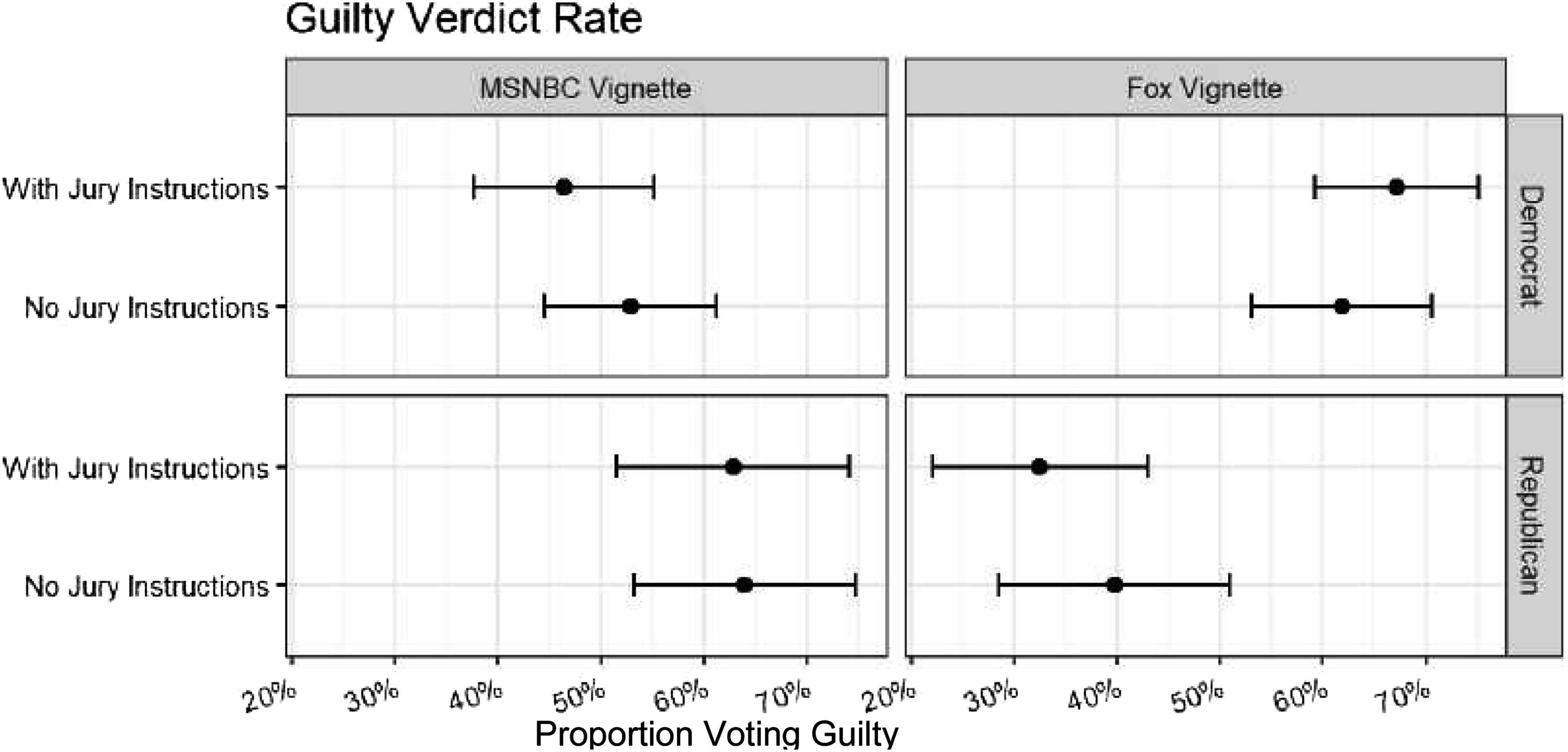
Taking Democrats first, we find that-among those receiving the MSNBC vignette, or a copartisan defendant-there was a small decrease in the probability of returning a guilty verdict if the respondent received the jury instructions, from 52.9% [44.6–61.2] for those who did not to 46.4% [37.7–55.1] for those who did receive jury instructions. For Republicans in the co-partisan defendant condition, the overall rate of returning guilty verdicts was much lower, but the effect of the jury instructions was about the same, with Republican respondents returning guilty verdicts 39.7% [28.5–51.0] of the time without jury instructions compared to 32.5% [22.0–42.9] of the time with jury instructions. In all, for co-partisan defendants, the jury instructions are associated with small though consistent declines in the rate of returning guilty verdicts.
On the other hand, we find a much different story with counter-partisan defendants for both Democrat and Republican respondents. For Democrats receiving the counter-partisan defendant, jury instructions were associated with an increase in the probability of returning guilty verdicts, with 61.9% [53.1–70.6] of Democrats returning guilty verdicts without jury instructions compared to 67.2% [59.2–75.2] of Democrats returning guilty verdicts for counter-partisan defendants when they had received jury instructions. For Republicans receiving the counter-partisan defendant, jury instructions had a negligible effect, with 64.0% [53.2–74.8] returning guilty verdicts without jury instructions compared to 62.9% [51.5–74.2] returning guilty verdicts with jury instructions.
Taken together, and as Figure 4 makes clear, the net effect of the jury instructions - if anything - was to exacerbate rather than mitigate the manifestation of partisan bias. Relative to Democrats who did not receive jury instructions, Democrats receiving jury instructions were more likely to see co-partisan defendants as not guilty and more likely to see counter-partisan defendants as guilty, whereas Republican respondents were more likely to see co-partisan defendants as not guilty while not changing their overall perspective of the guilt of counter-partisan defendants. In short, we find no support for the Jury Instruction Hypothesis, instead finding possible indications of a reverse effect.
10. Discussion
Jury service occupies a fraught position in contemporary American society. Jurors are expected to render impartial verdicts based on the relevant facts and legal standards. However, in today’s hyper-polarized environment, juries are likely to be comprised largely of partisans who may exhibit biases against out-party members.
These tensions motivate the central question explored in this article: Can a partisan defendant receive a fair trial when some jurors are members of the opposing political party? The findings of the two experiments presented in this article suggest that partisan polarization significantly undermines the impartiality of jurors. In Study 1, we show that both Democratic and Republican respondents acting as mock jurors are more likely to acquit their co-partisans and convict members of the opposing party, with the most affectively polarized individuals exhibiting the strongest biases. In Study 2, we provide further evidence of this pattern, by demonstrating that partisan biases are not mitigated by jury instructions intended to promote impartiality and a reliance on the facts.
These findings have profound implications for both academic understanding and the public sphere. In the first place, they contribute to the extensive literature on partisan polarization by demonstrating that its effects extend beyond social judgments into the legal domain, where citizens take on the role of a government actor as a juror. Even when citizens are called on to act as impartial administrators of justice, our findings suggest their partisan attachments and emotions may influence their perceptions of guilt and innocence. Although further research is needed to fully investigate the influence of partisan bias on juror behavior, our work highlights the necessity for scholars of polarization to extend their gaze to the intersection of polarization and legal processes.
Moreover, our research reveals that both Democratic and Republican respondents employ overlapping thematic justifications for their decisions, indicating that partisans are adept at rationalizing their biases using “appropriate” legal arguments. This insight suggests that partisan biases are not merely overt expressions of political identity but are deeply embedded within the framework of legally relevant reasoning. That partisan attitudes manifest more implicitly suggests that the effects of polarization may extend well beyond the overt expressions to other behaviors in ways that further segment society.
Additionally, our research raises questions about the efficacy of jury instructions in promoting impartiality among jurors. As the results of Study 2 showed, exposure to jury instructions intended to promote impartiality and adherence to the law did not suppress partisan bias in juror behavior and may have exacerbated it. Future experimental research should delve more deeply into how to induce impartial behavior among jurors.
As noted above, our study eliminates some of the key features of a real jury trial-cross-examination of witnesses, juror deliberations, and so forth-in order to pin-point the influence of partisan bias on individual perceptions of guilt. While our examination of jury instructions in Study 2 suggests that some real-world experiences may not moderate bias, other elements of a real jury trial may. In particular, the heterogeneity of an actual jury panel may serve to counteract some of the effects we observe, such that the experimental effects above may overstate the practical influence of partisan bias in real juror settings.
Considering this, a particularly promising potential avenue for future research is in the space of jury deliberation. Specifically, future research might randomly expose mock jurors to the opinions of other jurors (either real or manufactured, and either from co-partisan jurors or out-partisan jurors) to determine how this affects the influence of partisan bias. While our work leverages generative AI for the analysis of open-ended responses, other recent work demonstrates the conversational persuasiveness of generative AI in deliberative settings (see, e.g., Salvi et al., 2025). Leveraging that capability as part of the mock juror experiment would build on the work above, demonstrating how robust these effects are to co- or counter-partisan juror arguments.
Additionally, our study uses a mock case where the partisan identity of the defendant is particularly salient. This is appropriate for a first assessment of the partisan bias of mock jurors. However, future research could evaluate the scope of partisan bias among jurors in cases where the partisan identity of the defendant is less salient. Likewise, future research should explore the specific conditions under which partisan identity exerts an effect on juror decision-making.
In all, our research clearly demonstrates that partisan bias significantly influences juror behavior. This dynamic challenges the integrity of the legal system in an era of escalating political polarization. The results, therefore, call for expanded attention to the ways in which partisan polarization manifests in trials. Addressing this issue is crucial for maintaining the fairness and impartiality that are fundamental to the administration of justice.
Supplemental Material
Supplemental Material - Partisan Bias in Juror Decision-Making
Supplemental Material for Partisan Bias in Juror Decision-Making by Jesse Rhodes, Tatishe Nteta, and Douglas Rice in Journal of Law & Empirical Analysis
Footnotes

Funding
The authors received no financial support for the research, authorship, and/or publication of this article.
Declaration of Conflicting Interests
The authors declared no potential conflicts of interest with respect to the research, authorship, and/or publication of this article.
Data Availability Statement
All data and materials necessary to replicate the results reported in this article are available on the author's Dataverse at https://doi.org/10.7910/DVN/2LZDER.
Supplemental Material
Supplemental material for this article is available online.
Notes
References
Supplementary Material
Please find the following supplemental material available below.
For Open Access articles published under a Creative Commons License, all supplemental material carries the same license as the article it is associated with.
For non-Open Access articles published, all supplemental material carries a non-exclusive license, and permission requests for re-use of supplemental material or any part of supplemental material shall be sent directly to the copyright owner as specified in the copyright notice associated with the article.
