




Abstract
The European Court of Human Rights (ECtHR) is composed of one judge per country that has ratified the European Convention on Human Rights (ECHR). When a case is brought against a country, that country has the privilege to have ‘its’ judge take seat ex officio. When the elected judge is unable to sit ex officio, the country may propose an ad hoc judge. Ad hoc judges do not need to pass the normal test of scrutiny as to their competence and impartiality, allowing governments to propose pro-government candidates in politically sensitive cases. Consequently, academic literature, legal practice and even judges of the Court have voiced concerns over the neutrality and quality of ad hoc judges. Changes have been made to the Convention mechanism and further changes are called for to ensure the neutrality of ad hoc judges. By doing statistical analysis, this article suggests that the actual voting behaviour of ad hoc judges may not be so problematic as sometimes suggested. This may be relevant for a decision to introduce further changes to the Convention mechanism and the extent of those potential revisions.
Introduction
1 Every country having ratified the European Convention on Human Rights is allowed to have its ‘own’ national judge sit on the European Court of Human Rights. 2 Each Member State can list three candidates for the seat, from which the Parliamentary Assembly of the Council of Europe will chose one. 3 The Convention underlines that judges should be of high moral character 4 and ever since their initial formulation in 1959, the Rules of the Court stress that: ‘A judge may not exercise his functions while he is a member of a Government or while he holds a post or exercises a profession which is likely to affect confidence in his independence. In case of need the Court shall decide.’ 5 When a case is brought against a country, the elected judge proposed by that country, also called the national judge, has the right to sit ex officio in the Chamber deciding on the matter. The other sitting judges were initially selected by lot and are currently appointed by the President of the Section of the Chamber deciding on the case.
Having a national judge sit in the Chamber ensures, inter alia, that knowledge about the national language, particularities of the case and national legislation are available to the Court. Consequently, when an elected national judge needs to be excused due to either death, sickness, personal circumstances, a conflict of interest or another reason, 6 the country in question has the right to have an ad hoc national judge take seat. 7 While elected judges are carefully scrutinized by both the Parliamentary Assembly of the Council of Europe and the Court itself before being admitted, such mechanisms have been absent until recently when it comes to ad hoc judges and are still less stringent. 8 Consequently, ad hoc judges are generally believed to have a pro-government voting record and their neutrality, objectivity and quality have been questioned throughout the history of the Convention.
This article will argue that although the Convention mechanism indeed allowed countries to appoint ad hoc judges as political instrument, albeit more so in the past than now, statistical data does not support the dark picture generally painted of the functioning of ad hoc judges, although there are obviously points of concern. Rather, and perhaps counterintuitively to many, ad hoc judges seem to function in a relatively unbiased and neutral manner. While they do vote in favour of ‘their’ government more often than non-national judges do, such bias often only concerns one or two points of a case, with ad hoc judges voting in favour of finding a violation of the Convention with respect to their country on one or more different aspects of the case as well. In addition, in only a very small number of cases do they have the ‘swing’ vote, tilting the balance toward finding no violation when the other judges are par.
Section 2 of this article will illustrate why the ad hoc judge has received a fair amount of criticism and on which points their impartiality, objectivity and neutrality is questioned. Section 3 will describe which changes have been made to the Convention to remedy these points of concern, as well as the calls for further changes and even more stringent rules on the appointment of ad hoc judges. Section 4 will introduce the methodology of a statistical analysis performed for this study with respect to all cases in which an ad hoc judge sat on the ECtHR and describe the basic numbers and facts. Subsequently, section 5 will give an interpretation of the data and analyse what the results mean, showing that many of the critical points raised in academic literature, in legal practice and even by judges of the ECtHR are not always supported by the data. Finally, section 6 will wrap up by giving a small summary of this paper's main arguments and suggest which revisions, if any, could be introduced to address the drawback of the current ad hoc mechanism.
The prevailing sentiment: Criticism of the ad hoc judge
Critics who feel that ad hoc judges are used as political instruments by national governments point to judgments such as issued in the case of Cyprus v. Turkey from 2001, 9 concerning the Turkish invasion of Northern Cyprus. After the Turkish judge elect (Türmen) had withdrawn from the case, citing conflict of interest, Turkey appointed an ad hoc judge (Dayıoğlu), who withdrew from the case when the Cypriot government questioned his impartiality and competence. Turkey not only appointed another ad hoc judge (Ferdi), but itself opposed the Cypriot judge elect (Loucaides), questioning his impartiality, an appeal that was honoured by the ECtHR. Cyprus then not only appointed an ad hoc judge (Hamilton), who was replaced by another ad hoc judge (Marcus-Helmons) after his demise, but also opposed the newly installed ad hoc judge (Ferdi) for Turkey, a request which the Court yet again honoured, forcing the Turkish government to appoint a third ad hoc judge (Fuad). Only then could the proceedings start.
The judgment itself was a catastrophic defeat for Turkey. The Court found, inter alia, that there had been a continuing violation of Article 2 and 5 ECHR on account of the failure to conduct an effective investigation into the whereabouts and fate of Greek-Cypriot missing persons who disappeared in life-threatening circumstances, of Article 3 ECHR in respect of the relatives of the Greek-Cypriot missing persons, of Article 8 ECHR and Article 1 of Protocol 1 by reason of the refusal to allow the return of any Greek-Cypriot displaced persons to their homes and make use of their property in northern Cyprus, of Article 13 by reason of the failure to provide to Greek-Cypriots not residing in northern Cyprus any remedies, of Article 9 and 10 ECHR, among others because schoolbooks were subject to excessive measures of censorship, and of Article 6 ECHR, on account of the legislative practice of authorizing the trial of civilians by military courts.
All of these more than a dozen violations were established in the same voting ratio: 16 in favour, 1 against (the Turkish ad hoc judge). Mr Fuad did vote with the majority on more than 20 points, namely when decisions were in favour of the Turkish government, e.g., declaring parts of the application inadmissible or finding no violation of the Convention on specific points. 10 The Cypriot ad hoc judge, at its turn, dissented from the majority's judgment in the same 16 to 1 ratio on two points, namely when the Cypriot claims that Article 2 and 5 ECHR had been violated by reason of, inter alia, an alleged practice of denying access to medical services to Greek Cypriots and Maronites living in northern Cyprus, were rejected. These remarkable voting patterns seem to suggest that the ad hoc judges operated more as advocates for their respective countries than as independent judges, a suggestion which is reaffirmed by the fact that commentators qualified the arguments used in their dissenting opinions as meagre and weak. 11
It was these types of cases that raised alarm among academics, practitioners and the judges of the European Court of Human Rights. These feelings of concern were deepened by the number of cases in which an ad hoc judge was appointed. 12 Although the Convention mechanism had allowed countries to propose pro-government candidates (both in politically sensitive cases and unsensitive cases) when the judge elect had to excuse herself for decades, for a long period of time, this option was seldom deployed. This, however, changed around 2000. While in the period from 1960–1998, an ad hoc judge had been appointed in 35 cases only, already in 1999 and 2000 this had increased to 36 respectively 60 times per year. 13 The climax came in 2001, with 456 cases in which an ad hoc judge was appointed. After that, numbers continued to be high, but never reached that level again, and has subsequently steadily declined to only about a dozen or so cases in 2019. 14
Not only was there an explosion in the number of cases in which ad hoc judges operated, especially in politically sensitive cases in the beginning of this millennium, 15 some ad hoc judges sat on so many cases that they were called ‘quasi permanent ad hoc judges’. In addition, empirical evidence, albeit limited, seemed to point to a bias: 16 ‘(…) no judge ad hoc has ever voted with the minority of the Court against his own government, and in 10 out of 23 cases the judge ad hoc voted in the “suspicious” third category. When one compares the 43.5% of judges ad hoc with the 9.1% of titular national judges, the difference is evident. In 60.9% of the cases, the judge ad hoc voted in favour of the position of his own government. When a judge voted against his own government, he only did so assenting with the overwhelming majority of the Court (in 6 out of 9 cases the vote was unanimous).’ 17
This bias could be explained by the fact that, first, countries were able to select the ‘right’ candidate for the ‘right’ case, because the ad hoc judge was named only ‘(…) after a particular case has arisen. Thus, a party's government will be able to appoint a judge ad hoc who previously expressed views similar to the point of view of that government.’ 18 Second, ad hoc judges were assigned to the most sensitive cases. ‘While ad hoc judges are supposedly assigned only when the regular judge has to recuse himself or herself, I found that ECtHR Article Three (torture) cases were somewhat more likely to have an ad hoc judge than were other cases, even while including fixed effects and relevant controls.’ 19 Third, some ad hoc judges were financially dependent on their work as judge and could consequently have been inclined to vote favourably towards the country appointing them. Finally, ad hoc judges are often a candidate for becoming the titular national judge and could be reluctant to vote against the government, who later could play a decisive role in deciding on his or her appointment. 20
Changes to the Convention and the rules of the court
Given these points of criticism, a number of changes were made to both the Convention and the Rules of the Court. Protocol 14 (adopted on 13 May 2004, entering into force on 1 June 2010) brought about changes to the Convention entailing, inter alia, that countries no longer had the right to appoint an ad hoc judge per case, after the application had been made. Instead, Member States now have to submit a list of ad hoc candidates in advance, and it is for the President of the ECtHR to choose a person from that list to sit as ad hoc judge on a specific case. 21 The explanatory memorandum stressed that this new system ‘(…) is a response to criticism of the old system, which allowed a High Contracting Party to choose an ad hoc judge after the beginning of proceedings. Concerns about this had also been expressed by the Parliamentary Assembly.’ 22
In addition, the Court made changes to the Rules of the Court, that were in place ever since 1959, 23 in 2002, 24 providing that Member States were not only presumed to have waived their right to appoint an ad hoc judge if they did not respond within a month to the question of the president to that end, but also if ‘it twice appoints as ad hoc judge persons who the Chamber finds do not satisfy the conditions’ relating to competence, independence and impartiality. In 2010, the rules were further refined and now hold that the Member State is presumed to have waived its rights to an ad hoc judge if it has not supplied the Registrar with a list of three candidates as well as when the Chamber finds that less than three of five persons indicated in the list satisfy the conditions of competence, independence, and impartiality. In addition, the list should be accompanied by biographical details of the persons on the list and the persons whose names appear on the list may not represent a party or a third party in any capacity in proceedings before the Court. 25 Some minor changes to the Rules of the Court on the position of the ad hoc judge followed in 2015, 26 and in 2018, 27 the rules on the ad hoc judge were declared applicable mutatis mutandis to proceedings under Article 1 of Protocol No. 16 to the Convention, which grants the ECtHR the right to issue advisory opinions on request of the highest national court of Member States. 28
Although these changes have been generally well received, calls for even more rigid changes persist as a general believe is that although the changes have addressed a number of the problems signalled, many of the flaws that plagued the ad hoc mechanism previously are still prevalent. For example, when drafting Protocol 14, the Parliamentary Assembly wished to have the right to approve the list of ad hoc judges submitted by a Member State, but this was dismissed by the Council of Ministers, citing reasons of bureaucracy and worries that this would cause delay in the decision-making process. 29
The Parliamentary Assembly, however, remains critical of the current procedure. For example, in 2009, the Assembly accepted a Resolution urging ‘(…) the governments of member states which have still not done so, to set up – without delay – appropriate national selection procedures to ensure that the authority and credibility of the Court are not put at risk by ad hoc and politicised processes in the nomination of candidates. Furthermore, it invites the governments of member states to ensure that the selection bodies/panels (and those advising on selection) are themselves as gender balanced as possible.’ 30
In addition, a report of the Parliamentary Committee on Legal Affairs and Human Rights from 2012 underlined that worries with respect to the objectivity and neutrality of ad hoc judges still existed 31 and a Memorandum prepared by the Secretary General of the Assembly of 15 April 2019 stressed that as far as possible, no candidate judge should be submitted whose election might result in the necessity to appoint an ad hoc judge, for example because the candidate is or has been a government agent involved in preparing (numerous) cases before the Strasbourg Court or has participated in many judgments or decisions rejecting applicants’ final internal domestic appeals. 32
To provide a final example, the Court too continues to reflect on the position of the ad hoc judge. For example, Luis López Guerra, who served as judge on the European Court of Human Rights for Spain from 2015–2017, stressed in 2017 that, although stringent requirements had been introduced with respect to the selection process for candidates for the office of Judge of the Court, both at the national and international level, including strict transparency requisites and several levels of review, no such requirements existed for ad hoc judges. Although he acknowledges that it might be unreasonable to ask them to submit to review procedures identical to those required of permanent judges, Guerra suggested that some sort of filter (such as a review of proposed ad hoc judges by a panel like the one that assesses the governments’ proposed candidate lists) would improve the appearance of impartiality and quality of ad hoc judges. Second, pointing to the length of the mandate for ad hoc judges of two years with renewable mandates, he suggested that a longer mandate would shield ad hoc judges more effectively from the vagaries of internal political changes. ‘By way of an example, in one case a change of government in an ECHR state had a curious consequence: when the acting ad hoc judges’ two-year terms expired, the government advised the ECtHR that those judges’ mandates would not be renewed, while failing to propose an alternative list. It appears that the government was more interested in removing the acting ad hoc judges than in appointing new ones.’ 33 Finally, he argued, prior to the Protocol 14 reforms, a few states had appointed ad hoc judges that were non-nationals, but this practice declined over time, while it would likely contribute to the better functioning of the ECtHR if the states would include sitting judges on the ECtHR on their lists of ad hoc judges more often.
Statistical analysis: methodology and approach
From the previous two sections, it is clear that the ad hoc judge is generally perceived as a flawed or even dangerous element in the Convention mechanism. Although playing no role of significance for decades, by the year 2000, ad hoc judges were deployed in a high number of politically sensitive cases. Because ad hoc judges are not subject to the normal level of scrutiny and their voting behaviour seemed biased in favour of their government, their impartiality has been questioned. Academic literature has been almost unanimously critical, pointing to the fact that ad hoc judges are assigned after a case has arisen, allowing governments to select the ‘right’ candidate for the ‘right’ case, and can be dependent on their national country, both financially and because they are often a candidate for becoming the titular national judge. Citing these and other reasons, changes have been made to both the European Convention on Human Rights and the Rules of the Court, among others, requiring countries to submit a list of ad hoc judges in advance and allowing the president the Court to select the ‘right’ ad hoc judge from that list for a particular case. Although these changes are believed to have remedied some of the flaws, criticism endures and there are many calls to sharpen the rules with regard to the position of the ad hoc judge even further, both by the Parliamentary Assembly and by former judges of the European Court of Human Rights.
This article's aim is to evaluate to what extent this criticism is supported by a statistical analysis of the actual voting behaviour of ad hoc judges. The following approach has been taken:
There have been 1687 cases in which a country had the right to appoint an ad-hoc judge.
34
Only in 21 cases was that privilege waived by the government. For this study, all 1666 cases in which an ad hoc judge was appointed have been studied. Cases are included in this study that have been issued until 5 September 2019. Each case has been hand-coded by the same researcher, so as to ensure consistency in choices for codes and interpretations of relevant data. The analysis makes a difference between the judgments, the main decision and points. Judgments entail the full decision of the Court on a case. For the presentation of some statistics, it was necessary to look in particular to the main decision of a judgment. Determining the main decision per judgment, when there are multiple points on which the Court issues judgment, is not a matter of exact science. In general, points regarding to admissibility and awarding of damages are not considered the central element of a judgment, in general, decisions on material violations of the Convention (e.g., violation of the right to privacy) are considered the central element of a case rather than procedural violation of the Convention (e.g., the trial was unreasonably prolonged) and in general, matters concerning the right to life (Article 2 ECHR, the prohibition on torture (Article 3 ECHR) and the prohibition of slavery (Article 4 ECHR) are considered to constitute the central element of a case rather than matters regarding the qualified rights, that is Article 8, 9, 10 and 11 ECHR. However, determinative in decision on the central element of the case often also entails which parts has invoked the most discussion between parties and/or judges and the consequences attached to the decisions on those points. Each of the points per case have been coded separately. When the ECtHR itself separates ‘(1.) finding a violation of Article 6 ECHR’ and ‘(2.) finding a violation of Article 13’, these decisions have been counted separately, but when the Court includes both under one point, apparently because it feels that these points are interrelated, for example ‘(1.) finding a violation of Article 6 and Article 13 ECHR’, this decision has been categorized as one decision with respect to the first aspect mentioned in that decision, in this example Article 6 ECHR. However, when one point contained two conflicting (one favourable and one unfavourable) decision, for example ‘(1.) the case is declared admissible with respect to the claims under Article 6 and 13 ECHR, but inadmissible with respect to the other claims’, these have been categorized as two independent decisions. Decisions declaring a claim about, for example, Article 8 ECHR admissible and finding a violation of Article 8 ECHR have both been classified as decisions with respect to Article 8 ECHR, while general decisions about the admissibility of cases, without references to specific articles, have been classified in a separate ‘admissibility’ category. Because ad hoc judges are mainly criticized for being political tools in the hands of their government, the basic classification used for this study is whether the Court and the ad hoc judge voted favourably towards the government or not. Favourable decisions include, inter alia, the decision to declare a claim inadmissible, not finding a violation of the Convention and not awarding damages; unfavourable decisions entail the exact opposite.
35
Most judgments contain a number of separate points, which are listed 1., 2., 3., etc., for example (in simplified form) ‘(1.) declaring the case admissible’, ‘(2.) finding a violation of Article 6 ECHR’, and ‘(3.) awarding € 5.000 for immaterial damages’. Academic literature has questioned the competence of ad hoc judges, their neutrality, their independence
36
and their impartiality,
37
among other qualities. This article will look at the actual voting behaviour of ad hoc judges. It cannot assess to what extent ad hoc judges are competent, independent or impartial. What it can do is assess whether they are biased to vote in favour of their government and what the effects are of their potential bias. This study cannot verify or falsify whether, behind the screens, ad hoc judges try to influence the majority of the Chamber of the Court deciding on the matter and to what extent they are successful in doing so. It could be, for example, that the ad hoc judge is so successful in putting forward her argument that she influences the majority opinion of the Court, herself voting with the majority. It seems unlikely that this would be the case, because the ad hoc judge is the relative newcomer in the midst of appointed titular judges. In addition, should such attempts be a common practice, it seems that the number of cases in which the ad hoc judge had the swing vote in favour of her country would be substantially higher than it is (section 5). Finally, as will be clear from the results below, most decisions taken by the Court in cases with an ad hoc judge are unfavourable towards the government. Thus, it is clear that would it have been their goal to influence the majority judgment, ad hoc judges have been relatively unsuccessful in doing so. Still, it is possible that without their interference, the majority decisions by the Court would have been unfavourable toward the government in an even higher number of cases. This assessment falls outside the scope of this research. Follow-up research could take up this point, for example through interviews with both ad hoc judges and titular judges that sat on chambers in which an ad hoc judge was appointed. Finally, the identification of the voting behaviour of the ad hoc judge is typically easy, both because by far most decisions are taken unanimously and because there is a tradition under the Convention mechanism for judges that dissent from the majority to write a dissenting opinion, explaining the reasons for their different point of view. Judgments, in the final operative part, contain the outcome of the decision by the Court per right or doctrine. In the case of a fully unanimous court, this would be, for example: For These Reasons, The Court, Unanimously, (1.) Declares the application admissible; (2) Holds that there has been a violation of Article 10 of the Convention; (3.) Holds that the finding of a violation constitutes in itself sufficient just satisfaction for any non-pecuniary damage sustained by the applicants; (4.) Holds (a) that the respondent State is to pay the applicants, within three months from the date on which the judgment becomes final in accordance with Article 44 § 2 of the Convention, EUR 1,500 (one thousand five hundred euros), plus any tax that may be chargeable to the applicants, in respect of costs and expenses, to be paid directly into the bank account of the applicants’ representative; (b) that from the expiry of the above-mentioned three months until settlement simple interest shall be payable on the above amount at a rate equal to the marginal lending rate of the European Central Bank during the default period plus three percentage points; (5.) Dismisses the remainder of the applicants’ claim for just satisfaction. When the Court votes according to a similar, but non-unanimous voting ratio, instead of the opining sentence being ‘For These Reasons, The Court, Unanimously’ the opening sentence would be, for example, ‘For These Reasons, The Court, by six to one’. When the voting ratio is different per point, such is indicated per point, for example: For These Reasons, The Court (1.) Declares, unanimously, the application admissible; (2.) Holds, by six votes to one, that there has been no violation of Article 6 §§ 1 and 3 (c) of the Convention on account of the alleged restrictions on the right of access to a lawyer of his own choosing; (3.) Holds, unanimously, that there has been no violation of Article 6 §§ 1 and 3 (d) of the Convention on account of the allegedly arbitrary refusal to admit the defence evidence; (4.) Holds, unanimously, that there has been no violation of Article 6 § 1 of the Convention on account of the absence of reasons in the jury verdict; (5.) Holds, unanimously, that there has been a violation of Article 6 § 1 of the Convention on account of the unreasoned decision to declare inadmissible the applicant's appeal on points of law; (6.) Dismisses, unanimously, the applicant's claim for just satisfaction. Done in English, and notified in writing on 30 June 2022, pursuant to Rule 77 §§ 2 and 3 of the Rules of Court. In case of a divided Court, it can be assessed from the ‘Concurring Opinion’, ‘Dissenting Opinions’ or ‘Partially Concurring, Partially Dissenting Opinions’ where the ad hoc judge stands, as these opinions always carry the name of the author of the opinion and, where applicable, the judge(s) that support(s) that opinion. However, there is no legal obligation for judges to write a dissenting opinion when they dissent. Consequently, in a very limited number of cases, the Court is divided, but the exact voting behaviour of the individual judges cannot be verified. This study encountered two such cases. These are case where an ad hoc judge replaced the titular judge, in which there was a divided court on one or more points, but no dissenting opinion was written, so that the position of the ad hoc judge was unclear.
38
These two cases have been left outside most figures.
Outcomes
A number of points arise from an analysis of the data.
First, just a small number of countries is responsible for the 1666 cases in which an ad hoc judge was appointed: Turkey with 469 cases (28.2% of the total number of cases in which an ad hoc judge was appointed), Italy with 380 cases (22.8%), Ukraine with 216 (13%) and Romania with 154 (9.2%). Consequently, four countries are responsible for almost three-quarters (73.2%) of the total number of cases in which an ad hoc judge was appointed. In part, this reflects the total number of cases against those countries, which are relatively high: 39 Turkey with a total number of 3635 cases, Italy with 2408 cases, Ukraine with 1398 and Romania with 1492. Still, there are other countries with a far lower ratio: France with a total of 1025 cases, an ad hoc judge being appointed in only 12 of those, Greece with a ratio of 1022-17, Poland with 1178-4 and Russia with 2683-4 (Figure 1).
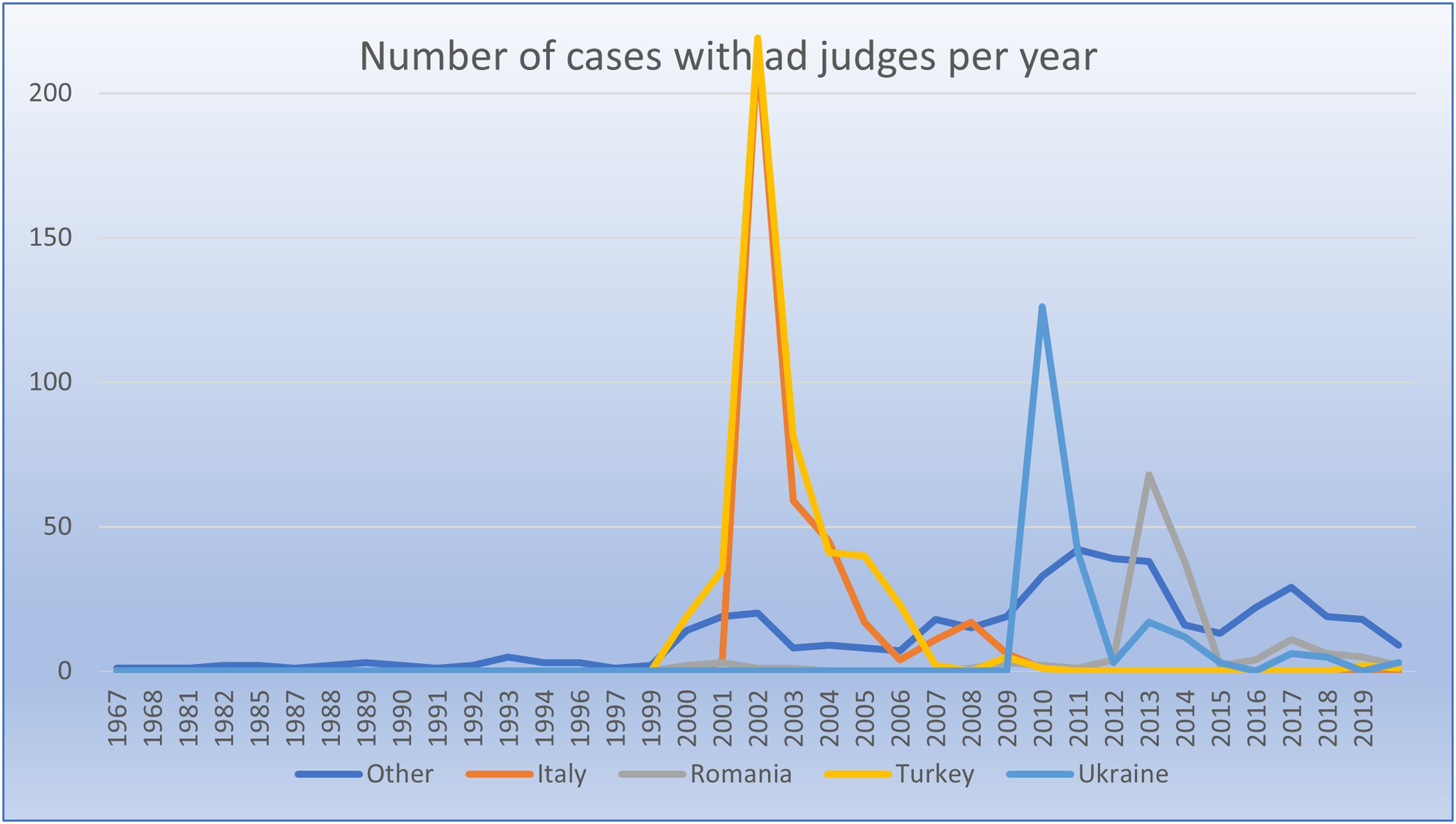
Number of cases per year for the four countries that are responsible for most cases with ad hoc judges.
Second, just eight judges have issued more than 50 ad hoc judgments in the history of the Court (together responsible for 70% of the cases in which an ad hoc judge was appointed): Gölcüklü (459 cases on behalf of Turkey), Raimondi (62; Italy), Del Tufo (163; Italy), Bravo (148; Italy), Shevchuk (84; Ukraine), Panova (60; Bulgaria), Buromenskiy (109; Ukraine) and Pardalos (79; Romania) (Figure 2).
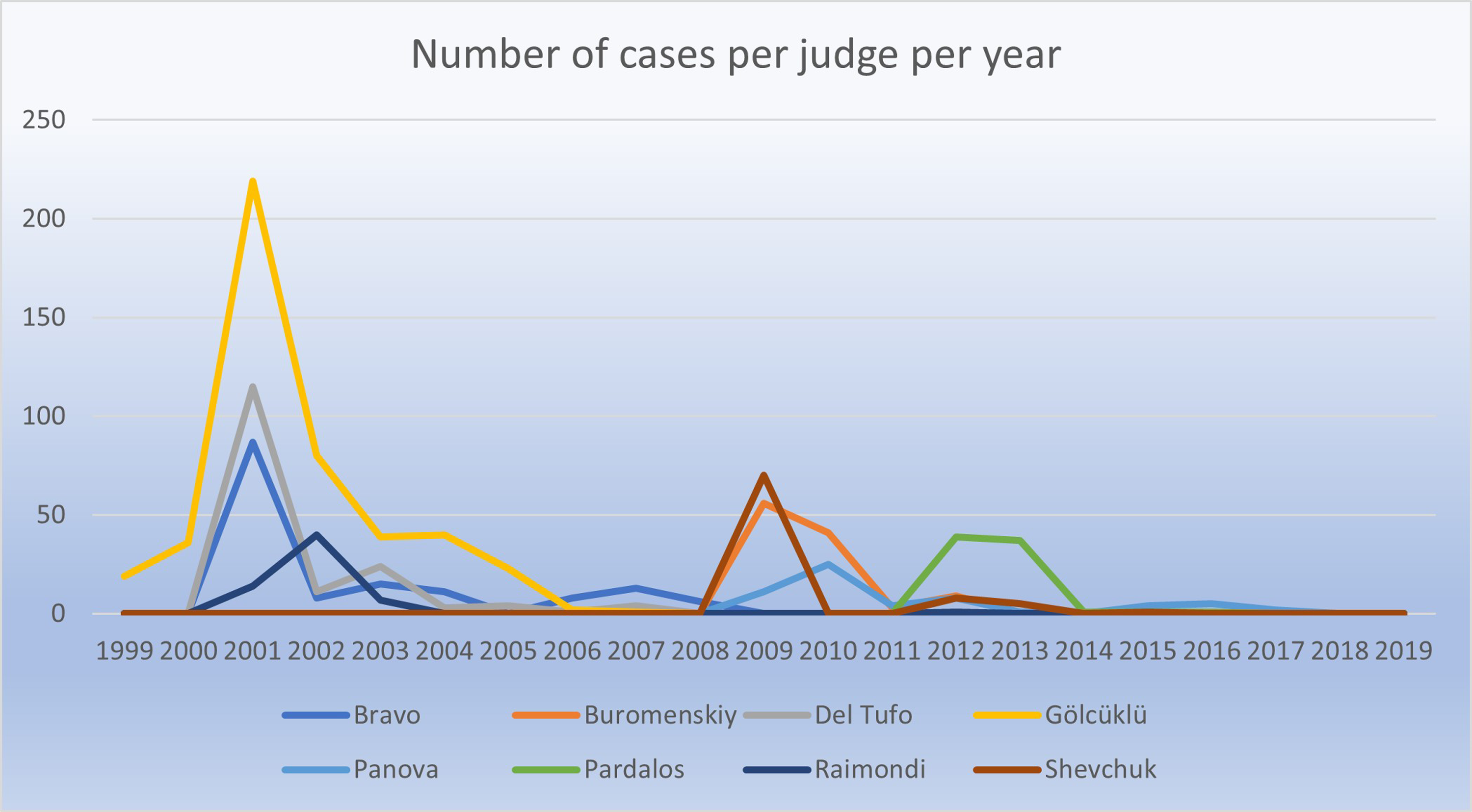
Number of cases per year for the eight judges that have issued most ad hoc judgements.
Third, although the number of cases with an ad hoc judge was high in the beginning of this millennium, the numbers have dropped steadily. Although in absolute numbers they have not been so low as the early years of the Convention, this should not come as a surprise, as the total amount of cases has grown exponentially as well. The relative number of cases in which an ad hoc judge is appointed has normalized and is now back to the percentage of cases that was prevalent in the first 50 years of the Convention. The argument that this is a result of the changes made to the Convention and the Rules of the Court seems unlikely, because the substantial changes came into effect only in 2010, while already in 2005 and 2006, the number of cases in which an ad hoc judge had been appointed dropped to 34 and 31 respectfully. In addition, in 2012, there was a spike in cases with an ad hoc judge again (Figure 3).
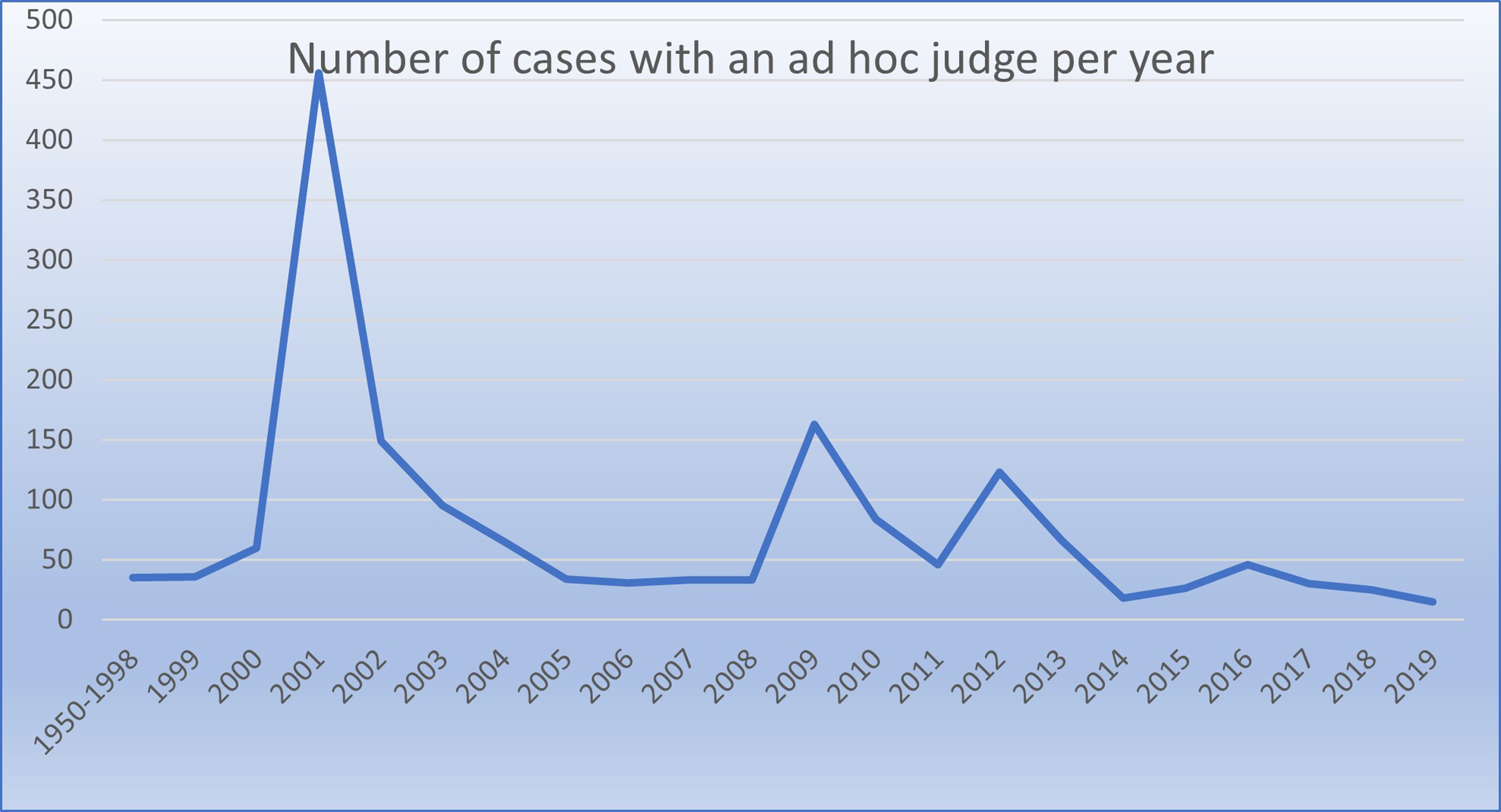
Number of cases with an ad hoc judge per year.
Consequently, the data do not support the belief that the possibility to appoint an ad hoc judge is widely abused; rather, there are four countries that have often appointed an ad hoc judge, for very specific reasons such as illustrated below. 40 It is also important to point out that the fact that four countries are primarily responsible for appointing ad hoc judges and that but eight ad hoc judges are responsible for more than two thirds of the judgments in which an ad hoc judge sat on the Court, means that part of the fears over countries selecting the ‘right’ ad hoc judge per case are not supported by the data. Rather, countries seem to select experienced judges that have either served on the ECtHR previously, have served at the national supreme court or have had a similar position. Also, this means that the dependency of ad hoc judges for, for example, financial reasons, on governments to appoint them again as ad hoc judge is unlikely. Most ad hoc judges had a prolific career before joining the ECtHR as ad hoc judge and do not seem to be dependent on their ad hoc positions on the Court for making ends meet. Also, some ad hoc judges, as will explained below, had already served on the ECtHR or were retired, meaning that there was no prospect of becoming a ‘normal’ national judge at the ECtHR in any case. It could be argued that these eight judges were appointed to so many cases because they voted favourably towards their governments, but, as will be explained below, such is not supported by the data.
Fourth, the spike in the number of cases in which an ad hoc judge was appointed in the beginning of this millennium was not a general sign of abuse of the possibility for states to appoint biased judges in politically sensitive cases, but had to do with a very specific situation in Turkey and Italy simultaneously. For example, when a large number of cases arose that were highly politically sensitive, having to do with Turkish aggression towards minorities, it was deemed appropriate for the sitting Turkish judge to excuse himself, as he was named in documents playing a role in those cases. The Court wanted to avoid any shred of doubt with regard to its impartiality. That is why, judge Gölcüklü was asked to join in those cases as ad hoc judge. He was asked, because he had already served as judge elect for Turkey on the ECtHR from 1978–1998 and was highly respected for the role he played during those years. This also held true for his functioning as quasi-permanent ad hoc judge in the beginning of this millennium. Luzius Wildhaber, the president of the ECtHR at that time, was so positive about this solution that in an interview in 2003, he argued in favour of countries appointing a permanent ad hoc judge. 41 This is important for a number of reasons. First, it was not the Turkish government that took the initiative to appoint judge Gölcüklü, but the Court. Second, judge Gölcüklü has highly respected for his competence and impartiality and certainly does not fit the bleak picture of ad hoc judges painted in academic literature. Third, although judge Gölcüklü is perhaps the only judge with respect to whom the data show some reason for concern, his role as ad hoc judge was appreciated so much that the president of the Court wanted to appoint more (quasi) permanent ad hoc judges
Fifth, the belief that ad hoc judges are political instruments in the hands of governments is also not supported by the data concerning their voting behaviour. Rather, ad hoc judges have voted unfavourably towards their own government more often than favourably and, as will be discussed in more detail when dealing with the sixth relevant point, ad hoc judges tend to vote with the unanimous court. 42 Below the presentation of the voting behaviour of the ad hoc judges, counting each point separately.
The graphs show whether the Court (unanimously or by majority) has voted against the government (blue) or in favour (orange) and what the position of the ad hoc judge was (either with the unanimous court, with the majority, with the majority providing the swing vote, with the minority or being the minority). It becomes clear that the ad hoc judges have voted unfavourably more often than favourably towards their government. Still, one caveat applies. It might be so that paradoxically, voting for a violation of one particular right could be less harmful to a state (reputation, legitimacy) and could end as a favourable decision at the end of the day if it means avoiding finding a violation on another point. This is a possibility that this study cannot verify nor falsify (Figures 4–11).
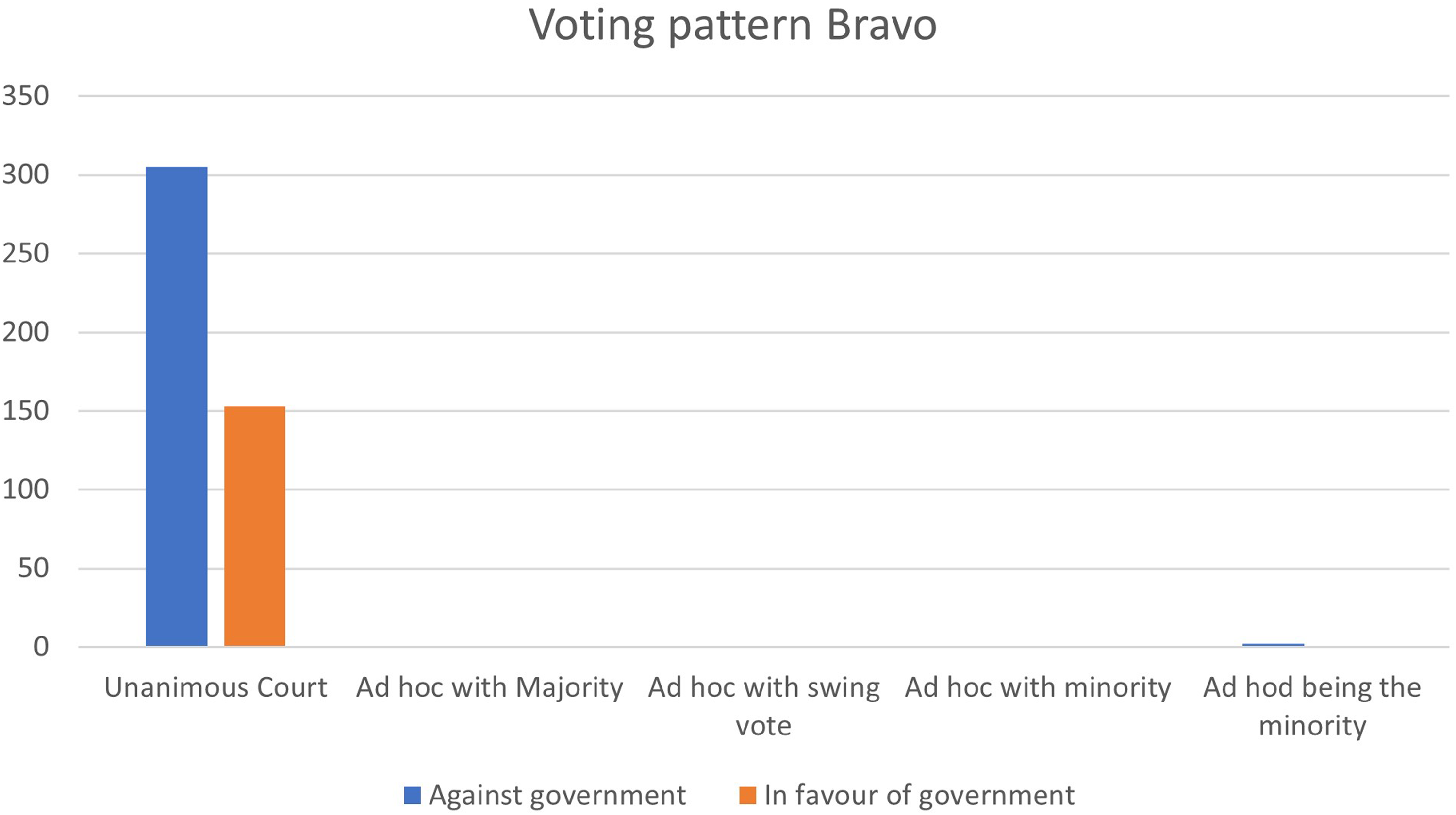
Voting pattern Bravo.
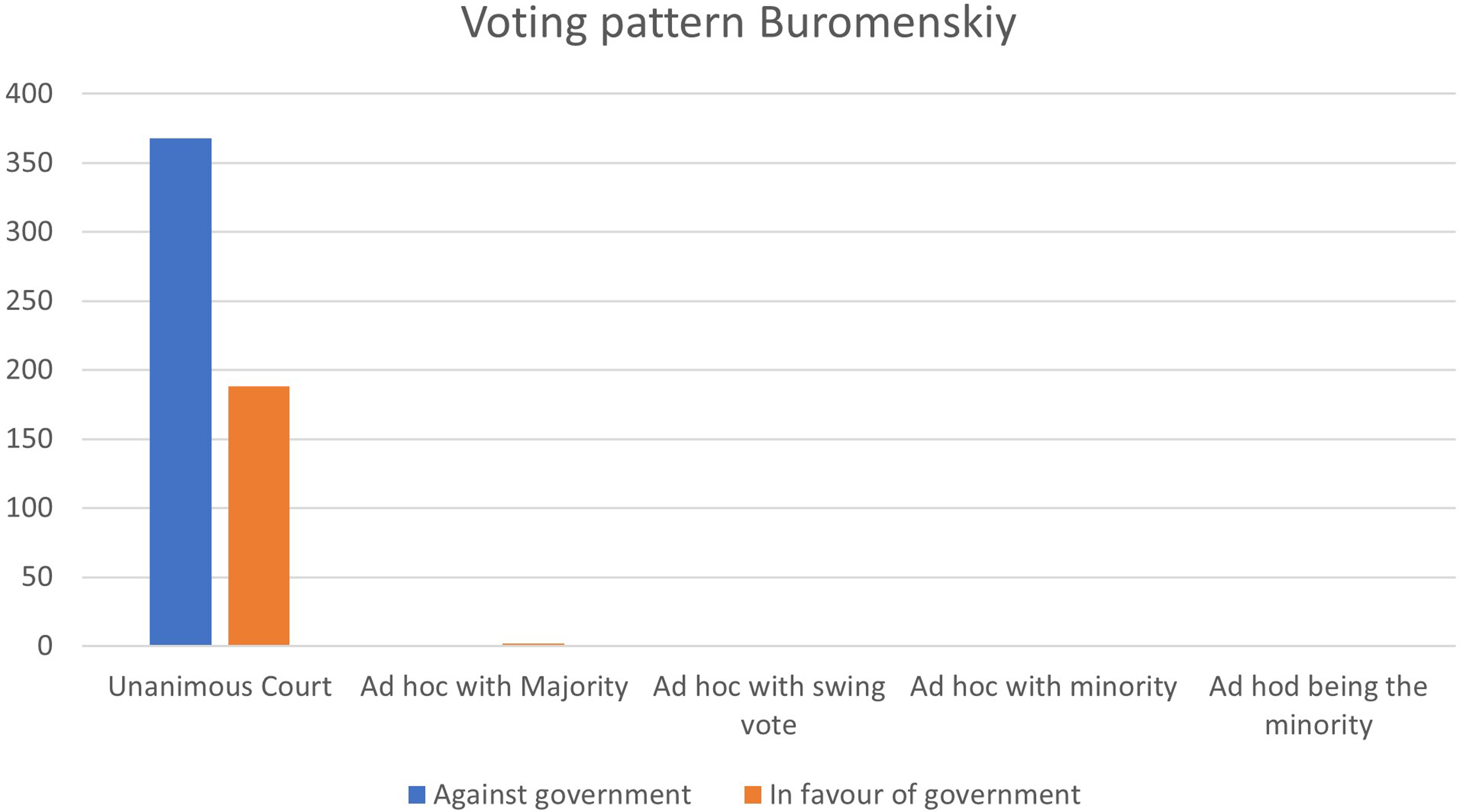
Voting pattern Buromenskiy.
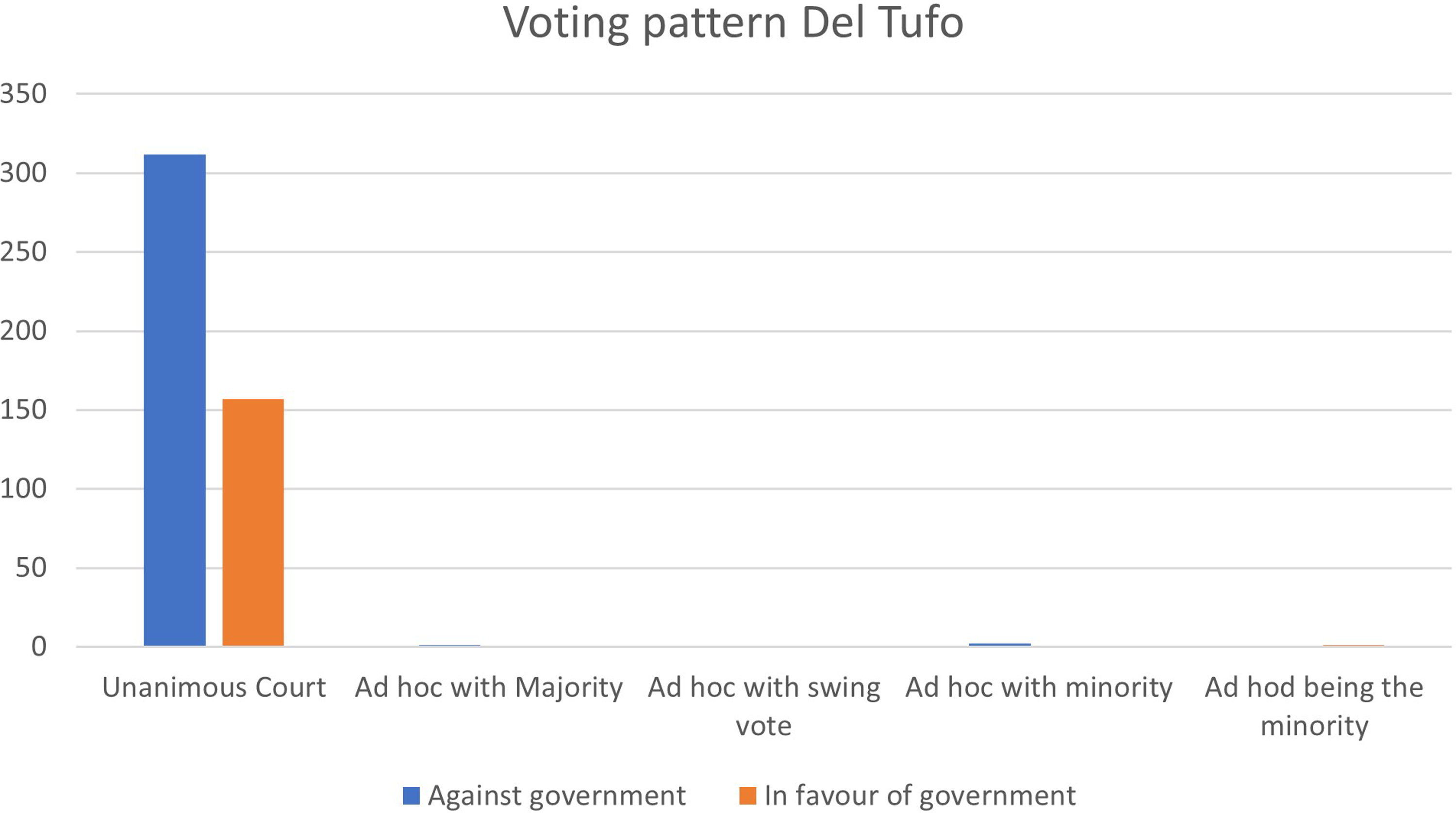
Voting pattern Del Tufo.
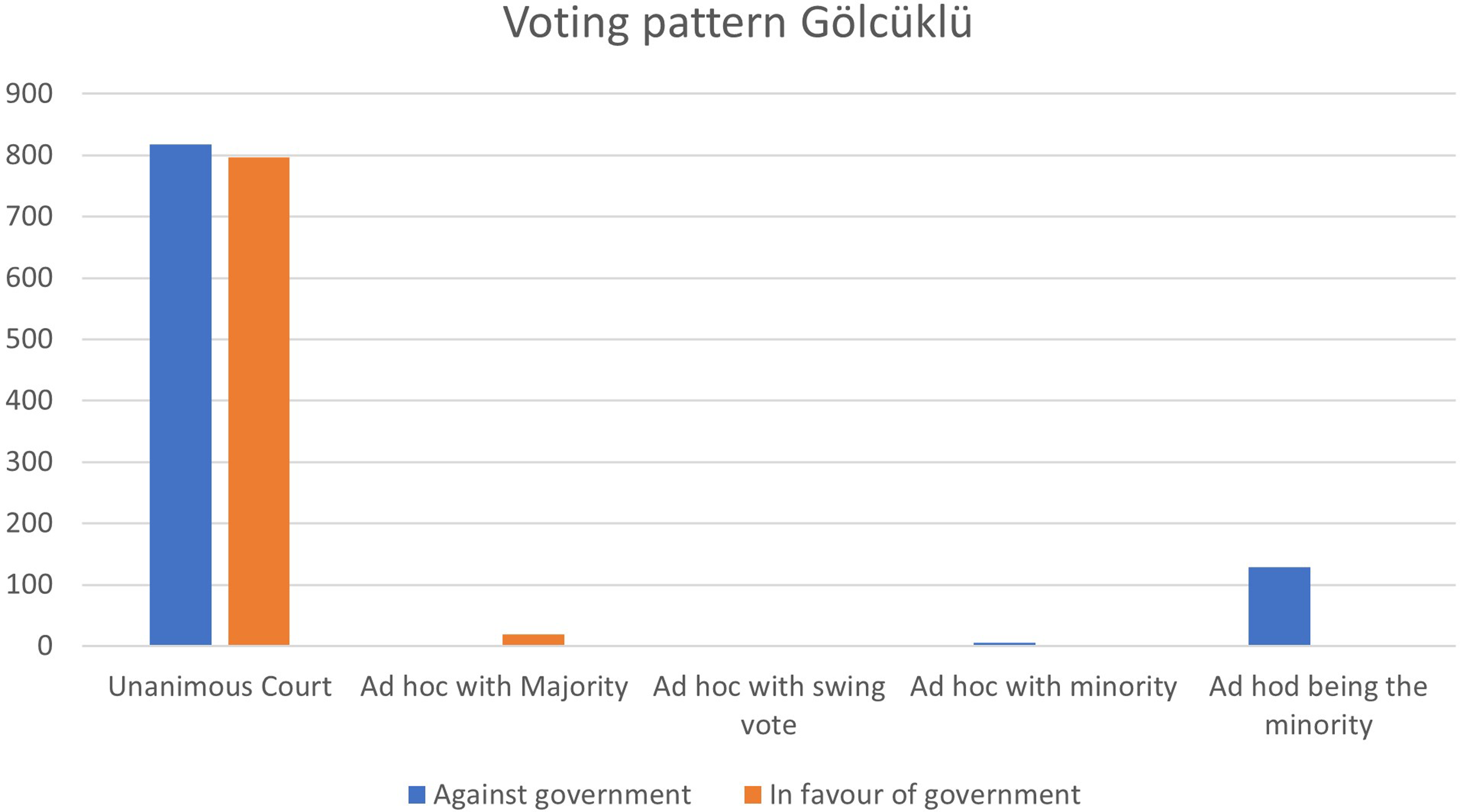
Voting pattern Gölcüklü.
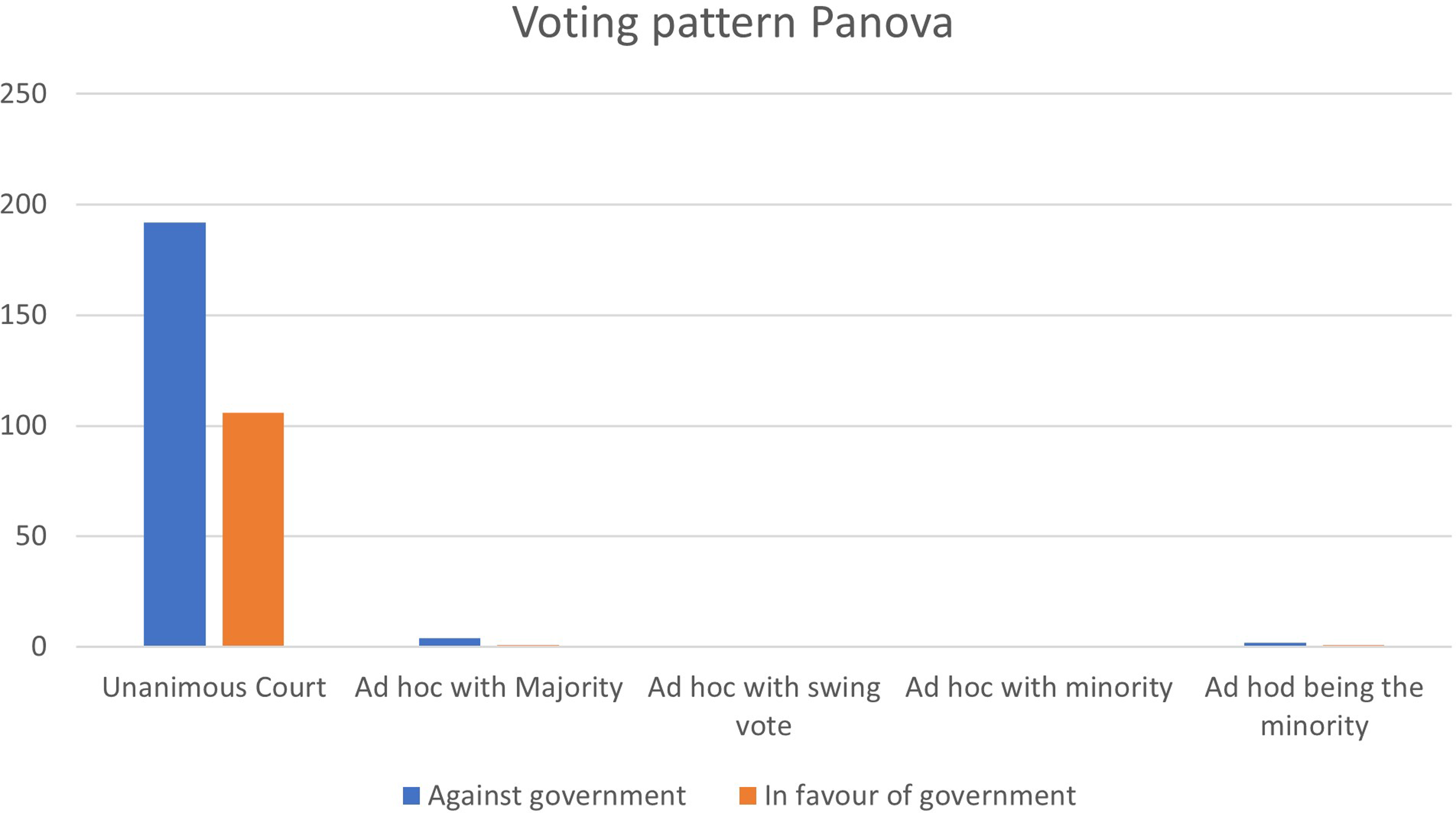
Voting pattern Panova.
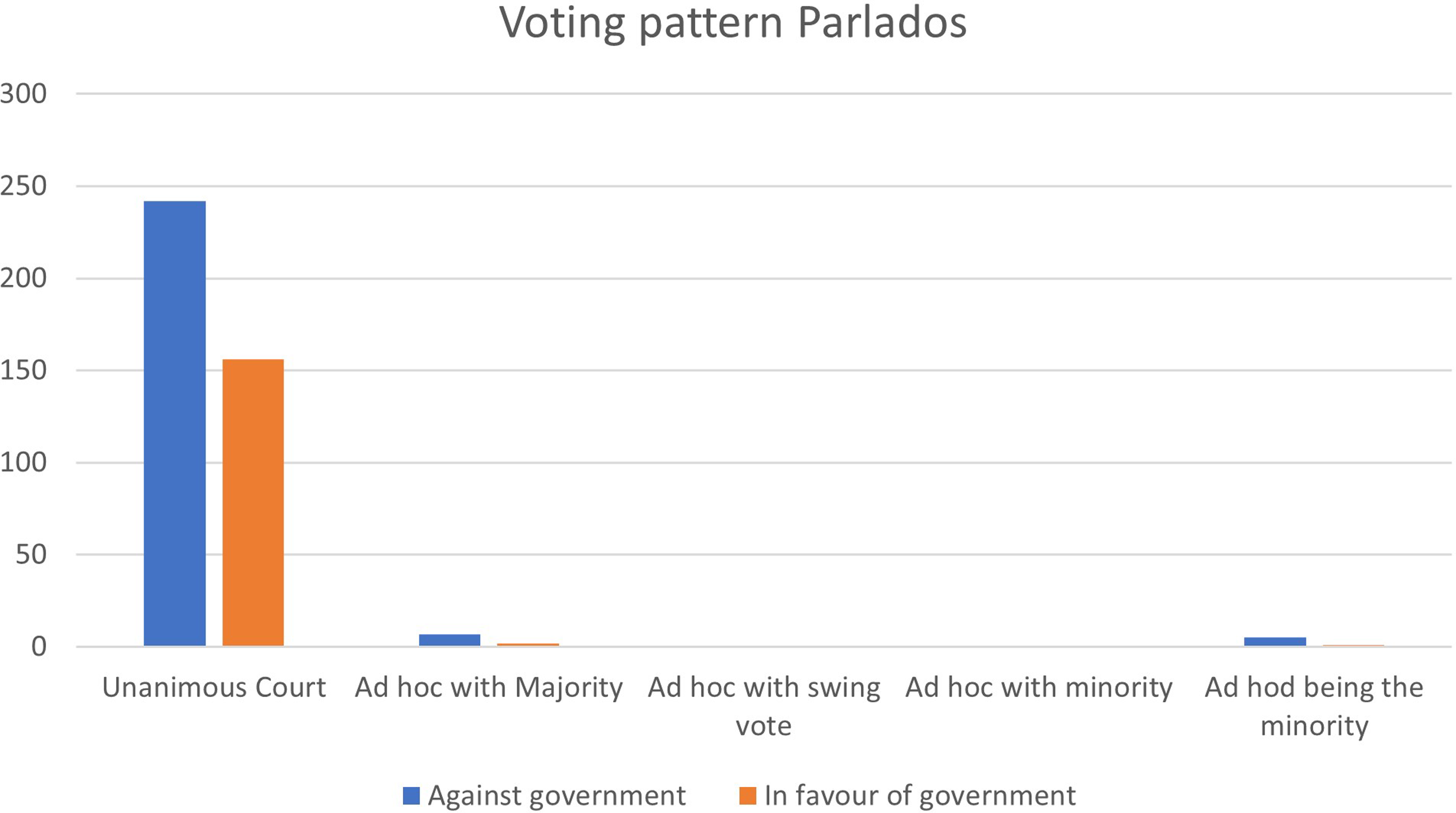
Voting pattern Parlados.
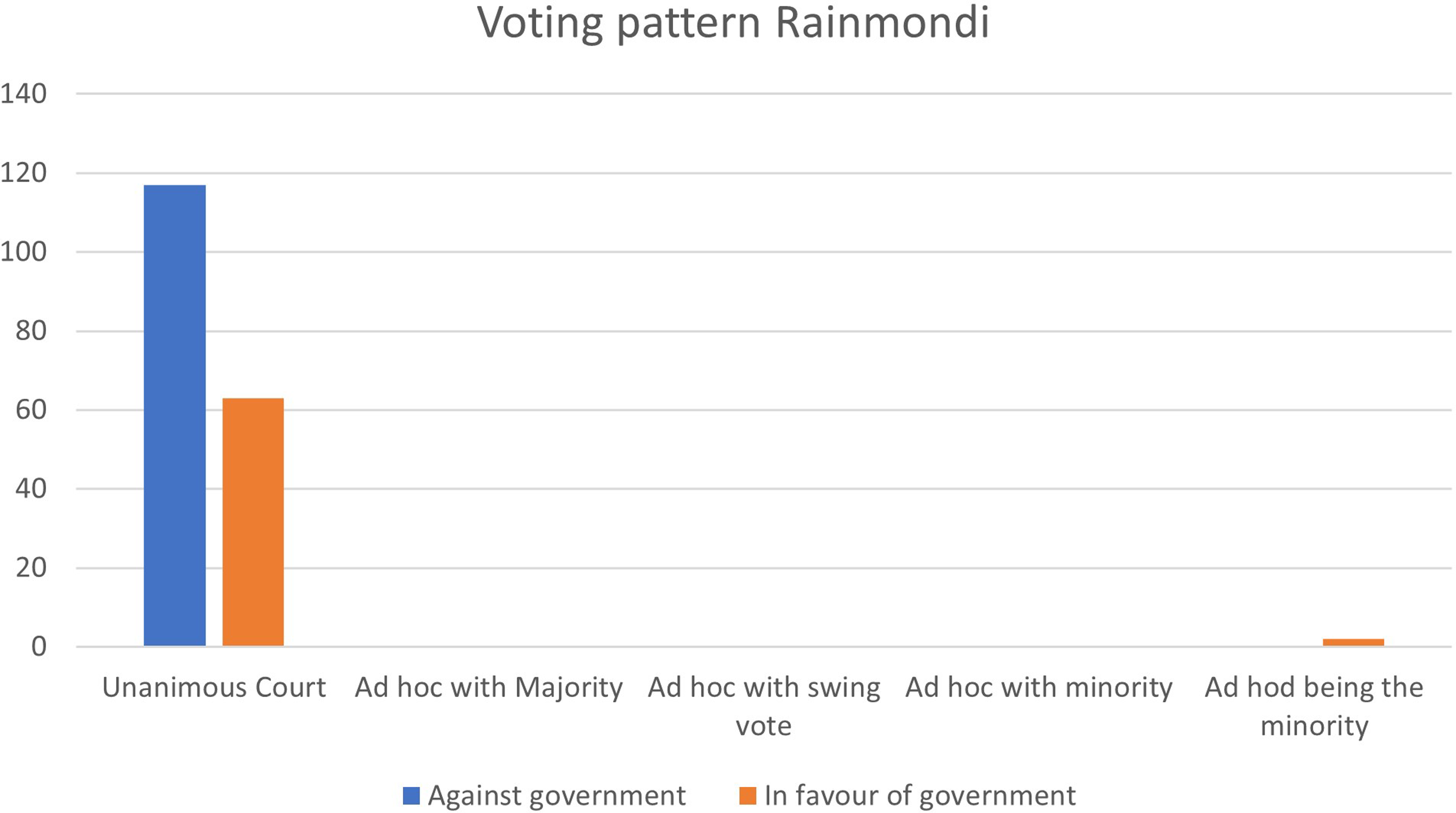
Voting Pattern Raimondi.
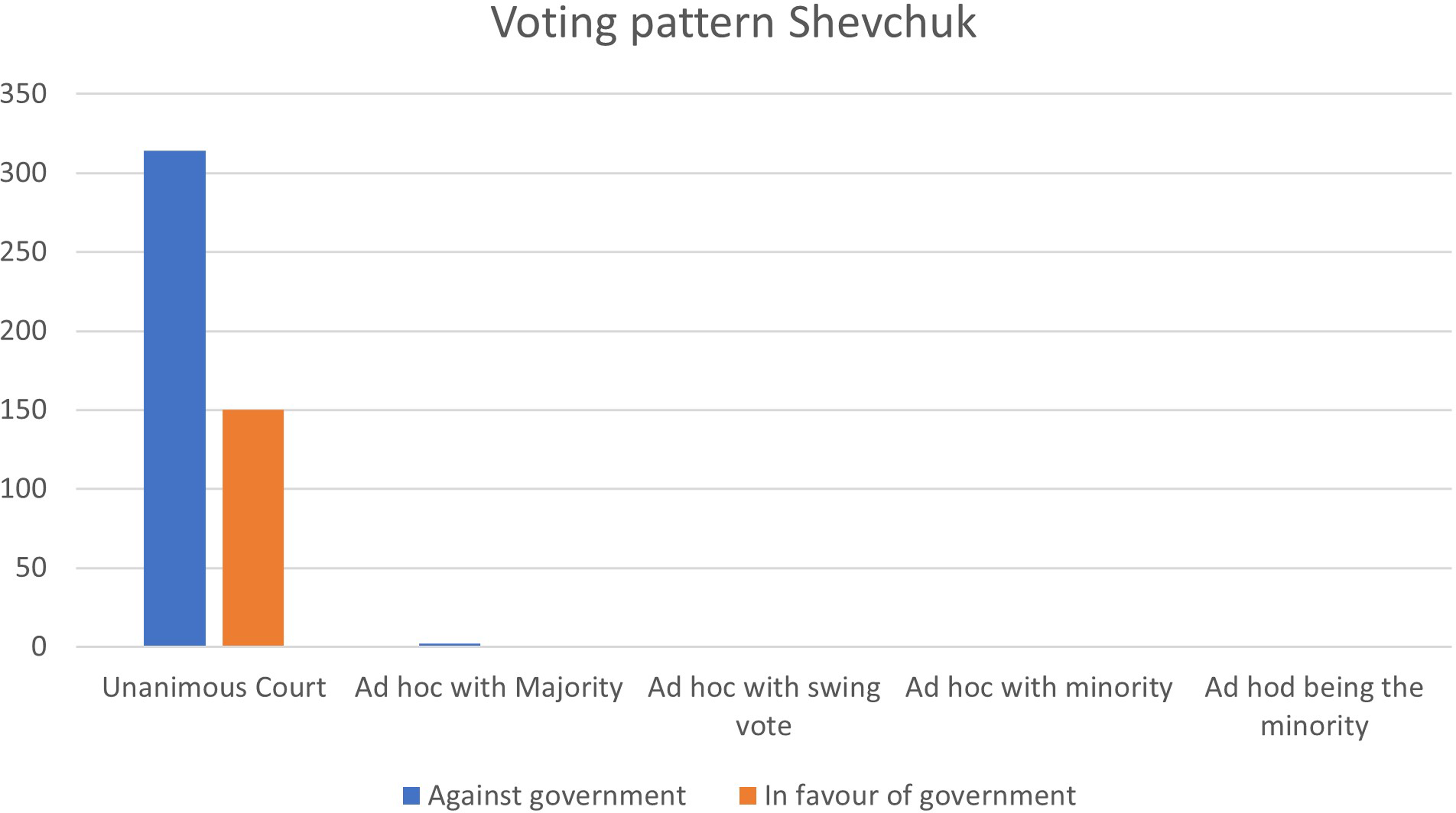
Voting Pattern Shevchuk.
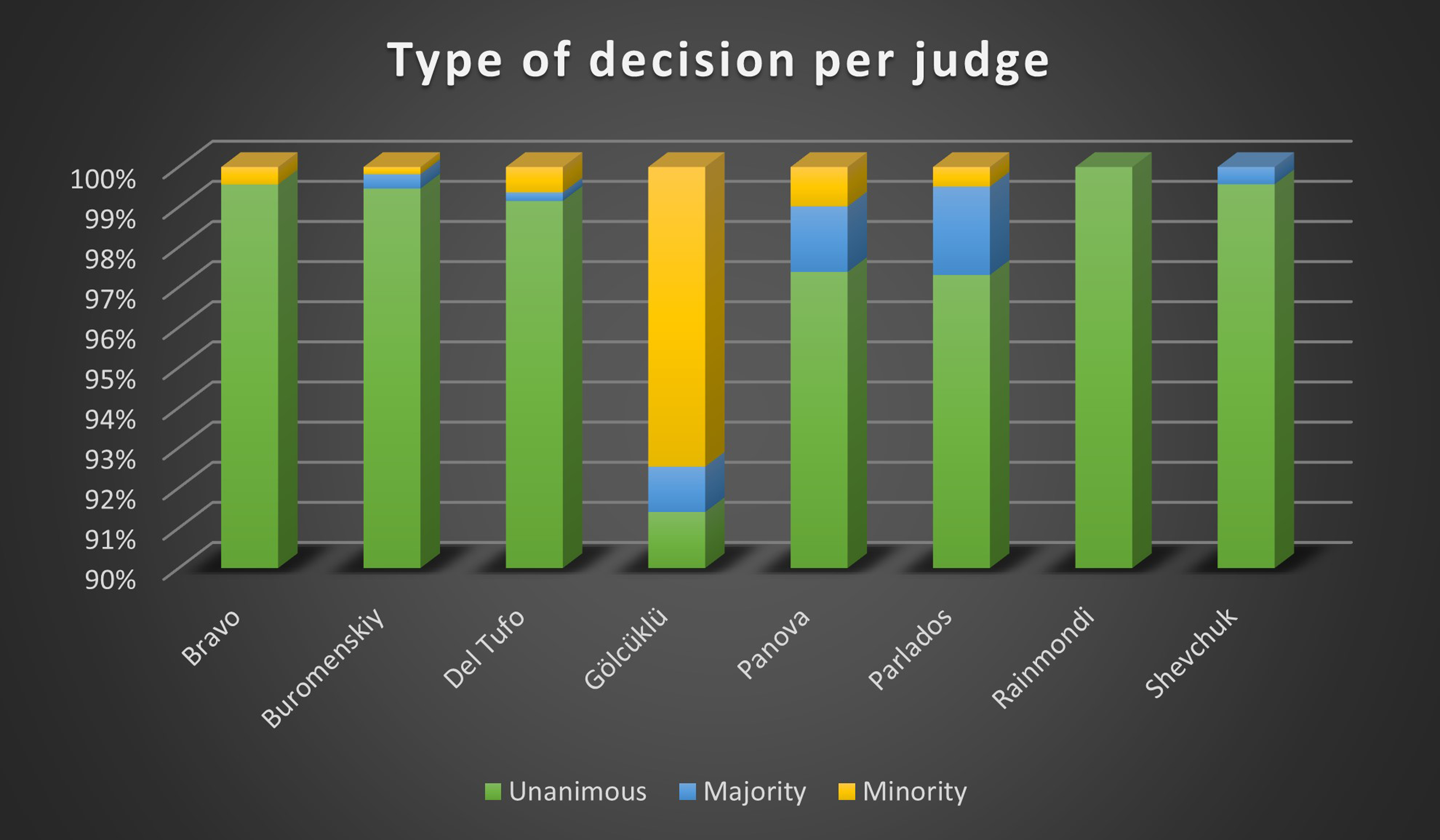
Voting pattern for the eight judges that have issued most ad hoc judgements.
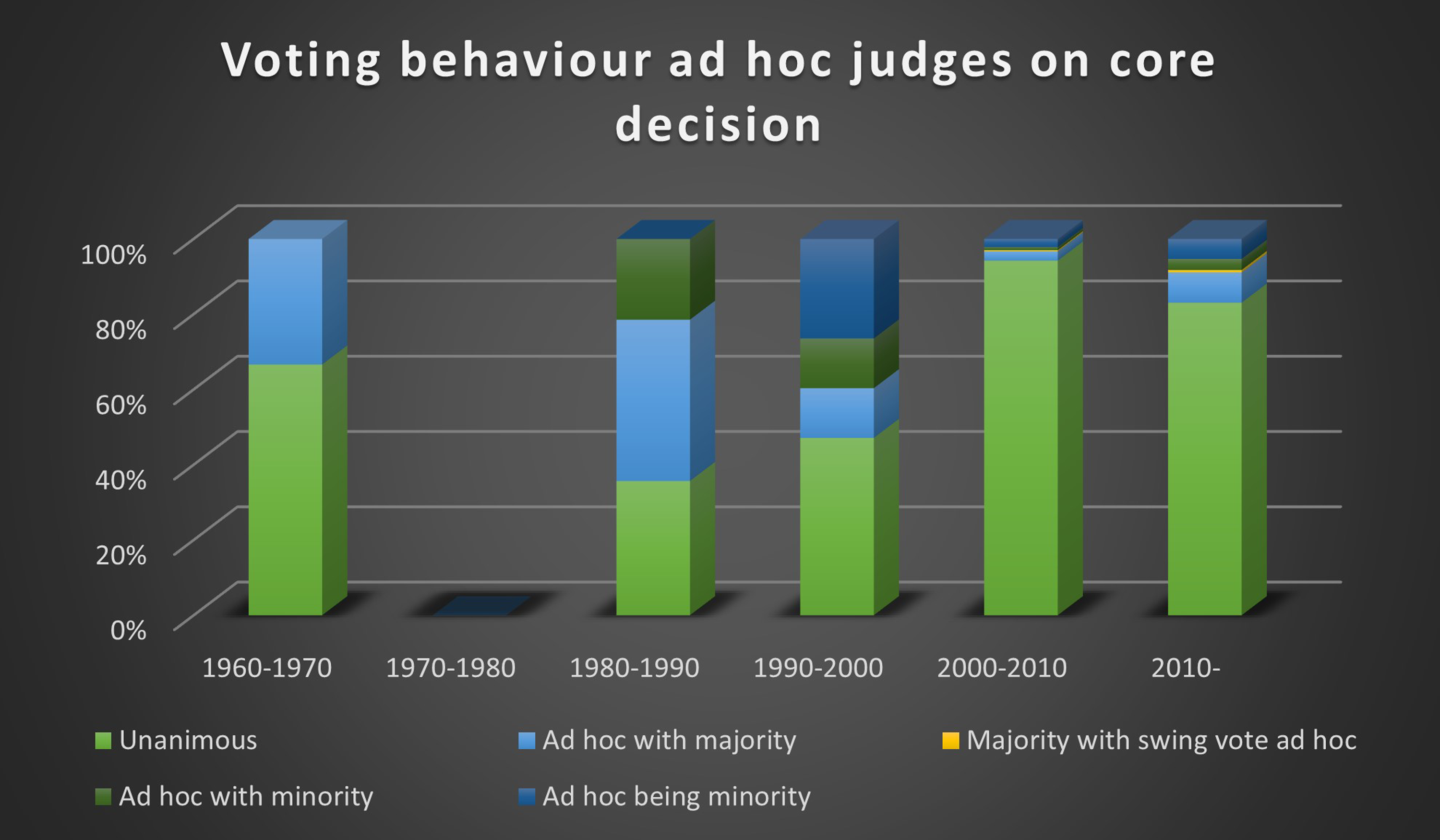
Voting pattern on core point all ad hoc judges per decade.
Sixth, and perhaps more importantly, when voting either in favour or against their government, in by far most points do the ad hoc judges join the unanimous Court. Thus, in general, ad hoc judges do not operate as eccentric soloists, defending their country against all odds, as was the case for Cyprus v. Turkey. With respect to all eight ad hoc judges, the percentage of points that are taken unanimously is above 90%, and except for judge Gölcüklü, in more than 98% of the points, the ad hoc judge voted with the majority. The graphic below shows the percentage of points in which the ad hoc judge voted with the unanimous court, with the majority or with the minority (sometimes being the minority) (Figure 12).
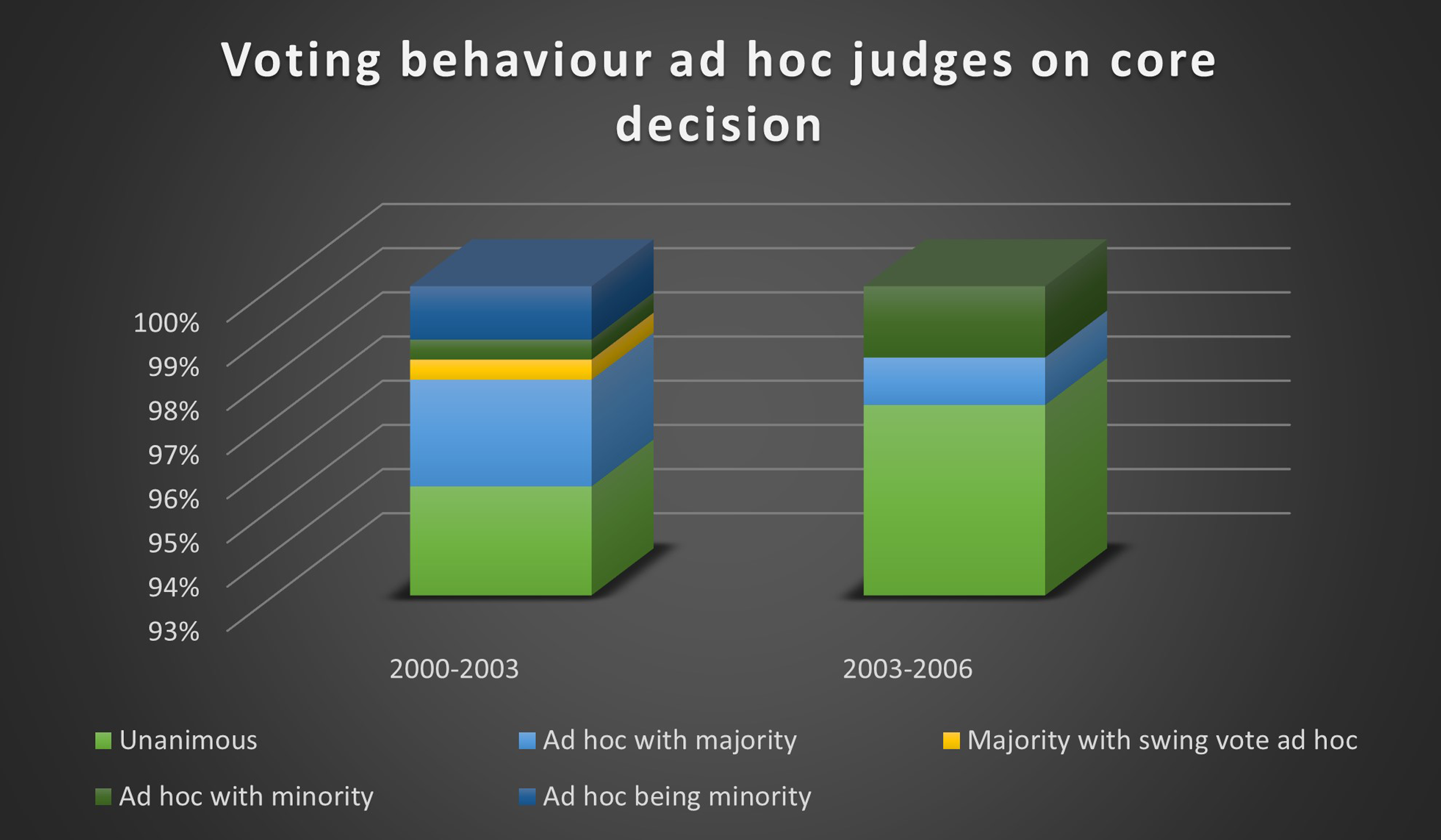
Voting pattern on core point all ad hoc judges between 2000-2003 and 2003-2006.
Seventh, although Gölcüklü did vote against the majority's decision relatively often, of the 459 judgments in which he served as ad hoc judge, only in 57 did he vote with the minority on one or more points. Of those 57 judgments, in no less then 42 did he vote with the majority or unanimous Court, finding a violation of the Convention rights (articles 1–18) on at least one other point as well. For example, he would vote in favour of finding a violation of Article 2 or Article 3, but would not find a violation of Article 13, while the majority did. 43 Consequently, judge Gölcüklü was by no means an apologist for his country; while the majority often found a violation on all or almost all points raised against Turkey in cases in which Turkish atrocities against minority groups were scrutinized, he would often vote with the unanimous Court on finding a violation on the most central and essential aspects of the case, for example a violation of the right to life or the right not to be subjected to torture or inhuman and degrading treatment, but would be milder when it came to peripheral aspects of the cases, such as whether the right to petition of claimants had also been violated.
Eighth, it can be problematic when the ad hoc judge has the ‘swing vote’ on a matter, in particular when he/she tilts the balance favour of his or her government. ‘A former judge of that court similarly indicated that ad hoc judges suffer from the suspicion of bias since they are appointed when the facts of the case are already known. In a chamber of seven judges, he reported that having the deciding vote come from an ad hoc judge would create enormous tension.’ 44 However, selecting those points in which the ad hoc judges voted with the majority in a non-unanimous court decision produced only ten cases in which the ad hoc judge had the decisive vote. 45 This is a marginal number only. 46
Ninth, ad hoc judges are marginally biased toward voting in favour of their government. When ad hoc judges vote with the (non-unanimous) majority, about two-third of the points are decided in favour of the government and only one third unfavourable. When ad hoc judges vote with the minority, almost without exception, this concerns matters in which the majority decides unfavourable towards their government. From the minority opinions by the eight selected ad hoc judges, almost 150 points concerned majority decisions that were unfavourable toward the government and less than 10 that were favourable toward the government.
Still, two caveats apply. First, this study cannot assess whether this ratio is bigger than that of elected national judges. The problem of bias might not be related to the position of ad hoc judges, but to the position of the national judge (elected or ad hoc) in general. Second, the reason behind the bias of ad hoc judges cannot be verified by this study. Though commentators and academics are quick to explain the bias by referencing a lack of competence, independence and/or neutrality, they do so without proof that these are the causes of the marginal bias. Perhaps ad hoc judges, because of their knowledge of the national legal system and the fact that they are appointed to judge a selected number of similar cases against one country are the best informed of all judges and are thus more nuanced. Perhaps ad hoc judges, not fully absorbed by the prevailing approach by the ECtHR, adopt a more diversified approach, while elected judges tilt more towards taking a unified approach to all different points of a case. There are multiple potential explanations for the marginal bias in the voting behaviour of ad hoc judges. Which one(s) are truly causal requires a separate research project.
Tenth and finally, when contemplating further revisions to the Convention mechanism to tackle these points, it is important to briefly reflect on the effects of the previous revisions. The perception that there were problems with how ad hoc judges functioned arose in particular in the late 1990s and the early 2000s. In response, several revisions were made to the Rules of the Court and the Convention mechanism. Except for one important revision to the Rules of the Court, most of these revisions entered into force after 2010. That is why it is relevant if any important changes in the voting behaviour of ad hoc judges can be discovered. Such is not apparent from the data. If anything, though the margins are below statistical significance, the data show a slightly more unfavourable picture after 2010. From the decision on the core point of the case, between 2000–2010, 93.9% of the time the ad hoc judge (not limited to the eight most prolific ad hoc judges) was part of the unanimous court, in 2.5% she voted with the majority, in 0.3%, she provided the swing vote, in 2.1% of the cases she joined the minority and in 2.1% she voted alone, contra the otherwise unanimous Court. 47 After 2010, these figures were 83.3%, 7.9%, 0.6%, 2.9% and 5.2% respectively. Thus, the percentage in which the ad hoc judge joined the minority vote actually increased and both the percentage of cases in which the ad hoc judge was the only dissenting voice in the otherwise unanimous Court and the percentage in which she provided the swing vote doubled (Figure 13).
There is a sharp difference between the voting behaviour of ad hoc judges in the 1990–2000 segment and the 2000–2010 segment. There are multiple potential explanations for these differences. First, it could be argued that this is the effect of the changes made to the Rules of the Court in October 2002. This would have to mean that there would be a difference in the voting behaviour of judges before and after 2003. But such is not supported by the data. It is true that in the period of 2000–2003, ad hoc judges provided the swing vote in 0.5% of the cases, while no swing vote was counted after 20210. However, on all other points, the picture is different. In the period before the changes to the Rules of the Court were made, the ad hoc judge joined the unanimous court in 95% of the cases on the main point, while in the years after the changes this dropped to 93.3%; in the years before the changes, the ad hoc judge joined the majority in a divided court on the main point in 2.4% of the cases, while this dropped to 1% of the cases in the years after the changes took effect. In 0.5% of the cases in the period 2000–2003 did the ad hoc judge join the minority on the main point and in 1.2% of the cases was she the only dissenting voice in the otherwise unanimous court, while these percentages increased to 1.5% and 4.1% in the period 2003–2006. As an alternative explanation, it could be argued that the attention paid to the voting behaviour of ad hoc judges itself increased awareness among the ad hoc judges as to the sensitivity of their voting behaviour and/or among countries appointing ad hoc judges. Such potential causal relationship cannot be verified through data analysis. However, if this were so, a legitimate question would be whether making changes to the legal system is the best approach to achieve such awareness, or that other approaches, such as awareness programs and trainings for ad hoc judges, would have sufficed or even have a bigger effect. As a final explanation, and certainly not the most unlikely one, there is no causal relationship between either the changes to the legal system and the attention to the voting behaviour of the ad hoc judges and the actual voting behaviour of the ad hoc judges. Rather, other factors and coincidence could provide the explanation for the change in voting behaviour of ad hoc judges between 1990–2000 and 2000–2010 (Figure 14).
This article showed that although playing no role of significance for decades, by the year 2000, ad hoc judges were deployed in a high number of (politically sensitive) cases. Because ad hoc judges are not subject to the normal level of scrutiny and their voting pattern seemed biased towards their government, their impartiality has been questioned. Academic literature has been almost unanimously critical, pointing to the fact that ad hoc judges were initially assigned after a case had arisen, allowing governments to select the ‘right’ candidate for the ‘right’ case, and that ad hoc judges can be dependent on their national country, both financially and because they may be a candidate for becoming the titular national judge.
Citing these and other reasons, section 3 explained which changes have been made to both the European Convention on Human Rights and the Rules of the Court, among others requiring countries to submit a list of ad hoc judges in advance and allowing the president of the Court to select the ‘right’ ad hoc judge from that list for a particular case. Although these changes are generally believed to have remedied some of the problems that were in place, many believe the system is still plagued by many of the imperfections that existed previously. Consequently, both the Parliamentary Assembly, academics and even former judges of the European Court of Human Rights have called for even more stringent rules and regulations.
Section 4 explained the methodology and basic outline of the statistical research performed for this study and provided the basic facts and figures. Section 5 offered and interpretation and analysis of these data. Although the results do not point one-sidedly in one or another direction, it is clear that ad hoc judges are in fact far less biased and apologetic towards their government than often believed. This concerns the data of both the ad hoc judges that sat on the Court before the revisions to the European Convention on Human Rights and the Rules of the Court have been introduced and after those revisions took effect. Even judge Gölcüklü, who is seen by many as the catalyst for the various changes to the Convention mechanism and the reason why academics, practitioners and judges have called alarm, is in fact very critical towards the Turkish government in the cases in which he sat on the ECtHR.
The statistical analysis produced for this study mainly indicates that ad hoc judges have not functioned in a problematic or worrying manner. Among others, the following results were found:
The number of cases in which an ad hoc judge is appointed has normalized, with on average fewer than 50 such cases for the last 10 years. The percentage of cases in which an ad hoc judge was appointed is equal to that of the first 50 years of the Convention. If there was any abuse of the privilege to appoint an ad hoc judge, it is clear that the vast majority of countries have not resorted to that possibility, only four countries being responsible for almost three quarters of the cases in which an ad hoc judge was appointed. The majority of the code points decided on by the Court on which an ad hoc judge took seat were in fact unfavourable towards the government. With respect to the decisions on specific points taken by the eight ad hoc judges central to this study, the percentage of decisions that are taken unanimously is above 90%, and, except for judge Gölcüklü, in more than 98% of the points, the ad hoc judge voted with the majority. Even if judge Gölcüklü did vote against the majority's decision relatively often, of the 459 judgments in which he served as ad hoc judge, only in 57 did he vote with the minority on one or more points. Of those, in no less then 42 did he vote with the majority or unanimous Court, finding a violation of the Convention rights (articles 1–18), on at least one other point as well. There is a small bias in the ad hoc judges’ voting behaviour towards favouring their government. However, two points require further analysis. First, whether this bias is bigger than the bias of elected national judges and second, what the reason is for the bias. In the almost 70 years that ad hoc judges have voted on judgments, only in about 10 cases did they have the ‘swing vote’ towards exonerating their government. Although ad hoc judges had the swing vote, a negligible number of cases, all of the cases in which they did have the swing vote, they voted in favour of their government. The tone of some of the dissenting opinions by ad hoc judges can be deemed problematic and inappropriate, with sometimes harsh attack on the majority, which might discredit the Court and harm its position. Ad hoc judges have, inter alia, qualified majority decisions ‘unjustified’, stressed that the reasoning ‘does not suffice’ and that the majority's opinion should ‘have been better supported both factually and legally’;
48
ad hoc judges have put forward that ‘the Court – ignoring its settled case-law – has not only undertaken speculative “actuarial calculations” but has moreover considered it just and reasonable to award the applicant an unprecedented and more than excessive’;
49
and have stressed that the choice of the majority is ‘quite irreconcilable with the principles previously laid down unanimously by the Commission and the Court’ in similar cases and that the court uses ‘artificial and superficial arguments, assertions unsupported by fact, a sort of trompe-l’œil’.
50
Taking into account that these are judges proposed by the country against which the case is brought, that they are appointed ad hoc, so that they have not been subjected to the normal test of scrutiny, and that every one of these statements were issued in dissenting opinions by the ad hoc judge in the voting ratio of 6 or even 16 against 1, it seems that the appropriate tone might have been a bit more coy. When ad hoc judges vote with the (non-unanimous) majority, about two-third of the decisions are in favour of the government and only one third unfavourable. When ad hoc judges vote with the minority, almost without exception, this concerns matters in which the majority decides unfavourable towards their government, with only about 6% of their minority opinions dissenting from a majority that voted favourable towards their government. The data analysed regarding the voting pattern by the eight selected ad hoc judges, most minority opinions were in fact positions in which the ad hoc judge stood alone, indicating their eccentric and soloist position on the Court.
Still, the picture is not one-sided. There are several points that show a bias of ad hoc judges. The most important points found by this study to this end are:
In conclusion, the need for the further revisions suggested by judges of the Court and by the Parliamentary Assembly to restrict and scrutinize the position of ad hoc judges to an even greater extent is not unambiguously supported by the data produced for this study. Before suggesting further changes, at least two points should be analysed in further detail: first, whether the bias of ad hoc judges is bigger than that of elected national judges and second, what is the most likely explanation of the bias in the voting pattern by ad hoc judges. This is even more important because some of the proposals for further revisions to the Convention mechanism may also have pitfalls of their own. For example, the whole idea to have national judges sit ex officio on cases and if she cannot sit on a case, to ensure that an ad hoc national judge can take up her role, is to ensure that someone sits on the Court with direct knowledge of the legal system, culture and language relevant to the case. A proposal such as suggested by judge Luis López Guerra to simply appoint non-national ad hoc judges, would deprive the Court from a person with such knowledge.
Alternatives to such more rigorous proposals could also be thought of. Some indicative and non-exhaustive solutions are provided below, as well as questions that should be answered before introducing them.
First, a rule could be introduced which disallows judges that vote against the otherwise unanimous (for example in a ratio of 16 against 1 or 6 against 1) Court to write a dissenting opinion. However, before introducing such a rule, several points should be considered. A first question that arises with respect to such a rule is whether it should be applied to ad hoc judges only, or also to elected national judges or even judges in general. 51 Second, when an ad hoc judge is prevented from writing a dissenting opinion, this might only add to the possibility for the judge to adopt a ‘victim-role’. Third, writing dissenting opinions adds to the legitimacy of the ECtHR, because various views and approaches to complex legal questions are represented and the internal dialogue and debate between judges with contrasting views. Such views, even if issued by soloist ad hoc judges, might have valuable insights, or show potential alternative legal argumentation. Such would be omitted from the Court's ruling when a rule disallowing soloist (ad hoc) judges to issue a dissenting opinion would be introduced.
Second, a rule could be introduced on the period of time and/or the number of cases an ad hoc judge can sit on. A decision on this point would have to choose between Scylla and Charybdis. The advantage of quasi-permanent ad hoc judges is that they are more experienced and, especially when there would be a rule on a minimum term or number of cases an ad hoc judge would have to sit on, would both reduce her potential dependency on the government to prologue an ad hoc judge's position and underline that ad hoc judges are in principle not planned to serve as titular national judge in the coming period. The disadvantage could be that an ad hoc judge would be subjected to a lower level of scrutiny before being appointed, while they would not serve as incidental ‘ad hoc’ but might, in some cases, be issuing more judgments than some titular judges do, and that if these ad hoc judges serving a fixed term or on a fixed number of cases would be considered biased in favour of their government, the impact would be significant. This dilemma touches upon a broader question with respect to the Convention mechanism, which is beyond the scope of this article but worth touching upon briefly: why would there only be one elect national judge? The decision to only have one national judge stems from the period when the number of cases was still a fraction of the amount of case load today. Why there could not actually be two national judges elect is not directly clear. In any case, having two national judges elect would reduce drastically the need for ad hoc judges, because it would be unlikely that both would have to be excused with respect to a case.
Finally, a rule could be introduced to disallow ad hoc judges to provide a swing vote (either in general or when in favour of their government). Again, the question would be whether such a rule should apply only to ad hoc judges, or more in general to national judges. A rule could be introduced, for example, that if a national judge has the swing vote in favour of its government, two additional judges will be asked to join the chamber deciding on the matter. However, this would add to the length of the judicial procedure and, moreover, if these two new judges split votes, the national judge will have the decisive vote still. It is questionable whether the advantages of such a solution would outweigh the disadvantages, given the very low number of cases in which the ad hoc judge had the swing vote in the past, but this solution could be considered an extra safety net, ensuring that in cases where national judges have the decisive vote, additional procedural checks and balances are put in place.
