



Abstract
The UK education system is in crisis, manifesting in increasing anxiety and non-attendance among Neurodivergent children. Existing research has identified school-based factors but has neglected systemic mechanisms. Our multi-perspective qualitative study explored school anxiety through the lens of neuro-normative epistemic injustice – knowledge positioning Neurotypicality as superior and default. We conducted focus groups incorporating innovative creative methods with 31 individuals with experience of school anxiety, including Neurodivergent children (n = 8, aged 10–16), adults (n = 5), parents (n = 8) and professionals (n = 10). We utilised participatory research methods, incorporating Neurodivergent input throughout. Using reflexive thematic analysis, we found neuro-normativity central to an inaccessible, anxiety-evoking system. Inflexible structures and under-resourcing gatekeep support until crisis or diagnosis, constraining parents and educators and fostering mutual blame. This system legitimises rejection by peers and teachers, compounding distress. Navigating such harm results in illness, trauma and non-attendance. Meltdowns and shutdowns emerge but are often penalised. Where authenticity is unsafe, camouflaging has catastrophic mental health consequences. Withdrawal, therefore, becomes necessary for self-preservation. Our findings highlight the urgency of re-conceptualising school anxiety and non-attendance as rational responses to systemic harm. Meaningful change requires systemic and cultural transformation – involving policy and pedagogy – grounded in the epistemic inclusion of Neurodivergent individuals.
Lay Abstract
Many Neurodivergent children in the UK experience high levels of school-related anxiety, often leading to illness, distress and being unable to attend school. While some research has looked at school-based factors, none have explored how the wider education system contributes to this crisis. In this study, we spoke with 31 people who have direct experience of school anxiety, including Neurodivergent children and adults, parents and teachers. We used creative, participatory methods to ensure that Neurodivergent voices were central to the process. Our findings show that the education system is not designed with Neurodivergent children in mind. Instead, it often expects children to behave and learn in ways that reflect Neurotypical values. Support is difficult to access unless a child is already in crisis or has a diagnosis. Schools are under pressure and often react in rigid ways, which can lead to children being blamed or excluded for behaviours linked to their distress. Children who try to hide their difficulties to avoid being punished can become severely unwell. Withdrawal from school is, therefore, not about refusal – it is a necessary act of self-protection. This research challenges the idea that school anxiety and non-attendance are caused by individual weaknesses. Instead, it shows how the system itself creates distress. We call for urgent changes to how schools and policies understand and support Neurodivergent learners, by listening to those with lived experience and creating education systems that value different ways of being and learning.
Keywords
Introduction
The UK education system is in crisis: under-resourced, constrained and failing to meet children's needs for learning and wellbeing. Between 2015 and 2022, Special Educational Needs and Disability (SEND) first-tier tribunals – legal disputes regarding educational provision – rose by 250%, signalling increasing parental dissatisfaction (Marsh, 2023). Simultaneously, non-attendance has surged, with 1 in 15 children with an Education, Health, and Care Plan (EHCP) – a bespoke document mandating specialist support – missing half the school year (Gov.UK, 2024a). The true scale of this crisis is likely far greater (Children's Commissioner, 2024a), with similar patterns emerging internationally, including within the United States (U.S. Department of Education, 2025) and Australia (ACARA, 2024), alongside a global decline in academic performance (OECD, 2023).
An underacknowledged driver of these patterns is the rise in distress experienced within school and, thus, school anxiety – future-oriented mood states associated with anticipated negative school experiences – which hinder academic and mental health outcomes (Ambrose et al., 2021; Fisher et al., 2025; García-Fernández et al., 2008; Mullally & Connolly, 2025). Yet, support is increasingly inaccessible, leading to profound mental health deterioration (Ashworth et al., 2025; Guardian, 2025; Judiciary of England and Wales, 2024; Wollaston, 2025). Only 5% of children receive an EHCP within the legal timeframe, while over 250,000 remain on waitlists for mental health support (Children's Commissioner, 2024b; Rose, 2024).
School anxiety disproportionately affects Neurodivergent children – a minority characterised by neurocognitive characteristics (ways of processing, thinking and behaving) which diverge from dominant Neurotypical norms (Adams, Young et al., 2019; Chapman, 2021; Connolly et al., 2023; Shah et al., 2022). These profiles are often labelled through diagnoses like Autism (Doyle, 2020; Goldberg, 2023), and associated criteria are culturally shaped. For instance, while low eye contact and intrusion into personal space are pathologised within Autism diagnostic frameworks, these behaviours are interpreted differently across cultures; UK, Nigerian and Somali cultures, for example, hold competing views on their significance and appropriateness (Jaswal & Akhtar, 2019; Legault et al., 2019; Perepa, 2014). Adopting the neurodiversity paradigm, we locate the deficit within the education system, whose rigidity disproportionately excludes neurocognitive profiles which fall furthest outside its narrow framework (Connolly et al., 2023; Fisher, 2023; Nešić, 2023). Critically, SEND status is often only granted when difficulties, such as anxiety and non-attendance, become evident (Gov.UK, 2014). Our conceptual lens for this study – including how Neurodivergence is constructed – is explored in greater depth in our commentary (Fisher et al., 2025).
There is growing evidence of the school-based, or micro-system, factors which contribute to Neurodivergent children's school anxiety and distress. The entire school environment is often experienced as hostile (Fielding et al., 2025), with recurring stressors of bullying, stigma, punitive policies, teacher understanding and sensory overload (Billington et al., 2024; Costley et al., 2021; Goodall, 2018; Jones et al., 2020; Mansfield & Soni, 2024; Mullally & Connolly, 2025). The minority stress model further considers how chronic exposure to stigma, discrimination and concealment within the school setting heightens anxiety (Botha & Frost, 2018). Many Neurodivergent children camouflage to evade these stressors and subsequent anxiety – expending significant effort to conceal and adapt their Neurodivergent traits (Howe et al., 2023; Miller et al., 2021). However, this is exhausting, leading to identity crises, undetected distress and, thus, school anxiety (Crane et al., 2023; Hull et al., 2017).
As outlined in Fisher et al. (2025), existing research often examines these contributors in isolation, rather than as interconnected manifestations of a deeper macro-systemic dysfunction – such as rigid policies and institutional attitudes that fail to include diverse needs. Consequently, proposed implications or interventions risk becoming oversimplified – or even counterproductive – when implemented (Stahmer et al., 2023; Williams-Brown & Jopling, 2021). Crucially, children's experiences are shaped by teachers and parents operating within systemic constraints. Teachers report declining wellbeing from unsustainable workloads driven by high-stakes accountability, leaving little room for inclusion (Brady & Wilson, 2021; NASUWT, 2024). For example, mandatory school inspections by Ofsted place pressure on resources, student intake, and, therefore, teachers to avoid ‘failure’ (Hutchings & Kazmi, 2015; Page, 2015; Williams-Brown & Jopling, 2021). Parents too are burdened with securing support, leading to rising unemployment and distress (Blackwell, 2024; Mullally & Connolly, 2025). Without attending to this broader context, research risks reinforcing reductionist understandings of school anxiety, which overlook the structural constraints faced by diverse stakeholders.
Most concerningly, understanding school anxiety in isolation risks reinforcing essentialist narratives that frame it as a fixed ‘deficit’ or ‘weakness’ of Neurodivergence (Boyle, 2011; Chapman & Carel, 2022; McKinlay et al., 2024). Such framings drive investment in ‘inclusion’ interventions aimed at correcting Neurodivergent children's ‘deficits’, rather than adapting the environments that generate distress (Perrelet et al., 2025; Rajotte et al., 2024). In contrast, we situate school anxiety within a broader context of systemic inaccessibility and neuro-normative epistemic injustice, where Neurodivergent individuals are excluded from shaping and sharing knowledge that societies deem mainstream and collectively held (Legault et al., 2024). Neuro-normativity operates as a culture of assumptions and practices that construct ‘Neurotypical’ neurocognitive traits as ideal whilst casting Neurodivergence as deficient (Legault et al., 2019). Dominant knowledge about development, Neurodivergence, and education is, therefore, produced through a neuro-normative lens, failing to recognise Neurodivergent experiences and possibilities beyond deficit framings (Legault et al., 2021; Omodan, 2023). Non-neuro-normative knowledge undergoes a process of testimonial injustice, where Neurodivergent perspectives are unjustly dismissed and structurally excluded (Dinishak, 2021; Enriquez et al., 2024; Fricker, 2007). As a result, hermeneutical injustice emerges – meaning that the concepts and language available within the education system are too limited or biased to be able to adequately understand, include or value Neurodivergent learners (Bueter, 2019; Hacking, 2009; Scully, 2018).
These injustices shape what children can do, perceive or access in educational settings – their affordances – through neuro-normative expectations (Nešić, 2023). Educational affordances refer to the opportunities school provides for individuals to learn and develop; when structured around neuro-normativity, they become inaccessible for Neurodivergent learners (Legault et al., 2021). For example, standardised curricula with narrow definitions of knowledge alienate learners with alternative ways of thinking (Rear, 2019; Sorrenti et al., 2019; Wood & Happé, 2023a). These affordances manifest through all layers of the system – from policy to everyday practice – systematically excluding Neurodivergent learners and generating school anxiety (Botha & Frost, 2018; Bronfenbrenner, 1994; Omodan, 2023).
True inclusivity, or accessible learning for all, requires affordances grounded in epistemic justice through Neurodivergent community-generated knowledge (Catala et al., 2021; Krueger & Maiese, 2018; Tøssebro, 2004). Yet, research on school anxiety remains underdeveloped, relying on standardised measures that fail to capture Neurodivergent anxiety manifestations (Adams, Simpson et al., 2019; Perihan et al., 2022), and samples drawn disproportionately from verbally communicative, white boys in mainstream secondary settings (Richter et al., 2025; Sasso & Sansour, 2024; Williams et al., 2019). Co-production, despite long-standing calls, also remains rare (Lebenhagen, 2024; Nordin et al., 2024).
Moreover, school anxiety research continues to isolate stakeholder perspectives. This has produced fragmented accounts that overlook how a shared system differentially shapes each group's experiences and insights on school anxiety (Adams, Young et al., 2019). Applying a neuro-normative epistemic injustice lens offers a powerful shift from locating pathology within the individual to recognising it as a systemic consequence (Fisher et al., 2025). Yet despite its critical relevance, this framework also remains largely unexamined in education. In this study, we apply it through a qualitative, participatory approach to challenge epistemic injustice and foreground the systemic contributors to school anxiety (Russell & Wilkinson, 2023).
Accordingly, we ask:
What are the systemic contributors to – and lived expressions of – school anxiety among Neurodivergent children, as told by Neurodivergent children and adults, parents and professionals?
Methods
Design
We employed a critical realist epistemology – a philosophical approach to reality and knowledge that recognises social phenomena as existing independently of our awareness, while acknowledging that our understanding of them is always shaped by cultural, social and historical contexts (Bhaskar, 2008). Within this framework, Neurodivergence and school anxiety are understood as existing within a stratified ontology – across multiple levels – and persisting independently of how they are interpreted (Kourti, 2021; Pilgrim, 2013). A multi-perspective semi-structured focus group method, incorporating creative methodology – approaches that expand beyond conventional question-answer formats – was employed to facilitate co-constructed dialogue (Lewis et al., 2023; Martin et al., 2019).
One-to-one, online and in-person interviews were offered as alternatives due to topic sensitivity.
Our positionality was committed to understanding neuro-normative epistemic injustice and the systemic roots of school anxiety. The research team was neurodiverse and included Neurodivergent researchers with lived experience as teachers and parents of Neurodivergent children. We viewed Neurodivergent community knowledge as key to deeper epistemic insight (Kourti, 2021). Accordingly, we adopted participatory methodology, recognising Neurodivergent community members as co-producers of knowledge (Fletcher-Watson et al., 2019). Data collection centred Neurodivergent voices, with phased focus groups beginning with Neurodivergent children, followed by Neurodivergent adults, parents and professionals. Later groups responded to topics raised by earlier groups, ensuring engagement with Neurodivergent perspectives.
Participants
The final sample comprised 31 informants: 8 Neurodivergent children (aged 10–16), 5 Neurodivergent adults, 8 Parents and 10 Professionals. No parents were related to child informants.
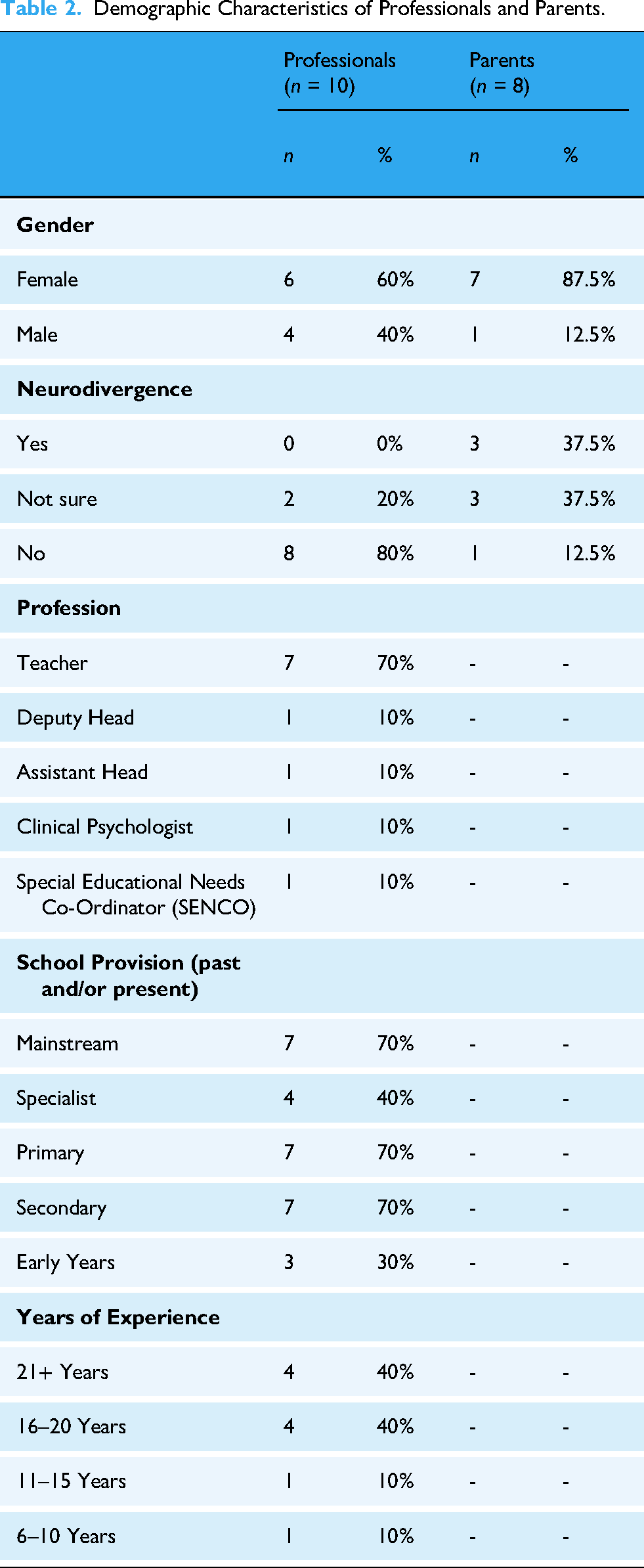
Among Neurodivergent children and adults, Autism (90.5%) and ADHD (66.7%) were the most frequently reported Neurodivergences (see Table 1). Over half had attended a specialist school, and 28.6% had experienced sustained non-attendance lasting at least half a year. Seventy-five percent of parents and 20% of professionals suspected or self-identified they were Neurodivergent (Table 2). Most professionals were teachers (70%) and had over 16 years of experience (80%).
Demographic Characteristics of Neurodivergent Children and Adults.
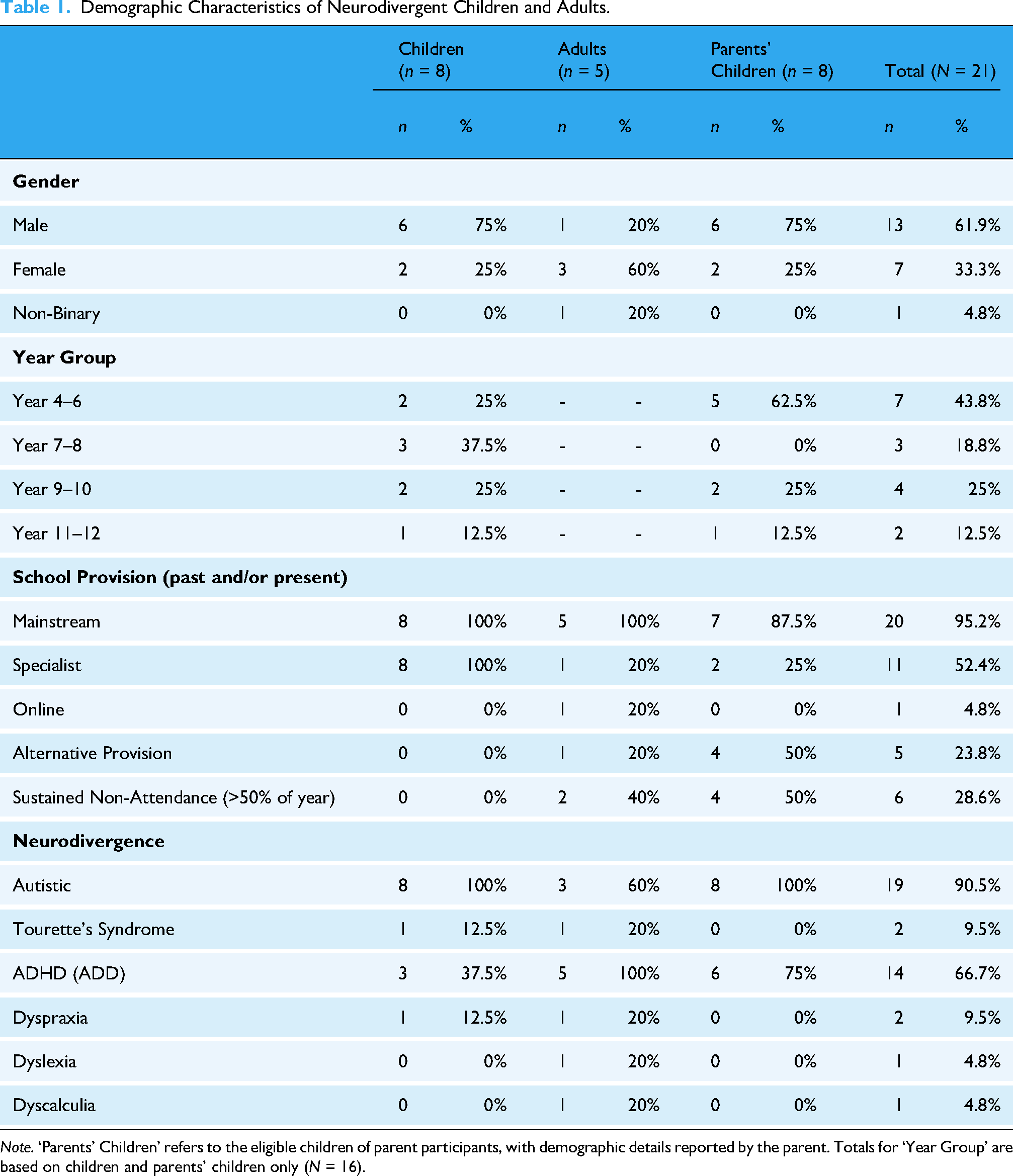
Note. ‘Parents’ Children’ refers to the eligible children of parent participants, with demographic details reported by the parent. Totals for ‘Year Group’ are based on children and parents’ children only (N = 16).
Demographic Characteristics of Professionals and Parents.
Eligibility required experience with Neurodivergence and school anxiety – directly or as a parent or professional. We focussed on developmental Neurodivergence (lifelong and present-from-birth), given its greater trait stability and disproportionate association with school anxiety (Connolly et al., 2023; Doyle, 2020). Neurodivergence was defined by participants’ self-identification as Neurodivergent, encompassing associated profiles or differences and diagnosable neurodevelopmental conditions (e.g., Autism, ADHD, Dyslexia, Dyscalculia, Dyspraxia and Tourette's Syndrome). Age ranges of 8–16 and 18–30 were used for Neurodivergent children and adults to support comprehension and recollection.
Recruitment ran between April and August 2024. Neurodivergent children were identified by staff within a specialist school. Neurodivergent adults, parents and professionals were recruited via online support groups (e.g., Not Fine in School and Autistic Girls Network), professional networks, charities and schools. Known professionals with prior interest in autism and anxiety research were also contacted. Recruitment ceased when data were sufficiently rich for in-depth analysis.
Ethics
Ethical approval was granted by Newcastle University Faculty of Medical Sciences Ethics Committee. Neuro-inclusive strategies, informed by Neurodivergent-led research and reflexivity, were implemented in all groups to minimise distress (Dark, 2024). We provided the interview guide, statement list and room images one week in advance. We offered breaks throughout the sessions, and a visual ‘leave’ card allowed participants to discreetly exit. Confidentiality was maintained, unless risk of harm was disclosed, and debrief was tailored for each group. Prior to participation, children also outlined how we could support their engagement and recognise discomfort.
Materials
To support diverse communication needs, we used multiple creative qualitative materials in each group (Teachman & Gibson, 2013): an interview guide, statement-sorting task and draw-write-tell technique. Combining these materials into a single session allowed flexibility in expression, accommodating different communication preferences and levels of comfort. It also enabled participants to build on their earlier ideas while expanding creatively into new ones.
The interview guide covered five domains relevant to our research question: (1) timing and onset, (2) presentation differences between home and school, (3) contributors specific to Neurodivergent children, (4) distinguishing school anxiety from generalised anxiety and (5) support barriers. Questions were tailored by participant input, age, communication needs and experience and were responsive to discussion flow (Figure S1). Where possible, questions were also co-constructed by earlier Neurodivergent participant and parent focus groups, who suggested questions for succeeding groups. For all activities, children were instead asked indirect questions about a fictional vignette child ‘Charlie’, who felt worried about school. We developed these vignettes to allow for psychological distance and safe discussion of sensitive experiences (Finch, 1987; Teachman & Gibson, 2013).
To extend prior micro-level findings, all groups completed a statement-sorting activity using refined items from two validated school anxiety measures: the School Anxiety Inventory-Short Version and School Anxiety Scale-Teacher Report (García-Fernández et al., 2014; Lyneham et al., 2008). We created additional contributor items – regarding sensory processing, uncertainty, injustice, camouflaging and exclusion – to reflect neuro-normative challenges absent from existing scales and prominent in micro-system literature (Atkinson et al., 2025; Connolly et al., 2023; Costley et al., 2021; Jones et al., 2020). Items were grouped into contributors, expressions and support strategies (Mullally et al., in press). This task was integrated with the interview guide to support rapport and deeper reflection, particularly beneficial for participants who found open-ended conversations difficult, and was not intended as an outcome measure (Lewis et al., 2023). All selected their top three most and least common contributors and expressions. Only non-child groups selected the top three most and least supportive strategies, as the items were not age-appropriate for children (Table 3; Table S1). Differences in group rankings are presented in Tables S2–S4. Whilst outside the scope of this study, differences in item ratings may be of interest to explore among larger samples in future research.
Items Most Frequently Selected as the Most and Least Common Contributors and Expressions of School Anxiety, and as the Most and Least Supportive Strategies, Across All Participants.

To further reduce communication barriers, all were invited to draw-write-tell anything they felt was absent from the lists (Angell et al., 2015). Children received additional artistic materials to facilitate non-speaking expression, including clay and paint (Phoenix & Chamberlain, 2025). For children, the draw-write-tell activity was embedded within the Charlie vignette to maintain psychological distance and reduce the risk of distress when exploring potentially triggering personal experiences. Adaptability was essential, with sessions participant-led and flexibly delivered (Den Houting et al., 2020). Notably, verbal communication was minimised, and alternative modes such as writing, drawing or task completion were prioritised for participants more comfortable with non-speaking expression.
Procedure
Following consent and, where applicable, assent, participants engaged in a focus group (42.2%; 3–4 participants in each group) or one-to-one interview (58.8%), facilitated by EF and a research assistant. In-person sessions (43.7%) were conducted at Newcastle University with Neurodivergent adults and parents, and at their attended specialist school with Neurodivergent children. The children participated in two age-based focus groups (8–12 and 13–16 years), held without staff present. Online sessions (56.3%) were conducted via Microsoft Teams, with professionals participating exclusively in this format.
Each session began with an icebreaker to build rapport, followed by an overview of aims and materials. For children, the icebreaker centred on sharing favourite foods or hobbies, while for adults, we asked why they were interested in taking part and what they enjoy doing for fun. For children, we also introduced our vignette – a fictional character called Charlie. Participants then completed the contributor statement sorting task and draw-write-tell task, repeated for expressions and, where applicable, support strategies. As children were not shown support items, they only drew or wrote what they felt would help Charlie feel less worried about school. Finally, to foster cross-group insights, Neurodivergent participants and parents suggested questions they wanted to ask the next group, as well as those they felt would address our research aims. These were noted verbatim and incorporated into the next session's interview guide, ensuring participant priorities shaped subsequent data collection. All were debriefed, with children reimbursed. Sessions were audio-recorded and lasted 1–2 hours.
Data analysis
We retained children's drawings, adult participants’ notes and transcribed audio recordings. We anonymised all data, replacing names with pseudonyms to protect confidentiality. We employed best-practice reflexive thematic analysis, as outlined by Braun and Clarke (2006, 2021, 2023), to explore both structural critique and individual meaning-making in the qualitative data (Bhaskar, 2008). Aligned with our critical realist epistemology, reflexivity was central in enabling critical engagement with power, neuro-normative assumptions and the representational limits of the data (Botha, 2021; Rosqvist et al., 2023).
We began with group-specific analysis, reflecting the phased data collection. We started with Neurodivergent individuals to prioritise their accounts and reduce the overshadowing of our interpretations by Neurotypical narratives. Transcripts were familiarised and coded iteratively in Microsoft Word. Codes were labels applied to segments of data to capture their meaning. We used both semantic codes, which reflected the explicit content of participants’ accounts, and latent codes, which identified underlying meanings, assumptions or patterns beyond the surface. Microsoft Excel was used to organise and track codes, quotes and developing themes. We interpreted the data through a deductive approach, focussing on what was pertinent to our research questions – specifically, neuro-normative epistemic injustice and systemic factors. This lens was iterative and reflexive, meaning it developed over time as we reflected on our own assumptions and refined our interpretations. However, we remained open to inductively, or data-driven, generated patterns, which also sharpened our interpretations.
Children's drawings and adults' notes were reviewed to refine coding. After initial group-specific coding, codes were synthesised across groups to generate shared patterns of meaning – or themes – prioritising relevance and epistemic depth over frequency. We actively constructed themes into a hierarchical structure to reflect stratified realities – from macro-systemic conditions to individual experiences (Bhaskar, 2008).
Analysing all groups’ perspectives together aligned with our critical realist focus on uncovering mechanisms across stratified layers of reality. This approach revealed both points of convergence and divergence between groups, offering a richer understanding of the interconnected nature of neuro-normative epistemic injustice and school anxiety. Juxtaposing these accounts within a single thematic frame further enriched our interpretations, revealing connections and contrasts that would have been less visible in separate analyses.
Reflexivity was implemented through reflexive journaling and discussions with Neurodivergent colleagues and the research team, supporting alternative readings and deeper insights (Botha, 2021; Braun et al., 2016; Braun & Clarke, 2019). For example, we documented moments where our experiences resonated strongly with participants’ accounts and where over-emphasis was a potential risk. These excerpts were revisited with attention to the raw data, and interpretations were discussed collaboratively within the research team. This process enabled awareness of where our insider position may have shaped meaning-making and supported transparent theme development. Two participants took part in member checking, reviewing the developed themes to ensure their experiences were represented. Additionally, five non-participating Neurodivergent children offered interpretations on selected quotes. All community contributors were reimbursed.
Results
We constructed four hierarchically arranged themes, as displayed in Figure 1. At the macro-level, Navigating an Inaccessible School System Rooted in Neuro-Normativity examines how neuro-normative structures foster inaccessible environments. A (Con)strained System: Internal Dynamics of Support and Accommodation Provision explores how these conditions shape institutional dynamics, including reactive and gatekept support and constraints on parents and teachers. Internalised neuro-normativity also leads to the interpersonal rejection of Neurodivergent children, captured within Internalised Rejection: Navigating Hostile Neuro-Normative Social Expectations. Finally, Survival Strategies in an Inaccessible System: When Only Non-Attendance Remains explores the individual toll, where withdrawal emerges as adaptation becomes untenable.

Thematic Map Depicting the Hierarchical Structure of Themes and Subthemes.
Navigating an Inaccessible School System Rooted in Neuro-Normativity
Schools are a part of society and it's a larger thing – they are not set up in a way that is friendly to young people with Neurodivergences. (Dennis, SENCO)
Whilst participants never specified the term ‘neuro-normativity’, their accounts implicitly illustrate an education system characterised by a societal preference for neuro-normativity – or Neurotypical ways of processing, thinking and behaving. In our analysis, descriptions of school rigidity, narrow definitions of success, conformity pressures and inflexibility in meeting Neurodivergent needs were characterised as manifestations of a neuro-normative system. This system was described as inherently rigidly misaligned with the needs, challenges and strengths of Neurodivergent children.
This systemic misalignment was described as purposeful – rooted in preparing children for the workforce. Schools were often perceived as training grounds for characteristics valued in a capitalist neuro-normative society, such as compliance and standardised productivity. Teachers echoed this, with concerns that altering the school experience could compromise qualifications necessary for joining the workforce.
School's argument was that this is what life is like … When you are in a normal working job, you have to deal with changes, it was their responsibility to ‘train the kids’. (Dianne, Parent)
Navigating a system of neuro-normative affordances was described as profoundly inaccessible and anxiety-inducing. Contributors to school anxiety were rarely viewed as isolated but rather within a relentless, interconnected network of underpinning neuro-normativity, which left many unable to cope.
All of them (contributors) are a problem, and they just build and build on top of each other. (Shaun, Neurodivergent Adult)
A recurring critique was the rigidity of schools in maintaining a neuro-normative one-size-fits-all model, where schools were ill-equipped to adapt to meet diverse needs. This rigidity extended to how, when and what children learned and to the implementation of anxiety-reducing changes. Many adult participants attributed this inflexibility to education policies, particularly full-time attendance requirements, which restricted schedule adaptations.
The pressure to get them in and ticking attendance boxes is why schools are no longer being flexible in terms of provisions, because that's not the rule … unless something changes up there then nothing changes for this child at the bottom. (Dee, Clinical Psychologist)
Children unable to meet attendance expectations often developed performance anxiety about falling behind in a standardised curriculum. Government-imposed academic standards were described as narrowly defining success and reinforcing rigidity in learning content, pace and assessment. Notably, the curriculum was described as overly academic, ill-suited to recognise or celebrate the diverse skills of Neurodivergent learners.
He's a really good problem solver … his way of thinking is not the same way it works in the class. It's not listening to loads of information and regurgitating it. He has to just do, but he won’t try … because he knows he is going to fail. (Stan, Parent)
Unsurprisingly, this inflexibility culminated in cycles of failure and anxiety, with high-stakes exams emerging as peak anxiety. Many Neurodivergent children and adults described feeling overwhelmed by excessive workloads. Secondary school was identified as particularly challenging, due to its increased pace and exam focus.
I am trying as hard as I can, but I still don’t fit what they want. (Eve, Adult)
When they fail tests, they are going to have to do it again and they just don’t want to do it again because they can’t do it. (Jack, Child)
Teachers pointed to systemic accountability measures – Ofsted inspections and exam results – as reinforcers of curriculum rigidity. These pressures often limited schools’ ability to adapt away from neuro-normative policies and towards inclusive practice. Most concerningly, systemic prioritisation of results over inclusion was seen to incentivise the exclusion of non-conforming Neurodivergent children.
Where is the incentive to be inclusive? You can just exclude and get outstanding Ofsted … When it is all about results, it is much easier to get rid of children that are going to bring results down … the system allows you to do that without being questioned. (Finn, Teacher)
Behaviour policies also served this broader policy rigidity, as one mechanism to maintain control and standardisation across all learners through rules. Children experienced this as a lack of emotional support, with teachers prioritising their academic performance.
When they are worried, they want to get away from teachers. Teachers are going to try and bribe them to go back inside and do their work, that's all they try and do. (Jack, Child)
You have the rule of a countdown 54321 everybody put your book down … but what happens if at 54321 you can't do that … because you've got a different need … if teachers have got that approach that they've got to follow that, it's very difficult, isn't it? To respond to a child's needs. (Rachel, Teacher)
Neuro-normative affordances, including unpredictability, change and sensory distress, were embedded in this rigidity. Unpredictability and change, through frequent and unpredictable transitions, fostered hyper-vigilance. Misaligned sensory environments further exacerbated anxiety, frequently described as overwhelming and distressing (Figure 2).

“I Hate Trying to Get to Class, It Is So Loud, It's Stressful. It's So Loud All the Time – I Can't Hear When It Is Loud”. (Isla, Child) (Ron's Drawing)
Participants emphasised that all children, despite labels, were different. Yet, the systemic prioritisation of neuro-normativity does more than marginalise Neurodivergent students – it perpetuates an inequitable system that privileges conformity over true inclusivity.
Our children are just canaries in the coalmine showing that there is a problem. I actually think it's a problem with a lot of kids. (Cristina, Parent)
A (Con)strained System: Internal Dynamics of Support and Accommodation Provision
Within an inaccessible neuro-normative system, accommodations were described as essential compensation – yet constrained by internal dynamics. Reactive Support: Insufficient and Delayed illustrates how the system's reactive nature gatekeeps support by necessitating crises and diagnoses, leading to ineffective interventions. Shifting Parent–Teacher Blame: (Con)strained Opportunities to Address School Anxiety explores how insufficient support fuels deflected responsibility and blame, reinforcing disempowerment, insufficient support and diverted focus away from systemic reforms.
Reactive support: Insufficient and delayed
In response to school anxiety, accommodations became reactive bolt-ons – added only after difficulties emerged, rather than embedded from the start. With accommodations the primary solution to school anxiety, demand far exceeded supply.
There is just no priority or funding from the government to enable services to do what needs to be done. Most kids should not need an EHCP. A school should just be able to meet need … the rigidity in schools, that's what's fuelled the problem and it is what makes it harder for those who really need specialist support, getting the specialist support. (Dennis, SENCO)
Compounded by under-resourcing, schools and external services struggled to provide basic support. Families often sought additionally resourced or specialist provisions, only to find these oversubscribed. Unable to compensate for systemic under-resourcing and inflexibility, alternative provisions often only offered 2–4 hours of teaching per week from overstretched services. For children, this resulted in broken promises, unmet needs and escalating anxiety.
They said I could go to the sensory room every day, but I never did. I went once but I never went back. (Xander, Child)
Strained capacity led to gatekeeping and ever-rising thresholds for access. Children had to reach a critical point of academic or emotional distress for their needs to ‘qualify’ for support.
(What do you need to do for support?)
Go to a normal school and be treated like a normal person until they find out I guess … (Ron, Child)
do terrible in it so you can come here (special school) and go crazy. (Xander, Child)
Alarmingly, some described that once distress disappeared, the same support that removed distress could be withdrawn.
Because I was performing well, the person in my school decided to take the access arrangements and stuff completely away from me. (April, Neurodivergent Adult)
Beyond distress thresholds, support was often contingent on formal diagnoses. Many, therefore, pursued private diagnoses, while children were aware that their needs were ignored without one.
Put a sign up on your forehead and say I am autistic! You need a diagnosis for therapy! (Isla, Child)
However, this diagnostic-driven model excluded those whose needs were not captured neatly by diagnoses and contributed to growing waitlists. Instead, many called for need-based approaches.
Everyone with ADHD is not going to find the same things challenging and the same things helpful … It is important to maintain an individual approach to things. (Eve, Neurodivergent Adult)
This reactive and bureaucratic system resulted in mistimed, delayed or tokenistic support.
They wait until crisis point to do something – it is too bloody late. (Cristina, Parent)
Tokenistic interventions – low cost and effort – were common due to resource constraints. Some felt the system incentivised such interventions to evidence the insufficiency of pre-existing resources for additional funding.
Schools have to show that they have tried in order to get access to more resources … to say actually, I can’t use my existing funding to provide us anymore we need … You are asking people to fail in order to get something better. (Dee, Clinical Psychologist)
In many cases, ‘support’ not only failed to address the root causes of school anxiety but also actively worsened anxiety. Rooted in behaviourist assumptions, they operated on the belief that children could learn to habituate to distress and conform to neuro-normative expectations – such as improving attendance and academic performance.
There was an unused classroom downstairs which I would go to while I was at school. I would sit down there in silence like I was in detention … They saw me sleeping as a success, because I was actually in the building. (Shaun, Neurodivergent Adult)
Such strategies enforced attendance at the expense of children's anxiety, including requiring parents to stay on-site or forcibly separating children from them.
I saw my son's friend who was autistic who was going through trauma at the time was refusing being physically dragged into school, away from his parents. (Cristina, Parent)
With an inaccessible system that necessitated accommodations, support arrived too late, was insufficient, and failed to address the root causes of school anxiety. By responding reactively rather than addressing inaccessibility, the system perpetuates cycles of under-resourcing and escalating anxiety for Neurodivergent children.
School anxiety was so preventable in some ways, if certain things had just been adapted. (Meredith, Parent)
Shifting parent–teacher blame: (Con)strained opportunities to address school anxiety
As school anxiety escalates, the demand for support surges within an ill-equipped system – yet even legally mandated support and accommodations often fail to materialise. Teachers and parents felt powerless to shoulder the burden, navigating rising distress in a culture of habitual responsibility deflection.
Local authorities are getting pressure from the government then the local authorities are pressuring schools and then teachers are pressuring parents and parents are pressuring kids. It's just trickling down to the most vulnerable person. (Thea, Parent)
Parents were forced into relentless advocacy, resisting the system's neuro-normative priorities – especially full-time attendance. Without school support, many funded private tuition and therapy. Consequently, many children only found safety and learning at home.
He had a different teacher on a Friday … just stressed him out so much, she was so rule focussed. I just said right, we are not going in on Fridays then. (Cristina, Parent)
This advocacy came at an emotional cost to parents: burnout, family tension and resurfaced trauma, particularly for Neurodivergent parents.
We have to put so much energy into helping my son. My daughter could be crying, saying ‘I don’t want to go to school’, but then my son doesn’t want to go to school a lot louder … she just gets dressed and goes. (Stan, Parent)
Under immense pressure to comply with neuro-normativity, not all could sustain this advocacy.
I am a bit ashamed of it, but sometimes I had to kind of drag him out of the car as I had been told to by the school. (Dianne, Parent)
Teachers, meanwhile, also felt powerless in their ability to reduce school anxiety – constrained by institutionalised neuro-normativity, rigid policies, limited funding and accountability pressures.
If something goes wrong with Ofsted, I’ve seen people lose their jobs … The (anxiety-reducing) strategies aren’t hard … but when they have got to fit in so many things that stops doesn’t it? (Rachel, Teacher)
This work environment was deeply demoralising, creating high workloads, poor wellbeing and burnout, especially when supporting highly distressed pupils.
There are staff who are exhausted … working 13–14 hour days … They will miss time with their own families to be able to try and make things better. (Dennis, SENCO)
Advocacy, therefore, often felt like an added burden, particularly when parents expressed frustration. Some teachers felt scrutinised, compounded by an unforgiving accountability culture.
Sometimes the way some parents talk to you … can be quite difficult for your empathy towards them. (Dennis, SENCO)
To reconcile tensions, responsibility was often redirected towards parents. Parental advocacy became reframed as pathological overprotection, and parental distress was blamed for modelling anxiety to children. The contrast between children's behaviour at home and school was used as further evidence for this parental blame narrative.
If you have been over-protected in your anxiety at home, then you get into school and you don’t find an adult who can replicate that … you are going to drown, aren’t you? (Rachel, Teacher)
They (teachers) just cannot see that this child who is the role model student in school could be that different at home … so ‘they must be useless parents then’. (Nelle, Deputy Head)
Parental blame was institutionalised: some parents received fines for children's non-attendance and were referred to parenting interventions. Many felt trapped – dismissed, blamed and unsupported – while caring for a child in escalating distress. Many parents also viewed advocacy as a source of resilience and self-understanding. Teachers’ blame shifting was often interpreted by parents as a defence against perceived criticisms in a high-stakes system.
Nobody wanted to accept responsibility. It's like, you just need to get him in … Teachers did the gaslighting of, ‘well the other Autistic kids just do it’. (Thea, Parent)
When children's distress was ignored, support delayed or suggested changes unimplemented, teachers were perceived as gatekeepers to support – scapegoating distress instead of addressing it.
Teachers had always known basically ‘we thought there might be something, but we just didn’t want to deal with it’. (Shaun, Neurodivergent Adult)
This inaction was often experienced as indifference or invalidation, deepening mistrust and frustration.
He (teacher) looked down at me and went where is your homework? And I immediately burst into to tears and started having a full panic attack … And he rolled his eyes, no need to cry about it and then he left the classroom. (Caroline, Neurodivergent Adult)
Teachers, in turn, felt unfairly scapegoated – worsening burnout and inaction. For many, they felt this underpinned teacher retention issues.
They are the people who will drive the change in education. But some of them are done … they just get completely overloaded with it all and they just don’t feel appreciated. (Dennis, SENCO)
Despite constraints, all recognised that individual relationships could alter a child's experience. However, such agency was constrained by a regimented system, creating a destructive cycle of blame. As teachers' burnout and parents grow frustrated, both become disenfranchised – locked in conflict rather than collaboration. Concerningly, this cycle shifts responsibility onto marginalised groups, masking the deeper issue: a fundamentally inaccessible system.
Internalised Rejection: Navigating Hostile Neuro-Normative Social Expectations
The neuro-normative system also legitimised rejection of those who deviated from its standards, forming an interpersonal culture where nonconformity was met with marginalisation (Figure 3).
If you showed any abnormalities or weaknesses, others might have judged you or not wanted to be friends with you. (Carolyn, Neurodivergent Adult)

“Basically in the Picture, It's Charlie Being Bullied by this Other Girl and She's Like Being Really Horrible. Being Like Laughing at Him. This Happened a Few Times in the Past”. (Leo, Child)
Rejection carried tangible consequences, including difficulties forming friendships, bullying and exclusion. Many were only aware of their Neurodivergence through the negative comments of others. Ostensibly positive peer attitudes were described as only tolerance rather than acceptance.
You are so very different that there are only certain parts of you people tolerate for so long, you are out on a limb to play with them. (Meredith, Parent)
Negative judgement also came from teachers. Children felt disfavoured compared to peers who conformed to neuro-normativity, often validated by perceived targeted punishments. Some children even equated this with bullying, intensifying anxiety.
(What is it about a child that makes them the teacher's favourite?)
They might not do the stuff that happens when you get worried – they might just be normal … (Shayne, Child)
Yeah maybe their needs are a bit less. (Natalie, Child)
Anxiety about rejection was common, with many worried about standing out as divergent from neuro-normative expectations – through their behaviours, diagnosis stigma or the provision of accommodations.
Stage fright! She might get anxious and she might not know what to say and stutter and that becomes an embarrassing situation and it is in front of everyone so everyone is listening. (Ron, Child)
A key mechanism underpinning rejection was hermeneutical injustice. Many expressed anxiety about having their intentions misunderstood by children and teachers with neuro-normative understandings. This mirrored the double empathy problem, with some feeling Neurodivergent peers would be more understanding.
We had terrible floods … Shaun said in class, ‘I am really glad I wasn’t flooded’. And he was excluded. I was told that he was a disgrace because of how he had upset other children who have been flooded … for him that is just a straight statement of fact … they all had an attitude of, not knowing what it is like for someone who is Neurodivergent. (Dianne, Parent)
Specifically, teachers’ training and knowledge of Neurodivergence was described as both most lacking and impactful. Notably, neuro-normative understandings led many anxiety expressions – especially non-speaking – to go undetected or dismissed. Unless you verbally speak about it and get them to listen to you, teachers probably won’t help because they don’t know what is going on. (Ron, Child)
If this person doesn’t understand me, how safe am I? (Meredith, Parent)
At worst, non-conformity was misinterpreted as controlled defiance. This misattribution had tangible consequences, particularly in the form of anxiety-promoting disciplinary approaches that inadvertently punished underlying needs.
She had a meltdown … teacher was saying ‘we don’t accept this kind of behaviour’ … he couldn’t comprehend anything to do with Autistic meltdowns. (Judi, Parent)
Discipline was perceived as rejection for nonconformity, making teachers' public reprimands, where differences became visible, especially anxiety-evoking.
It's teachers who pick, pick, pick … It is just the constant narrative of always drawing attention to differences. (Dee, Clinical Psychologist)
Attitudes and knowledge also contributed to testimonial injustice, through low expectations of Neurodivergent children based on neuro-normative stereotypes. Notably, many felt school anxiety was perceived by schools and teachers as caused by a lack of child resilience. This deficit framing led to inappropriate and infantilising interventions and the dismissal of children's voices, leaving families suggestions for support and interventions often unimplemented.
They were very dismissive of what I think that helped with the anxiety, and that made the anxiety a lot worse … I didn’t feel very understood (Eve, Neurodivergent Adult)
Over time, repeated instances of rejection often became internalised, shaping children's shame of characteristics which deviated from neuro-normative expectations or Neurotypical children.
That feeling of rejection led me to think I wasn’t as good as the other people. Why wasn’t I being chosen? (Carolyn, Neurodivergent Adult)
Shame, in turn, made school feel more unsafe, transforming everyday situations into high-stakes events that could invite comparison or judgment. Such events became overwhelming, where perceived shameful ‘deficits’ were vulnerable to exposure and reinforcement. Repeated rejection heightened this sensitivity, leading to hyper-vigilance and avoidance.
She is always worried saying ‘mum, you won’t talk to anybody about my autism, will you?’. (Judi, Parent)
Challenging this shame narrative was crucial for wellbeing, through recognising the faults of the system and reducing self-blame.
We talk about how Neurotypical people don’t always understand … then it became nincomtypicalpoops … it has really helped him to understand that he is not the problem and that's a lot to do with the shame and the self-esteem. (Cristina, Parent)
Shifting from a deficit-based to an identity-affirming understanding of Neurodivergence also aided the reframing of school experiences as a reflection of a neuro-normative environment. Children could then begin to understand deviation from neuro-normative expectations as a valued part of their self-concept, rather than as a deficit to be corrected.
I’ve waited for someone all of school to validate ‘you struggle with this’ and it's not just because you are stupid. (Eve, Neurodivergent Adult)
Survival Strategies in an Inaccessible System: When Only Non-Attendance Remains
Navigating this system was experienced as a physical and cognitive crisis. The body absorbed distress – through insomnia, chronic fatigue, illness and pain – while the mind became consumed by catastrophic and all-consuming thoughts. At its worst, this anxiety spiralled into perseveration, self-harm and suicidal ideation.
We even took him for an ECG once, because he said it was beating so hard he was scared. (Meredith, Parent)
I felt so anxious that I got so paranoid … I was like they (teachers and peers) are plotting … it was dangerous for me, I was a danger to myself … I was sectioned. (Caroline, Neurodivergent Adult)
Often, a small final trigger overloaded children's already overstretched coping capacities.
It is that coke bottle effect isn’t it, it's been shook all day and it is usually the one thing that tips it over the edge. (Cristina, Parent)
As anxiety became intolerable, many children experienced meltdowns – uncontrollable externalisations of distress. While cathartic, parents felt that meltdowns also forced adults to remove anxiety-inducing demands. When triggers persisted, meltdowns became intertwined with frustration and anger.
A meltdown is like if you make a big, huge snake mad, well it is going to attack you. That is basically what it is like. (Jack, Child)
However, meltdowns were unsafe in a neuro-normative system that prized conformity, leading many to adopt alternative survival strategies.
They only show how they feel at home, because they know that they are not going to be made fun of. (Xander, Child)
Many were forced to withdraw – hiding within school or being unable to attend entirely – to release distress safely, decompress and prevent further anxiety triggers (Figure 4). For example, many avoided interactions with children and teachers to evade rejection. Over time, withdrawal escalated into cycles of persistent non-attendance, particularly among those with trauma.

“That's a Bed, She's in Her Bed Hiding”. (Isla, Child)
Teachers feared withdrawal reinforced school anxiety through a pathological cycle of avoidance. However, forcing attendance did not resolve distress – instead, it removed the option to withdraw from overwhelming stimuli, through the constant presence of others, lack of privacy and expectation of continuous engagement. Without the option to withdraw, entrapment entrenched anxiety.
You are locked in that position and can’t get out because you have got that work to do, so you have got to sit back down and everyone is looking at you so you can’t leave … he's stuck. (Ron, Child)
Entrapment also left many to shutdown as temporary self-protection, leading to mood deterioration, skill regression, and, even, temporary paralysis.
At the end of the day, she would have episodes where she would just be lying on the sofa. She has gone for about 10 min … your whole brain is going no. (Dee, Clinical Psychologist)
Moreover, for those forced to attend another strategy remained: camouflaging through hiding, suppressing and conforming to neuro-normativity. This was an active effort to prevent the contributors of school anxiety caused by non-conformity.
What is the correct thing to say next? To continue this conversation? And do the right thing in this social situation? That was how I acted in school, where-as at home I would just be myself. (Carolyn, Neurodivergent Adult)
However, camouflaging was an exhausting process, requiring constant hyper-vigilance to regulate behaviour, hide signs of distress and anticipate other's responses. This depleted resources for emotional regulation and left many struggles unseen and, thus, unaddressed, exacerbating anxiety.
Masking drains your mental health, like a battery being used like an electric drill. You are just gone … masking can just ruin everything. (Jack, Child)
Ultimately, the effort required to camouflage in school became unsustainable, with distress seeping out at home or when alone. Withdrawal, therefore, emerged as the only viable option to unmask, recover and reclaim emotional autonomy.
I would come out of school and I’d immediately be so angry, like even hit her (mum), which I feel terrible … I was so tired because I’d been masking all day but wasn’t aware of it. (Caroline, Neurodivergent Adult)
I don’t look like I have any of these problems … nobody registers or notices unless they are paying really close attention. (Shaun, Neurodivergent Adult)
Consequently, many teachers felt it was crucial to allow children opportunities to feel comfortable to unmask at school. Yet, camouflaging was a necessity for survival in a neuro-normative system. Notably, when school demands surpassed children's capacity to camouflage, anxiety spiked.
That was the coping strategy and then someone has challenged it or been disproving. I just get very withdrawn; I think it would like break the mask a little bit. I’d just be like oh I can’t say anything now … and I’ve shutdown. (Eve, Neurodivergent Adult)
Despite all efforts to fit in or disappear, the system remained inherently inaccessible. Ultimately, withdrawal becomes the only viable strategy to escape a system that inherently shames, traumatises and rejects Neurodivergent children.
Discussion
This study is the first to critically examine the layered structures that produce and sustain school anxiety among Neurodivergent learners, drawing on neuro-normative epistemic injustice theories. We also centred lived experience through a sequential multi-perspective approach and integrated participatory principles. Our findings reveal shared macro-level mechanisms underpinning micro-level experiences of hostility, which contribute to school anxiety. Without attention to these structural causes, research fails to address the wider eco-system of anxiety drivers and resistance to change (Williams-Brown & Jopling, 2021). This risks inadequate recommendations: for example, calls to increase public funding, despite only 9% of Autistic children benefitting from existing mental health services when they received it (Ashworth et al., 2025). By locating school anxiety within intersecting systemic pressures, our findings offer a more robust foundation for research and reform.
We found school anxiety is rooted in a neuro-normative system shaped by rigid, binary assumptions about processing, behaviour and development. Viewed through an epistemic injustice lens, these assumptions constrain the education system's capacity to recognise, include and value Neurodivergence (Legault et al., 2021). They also normalise anxiety-inducing affordances – tangible conditions, like overwhelming classrooms, that cause distress. These affordances mirror the micro-level challenges experienced by Neurodivergent children and educators (Billington et al., 2024; Fielding et al., 2025; Simpson et al., 2020; Ware et al., 2022; Wood & Happé, 2023b), while extending them into a macro-level explanatory framework.
Policy was a key macro-level affordance described, which, aligned with research, extends inclusion only to those who emulate neuro-normative, capitalist productivity ideals (Berthelot-Raffard, 2022; Lehane 2017). While others have shown how standards and behavioural policies demand disproportionate effort from Neurodivergent learners (Poed & Fox, 2023; Williams-Brown & Jopling, 2021), we are the first to find that this generates school anxiety. For instance, this may elucidate elevated exam anxiety and exclusion among Neurodivergent pupils (Tomaskova et al., 2024; Wood & Happé, 2023a). Accountability pressures, through Ofsted and exam grades, have also been widely acknowledged to entrench the UK system's rigidity and hinder inclusive innovation (Glazzard, 2014; Williams-Brown et al., 2024; You, 2017). Ultimately, these dynamics lead schools to refuse places for pupils deemed too ‘complex’ (Lilley, 2013; Norwich & Black, 2015), deepening epistemic exclusion (Scully, 2018).
Our second-tier findings highlight the institutional consequences of a system that cannot proactively meet need: a reliance on overstretched, reactive accommodations. While underfunding is often cited, participants described deeper structural failures – supported by the routine redirection of support budgets to offset financial deficits (Marsh, 2023). This aligns with Ashworth et al. (2025), who illustrated the rationing process of mental health support – based on diagnosis or crisis severity, effectively reserved for those deemed ‘other’ enough to qualify. Consequently, 41% of children wait over two years for diagnoses without support (Children's Commissioner, 2024b). This reliance on child-based eligibility criteria may also deflect scrutiny away from systemic failure onto the within-child characteristics of marginalised learners (Fisher, 2023; Hodkinson, 2012). With nearly one in five pupils now identified as having SEND – and numbers rising – this model is increasingly untenable (Gov.UK, 2024b).
Concerningly, we found ‘support’ is often underpinned by behaviourist logics that enforce compliance – offering insight into why only a minority of Autistic children benefit from mental health provision when they receive it (Ashworth et al., 2025). This may explain why non-compliance becomes a prerequisite for access, echoing studies where support only follows school exclusion (Gray et al., 2023; Mullally & Connolly, 2025). The emphasis on behavioural conformity fuels a self-reinforcing cycle in which resources are redirected into crisis management. For example, parents are often forced to pursue SEND tribunals to secure school accommodations – despite a 96% success rate for parents (Gov.UK, 2022; Marsh, 2023).
Participants highlighted how parents and teachers also shoulder the burden of a broken system. Feeling constrained in their capacity to support Neurodivergent children, mutual blame becomes common – a dynamic institutionally sanctioned. Legal penalties for non-attendance among parents have risen by 396% between 2009 and 2024 (Gov.UK, 2025; Lissack & Boyle, 2022). Teachers too are held increasingly responsible for inclusion without corresponding resources (Done & Andrews, 2020). The emotional and financial toll on families, alongside rising educator burnout under rigid policy and growing need, is increasingly documented (Broady et al., 2017; Cook & Ogden, 2022; Mullally & Connolly, 2025). However, our findings add depth: systemic constraints intensify tensions, divert responsibility away from systemic dysfunction and undermine meaningful actions that could reduce school anxiety.
Moreover, Neurotypical teachers and children were described as enacting the systemic pathologisation of Neurodivergence through constrained knowledge, attitudes and practices. The negative impact of limited teacher knowledge is well-documented – particularly when Neurodivergent learners are perceived to threaten professional competence in managing behaviour or learning (Cappe et al., 2021; Gómez-Marí et al., 2021; Lu et al., 2020; Ravet, 2018). Elevated rates of peer victimisation among Neurodivergent learners are similarly well-established (Humphrey & Symes, 2010; Sarwono et al., 2020). Our findings support emerging evidence that anxiety can arise from anxiety-inducing practices – or even bullying – by teachers (Adams, MacDonald et al., 2019; Billington et al., 2024; Lin et al., 2020; Mulholland et al., 2015). Crucially, we extend these limitations by finding they stem not from isolated failings, but internalised institutional narratives that penalise Neurodivergence, leading non-conformity to neuro-normativity to be met with scepticism and frustration. The school system reflects wider societal patterns, in which Neurodivergence is routinely positioned as a deficit (Legault et al., 2021). In response, Neurodivergent children's internalised rejection often leads to anxiety and shame – a pattern supported by the minority stress model (Botha & Frost, 2018; Dunne, 2023; Wilmot et al., 2023). Unsurprisingly, many felt uncomfortable about being Neurodivergent at school, anticipating future shaming – a finding echoed in literature (Dorahy et al., 2017; Mullally et al., 2024).
When children are forced to navigate systems not built for their needs, it is no surprise that the consequences include anxiety, trauma, illness, and in some cases, suicidality – outcomes increasingly documented (Connolly et al., 2023; Fielding et al., 2025). We extend findings on the danger surrounding public meltdowns and shutdowns (Lewis & Stevens, 2023; Phung et al., 2021) to schools, where such responses are often punished. In this context, camouflaging is incentivised, compounding school anxiety. This supports broader evidence that camouflaging is a defensive response to exclusion and unsafety – one that fosters dysregulation and anxiety (Atkinson et al., 2025; Howe et al., 2023; Leong & Graichen, 2024). While advocacy and lived experience frame school non-attendance as a ‘can’t not won’t’ (Fricker, 2023), we are among few studies to explicitly find that recovery and safety may be impossible while children remain embedded in the very structures that generate harm.
Implications
Our findings suggest important implications for change to systems and practice. Firstly, while systems constrain, individuals retain some agency to enact change – through training and positive contact (Botha, 2021; Dickter & Burk, 2021; Terlich et al., 2024). Stakeholders highlighted how cognitive reappraisal, where framing distress compassionately as a rational response rather than a personal failure, can support identity development and reduce camouflaging (Botha et al., 2022; Mullally et al., 2024; Riebel et al., 2025). Supporting young people and those who support them to understand neurodivergence – and the structures that marginalise it – is, therefore, essential.
Secondly, our findings echo wider calls for systemic change to achieve meaningful and non-tokenistic reform (Crane et al., 2023; Marsh, 2023). For instance, the UK government's proposed Children's Wellbeing and Schools Bill imposes tighter restrictions on home education, highlighting a systemic disconnect from why families are forced to pursue it (UK Parliament, 2025). Although detailing systemic solutions was beyond our scope, our findings underscore the need for inclusive, flexible, needs-based models – incompatible with the current emphasis on academic standards and pathologisation (Williams-Brown & Hodkinson, 2020).
As written in our commentary (Fisher et al., 2025), system reform must decentralise neuro-normativity through the epistemic inclusion of Neurodivergent people with lived experience (Zilli et al., 2020). For example, grassroot organisations in the UK like Not Fine in School and Team Square Peg propose tangible solutions – such as removing legal penalties for non-attendance and introducing a mental health absence code. That these remain unimplemented, despite significant evidence and advocacy, reveals the depths of systemic inertia.
This resistance is rooted in decades of epistemic injustice, leaving mainstream systems unequipped to recognise or respond to non-neuro-normative experiences (Dimitrellou & Male, 2020; Scully, 2018). An urgent epistemic shift is needed – one that reframes school anxiety not as an individual pathology, but as a rational response to systemic harm (Fisher et al., 2025). This demands meaningful engagement with policy, pedagogy and lived experience and must be co-led by researchers, educators, families and policymakers to drive systemic transformation rather than piecemeal, micro-level change (Stanbridge, 2024).
Limitations
This framework is not intended to be generalisable to the positioning of all stakeholders. The sample likely reflects ascertainment bias, with those holding critical perspectives more motivated to participate. Future research needs to better understand those with contrasting views; for instance, some teachers argue that academic standards need not constrain inclusive practices (Williams-Brown & Jopling, 2021), and some Neurodivergent children enjoy mainstream schooling (Tomlinson et al., 2022). Assuming uniform impact risks overlooking the role of agency – something participants themselves identified as central to inaction and, thus, school anxiety. Further research is needed to explore how agency might be mobilised to reduce distress amid persistent systemic resistance to change.
Although more diverse in age, provision and informants than prior studies, our sample included only white participants, and no socio-economic data was collected. We were also unable to recruit nonspeaking individuals and those with co-occurring intellectual disabilities – Neurodivergent groups often excluded from research, due to greater divergence from neuro-normative standards, which demands funding and expertise to ensure meaningful inclusion (Brooker et al., 2015; Kalman et al., 2016). These limitations risk homogenising experience and obscuring how intersectional identities may compound hostility, epistemic injustice and school anxiety (Botha & Gillespie-Lynch, 2022; Cohen et al., 2022). For example, some families described accessing private services – options unavailable to many, particularly those facing testimonial injustices rooted in racism and classism (Lindsay et al., 2025; Totsika et al., 2020). In future research, we must collectively and intentionally centre underrepresented perspectives – through participatory inclusion – to expand our framework towards more inclusive understandings.
Conclusion
This study offers a new lens for understanding school anxiety, distress and non-attendance as a systemic – not individual – phenomenon, rooted in neuro-normative epistemic injustice. While no mind fully aligns with increasingly rigid ‘norms’, Neurodivergent children diverge most significantly and disproportionately struggle. Current models sustain and produce school anxiety, shaped by policy and accountability frameworks. Consequently, support becomes delayed, gatekept and ultimately ineffective – placing immense pressure on parents and teachers. Without safety, children must withdraw for self-preservation. Recognising the legitimacy of distress, and the structures that produce it, is a critical starting point for change. Practically, this demands context-first practice and policy grounded in epistemic inclusion and a reimagining of education itself. Without this, the system will continue to fail the very children it claims to serve.
Supplemental Material
sj-docx-1-ndy-10.1177_27546330251385325 - Supplemental material for ‘I Can’t Go to School, It Isn’t a Won’t’: Lived Experiences of Neurodivergent Children's School Anxiety Within the UK's Systemic Crisis
Supplemental material, sj-docx-1-ndy-10.1177_27546330251385325 for ‘I Can’t Go to School, It Isn’t a Won’t’: Lived Experiences of Neurodivergent Children's School Anxiety Within the UK's Systemic Crisis by Emmie Fisher, Keren MacLennan, Sinéad Mullally, Jacqui Rodgers and Effy Tzemou in Neurodiversity
Footnotes
Acknowledgements
The authors sincerely thank all participants who generously gave their time to take part in this research. The authors are also grateful to our Neurodivergent peers, colleagues and advisors whose insights and perspectives helped shape the study. Special thanks to Ruby Herrington for her support as a research assistant during data collection.

Ethical considerations
This study was approved by the Faculty of Medical Sciences Ethics Committee at Newcastle University. Informed consent (and assent, where appropriate) was obtained from all participants. Neuro-inclusive and safeguarding protocols were implemented throughout to support participant well-being and confidentiality.
Consent to participate
Informed consent and, where relevant, assent was obtained in writing from all participants.
Consent for publication
Written consent to publish was obtained from all participants.
Funding
The author(s) received no financial support for the research, authorship, and/or publication of this article.
Declaration of conflicting interests
The author(s) declared no potential conflicts of interest with respect to the research, authorship, and/or publication of this article.
Data availability statement
Supplemental material
Supplemental material for this article is available online.
References
Supplementary Material
Please find the following supplemental material available below.
For Open Access articles published under a Creative Commons License, all supplemental material carries the same license as the article it is associated with.
For non-Open Access articles published, all supplemental material carries a non-exclusive license, and permission requests for re-use of supplemental material or any part of supplemental material shall be sent directly to the copyright owner as specified in the copyright notice associated with the article.
