



Abstract
Evidence suggests that neurodivergent pupils are disproportionately impacted by school distress and attendance difficulties in mainstream schools in the United Kingdom. Research on school distress and attendance has predominantly consulted parents and teachers and neglected the pupil voice. This qualitative, online interview study involved neurodivergent adolescents (n = 30; 11–16 years), who were currently experiencing school distress and attendance difficulties, to understand their lived experiences. Using thematic analysis, the interviews highlighted that there was significant variability, but multiple factors such as sensory differences, uncertainty at school, social challenges, poor neurodiversity understanding and a lack of an appropriate alternative to mainstream schools, commonly coalesced to create distress. The wide-ranging impacts of school distress extended far beyond attendance. The young people did not feel that the current education system met their needs. The results contribute to considering how best to support neurodivergent pupils experiencing school distress and attendance difficulties in mainstream schools.
Lay Abstract
There is currently a UK school attendance crisis and research suggests that neurodivergent pupils are particularly impacted. Neurodivergent pupils can experience emotional distress at school more often than their neurotypical peers and this distress can be associated with attendance difficulties. Research has mostly consulted parents and teachers, but the current study interviewed 30 neurodivergent 11- to 16-year-olds in UK mainstream secondary schools who were all experiencing school distress and attendance difficulties with the aim of learning from their experiences. The young people highlighted multiple factors such as sensory differences, frequent uncertainty at school, social challenges and a lack of neurodiversity awareness (to name a few), that could all contribute to their experiences, but that school distress could vary significantly between pupils. Some pupils struggled to get to school in the mornings and others were anxious in the evenings. Some young people self-harmed or experienced significant emotional wellbeing difficulties. Young people did not feel understood or supported, but they did not feel that there was a viable alternative to their current school. The results contribute to considering how best to approach the current UK school attendance crisis in mainstream schools that we know to be disproportionately impacting neurodivergent pupils.
In the United Kingdom, a supposed ‘attendance crisis’ (e.g., Children's Commissioner, 2022; Connolly et al., 2023) is receiving significant attention in the media, and is impacting educational policy and national statutory guidance for attendance monitoring (Department for Education, 2024a). Attending school is crucial for school success and missing school can be related to poorer social, emotional and academic outcomes (Filippello et al., 2019; Kearney et al., 2019). Many young people have positive school experiences and high attendance. A recent report indicated that 64% of 253,000 young people said they enjoyed school (Children's Commissioner, 2024) but crucially, 19% (over 48,000 children) explicitly said they did not enjoy school. An increasing number of pupils have attendance difficulties and the persistent absence rate for the current academic year has doubled since 2018/2019 (attendance <90%, 20.3% up from 10.7%; Department for Education, 2020, 2024b). Although increasing absences were apparent before COVID-19, the pandemic has purportedly exacerbated the issue (Hamilton, 2024). While the current research is situated in the United Kingdom, school absence is an issue internationally (Havik & Ingul, 2021; Heyne et al., 2019a).
Within the UK education system, the dominant approach (while acknowledging some regional variations and practice variations across the devolved nations) is for neurodivergent pupils to attend mainstream, rather than separate, specialist schools as part of a policy of universal inclusive practice (cf. Maciver et al., 2023; European Council, 2018). Mainstream schools are providers within the general education system open to all pupils, that aim to cater for diverse needs in an inclusive manner. There is recognition that there is an increasingly neurodiverse pupil population within mainstream schools (Department for Education, 2021) but that neurodivergent pupils represent a minority group. Maciver et al. (2023) found that 16.22% of children in Scottish primary schools experienced neurodevelopmental differences, and 2.60% were autistic. Neurodivergent pupils are often considered as part of a wider group of pupils who require support (Alcorn et al., 2024), so it is difficult to know precisely how many pupils are neurodivergent, especially where variations in school systems and terminology exists (e.g., across the four nations; Alcorn et al., 2024). While acknowledging provision-based and regional-based differences, the norm is that pupils begin secondary educational provision at approximately 11 or 12 years of age, and attend school for around 6 hours per day, starting around 09:00 each day. Each lesson may last approximately 1 hour, and pupils tend to be required to move around the school to different classrooms for each lesson. Pupils typically wear uniforms but again this will vary by school. This contextualisation is relevant when considering the demands and expectations placed on pupils, including neurodivergent pupils, while acknowledging that there will be provision-based and regional-based variations to this norm.
Attendance difficulties are typically measured as the number of days absent in a given period (Department for Education, 2024b), but this oversimplifies the existence of both non-attendance for reasons such as appointments or bereavements, and various types of attendance difficulties: school withdrawal, truancy, school exclusion and school refusal (Totsika et al., 2020; Heyne et al., 2019b; Havik & Ingul, 2021). School refusal, the focus of this article, is “when a young person is reluctant or refuses to attend school because of emotional distress” (Heyne et al., 2020, p. 1). Some pupils can physically attend, but doing so creates distress and prohibits engagement in school life and learning. Therefore, attendance rates alone do not identify all pupils who are struggling. The term ‘school refusal’ is also problematic, as it locates the issue within the child and can lead to blaming the pupil/parent. Therefore, this is sometimes referred to as emotionally based school avoidance (Hamilton, 2024). Connolly et al. (2023) suggest that ‘school distress’ is the most appropriate term and this will be used in the current article.
A critical issue is whether certain groups of pupils experience increased school distress and attendance difficulties compared to their peers. In a recent study, of 1096 pupils currently experiencing school distress and attendance difficulties, 92.1% were neurodivergent and more specifically, 83.4% were autistic (Connolly et al., 2023). Of pupils who had 0% attendance rate, 95.7% were neurodivergent. Neurodivergence has multiple forms, including (but not restricted to) being autistic, or having attention deficit hyperactivity disorder (ADHD) or dyslexia (Chapman & Botha, 2023). Connolly et al. (2023) highlight school distress issues for neurodivergent young people broadly, as well as specific challenges for autistic pupils who tend to be over-represented in this group. Elsewhere it has been claimed that school distress causes nearly half of all non-attendance for autistic pupils (43% of non-attendance in 486 2–18-year-olds; Totsika et al., 2020) and that school absences are more frequent and longer for autistic students than non-autistic students (Munkhaugen et al., 2017; John et al., 2022). Comparatively, school distress and truancy combined, result in only a small proportion of attendance difficulties for neurotypical pupils (6.2% of 5,465 11–15-year-olds; Havik et al., 2015).
Most studies have focused on autism and quantitatively considered factors underpinning levels of attendance. Compared with non-autistic pupils, lower social motivation and greater social withdrawal have been reported by parents of autistic pupils unable to attend school (Munkhaugen et al., 2019), though the causal relationship is unclear. Social differences can lead to bullying (Park et al., 2020), which has been associated with school distress and attendance difficulties for autistic pupils (Bitsika et al., 2022; Ochi et al., 2020). Quantitative studies have also highlighted the potential role of sensory differences (Simpson et al., 2019; Dellapiazza et al., 2021), known to impact school experiences and learning (e.g., Howe & Stagg, 2016; Jones et al., 2020). Connolly et al. (2023) suggested that sensory differences play a role in school distress, even more so for autistic than other neurodivergent pupils. With schools and classrooms representing complex multi-sensory environments and the heightened prevalence of sensory differences for this group, this is unsurprising. It is also unsurprising that heightened anxiety has been associated with increased absences (Adams, 2022). The unpredictable, sometimes anxiety-provoking school environment speaks directly to difficulties coping with everyday uncertainty (Boulter et al., 2014). Uncertainty, separation anxiety, performance anxiety and anxious arousal have all been found to be high for autistic pupils experiencing school distress and attendance difficulties (Connolly et al., 2022).
Although quantitative studies have provided insights into possible underpinning factors, they have two key disadvantages. First, they have mainly relied on parents and teacher reports. Furthermore, school distress and attendance difficulties are difficult to measure quantitatively (Adams et al., 2022). While qualitative research can better capture the nuanced lived experience directly from neurodivergent young people who are experiencing distress and struggling to attend, few studies have used such methods. Some have considered autistic pupils’ school experiences generally. For example, Goodall (2018) interviewed 11- to 17-year-olds who were in Alternative Educational Provision (n = 7) or homeschooled (n = 5) about their previous mainstream school experiences. Participants highlighted the lack of support and inclusivity. Other studies have reported similarly negative retrospective accounts (Goodall & MacKenzie, 2019) but did not involve young people currently experiencing school distress.
Of the few studies that have considered attendance difficulties, the predominant focus has been either on retrospective accounts from pupils who have been excluded, or the re-integration of previously excluded pupils back into mainstream schools (Brede et al., 2017; Sproston et al., 2017; Gray et al., 2023; O’Hagan et al., 2024). Importantly, these were multi-informant studies (parents, teachers and pupils) but did not centralise the lived experience of the neurodivergent pupils. To date, no study has amplified the voices of neurodivergent and autistic pupils currently experiencing school distress and attendance difficulties in mainstream schools in the United Kingdom. Here, neurodivergent pupils were interviewed to answer the exploratory research question: Why and how do neurodivergent pupils in mainstream secondary schools in the UK experience school distress and attendance difficulties?
Methods
Participants
Parents provided informed consent and pupils provided subsequent assent. Opportunity sampling was implemented via social media, and local/regional organisations working with young people. Recruitment was open to young people across all four nations of the United Kingdom. The sample included 30 neurodivergent 11- to 16-year-olds (Table 1) who were reimbursed for participation. Six participants were currently long-term absent (three only accessing homeschool/online schooling, one with significant mental health challenges, one recovering from burnout). Twenty-three participants had a formal diagnosis and eight were on the diagnostic pathway (six in the process of obtaining a diagnosis, two under referral). The most common primary diagnoses were autism and ADHD. Seventeen participants had, were on diagnostic pathway for, or had been referred for assessment for, more than one neurodevelopmental diagnosis and 20 also had at least one diagnosed mental health condition (63% anxiety).
Participant Demographics.
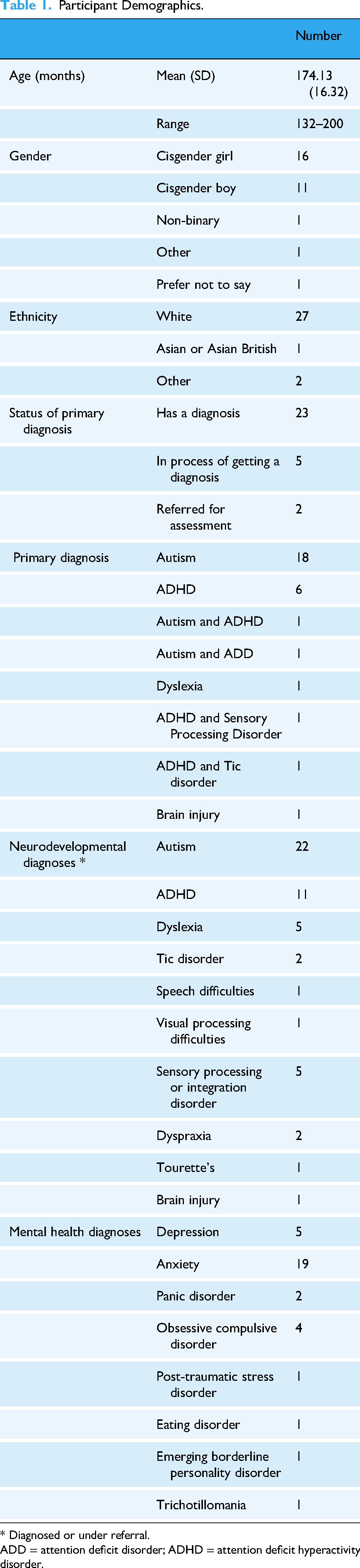
* Diagnosed or under referral.
ADD = attention deficit disorder; ADHD = attention deficit hyperactivity disorder.
Twenty-four participants had never experienced school exclusion, but five had previously received a suspension and one had been excluded. While many either had an Education, Health, and Care Plans (or similar; n = 8) or received Special Educational Needs support (n = 13), four received ‘other’ support, and five were reported by parents as having no support.
Community Involvement
An autistic adolescent and their mother advised upon the interview and parent questionnaires. Their feedback was used for interview refinement. Consultants were reimbursed for their time. In addition to the pre-study consultation with stakeholders, two research assistants supported the data analysis – one was neurodivergent, and one had previous experience of attendance difficulties. The research team was neurodiverse though no team members had lived experience of school distress.
Materials
Interview Protocol
An interview captured lived experiences directly from neurodivergent pupils (protocol available; Supplemental materials). Participants were asked open-ended questions on experiences of school distress and attendance. Indicative questions included ‘Can you tell me a little about your school?’ ‘I understand that being in school can be difficult, and that you have had some problems/difficulties attending school. Could you tell me about them?’ and ‘Can you think of anything else that would make attending school easier for you?’. In addition to open-ended questions, positive and negative statements about school were available to scaffold discussions for participants for whom open-ended questions were challenging.
Parent Questionnaires
Parents completed questionnaires via Qualtrics, which included information collected via a bespoke demographics questionnaire covering type of schooling, and attendance levels/difficulties (e.g., reporting attendance rate), as well as the three widely available questionnaires, that have previously been used in autism and neurodiversity research, described below. The questionnaires/quantitative data were included to provide secondary context and demographics of the sample, to complement the young people's lived experiences which formed the primary focus of the study, and which fed into the thematic analysis. These questionnaires would only be analysed to describe the sample.
The Sensory Processing Three Dimensions scale (SP3D; Miller et al., 2016) is a 73-item parent-report measure of sensory seeking, over-responsivity, and under-responsivity. Items cover all sensory domains and are scored 1 = Yes and 0 = No with possible scores ranging 0 to 73. Sensory difficulties are indicated by higher scores.
The Extreme Demand Avoidance Questionnaire (EDA-Q; O’Nions et al., 2014) is a 26-item parent-report measure for 5- to 17-year-olds. Rated statements include ‘Finds everyday pressures stressful’ and ‘Mood changes rapidly’ and are rated on a 4-point Likert scale (ranging 0 = Not true to 3 = Very true). Potential scores range 0 to 78. The 12- to 16-year-olds are likely to have an EDA profile if they score >45 (>50 for 11-year-olds).
The Anxiety Scale for Children-Autism Spectrum Disorder-Parent version (ASC-ASD-P; Rodgers et al., 2016) is a 24-item parent-report measure of anxiety for autistic 8- to 16-year-olds with four subscales: performance anxiety, anxious arousal, separation anxiety and uncertainty. Items are scored on a 4-point Likert scale ranging from 0 = Never to 3 = Always with possible scores ranging 0 to 72 (>20 significant anxiety). The ASC-ASD-P is used with caution for participants who were neurodivergent but not autistic.
Procedure
Approval was received from the local ethics committee. Due to the potentially sensitive issues that might be raised in the interviews, appropriate enhanced safeguarding was used. Participants were told that the researchers would raise any issues of significant concern with parents as per responsible safeguarding.
Parents completed online questionnaires and the participant was interviewed. Participants had the option of seeing the interview questions in advance to alleviate uncertainty. Interviews were held online via Microsoft Teams. Written and spoken interviews were offered by the researchers to parents and young people in the study information sheet, during recruitment, and again at the start of the interview, to accommodate communication preferences. Twenty-six participants chose spoken interviews and four provided written answers. Nineteen participants kept their cameras on, eight kept cameras off, and three used a mixture. Parents were present at the beginning and end of interviews, and 13 participants wanted parents present for the entire interview. Interviews lasted 29 to 105 minutes. Debriefing took place and parents received a tailored debriefing if participants disclosed issues of concern (e.g., self-harm and suicidal thoughts).
Data Analysis
Reflexive Thematic Analysis: The lead author analysed interview transcripts using reflexive thematic analysis to enable the construction of patterns and meaning (Braun & Clarke, 2006, 2019, 2022). The analysis was both deductive and inductive because although specific issues were anticipated, the open coding approach meant the analysis was not limited to these factors. A critical realist approach was used, to acknowledge that neurodivergent pupils’ responses will be uniquely impacted by their identity and experiences (Pearson et al., 2022). Critical realist approaches are primarily focused on understanding, rather than merely describing, social reality. The researcher coded the data using semantic and latent approaches and constructing meanings to these codes through theme development. Relevance was more important than frequency of codes and capturing the variability amongst participants was prioritised (Braun & Clarke, 2016). The coding and theme construction processes were not linear as the researcher oscillated between steps. The codes and themes were subsequently discussed with two research assistants to confirm the analysis represented the data.
Questionnaire analysis: Questionnaires were analysed using recommended scoring criteria and standard procedures for missing data as available for each measure.
Results
Sample Characteristics
Table 2 summarises the key sample characteristics. This was a group with heightened anxiety (as per ASC-ASD-P; Rodgers et al., 2016) and considerable sensory differences (as per SP3D; Miller et al., 2016). Eighty percent (n = 24) scored within the heightened anxiety range on the ASC-ASD-P. Seventeen percent (n = 5) scored within the range indicative of extreme demand avoidance on the EDA-Q though there was considerable variability. In the bespoke demographics questionnaire, parents reported that attendance difficulties began between 2.5 (nursery) and 16 years, and continued for between 1 month and 12 years. In the 4 weeks prior to participation, attendance varied between 0% and 100%. Parents described how attendance difficulties manifested in numerous ways, from not attending full days, being late, missing lessons and trying to avoid school. These questionnaire insights from parents are useful contextualisation for interpretation of the primary insights from the young people via their interviews.
Parent-Report Questionnaires.

ASC-ASD-P=Anxiety Scale for Children-Autism Spectrum Disorder-Parent; EDA-Q=Extreme Demand Avoidance Questionnaire; SP3D=Sensory Processing Three Dimensions.
Interviews with Young People
Four themes and six sub-themes were constructed from the interviews (Figure 1).

Thematic Map Identifying Core Themes and Sub-themes.
Theme 1: “The Whole School Environment is the Problem”: A Complex Interaction of Difficulties
This theme conveys the complex interaction of difficulties that participants highlighted throughout the school environment. The sub-themes reflect that although there was significant variability, school distress resulted predominantly from interactions between social difficulties, sensory differences and everyday uncertainty. Sub-themes did not occur in isolation and distress was described as building up over time, for example “when you put…flammable petrol in an oven and slowly heat it up, it will take a while for it to ignite but then eventually it will” (ppt 1, 13 years, autistic, attendance difficulties >1 year).
Subtheme: Interacting with People is Difficult
Participants often reported finding interacting with peers and teachers difficult. With peers there were challenges with conversation, friendships and bullying. Participants reported challenges maintaining friendships, and some described peers’ chaotic behaviour and bullying, for example “I kept being…pushed into walls” (ppt 2, 14 years, on autism diagnostic pathway, attendance difficulties 7 months) and the example that “when I walk past people…that have bullied me in the past…they sometimes like…pretend to punch” (ppt 19, 13 years, attendance difficulties 8 years). Conversations with peers during breaks between lessons could be challenging for some, because of “all of the different like cliques and friend groups. I'd usually just end up eating lunch alone in the school toilets, because like it's just too stressful. All of the dramas, all of the like he said this, she said this” (ppt 26, 14 years, autistic, ADHD, attendance difficulties 1 year 4 months).
Participants also highlighted difficulties communicating with teachers, for example when asked to answer a question “it's not like I don’t know…the answer or I can't figure it out…when I'm being pressured, it makes it much harder for me to think” (ppt 8, 15 years, autism, speech difficulties, attendance difficulties 7 years) and this was closely linked to anxiety, such that “I'm always scared I’ve done something wrong at school and I'll get told off” (ppt 22, 15 years, undergoing assessment for neurodivergence, attendance difficulties 2 years).
Subtheme: A Sensory Nightmare
Participants reported sensory differences and impacts which often stemmed from crowded spaces and noises were particularly challenging (e.g., fire alarms and busy spaces). Uncomfortable uniforms, very bright or dim lighting, and overpowering smells, were all reported as disrupting learning. Indeed, some participants highlighted the link between sensory experiences and their education, for example one young person reported “I'm always either…tapping my leg or…playing with…the ring I've got on…I literally cannot sit still” (ppt 15, 15 years, autistic, attendance difficulties 4 years) and another highlighted “I really find it hard to pay attention” (ppt 28, 11 years, dyslexia, visual processing difficulties, attendance difficulties 4 years). Broadly, sensory experiences were highly impactful – “they're painful…they actually hurt” (ppt 17, 13 years, autistic, ADHD, sensory processing/integration disorder, attendance difficulties 7 years) and “every area has the potential to be loud and noisy and busy” (ppt 24, 14 years, undergoing assessment for neurodivergence, attendance difficulties 4 years).
Subtheme: Stop Changing Things
Participants reported struggling with uncertainty and anxiety, and sudden changes were impactful. For example, “I like to know what's happening everyday…I like to think I'm flexible, but I'm really not…I really don't like change… if I'm not aware of it it's extremely difficult” (ppt 21, 14 years, ADHD, sensory processing/integration disorder, attendance difficulties 1 year). A key change had been the pandemic which impacted education and participants reported having mixed experiences. Some described positive aspects or explained that their opinions about school did not change during the pandemic. Many enjoyed being at home, but some struggled to learn. Almost half explained that the pandemic impacted, catalysed or exacerbated their school distress and attendance difficulties. Many participants also found the transition back to ‘normal’ school difficult as “it was a long break and its quite hard to go back” (ppt 4, 12 years, autistic, attendance difficulties 2 years).
Difficulties coping with change were also linked to changing schools as a possible solution to school distress. Participants overwhelmingly disliked this idea and did not think changing schools would help, for example “I don't really like the idea of changing school…I feel like most schools would be like this, not just mine” (ppt 27, 13 years, undergoing assessment for neurodivergence, attendance difficulties 15 months).
Subtheme: An Onslaught of Stress
School was reported as an ‘onslaught of stress’, with long days, back-to-back lessons, no time to recharge, too many people and never-ending sensory impacts all highlighted. These issues were not restricted to specific days and occurred throughout the school environment. One participant highlighted the impacts which appeared overwhelming – “It's the kids in the class, the way they teach, how fast they teach, the size of the classroom, where it is in the school…the lessons are still hard, no matter how accommodating they are…it's just difficult to be in that room for an hour, over and over” (ppt 3, 15 years, autistic, attendance difficulties 5 years).
Theme 2: “We All Show it Differently”: Multiple Versions of Distress
The uniqueness of experiences and impacts was important, and sub-themes highlighted this variability.
Sub-theme: Different Presentations of Distress
Experiences of school distress were reported as beginning at different ages and lasting for varying durations. In some cases, but not others, there were time-limited impacts, for example a specific school year/teacher. For example, “it's been a bit of an issue since year seven…But I started refusing to go…about when the school year started in September” (ppt 2, 14 years, autism diagnosis in progress, attendance difficulties 7 months) highlighting that distress preceded attendance difficulties for this young person. Some participants also reported that certain weekdays could be worst, depending on factors such as the subjects, teachers and friends they had in lessons – “the whole day could be a bit bad, or like certain lessons could be a bit bad” (ppt 12, 12 years, undergoing assessment for neurodivergence, attendance difficulties 6 months).
Distress could be present at different times of the day across young people. For example, some participants sometimes wanted to leave school during the day due to distress and others struggled to go into school. Mornings and evenings might be filled with anxiety by anticipating negative experiences the following day, for example “once I get home, I like started getting worked up about like the next day…it was like a big cycle” (ppt 30, 12 years, ADHD, autism diagnosis in progress, attendance difficulties 10 months). This distress directly impacted the ability to attend, with some managing to attend but experiencing distress, some only attending certain lessons, and others not attending at all (“I missed pretty much half of last year”; ppt 22, 15 years, undergoing assessment for neurodivergence, attendance difficulties 2 years).
Subtheme: A Devastating Impact
Participants described numerous emotional and physical impacts. Physical and/or physiological symptoms were associated with anxiety, for example “some days I feel like…someone's got their hands around my throat or like I'm being weighed down on my chest” (ppt 3, 15 years, autistic, attendance difficulties 5 years). Emotionally, participants reported self-blame and feeling “incompetent” (ppt 4, 12 years, autistic, attendance difficulties 2 years), as well as feeling sad, angry, lonely, different from peers and incredibly anxious. For example, “you're always isolated…life is a lot more miserable” (ppt 1, 13 years, autistic, attendance difficulties >1 year), and “it feels like I'm standing on the edge of a cliff…I'm trying everything I can to walk to safety but…even the tiniest of movements could send me into real danger…I'm very, very rarely relaxed at school” (ppt 21, 14 years, ADHD, sensory processing/integration disorder, attendance difficulties 1 year).
Regarding emotional impacts, masking was often reported, and this could be associated with exhaustion and burnout, such as “it's tiring, but it's…more simple than trying to…not mask, which gets you all kinds of problems” (ppt 25, 16 years, autistic, ADHD, dyslexia, attendance difficulties 3 years). Relatedly, school could feel stressful and all-consuming. Some participants did not enjoy other areas of life and experienced mental health difficulties, including self-harming and suicidal ideations, both in and out of school – “I've just had like suicidal thoughts this whole time. I can't really think of any other way out of this” (ppt 1, 13 years, autistic, attendance difficulties >1 year), and “I was sent home last week …clawing at my arm until it bled slightly…having what I could describe as a major anxiety attack” (ppt10, 16 years, autistic, sensory processing/integration disorder, attendance difficulties ∼1 month).
Theme 3: The Lack of Understanding and Support
Participants reported feeling that some staff/teachers lacked understanding of neurodivergent experiences, such as pupils’ sensory and communication needs and mental health difficulties. They felt a lack of appropriate understanding impacted the provision of physical accommodations or relevant emotional support. An awareness of different communication needs was highlighted, as “the way we see things and understand…can be…different…the teacher may be explaining something…but I may think they're having a go at me” (ppt 6, 14 years, dyslexia, autism diagnosis in progress, attendance difficulties ∼12 years, since nursery) and the importance of individualised approaches was critical to “[take] the time to like learn a child, so they’d…understand” (ppt 18, 15 years, diagnostic pathway for autism, ADHD, sensory processing/integration disorder, attendance difficulties 2 years). Some participants felt that teachers viewed them as defiant, failing to see their desire to learn and their worries about being excluded. Some participants also reported negative and invalidating behaviour such as “when I was having a panic attack, I was told to stop being pathetic and go back to class” (ppt 5, 14 years, on diagnostic pathway for autism, ADHD, attendance difficulties 5 years) and “one of the teachers I had made me roll up my sleeves…to prove that I was actually hurting myself and that's just messed up” (ppt 26, 14 years, autistic, ADHD, attendance difficulties 1 year 4 months).
Young people often felt that their support needs were not met within their current school provision. Participants reported struggling to obtain appropriate support, and support sometimes came so late that their needs had already changed. Participants felt that physical accommodations, such as exam arrangements and safe spaces, were either insufficient or non-existent, for example “I have like an individual support plan like strategies they are supposed to do…like putting subtitles on videos and a lot of them…don't follow it” (ppt 29, 16 years, autistic, ADHD, attendance difficulties 18 months).
Participants felt that teachers sometimes imposed inflexible rules which left them feeling they had no autonomy. For example, it was highlighted that “just making school more flexible…it can kind of be what it needs to be for different people” (ppt 25, years16, autistic, ADHD, dyslexia, attendance difficulties 3 years). Participants also wanted staff to be a source of support, through increased rapport and communication – “check in more…at the start of the year they should like sit down with the student and ask them what they can do to support them in their lessons…I'd feel like I’d be able to speak about stuff I would be worried about in lessons” (ppt 11, 16 years, autistic, attendance difficulties 5 years).
Theme 4: What is the Alternative?
While some participants commented feeling that they attended the best possible schools, they still experienced significant challenges. Many wanted to be able to go to school, and noted the importance of attendance, such as needing “good grades to get anywhere in life” (ppt 14, 16 years, autistic, sensory processing/integration disorder, attendance difficulties 9 years) and they acknowledged that finding solutions to school distress and attendance difficulties was challenging. For example, “everyone struggles with something…you can't do one thing that helps all of them” (ppt 16, 16 years, autistic, ADHD, Tic Disorder, Tourette's, attendance difficulties 2 years) and that it is complex such that “help that they give makes another thing worse…I have had my exit card but I couldn't really use it cause it was too stressful…that's solving one problem, but then causing another one” (ppt 24, 14 years, undergoing assessment for neurodivergence, attendance difficulties 4 years).
Participants described mixed feelings about alternative provision. While some thought attending a school specifically for neurodivergent pupils might help, others worried about academic achievement and bullying, for example “there was only one school…that…lets children…access the full GCSE curriculum, which is what I need” (ppt 17, 13 years, autistic, ADHD, sensory processing/integration disorder, attendance difficulties 7 years) and “I do worry that that the kids might still have an issue with me” (ppt 2, 14 years, autism diagnosis in progress, attendance difficulties 7 months). Home was reported as a safe space for some participants and homeschooling was “the only other best option” (ppt 14, 16 years, autistic, sensory processing/integration disorder, attendance difficulties 9 years). However, participants had sampled homeschooling during the pandemic, and faced some of the social and academic challenges, such as “you don't get to spend time with your friends” (ppt 12, 12 years, undergoing assessment for neurodivergence, attendance difficulties 6 months) and “I found… the online learning quite hard, very overwhelming, cause you just got…a big list of things to do” (ppt 6, 14 years, dyslexia, autism diagnosis in progress, attendance difficulties ∼12 years, since nursery).
Crucially, participants reported wanting to be able to attend school without distress and to learn – “I want to be [in] my lessons and I want to be learning” (ppt 29, 16 years, autistic, ADHD, attendance difficulties 18 months). However, they recognised the issues in that “If kids would rather…be sick than be in school…that's really a problem” (ppt 1, 13 years, autistic, attendance difficulties >1 year) and the challenges as “I don't think there really is anything that can make school easier for me. Just not going” (ppt 24, 14 years, undergoing assessment for neurodivergence, attendance difficulties 4 years). Some participants expressed a sense of hopelessness and felt that “no amount of trying could fix the school system” (ppt 1, 13 years, autistic, attendance difficulties >1 year).
In summary, across the four themes there was a complex interaction of experiences. One young person eloquently described their experience as: “imagine a pit and that pit is school…the pit is full of lions…every day you've been told to jump in… no matter how much pain it's going to cause you…because that's what everyone else does…sometimes they decide to add a couple of snakes…when that goes and [you’re] just left with the hungry lions…it's still terrible, but it does get worse…But everyone else has this very powerful armour on that the lions can't penetrate…I've not got that armour because I'm different…the SENCO will go here you can have half of it…half of it I’m managing, and the other half…I'm in a pit of lions and I'm not protected.” (ppt 17, 13 years, autistic, ADHD, sensory processing/integration disorder, attendance difficulties 7 years)
Discussion
The current study provides timely insights into the lived experiences of neurodivergent pupils currently experiencing school distress and attendance difficulties. Connolly et al. (2023) highlighted the ‘attendance crisis’ is ‘a story dominated by neurodivergence’ but that we currently lack sufficient understanding. Research so far has not prioritised the lived experiences of the young people themselves. This qualitative study allowed for the complexities of the lived experience to be captured via interviews and there is no doubt that the highly insightful, personal, and often harrowing descriptions in this study emphasise significant areas of concern. While these descriptions direct from the young people can make for hard reading, the evidence can be used to inform future decision-making, to break down barriers, and improve the equity of access to education.
Participants were diverse in their experiences of neurodivergence (Table 1). Previous research has predominately focused on the school attendance experiences of autistic pupils (Munkhaugen et al., 2017; McClemont et al., 2021; John et al., 2022; Totsika et al., 2020), but the current study took a broader approach. This is relevant as Connolly et al. (2023) emphasised co-occurring multiple forms of neurodivergence, as well as mental health challenges, within their sample, and a similar picture is seen here. While the current sample included young people with various forms of neurodivergence, for 18 participants (60% of sample) the primary diagnosis was autism. Connolly et al.'s (2023) sample was also predominantly autistic (83% of the sample). The three most common sub-groups in both the current study and Connolly et al. (2023) were autism, ADHD and sensory processing disorder. Neurodivergent samples do not fit into discrete diagnostic ‘boxes’ (Astle et al., 2021) and a broad approach to recruitment captures the real-world prevalence of neurodivergence(s). Failing to take such approaches risks under-recognising heterogeneity (cf. Joshi et al., 2017). This is especially relevant when considering the prevalence of neurodivergent young people within our mainstream schools (e.g., recent estimates of 16.22% of primary school children utilising formal diagnosis rates in Scotland, as per Maciver et al., 2023), beyond those who are autistic-alone. This issue is also important as we highlight that all themes were represented by individuals with a variety of forms of neurodivergence, and there was no clustering of experiences based on a specific diagnostic group.
The first theme highlighted that so many of the elements that are inherent within the school environment, but over which pupils have little or no control, can combine to impact school distress. The environment is complex and multi-sensory, schools are busy and pupils are constantly using social and emotional skills as well as trying to learn. The school environment is frequently changing, as different days mean different lessons/teachers, pupils need to move between lessons along busy corridors, and there might be unexpected routine changes (e.g., a substitute teacher). These features of school-life speak directly to issues that are known to be especially challenging for neurodivergent pupils. For example, it is known that sensory experiences can relate to learning for autistic pupils (Ashburner et al., 2008; Jones et al., 2020) and that anxiety can significantly impact school experiences (Adams et al., 2019). Several quotes in theme 1 highlighted the inter-related nature of these challenges which are not restricted to classrooms, but occur throughout school. The interplay between elements of sensory processing, anxiety and uncertainty has been highlighted previously in relation to autism (Wigham et al., 2015) and ADHD (Reynolds & Lane, 2009). Alongside the parental insights from Connolly et al. (2023), the current study maps these experiences to school distress and attendance in the views of the young people, and in the contextual data provided through parental questionnaires. While these issues appear complex, potential solutions were suggested by the young people themselves, such as providing quiet and safe spaces in school, reducing the amount of change to the school timetable, and increasing flexibility with the rules (e.g., allowing pupils to have uniform adjustments, wear earphones or time transitions to avoid busy corridors). These suggestions complement others in the literature, such as increased support for transitions (e.g., between school stages; Sideropoulos et al., 2024) and auditing the sensory environment (Jones et al., 2020). Although more evidence-based guidance is needed (cf. Johnston et al., 2024; Preece & Howley, 2018; Melin et al., 2022), the possible suggestions from participants are adjustments that schools could opt to implement immediately, some with minimal financial cost and time required. The neurodivergent young people in this current study highlight the potential impacts of prolonged unmet needs, further highlighting the necessity for these actions.
The second theme explored the varied presentations and impacts of school distress. The variability in how difficulties began, changed over time and impacted participants clearly demonstrates that these are not homogenous issues. The combined impacts across many aspects of life culminate in very challenging experiences of self-harm for some of these young people. The presence of self-harm in this group mirrors evidence from largescale quantitative data (John et al., 2022). Indeed, it is known that masking (Chapman et al., 2022) and self-harm (Blanchard et al., 2021) can be higher in autistic people than non-autistic people, and the current evidence makes a link between these issues and school distress. Since each child experiences school distress and attendance difficulties uniquely, the approach to supporting them should be tailored to their individual needs. A crucial way to do so is by embedding young people's views into systems that offer support.
The third theme highlighted that pupils felt there needed to be increased awareness of neurodiversity. This is not uncommon in studies of neurodivergent and autistic pupils in relation to schooling (Havik et al., 2014; Melin et al., 2022), or indeed concerning awareness within society (Cage et al., 2018). Some participants felt that insufficient support was a result of a lack of understanding of their needs. Pupils emphasised the need for neurodiversity-affirmative approaches and education for school staff, centred around both neurodiversity and mental health (cf. Dallman et al., 2022). The importance of this point is highlighted by the wider literature, where it has been found that teacher attitudes play a role in implementing inclusive teaching strategies (Wilson et al., 2019; Wilson et al., 2024).
The fourth theme emphasised that pupils often felt there was a lack of potential educational options available to them. This lack of alternative has been expressed elsewhere by parents when their neurodivergent child has been excluded from school (Gray et al., 2023). It was striking that pupils had a strong sense of wanting to be in school and that they felt they were going to great lengths to try to attend, but the current provision was not meeting their needs.
The overriding picture painted by the neurodivergent pupils interviewed in this study was one of the significant and wide-ranging school distress which impacted the ability to attend school and engage with learning. These issues were represented across individuals with multiple different diagnoses associated with neurodivergence and varying lengths of school distress experiences. Crucially, the themes highlighted by the young people do not occur in isolation – while we have taken them in turn for interpretation, the experiences in the real world are inter-related and together they impact lived experiences of school life for these young people. These diverse young people had a sophisticated understanding of their experiences and the impacts on many aspects of their lives. Alongside Connolly et al. (2023), these qualitative and quantitative insights from multiple informants should be used to inform policy and practice, as there is now significant evidence that triangulates to highlight that neurodivergent pupils need to be considered at the core of discussions about school distress and attendance difficulties.
Limitations of this study, and possible future directions for research, must be considered. First, participants were mostly White, and autistic and/or had ADHD. This limitation could be related to how participants were recruited, so it would be beneficial for future work to consider how the views of a more diverse group of participants can be included. While the current sample was able to use oral and written responses to enable participation, future research should look to enhance the range of methods used to gather multi-informant insights. This study focused solely on pupils who were registered at mainstream secondary schools, whereas future research also needs to be inclusive of young people with additional learning difficulties and/or communication differences or who might be struggling to attend specialist educational provisions (e.g., separate provision beyond the mainstream system that is aimed at supporting specific demographics of pupil). To enable this research, innovative routes to participation are needed, for example involving co-design with participants with learning difficulties (Tuffrey-Wijne et al., 2020), or methods such as photo elicitation (Sigstad & Garrels, 2021), or arts-based methods (Leavy, 2020). Future research should also consider different stages of education across each of the UK nations. These issues are not restricted to secondary education (e.g., approx. 11–18-year-olds) and impact primary school pupils (approx. 5–11-year-olds in the United Kingdom), and may look different across the devolved nations of the United Kingdom. Further embedding of educational experiences within different educational systems would be important further consideration (which was beyond the focus on the current study). To fully understand all educational experiences, across different forms and stages of educational provision, it is important that we take a multi-method, multi-informant approach. Finally, the aim of the current article was to utilise the standardised measures to describe the sample at the group level rather than making direct links between sensory experiences, anxiety or demand avoidance and lived experiences of school distress. Further research may take a multi-methods approach to linking these issues at a more individual level.
To conclude, this study gave neurodivergent pupils currently in UK mainstream secondary schools and experiencing school distress and attendance difficulties, the opportunity to share their experiences. Pupils highlighted numerous contributing factors and emphasised the highly impactful nature of their school distress experiences, not only for attending school but for their wellbeing. These neurodivergent young people did not feel their needs were currently being met by their school, but they also felt that there was also not a viable alternative to mainstream school available to them. The insights contribute timely evidence of how and why neurodivergent young people in UK mainstream schools are prone to heightened incidences of school distress, and how such distress can impact the ability to attend school and engage with learning. The education sector needs such evidence to determine a way forward.
Supplemental Material
sj-docx-1-ndy-10.1177_27546330251327056 - Supplemental material for Neurodivergent Pupils’ Experiences of School Distress and Attendance Difficulties
Supplemental material, sj-docx-1-ndy-10.1177_27546330251327056 for Neurodivergent Pupils’ Experiences of School Distress and Attendance Difficulties by Chloe Fielding, Alice Streeter, Deborah M Riby and Mary Hanley in Neurodiversity
Footnotes
Acknowledgements
The authors would like to thank the young people who shared their experiences and Priya, Kazel, and Rachel who all made contributions to the project.

Ethical Considerations
Ethics approval was provided by the Department of Psychology ethics committee at the University of Durham.
Consent to Participate
All parents were active informed opt-in consent for their child to participate and the young person (due to age) provided their assent at the start of the interview.
Consent for Publication
All data anonymised in the current paper as per ethical approval and data management approval.
Funding
The authors disclosed receipt of the following financial support for the research, authorship, and/or publication of this article: This research was funded by the Economic and Social Research Council (ES/P000762/1).
Conflicting Interests
The authors declared no potential conflicts of interest with respect to the research, authorship, and/or publication of this article.
Supplemental Material
Supplemental material for this article is available online.
References
Supplementary Material
Please find the following supplemental material available below.
For Open Access articles published under a Creative Commons License, all supplemental material carries the same license as the article it is associated with.
For non-Open Access articles published, all supplemental material carries a non-exclusive license, and permission requests for re-use of supplemental material or any part of supplemental material shall be sent directly to the copyright owner as specified in the copyright notice associated with the article.
