



Abstract
This paper describes the eight phases of an innovative procedure for collective and reflexive research about neurodiversity. Structured by Q methodology, this procedure allowed a small group (n = 10) of neurodivergent researchers to identify and discuss our different viewpoints on what neurodiversity means (three viewpoints) and aims for (three viewpoints). The rigour of the procedure was underpinned by the use of Q items collectively self-generated by the group, individual Q sorting of these items to render ‘operant’ each member's viewpoint, Q factor analysis to compare and group these data quantitatively, and group discussion to interpret these factors and to discuss the implications of our differences for the practical future of the neurodiversity movement. The significance of this procedure is that it provides a new way for neurodivergent neurodiversity researchers to collaborate in surfacing and understanding differences and similarities in their views on what the neurodiversity movement is and what it should aim to do. There is a growing focus on neurodiversity across society and it is important to appreciate diversity to avoid misunderstandings around concepts and aims. The variation in viewpoint here demonstrated can inspire future research and help shape the basis for the theoretical discussion informing the movement going forwards.
Introduction
Neurodiversity is a movement in dynamic flux, and the integration of its key concepts and practices into prevailing understanding and practice is still in its infancy (see Dwyer et al., 2024). There has been a move within the neurodiversity field for research to be conducted not ‘on’ or ‘with’ but by neurodivergent people, and in that context, there is much debate about what neurodiversity is and what it should achieve (Rosqvist et al., 2020). These academic and public sphere debates can involve misunderstandings and even acrimony amongst proponents and opponents of the neurodiversity movement (see Ne’eman & Pelicano, 2022). For example, neurodiversity is sometimes treated as if it referred exclusively to autism, and neurodivergence is sometimes treated as though it were a deficit (Thompson, 2024). Risk of thought and practice losing nuance and rigidifying around polarised oppositions is high (Gillespie-Lynch et al., 2020). As the movement progresses, there is clear need for open debate respectfully including a range of perspectives (Botha & Cage, 2022). Here, we present a reflexive and collective procedure for empirically identifying and openly discussing the nuanced variety of perspectives held by a small group of neurodivergent academic researchers who study neurodiversity (and/or neurodivergence).
Neurodiversity is the rallying-call for a relatively recent social and civil rights movement (Sinclair, 2005). The movement is predominantly Western and Anglophone (which has its own issues, see Botha & Gillespie-Lynch, 2022; Giwa Onaiwu, 2020; Kourti, 2022; Nair et al., 2024) and is spreading quickly, albeit unevenly, in today's interconnected world (Cheng et al., 2023). The birth of new concepts is rarely attributable to single individuals, but the coining of terms can be more easily traced (Collins, 2011). The US journalist Harvey Blume is credited with the first publications to use the terms ‘neurological diversity’ (Blume, 1997) and ‘neurodiversity’ (Blume, 1998) whilst Singer claims to have coined the word ‘neurodiversity’ in her sociology honours thesis from 1997/1998, first published as a book chapter in 1999 (see Singer, 2016). The concept of neurodiversity is grassroots however, having arisen from autistic community members in the early 1990s before being shortened from neurological diversity to neurodiversity (Botha et al., 2024; Dekker, 2023). Sinclair's (1993) ‘Don’t Mourn For Us’ was seminal in urging adoption of the perspective of Autistic people themselves, urging parents of autistic people to ‘look at our autism, and look at your grief, from our perspective’. This new perspective arose along with the emergence of autism advocacy groups like Autism Network International and associated networks and fora (Pripas-Kapit, 2020).
The term ‘neurodivergence’ is newer (Asasumasu, 2016), and clearly articulates the conceptual difference already present in Sinclair's activist distinction between our autism (generalised as ‘neurodivergence’) as marginalised by your neurotypicality. The concept of neurodiversity discourages any assumption that neurodivergence is a deficit. It highlights the harmful consequences this assumption brings to all, but especially neurodivergent people (Farahar & Bishopp-Ford, 2020). The marginalised category of the ‘neurologically diverse’ is broad, open-ended and open to debate (Kapp et al., 2013; Milton, 2020). It most often includes developmental neurodivergence such as autism, ADHD, dyslexia and dyspraxia, but in principle (and sometimes in practice) is expandable to include other ways of being or ‘neurotypes’ (Chapman, 2021a; see also Liebowitz, 2016). This terminology has been strongly influenced by neurodivergent researchers and activists (Eyal et al., 2010; Le Cunff et al., 2023) and has become ubiquitous within public sector institutions like schools and colleges, as well as within private businesses, popular culture and activist politics (Yergeau, 2018).
There are differences in how researchers view the core tenets of a neurodiversity framework and the utility of such an approachn (Donna-Lee, 2020). Some emphasise the productive value of certain kinds of minds (Baron-Cohen, 2017) whist others emphasise the emancipatory nature of a value neutral approach (see Dwyer et al., 2024). These disagreements can tangibly impact how research is conducted (Jaarsma & Welin, 2012), as well as questions around boundaries, politics and the scientific bases of the movement (Campbell, 2020; Chapman, 2020).
The current paper approaches these differences empirically, collaboratively and reflexively. Forming a small group of neurodivergent researchers of neurodivergence and/or neurodiversity, we designed and implemented a procedure for surfacing and exploring any theoretical, practical and political differences amongst us in an open way that could be discussed without defensiveness. This paper presents and reflects upon the collective and reflexive procedure we adopted, the results of our collaboration and their implications for the movement.
Procedure: Use of Q Methodology within a Collective Reflexive Process
Phase 1: Group Formation, Aim and Initial Plan
A team of 11 neurodivergent researchers, each with an active interest in research on neurodiversity, formed an online working group. We committed to developing a reflexive procedure for exploring similarities and differences in our own views on the growing field of neurodiversity. It is obvious that the constitution of the group matters and limits the results produced, and it is impossible for such a small group to include people from all (intersectional) backgrounds. The priority of the three of us who instigated the group formation (Paul Stenner, Monique Botha and Hanna Bertilsdotter-Rosqvist) was to involve researchers with an active interest in neurodiversity and who identify with a mixture of neurodivergences (autistic, ADHD, dyspraxic, dyslexic, dyscalculic). The group needed to be small, internally diverse, available for a long series of online meetings, mutually trusting and committed to a lengthy (two-year) process of reflexive self-examination. One person did not complete all aspects of the project (and just one Q sort), so below when ‘the group’ is referred to this includes the remaining 10 people.
Further biographical details and data of each group member can be found in supplementary materials here: https:/osf.io/z8qp4/. Following collaborative principles of respect, authenticity and empathy (see Fletcher-Watson et al., 2019), we respected the privacy of group members by allowing them to decide which biographical details each was prepared to share. The group is heterogenous in terms of age, research experience, academic disciplinary location, ontological and epistemological commitment and gender and sexual identity, but all reside in the UK or Sweden (two are Swedish, one German, one from the USA) and most are white. It must be stressed that the purpose of this group was not to claim to be ‘representative’ of a wider population of neurodivergent researchers of neurodiversity, but to be the vehicle for an innovative reflexive collaboration based on a qualitative process of airing, sharing and comparing our views. Our group does not claim to speak for the entire neurodiversity movement, but if variability of viewpoint can be systematically demonstrated and discussed even amongst a small group such as ours, then this might encourage further use of the procedure by other groups with different compositions, yielding further nuance of diversity. Our aim was thus to develop a robust procedure for getting a sharper understanding of the similarities and differences amongst our viewpoints, and for listening to that variety.
We have taken pains in the paragraph above to ward off a common misunderstanding that all methods (especially ‘quantitative’ methods) must provide statistical means for moving inductively from ‘sample’ to ‘population’. The process of reasoning from a ‘sample’ to a whole species is called induction. Were such inductive generalisation our aim then our ‘sample’ would be too small and biased. Our group, however, was not conceived as a ‘sample’ but as a vehicle for innovative reflexive inquiry. Indeed, our project questions the familiar (and perhaps neurotypical) norm of aiming to make inductive generalisations by running inferential statistical tests on ‘thin’ quantitative data collected from large numbers of participants. The almost ritualistic repetition of this norm has contributed greatly to a widespread replication crisis (Gigerenzer, 2018). Worse, those who first established this methodological norm (Galton, Pearson, Spearman and Burt developed the correlational and factoring techniques used in psychometrics, and Fisher developed experimentation based on analysis of variance) were eugenicists hostile to neurodiversity and to egalitarianism as such (Chapman, 2023; Richards & Stenner, 2022).
Phase 2: Incorporating Q Methodology into our Collective Reflexive Procedure
One UCL psychologist had the courage during the 1930s to fundamentally question the methodological assumptions of his colleagues Pearson, Spearman and Burt. William Stephenson was an able mathematician and physicist PhD before becoming a psychologist. He invented Q methodology, which uses the same statistical techniques as factor analysis but with very different assumptions, not based on inductive generalisation (Watts & Stenner, 2012). Q methodology has already proved useful for studying neurodivergence (Mantzalas et al., 2023; Thompson et al., 2019) including amongst neurodivergent researchers (Milton, 2016). Because of its rigour (see below), we decided to use it in an innovative way to structure our reflexive collaborative investigation. Q data are collected in the form of ‘Q sorts’ where each Q sort is a particular way of sorting a set of propositions about an issue. A first step was therefore to jointly generate a large set of propositions, each saying something about the issue of neurodiversity. We could then each sort these propositions to express our viewpoint, and then compare our viewpoints (i.e., our Q sorts) with the assistance of factor analysis (Stenner & Capdevila, 2019). This evidence-base could then provide an empirical spring board for discussing the similar and different understandings of neurodiversity at play in our group.
Phase 3: Generating the Propositions
After discussions, we generated many propositions about the neurodiversity movement. This was done synchronously in a meeting, and continued using a shareable online document. Over 200 propositions were generated and any implicit categories amongst the drafted items were noted, allowing us to organise them into thematic groupings. This coding then guided the drafting of new items to fill the gaps that became evident. At the end of this process, all items were grouped into five main categories (intersectionality, being divergent, the making of neurotypicality, existential rights and hierarchy of knowledges), some with subthemes (Hierarchy of knowledges had ‘diagnosis’, ‘research agendas’, ‘self-determination, leadership and empowerment’, ‘scope and range of construct of neurodivergence’ and ‘legitimacy of the construct’ as subthemes).
Phase 4: Selecting An Item Set from the Wider Pool of Propositions
A more manageable set of propositions was then selected by eliminating any redundant or unclear items. The remaining items proved divisible into two types of proposition: ‘what is neurodiversity?’ and ‘what should the neurodiversity movement do?’ Each set (called ND1 ‘understandings’ and ND2 ‘prescriptions’) contained 55 items (all can be found in supplementary materials here: https:/osf.io/z8qp4/. This selection process was led by a sub-group (n = 5) and checked and confirmed by the remaining group members.
Phase 5: Completing the Q Sorts
The items of both Q sets were numbered and uploaded to the online Qsortware programme for data collection (qsortware.net). Each group member was asked to complete both Q sorts by reading each item and then sorting each into one of three piles: agree, neutral and disagree. This initial sorting task makes it easier to complete the full sorts, which in both cases involved ranking each item into one of 11 piles ranging from −5 (most agree) through 0 (neutral) to +5 (most agree) according to the following distribution:
Ranking position: −5 −4 −3 −2 −1 0 +1 +2 +3 +4 +5 = 11 piles
Number of items: 2 3 5 6 7 9 7 6 5 3 2 = 55 items.
Phase 6: Analysing the Data
Principal components analyses (with varimax rotation) were conducted for both studies using KenQ software (Banasick, 2023). As further discussed in the Results and Interpretations section, three significant factors were identified in each study, each factor serving to group together researchers with a similar perspective on what neurodiversity is (ND1 factors 1, 2 and 3) and what it should do (ND2 factors 1, 2 and 3).
Phase 7: Collectively Interpreting and Discussing the Results
Guided by the most experienced Q methodologist (Stenner), each member of the group then entered the phase of interpreting the results. This involved: inspecting the distribution of items corresponding to each factor and summarising the perspective expressed; confirming that each factor corresponds to the actual views of those individuals grouped on the factor; discussing the differences in perspectives; observing how ‘understandings’ factors related to ‘prescriptions’ factors; and debating how useful and relevant these findings might be for the movement. This reflexive research activity resembles ‘auto-ethnography’ but also differs because of its collective nature (and because Q methodology was used to structure the process). This collective nature proved particularly interesting because – despite our ostensible similarity as neurodivergent researchers – it constantly provided concrete encounters with ‘otherness’. Each of us was presented with fruitful contrasts and points of comparison with one's ‘own’ position.
Phase 8: Co-Authoring the Paper
The first author led on authoring the paper, but each group member contributed as drafts were circulated. More details on authorship contributions can be found in supplementary materials here: https:/osf.io/z8qp4/.
Ethical Issues
This research project conforms to and complies with the Open University Human Research Ethics Committee's conditions for exemption from formal review. The work here reported is part of an openly conducted exploratory procedure undertaken solely by consenting academic researchers. Each co-researcher collaborated in generating Q sort items and each completed their own Q sorts to be analysed and collectively interpreted. Each involved researcher is a named author and individual Q sorts are also named and treated as an authored product of the process. Consistent with an Open Science ethos, we are making the creation of the Q sort instrument and its use in the collective reflexive process as public and transparent as possible. Each researcher signed a formal declaration of consent to this manner of making the collaboration process and product public.
Results and Interpretations
First, we report the results of the ‘understandings’ sort (ND1) and our interpretations of the three factors, followed by ‘prescriptions’ (ND2).
ND1: Understandings of Neurodiversity
Table 1 shows how the Q sorts completed by the 10 named neurodivergent neurodiversity researchers load onto three factors.
Factor Loadings for ND1 Understandings (Factor Grouping for each Person Noted in Bold).

A factor in Q methodology is a mathematical product defined by the Q sorts which load significantly upon it alone. Hence, factor 1 in the table is defined by the first seven Q sorts. Note that Monique’s Q sort is the best exemplar of this factor because it loads it at 0.83 but has negligible loadings on factors 2 and 3.
Q sorts with correlations on factors which exceed the 0.05 threshold of statistical significance are shown in bold on Table 1. The higher the correlation, the more completely a given Q sort exemplifies the viewpoint of a factor.
Any two factors can be compared using a spatial distribution of the data points on two dimensions. The first image in Figure 1 shows how the Q sorts are distributed between the dimensions of factor 1 and factor 2 (F1 and F2). F1 is the vertical dimension and all of its factor exemplars cluster around the positive (+) end of its pole (with Monique's Q sort being the most ‘northerly’, with loadings of 0.83 on F1 and 0 on F2). F2 is the horizontal dimension and its three exemplars (Q sorts 1, 9 and 11) cluster around its positive pole. Rebecca's Q sort (10) does not load significantly either F1 or F2 but it does exemplify the third factor which is shown in the second image of Figure 1.
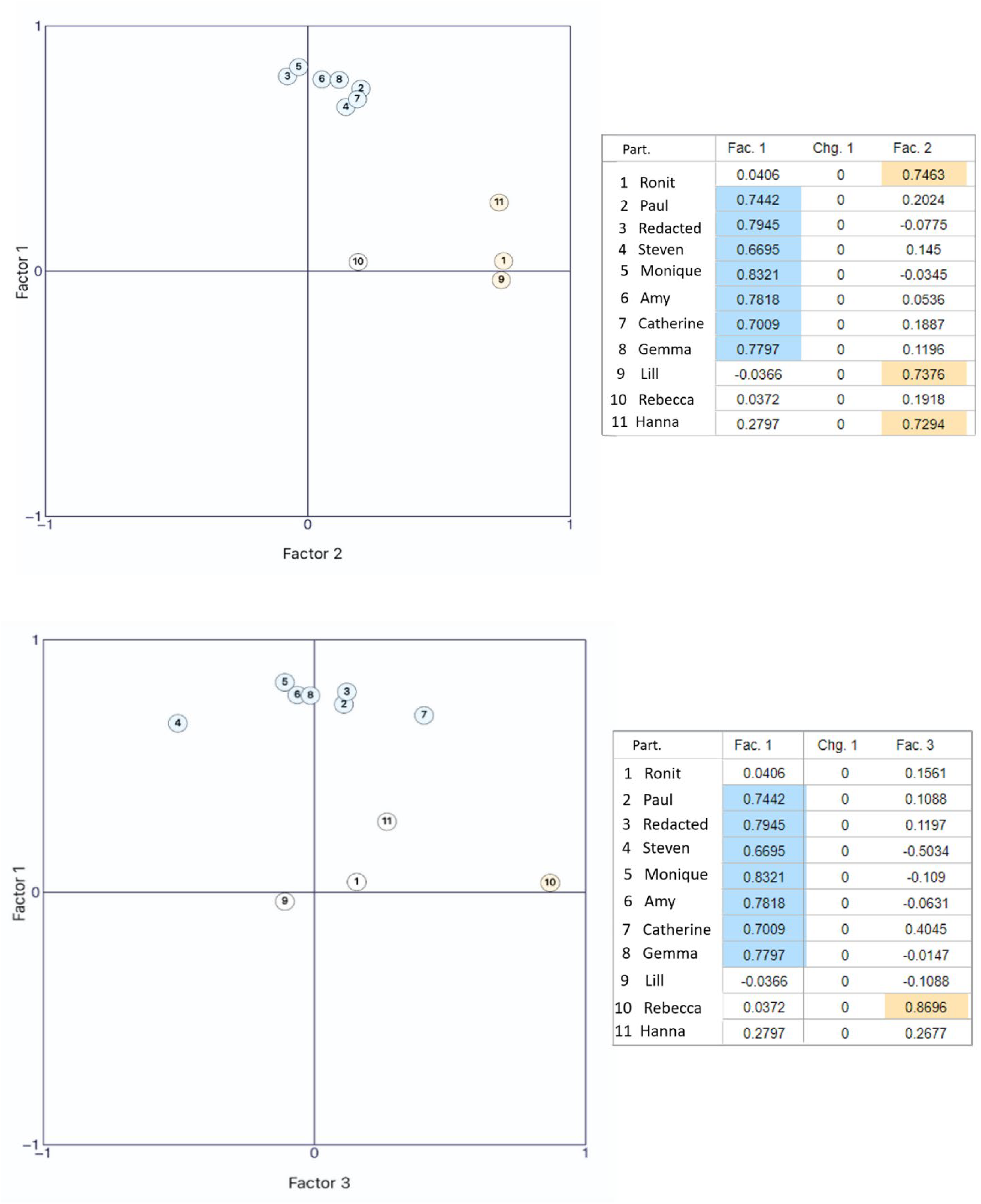
Spatial Representations of the Q Sort Loadings on ND1 F1/F2 and F1/F3.
ND1 Understandings of Neurodiversity: Interpretations
There are three clear perspectives in the data, yet they also share much common ground. We can interpret the content of each factor by creating and inspecting their ‘factor arrays’. A ‘factor array’ is produced by merging all the Q sorts that exemplify a given factor (using a procedure of weighted averaging). Hence, the seven Q sorts exemplifying F1 were merged to generate a single ‘factor array’ serving as the best-estimate of the factor 1 viewpoint (see Figure 2).

ND1 Factor 1 Array. *p > .05, **p > .01, > and < Denote Z Score Directionality (Higher or Lower) in Comparison to All Other Factors.
The factor array in Figure 2 is the basis for interpretating ND1 F1. Interpreting the factor is a matter of reconstructing the sense-making that informs the understanding ‘captured’ in Q sort form. Since Q sorters were also the designers of the study, the providers of the data and the authors of the paper, each exemplar could confirm the interpretation by explaining directly the perspective expressed. Interpretation starts by examining the most strongly agreed with and disagreed with items, but moves on to consider the rankings in all other piles. This is an ‘hermeneutic’ process of grasping the meaning of the whole factor array Q sort through progressive inspection of its ‘parts’ (each individual item ranking). The items most strongly agreed with in ND1 F1 are those that define neurodiversity as a social justice movement (item 7 +5) that requires a critical analysis of power (item 12 +5). It is grounded in a critique of capitalism (item 17 +4), and intersects with other rights-based social movements (item 6 +4). As such, neurodiversity is regarded as inherently political (item 26 −4). The items most strongly disagreed with are statements which reject neurodiversity as scientifically meaningless (item 34 −5) and express views about neurodivergent people having ‘superpowers’ (item 54 −5) (ore substantial interpretations showing items and rankings for this factor, and all factors below, can be found in supplementary materials here: https:/osf.io/z8qp4/.
We propose for ND1 factor 1 the title Neurodiversity as a social justice movement.
More nuanced aspects of F1 are seen when examining the relationship of this perspective to the perspectives of F2 and F3. Figure 3 shows the factor array for F2, which was produced using the same procedure of weighted averaging applied to the Q sorts from Ronit (1), Lill (9) and Hanna (11).

ND1 Factor 2 Array. *p > .05, **p > .01, > and < Denote Z Score Directionality (Higher or Lower) in Comparison to All Other Factors.
Comparing the arrays in Figures 2 and 3 shows sharp differences between the perspectives of ND1 F1 and 2. For F2, the neurodiversity movement is NOT primarily about social justice, and nor does it require critical analysis of power and capitalism. The F2 perspective suggests each neurodivergent person is of value and that recognition of neurodiversity will be beneficial to society. The neurodiversity movement is about respecting human rights and building a society that is stronger and fairer because it suits all neurotypes. For F2, the forthright critical and anti-capitalist political stance of F1 can sometimes hinder these aims of respectful co-existence. Despite the zero ranking of item 41 it indicates a stark difference of opinion with F1 on this matter. Other interesting differences between F1 and F2 are that F1 agrees with item 32 at +2 that the neurodiversity movement acknowledges that neurodivergence itself can contribute to disability, but F2 strongly disagrees (−5). F1 also strongly disagrees that neurodiversity is a ‘scientifically meaningless term’ (item 38) whilst factor 2 agrees with this proposition quite strongly (+4). As such, ND1 F2 was named Recognition of the rights of neurodivergent individuals as beneficial to society. Again, more nuanced aspects of both factors considered so far are brought out by further comparison with F3 (see Figure 4).

ND1 Factor 3 Array. *p > .05, **p > .01, > and < Denote Z Score Directionality (Higher or Lower) in Comparison to All Other Factors.
Of the three ND1 factors, F3 gives the strongest agreement (+5) to item 46 ‘Neurodiversity is about embracing all kinds of minds as equally valid’. This ranking does not make neurodiversity a primarily political movement for F3. Indeed, like F2, F3 strongly agrees that neurodiversity is not inherently political (item 26: +5). But Rebecca's reasons for agreeing with this statement differ to those of Ronit, Lill and Hanna. From the F3 perspective, what matters is that the politics of neurodiversity should not supersede or over-reach the science, but be confidently led by it. Hence, for the F3 understanding, it is crucial that neurodiversity be scientifically meaningful (for a full example of F3 loadings, see supplementary materials). We named ND1 factor 3 Neurodiversity based on scientific knowledge about different types of, equally valid, mind. Across all three factors, there were statements of common agreement and disagreement (see supplementary materials here: https:/osf.io/z8qp4/.
ND2 Prescriptions: Results
Table 2 (below) shows how the ND2 Q sorts completed by 10 researchers load onto three factors following a principal components analysis with varimax rotation, with bold text indicating statistically significant exemplars.
Factor Loadings for ND2 Prescriptions (Factor Grouping for Each Person Noted in Bold).

Figure 5 shows how the Q sorts are distributed in the space created by the two dimensions of ND2 factors 1 and 2. Exemplars of F1 cluster at the northern pole, and the two exemplars of F2 (Monique and Amy) cluster at the eastern pole of this factor space. It also shows that Ronit (1) and Lill (8) are the most distant of the F1 exemplars from the position of the two F2 exemplars (they occupy the top left quadrant). Of the F3 exemplars (whose Q sorts do not correlate significantly with either factor 1 or 2), Paul's Q sort (2) is a little closer to both F1 and F2 than are Steven (3) and Gemma's (7) Q sorts.

A Spatial Representation ND2 F1 and F2.
ND2 Prescriptions: Interpretations
The factor array for ND2 F1 is shown in Figure 6.
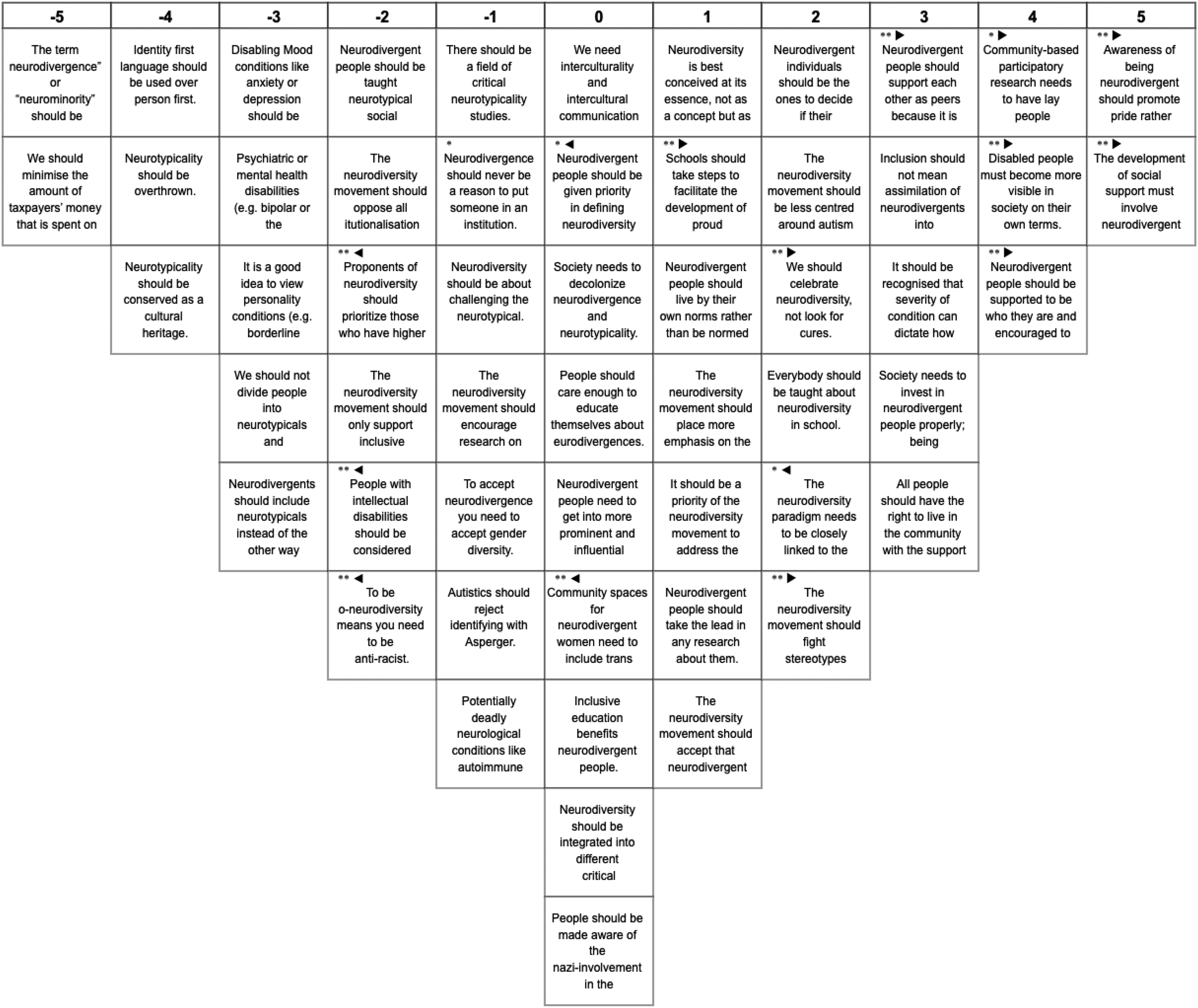
ND2 Factor 1 Array. *p > .05, **p > .01, > and < Denote Z Score Directionality (Higher or Lower) in Comparison to All Other Factors.
Proposed title: Proudly support neurodivergent people's rights to what we need to be active and productive members of society.
ND2 F1 emphasises that awareness of being neurodivergent should promote pride not shame (item 43: +5). The development of social support must involve neurodivergent people (item 14: +5) and must support us to be who we are, including embracing our own ways of being social, and becoming visible on our own terms (item 38: +4, item 9: +4). This proud involvement of neurodivergent people extends to research, and community-based participatory research needs to have ordinary neurodivergent people involved and not only neurodivergent academics (item 3: +5). All neurodivergent people should have the right to live in the community with the support they need (item 25: +3). This requires celebrating neurodiversity, not looking for cures (item 54: +3). It also means spending taxpayer money to support neurodivergent people (item 37: −5) and moving towards a culture that is more accepting of neurodiversity (item 28: −4). Society must invest properly in neurodivergent people (item 39: +3) and school level education about the issue is important (item 46: +2). Idealistic and misguided solutions should be carefully avoided (item 19: −4, item 22: −5, item 31: −2) and we should avoid over-extending the category of neurodiversity (item 7: −3, item 20: −3, item 45: −2), and getting hung up over politically correct terminology (item 22: −5, item 23: −4, item 12: −3) (Figure 7).
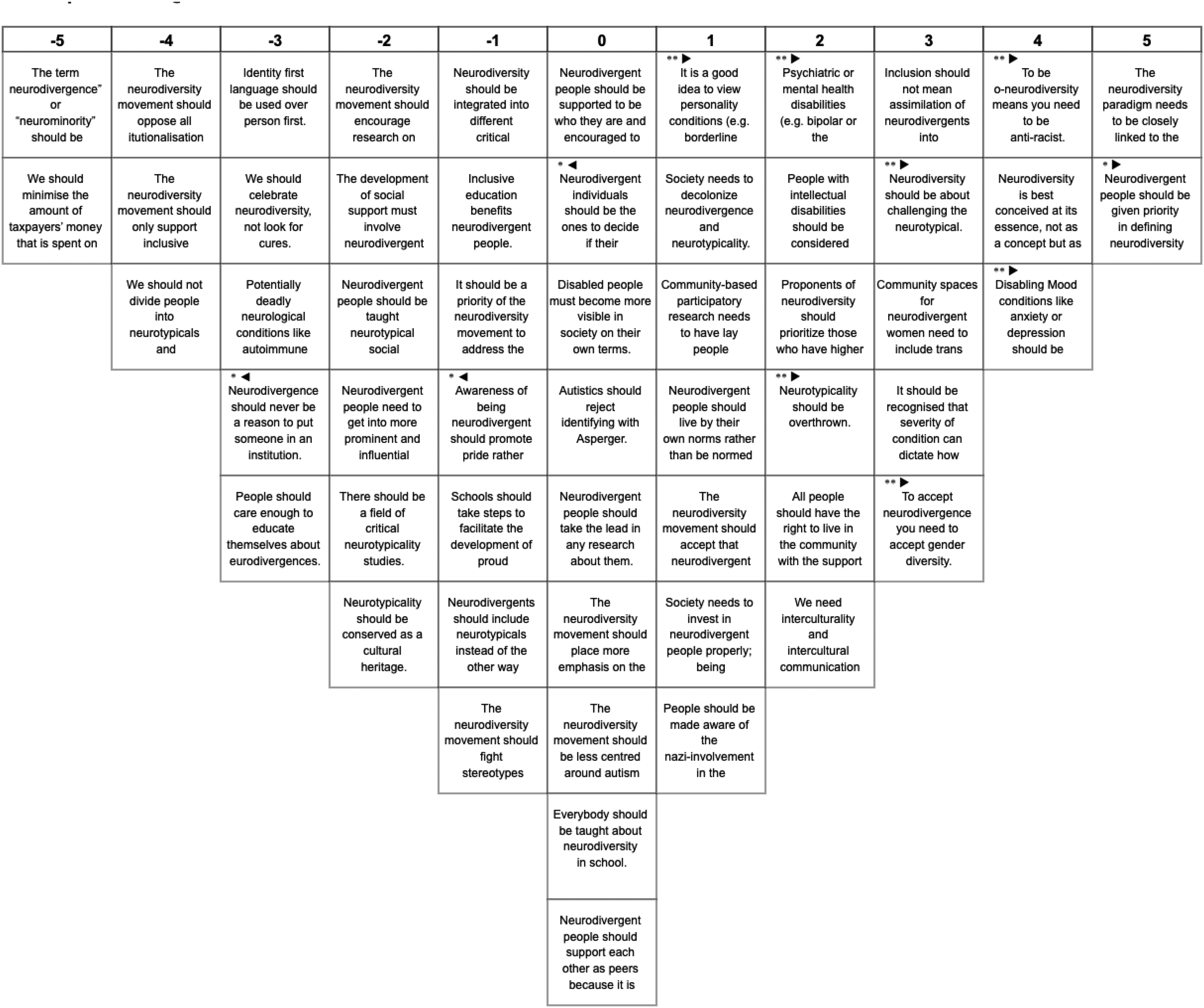
ND2 Factor 2 Array. *p > .05, **p > .01, > and < Denote Z Score Directionality (Higher or Lower) in Comparison to All Other Factors.
Proposed title: Neurodiversity as a radical movement for broad based societal change in alliance with other progressive political activists.
The factor array for ND2 factor 2 shows a perspective which prescribes making close links to other political movements and acknowledging that the neurodiversity movement is part of a broader anti-disablist (item 5: +5), anti-racist (item 18: +4), trans-inclusive (item 42: +3) activist movement that views itself as disrupting the status-quo (item 10: +5).
With this emphasis on an overarching and inclusive ideological framework, the perspective of ND2 F2 differs from F1 in its tendency to include disabling mood conditions, learning and psychiatric disabilities under the neurodivergence umbrella. Despite these differences of perspective, both ND2 factors disagree most strongly that we should not minimise taxpayer support of neurodivergent people (−5 F1 and F2), replace ‘neurodivergence’ or ‘neurominority’ with the simpler ‘neurological disability’ (−5 F1 and F2), get rid of specialist schools (F1: −2, F2: −4) or conserve neurotypicality as cultural heritage (F1: −4, F2: −2) (Figure 8).
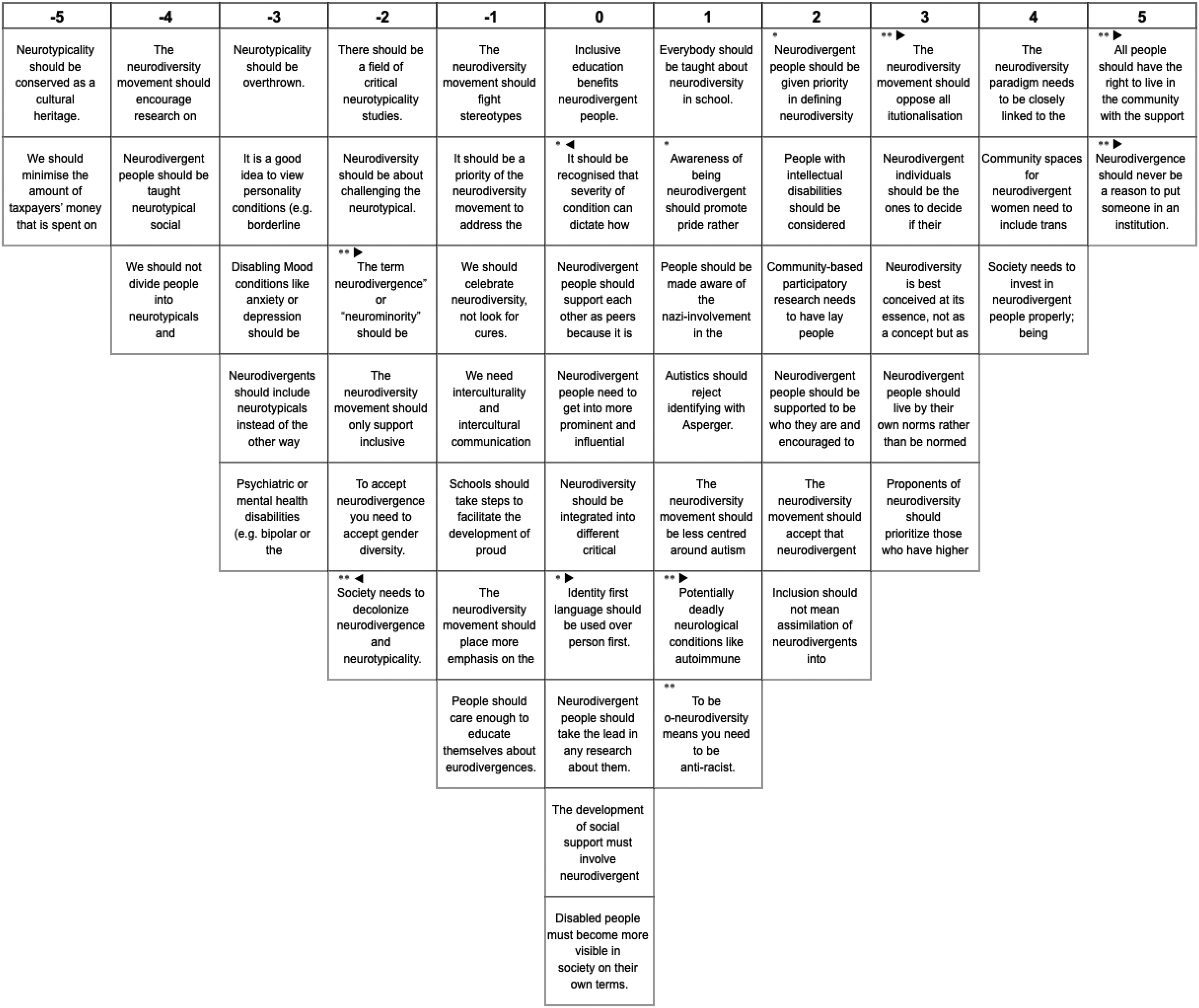
ND2 Factor 3 Array. *p > .05, **p > .01, > and < Denote Z Score Directionality (Higher or Lower) in Comparison to All Other Factors.
Proposed title: Neurodiversity as a movement for genuine social inclusion.
With regard to prescriptions, F3 gives strongest agreement to all people having the right to live in the community with appropriate support (item 25: +5) and that neurodivergence should never be a reason to institutionalise someone (item 26: +5). This clearly puts the greatest importance on the right to belong within society and not to be excluded.
Here, it is perhaps relevant that ND2 F3 shares the F1 inclination to not consider mental health conditions amongst the neurodivergences. Unlike F1 exemplars however, they do consider people with intellectual disabilities as neurodivergent (item 15: +2).
ND2 factor 3 prescribes activities and orientations that promote genuine belonging within communities, including trans-inclusive communities (item 42: +4) and alleviating poverty (item 39: +4). But F3 is neutral about the F1 emphasis on visibility (item 9: 0) and involvement (item 14: 0) of neurodivergent people in change. The prescriptive attitude of F3 falls somewhere between the ‘radicality’ of F2 and the ‘pragmatism’ of F1.
Across all three factors, there were statements of common agreement and disagreement (see supplementary materials here: https:/osf.io/z8qp4/.
Discussion
We have presented an innovative procedure for collective and reflexive research about neurodiversity. Structured by Q methodology, this procedure has allowed a small group of neurodivergent researchers researching neurodiversity and/or neurodivergence to identify and interpret amongst ourselves three different perspectives on what neurodiversity means and three different perspectives on the movement's aims. We will first summarise these differences before turning to the broad consensus underlying them. We will then summarise why we consider this work to be innovative, rigorous and significant before turning to address limitations and future prospects in a concluding section.
Issues of Diversity
Three ‘understandings’ were distinguishable in terms of emphasis placed on neurodiversity as a social justice movement (ND1 F1), as a rights movement stressing the benefits neurodivergent individuals bring to society (ND1 F2) and as based on scientific knowledge about different types of, equally valid, mind (ND1 F3). Three ‘prescriptions’ perspectives prioritised different overall aims, including proudly supporting neurodivergent people's rights to be productive citizens (ND2 F1), being a radical movement for broad based societal change in alliance with other progressive political activists (ND2 F2) and being a movement for genuine social inclusion (ND2 F3).
There were clear connections amongst the exemplars of the six factors across studies ND1 and ND2. 1 First, both ND1 F2 and ND2 F1 perspectives support neurodivergent rights by emphasising benefits this brings to society (‘rights from society’). Ronit, Hanna and Lill were the factor exemplars of ND1 F2 and all three of them also loaded ND2 F1 (Hanna and Lill being its highest loaders). It is thus for the most part their perspective that finds expression in both ND1 F2 and ND2 F1 (with Catherine and Rebecca contributing to ND2 F1).
Secondly, both ND1 F1 and ND2 F2 perspectives foreground that neurodiversity is a movement for social justice operating in alliance with other comparable radical movements for progressive societal change (‘radical social change’). Monique and Amy were the two exemplars of ND2 F2 and both were amongst the three highest loaders of ND1 F1. It is for the most part the shared perspective of Monique and Amy that finds expression in both ND1 F1 and ND2 F2 (with Gemma, Paul, Catherine and Steven contributing in ND1 F1).
These differences in perspective highlight discrepancies between ‘rights from society’ and ‘radical social change’, representing variations on the political nature of the neurodiversity movement rarely noted in the literature (Leadbitter et al., 2021; Runswick-Cole, 2014). This difference became increasingly obvious during the process of collectively interpreting these findings as it gradually crystallised from being a vaguely felt intuition of disagreement to being a clearly understood difference of the perspective we were speaking from. In this light, the group discussed the fact that, for example, Lill and Hanna are Swedish and the only group members not based in the UK, whilst Ronit, although UK-based, hails from Germany.
But geography is not the only (or even main) issue here since Catherine and Rebecca, both from the UK, also exemplified ND2 F1. A key difference was one of political ideology. The ‘societal change’ perspective is politically radical. It targets the capitalistic basis of the social order and urges explicit intersectional alliance with other anti-discrimination movements (anti-sexist, anti-racist, anti-disablist) aiming to change society. Hence, for ND1 F1 and ND2 F2 exemplars, neurodiversity developed as a civil rights movement to oppose the widespread poor treatment and limited rights afforded to autistic people because of assumed pathology. It fought limited access to social and political power, and limited collective voice. Such a movement necessitates coalition building with other minorities and movements, including the disability rights movement, Mad Liberation and the LGBTQ+ rights movements (Botha, 2021; Botha & Gillespie-Lynch, 2022). In contrast, the ‘rights from society’ perspective speaks on behalf of society, emphasising the benefits neurodivergent individuals bring to society. The pragmatic focus is less upon forming political alliances for societal change, and more upon meeting the support needs of neurodivergent individuals to facilitate their productive contribution. From this perspective, aiming to create a society that works for everyone by overhauling the many intertwined oppressive systems that currently operate seems somewhat idealistic. From the ND1 F2/ND2 F1 ‘rights from society’ perspective, such radical dilution of focus must be avoided if goals are to be actually achievable.
A third difference related to this same distinction concerns who is included as neurodivergent. The ND2 F2 perspective, best exemplified by Monique and Amy, adopts an open attitude whereby people experiencing mental health disabilities (e.g. depression), and people with intellectual disabilities are included within the category of the neurodivergent. Here, inclusion is not based upon shared aetiological roots or an anti-cure position (see Ne’eman & Pelicano, 2022), but upon shared social and political marginalisation. The ND2 F1 perspective by contrast believes such inclusiveness risks watering down (perhaps in the name of political idealism) what they believe should be the specific pragmatic focus of the movement: recognising the needs of people living with known and observable developmental differences and ensuring real social recognition of their rights.
The inclusion of people with intellectual disabilities as neurodivergent was particularly controversial, with ND2 F1 disagreeing with this proposition and ND2 F2 agreeing with it. As might be expected, this difference is a source of potential friction but it was discussed openly in our group. Steven (who exemplified ND2 F3, agreeing with item 15 at +2) commented that the ND2 F1 disagreement with item 15 could be used by proponents of ‘profound autism’ to argue that neurodiversity does not apply to them (Chapman, 2019, 2021b). However, Amy responded that this possibility should not prevent us from acknowledging the existence of the ND2 F1 viewpoint and its rationale. Lill pointed out that such views are likely more nuanced than represented in the Q sort: the position she expressed in her ND2 F1 Q sort was not the only position she might hold. It is the position that she holds when wearing an ‘academic hat’ as a neurodivergent researcher. Were she to have worn her ‘activist hat’, however, she might have sorted in a pattern closer to ND2 F2. Indeed, Q methodology makes no assumption that the viewpoints expressed are tied in any one-to-one fashion to those who express them. People can move between perspectives.
All three exemplars of ND2 F3, Steven, Gemma and Paul, were also ND1 F1 exemplars. This suggests that the understanding of neurodiversity as social justice that is at play in ND1 divides into two different ‘prescriptions’ factors (ND2 F2 and 3). It should be noted that the ND2 F3 perspective on the aims of the neurodiversity movement places comparatively more emphasis on society concretely supporting and investing in neurodivergent people's right to live well in an actual community. It takes a long-term view, recognising the unfinished history in which many neurodivergent people were and are institutionalised and segregated (see Chapman, 2023). It urges the value of de-institutionalisation whilst also pointing to the need for societal investment in genuine community inclusion. Steven, the highest loader, hails from the USA and noted that this emphasis on community living and inclusion generally is more familiar in US than UK neurodiversity circles.
The differences discussed above chiefly concern the political aspect of neurodiversity, but ND1 F3 is a reminder, even if it was exemplified by just one of us (Rebecca), that there are also different ways of understanding the role of scientific knowledge in the movement. For Rebecca, the chief political or perhaps ethical value of neurodiversity concerns the principle that all kinds of minds are equally valid. The realisation of this value, however, depends upon being able, credibly and robustly, to distinguish these different ‘kinds of minds’. This requires that ‘neurodiversity’ be more than ‘a scientifically meaningless term’. Rebecca's strong agreement that neurodiversity is not inherently political is not a denial of the political dimension of the movement. The assertion is rather that neurodiversity is not inherently political because to be viably political something like ‘natural’ human variation must also demonstrably exist as a meaningful scientific fact (see for example, Jaarsma & Welin, 2012). Accordingly, Rebecca holds that it is crucial to explain neurodiversity by reference to the brain, and to trust in evidence-based medication. Interestingly, the scientific status of neurodiversity is a contentious issue amongst us, because Lill, Hanna and Ronit strongly agree that neurodiversity is a scientifically meaningless term.
Issues of Consensus
In both sorts, we have highlighted several items where there was broad agreement amongst us. In contrast to a tendency in the academic literature to separate these issues (e.g., see Ne’eman & Pelicano, 2022), there was complete agreement that neurodiversity is simultaneously a biological fact, a framework of values and a social movement. This ‘togetherness’ of politics and science, value and objective description, is further expressed in consensus that the movement is based on gaining more societal recognition and support for neurodivergent people. There is also consensus that this means grappling with issues of power because neurotypical society, whether it likes it or not, must change. The neurodiversity movement thus necessarily involves a critique of neurotypical privilege, but there was also consensus that ultimately society stands to benefit greatly from this change.
We now briefly summarise the innovative, rigorous and significant aspects of this work. To begin, we wish to highlight the innovative nature of our procedure. To our knowledge, this is the first use of Q methodology to structure the activities of a small group of neurodivergent researchers researching neurodiversity and/or neurodivergence. The use of Q methodology, in its various aspects, has allowed us as a group: (a) to freely discuss our commitments and assumptions; (b) to present and compare our viewpoints in a transparent way; and (c) to openly discuss both our differences and points of agreement. It has allowed us not just to present our own views, but to listen to the views of others.
Next, the rigour of the procedure was underpinned by three features: first, by the use of Q items self-generated by the group to be of direct authentic relevance to the questions addressed; second, by the use of Q sorting to render ‘operant’ each subjective viewpoint as a publicly observable, statistically comparable objective datum (each Q sort); and third, by the use of Q factor analysis to compare and group these data both quantitatively and qualitatively. The qualitative comparison occurred by means of group discussion to: (a) interpret these factors to ensure adequate understanding of each viewpoint (as confirmed by those expressing the viewpoint); and (b) discuss the implications of differences and similarities of viewpoint for the practical future of the neurodiversity movement. The reflexive and self-referential basis of the collective procedure thus afforded transparent recognition of the partial and situated nature of any one perspective, thereby opening questions concerning the influence of particular routes of experience (and ‘positionality’) on perspective (Stainton Rogers et al., 1995). For each of us, the now and here of our sorting preferences arose from the biography of a distinct past uniquely woven into and out of a wider community of discourse and practice (see supplementary materials for biographical details here: https:/osf.io/z8qp4/. Consistent with feminist views on situated knowledge (Kafer, 2013), our procedure therefore rejects the mythical objectivity of a ‘view from nowhere’ (Nagel, 1986) and affirms the reality of a multiplicity of views, each from a now and a here (now/here not nowhere) (Stenner, 2009).
Finally, the significance of the procedure we have introduced is that it provides a new way for neurodivergent neurodiversity researchers to collaborate in surfacing and understanding differences and similarities in their views on what the neurodiversity movement is and what it should aim to do. In line with Dwyer et al. (2024), this promises an expansion of knowledge on the meaning and prescriptiveness of the term neurodiversity and its relevance to the effectiveness of the neurodiversity movement. There is a growing focus on neurodiversity within different parts of society (education, health, research and the media) and it is important to gain and maintain a nuanced sense of diversity amongst viewpoints to avoid misunderstandings and conflicts around key concepts and aims. The variation in viewpoint demonstrated in this paper can help shape the basis for the theoretical discussion informing the movement going forwards. The capacity our procedure afforded for airing, sharing and comparing our views could also prove practically useful given the growing centrality of practices around neurodivergent self-advocacy, the prioritisation of intervention targets set by neurodivergent people themselves and the need to recognise multiple neurodivergent developmental trajectories and life conditions (see Leadbitter et al., 2021). Practices like these should be informed by knowledge, not just of ‘the’ neurodivergent view, but of the demonstrable relevant variation amongst such views.
Conclusion, Including Limitations and Future Research Prospects
Given the significant entanglement of politics in human sciences, we hope that the procedure we have introduced provides an innovative way of taking seriously the subjective dynamics at play in scientific research, whilst maintaining scientific rigour in the ways sketched out above in our eight phases. We have suggested that many standard research methods based on descriptive and inferential statistics can tacitly reinforce neurotypical assumptions. At root, this is because they presume subjectivity to be merely a source of error variance (Watts & Stenner, 2012). Q methodology by contrast is suited to neurodiversity projects because of the way it positively incorporates subjectivity into its data collection procedure, and uses sophisticated statistics to trace the various patterns of its expression. Each Q sort is almost strictly unique given that, statistically speaking, the number of possible ways of sorting 55 items into these 11 piles is many thousands of times larger than the number of people on earth (see Brown, 1980, p. 267). The rigour of Q methodology thus derives from the sheer improbability of different individuals sorting such a large group of items into the same pattern of agreement/disagreement. Comparing our own Q sorts allowed us to ‘capture’ both the diversity amongst a small number of neurodiversity researchers (three distinct factors within each study), and the background of (considerable) consensus against which this diversity unfolds.
Identifying multiple perspectives is decisively important in fields like neurodiversity studies where science, politics and the personal are intimately entangled and whose outputs can determine outcomes for neurodivergent people more broadly. To manage the complexity at play, this project limited itself to a small group of neurodivergent researchers studying the way we ourselves think about neurodiversity. We have made it clear that we have used Q methodology to study and compare our views and make no claim to exhaustively represent the field of neurodiversity studies. Nevertheless, we consider it of great interest that even amongst our small group, we were able to identify three different perspectives within each study. It is likely that if this variety applies within our small group, then something comparable applies more broadly across the field. We hope to stimulate the further use and refinement of our Q methodology-based collective and reflexive procedure, especially by different groups of neurodivergent researchers of neurodiversity, including those with backgrounds and inclinations that differ from ours. This might also include alterations to the item sets generated, and perhaps also different item sets suited to different questions. Future research might also use our item set (or a modified version) in a more conventional Q methodological study involving a larger group of neurodivergent researchers. With respect to our item set, we decided to divide the items we generated into two sorts because roughly half of the items were prescriptive and half descriptive. This proved felicitous because of the resonance with the hybrid political (practical and ‘ought-based’) and scientific (‘is-based’) (see MacIntyre, 1959) nature of neurodiversity itself. Nevertheless, at times, the distinction between ‘prescription’ and ‘understanding’ was somewhat arbitrary and open to further refinement. Another limitation was that several researchers felt that both item sets were skewed towards ‘agreeable’ items (which could be improved by careful rewording).
This paper has introduced an innovative procedure for collective and reflexive research about neurodiversity. The rigour of the procedure was underpinned by the deployment of sophisticated quantitative procedures to ends that are primarily qualitative: surfacing and offering rich descriptions of a range of viewpoints. We found significant variation even within our small group, suggesting distinct viewpoint ‘camps’ that may impact on the questions we ask, and the priorities we seek to address. The significance of this procedure is that it provides a new way for neurodivergent neurodiversity researchers to collaborate in surfacing and understanding differences and similarities in their views on what the neurodiversity movement is and what it should aim to do. Given the growing focus on neurodiversity within educational, health, business, media and research settings, it is important to innovate procedures to collectively reflect on ways of understanding and expressing the key concepts and aims of the movement. We hope that the variation in viewpoint demonstrated in this paper will inspire future research and help shape the basis for the theoretical discussion informing the movement going forwards. Open yet rigorously structured dialogue about our conceptual and ideological differences will be critical in ensuring that research about neurodivergent people translates into tangible improvements in neurodivergent lives.
Footnotes

Author Contributions/CRediT
PS inaugurated and led the collaboration, led with methodology and data analysis, led item generation and the item editing sub-group, led the interpretation process, drafted the initial paper and coordinated the re-draftings, and contributed two Q sorts. MB generated items, was a core member of the item editing sub-group, contributed to interpretation, commented on drafts, re-drafted and contributed two Q sorts. SK generated items, was a core member of the item editing sub-group, contributed to interpretation, commented on drafts, re-drafted and contributed two Q sorts. CW generated items, was a core member of the item editing sub-group, contributed to interpretation, commented on drafts, re-drafted and contributed two Q sorts. AP generated items, contributed to item editing and interpretation, worked on tables, commented on drafts, re-drafted and contributed two Q sorts. RP generated items, was a core member of the item editing sub-group, contributed to interpretation, commented on drafts and contributed two Q sorts. HB-R helped select the initial researcher group and contributed to item generation and interpretation and contributed two Q sorts. LH contributed to item generating and interpretation, commented on drafts and contributed two Q sorts. GW contributed to item generating, editing and interpretation, commented on drafts and contributed two Q sorts. RS-W commented on drafts contributed two Q sorts.
Funding
The authors received no financial support for the research, authorship, and/or publication of this article.
Conflicting Interests
The authors declared no potential conflicts of interest with respect to the research, authorship, and/or publication of this article.