



Abstract
In Aotearoa New Zealand, Young Adult Courts provide an adapted court process for people aged 18–25, built on a commitment to procedural fairness and a vision of an enlightened world where all those seeking access to justice experience being seen, heard, and understood. The well-documented over-representation of ‘neurodivergent’ presentations, which impact information processing, comprehension, decision making, communication, and emotion regulation, are an inherent barrier to this aim, unless addressed directly. This paper describes how a multi-profession group grappled with challenges including diagnostic, conceptual, and ethical issues, cultural safety, resource limitations, and the pragmatic utility of recommendations. It outlines how these were resolved through the development of a ‘functional neurodiversity’ model that pays attention to the primary strains of court participation, and a strengths-based ‘Court Participation Tool’ that evaluates those strains and provides tailored recommendations to enable participation. Pilot outcomes from a trial of this screening process are described.
Lay Abstract
Going to court can be really hard. It puts a lot of pressure on things like language, understanding what is happening, staying focused, remembering details, thinking quickly, using your senses, and managing emotions. These are all areas where neurodiverse people often face challenges. But courts rarely recognise how demanding the process is, and they almost never make changes to help. This is worrying, especially since people involved in the justice system are much more likely to be neurodiverse. Without the right support, these challenges can make it harder to take part in court properly, and that may mean neurodiverse people get less fair treatment. To help with this, we created a screening process focused on how court works, and the challenges it creates. We made this personal, exploring individual strengths and challenges, and called it the Court Participation Tool. The tool gives practical advice to Judges, lawyers, prosecutors, and the person going to court about how to support them, so they can be seen, heard, understood, and take part in a fair way.
Introduction
Neurodiversity Within the Criminal Justice System
Neurodivergent characteristics affect concentration, comprehension, learning, memory, communication, and emotion regulation, all of which are required for meaningful participation in court (Lambie, 2020; Lynch, 2016; Taylor et al., 2021). Court demands include unclear social expectations, high sensory stresses, and the risk of misinterpretation of coping responses as indications of guilt or antisocial behaviour (Slavny-Cross et al., 2023; Woodhouse et al., 2024). Yet, every available prevalence study has found an over-representation of people with brain differences in the criminal justice system, with estimates ranging anywhere between 15% and 90% (Anns et al., 2023; Baggio et al., 2018; Bower et al., 2018; Horspool et al., 2017; Hughes et al., 2012; Popova et al., 2011). A 2023 systematic review highlighted an over-representation of intellectual disability, ADHD, autism, brain injury, and foetal alcohol spectrum disorder (Holland et al., 2023). A New Zealand national birth cohort study found that more than half of young adults with ADHD born between July 1, 1992 and June 30, 1995 had interacted with the criminal justice system by their 25th birthday (Anns et al., 2023). A 2012 paper for the U.K. Office of the Children's Commissioner reported similar rates of learning disability for young people in custody (Hughes et al., 2012). Neurodivergent adults are more likely to report not understanding what is happening at court (Day, 2022), being unable to fully participate (Gormley & Watson, 2021), less able to cope with stress, and less satisfaction with how they have been treated (Slavny-Cross et al., 2023). Yet neurodivergent participants are also more likely to be remanded in custody before trial or incarcerated on sentence (Day, 2022; Popova et al., 2011), and to receive longer sentences (Foster & Young, 2022).
These are substantial inequalities, placing neurodivergent participants at a disadvantage when it comes to their right to understand what is happening and fully take part in the case that relates to them. However, such differences are easily missed (Hughes et al., 2012) and access to specialist assessment or support is extremely limited.
A Neurodiversity-Affirming Approach
Often, discussion in this area has centred on diagnostic terminology (Buijsman et al., 2022; Bury et al., 2023), a ‘medical model’ that frames disabilities or impairments as abnormalities to be treated or fixed in order to bring people closer to dominant social constructions of normality (Zaks, 2024). An alternative approach, rooted in Swain and French's (2000) affirmation model and explored further by Cameron (2014, 2015), challenges the assumption that difference or disability is necessarily tragic. This conceptualisation foregrounds that living with impairment can be intrinsically rewarding rather than a problem to be fixed (Swain & French, 2000), is an ordinary part of human experience (Cameron, 2014), and that disability occurs when a person with impairment has to respond to other peoples’ expectations and assumptions, which make life difficult and restrict opportunities for equal participation (Cameron, 2015). Building from this foundation, ‘neurodiversity’ has been associated with an affirmative approach where explanations go beyond diagnosis (Botha et al., 2024). Such approaches are continuing to expand rapidly (McLennan et al., 2025), promoted as means by which to achieve strengths-based formulations that recognise difference rather than deficit (Izuno-Garcia et al., 2023; Rosqvist et al., 2023), affirm these as a way of being (Dallman et al., 2022), and highlight strengths alongside challenges (Redshaw & McCormack, 2022). Such an approach is particularly welcome in Aotearoa New Zealand, where medical terminology for neurodivergence is closely interlinked with experiences of colonialism. Indeed, Te Reo Māori translations of diagnosed ‘conditions’ often reflect Māori preference for strengths-based and contextual language: Aroreretini (“attention goes to many things”; ADHD) and takiwātanga (“in one's own space and time”; autism) have clear alignment with an affirming approach (Opai, 2022).
On the other hand, it is possible for neurodivergence to be both natural brain variation and disabling in some contexts, especially when there is a disabling interaction between a person's neurodivergent traits, and the physical and social environmental demands they face (Brown et al., 2021; Cameron & Smith, 2025; den Houting, 2018). This was explored in some detail by Bagnall et al. (2025) with a focus on police interviewing. In this experimental design study, autistic participants’ vulnerability within a police interview led the authors to present their ‘Individual Interpersonal Environmental Vulnerability Model’. This outlines factors that present potential strains for autistic suspects including environmental (access to support and assessment; custody setting; custody-wide autism knowledge and understanding); individual (trait and state emotion; social cognition and communication; sensory sensitivity; awareness/understanding; atypical behaviour); and interpersonal (presence/level of adaptive practice; perception of atypical behaviour; power/ social dynamics). Although focused on autism, Bagnall et al.'s work illustrates how interactions between a neurodivergent person's individual strains and the criminal justice environment could be conceptualised and attended to. Similar work has been conducted in Australia by Doyle et al. (2022) in their analysis of the strains in a prison environment for people with disabilities such as autism, intellectual disability and traumatic brain injury. They highlight how rarely such disabilities are identified, either via formal screening or self-disclosure. Yet, without identification, people risk having behaviour explained as criminogenic, experience disproportionate strains relative to peers, have exacerbated mental and physical health conditions, and are inhibited in their ability to engage with rehabilitative services.
A Need for a Different Approach
It is therefore necessary to pay attention to the environmental strains that stress a difference to the point of becoming a disability, avoid creating disabling environments, and strike a balance between affirmative language that promotes success, whilst responding when strain occurs (Kapp et al., 2013; Pritchard-Rowe & Gibson, 2024). Several authors have recognised the potentially unique role of the court in providing an opportunity to screen for, and respond to, neurodiversity, especially given the high prevalence but hidden nature already outlined. This has included suggestions for screening at the point of detention (Baggio et al., 2018; Woodhouse et al., 2024), and comprehensive assessment with onward referral to specialist services (Holland et al., 2023; McVilly et al., 2023). However, there are obvious challenges to such approaches, not least issues of resource and competence. Moreover, screening for diagnosis is at odds with an affirming approach that places responsibility on environmental accommodation rather than individual assimilation (Brown et al., 2021; Pritchard-Rowe & Gibson, 2024). On the other hand, an affirming approach has appeal within court, where participants may have understandable wariness about assessment and labels of ‘disorder’, yet still recognise there are challenges that make participation difficult. In such a model, exploration of areas of strength and challenge may help to provide a motivationally framed conversation, rather than one focused on ‘deficits’ (Redshaw & McCormack, 2022), whilst also illuminating ways in which the court has imposed disabling environments on participants with differences (Cameron, 2015) that restrict opportunities for equal participation (Cameron & Smith, 2025). Kirby has long advocated for a person-centred rather than categorical approach to screening for neurodiversity, with her ‘Do-IT Profiler’ used to inform individual accommodations and promote strengths. A 2025 paper published on Kirby's website outlines why this is particularly important in criminal justice, where people may have multiple interrelated traits but not meet thresholds for diagnosis; where background history may be particularly difficult to establish; and where contributing factors like early life trauma may contribute to functional difficulties. In a system reliant on diagnosis, such complexities are likely to lead to missed opportunities to provide assistance. Rather, Kirby presents her ‘Do-IT’ profiler as a way to achieve system-wide screening for neurodivergent traits and generate person-centred guidance and resources. This model has been applied in a variety of employment, education, and justice settings in the United Kingdom.
Clasby et al. (2022) attempted to address this complexity within the context of Aotearoa New Zealand's Young Adult Courts. Through an observational study, a panel of experts reviewed the court environment with the intention of identifying barriers to accessibility and recommendations for improvement. This led to several recommendations: universal support (e.g. systematic screening and training for staff), targeted support, (e.g. simple accommodations provided for participants) and individualised support (e.g. referrals to healthcare or communication specialists). Whilst methods for universal screening and adaptation have been explored in other settings (Bagnall et al., 2025; Doyle et al., 2022; Kirby, 2025), to our knowledge no court-based screening processes have yet been developed. Certainly, none have been developed in the unique context of Aotearoa New Zealand. The present authors built on Clasby's work by focusing on how to achieve systematic screening that would lead to targeted support, enabling participants to be seen, heard, and understood. The work was led by the Ministry of Justice and received support from a range of subject matter experts. The group grappled with how to achieve this in a way that would be neuro-affirming, culturally safe, pragmatic to administer within the fast paced and highly stressful court environment, and lead to actionable, tailored, accommodations for the participant.
This article extends the literature in three important parts: advancing universal screening approaches in a court setting; outlining how neurodivergent strains were conceptualised into a ‘functional neurodiversity model’; and introducing a screening process whereby person-centred interviews led to tailored accommodations. Finally, the article describes initial data from a pilot application of the resulting ‘Court Participation Tool’.
Context
This work was conducted in Aotearoa New Zealand. Here, the constitutional founding document Te Tiriti o Waitangi (the Treaty of Waitangi) sets out a partnership for co-governance between the indigenous Māori and the Crown. Over time, key ‘Principles’ of that treaty have been described, including partnership (to work collaboratively in decision-making that affect Māori), protection (protect Māori interests, rights, and treasures including language), and participation (opportunity to participate in decision making at all levels of government). It is widely recognised that there is an over-representation of Māori convicted and imprisoned, relative to other population groups (Justice Statistics, 2025). Accordingly, several initiatives are undertaken to promote partnership and equitable justice. Within the Courts, this is most significantly embodied by Te Ao Mārama, Enhancing Justice for all. Te Ao Mārama translates to the world of light, reflecting an intention to establish an enlightened approach to justice where all those participating are enabled to fully engage in the case that relates to them. It is judicially led, and involves partnership with iwi (tribes) and communities (https://www.justice.govt.nz/justice-sector-policy/key-initiatives/). The present work grew out of Te Ao Mārama, in recognition that its goals could not be realised if the high prevalence of neurodivergence, with its associated impact on information processing, comprehension, decision making, communication, and emotion regulation, was not better understood and addressed. Rather, such issues may be reasonably anticipated to create barriers that inhibit the ability to meaningfully participate. In line with Treaty Principles, partnership, protection, and participation with Māori was embedded, with involvement from both Māori clinicians and dedicated cultural advisors throughout the process, and a central focus on addressing inequities that limit positive health outcomes for Māori.
Method
Model Construction
A neurodiversity-affirming framework was adopted, primarily focusing on those brain differences that are common in forensic populations, and which would typically attract diagnosis: ADHD, autism, intellectual disability, brain injury, and FASD. The intention was to understand how these brain differences may impact court participation, and how to provide adaptations that enable participation. The project was led by two of the authors who, through their employment at the Ministry of Justice, brought together a team of ‘subject matter experts’ to explore both what we needed to assess and, crucially, how to do so. This expert working group received input from clinical, forensic, and neuro psychologists, forensic and adolescent psychiatrists, speech and language therapists, justice liaison nurses, cultural specialists, experts by experience, and Ministry officials. From the start, we were cognisant of the tensions in our task. Although an expert by experience was consulted during an initial ‘discovery’ phase, none of the primary development team identified as neurodivergent; we had been brought into the project due to our subject interest. We were acutely aware of, and robustly discussed, competing perspectives and the limitations of our own knowledge. Several contributors discussed the substantial health inequities that result in Māori being less likely to access healthcare, and less likely to receive formal assessment than their peers, with the consequent ethical imperative of providing a signpost to formal assessment, diagnosis, and access to pharmacological interventions. Particularly, it was argued, as medication for ADHD is associated with greatly reduced risks for a wide range of problematic outcomes (Zhang et al., 2025). Others, that neurodivergence may be inseparable from the impacts of colonialism and trauma, and therefore that the process must incorporate analysis of this; still others that screening for neurodivergence must also lead to quantifiable data for analysis. Frequent reflective meetings enabled a focus on neurodiversity affirming approaches, and our core intention that we develop a process that enables participation by reducing those barriers most closely associated with neurodivergence.
Together, we explored these conceptual, ethical, legal, and practical issues. As with Kirby's Do-IT Profiler, and mindful of how diagnostic labelling may facilitate assumptions about impairment rather than affirm personal characteristics (Cameron & Smith, 2025), we focused on person-centred rather than categorical assessment; an approach that has close alignment with Māori collectivist, systemic, world views. Further considerations included how to establish relationships in a culturally acceptable framework whilst severely constrained in the time available for assessment, and addressing substantial health inequities. We focused on determining features of neurodivergence, such as difficulty with learning, reduced control of executive functioning, global impairments of intelligence, and impairments to memory, adaptive functioning, and social skills (Holland et al., 2023). Quickly it became clear that no existing tool could provide what we wanted; all existing screening processes we found focused on diagnostic descriptors rather than functional challenges. None had been produced specifically to enable court participation, none enabled collaborative solution-finding, and few had been produced within the unique cultural context of Aotearoa New Zealand with its focus on relationally-based, identity affirming practice.
Building on the understanding that neurodivergence becomes disabling in large part because of the environmental strains that a person must face (Bagnall et al., 2025; Cameron & Smith, 2025), we first worked to formulate the demands of court, leading to our Functional Strain model of Neurodiversity (Figure 1). According to this model, neurodivergent people face difficulty across one or more of eight primary domains of social and cognitive functioning. These encompass executive functioning, language, social and emotional processes, and managing sensory input. However, the severity of those challenges is substantially the result of the context within which a demand occurs. With the right support, the functional difference is negligible; with high levels of strain, it may be disabling. In court there is potential for each of these domains to experience significant strain and for those challenges to vary for each person who presents. The strain is also not equal at all stages of court, for example with greater demands on reading and writing when presented with lists of charges, greater demands on organisation and planning when remembering when to get to court, and intense demands on attention, language, emotion regulation, and processing speed during court appearances.
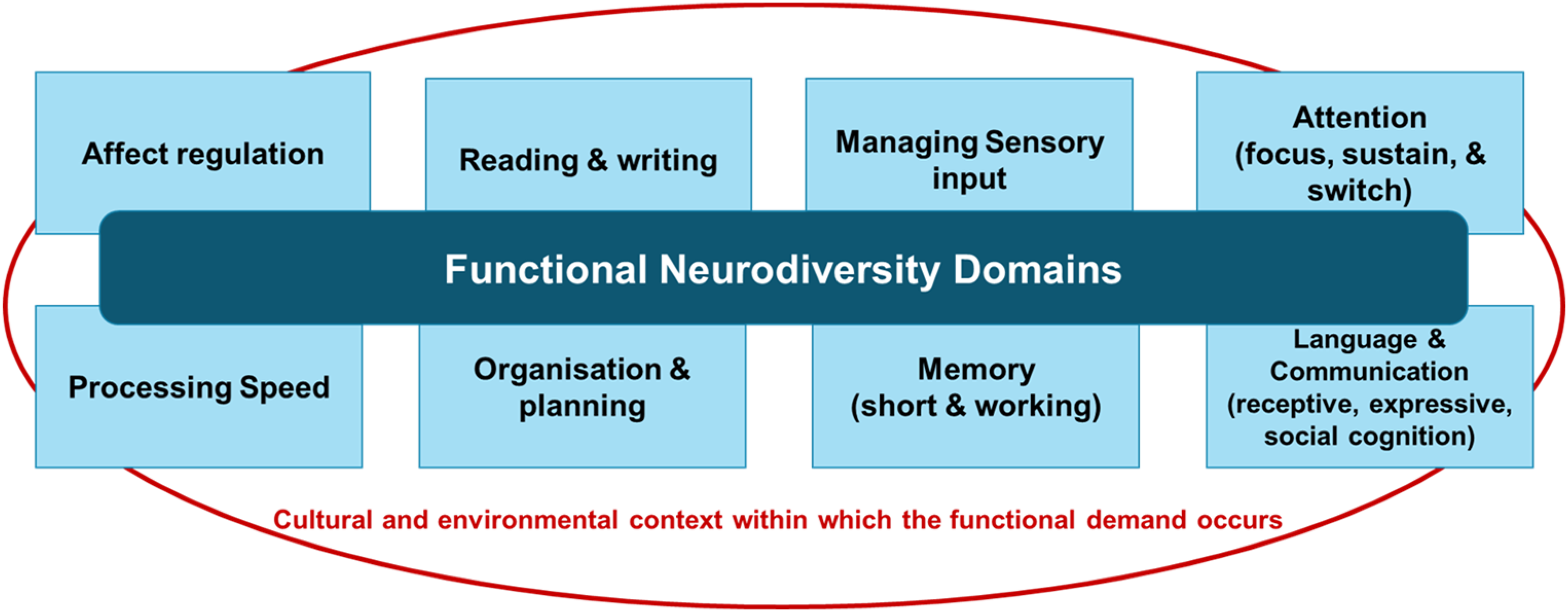
Functional strain model of neurodiversity.
The Neurodiversity Court Participation Tool
In line with the discussions above, a core principle of our process was that improving court responses to neurodiversity was not contingent on diagnosis. We encouraged an assumption that all those presenting to the court would have some brain differences and may need tailored accommodations. Likewise, they may have personal strengths that could be harnessed, and they should be enabled to participate in identifying strategies that would help them.
First, we considered each step of the court process, from getting to court through to following an ‘agreed plan’ (a pathway that supports a court outcome), and identified:
What is the task (e.g. reading and understanding bail conditions) What functional abilities may be required (e.g. language, working memory, attention) How we could identify ‘mis-match’ between the task and the person's abilities.
Following this, we developed an interview process by which we could explore these tasks and strains, guided by questions in published condition-focused screening tools (Baron-Cohen et al., 2001; Conners, 2022; Gioia et al., 2015; Hansson et al., 2005; Kopp & Gillberg, 2011; Nylander & Gillberg, 2001; Posserud et al., 2013; Ritvo et al., 2010), culturally framed assessment protocols for FASD from Australia (Bower & Elliott, 2016) and New Zealand (Hāpai te Haura, 2024), and the extensive clinical knowledge within the working group. We explored the limitations of these tools, particularly their dimensional, diagnostic, focus that suggested categorical labels for ‘types’ of neurodivergence, but did little to recommend interventions. They were used to generate ideas of how questions could be asked. This led into an iterative process of forming, testing, and refining our versions of those questions, targeting the areas of strain we were concerned about, in line with our model. Likewise, refining how to ask those in ways that had cultural validity within this context, such as the optional inclusion of Māori language or phrases. Several iterations led to the creation of our interview protocol.
The relationally based interview is structured around a method for guiding clinical interaction with Māori (Lacey et al., 2011), follows a person's journey through court, and adopts a mixture of forced choice, open, and scaled questions. Questions are not used as a scoring system to quantify degree of severity, but rather to achieve a nuanced indication of the participant's experience. Copies of the rating scales are provided to participants and they are encouraged to indicate their response using whatever method appeals (e.g. sticky notes, putty, marker pen, pointing). This had several aims, including visual appeal, kinaesthetic engagement, and helping the assessor pay attention to the participants’ verbal, visual, and sensory-motor skills. A brief test of literacy is included, with participants asked to write their name, date of birth, age, and current address. Diagnostic labels are never referred to; rather the participant is told that the assessment aims to help understand how to assist them participate in court. A detailed manual guides the assessor through each section, signposting which functional domains are being addressed, why those domains are likely to be stressed at that stage, and how to interpret participants’ responses. Assessor guidance also signposts when participant responses may indicate more severe difficulties that would require onward referral for assessment under Fitness to Stand Trial legislation or access to healthcare-provided diagnostic assessment.
The assessment starts with an ‘about me’ section that includes questions on language, ethnicity, social support, and court experience. This is followed by questions to do with getting to court, which focus on attention, executive function, and memory; meeting with their lawyer, focusing on memory, language and communication; reading and writing; being in the courtroom with questions on attention, working memory, processing speed, and sensory demands; and everyday life, with questions about general strengths and challenges associated with attention, executive function, language and communication, and emotion regulation. Assessors are advised that this final section helps establish the extent to which challenges are present in general, or are specific to the demands of the court, as well as identifying strengths, needs, and strategies that they may use elsewhere and which may be adaptable to court. Throughout, assessors are provided detailed guidance regarding what to pay attention to, and how to interpret participants’ responses. For example, a participant saying ‘they talk too fast, I can’t keep up’ signposted as a possible difficulty with processing speed, and ‘I can’t focus because I am stressed’ signposted as an indication that the participant is overwhelmed in the courtroom and may have sensory difficulties.
The process concludes with a summary sheet collaboratively produced with the participant. This begins with a strengths-framed pen portrait drawn from the ‘about me’ section, then a summary of strengths and challenges, and tailored recommendations to address the key areas of functional strain that the screen has highlighted (examples in Figure 2). The summary sheet was designed to be shared with the young adult, their lawyer, the judge, and the prosecutor. We aimed for this process to take around 35–40 min.

Court participation tool – Examples of functional strains and accommodation strategies.
Pilot
A pilot of the Court Participation Tool was run at a Young Adult court, for six weeks from February to April 2025. This court adjusts traditional District Court processes to better meet the needs of people aged 18–25 by adopting improved information sharing, solutions-focused judging, the use of plain-language, alternative courtroom layouts, and service provider pathways. It aims to ensure all young adults are engaged and able to participate in court, are assisted to understand the implications of the criminal justice process and are given an opportunity to be referred to other interventions. It was a natural place to pilot the Court Participation Tool.
The Ministry of Justice contracted an independent assessor to complete the screening tool. This assessor was a Speech Language Therapist and an experienced Communication Assistant but, for the purpose of the pilot, was trained to act as an assessor rather than a Communications Assistant. To support a universal model and help pick up hidden needs, lawyers were asked to invite all young adults to engage with the process rather than pre-screen those who they thought may need help.
Ethics guidance was provided by the Ministry of Justice project team. Members of the development team met with court stakeholders (e.g. judges, lawyers) prior to the project beginning to explain the purpose of the Court Participation Tool, including how it interacted with existing fair justice processes, such as ‘fitness to stand trial’ legislation. Information leaflets were given to young adults and their family, accompanied by posters in the waiting room. Prior to administering the Court Participation Tool, the assessor took participants through a consent form which explained that the process was voluntary, that they could withdraw at any time with no impact on their Court matters, and how their information would be stored and used. Young Adults were encouraged to have family members present with them if they wished. The co-constructed ‘recommendations’ sheet was agreed to by participants prior to it being shared with the court. The assessor training, and accompanying manual, included advice on how to refer on to other agencies, should any safeguarding, health, or wellbeing issues arise.
Project Team members from the Ministry of Justice were present on each pilot court day. The pilot aimed to test the feasibility of administering the tool, evaluate how close to the 30–40 min estimate it took to administer, and gather initial qualitative feedback regarding the value of information. Forms were time-stamped to record start and end times for each part of the process. Other evaluation measures included observing the courtroom, waiting area, and encounters with young adults, surveys and interviews with court professionals, assessment of completed forms, and interviews with the assessor. This was primarily an administrative review of the process, although some initial outcomes of its clinical utility were also identified.
Results
Administration Process
The feasibility of administering this tool and providing ‘real time’ recommendations for personalised adaptation was evaluated by recording how long it took to administer, and feedback from court officers regarding its integration with their processes. Administration time was recorded for each stage (consent, completion of the tool, and completion of the summary sheet). As shown in Table 1, completion times were variable, likely reflecting participants’ level of need. However, there was an overall average of 36 min, with a range of 23 to 55 min. As familiarity with the assessment improved, administration time decreased. Overall, although the court officers required time to read the summary sheet, the tool integrated well, with minimal disruption to the court.
Minutes Taken to Complete Tool.

Engagement
Over six pilot days, the assessor completed the tool with 14 participants. One participant opted out part way through the assessment. This was fewer than expected. It appeared that some lawyers were pre-screening participants, meaning hidden needs are likely to have been missed. Interestingly, one participant signed up after being recommended by a friend who had completed the process during a previous court day. All those who attended reported that it was helpful, confirming the affirmative and strengths-inclusive philosophy at our foundation. However, completing the tool was taxing for many participants, especially maintaining their engagement whilst co-developing the summary sheet.
Identification of Needs
Participants engaged well with the interview, sharing valuable knowledge that would otherwise not have become apparent. The assessor reported that the tool asked helpful questions that elicited important information; however, it required competent clinical skills to both administer and interpret responses, as well as knowledge of the court to make relevant recommendations. In line with our expectations, participants reported difficulties at each stage of court, even though these are not necessarily obvious. Participants described that remembering court dates was difficult, getting to court hard, being in court intimidating, problems with following conversations, forgetting things when it was their turn to speak, paying attention, having a ‘blank mind’ when there is too much information, and finding court professionals use ‘jargon’. The most frequently endorsed areas of strain were those related to literacy, communication, memory, and concentration. The process appeared to have success picking up hidden areas of difficulty at each stage of court, and the assessor told the project team that in the case of two participants, ‘neither would present with areas of concern unless the tool was completed’.
Personalised Adaptations
Lawyers reported that the information they received was helpful, giving information about their clients that they would otherwise be unaware of. They described the recommendations to be practical and easily implemented, assisting their engagement during court, and valuable for later interactions. Judges provided similar reflections, especially valuing the framing of strengths and challenges, reinforcing best practice, and tailoring strategies to the individual.
Discussion
This work has been an initial attempt to address the complex issue of providing universal neurodiversity screening to aid court participation. Our functional strain model provides a cross-diagnostic conceptualisation of the cognitive and social strains commonly experienced by neurodivergent people and has been specifically applied to the court environment.
A pilot of the court participation tool shows promise. It is relatively quick to administer and provides recommendations that have face validity for improving participation from the perspectives of both participants and court officials. It validated the importance of consistent communication and engagement practices in supporting participants to understand and engage with court proceedings, and recommendations for how to develop those. Young adults engaged positively and genuinely wanted to share their strengths, challenges, and experiences. Despite concerns that the tool could have a negative impact on the court process and slow down the flow of proceedings, this did not eventuate. Information provided to the court and lawyers was seamlessly dispersed after a tool was completed. However, the tool still requires substantial resourcing, with its application dependent in large part on the skill of the assessor. Although intended to be universally administered with all participants, lawyers sometimes chose not to refer their clients to be assessed, meaning potential hidden needs remained unevaluated. As a consequence, relatively few administrations of the tool also meant few conclusions could be drawn about its utility. The pilot also did not allow for detailed analysis of how participation in court changed following administration of the tool, or the extent to which recommendations were adopted. Anecdotal observations were that changes in practice were not particularly noticeable and the resulting behaviour from screened and non-screened participants not markedly different. This may be because the advice may:
Not be specific enough, lacking an instructive element beyond already established practices. Require additional time to digest and adjust to be fully incorporated into the approach of working with the participants. Better inform future engagements inside and outside of the courtroom, such as when the lawyer and client meet, during future court appearances, or when the participant engages with support services.
Our Functional Strain Model (Figure 1) theorised eight domains that experience considerable strain during court participation:
Affect regulation Reading and writing Managing sensory input Attention (focus, sustain, and switch) Processing speed Organisation and planning Memory (working and short term) Language and communication (receptive, expressive, social cognition).
These incorporate social and cognitive strains, and allow for a person-centred rather than categorical, diagnostic, evaluation. The development process attempted to create an interview that addressed each of these, focusing on the court stages where the strain was likely to be greatest. We did not expect that participants would have strains in each domain, rather, that across all participants, patterns of strain would emerge. We also anticipated that the Court Participation Tool's questions on ‘everyday life’ would help to elicit the extent to which the local environment of the court created those strains, and whether accommodations that worked elsewhere may be applicable to a court context. Strikingly, our initial data did not appear to strongly support this. Whilst strains were identified at each stage of court, the most commonly endorsed domains were reading and writing, attention, memory, and language and communication. We are unsure why this was the case; perhaps we did not have enough participants to identify patterns across the entire model. Perhaps, the tool lacks sensitivity in how questions are phrased, or being asked to identify strains related to affect regulation and social cognition places unrealistic expectations on the participants’ interoception. It may also be that the mapping of functional strains to different parts of the process was misaligned. A further consideration is that as the tool was administered by an experienced communications assistant, there may have been an implicit bias in identifying strains closely aligned with communications difficulties. These questions remain open for further exploration and are likely to be answered in future studies.
A secondary aim of this process was to address health inequities, enabling access to healthcare assessment or intervention for people who would otherwise never have the opportunity. It was a frequent area of discussion in our development meetings, trying to tread a careful path between enabling access whilst remaining in a non-diagnostic frame. At its heart, this work is about reducing inequity and promoting success; for some this would no doubt include diagnosis and treatment if they could be enabled to access it. Indeed, as Zhang et al. (2025) recently highlighted, pharmacological treatment for ADHD is associated with substantial risk reduction for suicidal behaviour, substance misuse, transport accidents, and criminality. Yet, access to that intervention is dependent on formal diagnosis, which the current process did not facilitate even though we had anticipated that it may do so. We are not able to draw firm conclusions as to why this was the case, but perhaps more can still be done to retain fidelity to our affirming approach, whilst increasing signposting and advocating for the personal benefits of such treatment.
We are also aware of our own limitations. None of the core development team identify as neurodivergent, and each of us approached this task from our foundation as healthcare or criminal justice professionals. Although we had initial consultation from an expert by experience, and frequent input from Māori clinicians and cultural experts throughout the development process, we are mindful that these limitations affect the conceptual authority of what we have produced. It is important that this affirming approach is considered further, and that we gain more direct input from participants regarding their experience of the tool, including if, and how, court participation changes as a result. We are interested to learn how the tool can be refined, if there are court strains neurodivergent people experience that we have not been able to capture adequately yet, and whether the recommendations made from the tool are successfully implemented. Accordingly, we have future evaluations in progress which will more explicitly address these issues, with an expectation that those outcomes will inform future iterations of the tool.
Conclusion
Our court participation tool has demonstrated initial practical utility in supporting court participation and providing personalised recommendations without the need for diagnosis. This work has made substantial steps towards addressing neurodiversity needs of court participants in an affirming, strengths-inclusive approach. It has demonstrated the initial validity of a theoretical Functional Strain Model of Neurodiversity and the practical utility of a method by which to assess and respond to those strains. Yet, there is much still to be done. Further testing of the tool is essential, especially in busier environments. This would include analysis of it being administered by assessors with different training, with a greater number of participants, and with longer term evaluation of whether and how recommendations are implemented. Analysis of how the Court Participation Tool and Functional Neurodiversity Model align, and detailed analysis of participants’ experiences of engaging with the tool and responding to adaptations, and of whether there are noticeable changes in participation following administration are also essential. A further 12 week pilot, integrated with a structured evaluation, is therefore scheduled to take place in a youth court, administered by forensic mental health professionals.
Footnotes
Acknowledgements
The authors would like to acknowledge the colleagues who donated their expertise, especially during the initial formation of ideas prior to the development phase of this project. Without their thoughtful contributions and wisdom, we would not have created the final tool that is described and tested here. Particular acknowledgement goes to Dr Enys Delmage and Dr James Gardiner who were instrumental in developing our ideas from theory to practice.

Ethical Considerations
This article reports a service development project completed as part of routine work within the New Zealand Ministry of Justice. Ethics reviews occurred as part of those processes but there was no requirement for a formal ethics committee submission and review. All participants provided informed consent prior to engaging with the screen.
Funding
The authors received no financial support for the research, authorship, and/or publication of this article.
Declaration of Conflicting Interests
The authors declared no potential conflicts of interest with respect to the research, authorship, and/or publication of this article.