



Abstract
Neurodivergent students often report lower satisfaction at school, lower levels of peer and teacher acceptance and understanding, and poorer wellbeing. This study aimed to explore the experiences of neurodivergent students, specifically autistic and attention-deficit/hyperactivity disorder students, in a mainstream, academically selective, girls’ school. Peer and teacher understanding of and views towards neurodiversity were measured. All students and teachers were invited to complete an online survey co-designed by neurodivergent students at the school. Open-text responses from 26 neurodivergent students, 84 neurotypical students and 36 teachers were analysed. Quantitative responses were compared across groups. The majority of neurodivergent students (n = 25, 96%) had disclosed their diagnosis to at least one person at school. Neurodivergent students reported higher use of camouflaging compared to neurotypical students. Qualitative data were grouped into five themes: (1) challenging assumptions: what is neurodiversity?, (2) ‘it makes them out as different’, (3) living in a neurotypical world, (4) steps towards a neuroaffirmative approach and (5) ‘breaking the ice on discussions around neurodiversity’. Recommendations for improving school understanding and support for neurodivergent students, and potential nuances for females, are discussed.
Neurodivergent students often report lower satisfaction at school, lower levels of peer and teacher acceptance and understanding, and poorer wellbeing. This study aimed to explore the experiences of neurodivergent students in a mainstream school. Peer and teacher understanding of and views towards neurodiversity were measured. All students and teachers were invited to complete an online survey co-designed by neurodivergent students at the school. Responses from 26 neurodivergent students, 84 neurotypical students and 36 teachers were analysed. Neurodivergent students reported a clear need for greater peer and teacher understanding and support of neurodiversity, and neurotypical students and teachers were motivated to learn more about neurodiversity. The majority of neurodivergent students (n= 25, 96%) had disclosed their diagnosis to at least one person at school. Disadvantages of disclosure included stigma, discrimination, and misunderstanding. Neurodivergent students reported higher use of camouflaging (using strategies to hide their differences to fit in with social norms/expectations) compared to neurotypical students. Recommendations for improving school understanding and support for neurodivergent students, and potential nuances for females, are discussed.
Introduction
Neurodiversity is a term used to describe the range of cognitive and communication differences found across the population (Kapp et al., 2013). The term encompasses all variations of cognitive difference, including those who are ‘neurotypical’, or similar to the majority within a population, as well as those who are ‘neurodivergent’, who have a clinical or self-diagnosis/es of neurodevelopmental conditions such as autism and attention-deficit/hyperactivity disorder (ADHD) and/or learning disabilities such as dyslexia. Neurodivergent individuals often exhibit cognitive strengths such as acute attention to detail, excellent memory skills and direct thinking that is not biased by emotion or societal conventions (Armstrong, 2012). Despite the vast array of assets neurodivergent individuals may demonstrate, it is important to acknowledge that challenges also arise from being different from the ‘norm’ and living in a world designed for and by ‘neurotypical’ people (Den Houting, 2019). Therefore, many neurodivergent individuals are likely to require accommodations to support them throughout their lives. These accommodations may be particularly pertinent during school years to equip neurodivergent individuals with skills and strategies that can be applied throughout their lives. Although the term neurodivergence encapsulates a wide range of presentations, this paper specifically focuses on ADHD and autism, as two of the most common neurodivergent diagnoses, and the term neurodivergent is used here to refer to these two conditions.
Education is an important environment within which to support skill development and functioning for all children. However, evidence has shown that neurodivergent students are likely to report more negative school experiences than their neurotypical peers. Fewer than half of autistic students who participated in a survey from the UK's National Autistic Society (2017) felt happy at school. Autistic adolescents have been found to report worse mental health than non-autistic peers (Lake et al., 2014). Additionally, students with special educational needs (SEN) in mainstream schools have been found to have lower levels of peer acceptance and are less integrated into peer groups (Pinto et al., 2019). The National Autistic Society (2017) report also found that 70% of autistic students said that their peers did not understand them, and 50% believed that their teachers did not understand them. Similarly, a systematic review found that students with ADHD have poorer student–teacher relationships than their non-ADHD peers, often experiencing rejection from school staff (Ewe, 2019). These findings emphasize the need to improve neurodivergent students’ schooling experience.
Females are less likely to be diagnosed with neurodevelopmental conditions such as autism and ADHD compared to their male counterparts (Loomes et al., 2017, Mowlem et al., 2019). One possible explanation is the historic predominance of male research samples, and subsequently, a biased understanding of neurodiversity that does not reflect the experiences and presentations of some females (Bolte et al., 2023; Faheem et al., 2022; Lockwood Estrin et al., 2021). Another suggestion is that females may be more likely to use compensatory and masking strategies to disguise their difficulties, and therefore may be less likely to be identified and diagnosed (Allely, 2018; Young et al., 2020). These strategies may be particularly pertinent in school environments where academically able neurodivergent students’ difficulties may be overlooked due to their good academic performance and apparent ability to cope in a highly structured environment. Therefore, it is possible that these students’ needs are not identified, with a longer-term negative impact on wellbeing and quality of life.
To date, there is limited research that captures the full picture of the understanding of autism and ADHD in schools, by incorporating perspectives and experiences from both neurodivergent and neurotypical students, and educational staff such as teachers. According to the social model of disability, challenges faced by neurodivergent students may stem from a lack of accommodations within the environment, and poor understanding from neurotypical peers and care providers (Woods, 2017). Therefore, it is imperative to gather evidence of current understanding of neurodiversity and available (and needed) support, to identify strategies to improve the experience of neurodivergent students.
We set out to examine neurotypical students’ and teachers’ understanding of neurodiversity. We also aimed to capture neurodivergent students’ experiences of school. As part of this study, we conducted an exploratory analysis examining neurodivergent students’ use of camouflaging strategies in comparison to neurotypical students.
Methods
School Setting
At the inception of the study, the authors were contacted by a teacher at a highly academically competitive and selective private single-sex girls’ school for girls aged 11–18 years old in the United Kingdom. The authors were approached to conduct a study exploring the experiences of neurodivergent students at the school, motivated by the school's wish to implement effective change and improve support for such students. The school and students involved in this collaboration for this study have asked to remain anonymous.
Participants
All teachers and students in the school were invited to take part in this study. Sixty-eight teachers completed the study, however, 38 were removed due to being aged 18 years old or under, and it was suspected that they were students who had been sent an incorrect link. As the links were only shared with staff or students within the school, these 38 participants were subsequently added to the student sample, but as there was only a crossover for two questions their data is only partially included. Due to this, the final teacher sample was 30, of whom 5 (16.7%) reported a neurodivergent identity, 22 (73.3%) reported a neurotypical identity and 3 (10%) were not sure. The teacher sample was aged 25–61 years, mean age of 46.27 years (SD = 10.45). The majority of the sample was female (n = 27, 90%) and three (10%) were male.
In total, 171 students accessed the student survey, however, those who had only completed the demographic questions (n = 58) were removed from the sample due to incomplete data. A further two were removed due to lack of recorded consent, and one participant from the student survey was removed for age above 45 years (suggesting that the form was completed by a staff member by accident). With the addition of the 38 students who accidentally completed the teacher survey, the final student sample size n = 148.
When asked about neurodivergent identity, 32 (21.6%) students identified as neurodivergent, 101 (68.2%) identified as neurotypical, 14 students (9.5%) selected that they were not sure and one (0.7%) selected they preferred not to say. The students were aged 11–18 years old, mean age of 15.6 (SD = 1.77). The mean age of the neurodivergent students was 15.63 years (SD = 1. 79) and 15.6 years (SD = 1.77) for neurotypical students. The majority of students identified as female (n = 135, 91.2%), one student identified as male (0.7%), seven identified as non-binary (4.7%; 4 = neurodivergent, 2 = not sure and 1 = neurotypical) and five selected ‘prefer not to say’ when asked about gender (3.4%; 1 = neurodivergent, 2 = not sure and 2 = neurotypical).
In the neurodivergent or “not sure” group (n = 46), four participants (8.7%) had a formal diagnosis of autism, 8 (17.4%) had a diagnosis of ADHD, 8 (17.4%) had a diagnosis of dyslexia, 4 (8.7%) had a diagnosis of dyspraxia and 10 (21.7%) had another formal diagnosis of neurodiversity such as a tic disorder. When asked about self-identification (without a formal diagnosis), 8 (17.4%) identified as autistic, 15 (32.6%) identified as having ADHD, 2 (4.3%) identified as having dyslexia and 6 (13%) identified as having another neurodivergence.
Participatory Approach
The initial focus of this study was conceptualised by a group of neurodivergent students (n = 10), a class teacher and the school SEN co-ordinator (SENCO). The class teacher subsequently approached the first and last authors, who are researchers, to further develop the study concept, aims and design. When considering what measures to implement in the study, the steering group of neurodivergent students provided insight into suitability and accessibility. The students, along with the class teacher, also developed the items included in a novel measure of camouflaging ADHD traits which is outlined below. The steering group (including the class teacher and SENCO) was also crucial in designing the study procedure to ensure we reached as many students as possible. This involved designing the recruitment materials (e.g. videos presented during school assemblies) to encourage survey uptake and reduce barriers to participation. Following data analysis, the results were fed back to the steering group along with three neurotypical students to gather their interpretation and reaction – this is outlined in the result section below.
Measures
Bespoke Survey
The survey questions were developed in collaboration between a group of approximately 10 neurodivergent students, two of the authors and the school's SENCO (all of whom are neurotypical adults). A copy of the bespoke survey questions can be found in the Supplemental Material.
The first section of each survey incorporated demographic questions and questions regarding neurodivergent diagnoses. All participants were then presented with a mixture of multiple-choice and open-text questions regarding their understanding of neurodiversity, the advantages and disadvantages of a student's disclosing their neurodivergence, and what they would like to know about neurodiversity in the future. Neurodivergent students were also asked questions about their experience as a neurodivergent student, such as ‘please could you tell us more about your experience of “fitting in” in an academic setting like [name of school] compared to other settings, such as in public or activities outside of school?’
Following a question asking participants to provide their own definition of neurodiversity, this simple definition was shown on a new screen: ‘Neurodiversity means some people have differences in the way they see or feel about the world’.
N.B. The term ‘neurodiverse’ was used throughout the survey to describe individuals who are neurodivergent. The authors have adopted the term neurodivergent throughout this report to reflect the understanding of neurodiversity as a spectrum that includes neurotypical individuals, and therefore to distinguish neurodivergent individuals from neurotypicals within that spectrum.
Following these bespoke questions, participants were asked to complete a series of self-report questionnaires.
The Camouflaging Autistic Traits Questionnaire (CAT-Q)
The CAT-Q is a 25-item self-report measure of the use of camouflaging strategies. All items are rated on a 7-point Likert scale ranging from 1 = strongly disagree to 7 = strongly agree. An example item is ‘When I am interacting with someone, I deliberately copy their body language or facial expressions’. A sum total of all items was used to represent overall total camouflaging. Higher scores indicate greater use of camouflaging strategies. All participants were asked to complete this measure, which was originally developed to study camouflaging of autistic traits and behaviours (Hull et al., 2019). In this sample, this measure had a Cronbach's alpha of 0.91.
An Adapted Version of the CAT-Q Focusing on ADHD Traits (ADHD-CATQ)
A 13-item measure was designed and developed by a group of neurodivergent students at the school. Each item was chosen to reflect strategies adopted by individuals with ADHD to disguise and compensate for their differences/difficulties, thus reflecting the underlying premise of the CAT-Q. Similar to the CAT-Q, participants were asked to rate the extent to which the items reflect their own experience on a 7-point Likert scale from 1 = strongly disagree to 7 = strongly agree. An example item is ‘I often borrow a friend's sheets or belongings, so people do not realise I have forgotten something’. Details of this adapted version can be found in the Supplemental Material. All students were asked to complete this measure. In this sample, this measure had a Cronbach's alpha of 0.87.
The Autism Quotient 10-item Measure (AQ-10)
The AQ-10 (Allison et al., 2012) is a 10-item measure of autistic traits. Participants are asked to rate items on a 4-point Likert scale from 1 = definitely agree to 4 = definitely disagree. Higher scores indicate a higher level of autistic traits. All participants were asked to complete this measure. In this sample, this measure had a Cronbach's alpha of 0.68.
Procedure
Ethical approval was granted from King's College London PNM Research Ethics Subcommittee, ethics reference number: HR-20/21-19437.
Participants were approached by the SENCO at the school via email and the school's online portal. The information sheet informed participants that the purpose of the study was to ‘learn more about the schooling experiences of neurodiverse students and how teachers and peers understand neurodiversity’. For students under the age of 16 years, parents were asked to provide online consent before a link to the survey was provided. Teachers and students above the age of 16 were given direct access to the online survey. Surveys were hosted by Qualtrics and initially presented participants with a study information sheet and consent form. Measures were then presented in the order stated above.
Data Analysis
Quantitative Analysis
Quantitative data were retrieved from multiple-choice questions and frequencies for each group are reported in the results section. A chi-square analysis was conducted to compare neurodivergent and neurotypical students’ responses where appropriate. Analysis was conducted to determine whether those who were ‘not sure’ about their neurodivergent status were significantly different from neurodivergent students. The two groups were combined for some quantitative data, where appropriate. For instance, for questions about diagnostic disclosure, it is not appropriate to combine the groups as those who were unsure about their status likely did not have a formal diagnosis to disclose. The group formation is clearly stated for each question.
For our exploratory analysis, a series of independent t-tests were conducted to compare scores on the standardised measures (CAT-Q, ADHD-CAT-Q and AQ-10) between neurodivergent and neurotypical students. All assumptions for the planned statistical analysis were met. To primarily assess the construct of the novel ADHD-CAT-Q measure, correlation analyses were conducted to identify whether there was a significant relationship between the level of autistic traits (AQ-10 scores) and each measure of camouflaging strategies (CAT-Q and ADHD-CAT-Q scores) in the overall sample.
Qualitative Analysis
Open-text responses were analysed using an iterative and reflective thematic analysis approach, based on guidance from Braun and Clarke (2021). After reading through the data as a familiarisation stage, data were coded by the first author. These codes were then considered across all open-text questions and developed into overarching relevant themes and/or subthemes. The authors discussed theme development throughout the process.
The identified themes were reported back by two of the authors to a group of 15 neurodivergent and neurotypical students, and the school SENCO, to verify these themes reflected the students’ experiences. Feedback and reflections from this meeting are reported in the Results section.
Researcher Positionality
VM (first author) is a White British female in her early thirties. She does not have any neurodivergent diagnoses and identifies as neurotypical. She has worked in the field of autism research for the past eight years and has also worked with autistic people (both as colleagues and service users) in educational, research and clinical settings. At the time of data collection and analysis, VM was completing her PhD exploring barriers to diagnosis and support for autistic women and girls. She strives to hold a neuro-affirming stance in her work and acknowledges the potential bias she holds as a neurotypical person. FH (senior author) has worked in autism research for more than 30 years, during which concepts of autism, including her own understanding and attitudes, have changed enormously. She is neurodivergent but not autistic, but has worked with, supervised, collaborated with and consulted with autistic people throughout her work. She embraces a neurodivergence and autism-positive approach.
Results
Tables of quantitative results can be found in the Supplemental Material.
Understanding of Neurodivergence
Twenty-eight neurodivergent students (including those who answered, ‘not sure’ about their neurodivergence; 61%) responded to the question ‘do you believe that people understand what it means to be neurodiverse?’. The vast majority (n=26, 93%) answered ‘no’.
All neurotypical students (n=102, 100%) answered the question ‘how would you rate your current understanding of neurodiversity?’. Four (4%) students reported their understanding of neurodiversity as very poor, 34 (33%) rated their understanding as poor, 44 (43%) rated their understanding as fair, 18 (18%) rated their understanding as good and 2 (2%) rated their understanding as excellent.
All teachers answered the same question (n=30, 100%). One teacher (3%) reported their understanding of neurodiversity as very poor, 6 (20%) rated their understanding as poor, 16 (53%) rated their understanding as fair, 6 (20%) rated their understanding as good and one (3%) rated their understanding as excellent.
Disclosing a Neurodivergent Diagnosis
Data were available from 26 students who identified as neurodivergent (not including ‘not sure’ participants, since they lacked formal or self-diagnosis) and are summarised below. The majority of students (n=25, 96%) reported that someone at school knows about their neurodiversity. When asked who, 16 participants reported teachers (62%), 16 reported SENCO or similar (62%), 22 reported other students in their class (85%), 15 reported other students in different classes (58%), three reported parents of other students (11%).
Fifteen neurodivergent students (58%) stated that they felt it was important to tell others they are neurodivergent. Of those who had disclosed their diagnosis (n=25, 96%), the majority of students reported that it was their choice to tell others (n=22, 89%). Twenty-one students (81%) felt able to tell others about their neurodiversity, but 8 (31%) said they would like help/support when telling others.
Ninety-nine (97%) neurotypical students and 44 (96%) neurodivergent students (including those who were ‘not sure’) answered the question ‘if there was a student in your class with a neurodiverse diagnosis (e.g. autism, ADHD and dyslexia), do you think it would be beneficial to know?’. Their responses (n, %) are shown in Figure 1. Around half the responses in both groups were ‘yes’, and a chi-square comparing neurotypical and neurodivergent student responses revealed no significant difference between groups, χ2(2) = 0.58, p = 0.749.

N(%) of Neurotypical and Neurodivergent Participants Responding to the Question ‘Would it be Beneficial to Know a Student in Your Class has a Formal Neurodivergent Diagnosis?’.
Seventy neurotypical students responded to the question ‘if there was a student in your class who self-identified as neurodiverse, would you want to know?’. The majority (n=42, 60%) said yes and 28 (40%) said no (no ‘not sure’ response was available for this question). Thirty-four neurodivergent students (including those who were ‘not sure’) responded to the same question; 17 (50%) said yes and 17 (50%) said no. A chi-square comparing neurotypical and neurodivergent student responses revealed no significant difference between groups, χ2(2) = 0.93, p = 0.334.
All teachers (n=30, 100%) reported it would be beneficial to know if a student in their class had a neurodivergent diagnosis. When asked if they would want other students to know about a classmate's neurodivergence, 19 (63%) said yes, 11 (37%) said no.
Support and Adaptations for Neurodivergent Students
All neurodivergent students (not including those who were ‘not sure’; n=26) answered the question ‘Do you find it easier or harder to “fit in” in an academic setting like their school compared to other settings, such as in public or activities outside of school’. Four (15%) reported it was a lot easier, 7 (27%) reported it was slightly easier, 7 (27%) reported it was neither harder or easier, 4 (15%) reported it was slightly harder and 4 (15%) reported it was a lot harder.
All neurodivergent students (n=26, not including ‘not sure’ due to lack of formal or self-diagnosis) responded to the question ‘do you feel valued for being neurodiverse at school?’. Nine (35%) answered yes, 17 (65%) responded no. All neurodivergent students (n=26) answered the question ‘do you think there is enough support for neurodiverse students at school?’; 11 (42%) answered ‘yes’, there was enough support at school, and 15 (58%) answered ‘no’. All neurodivergent students (n=26) responded to the question ‘would it be helpful to see or talk to older pupils at school who also identify as neurodiverse?’; the majority of neurodivergent students (n=21, 81%) reported that it would be helpful, five (19%) answered ‘no’.
The majority of teachers (n=29, 97%) answered the question ‘do you think you deliberately alter how you respond to and interact with neurodivergent students?’; 25 (86%) said yes.
Students’ Self-Reported Autistic Traits and Camouflaging
An independent sample t-test revealed that participants who selected they were ‘not sure’ (n = 12) were not significantly different to those who identified as neurodivergent on the AQ-10 (M (SD) = 5.85 (2.54), 5.25 (2.14), respectively; t(36) = 0.71, p = 0.486), therefore, these participants were combined for the following analysis. Descriptive statistics from the AQ-10, CAT-Q and the ADHD-CAT-Q can be found in Table 1.
Mean (SD) Scores Split by Student Group.

Note: n < total sample as not all participants completed these optional measures. The participant who selected to ‘prefer not to say’ on the neurodivergent question was not included. AQ-10: autism quotient; CAT-Q: Camouflaging Autistic Traits Questionnaire; ADHD-CAT-Q: adapted CAT-Q for attention-deficit/hyperactivity disorder traits developed by the authors (see Methods section). *** p< 0.001.
An independent samples t-test revealed that neurodivergent students reported significantly higher CAT-Q scores than neurotypical students with a mean difference of 22.14, 95% CI [14.16, 30.12], t(112) = 5.49, p < 0.001. Neurodivergent students also reported significantly higher ADHD-CAT-Q scores than neurotypical students with a mean difference of 18.48, 95% CI [11.14, 25.83], t(43.08) = 5.08, p < 0.001 (Levene's test for equality of variance, F = 4.6, p = 0.035).
A further independent samples t-test revealed that neurodivergent students reported significantly higher autistic traits than neurotypical students with a mean difference of 2.48, 95% CI [1.59, 3.37], t (59.16) = 5.59, p< 0.001 (Levene's test for equality of variance, F = 4.32, p = 0.040).
Within the whole sample, there was a statistically significant moderate non-parametric correlation between AQ-10 scores and CAT-Q, r(89) = 0.47, p < 0.001, AQ-10 and ADHD-CAT-Q, r(89) = 0.45, p < 0.001 and CAT-Q and ADHD-CAT-Q, r(90) = 0.62, p < 0.001.
Thematic Analysis
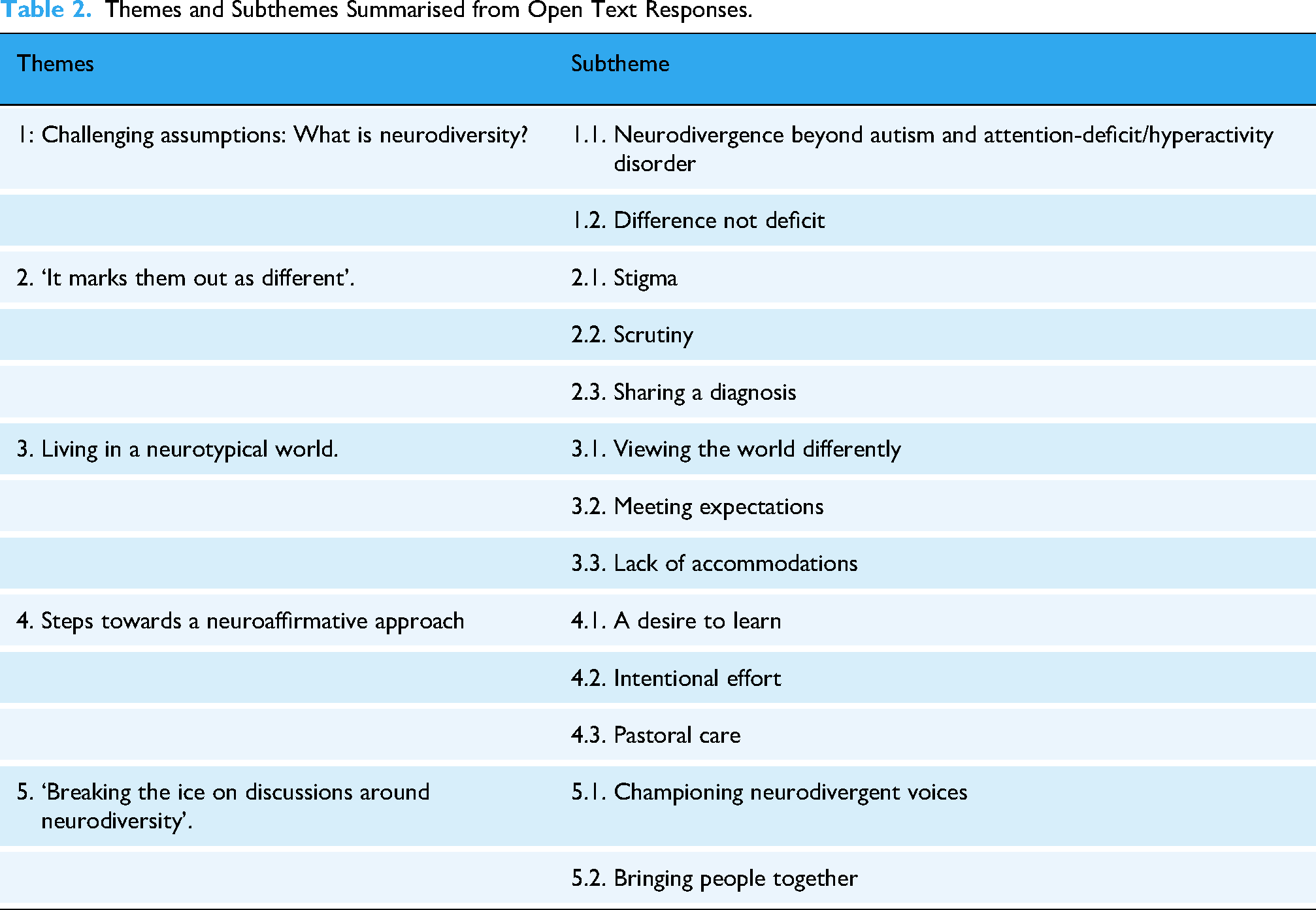
A summary of themes and subthemes can be found in Table 2 and are discussed below.
Themes and Subthemes Summarised from Open Text Responses.
I would understand neurodiversity to be a term that encompasses all those who feel they process information, the world or relationships in a different manner from the majority due to a diagnosed condition that affects their brain functions. (Neurotypical student) That it's not two or three stereotypes, and that we're not geniuses or grown babies, and that it's really complex and hard, and not to say insensitive things or make wrong assumptions. And that girls can also be autistic, and that autistic people can mask. (Neurodivergent student)
Several assumptions and myths were challenged in the responses collected, emphasising the heterogeneity of neurodivergence. However, many neurodivergent students expressed challenges faced when others did not fully understand their experience. In particular, one student noted ‘if I excel at something it's an excuse for them to renounce my struggles in other areas’, reflecting a limited understanding of the nuances and variation of neurodivergence, and a lack of strengths-based approach from those around them student.
I think my biggest fear about telling others I'm neurodiverse is I think it has previously been associated with weakness, being unable to handle what neurotypical brains can. It sometimes feels uncomfortable knowing that many people I know think like this subconsciously and are making judgements about me, but I feel it is important for people with whom I spend a lot of time to know about it as it is a significant facet of my character. (Neurodivergent student) The neurodiverse student might not want all those around them to know the details of their neurodiversity. Where students aren't mature enough to understand neurodiversity, this could lead to bullying, inappropriate behaviour etc. (Teacher)
Many responses echoed a sense of scrutiny from peers, with statements suggesting that only a formal label would allow for understanding and compassion towards a person's behaviour. Some participants expressed concerns about ‘not being believed’ due to preconceptions about what neurodivergence ‘should’ look like. Students shared experiences of ‘being forced to prove it’ and being ‘held to’ fixed assumptions about neurodivergence. There was a sense that neurodivergent labels are perceived as an ‘excuse’. Some participants reported being ostracised by peers, sharing experiences of being singled out or isolated. Sharing a diagnosis was thought to reduce scrutiny from others, as peers would understand why teachers respond differently. …I feel like sometimes it is interpreted as an excuse for certain behaviours such as disorganisation, messiness, or lack of attention. This can feel incredibly distressing because neurodiversity isn't an excuse and when teachers react in this way it becomes harder to learn. (Neurodivergent Student)
There was a strong narrative that ‘neurodivergence is not an excuse or an embarrassment’. Neurodivergent participants discussed being treated or perceived differently or feeling embarrassed about differences which arise from their neurodivergence. Teachers and neurotypical students brought in the idea that disclosing a diagnosis may be an ‘invasion of privacy’, which may reflect their biases that neurodivergence is something shameful to share.
It was noted that participants were concerned about the possible negative consequences of disclosing a diagnosis. Others felt that they did not wish to disclose a diagnosis due to the belief that disclosure would not change anything for the better. Teachers shared that, without a neurodivergence disclosure, they would likely perceive a child as ‘misbehaving’ and ‘naughty’ and would subsequently use punitive measures. There was a sense that adaptations could not be made without understanding the underlying reasons why a person may experience difficulties or act differently from the norm. Teachers also noted concerns that knowing a person is neurodivergent might result in other teachers responding negatively or in a patronising manner towards the student. Teachers were hesitant to ‘overcompensate’ or show a bias towards or against neurodivergent students. Similarly, some participants expressed problems with teachers underestimating neurodivergent students if a diagnosis is disclosed. In contrast, comments from neurotypical students suggested that disclosure is required to avoid or reduce judgements or assumptions. These responses led to many neurodivergent students feeling as though disclosure is a ‘lose, lose’ situation, as they might face prejudice from peers if a disclosure is not made, or from teachers if they are open about their diagnosis. It marks them out as different which could mean that a teacher reacts differently to them or makes assumptions about [what] they can and can't do. (Teacher) So that I know that if they are behaving in a strange way, it is not because they want to be annoying. I can also try to help them if I can. (Neurotypical Student)
Neurodivergent participants shared feeling ‘stupid’ when speaking with peers, especially in group settings as they faced challenges with initiating and ending conversations. They also reflected on challenges with ‘understanding verbal and non-verbal rules’, for instance using eye contact to demonstrate attention, and uncertainty around how much to share with others.
Specifically for this school setting, many students shared experiences of not keeping up with the pace or demanding workloads in lessons and feeling pressure to perform well in a highly academic environment; these difficulties were amplified for neurodivergent participants, with one neurodivergent student noting ‘everyone else's brains work different to mine, and it's very evident in school. This makes me feel really dumb’.
Participants highlighted the day-to-day impact of living in a world designed for and by neurotypicals, emphasising the need for adaptations and/or accommodations to be put in place. One student noted ‘it's not just a sort of arbitrary label […] it makes everyday tasks a lot more difficult than it might for most people’. Living in an environment without acceptance, understanding and adaptations led to an effortful attempt to fit in, with some students feeling as though they were required to ‘perform’. This additional effort to fit in at school was reported to lead to exhaustion, and for some, feelings of embarrassment. I would like people to understand that neurodiversity isn't an excuse for being unable to think/process information/act like neurotypical people. I wish people understood that certain mechanisms have to be put in place in order to help neurodiverse people vs forcing neurodiverse people to fit an education system that wasn't designed accounting for neurodiversity. (Neurodivergent Student) as a lot of the time you are forcing yourself to adjust yourself to a system of work that is much harder for you without help from others because you feel embarrassed. (Neurodivergent Student) being in this sort of environment made it so easy to think that I was simply lazier and less intelligent than most girls at [name of school], and that's why I had to work so hard to achieve the same grades. (Neurodivergent Student)
Several teachers reported a desire to protect neurodivergent students’ wellbeing and self-esteem, however, they felt that in order to do this, awareness of a diagnosis was required to facilitate understanding. Several teachers commented that they made intentional efforts to adapt their approach to neurodivergent students. Examples included attempts to improve communication, such as adjusting and clarifying expectations, and changing the language used when explaining tasks or giving instructions. Teachers noted that they strived to be ‘more patient and compassionate’ in response to neurodivergent students, stating that awareness of a diagnosis facilitates their ability to do this.
In addition to these adaptations, students called for ‘better pastoral care’, including suggestions about having someone to speak to, a support group, and safe spaces for neurodivergent students to go when overwhelmed. I hope (but doubt that I can say I do this really effectively) that it might deliberately alter how I respond for positive reasons – to facilitate their needs in the classroom. I question whether I do that really because I think [name of school] has a narrow academic ability and attainment band and we are very used to not having to teach a classroom to varied ability levels. I think that might make us particularly bad at accommodating needs. (Teacher) I am interested in these sorts of things, and I think it is nothing to be ashamed about. I also want to be able to help the classmate if they have any difficulties. (Neurotypical Student)
Within this, it was considered essential to champion the voices of and amplify the perspectives of neurodivergent students themselves. Several participants noted the importance of taking ‘neurodivergent students seriously’ to demonstrate respect and consideration of their needs. Opening conversations about neurodivergence was also thought to bring together people with similar experiences and create a sense of community. However, it was also noted that the responsibility to educate others should not be solely placed on the neurodivergent students. Create an environment whereby stigma surrounding neurodiversity at school is broken down by talking about it. Encourage those who identify as neurodiverse to talk about their conditions + help others to understand what that means. Will create an environment where people can talk freely and removes misconception that neurodiversity is something to be frowned upon. (Neurotypical student) I would definitely like neurodiversity to be more visible and spoken about at school as in my view, it is rarely mentioned compared to other topics such as gender equality, race, mental health or physical disability. (Neurotypical student)
Feedback From Students
On completion of the data analysis, the first and second authors met via online meeting with a group of neurodivergent and neurotypical students from the school, as well as the school's SENCO (total n=15, neurodivergent status was not formally recorded by the researchers but was indicated by the SENCO). The purpose of the meeting was to feedback on the results to the students and to discuss their reactions and opinions about what was found. The students were not surprised that stigma was common across many of the themes, as this was their daily experience. However, the neurodivergent students were surprised that their neurotypical peers were aware of the stigma that they face at school, including the discomfort that students may face when disclosing a diagnosis. It was noted that often the burden is placed on the neurodivergent student to draw attention to their needs and to be noticed by others. Many commented that neurotypical students' and teachers’ motivation and interest in learning more about neurodivergence felt superficial and more needed to be done in practice. All of the students agreed that the results highlighted the need for change in their school, to look ‘beyond the stereotype’, and improve provision and support for all.
Discussion
This study aimed to explore neurodivergent students’ school experience alongside peer and teacher understanding of neurodiversity, in a mainstream, academically selective girls’ school. Overall, the results of this study highlight not only a strong need, but also a desire and motivation for improved awareness and understanding of neurodivergence from both students and teachers. With only a quarter of teachers and a fifth of neurotypical students rating their own understanding as good or better, these results also highlight that, despite some appropriate definitions of neurodiversity from students and teachers, awareness itself is not enough. This is particularly important as previous findings demonstrate knowledge and understanding are related to more positive attitudes towards neurodivergent students and inclusive practice. For instance, Toye et al. (2019) surveyed the knowledge and attitudes of school staff towards students with ADHD. They found that increased knowledge and reduced stigmatising beliefs about ADHD predicted more positive and inclusive attitudes towards students. Further existing evidence from Lindsay et al. (2013) investigated educators’ perspectives about inclusive practices used when teaching autistic students. The teachers interviewed in their study emphasised the importance of developing inclusive environments integrating awareness and understanding of autism. It is clear that further education is needed including information regarding the range of differences and difficulties that neurodivergent students experience, and ways to support them in school – an important environment where the majority of young people's time is spent.
Stigma and discrimination were two notions common to several themes identified in this study, including barriers and disadvantages to disclosure and challenges faced by neurodivergent students. This is a common experience for many neurodivergent individuals. For instance, autistic people report negative societal perceptions of autism regardless of the autistic person's own feelings towards their autistic identity (Botha et al., 2020). Additionally, a study of 104 adults with ADHD found that the majority (69%) report perceived public stigma, and even more report internalised stigma (88.5%) (Masuch et al., 2019). Responses from neurodivergent and neurotypical students in this sample mirror the notion of a double empathy problem (Milton et al., 2021). The neurodivergent students expressed difficulties understanding the social norms and expectations evidenced by their neurotypical peers and teachers, but also felt their own differences were misunderstood by others. Neurotypical students’ and teachers’ responses highlighted a limited understanding of neurodivergent experience. Conceptualising this as a double empathy problem minimises stigma towards neurodivergent differences and emphasises the importance of rebalancing responsibility for mutual understanding.
Many neurodivergent students indicated that diagnosis led to greater self-understanding. Although we do not argue that all students should disclose their diagnostic status, all students should feel safe and comfortable to do so if they so choose. Around a third of the neurodivergent students in our study stated that they would welcome support to disclose their diagnosis to others. One way to assist disclosure would be to address stigma-related barriers. Ranson and Byrne (2014) conducted an anti-stigma intervention in a school to improve the experience of autistic adolescent girls and found improvements in peer understanding and behaviour. These types of interventions could also be applied to teachers and other school staff and may be a first step to reducing stigma and supporting neurodiverse students.
Stigma has also been identified as a possible driver of camouflaging behaviours (Perry et al., 2022). In addition to our main aims, we compared the self-reported level of compensatory strategies used by neurodivergent and neurotypical students. Similar to existing evidence (e.g. Hull et al., 2019), our results showed neurodivergent students scored significantly more highly on measures of camouflaging than neurotypical students. Evidence has shown that camouflaging is associated with negative mental health and wellbeing outcomes, and poorer quality of life for autistic individuals (Cook et al., 2021). Therefore, it is essential to further examine the impact of camouflaging for both neurodivergent students and neurotypical students who have high levels of neurodivergent traits but who have not been identified for support.
There is limited evidence regarding the role of camouflaging in other neurodivergent conditions, however, some researchers suggest that individuals with ADHD also engage in these behaviours (e.g. Young et al., 2020). In this study, a subgroup of neurodivergent students designed an adaptation to the CAT-Q, to try to capture camouflaging attempts by students with ADHD; to our knowledge, this is the first such attempt. While this was not a psychometrically rigorously designed scale, it is interesting to note that the correlation between this measure and the AQ-10 was broadly equivalent to that between the AQ-10 and the original CAT-Q, which was designed to capture the camouflaging of autistic characteristics. Similarly, there was a strong positive correlation between scores on the CAT-Q and the novel ADHD-CAT-Q, suggesting similar or related constructs may have been measured. While camouflaging and masking of ADHD are discussed on social media and in the grey literature, more research is needed to understand and measure this phenomenon and establish whether – as is the case for autistic people – it is associated with delayed diagnosis and poorer mental health (Cook et al., 2021).
Strengths and Limitations
Our findings elucidated the experience of neurodivergent girls and young women, who have historically been overlooked in research. However, the sample used in this study is unique in many ways, and unlikely to be representative of the wider population. The highly academically selective nature of the school means that these participants are intellectually extremely able, and we cannot presume the results will generalise to neurodivergent individuals with average or below-average intellectual ability. No data regarding ethnicity or ancestry were collected, however, the demographics of the school population is predominantly white, therefore we cannot assume that the experiences reported here reflect those of non-white neurodivergent individuals. We also focused on students at a girls’ school and cannot infer that their views would be reflected in a boys’ school sample; future work is needed to see what may be the same or different for boys in a single-sex school, or indeed for all genders in a mixed-sex educational setting.
We used the CAT-Q (Hull et al., 2019) and an adapted novel version addressing camouflaging in ADHD. Recent evidence has suggested lower construct validity when implementing the CAT-Q with individuals younger than 15 years of age (Lundin Remnelius & Bolte, 2024). Additionally, as the ADHD adaptation is novel to this context, we are yet to determine its psychometric properties. Results should be interpreted with these possible limitations in mind. The AQ-10 was used in this study, however, the Cronbach Alpha was 0.68 which indicates questionable internal consistency of the measure. The low number of items measuring a widely heterogeneous condition might explain this value; low internal consistency has also been found by Bertrams (2021) and was explained as the low correlation between different diagnostic dimensions (e.g. imagination vs. attention to detail).
A major strength of this study was the collaboration with key stakeholders and neurodivergent young people throughout each stage of the project, from inception to interpretation of findings. It is imperative that neurodivergent individuals are involved in research that addresses their experiences to ensure that their voices are represented and contribute to appropriate recommendations for the future.
Recommendations
Our results call for improved whole-school education about neurodiversity that includes practical suggestions on how to create an inclusive and supportive environment. This may take the form of workshops incorporated into existing lessons, specialised lessons or assemblies, whole school projects evaluating the needs of the students, adaptation to school ethos and values, and greater connection with specialist services. All steps towards improving understanding and support should be conducted in collaboration with neurodivergent students to ensure that the strategies used accommodate their needs and are not biased by a neurotypical lens (Fletcher-Watson et al., 2021).
Schools should create and dedicate safe and non-judgemental spaces to facilitate conversations about neurodivergence with all students and staff. Our study shows that both students and staff are motivated to participate in these conversations. The benefits of these conversations are manifold, with both short- and long-term consequences for all (Gillespie-Lynch et al., 2015, 2017; Muniroh et al., 2017). These include reducing stigma and improvements in peer cohesion, which may improve mental wellbeing, academic achievement and the overall school environment.
The findings of this study suggest that there is a relationship between camouflaging strategies and autistic traits across the clinical and subclinical range. It is important to consider that, within the context of an academically selective school, neurodivergent differences may be overlooked due to high academic performance and the rigid structure of the education setting. It is likely that putting in practices such as ensuring instructions and expectations are clear and explicit, a quiet space to go to recharge, or management of sensory stimuli, may be beneficial for all students – regardless of neurodivergent status. An additional benefit to the general application of these strategies is that it might alleviate the fear of judgement or stigma felt by neurodivergent students following or leading up to a neurodivergent disclosure. If support is offered regardless of diagnostic status, this may remove concerns around the need to disclose in order to receive support in school. However, it is important that students feel that they have a safe and trusted environment where they can share their diagnosis without negative consequences. It is therefore imperative that staff are trained to sensitively support and protect these students, should they choose to disclose. Our ultimate aim should be that students can own their neurodivergent identity, build self-esteem and self-understanding, and be confident that their differences will not be a source of discrimination.
Amongst the teachers taking part in our study, a small number identified or were diagnosed as neurodivergent. It was not possible to systematically compare their responses to those of the neurotypical teachers, but this would be an interesting focus for future research with larger samples. Recent research has begun to highlight the strengths that autistic teachers bring to their job, as well as the aspects of school life and environment that are most challenging for this group (Wood & Happé, 2021; Wood et al., 2022). These studies have shown that some neurodivergent teachers, just like some of the neurodivergent students in our study, are reluctant to disclose their diagnostic status. Therefore, having more inclusive environments might support teachers with their own disclosure, which might in turn help students feel able to be more open about their neurodivergence.
Conclusion
This study aimed to explore neurodivergent students’ experiences at school, alongside their peers’ and teachers’ understanding of neurodiversity. We found that there is both the need and motivation to improve understanding. Many of the barriers and disadvantages of disclosure could be alleviated by the reduction of stigma, which in turn may improve access to appropriate support. We recommend that, alongside improving understanding and awareness of neurodivergence, practical adaptations are made to the support offered to all students, including those whose neurodivergence may be disguised by their academic ability and efforts to camouflage in the school environment.
Supplemental Material
sj-docx-1-ndy-10.1177_27546330251326056 - Supplemental material for ‘Beyond the Stereotype’: Neurodivergent Students’ Experience and Peer and Teacher Understanding of Neurodiversity in a Mainstream Girls’ School
Supplemental material, sj-docx-1-ndy-10.1177_27546330251326056 for ‘Beyond the Stereotype’: Neurodivergent Students’ Experience and Peer and Teacher Understanding of Neurodiversity in a Mainstream Girls’ School by Victoria Louise Milner, Ladan Mohamed and Francesca Happé in Neurodiversity
Footnotes
Acknowledgments
The authors would like to thank the school and students who helped develop this study.

Funding
The author(s) received no specific financial support for the research, authorship, and/or publication of this article. The first author was a PhD student funded by the ESRC LISS-DTP at the time the research took place.
Conflicting Interests
The second author was a teacher at the school in which this research took place when this project was first conceptualised. The first and final author declare no potential conflicts of interest with respect to the research, authorship and/or publication of this article.
Supplemental Material
Supplemental material for this article is available online.
References
Supplementary Material
Please find the following supplemental material available below.
For Open Access articles published under a Creative Commons License, all supplemental material carries the same license as the article it is associated with.
For non-Open Access articles published, all supplemental material carries a non-exclusive license, and permission requests for re-use of supplemental material or any part of supplemental material shall be sent directly to the copyright owner as specified in the copyright notice associated with the article.
