



Abstract
Neurodivergent children educated in mainstream classrooms too often face poor outcomes compared to neurotypical peers. These may be caused, or exacerbated, by the negative attitudes and actions of classmates. One way to address these poor outcomes could be to educate all children about neurodiversity and neurodivergence, and how these differences manifest in school. The LEANS programme is a comprehensive, whole-classroom resource for teaching about neurodiversity concepts. In this feasibility study, LEANS was trialled in seven classrooms in Scotland. Measures captured pupil knowledge of neurodiversity, and their attitudes and intended actions in relation to their classmates. Approximately 140 children took part in the programme, of which 62 (about 40%) had parent consent to submit data for analysis. Quantitative analyses were pre-registered. Children who participated scored significantly above chance in their knowledge of neurodiversity at outcome (mean = 5.08 correct answers) and increased their scores on the Attitudes and Actions Questionnaire (mean difference = 1.14, p < .001). Qualitative data revealed good feasibility and low risk of harms. The LEANS programme can successfully teach children terminology and ideas about neurodiversity and neurodivergence, and this also increases positive attitudes and intended actions. This feasibility study should be followed up with a fully powered evaluation in a more diverse sample, which also captures long-term impacts of LEANS.
Lay Abstract
Neurodivergent children in mainstream education often face difficulties succeeding at school. These problems may be caused, or made worse, by classmates who don’t understand them. One way to fix some of these problems could be to teach children about the differences between pupils, in how they learn and experience things at school. The free LEANS programme provides everything a teacher needs to educate pupils aged 8–11 years about the differences present in neurodiverse classrooms. In this study, we tested whether LEANS worked in seven classrooms in Scotland. Approximately 140 children took part in the programme, of which 62 (about 40%) completed quizzes to measure pupil knowledge of neurodiversity concepts, and their attitudes to each other. Analyses were all pre-registered, meaning we planned what to do in advance, and published the plan. Children who took part in LEANS gained new knowledge about neurodiversity and their quiz scores also suggest that their attitudes toward each other got better. Pupils and teachers seemed to think LEANS was a good idea and learning about neurodiversity didn’t seem to have any down sides. The LEANS programme works to teach children about neurodiversity, and it also helps improve children's attitudes and how they plan to behave with each other. This was a small study though, and it should be followed up with larger project which can find out whether LEANS has other kinds of benefits, over time.
Population-level data from the UK nations show that 17–37% of children in mainstream schools are classed as having disabilities or learning needs that require heightened levels of support (Department for Education, 2023; Scottish Government, 2023). At the time of writing, Scotland describes this group as having ‘Additional Support Needs’ (ASN), Wales uses ‘Additional Learning Needs’ (ALN), and England and Northern Ireland refer to ‘Special Educational Needs and Disabilities’ (SEND). These terms are not interchangeable, but all of them encompass multiple types of needs, from physical disabilities to mental health challenges. All refer to children who may need specialised support to access education, compared to their peers. Available data on recorded types of need suggest that a large proportion of children in these groups currently have, or would qualify for, neurodevelopmental diagnoses such as ADHD, autism, developmental co-ordination disorder, developmental language disorder, and dyslexia. Thus, pupils with these neurocognitive profiles are a sizeable minority of the total mainstream school population.
Inclusion is a prominent part of educational policies across the UK nations (Barrett et al., 2015; Florian et al., 2016) and around the world (Ainscow, 2020; UN, 2016), though definitions of inclusion and applications in practice vary substantially. In Scotland, where the current feasibility study took place, a key principle of inclusion is a ‘presumption to provide education in a mainstream setting’ for all children, with education in special schools 1 to be treated as exceptional (Scottish Government, 2019, 2000). In Scotland, every classroom is highly likely to be a neurodiverse classroom by design, with a mixture of processing styles and support needs present.
Despite the goals of inclusion, children with additional needs 2 in Scotland and elsewhere experience a range of educational inequalities. For example, children with various neurodevelopmental diagnoses are more likely to be excluded from school than their peers (Paget et al., 2015) and children with special educational needs participate less in class (Maciver et al., 2019). They have been shown to be vulnerable to bullying and victimisation (Fink et al., 2015; Øksendal et al., 2019) and likewise many experience very poor mental health (Emerson & Hatton, 2007; Fleming et al., 2020; Hansen et al., 2018). Two factors underlying these inequalities are lack of understanding from adults and peers (e.g. Campbell & Barger, 2011; Gini et al., 2021) and stigma, which contributes to negative attitudes within school communities. Stigma, in particular, has been explicitly linked to poor outcomes for autistic people, who have been more-studied in this respect than other neurodivergent people (Botha & Frost, 2020; Perry et al., 2022; Understood.org, 2022).
An established approach to combatting stigma is addressing knowledge gaps about the stigmatised group through direct teaching (Salinger, 2020). The choice of what to teach about is of paramount importance in achieving anti-stigma goals. The neurodiversity paradigm and its terminology provide a useful, affirming lens for talking about the characteristics, experiences and needs of this group of young people. Neurodiversity, at its simplest, is the variation present across a group of individuals in the way their brains take in, process, and respond to information (Pellicano & den Houting, 2022; Sonuga-Barke & Thapar, 2021). The neurodiversity paradigm is a theoretical perspective on this fact of human diversity, and it holds that this variability in processing occurs naturally in the population and is value-neutral. It rejects the idea of a single ‘normal’ or ‘healthy’ brain or type of function to which all others are compared. Having a neurocognitive profile that diverges from a population's dominant i.e. neurotypical style of processing is simply less common, not less-than. People with existing neurodevelopmental diagnoses such as ADHD may be described as neurodivergent, because of their minority processing profiles. However, neurodivergence is not in itself a diagnosis, nor a term for a collection of diagnoses: it comes from a different theoretical perspective than medical or psychiatric diagnoses. Importantly for our purposes, while the neurodiversity paradigm emphasises the equal value of all people and celebrates diversity, it does not deny the potential of disability or the presence of support needs (Walker, 2021). Neurodivergent people may, but do not necessarily, consider themselves to be disabled.
We propose that teaching children about differences in information processing and learning using the neurodiversity paradigm, specifically, can help reduce negative attitudes, without detrimentally impacting access to support. Teaching about neurodiversity, not neurodivergence alone, contributes in an important way to fulfilling the vision of an inclusive classroom. It counteracts the positioning of neurotypical people as ‘other’, because all members of the class are part of its diversity – including the neurotypical majority, who are an essential audience for any efforts to change knowledge and attitudes.
We created a freely downloadable, comprehensive programme to teach about neurodiversity and neurodiverse school experiences to mainstream primary school pupils aged 8–11. It comprises a curriculum structure and learning objectives supported by extensive teacher and child-facing resources, called Learning About Neurodiversity at School (Alcorn et al., 2022). The content and format of the LEANS programme was designed with a neurodiverse team of educators in reference to school contexts in the four UK nations and Republic of Ireland, and refined through consultation cycles with teachers, neurodivergent adults, and the public.
Here we report on a feasibility study in schools, capturing elements of acceptability (Sekhon et al., 2017) and preliminary indicators of potential effectiveness. This is a crucial step towards implementation and future comprehensive evaluation (Moir, 2018). The research questions were:
Analyses to address the first and second research questions are qualitative and exploratory, with no fixed hypothesis. Analyses to address the third and fourth research questions were pre-registered (Alcorn et al., 2021). We expect to find increases in neurodiversity knowledge and in positive attitudes and intended actions, from baseline to outcome. For neurodiversity knowledge measures collected at outcome only (see Methods for details), we expect to see performance significantly above chance.
Methods
Participants
Per our study pre-registration (Alcorn et al., 2021), eligibility criteria for schools specified that they must be located in Scotland, but could be of any size or type (state-funded, private, academy) as long as they offered mainstream primary provision. Exclusion criteria debarred schools with high proportions of (a) students with English as an additional language or (b) pupils working substantially below grade level. This is because educators on our design team believed the LEANS programme would require substantial adaptations to be accessible for populations with these characteristics, thus affecting our ability to meet study goals (i.e. assessing the current version of the resources).
Classrooms were eligible if they included children aged 8–11 years (including mixed-age classrooms) and delivered mainstream provision, that is, the classes were not within a resource base or other specialised provision co-located at a mainstream school. Furthermore, a fully qualified teacher employed by the participating school must be available to deliver the entire LEANS curriculum and complete the teacher diary information. Co-taught classes were eligible as long as the teacher(s) delivering LEANS met the outlined criteria.
Participating schools were all in Scotland, state-run and offered mainstream provision, teaching children ages 8–11 years old. Eight classrooms and nine teachers (one class changed teachers partway through the term, due to staff absence), drawn from four schools, enrolled in the study (see Table 1). The entire class participated in LEANS together as part of their scheduled curriculum, including completing the LEANS quizzes (see Measures section). This meant that approximately 160 pupils took part in some or all of the LEANS curriculum. In each enrolled classroom, the person delivering the LEANS programme and completing teacher-diary information was a fully qualified teacher permanently employed at the participating school.
Participating LEANS schools.
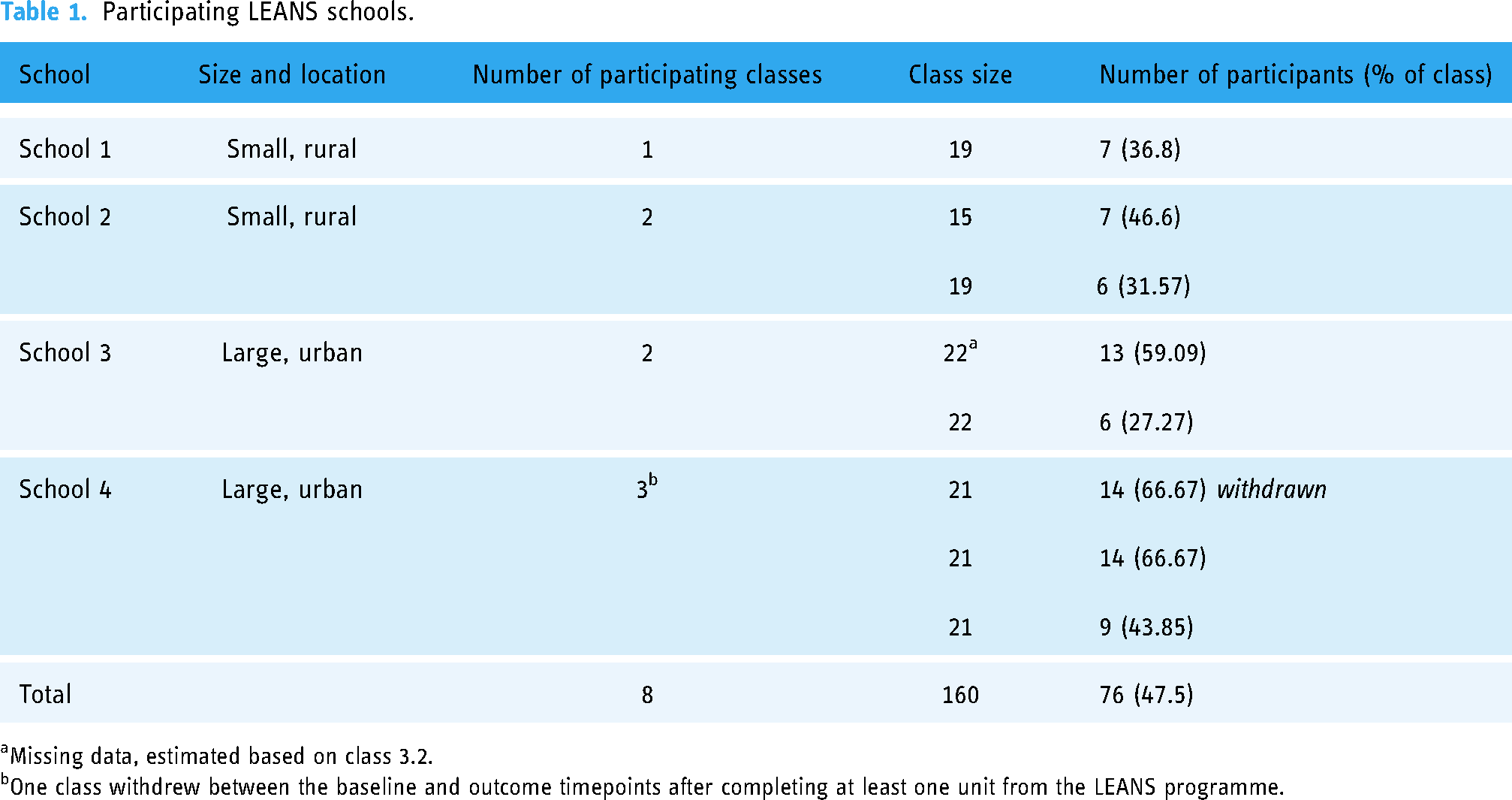
Missing data, estimated based on class 3.2.
One class withdrew between the baseline and outcome timepoints after completing at least one unit from the LEANS programme.
Participants whose data are reported here are teachers, and children in those classes whose parents or carers opted-in to the LEANS study. This means they provided explicit consent for their baseline and outcome scores to be submitted to the research team for analysis. There were no exclusion criteria with respect to child characteristics, and no quotas for child age, gender or other demographic characteristics. Seventy-nine children enrolled at the beginning of the study.
One class withdrew from the study between the baseline and outcome time points, after completing at least one LEANS unit. We removed this entire class's baseline and demographic data from analyses of all measures, because they had no post-test data and did not substantially engage with the programme content. Communication from the class teacher indicated that the decision to withdraw was closely related to disruption caused by the COVID-19 pandemic, which was active in the UK at the time of the study (autumn 2021). Approximately 140 children in the remaining seven classes were thus exposed to the full LEANS curriculum. We include parent/carer reported pupil demographics for the seven classes that completed both baseline and outcome time points, for a total of 62 enrolled participants.
Of these children, parents/carers reported child gender as female = 34, male = 26 and all other gender options = 0. Their mean age was 9.84 years (range: 8–11) and 11 participating children (17.74%) had parent-reported learning challenges. These challenges were a mix of formal neurodevelopmental diagnoses such as ADHD or autism, suspected but undiagnosed challenges, and children on waiting lists for diagnoses. Multiple children had multiple diagnoses each, or a mixture of diagnosed and undiagnosed challenges. Forty-seven children (75.8%) were reported to be from White British backgrounds, 10 (16.12%) from other White backgrounds, and five (8.06%) from other backgrounds including Indian, Arab, Black African and Mixed/Multiple backgrounds. All children in the sample were fluent English-speakers (96.77% native speakers, 3.22% non-native speakers). We do not report pupil characteristics by classroom or by school because of risk of identification with small sample sizes. Two of the schools are extremely small and even age data are potentially identifying.
We report data on the teachers in the seven analysed classrooms as a group (n = 7, all female), to avoid possible identification due to small schools. An additional teacher joined the study partway through term on an emergency basis due to staff absence, as noted above, but did not complete the background information. All had completed their teacher training in the UK, with 3–27 years of professional experience (mean = 15.28 years), sometimes covering multiple pupil age groups and teaching roles. They varied in their self-reported knowledge of neurodiversity: not at all knowledgeable = 2, a little bit knowledgeable = 2, moderately knowledgeable = 1 and very knowledgeable = 2. The five who reported a degree of neurodiversity knowledge had learned about it from multiple sources, including day-to-day teaching experience, training on additional support needs and inclusion topics, and online or social media sources. Only two teachers reported previously delivering any primary-level programme that directly discussed learning differences and/or inclusion topics (no = 4, not sure = 1). The majority (n = 5) reported feeling moderately confident with teaching topics related to diversity (e.g. ethnic or religious diversity) and/or discussing diversity/inclusion issues in their classes (a little bit confident = 1, very confident = 1).
Materials: The LEANS programme
The teacher-delivered LEANS programme was developed by a neurodiverse team of researchers and educators, for use by whole classes of primary school pupils (age = 8–11). Its goals were to inform them about neurodiversity, and to increase positive attitudes and intended actions towards neurodiversity and neurodivergent people (referred to within LEANS materials as Know-Think-Do goals). Figure 1 summarises the LEANS programme content and materials, with further details available in the Supplementary Materials, Part I. You can download the complete LEANS programme for free at https://www.ed.ac.uk/salvesen-research/leans.

Summary of the LEANS programme topics and materials.
Materials: Measures of feasibility, acceptability and harms
The parent/carer-completed Strengths and Difficulties questionnaire (Goodman, 1997) was used to characterise the consented pupil sample.
Highly structured teacher diaries were provided to capture formative feedback about the LEANS resources and to estimate programme completion, a key measure of feasibility and acceptability. Required sections for each unit asked teachers to tick off which resource items they delivered, estimate total unit delivery time, and comment briefly on aspects that were perceived to have gone well or to need improvement. Optional diary sections allowed for more detailed qualitative feedback on the programme overall. A key goal of the diaries was to identify evidence of potential harms, and inform resource revision ahead of public release. Audio (via a Dictaphone), digital and paper diaries were offered, and all teachers selected to type or handwrite a written diary.
We also conducted pupil interviews with a sub-set of those participating. The interview topic guide and consent script are included in the Supplementary Material, Part III. We were particularly keen to hear from children who might be considered neurodivergent, based on background information provided by parents/carers. This was because we were concerned to uncover potential harms, to which we thought neurodivergent children might be especially vulnerable. For example, bullying from peers following introduction of neurodiversity vocabulary, or distress about discussing neurodivergence in class.
Materials: Measures of preliminary effectiveness
In the absence of existing appropriate measures, novel measures were created to capture child knowledge and attitudes about neurodiversity. The Neurodiversity Knowledge Quiz (NDKQ), was administered at Outcome only (see Procedure for rationale) and the Attitudes and Actions Quiz (AAQ) was administered at baseline and outcome. Details of measure creation and scoring appear in the Supplementary Materials (Part II), but in brief we captured: (a) proportion of participants selecting the correct definition of neurodiversity from a multiple-choice list; (b) total number of correct responses to multiple-choice questions on the NDKQ and separately on the AAQ; (c) averaging responses to Likert-style response questions on the AAQ.
Design and procedure
The study had no control group, collecting pre-test data at baseline and post-test data upon completion of the LEANS programme at outcome. A sub-set of children took part in follow-up interviews one to two months after completing LEANS. Ethical approval was provided by the Moray House School of Education and Sport ethics review committee, at the University of Edinburgh (Ref: AA10042021).
Schools were identified via educators who had already signed up to the LEANS project mailing list, social media posts, and word of mouth. Five school leaders who expressed interest in participation received written study information, and then completed at least one phone call with a researcher to discuss the study requirements and ask any questions. After further internal discussions, four schools elected to join the study. The fifth school ceased responding to the research team after initially expressing interest during their phone call to discuss the study. We identified candidate teachers in partnership with school leaders, who then invited them to opt-in to participation.
Teachers received all LEANS materials at least four weeks before the scheduled start of delivery, and had a direct line to the research team for questions. Teachers did not receive any type of LEANS training session or briefing, because no such sessions would be available to future programme users. The LEANS design team deliberately chose a model of self-directed teacher study and preparation using a comprehensive Teacher Handbook, over a centralised training model that would be unsustainable in the long term.
Teachers circulated information about LEANS to their classes, stating that the whole class would take part in the programme, and inviting parents/carers to provide consent for participation in the research element. Parents/carers completed online consent forms, basic demographic information about their child and a parent-report Strengths and Difficulties questionnaire.
At baseline, children completed paper copies of the Attitudes and Actions Quiz (baseline version) in class. The class then proceeded through the LEANS materials (see Supplementary Materials Part I for details) in the following weeks. Teachers were free to decide on the schedule of engagement with LEANS provided that they: (a) proceeded through the units in order; (b) completed all non-optional materials in each unit; and (c) completed at least six units of the curriculum before the end of the school term. Completion of Unit 7 (review and reflection) was not mandated due to time pressure, and because it does not introduce new content. Due to staff/pupil absences and other delays, the total period of study participation varied from 8 to 15 weeks, excluding school breaks. Teachers were asked to record delivery information in their teacher diary during/after each unit as a required part of the study, with the option to provide additional qualitative information at the end of programme delivery.
At outcome, children completed paper versions of the Attitudes and Actions Quiz (outcome version) and the Neurodiversity Knowledge Quiz. Quizzes were completed soon after completion of the final LEANS unit: normally within one week. The Neurodiversity Knowledge Quiz was administered at outcome only, as this relied on novel vocabulary introduced during LEANS, highly unlikely to be known to primary school children beforehand. We were concerned that a quiz testing knowledge that had not yet been taught would have been off-putting to pupils if administered at baseline.
Parents/carers who had provided consent for follow-up were approached to invite their children to take part in an interview about their LEANS experience. The final sample included seven children, drawn from three participating schools. There were four boys and three girls, ranging in age from 8 to 11 years old. All were white British. Three had a neurodevelopmental diagnosis, two more had undiagnosed learning needs (parent-reported), and two more had no reported diagnoses or undiagnosed needs, but scored in the ‘high’ or ‘raised’ categories for their SDQ Total Difficulties score.
Analysis plan
Feasibility and acceptability of the LEANS programme (RQ1) was assessed by reporting the number of classes completing LEANS and by targeted extraction (without analysis) of relevant feedback from teacher diaries and pupil responses to open-ended quiz questions, with a focus on identifying perceived problems with the resources and their means of delivery. We also examined these sources for any reporting of harms (RQ2). Risk of harms was further assessed by interviewing a sample of children who had taken in part in the LEANS programme. We used a simplified and abbreviated deductive thematic analysis to identify any evidence of harms (regardless of whether these were directly described as such by participants). Since the interviews were both conducted and analysed by originators of LEANS there was substantial potential for bias, based on a desire to show that LEANS was useful. The choice of a reflexive approach like thematic analysis encouraged the research team to acknowledge this bias and keep it at the forefront of their minds. We asked directly about harms (e.g. Was there anything you didn’t like? Were there any times that you felt unhappy or uncomfortable?) and via open questions allowing room for harms to be reported (e.g. Did you ever talk about LEANS outside of the classroom with your friends? If so, how did you feel about these conversations? And Do you think learning about neurodiversity has changed things in your class? If so, how?). We proactively sought evidence of reported harms in the data and worked hard to draw out any negative or constructive feedback, as well as other insights from the data.
Analysis steps were: repeated watching of interview recordings; extraction of quotes; organisation of quotes into codes and then themes; naming and defining themes (all last author); cross-checking with two independent team members (first and second author); and interpretation of themes in relation to evidence of harms. Plausible harms could have included: interference by LEANS in daily school life or engagement with learning; discomfort or distress in relation to LEANS content or topics; unwelcome revelations about the self or others; intimations of bullying or victimisation (observed or experienced) in relation to being neurodivergent; problems within the family as a result of discussions about LEANS.
Preliminary effectiveness was analysed via comparison of baseline and outcome scores. Before completion of quantitative analyses, missing data (per participant) on one or more baseline or outcome measures (e.g. if the child was not present in class on the day the quizzes were administered) were imputed from the mean score of their classmates on the same test, taken at the same timepoint. The ‘target item’ from the Neurodiversity Knowledge Quiz was not imputed because it was a single item scored 0 or 1. The number of children with imputed scores at baseline was n = 13 (20.96%) and the number of children with imputed scores at outcome was n = 6 (9.67%).
Knowledge about neurodiversity (RQ3) was assessed in two ways. First, we examined change in the proportion of correct responses from baseline to outcome on the neurodiversity knowledge ‘target item’ from the Neurodiversity Knowledge Quiz. We calculated an odds ratio with 95% confidence intervals to quantify this change. Second, for the Neurodiversity Knowledge Quiz scale assessed at outcome only, we examined mean total score against chance-level (20% or a score of 1.6) using a single-sample t-test.
Attitudes and actions (RQ4) were measured at baseline and outcome, yielding two sub-scales. For each sub-scale score, we used a paired samples t-test to examine differences between baseline and outcome for the full sample. In addition, we constructed change scores by subtracting score at baseline from score at outcome, whereby a larger score with a positive value indicates closer alignment with LEANS curriculum content. Change scores were used to investigate consistency of LEANS response, described below.
We carried out the following sensitivity analyses. First, children who failed both screening items at the start of the Neurodiversity Knowledge Quiz (n = 2) were excluded from the sample and quantitative analyses were repeated with the remaining sample. This is because failure to pass these screening items signalled a lack of comprehension of, or exposure to, the LEANS materials. All results were the same in direction and significance of effect: see Supplementary Material Part IV for reporting.
In addition, we carried out the following exploratory analyses to examine consistency of response across schools and participants. First, paired samples t-tests were used to examine differences in AAQ between baseline and outcome in each school (n = 4) separately. Second, we examined relations between child characteristics and response to LEANS. Child demographics (age, gender, ethnicity, English proficiency, diagnosed and/or undiagnosed learning need) and Strengths and Difficulties scores were correlated against: Neurodiversity Knowledge Quiz mean score at outcome; Attitudes and Actions Quiz multiple-choice subscale change score (outcome – baseline); Attitudes and Actions Quiz agreement subscale change score (outcome – baseline). Variables representing child characteristics that showed significant correlations with quiz scores were entered individually and simultaneously into three separate regression models, to predict each outcome variable listed above.
We use the standard p < .05 criteria for determining if tests are statistically significant. One-tailed t-tests were conducted as we only predict improvements in scores on all measures. A post-hoc sensitivity power analysis on actual sample size (n = 62) demonstrates that we can reasonably expect to detect effect sizes of 0.37 or above for both single-sample and paired-samples t-tests at 90% power (Faul et al., 2009). Given the medium-large effect sizes required to reach significance, we will discuss our results with reference to established effect size metrics (i.e. Cohen's d for the social sciences: small = 0.10; medium = 0.30; large = 0.50).
Other analyses planned in our pre-registration were not carried out due to inadequate sample size, and therefore power. Specifically, sample sizes in individual classrooms were judged both too variable and too small (see Table 3) to permit analysis at classroom level. In addition, total sample size was judged too small to permit regression incorporating each of five sub-constructs from the Strengths and Difficulties Questionnaire. Likewise, regression incorporating every demographic variable, including those not correlated with outcomes, was not considered reasonable given the large number of variables and modest sample size.
Community involvement
The core LEANS project research team is a neurodiverse group of seven academic and non-academic team members, including an adult autistic advocate and teacher, and a neurodivergent young person. All project team members gave input and feedback on the design of the present study, the bespoke neurodiversity measures, and later the interpretation of the results.
The LEANS programme content, format and teacher guidance were designed by a neurodiverse Participatory Design Team of education professionals in the UK and ROI, working closely with the core research team. This was a clearly defined role paid at an hourly rate, with a structured selection process to recruit people with a range of professional and life experiences related to neurodivergence and primary schools.
An online consultation study (Zahir et al., 2023) solicited feedback on the planned resource design from the wider community, including a high percentage of neurodivergent respondents. A separate diversity consultation involved experts by experience (i.e. people with minority identities) to shape our representation of diversity (in terms of gender, ethnicity, disability, culture) and avoid stereotypes in LEANS classroom resources, particularly the story characters and illustrations.
Some Participatory Design Team members opted-in to further paid involvement in implementing teacher and child feedback collected in this study, before the programme release. All members had the opportunity to review and approve semi-final versions of the materials near the end of the development process, and confirm their crediting in the final resource (Alcorn et al., 2022).
Results
Feasibility and acceptability
Seven classes completed at least six out of the total seven LEANS units; the eighth enrolled class dropped out as described above. Based on teacher diaries (e.g. noted timings of content delivery, qualitative comments) and direct communication with schools, teaching was severely disrupted for the whole delivery period. At the time, there was no lockdown in the UK, but COVID-19 cases were very common and local rules meant that people with positive tests, and known contacts, had to miss school. Staff and pupil absences were a major issue in almost every classroom, and two schools had sizeable gaps in LEANS delivery due to staff illnesses. Evidence of the feasibility and impact of LEANS should be considered in the light of the less-than-ideal circumstances of its delivery. Teacher diaries further yielded constructive feedback that drove updates to the resources (e.g. clarity of instructions, activity completion time estimates), and noted examples of perceived positive changes in children's knowledge and behaviour. Teachers did not note any essential instructions or content that they thought was missing from LEANS, nor did they communicate with the research team to clarify or request additional instructions on content delivery. This suggests that the programme model of providing teacher information via a Handbook, rather than a training course, was overall feasible and acceptable.
In addition, pupils made a number of practical comments about the feasibility of LEANS, largely focused on length: ‘I liked it but it could have been shorter’; ‘It is good but I did not like how long it was’; ‘It was good but when our teacher had to read the long parts people got very fidgety’; ‘It was fun; stories were a bit long’. We found no evidence in pupil reports of harms, beyond this consistent feedback on length, particularly around the story content. One pupil requested: ‘Please continue to teach children about neurodivergent people’.
Risk of harms
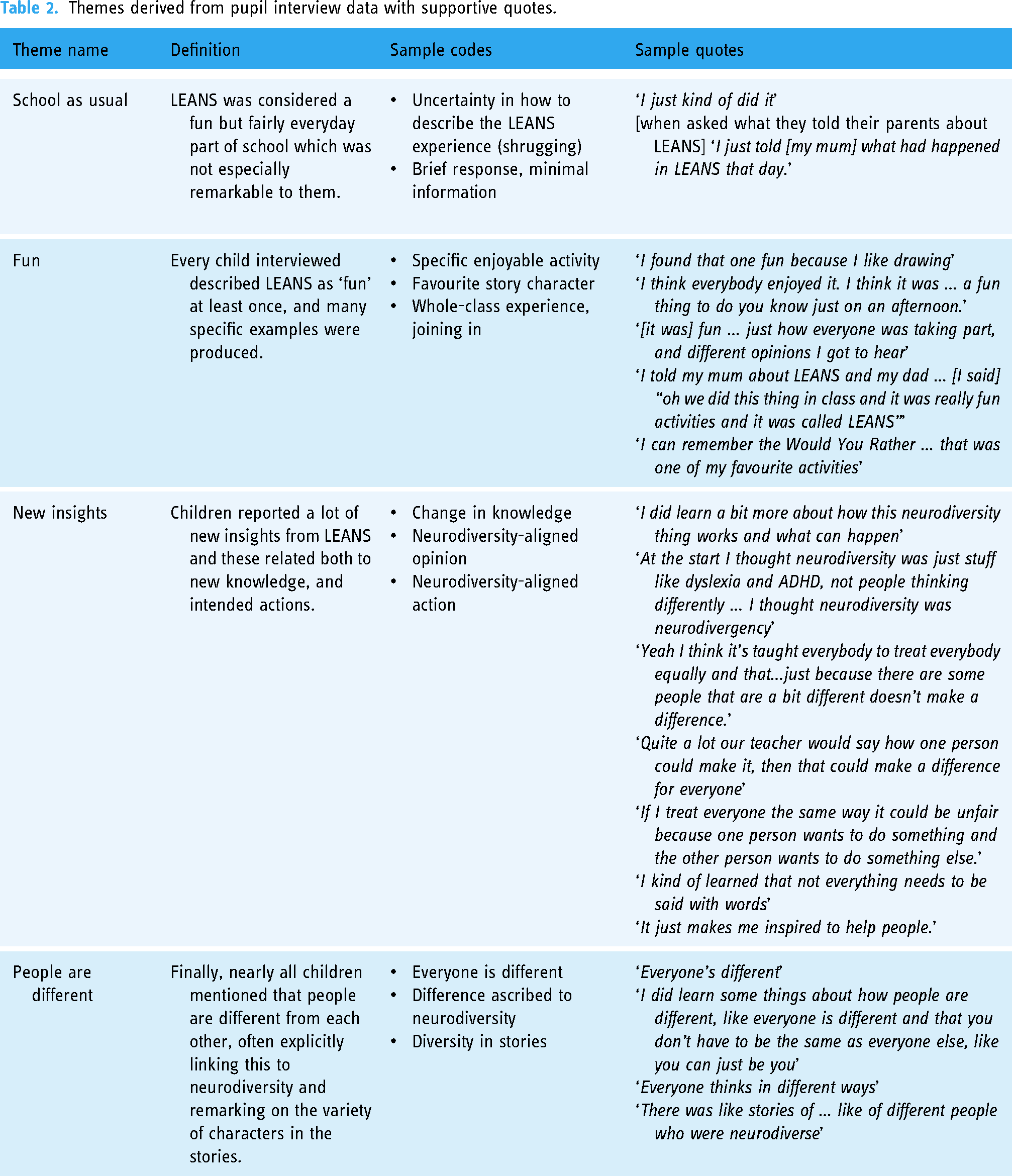
Four themes specifically relevant to the question of whether the LEANS programme caused harm to participating children were deduced from the interview data. These are presented with underlying codes and illustrative quotes in Table 2. Our interpretation of these themes is that there was no evidence of risk of harms either explicitly or implicitly referenced in these pupil interviews. LEANS did not seem exceptional as a school activity (School as Usual) and much of it was enjoyable (Fun), particularly the game-based and arts-based elements. Pupils displayed new knowledge and intentions (New Insights), all reported in a positive manner, and they consistently referenced diversity as a key element of the programme (People are Different). When asked directly if anything in LEANS upset them, every child responded with some variation of ‘um, no’.
Themes derived from pupil interview data with supportive quotes.
One adverse event took place during LEANS, concerning a participant who took part in the LEANS programme with their class but did not enrol in the research study. This pupil experienced a short period of distress in related to an in-class conversation about the materials. Following conversations between their parents and research team, this pupil's distress was quickly resolved. This event directly inspired several revisions in the publicly released version of the LEANS programme, including expanded guidance on staff–pupil and staff–family conversations regarding neurodivergence. Final guidance stressed the need for all classroom staff to be included in safety planning (even if they are not part of LEANS delivery), and to have an agreed procedure for handling sensitive conversations around neurodiversity and neurodivergence.
Neurodiversity knowledge
At baseline, 17.7% of children selected the correct neurodiversity definition on the ‘target item’ – a level that is close to chance (20%, with 5 multiple-choice options). At outcome, 59.7% of children provided correct answers, representing an odds ratio increase of 2.39 (95% CI: 0.435–13.1). At outcome, the mean Neurodiversity Knowledge Quiz score was 5.08 correct answers, and this was significantly higher than chance level: t(61) = 12.64, p < .001, d = 1.61.
In open-ended questions at the end of the quizzes, pupils reported learning a range of new things from LEANS including ‘I learned about Neurodiversity and how brains process info differently. Depending on whether they are Neurodivergent or Neurotypical. However not all Neurotypical people are the same’; ‘There is a difference between NEED and WANT’; ‘I learnt a new word Neurodiversity’; ‘I learnt a lot more about fairness’; ‘People are different and shouldn't feel that they have to change’.
Attitudes and actions
There was a significant improvement in mean scores at outcome as compared to baseline, on the multiple-choice subscale: mean difference = −1.14, t(61) = −6.04, p < .001, d = −0.77. This means that after LEANS, more children endorsed courses of action (or judgements about school situations) that aligned with the LEANS content. There was a small but significant reduction in mean scores at outcome as compared to baseline, on the agreement subscale: mean difference = 0.24, t(61) = 2.64, p = .011, d = 0.33.
Consistency across participants and schools
Analyses reported here examine the degree to which response to LEANS varied between individuals and schools. There were significant correlations between some child demographics and quiz scores. Older children had better Neurodiversity Knowledge Quiz scores at outcome (r = .314, p = .013), and showed larger changes in Attitudes and Actions multiple-choice question scores between baseline and outcome (r = .313, p = .013).
Children with higher total difficulties scores on the parent-reported SDQ (i.e. greater level of difficulties) performed worse on the Neurodiversity Knowledge Quiz at outcome (r = −.256, p = .045), but this does not survive statistical correction for multiple testing. We did not find any significant correlations between SDQ and change scores on either sub-scale of the Attitudes and Actions Quiz.
The regression model for Neurodiversity Knowledge Quiz scores at outcome was significant, F = 6.227, p = .006, explaining 17.4% of the variance in outcome. Significant predictors were age (
Table 3 reports analysis of key variables (Neurodiversity Knowledge Quiz at outcome, change in Attitudes and Actions scores) broken down by school. Our two larger schools show a pattern of results much the same as the whole-sample, while schools 1 and 2 have some null results. This suggests a problem with statistical power, whereby apparent inconsistency in results between schools may be due to variability in sample size, rather than variability in LEANS response.
Analysis of key variables by school.

Discussion
Feasibility and acceptability
The feasibility and acceptability of LEANS, from both teacher and pupil points of view, was strongly endorsed despite the challenging context of delivery during an active phase of the COVID-19 pandemic. The fact that teachers adhered to LEANS delivery despite the extremely challenging circumstances is interpreted as a strong vote of confidence in the programme's acceptability and feasibility. Nonetheless, we must also take seriously the fact that not every teacher managed to complete the seventh and final LEANS unit by the end of term, and that teacher and pupil feedback noted that parts of LEANS were too long. As a result, we made revisions throughout the content, focusing on reducing complexity, repetition, and preparation time. For example, we edited the stories to remove 28% of length (without removing any major events or characters) and removed Teacher Handbook sections that summarised content available in other files. It is clear that delivering LEANS remains a substantial commitment for teachers, but further reducing the resource (e.g. cutting units/topics) risks moving away from its foundations in participatory design with a neurodiverse educator group, and jeopardising potential for learning. Future implementation of LEANS must involve clear communication with teachers about the time commitment involved.
Especially given that degree of commitment, future studies should further explore the factors that might make LEANS more or less feasible in given settings, and which models of programme rollout are considered practical and ethical. Both this study and LEANS’ published guidance, derived from our participatory design process, focus on a classroom-level opt-in model of delivery and stress that the programme should not be imposed top-down on unwilling staff, due to the importance of teacher buy-in when delivering this sensitive topic. However, school leadership and education policy can both play critical roles in championing inclusion and facilitating uptake of new programmes. It is an unresolved question whether and how policies to encourage neurodiversity teaching can be reconciled with the inevitably-varying commitment and endorsement of the approach present across individual teachers. In the interim, this current study and the ‘early adopter’ classrooms who report using LEANS since its 2022 public release provide important examples of real-world use that may inspire other teachers and schools to commit their time.
Risk of harms
Interviews with pupils revealed no evidence of risk of harms to themselves, or observed in classmates. No harms were identified explicitly or implicitly by teachers. A single adverse event was quickly resolved, and led to changes in the finished materials to prevent recurrence. Pupils reported finding LEANS fun, while also experiencing it as a regular part of their school day. This is important and positive, given LEANS’ messaging that every classroom is neurodiverse. This ‘regularness’ is not to say that LEANS had no impact – pupils clearly reported enjoyment of the activities, effective learning and a commitment to new behaviours.
Preliminary effectiveness
These qualitative data are supported by our quantitative findings. Neurodiversity knowledge at outcome was good, well above chance levels for the whole sample and each school individually. Likewise, children showed evidence of more accepting attitudes to neurodiversity and neurodivergence, and indicated more positive intended actions following LEANS participation. While we cannot completely rule out changes due to maturity, this seems an implausible explanation for such specific changes in knowledge over such a short period of time. Practice effects can also be partly ruled out by the many measured items assessed at outcome only. The impact of LEANS on measured variables was fairly consistent across pupils. Older pupils did do better on the quizzes, unsurprisingly. Slightly poorer performance recorded for pupils with more parent-reported difficulties was a small effect that did not present consistently.
The agreement sub-scale of the Attitudes and Actions Quiz did not reveal the predicted increase in scores: in fact, there was a small but statistically significant reduction in pupils’ mean agreement with these items. Scrutinizing the items in the light of this result raises the possibility that LEANS caused pupils to reconsider their views of the classroom. For example, one item on the quiz is ‘In my class, most people are kind and friendly to people who are different than they are’. We predicted an increase on this item, as a result of pupils committing to improve how they and their classmates relate to each other, following participation in LEANS. However, it is possible that a decrease in agreement with this item might arise from a pupil re-assessing who or what counts as ‘different’, or what constitutes kind and friendly actions.
Limitations
Our conclusions about feasibility and acceptability for pupils are limited by not including neurotypical children in our interview sample, although the neurotypical children are the largest group represented in the qualitative questionnaire data. Neurotypical children are, by the numbers, the largest audience for LEANS content, and thus their experiences are highly important for its overall feasibility. In interviews, they may have shared different experiences or concerns than those of their neurodivergent classmates. Similarly, teacher diaries provided only functional information about the trialled version of the LEANS programme and these lacked the volume or detail required to allow for formal analysis. Future study should attempt to capture richer information about teacher reflections to inform implementation. Both of these factors will be important to investigate in a future evaluation.
Schools and teachers volunteered for this study, which is in line with LEANS’ recommended use (where, for reasons of safety and ethics, the guidance strongly discourages top-down imposition of the programme). Any insights on feasibility and acceptability are coloured by this fact, and it is not clear how feasibility and acceptability would be different for a larger pool of educators. By chance, the schools had substantial homogeneity among participating staff and the pupils enrolled in the study, such as the high proportion of native English speakers (not reflected across many other parts of the UK). We cannot know for sure whether these results would hold for a larger and more diverse collection of schools. Another limitation is the impact of the COVID-19 pandemic on delivery, which meant one class dropped out of the study, and others did not complete the final LEANS unit. For all classes, we know pupil attendance was disrupted, but lack data about how much or little of the content individual pupils experienced.
When it comes to preliminary information about effectiveness, our analysis is limited by the lack of a control group. On the other hand, it is hard to imagine how practice effects or maturity could have delivered increases in specific technical knowledge about neurodiversity terms and concepts. Extended outcomes were not measured, such as changes in pupil wellbeing or peer relationships, but these should be addressed in future. Nonetheless, in the context of the disrupted administration described above, we believe the recorded increases in pupil knowledge, attitudes, and actions, are all the more impressive and show potential.
Future directions
It is clear that LEANS achieved its goals to change what pupils know, think and do about the neurodiversity present in their classroom, while meeting acceptability and feasibility expectations and avoiding harms. It joins a small group of programmes that aim to generate more positive knowledge about, and attitudes to, neurodevelopmental diversity (e.g. Gillespie-Lynch et al., 2015; Gordon et al., 2015; Salinger, 2020). While programmes on related topics are available (e.g. awareness of disability and specific diagnoses, anti-bullying, promoting empathy), to our knowledge this is the first programme to explicitly adopt a neurodiversity framework and to teach about neurodiversity as a classroom topic, including neurotypicality and the experiences of pupils without formally recognised differences or support needs. In the longer term, LEANS or closely related programmes may have the potential to be used as whole-class, non-specialist interventions to support pupils’ health and wellbeing. A key step towards that goal would be direct testing of hypotheses about the predicted links between neurodiversity teaching in the classroom, stigma, and pupil wellbeing, in addition to more rigorous programme evaluation.
In response to the observations of teachers and pupils, LEANS resources have now been further refined and released to the public. Future research will be needed to examine how these perform, ideally during a term that is not subject to pandemic-related disruption, and in a controlled study design. A specific focus could include the acceptability of LEANS from a parent perspective, long-term impact of LEANS on pupil mental health and wellbeing, and relationships to measures of school belonging.
Conclusion
The LEANS programme provides a way for teachers to introduce an entire class of children to neurodiversity and related concepts. Findings from this initial study indicate that the curriculum is acceptable and feasible from both a teacher and a pupil perspective, with minimal evidence of harms. Outcome measures indicate that LEANS is successful in introducing children to new knowledge and cultivating more positive attitudes and intended actions. This may include children re-assessing their school environment in the light of new information learned. Given the preliminary and limited nature of this feasibility study, teachers should cautiously deploy LEANS to educate children about neurodiversity, and as part of a wider commitment to inclusion.
Supplemental Material
sj-pdf-1-ndy-10.1177_27546330241272186 - Supplemental material for Learning About Neurodiversity at School: A feasibility study of a new classroom programme for mainstream primary schools
Supplemental material, sj-pdf-1-ndy-10.1177_27546330241272186 for Learning About Neurodiversity at School: A feasibility study of a new classroom programme for mainstream primary schools by Alyssa M. Alcorn, Sarah McGeown, William Mandy, Dinah Aitken and Sue Fletcher-Watson in Neurodiversity
Footnotes
Acknowledgments
The authors would like to thank the four evaluation study schools, and all staff members and pupils who took part in LEANS during a very difficult school term. We would also like to thank LEANS research team members Fergus Murray and Liam J.J. Peacock for their feedback on the evaluation study plans and on the interpretation of results, Reesha Zahir and University of Edinburgh student volunteers for supporting quiz scoring and entry, and to the adult and child volunteers who gave feedback during the measure development process.
Declaration of conflicting interests
The authors declared the following potential conflicts of interest with respect to the research, authorship, and/or publication of this article: All authors on this manuscript are also authors of the LEANS programme. No royalties are paid to programme authors, since the LEANS materials are free to use, but the authors may gain professional advantages from association with the programme. Such advantages could include paid speaking opportunities or enhancement of their professional reputation.
Funding
The authors disclosed receipt of the following financial support for the research, authorship, and/or publication of this article. This work was supported by the Salvesen Mindroom Research Centre – Scientific Advisory Board (grant number 2019-FW).

Supplemental Material
Supplemental material for this article is available online.
Notes
References
Supplementary Material
Please find the following supplemental material available below.
For Open Access articles published under a Creative Commons License, all supplemental material carries the same license as the article it is associated with.
For non-Open Access articles published, all supplemental material carries a non-exclusive license, and permission requests for re-use of supplemental material or any part of supplemental material shall be sent directly to the copyright owner as specified in the copyright notice associated with the article.
