



Abstract
Ecosystem services has been widely explored in various theoretical or practical studies since its emergence more than 20 years ago. The two big issues in the past golden era of ecosystem services research were: ecosystem services valuing and ecosystem services trade-offs. We analyzed advantages of ecosystem services in promoting the attention that government and the public pay to the natural capital and the management of ecosystem services, together with summarizing the shortcomings. It was found that ecosystem services valuing made the public aware of the importance of natural capital from an economic perspective, while ecosystem services trade-offs highlighted the relationship between various ecosystem services from an ecological perspective, which could be better applied to ecosystem services-based ecosystem management. With an increasing number of papers focusing on ecosystem services flows, it is believed that ecosystem services flows integrating ecology, economy, sociology and geography disciplines will become a new key direction after ecosystem services valuing and trade-offs. To further promote the study of ecosystem services flows that link human and nature within geographical context, we need to focus on the value of ecosystem services flows with payment and benefit accounting, the relationship of ecosystem services flows by trade-off and synergy analysis, and the direction of ecosystem services flows by spatial and temporal assessment. In addition, a more efficient and widely recognized method is also essential for the development of quantifying ecosystem services flow. This study contributes to understanding the development stage of ecosystem services research and highlights the importance of ecosystem services flow research.
Introduction
Ecosystem services (ES) are the benefits that humans obtain from ecosystems, which are the bridge connecting social systems and natural ecosystems (Costanza et al., 1997; Daily, 1997; MEA, 2005). Due to the advantages of ES in connecting human and nature, considering stakeholder groups, as well as the diversity and simplicity of quantitative indicators, the concept of ES has been continuously incorporated into various theoretical and practical issues, such as soil, biodiversity, agriculture and food security, global climate change, urban ecosystem health, urban greening, and landscape management.
Since global ES values were first assessed by Costanza et al. (1997), ES valuation became the hottest topic in ES research at the beginning of the 21st century (Costanza et al., 2017). Since then, ES trade-offs gradually became the main topic during 2010s (Rodríguez et al., 2006). Accordingly, there is now an important question: on the way to the next crossing, what is or will be the leading topic of ES research in the next decade?
While ES research has come a long way since 1997, it still faces the complex ecological and social challenges in the context of climate change (Costanza et al., 2017). Therefore, in this study we aimed to explore the future direction of ES research based on the development history and research gaps of ES valuation and trade-offs, which have been studied extensively in the past two decades. In detail, we first note a brief summary of the development processes of the two major issues of ES valuation and ES trade-offs over the past two decades, with a special focus on their shortcomings and potential solutions. Then, we discuss the most likely direction for future ES research, namely ES flow. Finally, the direction of quantitative assessment on ES flow was investigated in order to make a better contribution to decision-making.
Golden era of ES: Valuation and trade-offs
Web of Science Core Collection database was used to show the development of ES research (up to July 2022). Peer-reviewed journal papers containing ecosystem services, value and trade-offs as their topics were searched. As shown in Figure 1, the number of papers focusing on ES has exploded over the past two decades. The number and citation of papers on the subject of ES valuation have been increasing, while the proportion declined after 2000 and then stabilized, and the number and citation of papers on ES trade-offs increased and then stabilized.
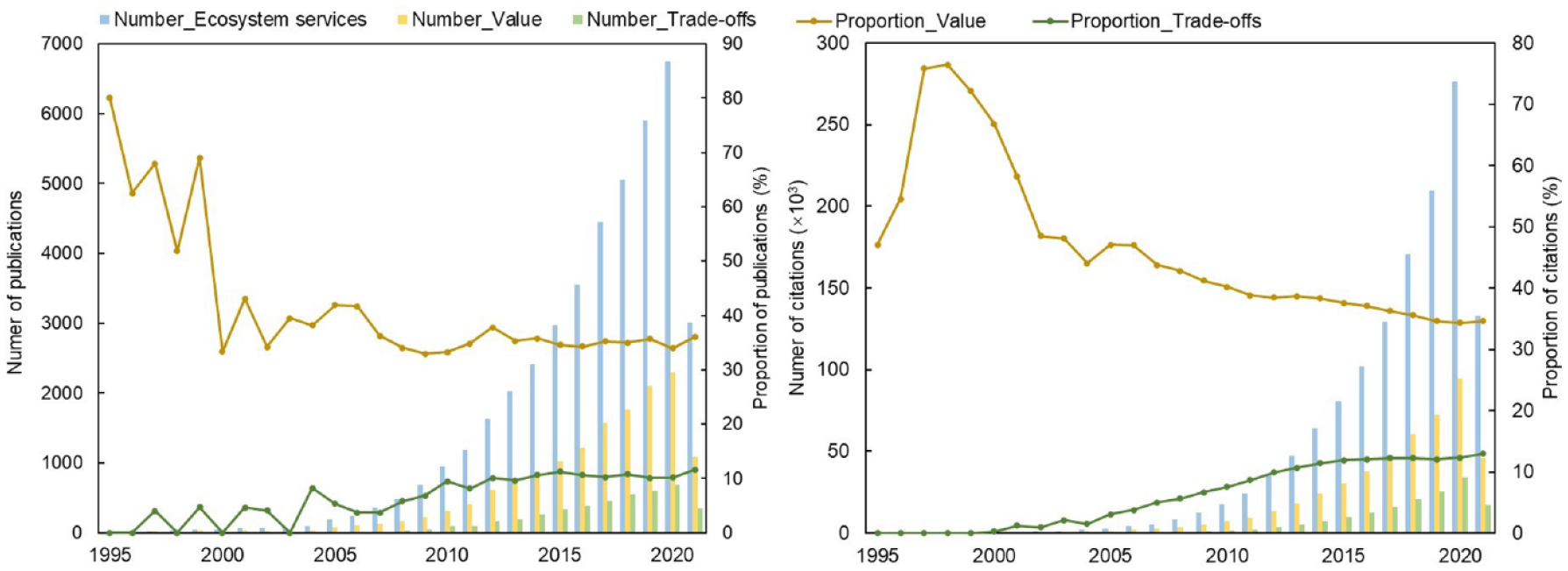
The number and proportion of publications and their citations of three categories from 1995–2022. The category “Ecosystem services” refers to papers including the topic “ecosystem service*”. The category “Value” refers to papers including the topic ‘‘ecosystem service* AND value*”. The category “Trade-offs” refers to papers including the topic ‘‘ecosystem service* AND trade-off*” or “ecosystem service* AND tradeoff*”.
Ecosystem services valuation
Westman (1977) published a paper in Science entitled ‘How Much Are Nature's Services Worth?’, marking the modern historical origin of the concept of ES, which aroused public awareness of the value of biodiversity conservation by using ecosystem functions as a practical framework for services (Ehrlich and Ehrlich, 1981; de Groot, 1987; Gómez-Baggethun et al., 2010). The birth of the ‘ecological economics’ discipline in the 1980s provided a theoretical basis for quantifying ES value (Costanza et al., 1991), which spanned the fields of ecosystem ecology and environmental and resource economics.
Costanza et al. (1997) made the first quantitative assessment of global ES value under the assumption that both the supply curve and demand curve of ES were a vertical line. They estimated ES value item by item in various ecosystems and concluded that the global ES value was much higher than world GDP. This led to a wide discussion on ES value among scholars and marked the beginning of the first golden era of ES research. The concept of ES value allows people to attach importance to natural ecosystem whose contributions to humans are not comprehensively valued by the market, such as climate regulation, and thus better develop ecological strategies to address social challenges (Costanza et al., 2017). What is more, through monetization and commercialization of nature’s contribution, ES can attract local governments' support for ecosystem protection or restoration (Gómez-Baggethun et al., 2010). Therefore, a lot of highly cited papers on ES valuation appeared in this period, such as localization of ES value assessment (Xie et al., 2003), establishment of Ecosystem Service Value Database (ESVD) (de Groot et al., 2012), updating the global ES value (Costanza et al., 2014), and valuation of specific ES (Grizzetti et al., 2016).
The development of ES valuation promoted the practical application of ES (Gómez-Baggethun et al., 2010). Firstly, the ES valuation means that the ecosystem is viewed from the perspective of economic value, which promotes the attention of global policy-makers to natural capital (Costanza et al., 2017). Accordingly, ES have been incorporated into the SEEA-EEA (System for Integrated Environmental and Economic Accounting-Experimental Ecosystem Accounts) framework (United Nations, et al. 2014) to better support government decision making in economic, social and environmental fields. Secondly, ES valuation coordinated the relationship between decision makers and stakeholders in an intuitive way (Hein et al., 2006). For example, Payments for Ecosystem Services (PES) reward resource managers to provide ES economically in the form of trade, so as to ensure sustainable ES supply.
However, valuing tangible and intangible ES also raised some objections, especially on the methodological double counting. For example, the estimation of the unit price of ES was not based on the objective market, which led to non-negligible uncertainty in estimation results. Some discussions also focused on the environmental ethical issues caused by the ES valuation, such as the neglect of ES with low use value caused by the commercialization of ES, which might drive the private ownership of public ES, and utilitarianism caused by introducing ecological issues into market strategy (Jax et al., 2013). In essence, ES valuation examines the ecosystem from the perspective of economics, which will inevitably lead to the trend of monetization and commercialization of ecosystem functions, processes and services (Gómez-Baggethun et al., 2010). However, criticisms and doubts about the ES valuation also mean that simply valuing ES seems to be limited in solving practical problems.
In short, ES valuation, from the perspective of economics, capitalized natural resources and presented them to the public in the form of monetary value, which promoted the government and the public to attach importance to the conservation of natural capital. However, due to its disadvantages such as utilitarianism and quantitative uncertainty, ES valuation could not reveal the diverse relationship among multiple ES, and the role of humans in the process of consuming ES. Moreover, ES valuation usually could not help people to make decisions on how to improve ES in practice.
Ecosystem service trade-offs
The next question that should be answered is: what are ES trade-offs and why is it so important in the second golden era of ES research? As Rodríguez et al. (2006) pointed out early on, trade-offs occurred when the provision of one ES decreased due to increased use of another ES, or when one stakeholder got particular ES at the expense of other stakeholders. Compared with ES valuation which can only help policymakers understand how important ES are, ES trade-offs can further let policymakers know which ES is more important, especially in the case of limited social resources input. Moreover, the emergence of ES models such as Integrated Valuation of Ecosystem Services and Trade-offs (InVEST) and the improvement of geospatial information technology based on land use change have made it possible to analyze the ES trade-offs in multiple dimensions, which encouraged researchers to turn to the study of ES trade-offs to a large extent to improve the efficiency of ES-based ecosystem management.
Due to the dramatic land-use changes in recent decades, humans realized the cost of environmental degradation due to consumption of natural resources, as well as trade-offs between immediate benefits and long-term stability of ES (Foley et al., 2005). The trade-offs that researchers first paid attention to came from the choice of various ES by demand-side stakeholders. For example, Carpenter et al. (2006) found that people tend to ignore the value of regulating services but choose provisioning services. Then the trade-offs between provisioning services and regulating and cultural services have gradually become the consensus globally (Peng et al., 2019a).
The ultimate purpose of studying ES trade-offs is to guide decisions on ecosystem and landscape management (Zheng et al., 2019). ES trade-offs can answer the question of which ES are more important than others, and the results of ES trade-offs are reflected in land-use decisions (Peng et al., 2018). Firstly, there are significant differences in the types and intensities of ES provided by different land-use types, and understanding the trade-offs between ES at landscape scale can help to improve spatial distribution of different land-use types in terms of quantity and pattern (Peng et al., 2019b). Secondly, the consideration of ES trade-offs helps to better meet the preferences of stakeholders in land management decisions. Since the stakeholders with different backgrounds, powers and perspectives have vastly different views on the importance of ES, the ES trade-offs are conducive to improving human well-being and achieving win-win outcomes in ES management when taking the preferences of stakeholders into consideration (Howe et al., 2014). Accordingly, ES trade-offs are increasingly applied to spatial planning, such as ecological restoration planning, agricultural development planning and urban landscape planning.
ES trade-offs explored the relationships between human and nature more deeply than ES valuation, as it not only discussed the principles that decision makers should follow from the two aspects of ES supply and demand, but also made clear the vital role of stakeholders in ES trade-offs. Some research frameworks began to quantitatively integrate ES supply and demand, rather than exploring the trade-offs of one side in isolation (Burkhard et al., 2012). That is, the supply and demand of ES were respectively assessed by models, expert evaluations and questionnaire surveys, to identify the spatio-temporal mismatches of ES, their influencing factors and socio-ecological consequences (Wei et al., 2017). This further highlighted ES differences in landscape patterns and stakeholders from different backgrounds, as well as contributing to improving human well-being from ES-based ecosystem managements more systematically. However, although the issue of ES trade-offs has tried to match supply and demand, it still failed to clarify the trade-off relationships arising from the delivery of ES from supply to demand, which also meant that it was hard to examine the coupling relationship between society and ecosystem because of the spatial and temporal mismatching of supply and demand.
In brief, the exploration of ES trade-offs, emphasizing the ecological perspective of ES, has greatly helped policymakers to make progress in ES-based ecosystem management by further considering stakeholders’ preferences. However, it was difficult to describe the dynamic process of ES supply and demand due to the obstacle of quantitatively mapping the process of ES from the source to the beneficiary.
ES at the next crossing: Flows as the leading topic
Recent development of ecosystem service flows research
There are two stages in the past decades since ES research emerged globally: ES valuation and ES trade-offs (Figure 2). The former helped to bring the concept of ES into mainstream macroeconomic indicators such as Gross Domestic Product (GDP) (Nahlik et al., 2012), and the latter promoted the link between human well-being and ES (Howe et al., 2014). However, since ES were often characterized with static spatial patterns bound to sites, the above two issues did not solve the spatial mismatching problems between the ecosystem providing ES and people enjoying the services (Bagstad et al., 2013; Fisher et al., 2009).
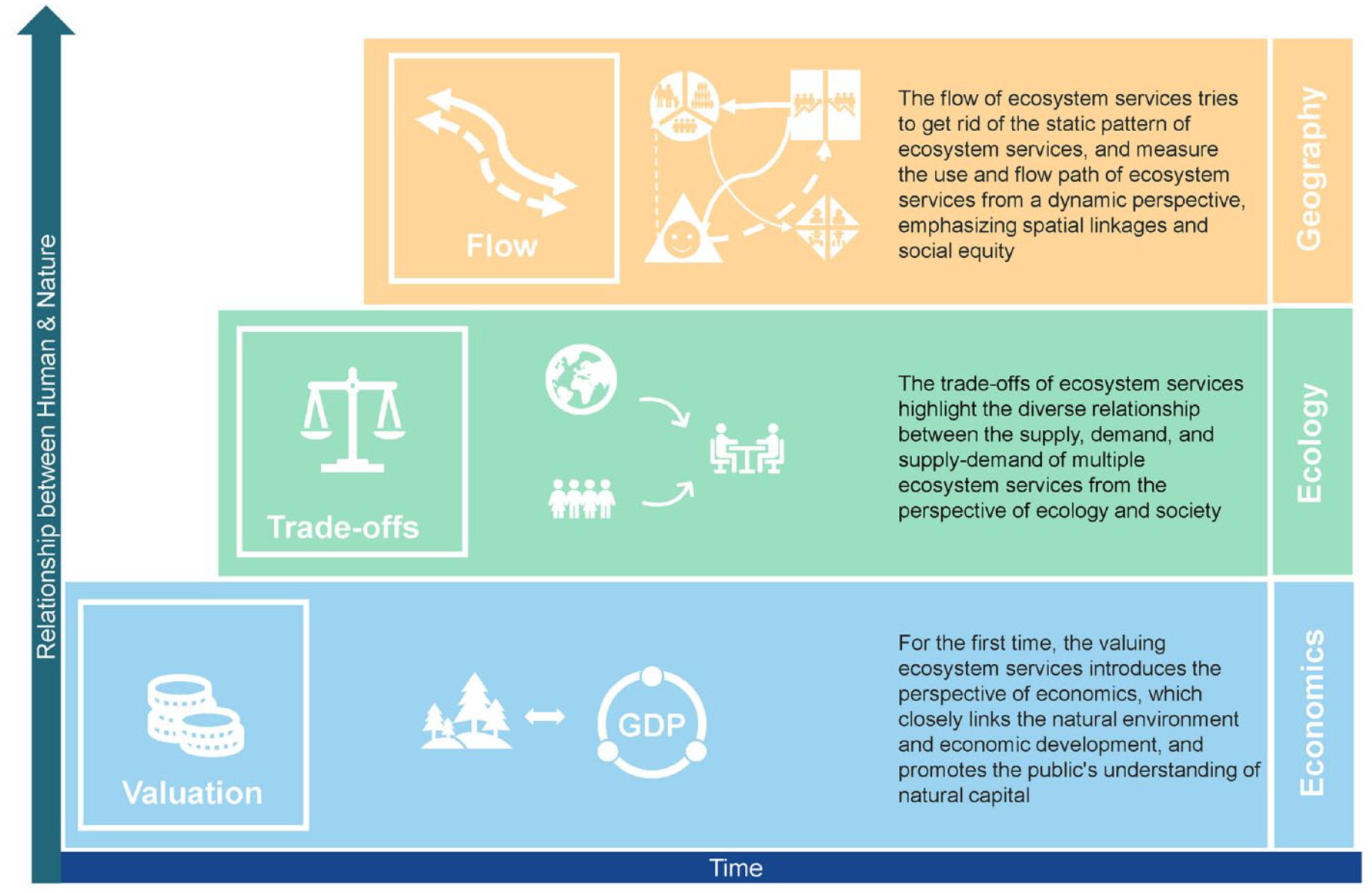
The development of ES research. The research on ES developed from the perspectives of economics, ecology and geography, which formed three research stages: valuation, trade-offs and flow.
From the perspective of geography, the concept of ES flow focused on the dynamic flow process of ES in space. This concept has the potential to solve the problems of spatial mismatches among the supply and demand of ES, answering how ES were consumed by local and non-local people. ES flow was defined as the processes that ES used to flow from source region to use region (Bagstad et al., 2013; Serna-chavez et al., 2014). Since Bagstad et al. (2013) introduced the concept of ES flow, studies on it have gradually increased. Different from the discussion on ES valuation or trade-offs, ES flow focuses more on exploring the actual benefits that humans obtain from ecosystems (Villamagna et al., 2013), which can better highlight the deficit, surplus, flow direction and loss of ES in the process from sources to users.
ES flow takes the consumer side of the social variables of ES into consideration and gets rid of the binding fixed site static model. Therefore, methods based on land-use frameworks are no longer completely suitable for quantifying ES flows. Many methods from other disciplines besides ecology have been introduced into the quantification of ES flows, such as many hydrological process models, Service Path Attribution Networks (SPANs), goods trading system, multi-regional input-output (MRIO), and Life Cycle Impact Assessment (LCIA). ES flows are generally nothing more than a process of transferring ES from source areas to beneficial areas, which can be divided into water-related flows, information flows, species migration flows, and flows through the trade of goods according to what and how they are delivered. The flux and direction of ES flow, the spatial display of flow processes, and the identification of influencing factors are the main research topics in ES flow research (Bagstad et al., 2013; Mitchell et al., 2015; Villamagna et al., 2013).
It should be emphasized that although people have paid attention to ES flow, a mature theoretical framework on ES flow has not yet been formed (Wang et al., 2022), and the scale of research was still relatively limited. Firstly, studies on ES flow were mainly based on the analysis of ES supply, demand or hot spots, and few breakthrough discoveries beyond general cognition were made. Secondly, simple and standardized quantitative methods and systematic models to quantify ES flows were lacking, which limited the quantification of ES flows. Finally, although the research results of ES flow were aimed at decision making, it was still difficult to apply them directly in practice (Wang et al., 2022). Thus, we still need to pay attention to the development of ES flow because of its advantages in characterizing the dynamic consuming process of ES connecting human and nature.
Core issues of ES research at the next crossroad
Relatively, the concept of ES lacks clear boundaries (Nahlik et al., 2012), which facilitates cross-disciplinary communication (Schröter et al., 2014). Therefore, more interdisciplinary issues should be introduced to the development of ES research, which can be summarized as the following four aspects (Figure 3).
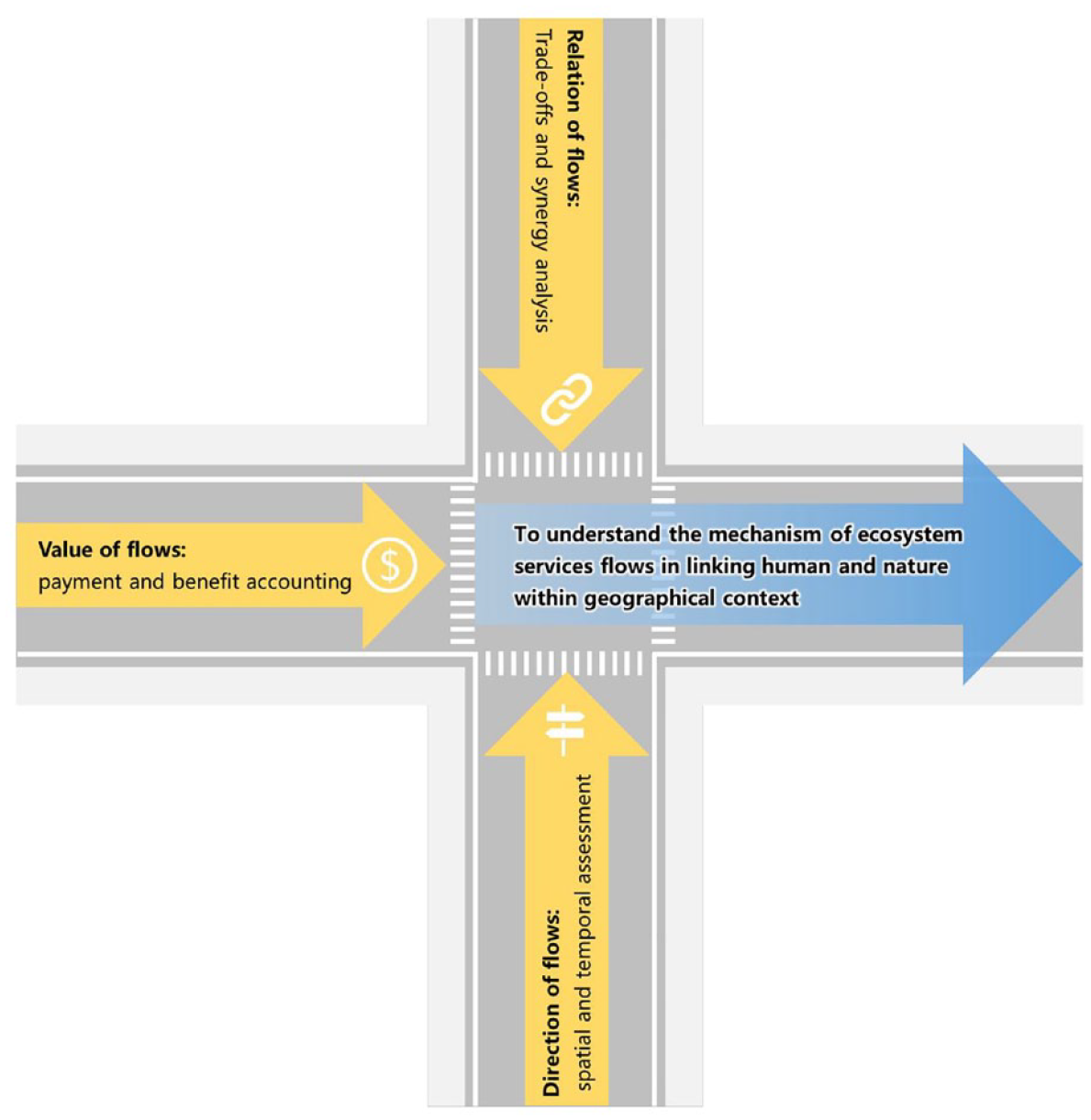
The way forward at the crossroad of ES research.
First is research on the value of flow by payment and benefit accounting. At present, the willingness to pay for ecosystem services (PES) and ecological compensation are directions that reflect the role of ES valuation in the study of ES flow (Metzger et al., 2021). In previous studies ES valuation mainly focuses on ES supply, while PES can reflect the attitude of stakeholders towards ES valuation from the demand perspective. ES flow helps to match the value of demand with that of supply, and thus ES are managed through ecological compensation (Peng et al., 2022). For some stakeholders, the decisions made based on the value of flow are beneficial to human well-being. For example, multi-level decision-making based on PES can bring huge gains to the poor, thus achieving a win-win situation for both ecosystem conservation and poverty alleviation (Turner et al., 2012).
Second is the research on the relationship of flows by trade-off and synergy analysis. The trade-offs of ES supply can be understood as the trade-offs of flow quantity, and trade-offs of ES demand are regarded as the trade-offs of flow direction. Analyzing the trade-offs of ES from the perspective of ES flows can help to better support decision-making (Xu and Peng, 2022). For example, the identification of the trans-regional flows of ES helps to coordinate the costs and benefits between regions for some cross-border river regions, so as to achieve a win-win situation for upstream and downstream stakeholders (Bagstad et al., 2019). On the global scale, an assessment of the ES flows that accompany biogeochemical cycles can help policymakers better address global issues such as greenhouse gas emissions and water resource scarcity (Schirpke et al., 2019b).
Third is research on the direction of flow by spatial and temporal assessment. The ES flow is jointly determined by the landscape heterogeneity of ES supply and the preference heterogeneity of ES demand. Some studies have determined the route and flux of spatial ES flows through the differences of ES supply and demand between different regions (Lin et al., 2021). However, the specific routes of most ES flows are still unclear, and the differences in preferences of stakeholders are neglected in most studies except some water-related ones. Moreover, the identification ES flow is greatly affected by the differences of spatial and temporal scales. On the temporal scale, the time required for different ES to generate benefits is different, and the time lag may also vary significantly (Xu and Peng, 2022). On the spatial scale, the characteristics of different ES flows are closely related to spatial scale (Schröter et al., 2020).
Finally, all the above comes down to understanding the mechanism of ES flow in linking human and nature within geographical context. Due to the increasing attention paid to human beings in ES, ES research should focus on how to combine research findings with practices such as social and ecological decision-making (Xu and Peng, 2022). The concept of ES is well suited to be incorporated into the Sustainable Development Goals (SDGs) decision-making framework due to its advantages in connecting supply and demand (Schirpke et al., 2019a). For example, the concept of ES flow could be combined with specific targets to assess the cost of and difficulty in achieving the SDGs. It is also necessary to consider how equity and efficiency in stakeholder communities can be balanced through the management of ES flows. In general, ES flow research can take advantage of the close connection between ecosystem processes and human well-being to maximize human well-being and achieve local and global sustainability with a geographical perspective.
Requirement of quantifying ES flows
Due to the extensive and diverse contents of ES, it is not feasible to propose a quantitative framework that includes all ES flows. However, it is still necessary to integrate the theories and methods of ES flows assessment, and thus to propose a more effective and widely recognized way to quantify ES flows.
Firstly, it is a long-term challenge to enrich the assessment of ES flows. In addition to the lack of display of the process of spatial ES flows, there is a greater need for effective means to accurately quantify the supply and demand flux of ES. Current studies of ES flows are mostly based on the quantification of supply and demand to show the theoretical ES flows. There is a need to identify the actual used and consumed ESs, and then to compare them with the supply and demand of ES. Meanwhile, mediating factors of ES flows, having important impacts on the flow direction and usage of ES (Mandle et al., 2021), should also be considered as they vary in different ES flows across multiple spatial or temporal scales. Furthermore, more attentions should be paid to easily neglected ES, such as the services of climate regulation and pollination, compared with some fully-studied ES, such as food production, water purification and soil conservation.
Secondly, the accuracy of ES flows assessment should be improved. The coupling mechanism model and big data approach will be a vital means of improving the accuracy of ES assessment. For example, due to its advantages in describing human behavior and perception, big data methods have been widely used in the study of cultural services. However, although the big data methods may be an effective tool in depicting the dynamics of ES flow, it has not been integrated with ES beyond cultural services due to the lack of mapping indicators. Furthermore, the mechanism-based models can accurately reflect the states and processes of different components in the ecosystem, but due to high data requirements and operational difficulties, few models have been applied well in ES flow research.
Finally, promoting the standardization of ES flows assessment is inevitable for accelerating the development of ES research. To establish a systematic and comprehensive framework of ES flows assessment, it is necessary to put forward a more authoritative and unified summary of the concepts and forms of different types of ES flows, and to develop comparable indicators across various spatio-temporal scales. As a result, human and nature are connected more systematically and dynamically.
In a word, the development of ES modeling can not only improve the accuracy, spatialization and standardization of ES flow quantization, but also helps to understand the complex mechanism of ES transfer from the supply to the demand region, so as to better serve the development of ES flow research.
Conclusion
Aiming to better understand how humans can better benefit from natural ecosystems, ES research has been applied to a wide range of disciplines. The hot topics of ES research have experienced a change from valuation to trade-offs. ES valuation helped people understand the importance of ES from the perspective of economics, and the ES trade-offs analysis examined the supply and demand of ES from the perspective of ecology, which guided people to better manage ES. However, despite the remarkable results achieved from ES valuation and trade-offs, there is a bottleneck in the development of the discipline, especially in further exploring the role of ES in connection between human and nature. Facing a crossroad in the development of ES, how to make up for the shortcomings of dynamic process depicting and spatial correlation characterizing by combining new methods and breaking through the cognitive bottleneck in ES valuation and trade-offs, will become an urgent issue for ES research in the next decades.
Inheriting the valuation and trade-offs, ES flow research emphasizes the spatial dynamic process of ESs from the perspectives of geography, with a special focus on understanding the spatial matching process of ES from the supply to the beneficiary, in order to better improve human well-being. This makes ES flow a likely direction to lead the next generation of ES research, which means that people begin to pay more attentions to the relationship between human and nature in ES research. Therefore, we need to valuing ES flows from payment and benefit accounting, to explore the relationship of ES flows through trade-offs and synergy analysis, and to conduct spatial and temporal assessment ES flow, so as to understand the mechanism of ES flow in linking human and nature within geographical context. Despite the multiple challenges, it is believed that ES flow is becoming a leading topic, which can be better applied to social actions to improve human well-being and conserve natural ecosystem, and thus to achieve sustainable development goals.
Footnotes
Author contributions
Original idea and writing original draft – J.P., P.X., writing, review and editing, Y.L., Z.X., H.Z., T.L., S.Y.
Declaration of conflicting interests
The author(s) declared no potential conflicts of interest with respect to the research, authorship, and/or publication of this article.
Funding
The author(s) disclosed receipt of the following financial support for the research, authorship, and/or publication of this article: This research was financially supported by National Natural Science Foundation of China (U20A2084).
