



Abstract
Ecosystem services are the basis for human survival and development and act as a bridge between nature and society. In recent years, ecosystem service flows have become the focus and primary challenge of ecosystem service research, with development in research efforts toward quantification and spatialization. This review explains the necessity of ecosystem service flows, discusses the progress of research in this area over the last decade, and compares the theoretical and representative research approaches from two conceptual perspectives on ecosystem service flows. One of these approaches focuses on processes, treating ecosystem service flows as the spatiotemporal association between ecological service provision areas and service benefit areas, and the other emphasizes final utility, considering ecosystem service flows as the actual supply of ecosystem services to beneficiaries in different areas. On this basis, the research gaps in theoretical principles, assessment methods, and applications are summarized, and future research perspectives on ecosystem service flows are proposed, with a focus on optimizing ecosystem service benefits and promoting cooperative development of systemic human–nature relationships.
Keywords
Introduction
Ecosystem services are tangible and intangible benefits that ecosystems provide for humans that serve social systems (Carpenter et al., 2009). The concept of ecosystem services was first introduced in the 1960s and has since been enriched and evolved (Figure 1). Costanza et al. (1997) promoted major developments in ecosystem services research. In the early 2000s, the UN published the Millennium Ecosystem Assessment report, which categorized ecosystem services into four categories: provision, regulation, cultural, and supporting services. Numerous studies have been conducted on these types, and valuations have been carried out at different spatial and temporal scales. However, in the past, ecosystem service research was primarily based on static indicators to assess the supply of ecosystem services. When a spatial mismatch between supply and demand for ecosystem services was discovered (Bagstad et al., 2013; Fisher et al., 2009), ecologists began to study the linkages between them, i.e., they studied ecosystem service flows. The spatial mismatch between ecosystem service supply and human demand necessitates the flow of ecosystem services.
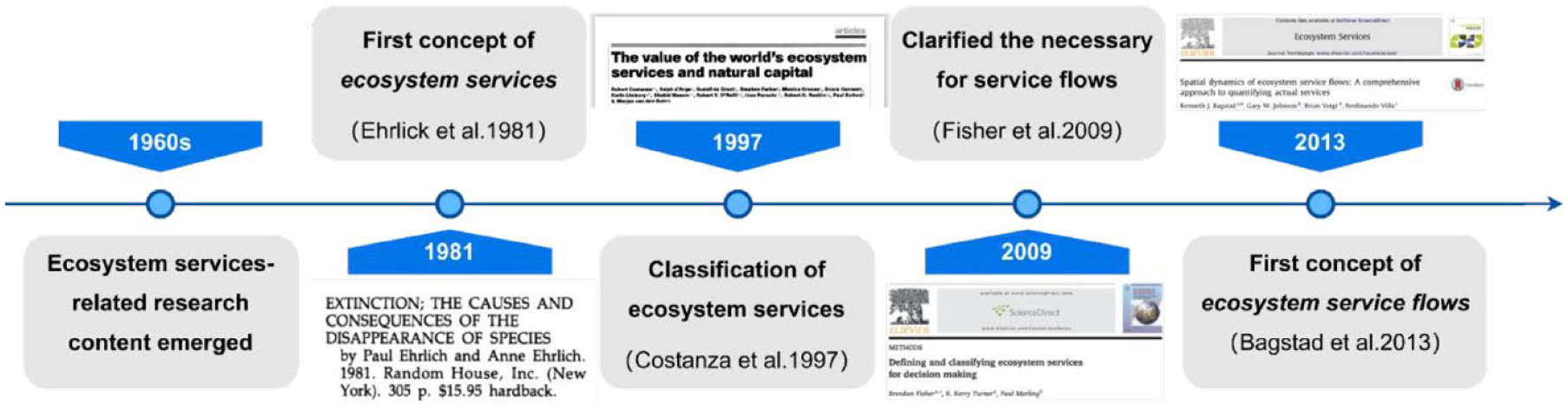
The development of ecosystem service flows.
Studies on ecosystem service flows have been conducted for a long time, and a research system was initially established, comprising steps from conceptual analysis to assessment to integrated application. In early conceptual explorations, Norris and Joshi (2005) claimed that ecosystem services flow to populations or economic agents, depending on the physical nature of the services. Naidoo et al. (2008) used maps to represent the production and benefits of ecosystem services. Syrbe and Walz (2012) defined the spatial interval between discrete supply and benefit areas as the service linkage area, indirectly elaborating the spatial characteristics of service flows, but not quantifying them. Serna-Chavez et al. (2014) argued that studying the flow of ecosystem services can establish a spatiotemporal relationship between supply and demand.
In terms of assessment and quantitative tools, Johnson et al. (2010) developed a service path attribution network (SPAN) model, spatialized and quantified the mobility process of ecosystem services provided by landscapes for humans, and presented a new approach to the assessment of economic benefits. Villa et al. (2014) developed the Artificial Intelligence for Ecosystem Services (ARIES) model to study freshwater supply, potential availability of water quality, flow, and actual use of purification services in Madagascar. Li et al. (2017) used the ARIES and Integrated Valuation of Ecosystem Services and Trade-offs (InVEST)models to quantify and spatialize the supply, consumption, and service flow processes of freshwater ecosystems in the Beijing-Tianjin-Hebei region at different spatial and temporal scales. Li et al. (2019) simulated the spatial flow paths of ecosystem carbon sequestration services in the Guanzhong-Tianshui Economic Zone using a Bayesian Belief Network (BBN) approach.
Recently, a growing number of studies have expanded the application of ecosystem service flows. Schröter et al. (2018) proposed a framework for basic research on ecosystem service flows in 2018 and tested it in four different ecosystem services studies to inform decision-making and governance of ecosystem services with the goal of sustainable development. Liu et al. (2021) used the wind and sand dispersion model to simulate the flow characteristics of the main ecosystem services in the watershed, and accordingly determined the areas to be compensated, the areas to be paid and the criteria for compensation. Tiemann and Ring (2022) proposed the forest ecosystem service flows indicators and quantified five forest ecosystem service flows as a basis for sustainable forest management and optimal forest arrangement.
However, there is currently no consensus on the concept of ecosystem service flows in academia, and different researchers have different understandings of this concept, owing to their different research interests (Liu et al., 2016a). In general, the concept is mainly defined and understood from the following two perspectives: one focuses on the process, considering ecosystem service flow as the spatial and temporal correlation between ecological service provision areas and service benefit areas, and the other emphasizes the final utility, considering ecosystem service flow as the actual supply of ecosystem services to different regions. This paper begins with two different conceptual perspectives on ecosystem service flows, and Section 2 details their representative research approaches and compares their strengths and weaknesses. Sections 3 and 4 present key issues and research perspectives in contemporary research on ecosystem service flows, respectively.
Research methods for ecosystem service flows
Spatial flow simulation (emphasis on process)
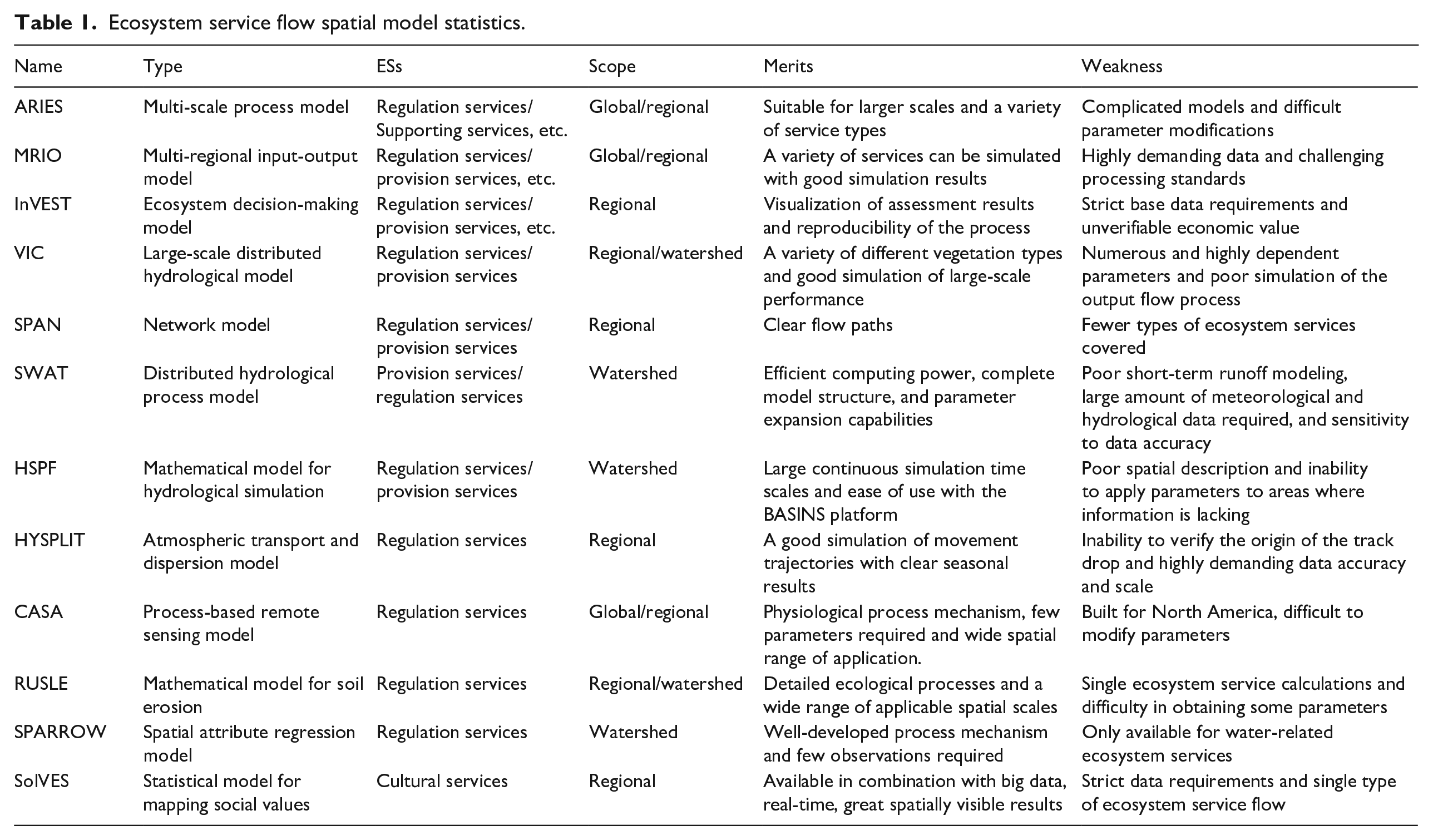
Many scholars have explored the spatial flow process of ecosystem service flows using various models. For example, Bagstad et al. (2011) used BBNs to analyze the transmission of ecosystem services from supply to demand, based on the ARIES model, and built SPANs to simulate the spatial transmission process and flow paths of ecosystem services. Xu et al. (2018) used the Hybrid Single Particle Lagrangian Integrated Trajectory (HYSPLIT) to simulate the transmission path of wind and sand control services in Yanchi County, Ningxia Autonomous Region. Chen et al. (2020) explored the future spatial flow pattern of water resources in the Yanhe River basin in 2050 using the SWAT and land use projection models. This method is the primary tool in the study of ecosystem service flows, as it uses a spatial model to visualize the path, direction, and flow of ecosystem services from supply to demand areas and elucidates the mechanism of the delivery process of ecosystem services. However, the ecosystem service delivery process is complex, it involves the combined effects of many biotic and abiotic factors, which require many parameters to be considered in model simulation. Different models have merits and weakness in quantifying the ecosystem services (ESs) types, and application scope. Referring to the statistics on ecosystem service flow models (Yang et al., 2022), we filtered the models that could be used for spatial flow simulation and arranged them according to the types of ES, from widely used to single, as shown in Table 1.
Ecosystem service flow spatial model statistics.
Ecosystem service flow assessment (emphasis on utility)
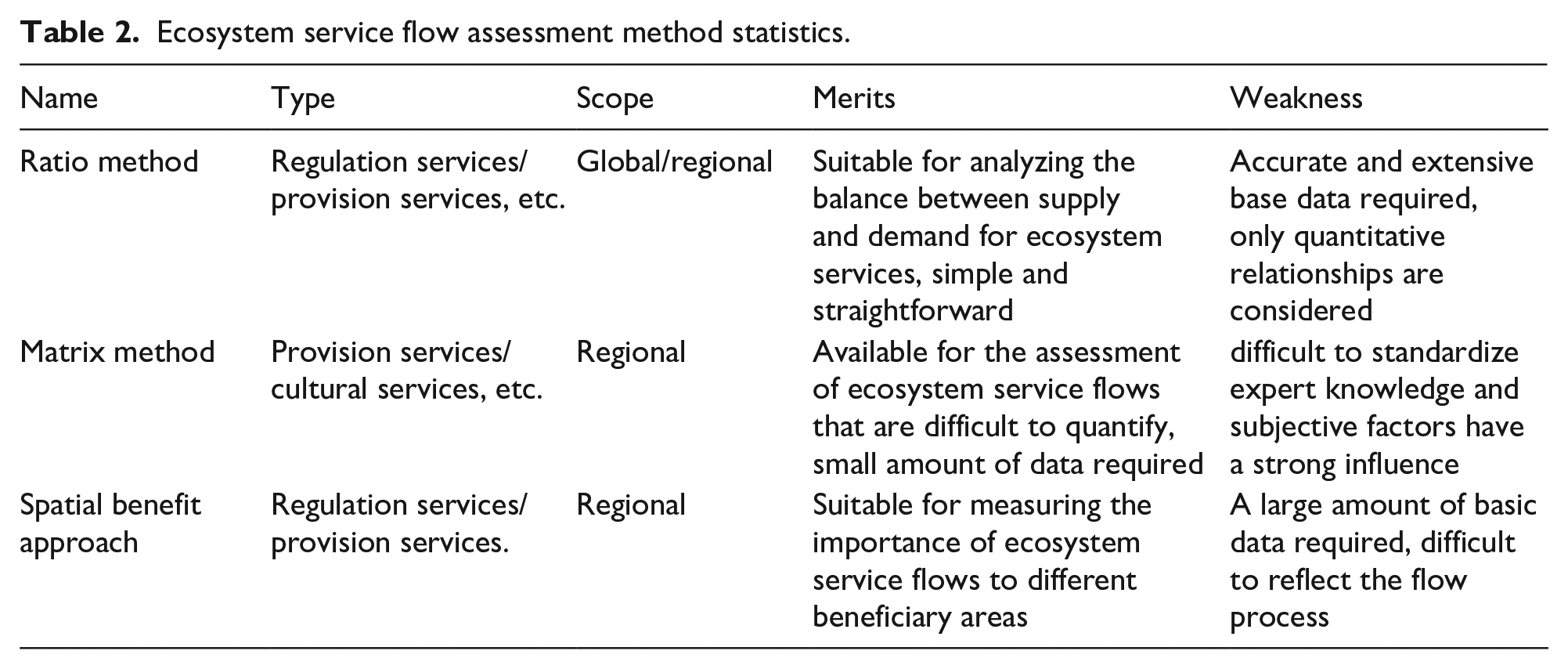
Ecosystem service flow assessment methods are used to identify and quantify the spatial distribution of supply and demand for ecosystem services, thereby analyzing the supply-demand balance for ecosystem services. (Yao et al., 2018). Commonly ecosystem service flow assessment methods include the ratio, spatial benefit, and matrix methods. For example, Serna-Chavez et al. (2014) identified pollination, groundwater supply, and climate regulation services at different scales; identified the spatial location of supply areas, service radius, and demand areas for each type of ecosystem service; analyzed the spatial linkages between supply and demand areas; and introduced supply and demand ratio indicators (spatial benefit approach) to investigate ecosystem service flows. Focusing on the Puget Sound region of Washington State, USA, Bagstad et al. (2014) selected five ecosystem service types and analyzed ecosystem service flows by examining the theoretical supply, actual supply, and ratio of actual supply to theoretical supply for each type of ecosystem service flow. Palomo et al. (2013) used expert evaluation methods to analyze the supply-demand flows of multiple service types for provision, regulation, and culture in Doñana National Park and the surrounding area in Spain. With reference to expert knowledge, Awuor Owuor et al. (2017) quantified and mapped ecosystem service flows in Africa using a matrix of ecosystem service supply and demand scores. Based on a related study (Feng et al., 2019), we summarized the merits, weakness, and scope of the methods emphasizing utility, as shown in Table 2. The matrix method and the spatial benefit approach are as follows in detail.
Ecosystem service flow assessment method statistics.
Matrix method
The matrix method is a land use matrix method developed by Burkhard et al. (2009), in which ecosystem services represent the x-axis and land cover types represent the y-axis composition (modified for ecosystem service types and land use types according to the specific conditions of the study area, the point in time, and the data obtained) to calculate a single result for each land type corresponding to each service, based on statistical data and expert knowledge. In the study of ecosystem service supply, demand, and flow, the Land-Use and Land-Cover Change (LUCC)-based ecosystem service supply and demand matrix method considers land use/land cover as a proxy indicator for analyzing ecosystem service supply and demand and scores the supply and demand of ecosystem services provided by different land use types based on expert evaluation methods, taking into account the actual situation of the study area. The flow of ecosystem services is quantified by comparing the supply and demand scores in a given area; this method is simple, easy to implement, and only requires a small amount of data, but it does not reveal the mechanisms underlying ecosystem service delivery processes, and study results are usually heavily influenced by subjective factors.
Spatial benefit approach
The spatial benefit approach is a framework proposed by Serna-Chavez et al. (2014). The method is used to describe spatial benefit flows based on the spatial relationship between ecosystem service supply areas and benefit areas. It can indicate the extent to which benefit areas depend on the ecosystem service spatial flow of supply areas. This method is a first approximation to assess the importance of ecosystem service flows, but it requires more prepared data and cannot map the flow paths of ecosystem service flows.
Comparison of two research method types
This study compares two approaches to ecosystem service flows based on a synthesis of related research (Wang and Zhou, 2019). Spatial flow simulation focuses on spatially accurate dynamic processes in the transfer of ecosystem services from the provision to benefit area using distributed models, it is usually applied to identify priority areas for ecological restoration. Whereas ecosystem service assessment is more amenable to quantifying the ecosystem services exhibiting real-world usage by humans, it is commonly used in ecosystem services supply and demand analysis, and quantitative mapping. The former is hampered in its application in areas where data are lacking, owing to the large amount of data and disciplinary knowledge required to support it; the latter is more suitable for situations where data are lacking, owing to the black box approach to ecosystem processes. However, the two approaches and their respective research methodologies are not separate, and instead, they interpenetrate, as a result they can be used in conjunction to achieve a deeper understanding of the spatial dynamics of ecosystem service flows and their quantification, thereby providing scientific support for policymakers.
In addition, many researchers have attempted to introduce more mature methods applied in other fields to study ecosystem service flow. For example, for analyzing the characteristics of spatial transfer of ecosystem services at the watershed scale, Qiao et al. (2017) constructed a model of the spatial transfer of ecosystem services in watersheds based on field strength theory and breakpoint models. Lin et al. (2021) operated the R language platform and used the RSPARROW model to simulate water quantity and quality in a watershed to clarify the process of water-related ecosystem services from ecosystem to beneficiary and ultimately back to ecosystem. They analyzed the causal links between the spatial flows of ecosystem services and residents' well-being. Interdisciplinary knowledge brings new concepts to the study of ecosystem service flow.
Current issues
Exploratory research has been conducted on the theoretical content and application of ecosystem service flows, to improve our understanding and overall knowledge of them. However, this field of research is still in its infancy; in its theoretical principles, evaluation methods, and applications, there are still many aspects left blank. The following is a discussion of these aspects.
Spatial and temporal flow mechanisms of ecosystem service flows are unclear
The core content of ecosystem service flow research explores the mechanisms and patterns of ecosystem service transfer in space (Xiao et al., 2016). Supply and demand of ecosystem services do not match; existential space ecological systems for the production of products and services must reach requirement areas through space flow mechanisms and realize the value of their services. This transfer process has cross-scale and cross-regional characteristics, and its scale range varies with the type of ecosystem service. For example, air purification, temperature regulation, recreation, and other services generally operate on a regional scale (Goldenberg et al., 2017; Vigl et al., 2017), but the impact scope is relatively small. Flood regulation, water supply, and other services involve the transmission of services between upstream and downstream, and they generally operate on a regional scale (Chen et al., 2020; Nedkov and Burkhard, 2012). The impact of carbon sequestration services can be found on regional, national, and global scales (Li et al., 2019; Liu et al., 2016b). As the transmission of ecosystem services involves two major systems, namely, natural ecology and human social economy, the transmission process is relatively complex and affected by many factors (Bojie et al., 2009). Moreover, the circulation mechanism and pattern of ecosystem services from the supply area to the demand area are not clear in the current research landscape, especially as the contemporary research on ecosystem service flow mainly focuses on small-scale models. To some extent, this has limited the development of ecosystem service flow research.
Process model of flow path for ecosystem services is not mature
Currently, the most typical networks are SPANs and BBNs. SPANs use a model research framework based on artificial intelligence techniques to analyze the flow of ecosystem services from supply areas to benefit areas (Bagstad et al., 2011). However, this model contains a large number of parameters in the operation process, which need to be localized according to regional differences. Using machine learning, BBNs can learn and reason that the spatial flow process of ecosystem services is limited and incomplete. The SPAN-BBN model couples the SPAN model conceptual framework with the BBNs model; moreover, it realizes an organic combination of ecosystem service flow capacity, flow path, and demand. With the features of solid machine rationality and high accuracy, the SPAN-BBN model can simulate the process of ecosystem service flow through delivery carriers to ultimate utility. For example, Liu et al. (2017) simulated the flow path of a water production service by simplifying the SPAN-BBN model. Zeng and Li (2019) used the SPAN-BBN model to simulate and evaluate the transfer process of water conservation service flow. Qin et al. (2019a) simulated provincial-level water flow changes by coupling the simplified SPAN model with the InVEST model. However, the quantified flow paths and spatial ranges of ecosystem services differed significantly because of the complex influence mechanisms of different ecosystem service flow carriers. For example, the ecosystem service flow from the supply area to the demand area can be evaluated by relying on water flow as the carrier (Goldenberg et al., 2017). A transmission path diagram of the service flow was drawn based on the main wind direction as the carrier, and the service flow was quantified (Yang et al., 2019). Li et al. (2019) visualized the drivers of carbon sequestration service flows with the help of topographic factor representation. Therefore, the SPAN-BBN model must be coupled with models that can depict the flow characteristics of different delivery carriers to effectively simulate the complete process of ecosystem service flow.
Need for improving research on diffusion effects of ecosystem service flows
Ecosystem service flow has a typical cross-regional diffusion effect. Elucidating ecosystem service flow and its transfer mode on a large spatial scale can accurately define the supply and benefit range of ecosystem service flow (Costanza, 2008). Following the direction of the flow diffusion effect, Fisher et al. (2009) classified them into three categories: in situ service flow, where the supply and demand of ecosystem services coincide in space; directional service flow, where the demand for ecosystem services occurs in a specific area around the supply area; and non-directional connected service flow, where ecosystem services can be demanded and consumed globally. According to the effect range of flow diffusion, Turner et al. (2012) divided it into neighboring, global, and topographic models. In addition, Serna-Chavez et al. (2014) introduced the concept of a service space flow achievable range for classification. Li et al. (2014) classified the spatial flow of ecosystem services according to the attributing characteristics, transmission processes, and mobile characteristics of the supply and demand subjects of service flows.
Owing to the differences in the spatial transport carriers of ecosystem service flows, different types of ecosystem service flow can flow from local, regional, and global scales. The classification of ecosystem service flow types provides an essential basis for assessing the diffusion effects of ecosystem service flow. Many studies have been conducted on the diffusion effect within the domain but few have examined the diffusion effect outside the domain (Li et al., 2018a). For example, Liu et al. (2016c) analyzed the cross-regional diffusion process of water supply services caused by the South-to-North Water Transfer Project. Schröter et al. (2018) developed a conceptual framework for interregional ecosystem service flows and verified the long-distance coupling effect of ecosystem service flows across geographical boundaries. Schirpke et al. (2019) evaluated the flow effects of six key ecosystem services in the Alps at the global and regional scales to better understand the interregional transfer of ecosystem services. Kleemann et al. (2020) calculated that 40% of flood regulation services exported by Germany were in neighboring downstream countries, revealing the diffusion effect of cross-border flows. Semmens et al. (2018) revealed the long-distance coupling effect of cultural service flow through long-distance attenuation function and baseline catchment pool modeling.
Currently, the definition of the interregional diffusion range of ecosystem service flows is a key but difficult point for assessing spatial effects. The main bottleneck is that it is hard to characterize and quantify the loss/dissipation caused by urban sprawl when describing flow paths.
Insufficient research on internal driving mechanisms of ecosystem service flows
Ecosystem service flow is a complex process that is driven by natural and human factors (Costanza et al., 2014). This involves many subjects and elements, and the relationship between supply and demand is complex. Different scales and ecosystem service flow types have different formation mechanisms, spatiotemporal transmission characteristics, and internal driving mechanisms. Many researchers made ecosystem service flow insights into ecological compensation standards for water resource and water security management (Qin et al., 2019b; Xu et al., 2019; Zhu et al., 2022). At the same time, some studies focus on the implications of land management on the delivery of ecosystem services (Bai et al., 2016; Gomes et al., 2020; Phillips and Joao, 2017). Three socially constructed factors which are resilience, sustainability, and vulnerability, affect the flow of ecosystem services (Robards et al., 2011). Existing studies, however, whether in the conceptual description, analysis of component units, spatial analysis, or quantitative assessment of service values, have primarily focused on identifying components and processes of ecosystem service flows and less on exploring the underlying driving mechanisms. Such a status quo may constrain our understanding of ecosystem service flow concepts, patterns, and utility. This may affect the direction and scientific validity of related research, in addition to affecting the ecosystem's health.
Perspective
In recent years, ecosystem service flows have received widespread attention from researchers worldwide (Li et al., 2018b; Palmer and Ruhi, 2019; Peng et al., 2017; Wang et al., 2022). However, ecosystem service flows are complicated, involving the analysis of multiple elements of natural ecosystems and human social systems, and they require a multidisciplinary knowledge base. Based on a summary of the research gaps, this review argues that future research should be reinforced in the aspects discussed below.
Understanding the mechanisms of ecosystem service flow
The concept and characteristics of ecosystem service flows are currently being explored and debated. Identification of complete pathways of ecosystem service flows has become a research hot spot. Existing research methods cannot accurately quantify the complete realization of service flows; they are mostly limited to the spatial relationship between the supply and benefit areas of ecosystem service flows, overlooking the temporal characteristics. Moreover, our understanding of interregional ecosystem service flow characteristics, drivers, and impacts is minimal, requiring further insight.
Ecosystem service flows are spatially mobile and have three attributes: the flow direction, rate, and volume. The flow direction is where the ecosystem services are transferred from the supply area to the use area. The flow rate of an ecosystem service stream is the ratio of the distance to time for the transfer of ecosystem services from the supply area to the benefits area. The volume of ecosystem services refers to the capacity of the services transferred from the supply area to the benefits area. Ecosystem service flow carriers influence the direction of the service flow. For example, ecosystem services delivered by water flow are directed by gravity and flow according to topography, terrain, slope, vegetation, and other factors (Wu et al., 2006). Ecosystem services are delivered by airflow undirected by the Brownian motion of air molecules. Humans rely on external forces to transport ecosystem services and products along different paths and directions into areas of demand. Under certain conditions, humans can alter the flow of ecosystem services delivered by other carriers (Zheng et al., 2003). Both the natural environment and human activity influence the flow rate of ecosystem services. Specific artificial structures can slow down the flow of abiotic-based services, and some aspects of the geographic environment can affect the flow of biotic-based services. There is a spatial mismatch between the supply and beneficiary areas of ecosystem services (Nelson et al., 2009), and there is a time delay in their delivery. With the ease of transport and modernization of means of delivery, the flow rates of some ecosystem services have increased. As can be seen, the spatial attributes of ecosystem service flows are important for clarifying their flow mechanisms.
Improving quantitative assessment methods for cultural service flows
Some service types do not have more accurate quantification methods because of the specific attributes of the ecosystem services in question (Yu and Hao, 2020; Yuan and Wan, 2019). Currently, quantification of cultural services is difficult (Inostroza and de la Barrera, 2019). Heterogeneity in ecosystem cultural services, whereby the same ecosystem may provide different ecosystem cultural services to different people, may have important implications for implementing more equitable environmental decision making.
At present, people's different views on ecosystem cultural services are mostly conducted through questionnaires, interviews, etc. (Ko and Son, 2018; Larson et al., 2016). However, this work is time-consuming and laborious, and the limited sample size also leads to the subjectivity of the results. With the widespread use of Internet and social media, social networking has gradually become an important method to evaluate some data. These data and comments can reflect the reviewers' perception state and emotional attitude towards specific ecological infrastructures, and are easier to collect and more random than traditionally obtained data. It provides a new perspective for quantifying the demand for cultural services. In addition, proxy indicators (Dang and Li, 2021; Zhao et al., 2018) and models (Paracchini et al., 2014; Sherrouse et al., 2014) have also been considered by scholars. However, they cannot fully reflect the immaterial dimension of ecosystem cultural services (Cheng et al., 2019), and established empirical models need to be verified. Therefore, a method is still needed to assess the matching relationship between supply and demand for cultural services in multiple ecosystems, taking into account the perspective of beneficiaries.
Current studies mainly focus on how to estimate the actual number of tourists and economic value, when investigating the spatial flow of cultural services in ecosystems. The research methods are not clear enough, and there are also some difficulties in the comprehensive modeling and simulation of ecosystem services flow (Bagstad et al., 2013; Goldenberg et al., 2017; Verhagen et al., 2017; Xu et al., 2019). As a kind of geospatial data that can provide users with real-time positioning information, mobile phone signaling data can be used to realize the characteristics analysis and mining of population mobility patterns within cities (Schlaepfer et al., 2021). The research is still in the stage of conceptual exploration, and its quantitative assessment methods are not yet fully developed.
Increasing spatial and temporal scales research
Ecosystem services provide human benefits through spatial flow at different scales, ranging from local to global (Bagstad et al., 2013; Balmford et al., 2011; Cimon-Morin et al., 2013). Different carriers of ecosystem service flow have different spatial scales. The time required to transfer ecosystem service flows to beneficiary areas varies from long to short. For example, support services such as soil formation have longer time scales (Yang et al., 2013), and the supply of agricultural products takes several months (Yang et al., 2012), which is the second longest time scale. Pollination services only occur during the flowering period (Potts et al., 2010), which is a smaller time scale. Existing studies on ecosystem service flows are mainly focused on small scales, such as watersheds, with few studies at the global scale; the time scales of these service flows are also mainly short-term, with few studies exploring long-term. The spatial and temporal scales of ecosystem service flows are often coupled. Generally, service flows delivered on large scales take longer to reach, therefore, future attention must be paid to ecosystem service flows across larger scales and longer-term series of changes.
There is still a relatively mature scale-up technique called wavelet transform. With the help of Daubechies base (Mount et al., 2013; Weniger et al., 2017) and Mallat algorithm (Funashima, 2017), researchers have had relatively mature applications in different time scales of climate change (Lu et al., 2006; Zhao et al., 2002) and the impact of hydrological parameters on ecosystems (Xie et al., 2018), etc., which can draw on the theories and ideas of existing studies. In the future, it will clarify the contribution rate of each ecosystem service to the ecosystem, so that the value assessment results of the original data in small scale will be closer to the real value. The model expression established by using these factors should not only be suitable for small-scale research, but also be consistent with large-scale research, so as to reflect the characteristics of scale transformation (Burgess et al., 2011). Error analysis and uncertainty analysis are needed to verify the rationality of the final results.
Expanding a framework in coupled human and natural systems
Future studies must explore the complex cause-and-effect-feedback mechanism between the supply and demand of ecosystem services in the coupled system of humans and nature (Xiao et al., 2016; Xue et al., 2021). This should be based on the analysis of the integrated role of various elements in the process of ecosystem service flow transmission and their driving mechanisms, and incorporate ecosystem management and regulation into the framework of ecosystem service flow research, with a focus on providing a basis for the formulation of scientific and rational management policies through the analysis of interaction mechanisms of the various elements involved in the process of ecosystem service flow (Bhattarai et al., 2020; Cid et al., 2022). Furthermore, future studies must analyze the interaction mechanism among the elements involved in the flow of ecosystem service functions, to determine a basis for formulating scientific and reasonable management policies and realizing cooperative development between humans and nature (Figure 2).
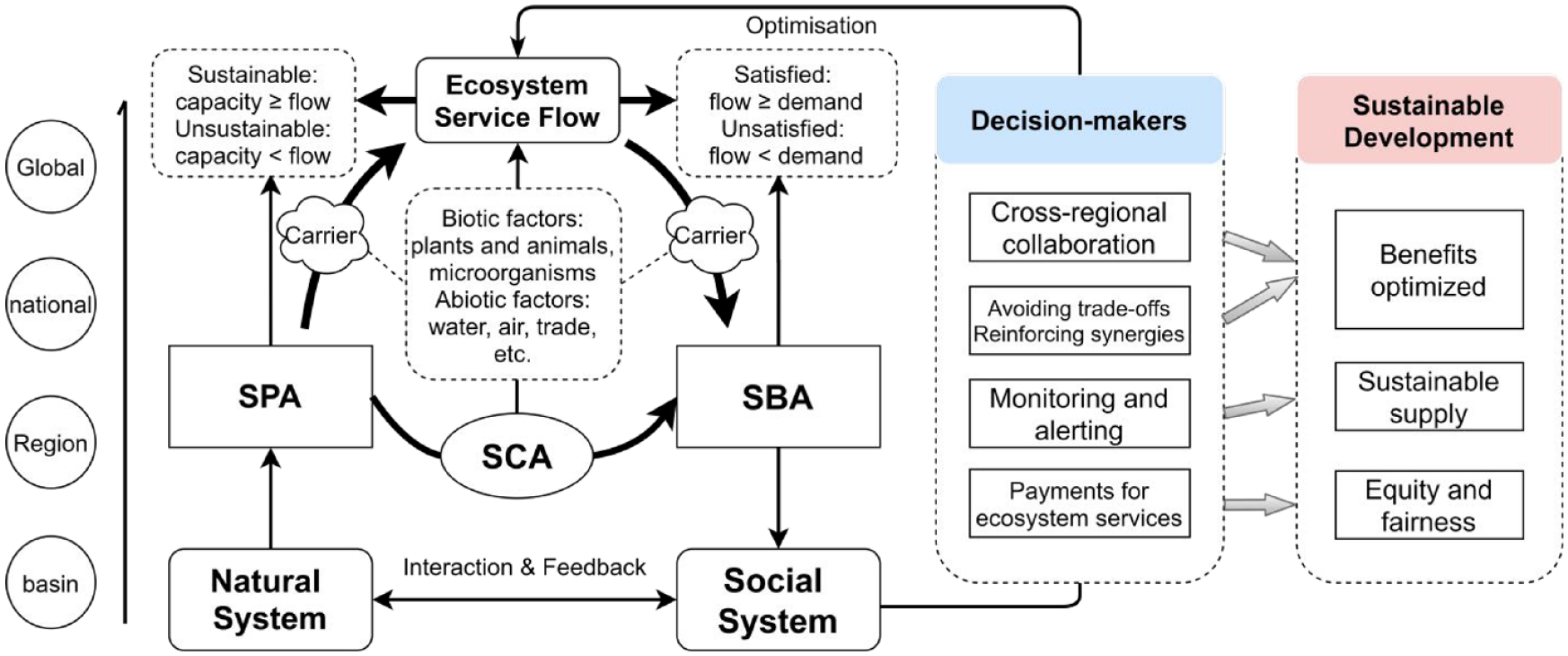
Expanded framework for research on ecosystem service flows.
In general, to promote research on ecosystem service flows in coupled human and natural systems, it is necessary to develop the following areas: (1) Systematic analysis of the mechanisms of ecosystem service flows across scales and regions in coupled human and natural systems is the cornerstone of research. For example, ecosystem services have various flow directions and carriers, and understanding the mechanisms of ecosystem service flows is the basis for an accurate ecosystem service flow assessment; (2) Integrated management from the perspective of policymakers is a means of optimizing the flow of ecosystem services and important feedback from social systems to natural systems. For example, policymakers can optimize the quantity and quality of ecosystem service flow through cross-regional collaboration, avoiding trade-offs and reinforcing synergies, monitoring and early warning, and ecological compensation; (3) Improvement of the research framework of ecosystem service flows in human–nature coupled systems so that they contribute to human well-being and sustainable development. For example, cross-regional collaboration, avoiding trade-offs, and reinforcing synergies contribute to optimizing service benefits on a spatial scale; monitoring and early warning contribute to sustainable supply on a temporal scale; proactive ecological compensation makes services more equitable and fair on a spatial and temporal scale.
Conclusions
Ecosystem service flows bridge the gap between ecosystem service supply and human demand. Therefore, it is essential to explore the interactions between ecosystem services and human well-being. Ecosystem service flows also form a hotspot in contemporary ecosystem service research, with the findings having critical implications for improving human well-being and achieving sustainable regional development. The two main research methods have different focuses—one emphasizing process and the other utility—and each has distinct advantages and disadvantages. Future research should focus on four main aspects: (1) the transmission processes and mechanisms of ecosystem service flows in complex systems, (2) strengthening research efforts toward quantitative methods of evaluating ecosystem service flows, (3) expansion of research focus to different scales of ecosystem service flows, and (4) improving the research framework of ecosystem service flows within the context of human–nature coupling.
Footnotes
Declaration of conflicting interests
The author(s) declared no potential conflicts of interest with respect to the research, authorship, and/or publication of this article.
Funding
The author(s) disclosed receipt of the following financial support for the research, authorship, and/or publication of this article: This research was supported by the National Natural Science Foundation of China (grant no. 42071285) and the Key R&D Program Projects in Shaanxi Province of China (program no. 2022SF-382).