




Abstract
Driven by intensive globalization and technological development, shifting from place-based research on ecosystem services to an understanding of multiple human and natural interactions within the focal system, as well as between adjacent and distant systems, is becoming an urgent necessity. An integrated framework of metacoupling (socio-economic-environmental interactions within and across borders) is proposed to address this shift. Here, I have demonstrated the utility of the metacoupling framework, which includes intracoupling, pericoupling, and telecoupling, in the assessment of ecosystem services. I have referred to three examples from China (water supply, soybean production and trade, banana planation and displacement). I have also provided regulations and cautions in the application of the metacoupling framework. Strengthening the assessment of ecosystem services with the metacoupling framework can yield important insights toward sustaining ecosystem service provisions, balancing trade, offs, promoting regional and global cooperation, and achieving the United Nation’s Sustainable Development Goals.
Introduction
Ecosystem services are the benefits that people obtain from ecosystems. They are co-produced by interactions between ecosystems and human societies (Costanza et al., 1997; Daily, 1997; Mandle et al., 2021). To understand the impacts of such benefits and co-production on ecosystems, the assessment of ecosystem services has received widespread recognition from the scientific community and political decision-makers over the past decades (Fu et al., 2013; Mandle et al., 2021).
Ecosystem services function as links between ecosystems and human societies (Grunewald and Bastian, 2015). Such links are bi-directional, and include the supply of ecosystem services (the total amount of ecosystem services products provided within a specific area and seen as the upper limit of nature’s carrying capacity for human activities) and the demand for these services (ecosystem service products consumed or utilized within a specific area) (Grunewald and Bastian, 2015). To comprehensively understand the links between the supply and demand of ecosystem services, the framework of coupled human and natural systems (CHANS) has been proposed (Figure 1). The CHANS framework integrates patterns and processes that connect humans (different sectors and stakeholders) and natural systems (different abiotic and biotic factors) within and across multiple organization levels.
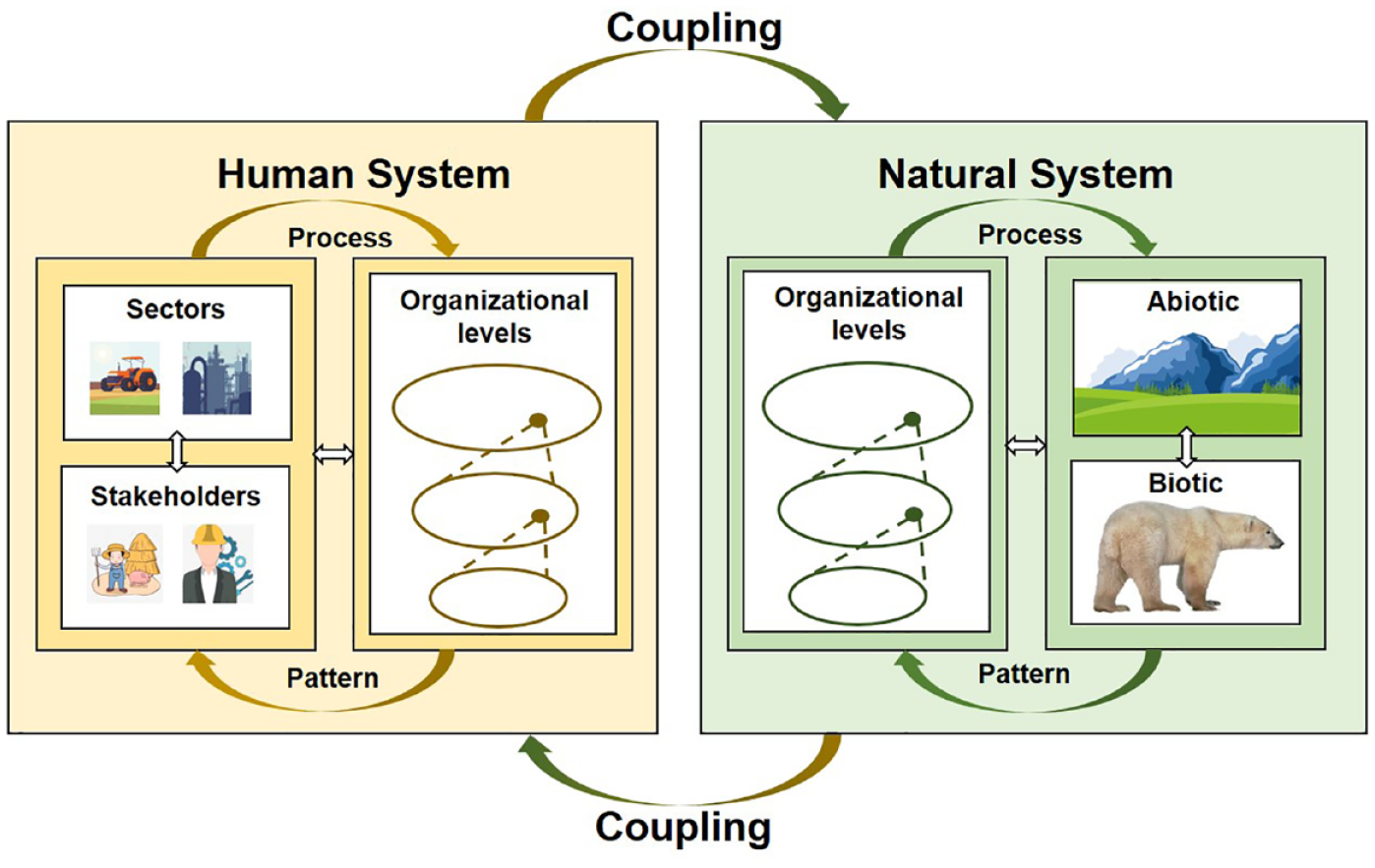
Schematic representation of a coupled human and natural system.
In the Anthropocene era, human societies are becoming heavily reliant on the ecosystem supply, thus creating challenges for ecosystem services (e.g., habitat degradation, biodiversity loss). Adoption of the CHANS framework is particularly useful in addressing such complex challenges. For example, biodiversity is commonly considered to be somewhat shielded from human activity after an area is designated as a protected area. However, based on the CHANS framework, ecological degradation has been detected in the Wolong Nature Reserve, a protected area for giant pandas in southwestern China (Liu et al., 2001). The major driving force of such degradation is the increase in household numbers in the reserve, because more young people have established new households and no longer staying with their parents. Newly established households require construction materials (wood) and involve a variety of economic activities (e.g., agriculture, fuelwood collection, timber harvesting, road construction and maintenance, and herbal collection), leading to deforestation in the reserve and degradation of protected areas. The CHANS framework has been widely incorporated into habitat restoration and conservation endeavors in the Wolong Nature Reserve. Moreover, it has been quite successful because giant pandas have been downgraded from endangered to vulnerable levels (Xu et al., 2017). CHANS framework-based studies on ecosystem services have yielded fruitful scientific discoveries and useful policies over the past few decades, with most focusing on a specific place or simple comparisons between just a few different places (Alberti et al., 2011; Kramer et al., 2017).
Driven by intensive globalization, more human and natural interactions are occurring between geographically, culturally, and institutionally distant systems, and across local, regional, national, and global scales. Thus, moving from scattered and separate place-based research to systematically integrated research is becoming an urgent necessity. It is crucial to build a networked research scheme, promoting the assessment of ecosystem services, and generating novel insights for understanding complex relationships among the 17 United Nations Sustainable Development Goals (SDGs) within and between adjacent and distant places.
From CHANS to metacoupling
Place-based CHANS around the world are becoming increasingly connected through distant interactions, such as international trade, migration, cultural communication, and species invasion (Liu et al., 2007, 2021). This distant connectedness has profound implications for addressing global challenges, such as food security, energy security, biodiversity conservation, environmental protection, and human well-being (Sun et al., 2017; Tong et al., 2017; Tromboni et al., 2021). Therefore, it is becoming a major concern in the assessment of ecosystem services (Elmqvist et al., 2013; Grunewald and Bastian, 2015).
To address the distant connectedness among multiple CHANS, an umbrella concept, telecoupling, has been created, which refers to socio-economic and environmental interactions over distances (Liu et al., 2013; Sun et al., 2020). The telecoupling framework has been proposed to study these distant interactions; it consists of multiple CHANS and can be classified as a sending system, receiving system, and spillover system (Figure 2). Telecoupling has been widely applied in the assessment of ecosystem services (Liu et al., 2016) and in many other arenas (Hull and Liu, 2018; Rulli et al., 2019). According to recent reviews, the numbers of applications, publications, and citations on telecoupling are increasing since the release of the first telecoupling paper by Liu et al in 2013 (Kapsar et al., 2019; Sun et al., 2020).
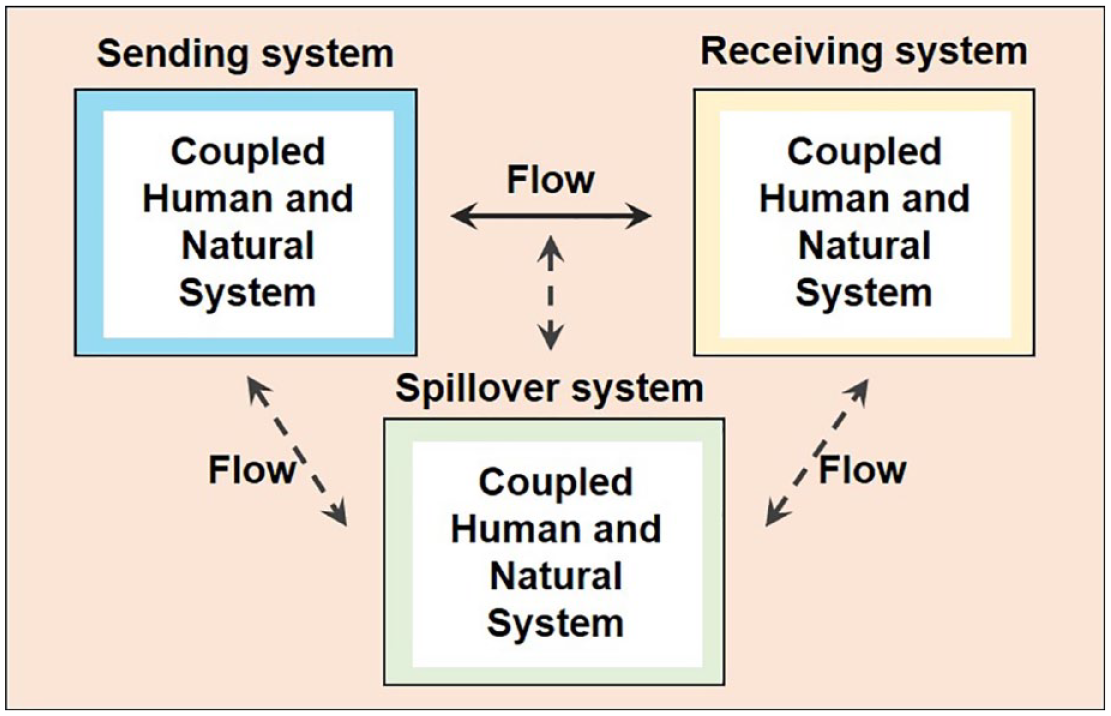
Schematic representation of the telecoupling framework.
However, the cumulative empirical studies show that the telecoupling framework and other frameworks have not explicitly integrated the interaction between adjacent CHANS (Liu, 2017). Although a collection of studies focuses on cross-border issues, such as transboundary air pollution (Abas et al., 2019) or socio-economic issues (e.g., migration and social remittances between Mexico and the USA) (Azizi and Yektansani, 2020), none of them examine socio-economic and environmental issues simultaneously.
The metacoupling framework has been proposed to integrate human and natural interactions within a system (intracoupling), between adjacent systems (pericoupling), and between distant systems (telecoupling) (Figure 3) (Liu, 2017, 2018). The framework has already been adopted in a range of studies, regarding watershed management (Merz et al., 2020), the diagnosis of inequity in cultivated land use (Chuai et al., 2021), the food-energy-water-CO2 nexus in agricultural irrigation (Xu et al., 2020), and the fishery management (Carlson et al., 2020). Furthermore, some studies have already attempted to use the metacoupling framework in ecosystem services (Zhao et al., 2018).
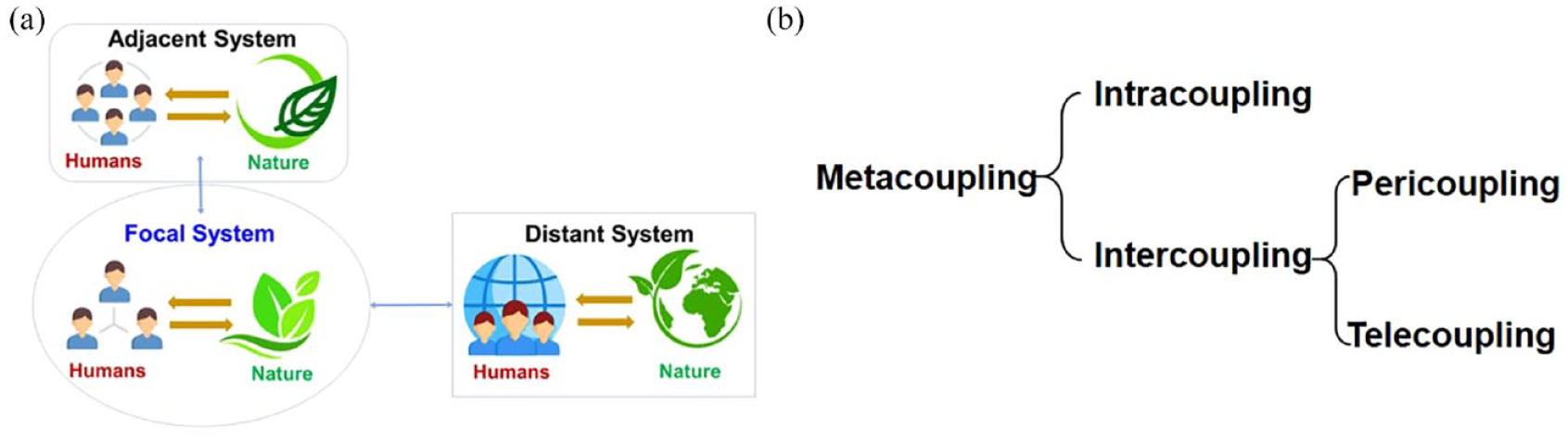
(a) Sketch of the metacoupling framework of a focal CHANS, an adjacent CHANS, and a distant CHANS, and their interrelationships (arrows). (b) Metacoupling includes intracoupling and intercoupling, while intercoupling includes pericoupling and telecoupling.
To demonstrate the utility of the metacoupling framework in the assessment of ecosystem services, I provide three related examples from China: Beijing’s water supply, soybean production and trade in northeastern China (the largest soybean production region), and banana plantation and displacement between China (southwestern China, the largest banana production region) and Laos (northern Laos) (Figure 4).
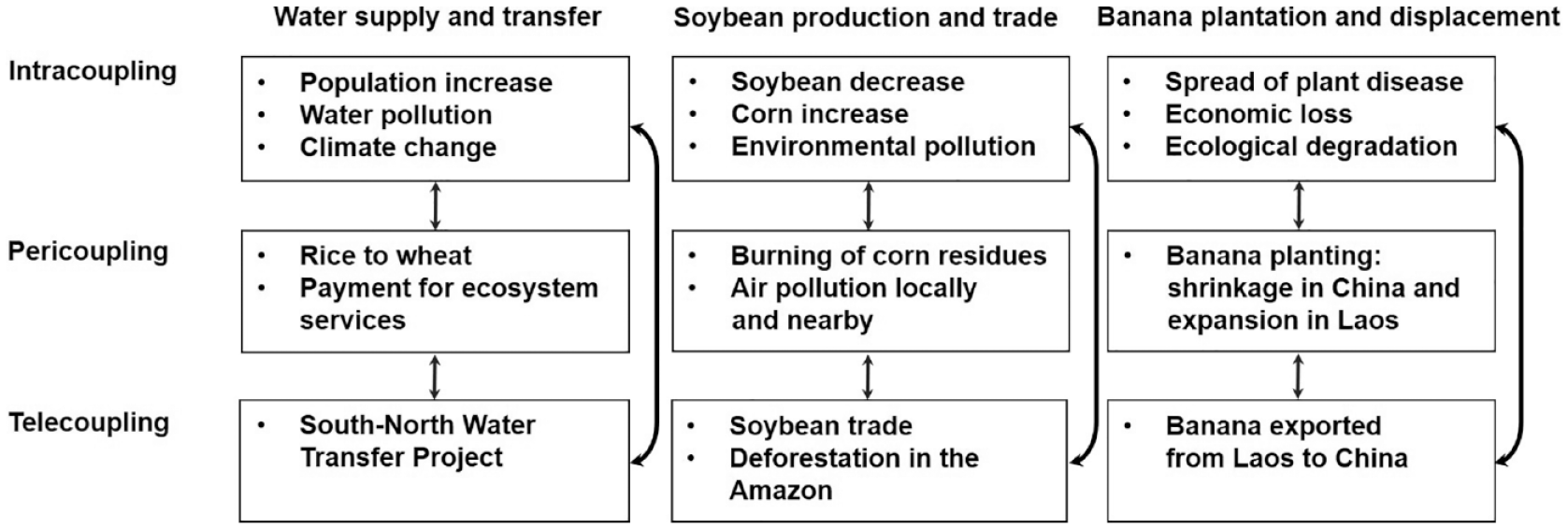
Examples of the metacoupling framework in the assessment of ecosystem services.
Embracing the metacoupling framework in ecosystem services
Water supply and transfer
Beijing, China’s capital, is one of the most water-scarce cities in the world (119 m3·y−1 per capita, far below the international criterion of 1000 m3·y−1 per capita), due to the overexploitation and pollution of water resources in recent decades (Wang et al., 2017; Ye et al., 2018).
Soybean production and trade
Soybean production and trade are high-profile examples in CHANS and telecoupling studies (da Silva et al., 2021; Sun et al., 2018). Soybeans are an important food crop, providing oil and fodder. Although soybeans were originally domesticated by Chinese farmers, China has become the largest soybean importing country, because of its population growth and changes in dietary structure (from plant-based to meat-based) (Food and Agriculture Organization of the United Nations, 2021).
Banana plantation and displacement
Southwestern China (Guangdong, Guangxi, and Yunnan provinces) is a traditional banana plantation region, accounting for more than 85% of the national total planted area (Ma et al., 2022, National Bureau of Statistics of China, 2021). Banana production is a pillar industry for local farmers.
Caveats in the application
I suggest using the first law of geography, that is, distance decay, as one method to justify whether multiple CHANS connected by certain flow(s) are metacoupled. Distance decay means that the human and natural interactions involving locals decline as the distance between them increases, whereas metacoupled systems do not conform to this law. For example, although the distance between China and Brazil is approximately 16,622 km2, soybean trade has significantly affected socio-economic and environmental systems in the two countries, such as changes in crop planting structure in China and deforestation in Brazil.
Perspectives
The Anthropocene era is full of uncertainties and surprises, including climate change, war, and COVID-19 pandemic, all of which have demonstrated the importance of assessing ecosystem services within intracoupling, between pericoupling and telecoupling. This is particularly true for the food supply in the ongoing Russia-Ukraine War. Direct effects of the war (intracoupling) include the suspension of food exports from Ukraine (the breadbasket of Europe), with future planting and harvest in question. The reduction of fertilizer exports from Russia (the largest nitrogen, second-largest potash, third-largest phosphatic fertilizer producing country) is also a concern. Far beyond the boundaries of Ukraine and Russia, the war has threatened global food security. Many European countries that rely on food crops from Ukraine to feed their people and fertilizers from Russia to feed their food crops (pericoupling) are struggling to find alternatives; and the rest of the world is experiencing spiked prices of agriculture commodities (telecoupling).
Adoption of the metacoupling framework in the assessment of ecosystem services is still at the start-up stage. Moreover, it is facing various challenges. Here, I list two challenges that must be addressed immediately. The first is quantification. To date, many papers focus on applications of the metacoupling framework conceptually, highlighting the importance of quantitative analysese. Many quantitative attempts have been made to assess ecosystem services in telecoupling studies using network analyses, GTAP modelling, and the telecoupling toolbox (Sonderegger et al., 2020; Tonini and Liu, 2017; Yao et al., 2018). Such studies shed light on quantitative metacoupling analyses. The second challenge involves platform. Since the concept and framework of metacoupling have been widely applied, it is necessary to build platforms (e.g., websites, forums) to regulate language usage (e.g., terminology), recommend application procedures, and organize sections in ecosystem-services meetings and conferences so as to promote an understanding and applications of the metacoupling framework in the assessment of ecological services.
The illustrations provided here indicate the powerfulness of metacoupling in the assessment of ecosystem services, such as helping identify knowledge gaps, advance ecosystem services, develop relevant policies, and reveal hidden and important interactions within a system (intracoupling), between adjacent systems (pericoupling), and between distant systems (telecoupling). Metacoupling also enhances the governance of ecosystem services. Future research in ecosystem services that embraces the metacoupling framework will add important insights toward sustaining provision, balancing tradeoffs, promoting regional and global cooperation, and advancing SDG goals.
Footnotes
Declaration of conflicting interests
The author(s) declared no potential conflicts of interest with respect to the research, authorship, and/or publication of this article.
Funding
The author(s) disclosed receipt of the following financial support for the research, authorship, and/or publication of this article: This work was supported by the National Natural Science Foundation of China (No. 42271276).