



Abstract
Winter cities’ development faces numerous challenges, with one of the most fundamental being their harsh climatic conditions. Urban research plays a crucial role in guiding the healthy and systematic development of cities. It is tasked with addressing the challenges posed by harsh climate conditions, improving the living environment for humans, and promoting sustainable urban development. Firstly, we analyze the progress of planning research on winter cities in China and classify them into three main stages: starting attempt, stable growth, and rapid development. Secondly, studies are sorted out in terms of the optimization of the urban environment and the support for urban residents. The problems and challenges faced by urban planning research in winter cities are further condensed against the limitations of existing studies and the complexity of urban development. Finally, future research directions are proposed, including undertaking the requirements of national development strategies, strengthening the support of new technologies and methods, and building the multi-dimensional interaction mechanism. The review and outlook from this research will help promote theoretical development and application innovation in this field, which in turn better enhances the urban resilience of winter cities, promotes low-carbon construction, and facilitates the high-quality development of the human living environment.
Introduction
The degree of climate suitability determines the comfort level of the human living environment, and also affects urban development and residents’ life. With the deepening of the concept of sustainable urban development and ecological design, we should further consider the climate environment characteristics of winter cities and expand the climate adaptation in architectural design to the urban level. How to deal with climate problems is a long-term challenge for the development of the discipline and the research of urban planning in cold regions. The winter of cities in cold regions is long and hard. Urban livability is greatly affected. Scholars of winter cities have begun comprehensively researching theoretical approaches and applied practices of climate-resilient design of urban spatial environments. More and more scholars are also focusing on the impact of urban planning, landscape design, and architectural design on the local microclimate environment of cities in urban development. As an essential technical tool to guide urban construction, urban planning plays a critical role in coping with climate change risks, improving the quality of the human living environment, and ensuring cities’ low-carbon and healthy development.
China’s winter cities have a vast area and a large population. The quality of their living environment is of great significance for the implementation of national strategies such as sustainability. Based on the research progress of Chinese winter cities, we review the research contents, including the optimization of the urban environment and the response of human behavior. Then, in light of the development trends of science and technology, social needs, and policy orientation, we further analyze the problems and challenges in cold regions from two aspects: the limitations of previous studies and the complexity of urban development. In this context, we propose a research outlook for future-oriented winter cities, including undertaking the requirements of national development strategies, strengthening the support of new technology new technologies and methods, and building multi-dimensional interaction mechanisms. It is expected to provide fresh ideas and ways to improve the quality of the urban space environment in cold regions and promote the sustainable development of the human living environment.
Progress of urban research on Chinese winter cities
The research on Chinese winter cities started at the end of the 20th century. Combining with related literature, we divide the research process into three main stages: the starting attempt stage, the stable development stage, and the rapid development stage (Table 1).
Stages of research on Chinese winter cities.
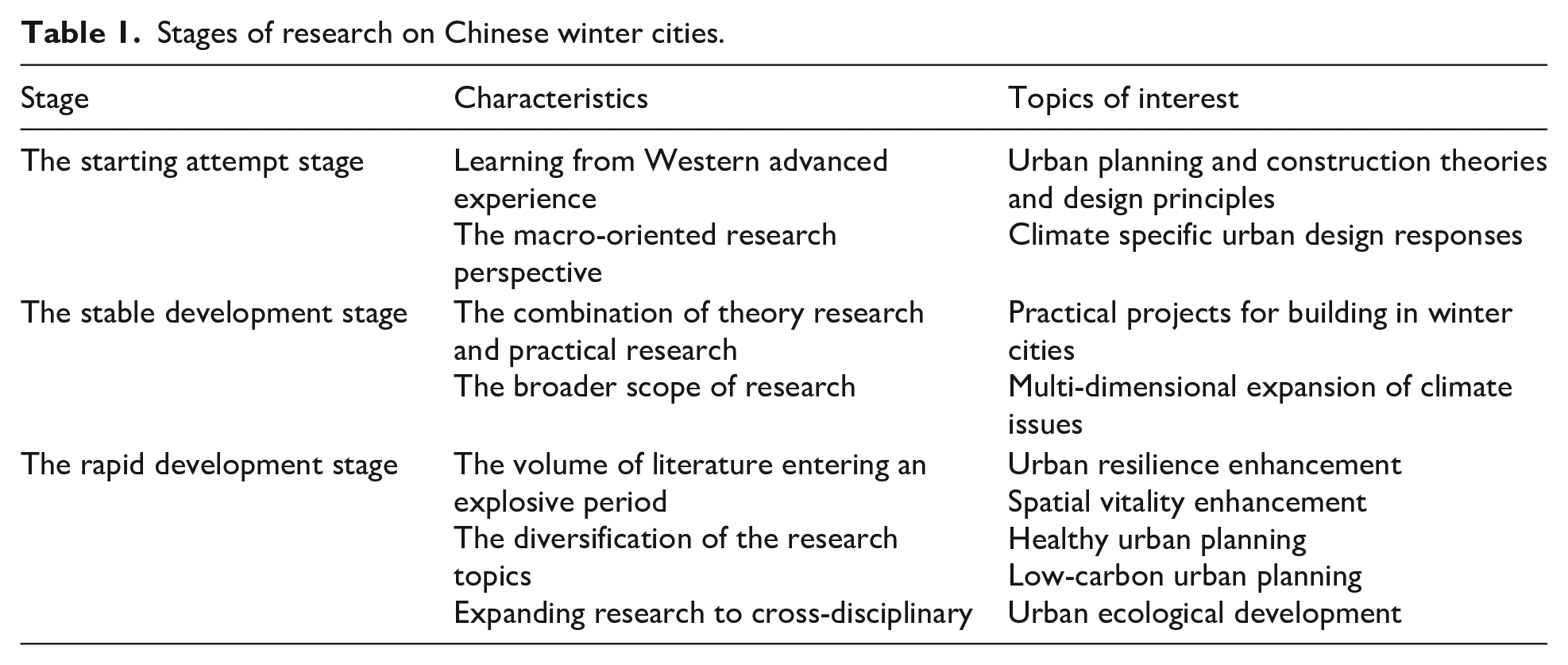
The first stage is the starting attempt stage. In the late 1980s, to systematically understand urban planning and design discipline, the Chinese Ministry of Construction commissioned Guo Enzhang, Jin Guangjun, Liu Deming, and others to study at the MIT environmental design research center, which marked the beginning of research on winter cities. Western research on winter cities was far ahead of China. Inspired by the West, these scholars introduced advanced concepts and techniques to China, such as modern urban design (Guo and Lin, 1988), planning and construction of green pocket spaces (Zhang and Guo, 1989), and design responses to public spaces (Guo, 1998). They also emphasized the importance of climatic factors in urban planning and construction (Sun and Guo, 1998). Since then, China has gradually explored its path of cold regions instead of simply following the trend of international academic development.
The second stage is the stable development stage. With the acceleration of urbanization and the rapid development of the urban economy, the scope of research in cold regions of China became progressively broader in the early 21st century, showing the development characteristics of the combination of theory research and practical research. The multi-dimensional expansion of climate issues became the key to leading the hot frontier (Guo et al., 2003). There was also a rapid development of related urban planning construction and practice projects (Lu et al., 2005; Xu and Guo, 2003). The theories and strategies for the construction of winter cities in China are enriched by learning from the development of livable urban environments in high-latitude cold regions abroad. Scholars applied theories to guide the building of the city. In turn, the problems found in practice also promoted the continuous improvement of theoretical research.
The third stage is the rapid development stage. The publication of scholar Leng Hong’s book “Study on Urban Environmental Livability in Cold Regions” has led to a surge of research on livable cities in the academic community of winter cities in China (Leng, 2009). The volume of literature on related studies has entered an explosive period. The scope of research has been further expanded to cross disciplines, including architecture, geography, sociology, medicine. Urban resilience enhancement (Leng et al., 2021a), spatial vitality enhancement (Chen et al., 2017a; Lu and Cai, 2017), healthy urban planning (Yuan et al., 2021), low-carbon urban planning (Li et al., 2012; Mo and Ye, 2020), and ecological development have become research hotspots in the context of cold climates (Ma and Leng, 2016; Sun et al., 2013). During this stage of development, China’s research on cold areas has been gradually promoted and enhanced, and has become an increasingly influential part of academic research. However, a complete system has not yet been formed, and there is still a long way to go for urban research and practice in winter cities. At the same time, along with the rapid development of the economy and society and the continuous innovation of science and technology, the man-land relationship and people’s behavior have changed. As a result of such changes, higher requirements for building a sustainable and human living environment in cold areas have been put forward with more contemporary significance.
Content of urban research on Chinese winter cities
The purpose of the study of cold cities is to alleviate the negative effects of special climatic conditions on urban construction. The suitability of the climate determines the extent to which the habitat is comfortable. An essential characteristic of a winter city is the climate, especially in winter. There are five specific characteristics of cold urban winters, including temperatures generally below 0°C, precipitation often in the form of snow, short daylight and sunshine hours, long duration of the above three characteristics, and distinct seasonal changes (Leng, 2009). As a stable and persistent natural factor, the cold climate significantly impacts the built environment, urban energy consumption, the inhabitants themselves, and the socio-economic development of cities. A wealth of research has been accumulated on China’s winter cities. With the goal of promoting the development of winter cities, existing research in China has focused on both the optimization of the urban environment and support for urban residents. Among them, urban environment includes physical environment, living environment, landscape environment and social environment, and support for urban residents includes support for residents’ activities and support for residents’ perceptions (Figure 1).
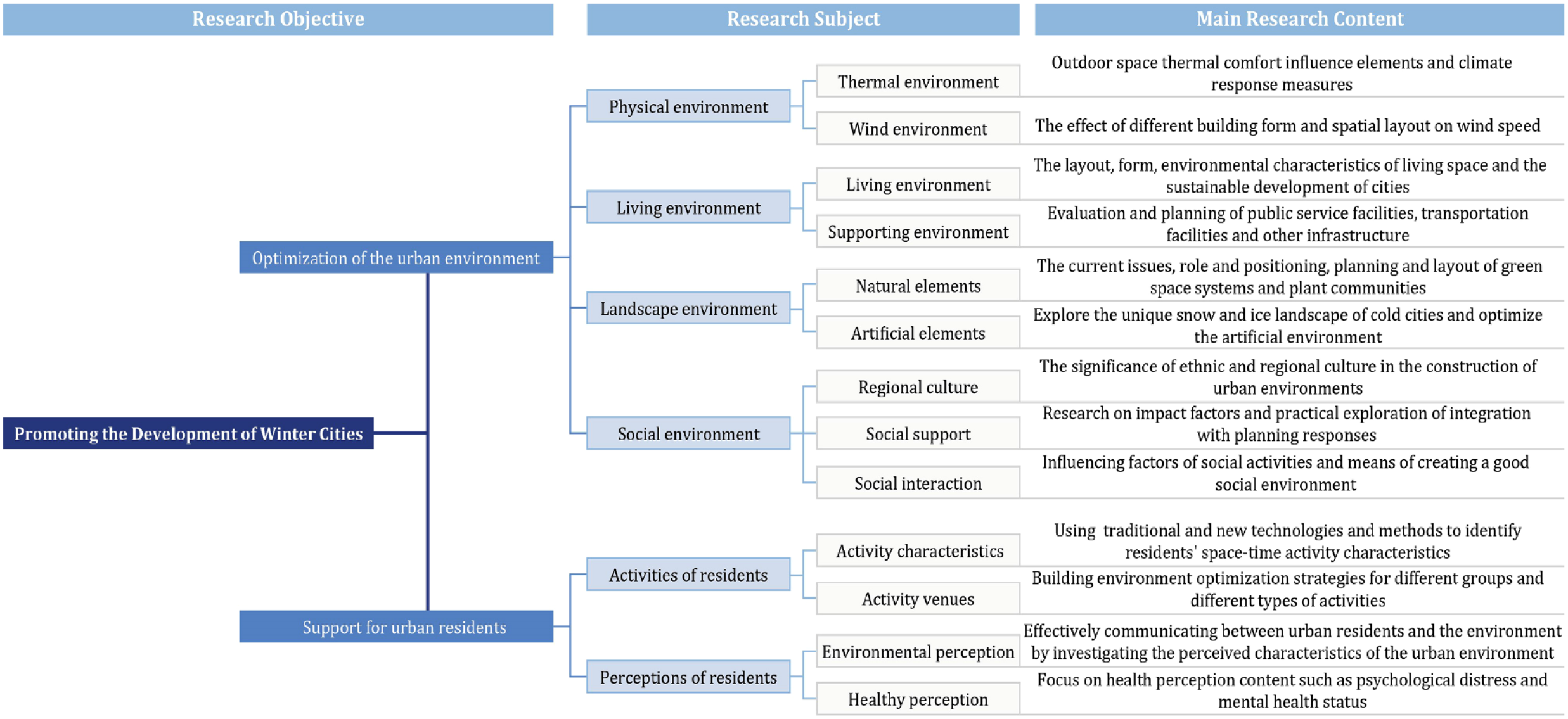
Content of research on Chinese winter cities.
Optimization of the urban environment
The urban environment is greatly influenced by climatic factors, and as a carrier for undertaking various public activities, it largely affects the future development of the city and the physical and mental health of its residents. The unique climate conditions in winter cities have made environmental construction a focal point for scholars for many years. The current research on urban environment in cold regions mainly involving four significant aspects: physical environment, living environment, landscape environment, and social environment.
Physical environment
A city with fresh air, a pleasant environment, safety and comfort cannot be achieved without the support of the physical environment. The urban physical environment mainly refers to the sound, light, heat, wind, and other elements generated by urban space in urban construction (Liu, 1999). In the era of ecological and digital urban structure, the research on the urban physical environment using cutting-edge computer technology has gradually become an influential part of the study of winter cities, in which planners pay more attention to the thermal environment and wind environment. In the research of thermal environment elements, urban planners in cold regions have classified residential areas of different types and scales. Scholars have studied the impact of residential areas on the thermal environment by combining field measurements and computer simulations, and proposed strategies and methods for coping with winter climate under different building layout conditions (Chen et al., 2017b; Zhu et al., 2012). In the research of wind environment elements, planners have used computer simulations to control morphological elements such as building density, height, volume and different angles between structures to explore the effect of building form and spatial layout on wind speed (Jin et al., 2016). Wind environment prediction can improve the scientific nature of the urban spatial layout, which is crucial to reduce the dispersion of PM2.5 and mitigate the urban heat island effect (Li et al., 2015).
The winter of cities in cold regions is long and hard, and the thermal comfort of public space is chronically low (Jiang and Leng, 2017). Planning and design without adequate consideration of climatic conditions or appropriate protective measures could easily lead to microclimatic problems such as high wind speeds and short duration of sunlight. Poor physical environment quality will affect residents’ outdoor activities and physical and mental health to a certain extent (Wang et al., 2014; Zhao et al., 2019). Therefore, the physical environment comfort of urban public spaces in cold regions should be improved through urban planning. Planning and design actions such as proper siting and layout of building groups, planning of water landscapes, and configuration of plants can effectively increase temperatures, block cold winds or reduce wind speeds. Increasing solar radiation and creating a positive daylight environment can also improve the comfort of the microclimate environment in public spaces (Zhao et al., 2020). Adding seasonal structures with wind and snow protection, heat insulation, and warmth or devices with heating functions for climate protection during the cold season in winter cities helps create a suitable environment for activities in extreme climatic conditions. Creating a comfortable physical environment will help stimulate residents’ willingness to move around and effectively improve the health efficiency of urban public spaces (Zhao et al., 2019).
Living environment
The development of winter cities has always accompanied the study of the living environment. The living environment in this paper refers to places that provide shelter for people’s daily lives and activities, including the living environment and the supporting environment. Currently, the research on the living environment mainly focuses on the layout, form, environmental characteristics (Wang and Mei, 2018), and influencing factors of urban spaces such as blocks (Zhang et al., 2022), residential areas (Leng and Xiao, 2020; Qu and Qu, 2021), and public spaces (Zhang and Li, 2019; Zhao et al., 2018a). Scholars obtain geographic information data such as land use classification, layout form, building height, building density, and plot ratio through field surveys or remote sensing image interpretations to verify the significant impact of urban morphological features on the energy consumption of urban buildings and the physical and mental health of residents (Leng and Song, 2021; Leng et al., 2020b, 2021b). The functionality, safety, aesthetics, accessibility, comfort, and diversity of public spaces have the potential to affect the daily lives of urban residents (Yuan et al., 2022). Activity spaces of good quality not only increase the use of public spaces but also better promote healthy behavior among residents (Zheng et al., 2020). Research on supporting environment mainly focuses on evaluating and planning public service facilities, transportation facilities, and other infrastructure. Urban planners consider the infrastructure state of the cold urban research area based on field surveys, questionnaires, remote sensing images, and other data. Based on the assessment results, technical aspects such as planning objectives, strategies, and methods are proposed (Ma and Wang, 2022; Rong et al., 2007).
The urban living environment is closely linked to the sustainable development of cities and their inhabitants’ physical and mental health (Li et al., 2021). First, it is necessary to reduce urban energy consumption and promote healthy growth by adjusting urban form elements such as overall block height and form, block size, length of continuous building interfaces, and the size of public areas (Leng and Song, 2020). Secondly, the focus on a compact and concentrated site layout in cold cities, with a balanced mix of jobs and housing and a moderate blend of functions, helps to shorten travel distances for residents and improve the efficiency of urban operations (Jin and Zhang, 2008; Shan, 2015), thus promoting energy conservation and a comfortable and convenient environment for employment, living and leisure (Leng and Li, 2017). Finally, the public space’s scale and the activity facilities’ adequacy and refinement should be guaranteed. Non-slip paving materials such as wood and asphalt should be used as far as possible, and clear and safe lighting facilities should be installed. The aim is to enhance the refinement of the activity facilities and the residents’ experience of the activities and to promote their physical and mental health (Wang and Mei, 2020).
Landscape environment
The landscape environment can relieve stress and delight the mind (Wang and Mei, 2019). The landscape environment includes natural and artificial elements in urban studies of cold regions. Research on natural plants by urban planning scholars in cold regions is dominated by descriptive analysis, assisted by spatial analysis and numerical simulation. The content revolves around the current issues, role and positioning, planning and layout of green space systems and plant communities (Yao et al., 2016; Zhao et al., 2018b). However, with its withering greenery and reduced green cover and view rates, the cold winter climate reduces the restorative function of natural landscape elements. But indoor greenery and outdoor non-green landscapes in winter also have a restorative effect (Fu and Lu, 2020). Therefore, exploiting the unique natural landscape of snow and ice in winter cities and optimizing the artificial environment has become one of the key research priorities in recent years. The changes in the elements of the winter landscape affect the environmental perception, stress regulation, and physical activity levels of urban residents (Leng et al., 2021b). Appropriate landscape design strategies will help improve the visual comfort of urban residents in the long winter, enhance their life interests, and contribute to the image of winter cities.
Urban planning scholars should fully explore spatial resources to improve the diversity of the landscape environment in terms of snow and ice, color, night, and water (Leng, 2009). In the design of the ice and snow landscape, it is essential to focus on the macro-level integrated planning of the city regarding site selection, distribution, grade, scale, and capacity, and to carry out detailed design under the guidance of macro planning. For example, the site can be flexibly adapted to the different seasons (Li and Mei, 2021). That is, a water feature such as a fountain in summer can be turned into a skating rink in winter, and a trail in summer can be turned into a ski trail in winter (Wu et al., 2022). In terms of color landscape design, it is advisable to use neutral or warm colors of medium to high brightness to pass on the historical heritage of winter cities and increase the warmth. At the same time, colors and other media are used to give full play to the visual effects of buildings, structures, plants, snow and ice and other landscape elements, to enhance the attractiveness of urban space (Lu et al., 2017). In the night landscape design, different lighting measures are taken for different functional areas such as single buildings, streets, squares, public green areas, and residential areas. Suitable lighting improves the cold urban landscape environment and increases the safety of the public urban environment at night. In the design of water landscapes, winter cities should follow the principles of seasonality, economy, and diversity and minimize large areas of artificial water landscape (Li et al., 2018).
Social environment
The social environment is the environment in which human beings interact with each other. It provides material or spiritual services that meet residents’ physical, psychological, and behavioral needs and is an indispensable condition that fuels sustainable urban development. The social environment includes support for the population, social classes, cultural patterns, economy, education, health and welfare, law, administration, and so forth (Wu, 2001). Research on the social environment in winter cities has focused on three aspects: regional culture, social support, and social interaction. Regarding regional culture, urban planning scholars have focused on the significance of ethnic and regional culture in the construction of urban environments, with descriptive analysis taking the lead. Promoting the unique regional culture of winter cities by creating spaces with regional characteristics can enhance residents’ sense of belonging and identity (Wu et al., 2022). In terms of social support, winter cities focus on studying influencing factors and the practical exploration of combining them with planning responses. Strengthening social support by satisfying residents’ pursuit of a good living and working environment can help enhance the ability of society to function stably (Dong et al., 2021b). In terms of social interaction, scholars have demonstrated through empirical studies that promoting social interaction can alleviate the negative emotions brought about by bad weather and thus improve the mental health of residents. Based on this, scholars have concluded the factors influencing social activities and the means to create an excellent social environment (Yuan et al., 2022).
There are three main paths to building a suitable social environment in winter cities. The first is to cultivate cultural identity (Sun et al., 2018). With rich snow and ice resources, winter cities can construct a snow and ice culture system by developing a series of snow and ice industries, such as cultural parks and fairs. Snow and ice culture is a distinctive feature of winter cities. Exploring the artistic connotations and giving full play to the attractiveness of the snow and ice landscape to the people can cultivate the residents’ understanding and identification with the cold urban environment (Leng et al., 2021b), thus improving the feasibility of other strategies (Wu et al., 2022). The second is to strengthen social support. Encouraging residents to actively participate in community affairs and activities and establishing a sound system of social support and rights protection will help reconstruct local social networks and enhance residents’ sense of belonging and values (Han and Leng, 2022; Ma et al., 2020). The third is to promote social interaction. Social interaction is the basis for ensuring an excellent social atmosphere and the identity of individual residents. A well-developed social network facilitates interaction and collaboration among residents, further enhancing their mental health (Dong et al., 2021c). Organizing activities such as awareness talks and public welfare projects provides a platform for residents to communicate and shorten the social distance, which helps to form highly trusting interpersonal relationships, thus further enhancing residents’ sense of identity with the community and the city (Dong et al., 2021b).
Support for urban residents
In addition to the urban environment, scholars in cold regions also focus on the urban residents. Differences in residents’ behaviors will further influence the composition and construction of urban spaces. Research on the behavior of residents in winter cities has focused on activity and perception. Existing studies mainly obtain data through on-site observation (Sun et al., 2022), questionnaires (Qu and Qu, 2021; Zhang and Li, 2019), and interviews (Chen et al., 2022). Studies have explored the spatial distribution features of residents’ activity behavior and perceived behavior to propose strategies for improving the spatial environment in winter cities.
Activities of residents
Scholars in cold regions construct human living environment optimization strategies based on identifying residents’ space-time activity characteristics. With the rise of big data, scholars have realized the importance of using new technologies and methods to study urban environmental issues. The application of processes such as Baidu heat (Su et al., 2022), mobile phone signaling, web crawler data (Guo et al., 2021), and wearable device records is gradually increasing in proportion. Research has shown differences in the behavioral characteristics of different groups in terms of venues, types, duration, and frequency of activities, influenced by individual attributes, external environment and other factors (Jiang et al., 2022; Yuan et al., 2022). For example, the age gap brings variations in physical fitness and experience, leading to differences in people’s preferences for types of activities. Children often prefer fun activities that require environmental support, such as playing in the snow (Leng et al., 2020a). On the other hand, older people have an increased need for climate comfort due to changes in their physical and mental health. They, therefore, prefer leisure activities such as chatting, walking, and square dancing (Zhang et al., 2014; Zheng et al., 2020). Gender can also lead to different needs for hardiness and spatial elements. Gender can also lead to varying requirements for hardiness and spatial characteristics. Females are more sensitive to temperature changes and less cold tolerant, so they have shorter activity times and higher demands on facility conditions and the physical environment. In the same external environment, males are more concerned with elements such as accessibility of the site (Yuan et al., 2022). In addition, studies have also demonstrated different patterns of thermal adaptation among people from different origins, with higher satisfaction among out-of-town visitors in colder environments (Xi et al., 2019).
Perceptions of residents
Perception is an acquisition of awareness or comprehension of perceptual information (Wang et al., 2022). Environmental perception is the basis for spatial construction. Clearly and effectively communicating the relationship between the urban environment and perception is one of the key directions for urban planning research in cold regions. Scholars of winter cities have mainly investigated the perceived characteristics of the urban environment and perceived satisfaction through questionnaires and interviews (Chen et al., 2015). At the same time, some have also focused on other perceptual components, such as positive psychology and psychological distress (Dong et al., 2021c). Relevant studies often use analytical methods such as correlation analysis, linear regression, or structural equation modeling to explore the mechanisms of action between the urban environment, subjective perceptions, and individual health (Dong et al., 2021a; Yao and Leng, 2017). Studies have shown that the harsh winter conditions have a negative impact on residents’ subjective perceptions of the urban environment. Subjective perceptions of residents are often expressed as mediators of the urban environment and individual health (Leng et al., 2022).
Resident’s behavior is subjective and dominant in the interaction between behavior and living environment in winter cities, so studying resident’s behavior can help build a comfortable living environment. The spatial planning of cold urban areas should be fully respectful and responsive to the conduct of the residents. Among them, children and the elderly are the most frequent users of urban public spaces and the most vulnerable groups, whose needs and activity behavior should be respected to the greatest extent possible. Of all urban residents, children and the elderly are the most frequent public space users and the most vulnerable. Their living needs and activity behavior should therefore be respected to the greatest extent possible. Firstly, the planning and design of cold urban spaces should be adapted to the diverse needs of different people while compensating for the differences in physical conditions between individuals and creating an equitable, open, and inclusive urban environment as far as possible (Li and Mei, 2021; Shan et al., 2022). Secondly, planners should pay attention to the spatial and temporal characteristics of the activities of different groups of people. Differences in the types of activities undertaken by children and older people in specific seasons should be clarified (Leng et al., 2020a). It is indispensable to focus on constructing green spaces and fitness areas where residents gather and stay at high frequencies (Huang, 2022). All these measures contribute to promoting outdoor activities and interaction among residents.
Problems and challenges faced by urban research in winter cities
The research on Chinese winter cities is closely related to the changes in science and technology, social needs, and policy orientation. Facing the limitations and dilemmas of existing research and the complexity of future cold urban development in China, how to transform the problems and challenges faced by research under severe cold climate conditions into development opportunities is a pressing issue for scholars in the discipline of urban planning.
Limitations of existing research
The development time of Chinese winter cities’ urban research is relatively short, and the number of related studies is few. Through the systematic review of the previous study, it is found that the existing research has certain limitations in the aspects of the research system, research data, and research cooperation.
The research system needs to be improved. In terms of content, some studies on winter cities are not closely related to regional climate conditions, and the studies are not targeted enough. In terms of depth, most of the existing studies are in a superficial state, staying at the stage of descriptive analysis. The explanation of influencing factors mainly adopts correlation analysis or linear regression, which cannot reveal the mechanism of action. The research data needs to be balanced. Collectively, the existing research results of winter cities cannot break through the dilemma of severe cold climate conditions limiting urban development. The current research data in the field of winter cities urban planning include traditional spatial data obtained through field observation, questionnaire method, and big urban data obtained through sensor technology or mobile positioning technology. The sample size of traditional spatial data is limited, while the data accuracy of big urban data still needs to be considered. The application of urban big data is not comprehensive enough, and the integration and balance of multi-source data is still lacking. The research cooperation needs to be strengthened. The research related to winter cities in China has involved urban planning, geography, psychology, sociology, and other multidisciplinary fields, showing a trend of interdisciplinary and multi-dimensional development. However, high-level research cooperation is still relatively lacking, which leads to a lack of scientific support for many studies in the planning field, and the results cannot be implemented.
Complexity of urban development
Urban environmental construction is a long-term process during which it is necessary to respond to policy guidance and meet the needs of residents. The goals of urban environmental construction show complex and diversified characteristics, specifically including actively addressing the risks of climate change, promoting high-quality urban development, and meeting the health needs of residents.
The international community regards climate change as one of the most critical factors threatening human health in the 21st century. The average temperature change and extreme weather events caused by climate change have a huge impact and loss on the economy, health, ecology, and safety of cities at the macro level. It also inconveniences residents’ daily life and travel behavior at the micro level. It is the opportunity and challenge for the future environmental construction of winter cities that clear how to deal with the risks of climate change and achieve the “double carbon” goal through low-carbon mitigation and resilient adaptation measures. Comprehensively promoting environmental improvement and improving resource and energy efficiency depend on administrative and planning controls and effective technology integration. President Xi Jinping pointed out that to promote high-quality urban development needs to grasp that “development firmly is the priority, talent is the first resource, and innovation is the first driving force.” Exploring the development and application of efficient and innovative technology to realize the city’s smart transformation has gradually become a key focus topic for domestic scholars. In addition, carefully considering residents’ health needs is also one of the goals of the future urban environmental construction in winter cities. Differences in social, economic, and environmental conditions lead to different levels of vulnerability to climate change health threats for diverse populations and regions. Formulating appropriate climate change adaptation goals and actions to meet the health needs of residents is a challenge for the environmental construction of winter cities.
Prospects for future-oriented urban research in winter cities
Based on adapting to the macro-regional climate and improving urban microclimate, the research on winter cities should further aim to improve the quality of the urban spatial environment and promote sustainable development of the human living environment. Considering the needs of urban construction in cold regions and academic frontiers, the research should be carried out from three perspectives: undertaking the requirements of national development strategies, strengthening the support of new technologies and methods, and building the multi-dimensional interaction mechanism (Figure 2).
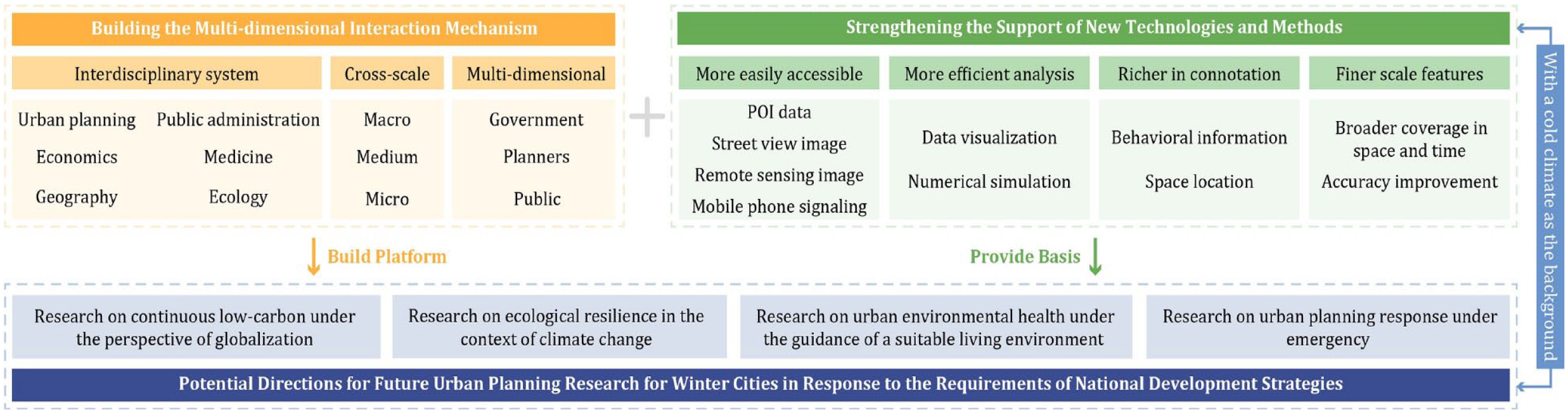
Concerns for future research on Chinese winter cities.
Undertaking the requirements of national development strategies
China is currently facing opportunities and challenges brought about by climate change. Based on the practical needs of the country’s green, healthy, and high-quality development, we propose several potential directions for urban planning research for winter cities.
Research on continuous low-carbon under the perspective of globalization. Guided by the concept of “community of human destiny,” urban planning adapted to the cold climate should move toward the measurement direction of combining macro and micro, multi-platform and multi-time dynamic monitoring in the future. The whole-factor control of national spatial planning based on precise carbon emissions can effectively connect the “carbon peaking and carbon neutrality” target with the urban spatial development path.
Research on ecological resilience in the context of climate change. Under the guidance of macro policies such as the National Strategy on Adaptation to Climate Change, the future planning of winter cities for climate change adaptation should aim at ecological protection and restoration, improving the resilience of the human living environment. And the policies and regulations of climate change adaptation are incorporated into the construction of resilient cities and urban renewal. Urban planning scholars need to fully consider the ecological value that urban green areas can play in the adaptation planning for climate change and enhance the ecosystem service function.
Research on urban environmental health under the guidance of a suitable living environment. Under the guidance of the “human-oriented” concept, we should conduct relevant research on the theories and methods of urban planning in winter cities with public health as the orientation and active protection and intervention as the means of action. Future research can focus on exploring different groups’ behavioral characteristics and intrinsic needs, improving the physical environment, enhancing the attractiveness and utilization of urban space in winter and transitional seasons, encouraging residents to go out and reducing the risk of disease, etc. It can also strengthen the discussion on effectiveness evaluation indexes and influence mechanisms of urban public space health.
Research on urban planning response under emergency. Under the normalization of epidemic prevention and control, we should explore the countermeasures of urban environmental planning in winter cities, including the design and construction techniques of residential areas and public spaces, and the risk assessment and response mechanism of the human living environment. It is also necessary to further explore the optimal layout of medical treatment, disaster prevention and mitigation, environmental health and other infrastructure; simulate and predict the space requirements for specific resources and facilities under various emergency conditions such as flood and environmental pollution.
Strengthening the support of new technologies and methods
The rise of new technical methods provides an extensive range and high-precision empirical basis for urban planning in cold regions. In the future, research supported by multi-dimensional dynamic big data and corresponding spatial analysis methods will become a hot topic. The data obtained using the new technology has certain advantages: acquisition method, analysis efficiency, connotation information, and scale characteristics.
Compared with traditional data, data is more easily accessible under the new technologies and methods. While professionals usually collect traditional data for specific research objects or experimental purposes, the providers of new data include professionals such as urban planning scholars and a large number of non-professional institutions and personnel. For example, we can collect high-precision spatial information of cold cities through POI data and image information collected by cameras. Another example is that social media data such as microblogs can more intuitively reflect residents’ environmental perception and evaluation of urban space in winter cities at different times and spaces.
Compared with traditional data, data analysis in the context of new technology methods is more efficient. In terms of data presentation, new technologies and methods help achieve data visualization to improve the efficiency of data analysis and reduce the cost of understanding for readers. For example, by combining GIS technology, the microclimate characteristics of different regions can be highlighted through visual means. In terms of data analysis, numerical simulation and other computer frontier technologies are commonly used in outdoor thermal environment and energy consumption impact.
Compared with traditional data, the new data are richer in connotation, especially regarding residents’ behavior information. The data obtained by traditional methods, such as remote sensing images, focus more on urban spatial elements and less on residents’ behaviors. It is difficult to fully describe the vital issue of urban planning, namely the relationship between space and people. The emergence of new technology methods brings opportunities to acquire behavioral data of residents, such as mobile phone signaling and intelligent punching data, which are rich in behavioral information. For example, mobile phone signaling data plays a huge role in an epidemiological survey of epidemic prevention and control.
Compared with traditional data, the new data has the advantage of a finer scale and broader coverage in space and time. For example, due to the limitation of cost and capability, traditional questionnaire methods can only capture a small range of residents’ behavior information. At the same time, mobile phone signaling data can almost cover the whole city.
Strengthening the support of new technical methods directly affects the accuracy and reliability of future urban planning in winter cities. Using multi-source data to interact with urban spatial elements can help improve the well-being of residents and promote the peaceful development of cities in cold regions.
Building the multi-dimensional interaction mechanism
With the shift in China’s economy from high-speed growth to high-quality growth, the construction of the human living environment has become an essential task in the current practice of China’s modernization. In response to the actual needs, we should give full play to the supporting and leading role of the human living environment at the academic level. In the future, urban planning research in cold regions should pay more attention to the holistic nature of theoretical development. We should strengthen the introduction and integration of knowledge from humanities and social disciplines such as economics, geography, public administration, and psychology and build an interdisciplinary exchange system. From a multidisciplinary perspective, systematic research is carried out step by step, level by level, and with multiple means. In the research, we should follow the process of “basic theory research – evaluation of construction status – exploration of influencing factors – measurement of influencing degree – prediction of development trend – proposal of planning strategy.” In addition, empirical validation should be conducted based on theoretical research. In microclimate research, primary data and advanced technologies from urban meteorology, GIS, and other related fields are introduced to establish a complete evaluation framework. Meanwhile, the platform feedback mechanism is utilized to optimize the microclimate environment in winter cities continuously. Regarding the research on the impact of climate change on the health of cities and their residents, cooperation and cross-disciplinary construction between urban planning disciplines and multiple fields such as medicine, meteorology, anthropology, and biology should be strengthened. Disciplinary collaboration helps provide insight into the impact pathways and effects of climate change. In terms of low-carbon city construction, we should integrate ecological research methods and propose planning strategies according to the current situation of urban development. Promoting the study of winter cities’ urban planning from an interdisciplinary perspective will encourage the improvement of the disciplinary system of urban planning in theory, enhance the ability of urban spatial development and prediction in empirical evidence, and support the construction of more livable, healthier, and low-carbon winter cities and communities in the application.
Facing the complex urban problems in cold regions, besides strengthening the communication and cooperation among different disciplines, it is also necessary to shift to a cross-scale and multi-dimensional direction. In the analysis of urban problems, urban planning scholars should pay more attention to climate conditions. They should carry out planning management control at different levels from macro, medium to micro in cold region cities. Specific planning measures are then integrated into multi-process such as planning approval and implementation evaluation. Thus, a systematic planning perspective is formed, and cross-sectoral cooperation is promoted.
Conclusion
The climate condition is an essential factor affecting urban research in cold regions. While the research on coping with climate problems has attracted more and more attention from the international community, the relevant experience is also becoming more and more abundant. Chinese scholars have conducted theoretical and practical research on climate issues in winter cities and have made some progress. However, their research is still in the preliminary stages, given the complexity of climate issues. The empirical details of how to respond to the climate problems of winter cities from the perspectives of undertaking the requirements of national development strategies, strengthening the support of new technical methods, building the multi-dimensional interaction mechanism, and finding the landing points for spatial strategies implementation still need to be studied systematically and thoroughly. In the context of rapid technological development and urban reconstruction, scholars in the discipline of urban planning have the responsibility to clarify the future direction of winter cities in China and actively conduct corresponding research using new technological methods, thus promoting the healthy, sustainable, and high-quality development of winter cities.
Footnotes
Declaration of conflicting interests
The author(s) declared no potential conflicts of interest with respect to the research, authorship, and/or publication of this article.
Funding
The author(s) disclosed receipt of the following financial support for the research, authorship, and/or publication of this article: This research was funded by the National Natural Science Foundation of China (51978192).