



Abstract
This paper reflects on the meaning of chance and the impact that the occurrence of ‘accidents’ have in the creative process. I draw insights from two main sources: material engagement theory and the art of ceramics. In particular, based on observations from my comparative anthropological study of creativity in pottery making I present a process-oriented enactivist vision of chance as a meaningful coincidence where flow and form diverge from the norm and give rise to creative gesture. First, I introduce the notion of enactychism (blending ‘enactivism’ and the Peircean concept of ‘tychism’ from the Greek word ‘tyche’ for ‘chance’) as a means to conceptualise the relationship between chance, agency and materiality. Then, I explore the relationship between chance and creative gesture and propose ways for tracking the operation of chance in action.
Introduction
There are many ways and timescales to approach and define creative activity and the variety of improvisational performances that characterise human engagement with the material world. There is also variability in the ways we value and evaluate creative achievements. What about chance? What is the role and meaning of chance and accidents in the creative process? Traditional cognitivist approaches (that reduce and localise creativity inside the human head) struggle to incorporate chance in their models of improvisation. The main reason being that the unpredictability of chance seems to undermine the hylomorphic ontology of pre-determined intentional action that defines the orthodox representational paradigm of thinking about the creative process (Ingold, 2012; 2013; Malafouris, 2014). Accidents are by definition complex, undetermined, diffractive and noisy undermining the agency and control of the maker over the process of creation and, by extension, the perceived value and significance of the creative process. These cognitivist assumptions present a methodological barrier to understanding the relation between chance and human creativity. This applies to all major types of creativity at multiple scales. From Boden’s (2004) classical distinction between ‘Historical’ creativity (where the novelty is relative to an entire society or historical tradition) and ‘Psychological’ creativity (where the novelty is relative to a single individual), to Sawyer’s distinction between ‘Product’ creativity and ‘Performance’ creativity (Sawyer, 1998, p. 11), to more recent formulations, such as that by Kaufman & Beghetto (2009) 4C model of big and little creativity: mini-c (involved in learning and meaning-making), little-c (mundane, everyday creativity), Pro-C (professional creativity) and Big-C (revolutionary creativity) (Kaufman & Beghetto, 2009).
To highlight these concerns and to differentiate my approach to the study of creativity, in this paper, I propose a different view regarding the meaning of the creative process and significance of ‘chance’ and ‘accident’ in it. In particular:
1) I will use material engagement theory (MET) (Malafouris, 2004, 2013, 2014, 2019; Malafouris & Renfrew, 2010; Ihde & Malafouris, 2019) to argue for a radical continuity, and necessary unity between creative cognition and material culture (in the broadest sense of the term) (Figure 1). The basic message from a material engagement perspective is that, methodologically speaking, the starting point for studying the processes we label as ‘cognitive’ or ‘mental’ cannot be localised inside the head of the individual but needs to incorporate all relevant aspects of the material environment. We do not just think about things; rather, we primarily think with and through things. The terms ‘minds’ and ‘things’ make better sense as verbs; they essentially refer to processes. Minds are for minding and things are for thinging (Malafouris, 2019, 2020, 2021). Relevant here is the notion of creative thinging which designates specifically the human disposition to the discovery of new varieties of material signs and modes of enactive signification through improvisatory attentive engagement with things and form-generating materials (Malafouris, 2014). From the point of view of material engagement theory creativity is defined as a process of enactive discovery (Malafouris, 2011). Enactive discovery denotes a mixture of enactive signification and material imagination which are the two processes that allow materials and skilled bodies to become attuned so that the invisible becomes visible and the absent becomes possible (Koukouti & Malafouris, 2020; cf. Ingold, 2022). This is a process that takes place inside the world rather than inside the head. The term ‘process’ here has a technical, ontological meaning targetting and prioritising modes of becoming rather than being and by extension situated descriptions over closed definitions (Gosden & Malafouris, 2015; Malafouris, 2021; Malafouris et al., 2021). I do not mean that important parts of the creative process are not happening inside our heads or enacted through our bodies. What I argue is that, if we accept that creativity usually happens where new lines are drawn, whether on paper, clay or other material, then it is these areas of friction that should form the primary focus of our attention. Most of what really matters to the creativity process (including chance) takes place in those in-between areas where brain, bodies and things exchange properties and information. Selecting the appropriate level of description is a problem that must be addressed on a case by case basis following the local dynamics of situated action. I do not imply that creativity is not a cognitive process that needs to be studied by psychologists and is rather a sociomaterial process that should be studied by sociologists and anthropologists. What I argue is that creativity is a synergy of both cognitive and sociomaterial processes and that any attempt to reduce one part to the other is only going to obscure the value and meaning of this term in human life and in human becoming.
2) Adopting such a pragmatic and process oriented philosophical grounding and drawing on recent advances in ecological psychology and enactive cognitive science (Baber et al., 2019; Chemero, 2009; Clark, 1997; Fuchs, 2018; Gallagher, 2017; Glaveanu et al., 2013; Hutchins 2010; Newen et al., 2018; Rietveld & Kiverstein, 2014; Vallée-Tourangeau & March, 2020) I propose and discuss the notion of enactychism (blending ‘enactivism’ and the Peircean concept of tychism from the Greek word ‘tyche’ for ‘chance’). Tychism is a thesis proposed by the semiotician Charles Sanders Peirce that holds that absolute chance, or indeterminism, is a real factor operative in the universe (Kaag, 2008). Peirce, in a series of papers published at the end of the 19th century, developed his thesis of tychism proposing a close relationship between chance and agency (Peirce, 1892a, 1892b). As he writes: ‘chance is but the outward aspect of that which within itself is a feeling’ (CP 6.265; cited in Kaag, 2008, p. 397). As Kaag points out in his analysis, the vital connection and continuity between cognitive and material processes is brought to the fore in Peirce’s description of the ‘regularity’ of tyche, by which he ‘insist that chance does not imply sheer randomness, but rather gives birth to a type of order that emerges provisionally in the midst of phenomena’ (Kaag, 2008, p. 397). To understand the meaning of that we need to remind ourselves that Peirce, with other pragmatists, for instance John Dewey, saw a radical continuity between cognitive and material processes. This necessary unity of organism and environment – of mind and matter – is expressed through his doctrine of synechism (from the Greek synechēs, meaning continuous) which underwrites his famous theory of signs. For Peirce tychism is connected to the idea of synechism. He would claim that chance does not imply sheer randomness but rather gives birth to a type of order, or regularity that emerges provisionally in the making of habits (Kaag, 2008, p. 397–398). I do not wish to dwell further on this philosophical background. I only refer to it to give a basic idea of the long genealogy of some of the arguments to follow. The question for us is how exactly should we understand the role of chance within the creative process? Suffice it to say, that, in contrast to the notion of ‘pure’ chance as a passive happening without cause, enactychism designates something that people do: chance enacted, as the title of this article suggests. Enactychism is a form of attentive engagement that depends on the makers’ ability to respond to chance encounters (Malafouris & Koukouti, 2022).
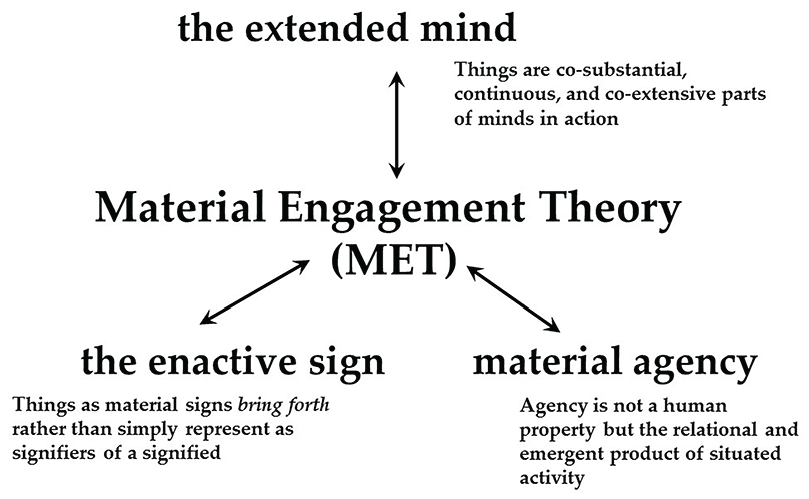
Outline of Material Engagement Theory (Malafouris, 2013).
A Situated and Meaningful Coincidence
Chance is usually perceived as something that happens without a clear motive, or apparent cause or reason. We use the term ‘chance’ to refer to those unexpected encounters that seem unconnected and unaccounted by our plans, intentions, anticipations and actions. For the purposes of this paper, which is to ground the meaning of ‘chance’ more specifically in the context of creative material engagement, I propose two moves that seem especially relevant in helping us to take seriously the agency of chance and to reconfigure the kind of chance that matters to human creative imagination.
The first move is to temporalise chance. Temporalising chance means placing it inside time. Placing it inside time allows us to describe chance as both coincidental and meaningful. Approaching chance as a meaningful coincidence, help us to recognise that the temporality of ‘chance’ is durational (rather than sequential or chronometric). The time of the accidents we may call creative is experienced as a disruption of established sequences and connections between past, present and future offering possibilities for new connections and detours.
The second move is to situate chance. Situating chance means placing it outside a straightforward cause-and effect relation. Which in turn allows us to admit that none of the usual dualistic descriptions (which assume a separation of mind from the environment) can be used to account for it. To recognise chance as situated, allows us to decentralise agency (Malafouris, 2008) widening the agential possibilities of the serendipitous process which in spite its distributed dynamic nature it tends to be construed in individual human terms (March & Vallée-Tourangeau, 2022; Ross, 2020; 2022). Situatedness denotes the unity and simultaneity of organism and environment. Chance is contingent; but it is contingent in a relational way.
Understanding the temporality of accident is essential for understanding the situated agency that it has and, crucially, the skill to realise its creative potential (Ross & Vallée-Tourangeau, 2021; 2022; Ross & Grove, 2023). Two preconditions: (a) we choose carefully the time window that we hypothesise best encapsulates the accident we want to describe (different chance phenomena and creative processes may take place over different time scales) and (b) we situate the chosen time window within the broader creative process to see if it constitutes a meaningful event in the larger entanglement of forces and transformations that make up the creative activity we seek to explain (bearing in mind that the perception and experience of time is practice based and culturally variable).
Before I explain that further, a major potential pitfall needs to be pointed out:
Associating chance with that which is not intentionally caused or planned, we are often misled to implicitly create a false opposition between intentional ‘creative agency’ and unintentional ‘chance agency’ and to assume, that the former must be directed and controlled in a way that the latter is not. I want to argue against that opposition. Instead of thinking of chance as that ‘external’ part of the creative process which cannot be causally explicable, I suggest we should see chance as operating from the ‘inside’ challenging creative habits, predictions, intentions and anticipations. Accidents that matter to the creative process do not happen ‘before’ or ‘after’ that part of the process we identify as creative; they are not causing the insight from the ‘outside’. Instead, chance is enacted inside out. It operates like an acausal connecting principle by which, to borrow the words of Vallée-Tourangeau and March ‘insight becomes outsight’ (Vallée-Tourangeau & March, 2020, p. 824). Chance and accidents are real forces or agencies of actualisation. They have causal efficacy (they are causally significant) even though they can have no satisfactory causal explanation. This is also why I will argue in the following section that there is a close relationship between chance and creative gesture. Creative gesture is how chance becomes enacted. The phrase enacting chance denotes the generation of possibilities, that is, to make something possible.
Two diachronic examples of creative material engagement in the course of human becoming can help us illustrate the previous points: the production of an edge for cutting and the making of a ceramic container. These examples also nicely highlight the different temporal scales that the relation between chance and creativity can be understood, that is, the macro-scale engagement, meso-scale engagement and micro-scale engagement.
I start with stone tool making and macro-scale engagement. Imagine a nonhuman primate or wild West African chimpanzee using a stone anvil and hammer to crack a nut (Luncz et al., 2022). Occasionally, during nut cracking, either the hammer or anvil are fractured in a way that produces sharp-edged flakes. This accidental or unintentional flake production associated with chimpanzee nut cracking has been argued to be the source of one of the greatest innovations in the human becoming that is, the production of a cutting edge. According to the so-called ‘by-product hypothesis’ intentional stone flaking originates in hominin percussive behaviour resulting in accidental flake detachments. But let’s take a closer look at the meaning of ‘accident’ or ‘chance’ here. What at first glance may seem as a clear example of unconnected and unaccounted chance on closer look is full of conditions, dependencies and constraints. For one thing, ‘accidental’ flakes occur in the context of a given practice, namely, using a stone anvil and hammer to crack a nut. Not any kind of stone or nut cracking action will produce flakes. Not only hammer and anvil must be made of stone, but for successful wedging to occur, they also need to be sufficiently fine grained and isotropic. Moreover, for flakes to be accidentally detached an angle of less than or approaching 90° is required between the active plane and the adjoining horizontal plane. Importantly, even if all that happens, accidental flakes will not occur if the percussive activity is performed accurately. You need sufficient amount of mis-hits during the nut cracking action so that the hammerstone strikes the anvil directly with enough regularity to produce substantial quantities of sharp-edged flakes.
I turn now to our second example, pottery making (Figure 2). Seen from a macro-level perspective, it may be classified as a voluntary intentional skilled process – the potter performs a sequence of goal-directed bodily movements aimed at producing a pot. Accidents may, and do happen during that process. All accidents are disruptive, but in different degrees. Often accidents will be corrected, or at least the potter will try to correct them. But, it is also the case that some of those accidents will not be perceived as mistakes to be corrected but as opportunities to be followed. In the latter cases, disruptions invite creative behaviour. Indeed, when seen from a micro-level perspective, pottery making, as a demanding skilled action, can be described as a dynamic assemblage of various bodily, social, mental, technical and material elements where accident is inherent and thus, inseparable from the regular flow of events. In the latter case, and scale of analysis, accidents are no longer experienced as an unwanted disruption or a problem to be corrected but are now seen as welcomed creative opportunities or constraints that actually separate the handmaking process from mechanic mass production.
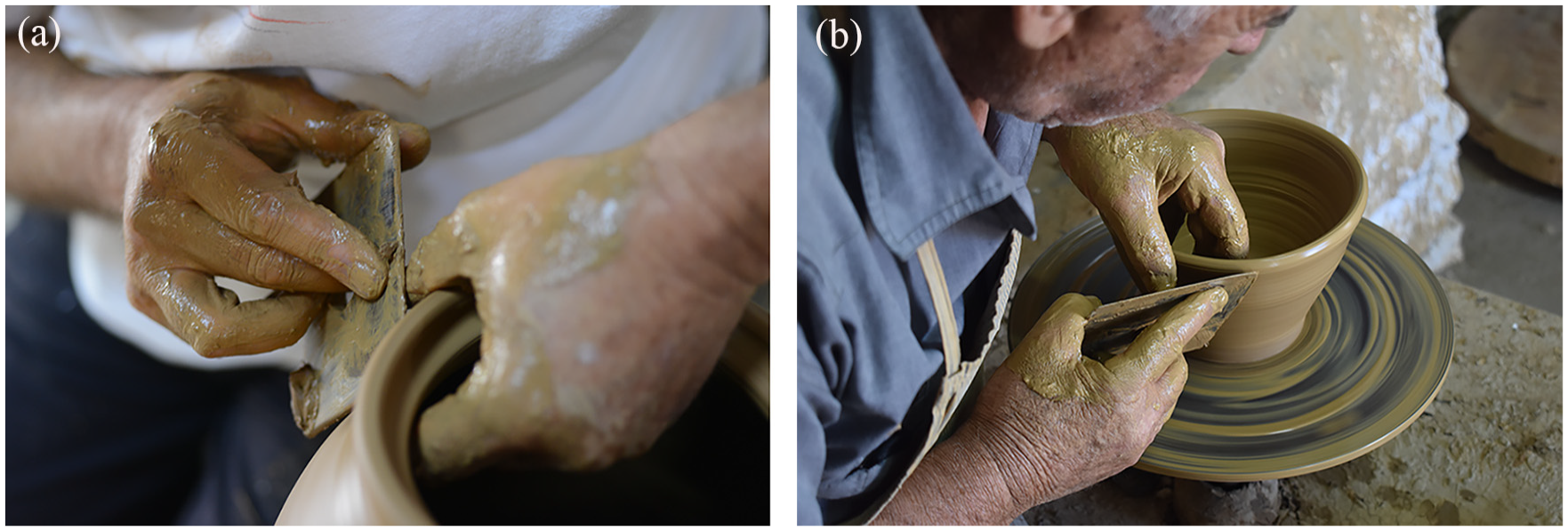
(a) Enacting chance with clay by the hands of the Sifnian potters Antonis Atsonios and (b) Kostas Depastas (photo: Rory Carnegie for ERC/Handmade Project.)
This brings us to the question of understanding the relationship between chance, agency and materiality. Different occasions in the process of making will be associated with different accidents and varieties of agency. The common cognitivist account of action and mental causation, wants us to see the hand as an instrument in the service of the potter’s brain. Creative agency starts as a brain state and flows through bodily movement to worldly action. But this is not an adequate description of the ways of the potter’s hand. As I explain in more details elsewhere, the problem with agency in the context of making is that the purity of perception, intention and action is lost: ‘Trying to separate cause from effect inside the loop of pottery making is like trying to construct a pot keeping your hands clean from the mud’ (Malafouris, 2008, p. 25; Malafouris, 2013, 2014). Such a decentralised and temporally emergent notion of material agency is exactly what we see in the case of pottery making through the transformation of clay and the genesis of form. When working with clay even the simplest motion instantiates a recursive dialectic between the agency of the potter and the material affordances of clay or, if you prefer, between the agency of clay and the affordances of the potter’s body. The affordances of clay inhabit the potter’s body as much as the potter’s intentions inhabit the clay (I am using the term ‘affordance’ in the ecological Gibsonian sense (1979) of interactive relational possibilities). This is how skill develops. Creativity, responsiveness, anticipation, prediction; all happen in the making. Clay is plastic but it also resists. This resistance is an important source of, and in many cases a necessary condition of agency and creativity.
How Accidents Come to Matter: Capturing Chance
Any accident in the process of making (for instance, those occurrences when tools and materials either behave in unknown or unexpected ways or disobey and resist doing exactly what the ceramist don’t want them to) can be experienced, potentially, as a possibility for creative material engagement. But not every accident matters. Only some accidents will be entangled in the emergence of novelty and improvisation. Previously, we have sought to understand the relationship between chance, agency and materiality. In this section I want to investigate, specifically, how accidents come to matter. This is crucial for understanding their role in the creative process. To understand how accidents come to matter we need to take the broader cognitive ecology and human engagement with materials seriously, escaping the dominant hegemonies of representation. As we saw in the example of pottery making, entangled with the throwing and shaping of the clay, the potter’s agency cannot be rigidly defined or separated from the affordances of clay as well as the actions and gestures that drive the creative process forward. But even if we recognise this cognitive ecology, and see chance as another factor in the field of relevant affordances (Kiverstein et al., 2021; Rietveld & Kiverstein, 2014), the question remains: how can we capture the process or processes by which accidents come to matter? What does this capturing entail? Obviously, there is little ‘chance’ to predict, or to know in advance, when chance will occur and if or how its occurrence will affect the creative process. You cannot plan or intend serendipity. Chance has no general but only local and action-specific features. In that sense, chance encounters are self-specifying. They are, or they become meaningful in a situated way.
From a performative material engagement perspective there are, nonetheless, ways to track and trace the operation of chance in action. One possible way of doing that is by following creative gesture using the methodology of Perspectival Kinaesthetic Imaging (Malafouris et al., forthcoming). Perspectival Kinaesthetic Imaging is employed in the context of multi-sited participatory observation to facilitate the sensitivity and responsiveness to the material environment needed for the study of enactive signification in the context of skilled material practices and creative material engagement. Technically, this objective is achieved through the selective juxtaposition of a combination of multimodal visual captures (i.e. photography, video, drawing and mobile eye-tracking). Each of these multimodal visual captures affords a specific spatio-temporal perspective from which to identify and observe morphogenetic events of interest (e.g. creative gestures) by following their material traces. The basic idea is that the juxtaposition of different media enables the discovery of semiotic connections and material relations that are often obscured when seen from a single perspectival point. The multimodal visual captures are used like traps for capturing ‘in the wild’ material transformations and movements ‘that matter’ to the process of making. Based on insights derived from this methodology, I propose that creative gesture is the way the potter’s hand turns chance or accident into enactive discovery. What does this mean?
Creative gestures, like accidents, are brief and transitory events. They may also be described as moments of disturbance or deviation from creative habits or techniques that may lead to improvisation. Creative gestures should not be confused either with technical or communicative gestures or traditional grips employed during the process of making (and are usually associated with local traditions of making and aspects of the formation process). Creative gestures enact and objectify material imagination allowing the potter to respond to these disturbances or deviations in novel and unexpected ways and to recognise and actualise the opportunities that these novel occurrences afford. Creative gestures allow the maker to become simultaneously physically and imaginatively involved in the form-making process.
I am not arguing that creative gesture is the product of chance (in a causal sense); I only suggest, as I had the chance to observe in the course of my ethnography, that the two phenomena are usually co-present and co-produced. I mean that in the sense of enactive signification: creative gesture brings forth the agency of chance. In other words, creative gesture is the minimal improvisatory performance (across the various timescales of performance) that allows the maker/performer to reconfigure established predictions and habits in response to chance so that the accidental can now be partially controlled and placed into the service of the creative process. Put it simply, creative gesture is the mastery of chance.
This observation can potentially offer a valuable tool for imaging and capturing how chance is enacted during the process of creative action. Accidents matter only when they engage ‘creative gesture’. Of course, we should not forget the multi-temporality of chance we discussed in the previous section. It is often the case that accidents are initially put on hold only to become engaged later on in the process of making or even in a different instance of making. The occurrence of chance and the enaction of chance are two different processes. The relationship between chance and creativity is not one of succession that can be described in causal terms as part of a linear temporal sequence (before and after). It is rather, one of persistence, duration and correspondence that can only be described in dynamical terms of multi-temporality and co-constitution. Moreover, accidents have an aesthetic dimension which is crucial for their subsequent incorporation into the creative process. Creative gestures are not made of movement (in the sense of kinesis); they are made of aesthetic movement (in the sense of kinaesthesis or ‘thinking in movement’ as described by Maxine Sheets-Johnstone (1998, p. 486)). There is always an aesthetic (Malafouris, 2011; Malafouris & Koukouti, 2020) and emotional (Brinck & Reddy, 2020) element involved which prepares the ground for enactive discovery.
Take for instance the example of firing. The firing process, although to some extent controlled, allows the accidental to permeate the creative process, and thus, provides a source of unforeseen possibilities, perhaps more than any other stage of the making process. Those accidents cannot elicit an immediate response (there is little that the potter can do) but they can certainly influence the thinking and aesthetic perception of the ceramist. In that sense, some of those accidents will become incorporated into future designs and influence aesthetic experience. Specific pottery techniques, like raku (Figure 3), which is characterised by the rapid firing and cooling, offer a characteristic example of a creative process where the accidental is both unexpectedly encountered, intentionally sought, and attentively engaged. The technique of raku is based on the skilful handling of chance which in this case is explicitly recognised as a major source of creative agency. On the other hand, accidents that happen during the process of making elicit a more direct response from the potter who must decide if she will follow, abandon or try to correct this unexpected occurrence. These are instances where chance is directly perceived and enacted (either as a possibility to be actualised, deviation to be corrected, or closure in the sense of abandonment).
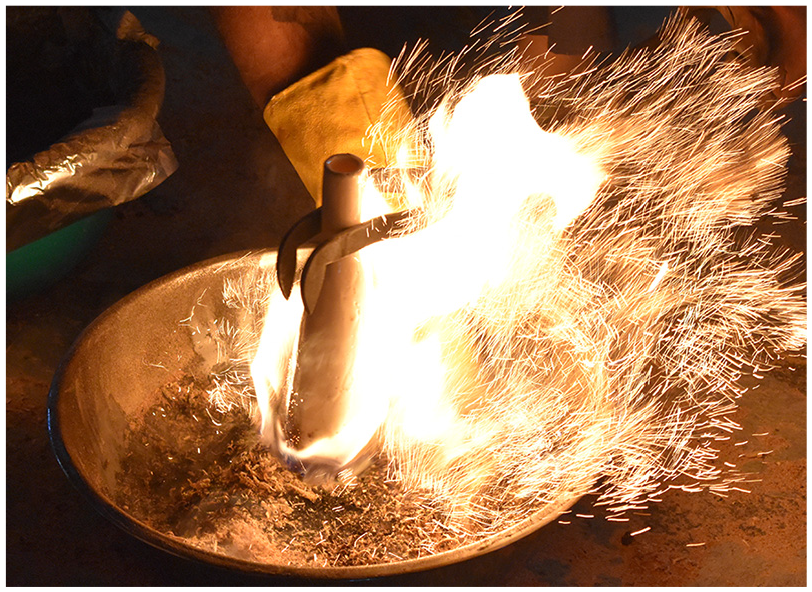
Raku firing (photo: ERC/Handmade Project.).
Creative gesture embodies two opposing skills, that of distraction and that of attentive material engagement (Malafouris & Koukouti, 2022). Those two skills create a tension that pushes the potter’s hand to move beyond its learned habits (technical and perceptual). Creative gesture is how habits of mind (in the sense of skill and technique) and habits of clay (in the sense of material affordance) mutually respond and adapt to the disruption or violation caused by a novel occurrence (chance in the form of spontaneous agency). Put it in another way, chance is the environment of creative gesture, and creative gesture is the expressive medium by which chance can exert its powers over the regularities of mind and matter.
However, what allows the potter to identify creative possibilities in the accident (which is as yet not known or does not exist) and to decide which accidents to put in the service of the creative process is skill. Skill also determines how much risk a potter is willing to take when engaging with accidental occurrences. The making of a new form is the product of the potter’s skill that includes a mastery of chance. The potter’s sense of agency, which as mentioned, is also largely the product of skill, is what allows the potter to construct an agency judgement and narrative on the role and possible meaning of those accidents. However, those narratives can only be partial. Importantly, potters may recognise or choose to ignore the agency of chance. This is how, I suggest, chance matters: it matters as an opportunity for ‘disruption’ and ‘distraction’, that is, an occasion for creative gesture. The significance of chance lies precisely in this ‘diffractive’ (in Barad’s sense 2003) interruption that chance phenomena can effect in the flow of creative activity. The potter’s sensitivity to chance and ability to recognise and to actualise the creative potential of the accidental is a central part of her/his creative ability.
Conclusions
In this paper I have used theoretical insights from material engagement theory and practical insights from the craft of ceramics to examine the role of ‘chance’ and ‘accidents’ in the context of creativity. The morphogenetic potential and plasticity of clay offers a powerful diachronic means for studying the phenomena of material agency (Malafouris, 2008, 2013), creative thinging (Malafouris, 2014; Malafouris, 2011) and enactive material imagination (Koukouti & Malafouris, 2020; Malafouris & Koukouti, 2020; Malafouris & Koukouti, 2018). To understand better the role of chance within this spectrum of spontaneous and decentralised agency, as well as how people engage with chance in the context of creative activity, I proposed the notion of enactychism. Against this theoretical background we have explored the relationship between chance, agency and materiality, asking what chance does and when it matters for the creative process. Despite the present focus on clay and the craft of ceramics much of what was proposed and discussed apply for all creative activity independently of technique or material medium. You may change medium, or think of a different craft or form of human skilled practice; but those basic questions remain.
The main argument can be summarised by way of four premises:
The first premise is that creativity needs chance, as much as it needs skills, habits and plans. Or else, chance is a force upon which human creativity depends. It is not a mechanical deterministic force that can be analysed in terms of cause and effect. Rather, it is an affective kinaesthetic force, of the kind that operate through modes of engagement we call transactional. Transactional engagements are inalienable relations of reciprocity that bind people and things, like the force of the gift binds the donor and receiver.
The second premise is that chance or accidents do not necessarily coincide (although they often overlap or imbricate) with the creative process they become entangled. For an accident to be associated with a creative process it must be said to be contemporaneous. However, their contemporaneity should not be understood in the sense of a strict temporal alignment (as existing at the same point in time, or ‘synchronously’). Chance and creativity may correspond to different temporal scales. They can also be asynchronous. After all, creative material engagement brings a commitment to occupy time more attentively than it might be the case with our usual reaction to, or disregard for everyday accidental occurrences. Thus, understanding the temporality of the creative process is crucial.
The third premise is that there is no way to predict or to pre-determine the agency of chance in the creative process. As mentioned before, their contemporaneity is not reducible to a uniform and directional conception of time and causality. There are, nonetheless, ways to observe and to capture the operation of chance in action, by following and tracking creative gestures. I argued that, creative gesture is what allows the maker to put accident in the service of the creative process; a mastery of chance. Creative gestures have the advantage of being accessible to observation, offering a brief temporal horizon in which chance phenomena of interest can be identified before they are obscured.
The fourth premise is that chance provide opportunities for attentive material engagement and haptic attentive unity (HAU) (Malafouris & Koukouti, 2022) that may (or may not) lead to creative outcomes. I should explain that haptic attentive unity denotes the situational attunement between the potter and clay (or any maker and material) as this can be observed with increasing levels of skill. In particular, the term describes the active role that tactile perception plays in transforming a mere kinetic interaction (where potter and clay are causally coupled) into a multi-modal kinaesthetic transaction (where the potter becomes attentive to the expressive affordances of clay, and recursively, the clay becomes responsive to the creative affordances of the potter’s hand). It goes without saying that not every accident matters. I argued that understanding how accidents come to matter is important for understanding their agency in the creative process and that to understand how accidents come to matter we need to take the engagement with materials seriously.
Footnotes
Declaration of Conflicting Interests
The author declared no potential conflicts of interest with respect to the research, authorship, and/or publication of this article.
Funding
The author disclosed receipt of the following financial support for the research, authorship, and/or publication of this article: HANDMADE: Understanding Creative Gesture in Pottery Making, European Research Council Consolidator Grant (No. 771997; European Union Horizon, 2020 programme).