



Abstract
In what ways do creators in non-artistic domains recognize and act upon their creativity, in mid-adulthood? This paper takes a developmental perspective combined with the socio-cultural lens to examine how Pro-c experts, in the mid-stage of their careers, view their creativity, and its relevance, in their work roles. Also, this study aims to identify possible new ways of understanding one’s creativity and how they become visible in professional choices. Previous research found creative thinking processes, commitment to creative activities and the expression of one’s feelings through creative outlets to play an important role in the formation of an adolescent’s identity. Based on the interviews with eight professionals in entrepreneurship, science, and engineering, one’s creative identity can be fluid and multiple in mid-adulthood, marked by moments of proactivity intertwined with the serendipity of interpersonal interactions, underlined by economic changes and multicultural living. In essence, this paper proposes a four-faceted nature of non-artistic creative identities, characterized by their dynamic expression, as an artistic skill, a passion, as creative thinking, or as resourcefulness. The fluidity is enabled by creative metacognition, which triggers agentic mechanisms towards new actions, in entrepreneurial, scientific, or expert roles.
Introduction
The World Economic Forum (WEF) defines creativity as the ability to come up with unusual or clever ideas about a given topic or situation or to develop creative ways to solve a problem. Since the mid-2010s, creativity has been acknowledged in the top ten working skills in the Future of Jobs Reports, prepared by the WEF. By 2016, it had risen to become one of the top three most essential cognitive skills projected to be in demand by 2020 (Gray, 2016). Further emphasizing its importance, the WEF’s 2020 report highlighted creativity, along with initiative and originality, as among the top five skills required by 2025 for emerging professions across various industries (Whiting, 2020).
In the latest WEF report published in 2023, creative thinking made it to the top two as most desired working skills, right after analytical thinking, as a recognition of the importance of workers’ ability to adapt to disruptions in the workplace (Masterson, 2023).
The WEF reports are a reflection of the cross-cultural shifts in societal awareness about the role of creativity in the development of individuals, economies, businesses, and local communities. How might these conversations affect the awareness and curiosity of individuals to actualize their creative potentials in changing contexts at work or in their broader community?
The sociological and psychological theories of identity characterize the individual-context relationship as a mutual adaptive process between an active individual (with their expectations, preferences, and values) and the changing contexts (De Valverde et al., 2017). Time brings changes both in the individual and in the contexts that the individual experiences, which may question the personal and professional identity—cognitive factors, personality traits, interests, and close relationships.
Considering the increasing discourses on creativity in the public spheres and the need for reskilling and upskilling in the job market, I consider this to be a good moment for creativity researchers to explore deeper the role of creativity in self-construction, in making career decisions and designing one’s career path beyond adolescence and college years (Fusco et al., 2019; McMahon, 2016,). In this paper, one way to understand creativity is as the individual’s ability to construct original interpretations as a result of the experiences in their domain of expertise and dialogues with significant individuals in their social network (Runco & Beghetto, 2019). This type of creativity is the mini-c moment described by Kaufman and Beghetto (2009) as a “novel and personally meaningful interpretation of experiences, actions, and events” (Kaufman & Beghetto, 2009, p. 3). This creative insight motivates the individual to take action and make their lives more meaningful and enjoyable. Mini-c experiences of creativity do not need to be recognized as original, valuable or meaningful by others. It suffices that the person experiencing it considers their insight to be creative and they are moved to take action.
Individuals are guided towards specific creative processes by a cultural frame, which Glăveanu (2011) calls the “personal representational space,” consisting of dynamic mediation between the self and other, self and community, self and culture. Each unique representational space encompasses symbolic resources—beliefs, concepts, methodologies, procedures, objects, etc.—in which individuals see meaning and motivation for further creative activities (alone or in a group). By sharing these resources—ideas, experiences, techniques—with others in the group, individuals can start to see other ways of understanding, which allow for the emergence of a new representational space and might motivate engagement in a new creative process.
In addition, Kaufman and Beghetto (2023) highlight the role time plays in evaluating the creativity involved in the four forms of creativity: mini-c, little-c, Pro-c, and Big C. They discuss how audiences see creative individuals and their work, specifically examining how opinions on originality, meaningfulness, and impact change over different periods. One key question is what form of creativity is being evaluated? The Big-C creativity is the form of creativity that most of the people, researchers and laypersons, are familiar with—the work of geniuses, which takes years to be recognized and has significant impact centuries after. The little-c creativity is the everyday creativity of individuals in expert roles expressed in the tolerance for ambiguity in their projects, the willingness to take risks, the passion for the tasks at hand, etc. The Pro-c level of creativity is unlocked after 10 years of knowledge or experience acquisition in a specific domain and creative achievements recognized by the field.
All forms of creativity start with a mini-c experience, the personal or individual creativity reflected in the unique and personally meaningful interpretations that individuals can spontaneously make in learning contexts (Kaufman & Beghetto, 2009). The transitions from mini-c to little-c and respectively, Pro-c are unique to each individual that has the desire to try a new interest in a professional project. They can involve a series of experimentations in informal settings with colleagues and audiences or formal training in academic institutions.
This temporal dimension enables not only sociocultural but also developmental perspectives on creativity. From a developmental approach, creativity develops from adolescence to adulthood through the continuous development of intelligence, expertise, motivation, meaning-making, and environment, which influence an adult’s engagement in a creative process or action (Hui et al., 2019). To this view, this paper explores two fundamental questions: (1) how do creative individuals themselves judge their creativity and need for it in their work in mid-career? and (2) what might influence any possible change in the respective evaluations and what actions they might take?
Barbot et al. (2016) introduced the “optimal-fit” concept to explain the individual differences in developing one’s creative potential in adulthood. An individual may not be aware of their creative potential in a specific domain and the possibility of creative achievement if they never had the opportunity to engage in the respective domain, or if they don’t choose to invest time and energy in that direction. A core takeaway is that creative potential is a multidimensional personal resource that can be developed in a multitude of possibilities based on the combination of other personal-level resources and environmental influences.
Beghetto and Dilley (2016) identified creative mortification as a factor that potentially suppresses children and adolescents’ creative aspirations and thus stunts the development of their creative identities. To circumvent creative mortification, the loss of one’s willingness to pursue a creative aspiration after a negative performance outcome, Beghetto (2021) addressed the question, “How then might school and classroom experiences support students’ and teachers’ creative identity development?” (Beghetto, 2021, p. 395). He emphasized the role of beliefs and adaptive beliefs about the creative-self for the development of one’s creative identity, which is underlined by the exploration of interests.
Both the optimal fit and the creative mortification characterize some professional lives. To this view, this paper aims to gain insights into how professionals in science, entrepreneurship and expert roles understand their own creativity, its importance in their work and the career implications, at the time of the interviews.
The article unfolds as follows. Section “The dynamics between creativity and identity” reviews the literature that discusses the link between creativity and identity. Section “The role of creative metacognition in the development of one’s creative identity” discusses the role of creative metacognition in the development of one’s creative personal identity. Section “Methodology” describes the interview methodology. Section “Analysis and findings” contains the analysis and the four central themes emerging from the interviews: (1) the meanings of creativity for the interviewed professionals; (2) the four facets of one’s creative identity; (3) the role of work orientations in engaging in new projects as a Pro-c creator; and (4) possible interactions between creative metacognition and work orientation leading to the enactment of a new role as a creator. The article ends with conclusions, the limitations of this study and future research directions.
The dynamics between creativity and identity
Throughout the lifespan, creativity and identity seem to contribute to the development of one another interactively (Barbot & Heuser, 2017; Dollinger et al., 2005). Identity is viewed as an aspect of the self and the collection of physical and psychological qualities that differentiate an individual from others, give a sense of continuity and can be discovered (Dollinger & Dollinger, 2017). Identity can be best described by the question, “Who am I?”
Regarding the influence of identity on creativity, identity motivates the engagement in activities which are in line with the self-perceived image and creative achievements. For instance, Jung and Lee (2015) investigated 113 US-based Amazon Mechanical Turk users to verify the effect of a conflictual relationship situation on creativity for individuals with an activated relational self - defined as the self in relation to specific or general significant/close others—versus individuals with an activated independent self-focused on autonomous goals. They found that relationship conflict combined with relational self influence positively creativity, which was measured as a Remote Association Test. So, one’s personal sense of self can facilitate or impede creative actions and reactions to external events.
In addition, strong commitment to creative tasks that result from deep exploration in adolescence, facilitate the development of one’s creative potential in a specific domain (Barbot & Tinio, 2015). Some interests will grow stronger, while others might fade away or stay just as hobbies (Beghetto, 2021). Over time, with encouragement and ongoing involvement, certain interests can become more important and eventually become a part of someone’s creative identity. This means that a young person’s relationship with a creative activity can change from simply an external activity to a key part of who they are. The creative identity develops through three phases: enjoying the activity,—“I like drawing”—, aspirational goal—“I want to be an artist”—and finally, a part of one’s identity—“I am an artist.” (Beghetto & Dilley, 2016). To sum up, these studies suggest that identity formation leads to higher divergent thinking and development of creative potential.
Regarding the influence of creativity on identity, creative thinking processes can lead to identity development. Identity formation can be considered as a creative process where individuals explore alternatives about themselves in order to come up with a new and differentiated identity that is recognized by others. The key thinking processes underlying creativity—divergent-exploratory thinking and convergent-integrative thinking—may be underlying identity construction as well. For instance, Berman et al. (2001) measured creativity as a divergent thinking task used for the generation of solutions to a hypothetical life choice. In a group of 215 psychology students, they found that creativity explained 16% of the variance in identity exploration scores. Storme and Celik (2018) investigated the moderating role of creative self-efficacy on the relationship between career exploration and career decision-making difficulties among French undergraduate students. Students with low levels of creative confidence, environmental exploration, and self-exploration regarding career options expressed dysfunctional beliefs regarding one’s career path and general indecisiveness.
These findings indicate that creativity, as a thinking process, as a creative confidence, could enable people to envision possible future selves that reflect their values and aspirations to create. However, for deeper theoretical understandings of the relationship between creativity and identity and actionable practical implications, further explorations of multiple definitions and measures of creativity and diverse methodologies may be required.
In this paper, the interest is on creativity as a system of beliefs, for which Karwowski et al. (2019) provide a three types categorization: (1) creative self-image beliefs which encompass beliefs about one’s creative identity—perceiving creative activities, aspirations or abilities as a part of one’s sense of self; (2) the creative self-awareness beliefs, which are composed of creative metacognition—beliefs about when, why, and how to be creative—and creative mindset—beliefs about whether one’s creative potential is fixed or can be developed; and (3) creative confidence, which contains the creative self-efficacy, one’s perceived confidence of acting creatively at a certain point in time and in a specific context.
The interest is to explore how the interplay between creative metacognition and beliefs of one’s creative identity underpins the possible ways mini-c moments can be transformed into moments of creation recognized by others in professional contexts. Little is known about the possible mechanisms of creative self-beliefs in orienting knowledge workers towards career development, creative achievements in their jobs or career transitions in areas of business, science, or technology (Dollinger & Dollinger, 2017; Karwowski & Barbot, 2016; Szostak, 2020). Why would knowledge workers become motivated to develop their mini-c moments? Why do they think what they think of their creativity? When do they value it? How do their work identities shape their engagement in activities enabled by mini-c moments?
Professionals who perceive themselves as being creative based on possessing artistic skills will see affordances in their immediate environments to embark on career trajectories that leverage their perceived creativity. They will thus engage in behaviors of creativity that will become part of how they define themselves—creators in a particular niche as designers, photographers, video makers, illustrators, etc. These people belong to the category of “promoted creative identities” proposed by Glăveanu and Tanggaard (2014). They perform activities recognized by society as creative, such as advertising, architecture, arts, design, film & video, music, publishing, software and computer services, television, and radio (Dawson & Andriopoulos, 2021).
Moreover, to date, research understands more about the experiences of Big-C creators, whose creative identities form in childhood and consolidate in early adulthood (Barbot & Heuser, 2017; Karwowski, 2015, 2016; Lebuda & Csikszentmihalyi, 2017). In this paper, the focus is on Pro-c creators, the individuals whose work requires moments of performance that bring originality and usefulness for a specific group of individuals at a specific point in time (Kaufman & Beghetto, 2023). Many of these creators may not have recognized their creative identities during the early stages of their careers. The goal is thus to get a glimpse into their creative identities in adulthood and career choices in roles that do require creative thinking and deep interest to frequently solve problems.
To this view, this paper joins Glăveanu and Tanggaard’s (2014) call for bringing the theory of identity into the study of creativity, starting from the re-conceptualization of the notion of creative identity as a socially embedded phenomenon and as a representational project emerging in the interactions between the creator, different audiences and the conversations on creativity circulating in the social spheres. Differently said, individuals derive their sense of creative self-based on the ongoing social interactions at work, hobbies, and in the family and from the societal discourses, such as social media and online forums, of what creativity is, who a creative person is, and what a creative person does.
Individuals in artistic careers may have a smoother experience in positioning themselves as the creators in the world, as they develop their sense of self around a socially recognized set of creative artistic activities and outcomes. How about the sense of creative identity of experts who perform in business, science and technology settings? Why and when, if ever, do they believe they are creative individuals? What kind of creative identities is it possible for them to form?
Experts who don’t see themselves in the artistic creativity archetypes may still be creative in other ways driven by their unique needs to create, like the need for power, discovery or individuality (Luria & Kaufman, 2017). More than that, they can be creative in the way they seek, negotiate and communicate their need to create in their communities. Yet, when are they willing to act on emerging needs to create as their environments change?
De Valverde et al. (2017) argue that identity construction is a process of realization that identity cannot be only about repeating past actions but also about seeing possibilities in the pursuit of an aspirational sense of self. Moreover, when it comes to the creative self-image, Glăveanu and Tanggaard (2014) suggest the socio-cultural model of creative identity based on the assumption that identities are relational structures resulting from a meaning of creativity shared by the self and multiple others. Starting from the premise that creative identities can be formed and developed in a representational space that can be more or less nurturing, they propose a typology of promoted, denied and problematic creative identities of professionals in industries traditionally acknowledged as creative.
In the remaining part of the article, I introduce a fourth category, the non-artistic creative identity, with its multifaceted and developmental possibilities through choices of new roles of creation in enterprising, investigative, and realistic domains. In the next session, I discuss how creative metacognition, including the awareness of a possible new interest to create, might underlie the development of one’s creative identity.
The role of creative metacognition in the development of one’s creative identity
The decision to take action in line with one’s awareness of creative identity is initiated in a serendipitous moment of perception, of paying attention to an unexpected but possibly useful aspect of a social context—observed behaviors or words, internal shift in perspective on an existing situation, external object, etc. (Glăveanu, 2020). Then the creator must decide. Do they ignore the serendipitous moment? Or do they make time for a new creative action?
The possibilities of action are influenced by creative self-beliefs. For instance, Jaussi et al. (2007) find that individuals who see creativity as an important part of who they are, are more likely to engage in creative pursuits in work contexts. Moreover, the creative self-image can explain the variance in an individual’s creativity at work beyond and above creative self-efficacy.
Karwowski (2012) finds that curiosity is closely related to an individual perceiving oneself to be a creative person.
Karwowski et al. (2019) take an integrative approach to creative self-beliefs—creative confidence, creative self-awareness and creative self-image—that might describe the transformation of creative potential into creative behavior and achievement. They propose that creative confidence has a mediating effect on the link between creative potential and behavior, while the creative self-image has a moderating effect. Also, the model captures the regulating role of creative metacognition for the actions that individuals choose to take.
Creative metacognition is defined as a combination of self-knowledge—beliefs of one’s creative strengths and weaknesses—and contextual knowledge—beliefs about when, why, and how to be creative, which can be orientated towards a present situation and influenced by both present and past self-beliefs (Karwowski et al., 2019). Furthermore, in this article, creative metacognition extends to awareness of new creative potentials. Thus creative metacognition serves as an agentic action that could transform an emerging creative aspiration into new creative behaviors and performance—“I’m tempted to learn more about public speaking skills to inspire people.”“I’d like to become an entrepreneur although it’s just an intuition.” There’s no development of creative identity if one does not become aware of the possibility of exercising new skills that require their creativity—in the way they understand it and value it. There’s no development of creative identity if one does not choose opportunities to exercise new skills that require creativity—in the way they make sense of it in a specific context.
Therefore, creative metacognition can be about awareness of one’s creative strength and actions but also about an unexpected insight of the worth of a new creative interest related to their broader sense of self. This brings us to the socio-cultural contexts in which the individual lives and where they position themselves through self-awareness. What is the contribution that one seeks to make? Who one aspires to become in personally relevant work settings?
A key assumption in cultural psychology is that human experience is always cultural. This implies that even in situations when human activity takes place in isolation, away from others’ physical presence, it is socially and culturally constructed, resulting from the internalization of one’s past experiences or one’s imaginative capabilities (Glăveanu, 2018; Glăveanu et al., 2015). Therefore, an individual’s reflection on their own creative thinking and choices has a dialogical and cultural nature.
Glăveanu and Tanggaard (2014) depict the creative identity as an identity project fostered by the self, engaged in activities requiring creativity, and accomplished within social encounters. Individuals develop their creative identities around the meanings they assign to creativity, which in turn are influenced by social interactions with significant others and the dominant meanings of creativity that are circulated in society.
The extent to which one sees oneself as a professional creator depends on the support and validation of one’s creative achievements by others—peers, leaders, critiques, etc. In other words, the conscious image of oneself as a creator requires others to see and relate to the individual as a creator. More than that, reformulating one’s creative identity is based on the ability to act on a new meaning of creativity which becomes apparent in a present situation. In short, the creative identity is constantly built through individual action and communication with the people who act as gatekeepers to the realm of who and what is considered creative work.
I propose to add the dimension of the future to the model of creative identity as a representational project developed by Glăveanu and Tanggaard (2014) (see Figure 1). Creating an image of oneself as a creative individual can be shaped not only by past experiences but also by imagined possibilities of action, desires and emerging needs to create and contribute to society. To the extent that the individual creator gets curious about a possible role that may not exist anywhere in their immediate surroundings, they are inclined to take action and search for others who can provide support in realizing one’s image.
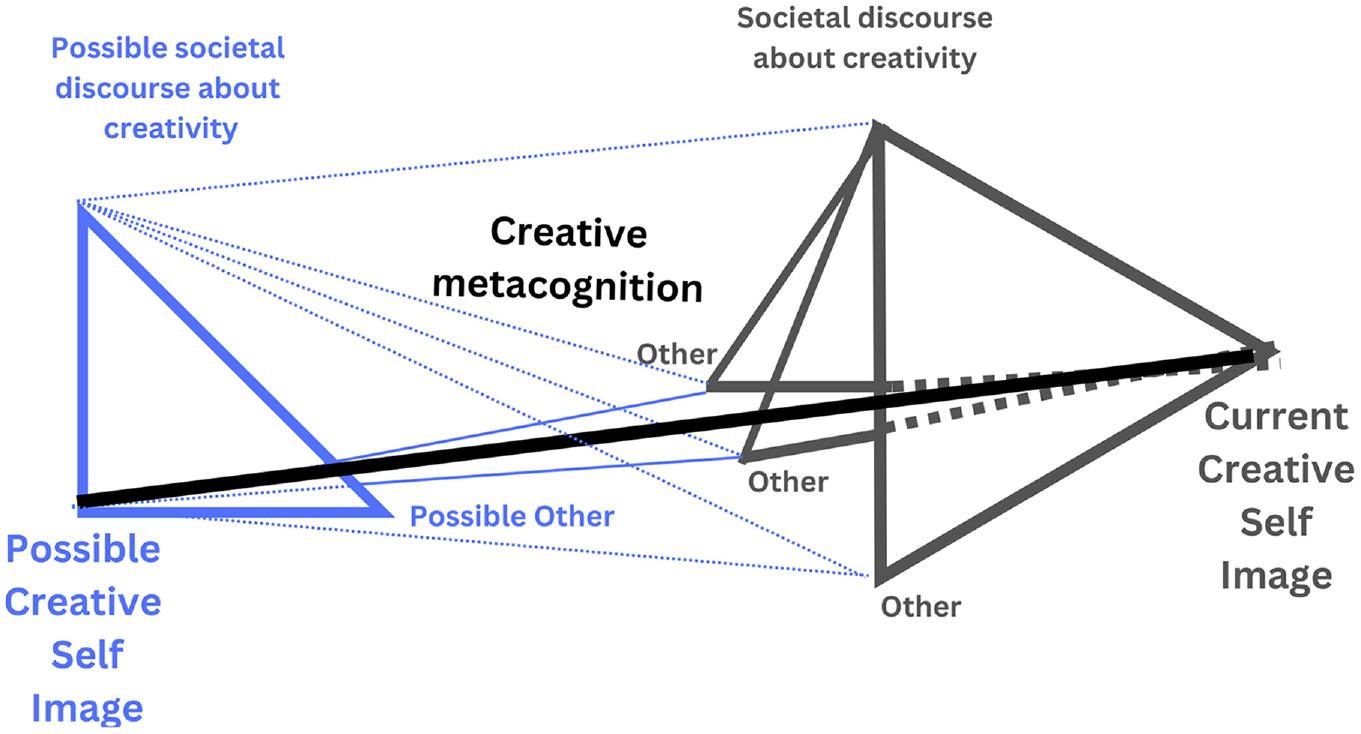
Creative metacognition as agentic action towards creative identity development.
This conceptual model guided the development of the interview questions, which will be described in the next section. For instance, the creative metacognition, a proxy of the representational spaces emerging in the interactions between the creative self and others, was evaluated through questions such as, “When did you become aware of your creativity?” and “How has your understanding of what it means to be a creative person changed?”.
In conclusion, creative action can be informed both by past roles as a creator and by possible future roles as a creator and the creative metacognition can motivate or inhibit the respective action.
Methodology
The data collected for this paper consists of interviews with individuals whose jobs require creative achievement at the Pro-c level. Individuals in entrepreneurship, science, and technology were targeted because these three domains require creative thinking and deep interest. To gain deeper insights into the development of personal creativity is useful to understand the level of self-awareness of the creative-self beliefs of the individuals involved in these domains and how the respective beliefs influence the actions and achievements.
In line with Figure 1 in the previous section, which emphasizes the evolving creator as the individual who takes the lead and shapes societal discourses, the individuals invited to the interviews were people with diverse professional experiences or navigated career transitions, and they all had lived in more than one country, as shown in their LinkedIn profile. These life transitions are considered as a proxy for enacted possible selves.
The interviewees fulfilled the characteristics of a creator. In this paper, a creator is defined starting from the definition of an artist provided by the United Nations Educational, Scientific, and Cultural Organization (UNESCO) is as follows: “…any person who creates, or gives creative expression to, or re-creates works of art, who considers his/her artistic creations to be an essential part of his/her life, who contributes to the development of art culture, and who asks to be recognised as an artist, whether he/she is bound by any relations of employment or association.” (Bokova, 2014, p. 3)
This definition emphasizes the central role of artistic activities in the artist’s life and the need for recognition. Artists have been the most recognized creators, both among creativity researchers and the general public (Dollinger & Dollinger, 2017; Dollinger et al., 2005; Glăveanu, 2014; Patston et al., 2018). However, to recognize the multiple manifestations of creative identities, I consider it essential to extend the definition of a creator to comprise the non-artistic types of creators (Cropley & Cropley, 2010).
A non-artistic creator is thus any person who consciously contributes to the development of their domain of specialization, considers their work to be a central part of their life and is willing to bring into existence something meaningful and new, which is found useful and valuable by certain others. Artists, entrepreneurs, scientists, and technical experts are four breeds of creators who share three characteristics:
(1)The way creators relate to their work. In UNESCO’s definition, the creator sees their artistic creation at the core of their life. Moreover, in this article, a creator is an individual who sees the realization of a mission—be it scientific, social, or entrepreneurial—as a central part of who they are. They have a strong work identity.
(2)Creators find value in their personal creativity for performing their tasks. Creativity as a value is key to the motivation for engaging in acts of creation. For instance, some entrepreneurs can be aware that their strength is the ability to come up with an abundance of ideas to craft new products, marketing messages and sales strategies to reach their possible clients.
The success of a business owner may depend on other abilities like networking, persuasion and the core competencies that help creators land a deal and deliver a quality product. However, creative thinking and personality bring the differentiating value for thriving in entrepreneurial pursuits.
Indeed, according to Runco (2006), creative individuals choose to spend their time and effort in constructing original interpretations and engage in the creative process because they are attracted by creative things and enjoy complexity.
(3)Self-direction towards cross-disciplinary learning. In addition to placing work at the center of one’s life and having creativity as a value that motivates them to begin the creative process, creators also independently choose to develop their expertise to engage in specific creative actions. Self-direction has been found to be related to both creative performance and self-reported creative achievement (Dollinger et al., 2007; Kasof et al., 2007). Self-direction is thus crucial for the formulation of one’s identity as a creator.
One of the interviewed solopreneurs, Tulia Lopes, Founder of Speak Up and Lead Academy, stated, “In the past, I had boyfriends who used to say to me, ‘Why do you do all these things, why do you go to all these courses that have nothing to do with what you do?’. And I say, ‘Well, I don’t know, I’m curious.’ But life has proven to me that one way or another, in the future, whatever you learn, you’ll use it. So, it’s never wasted time.”
Tulia’s testimony is illustrative for creators as individuals who freely choose their goals and are curious to continue learning, which in her case, it started with architecture studies and continued with communication and leadership.
Considering the above-described characteristics of a creator, I interviewed five seasoned knowledge solopreneurs who will share how their understanding of their creativity led to their choice of entrepreneurship as a career. Two science professors talk about their relationship with their creativity at a career stage when they both made it to full professorship. Last, a technical expert, book author, and podcast host talks about his creativity and willingness to do more than what’s required for his job role (see Table 1).
Respondents’ demographics.

To sum up, the interviewees qualify as Pro-c creators—individuals who find their work to be a central part of who they are, they value their creativity, are interested in continuous learning, while being deliberate about bringing something new and valuable to a specific group of people.
The interviewees were contacted by email or on LinkedIn. They were informed that their participation was needed for a research project aimed at understanding how they think about their creativity and how important is their creativity in their work-life. Three interviews took place face-to-face, in a quiet office space. Five interviews were conducted via Zoom, while the interviewees were in their home offices. The length of interviews varied from 1 hr to 1 hr and a half.
The interviews were semi-structured and guided by the conceptual model in Figure 1. Creative metacognition is deemed as a proxy of the new representational spaces emerging from interactions between the current creative self and others. According to Karwowski et al. (2019), creative metacognition has two components: self-knowledge—beliefs of one’s creative strengths and weaknesses—and contextual knowledge—beliefs of when, why and how to be creative. As a result, the interview was designed with questions to evaluate the two components.
The creative self-image, the second core concept in Figure 1, was viewed as a proxy for the creative personal identity and this view was adopted in the design of this questionnaire. The questions pertaining to the creative self-image were thus inspired by the creative personal identity scale developed by Karwowski et al. (2018). In addition, two questions address professional interests, which can be an indicator of one’s creative self-image (Beghetto & Dilley, 2016). Last, considering that people in the creator role appear to see their key activities at the core of who they are, two questions were meant to evaluate the interviewee’s work orientation (see Table 2).
Interview questions.
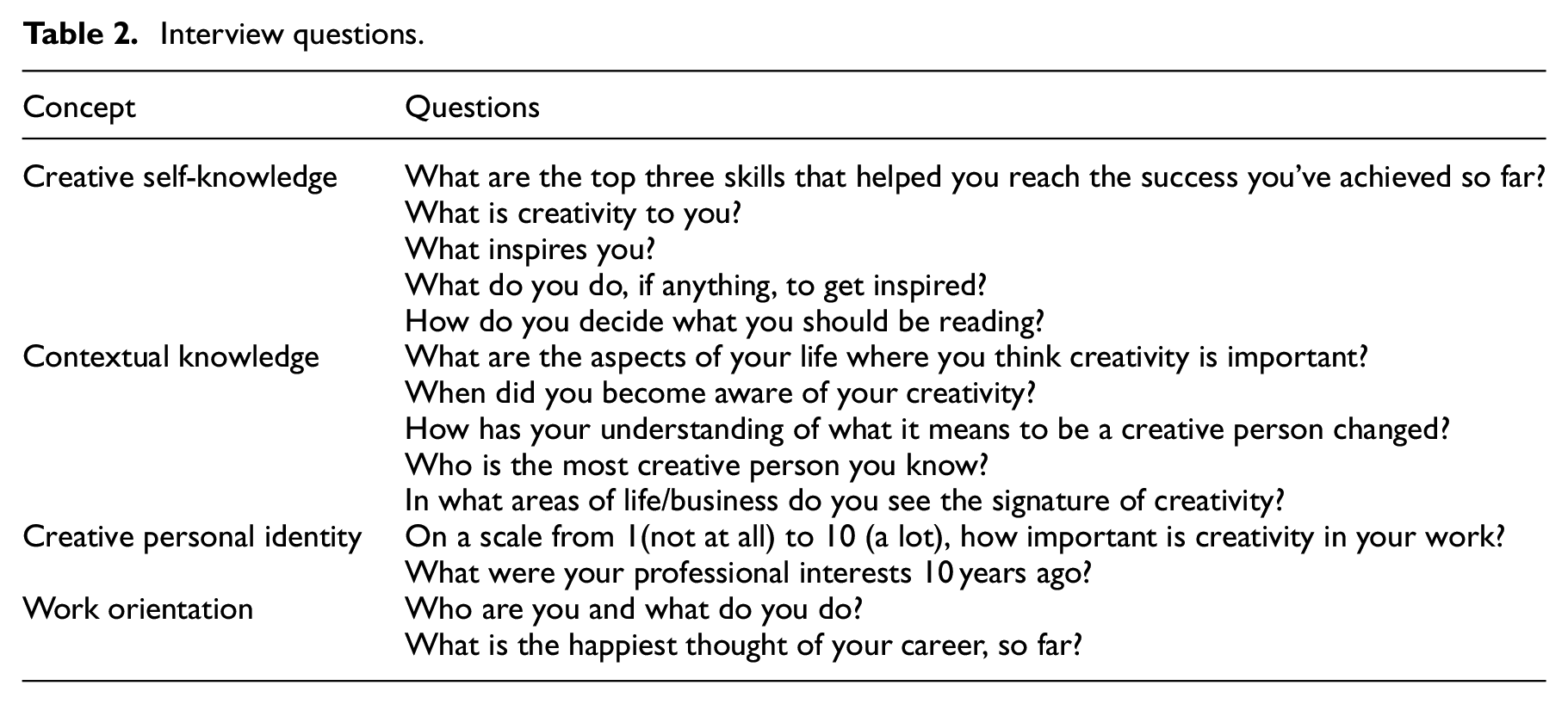
Overall, the interviews consisted of questions that covered the following four concepts: creative self-knowledge, contextual knowledge, creative personal identity, and work orientation. The goal was twofold. First, to identify when possibly related themes, which I didn’t consider at the outset, emerged in the respondents’ answers. Second, to observe possible interactions between the identified themes that might explain the development of the creative self, for each respondent.
The interviews were recorded and transcribed. Their content was verified by the interviewees. The transcripts were complemented by secondary sources of information about the interviewees’ professional lives such as websites, published articles and books authored by the interviewees and social media posts reflecting the interviewees’ actions in their work life.
The ethics clearance for this research was obtained through a transparent and voluntary process. Initially, the data was collected via interviews conducted for a book project (Velcu-Laitinen, 2022). Subsequently, with the intention to use the same interview material for academic research, I re-approached the original interviewees through email and LinkedIn messages. In these communications, I explicitly sought their consent to utilize the interview material for scholarly purposes, ensuring they were fully informed of the new context. Furthermore, I provided each interviewee with the option to either be identified by name in the research or to remain anonymous, respecting their autonomy and preferences. This approach aligns with ethical research practices, ensuring that participants’ rights and confidentiality are prioritized throughout the research process.
Analysis and findings
The interview materials were analyzed using thematic analysis, following the guidelines established by Braun and Clarke (2006). The transcription was a crucial phase of the analysis, which enabled me to interpret and make meanings of the words I heard and put on paper. The immersion in the interview material continued after I finished transcribing all the interviews by reading the responses a couple of times in search of ideas about what is relevant about the respective responses in light of the conceptual model in Figure 1. How do respondents talk about creativity, in general and their own, in particular? What are the creative moments in the respondents’ worklife that they talk about in the interview? What aspects of their professional journey do they emphasize?
These were the questions around which I did the coding in order to capture interesting experiences that reflect the interviewees’ representational space of creativity in terms of beliefs of what they think creativity means for them, when they think they are creative, why they think they need creativity, possible others they refer to as influential figures and how they relate to their work.
The initial codes resulting from the individual extracts from the interviews resulted in a specific sub-themes and themes. In Table 3, you can see the illustration of the three phases of the analysis: interview extract, sub-themes, and theme emergence.
Thematic data analysis.
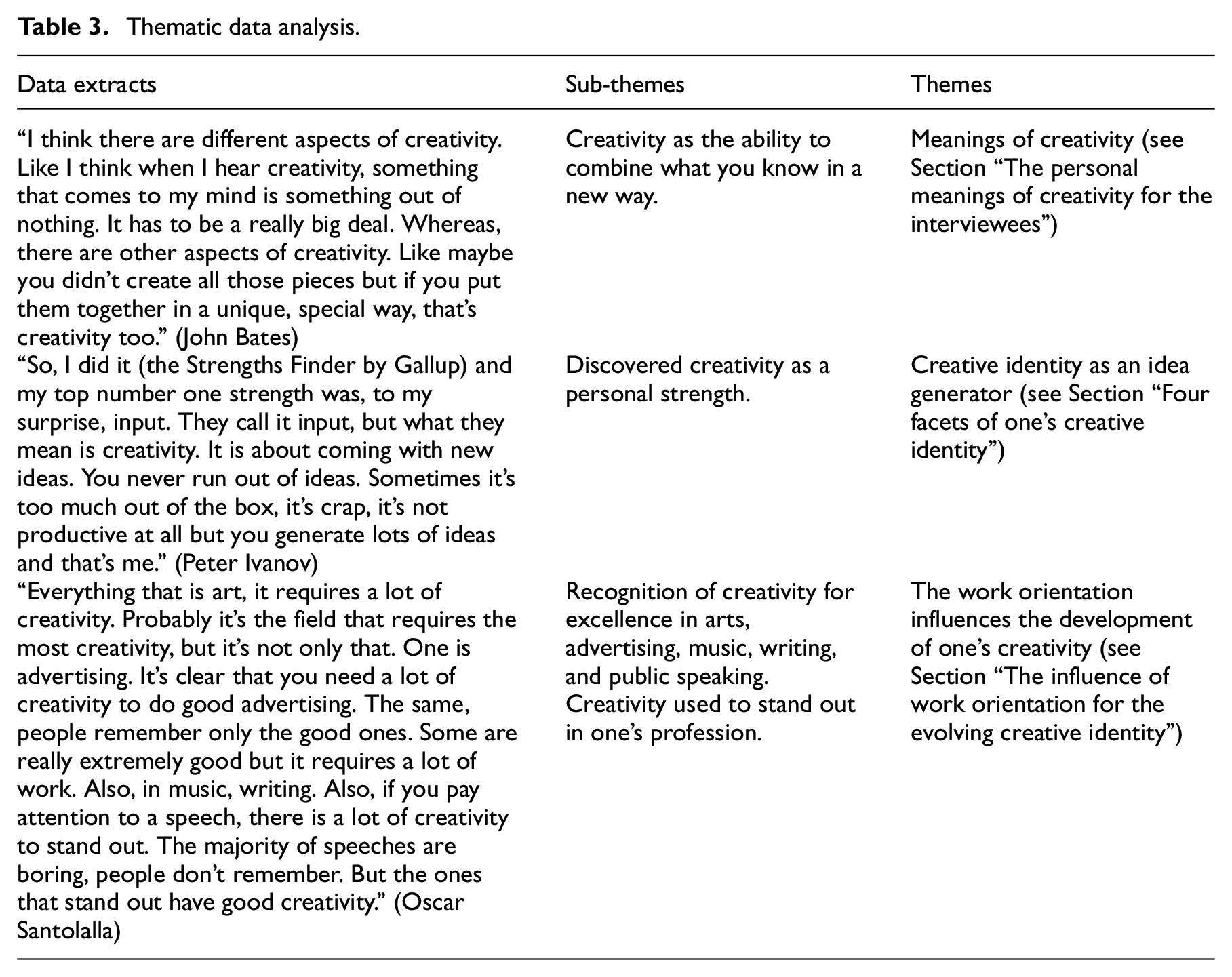
Overall, I identified four themes: (1) personal meanings of creativity, (2) the four facets of one’s creative identity, (3) influences of different work orientations, and (4) possible agentic mechanisms triggered by creative metacognition towards new creative actions. In the following sub-sections, these themes are elaborated.
The personal meanings of creativity for the interviewees
Here’s how the interviewed Pro-c creators talk about their creativity.
The ability to hear music or write a poem
“Creativity! There are lots of things that come to my mind.” says Leadership Communication Expert John Bates. “The very first thing is that I remember when I was singing in the band and I would consider myself a poet, I would carry around a pencil and a little notebook everywhere with me. Whenever a phrase hit me or I saw or heard something interesting or beautiful, I would stop and I would write it down in the notebook. A lot of that became the songs that I was writing.”
The ability to change perspective on life’s obstacles
“What creativity means, and helped me, is a way to see.” says Communication Architect Trainer Tulia Lopes. “Creativity allows you to see obstacles not as obstacles, something that blocks you to move forward, but you see them as challenges that will require you to have better and more creative solutions. So that’s the way I see creativity, it’s when you allow yourself to bring different perspectives and different answers for a specific question.”
The ability to conceive many new ideas and concepts
For Peter Ivanov, speaker on new leadership and virtual teams management, creativity is about, “… Combining in a new way, coming up with a new concept. And this is a fascinating process and this is probably what distinguishes us human beings from even smarter learning machines. Apparently we have the capability of imagining something completely new and it becomes something tangible that inspires other people.” “This is a long time ago, before meeting you, when I started to think that probably, probably I am creative.” says Vincenzo Cerullo, Professor at University of Helsinki and Head of the Drug Research Program. “I felt like there is one thing that nobody can ever steal, is the amount of ideas that come out anyway, that I cannot stop. It’s like sweating when you don’t want to sweat. You’ll sweat anyway, and the more you think about it, the more you sweat. Another example is the words of my ex American boss who is a great scientist and works with super good scientists. I don’t think of myself as a great scientist. I just think that I am somebody that is very curious and wants to learn. But I remember that once he told me: ‘Ah, you have been one of the most productive scientists I’ve worked with!’. But he didn’t mean in terms of publications, but rather in terms of idea generating.”
The ability to diverge from the habitual ways of doing things and experiment
“I think, to me, what creativity means,” says Helder Santos, Professor in Pharmaceutical Nanotechnology. “, also from the research that we do, means trying to think of a new way to solve a problem. For example, we know that there is a disease. Let’s talk about cancer, because it is more familiar to everyone. So we try to look into the problem. What if we use certain kinds of methods? What if we apply our knowledge in a different way that has not been tried, for example, and try to solve this problem? So in a way it is creating a new approach, new ways, to solve in our case a health problem.”
As an ability to express yourself in meaningful ways for yourself and others
Pamela Thompson, radio show host “Feminine Leaders Catalyzing Change”, describes creativity as “the ability to tap into my right creative brain and express it through myself, whatever that looks like.” “I see creativity as a skill.” says sales engineer Oscar Santolalla. “I guess everybody has it but some people have developed this skill. You can be a child and you can be already creative and depending on how much you develop, you can be extremely good at that or maybe you forgot and you just don’t develop that. Or when you are an adult, you start developing that. So, I see it as a skill. I think it’s a very important skill. For instance, some people today talk about stories and they say that we people are hungry for stories. You’ve probably heard that. But the stories that people remember and are past from generation to generation are stories that are shaped with some creativity. Because something can happen to you in life and if you don’t tell it or write it in a way that gets engaging, it just gets forgotten. So, it matters how you craft it, how you write it. So, most stories don’t survive for instance because of that.” “It’s a very very complex topic. For me, it’s the creative impulse of life.” says solopreneur Harriet Fagerholm, supporting people in releasing their creative sensuous knowledge. “I have come to learn from myself and through my clients that you need to activate the creative impulse. For example, depression can be the result of that creative impulse so suppressed that you don’t understand that that’s the source of your life energy. And it’s a source of the spirit. The human spirit is creative. We are creative by definition. We are designed to be creative.”
The above definitions indicate how the interviewees’ personal creativity is influenced by their experiences, with the embedded expectations of their occupational roles. When you have worked in environments that frequently require solving problems, creativity is perceived as the ability to generate original and practical ideas. Creativity is a way of living when you are the kind of person who desires to express themselves.
Self-perceptions are evidenced in each of the above-mentioned definitions, which can be summarized in self-perceived creativity, as defined by Batey and Hughes (2017): “Personal assessments concerning the extent to which an individual identifies themselves to possess the traits and processes required to produce products they consider to be creative as well as perceptions regarding the environments where they feel induce creativity.” (Batey & Hughes, 2017, pp.186)
Perceptions of one’s creativity are formed in social interactions with peers and audiences. They are relevant at the individual level because they predict both the creative achievement and the motivation to make an effort to develop a particular creative potential.
A central observation based on the above answers is that the interviewees’ meanings of creativity varied based on their past engagements with creative interests and environments where they developed the respective interests into a core competence.
Four facets of one’s creative identity
Two interviewees distinguished themselves through moments of mini-c creativity, when they had insights into novel and personally meaningful interpretations of old creative interests, recently discovered interests or new environments where they could pursue new creative pursuits. Such moments led to shifts in creative self-perception, new creative action, and forming a new creative identity.
For instance, gaining new insights into her creative potential, Tulia Lopes decided to change her professional role so creativity would play a central role, despite that the initial carrier was already in the creative domain of architecture. Upon getting into university, she found it easier to apply for studies that were in line with her drawing talent discovered in childhood.
“I never had this confusion, when you finish high school, to decide, what I’m going to do now with my future?” says Tulia. “I knew I was going to be an architect.”
Tulia made it to adulthood with creativity at the core of who she is.
“My relationship with creativity is very very close because my background is architecture so you cannot be an architect if you’re not creative. And for me creativity was always part of me, is part of me.”
Later in life, when she recognized her preferences for new skills, a new stage of creative self-development started.
“I moved from Spain to Ireland to learn English, and with the plan to go back to Spain or go back to Brazil, and I ended up staying in Ireland for 13 years. I got into the IT world because it was the moment there, in ‘94 when Ireland was becoming the software hub in Europe. So this was a big opportunity to learn about IT, computers and things like that. I never went to the very technical area but I was technical enough to understand how certain things work and I started translating software programs for the Brazilian market. I got into that as a matter of curiosity and also I saw the opportunity of learning something different, and the money was very good. So, I stayed there for more than 10 years and there I also discovered a different skill that I had, which was the ability to work with people and lead people. But that would have come as a necessity but I felt I had the thing to work with people. So I was given more and more responsibilities in my roles, and then I started as a team leader, then project coordinator, then project manager then it was going up and up.”
The learning cycle brought Tulia to another professional crossroads when she longed to do something more creative at work. She then took the entrepreneurial path, opening a jewelry store in Barcelona.
By contrast to Tulia who chose architecture in early adulthood, Peter Ivanov studied mathematics at Sofia University in Bulgaria. He became aware of his creativity in mid-adulthood after years as an IT manager in Germany.
“So it all started with this realization that actually creativity is my strength. It came through an external source but once you believe it, once you make it believable because you check your past and see it does this, you could create more energy and then it becomes a real strength.”
As Peter recognized his creativity as an idea generator and as a core personal strength, he switched gears to an entrepreneurial life.
“My biggest strength is coming up with new concepts and making them marketable, seeing from your client’s point of view … and then coming up with the right messages which would appeal.”
It is thus possible that when creativity is internalized as a personal ability, it shifts the perspective on one’s professional possibilities, like entrepreneurial projects where a high level of creative thinking is required.
Summing up, Tulia, who practiced drawing skills in childhood and early career, sees her creativity as an artistic talent central to who she is. At the same time, Tulia sees her creativity as resourcefulness: “Creativity allows you to see obstacles not as obstacles, something that blocks you to move forward, but you see them as challenges that will require you to have better and more creative solutions.”
Peter, who was exposed to analytical skills, is more likely to think of creativity as a psychological resource, an enabler of entrepreneurial interests and excellence in his job. In 2023, riding the wave of discussions on the AI disruption in businesses, Peter chose to get the MIT Sloan School of Management certification on AI implications for business strategy. As a result, he is nowadays helping teams make smarter decisions through the use of AI. Therefore, creative self-development starts when individuals become aware of a new meaning of creativity.
The evolving creative identity is gradually consolidated with engagements in new activities centered around personal meanings of creativity (see Figure 2).
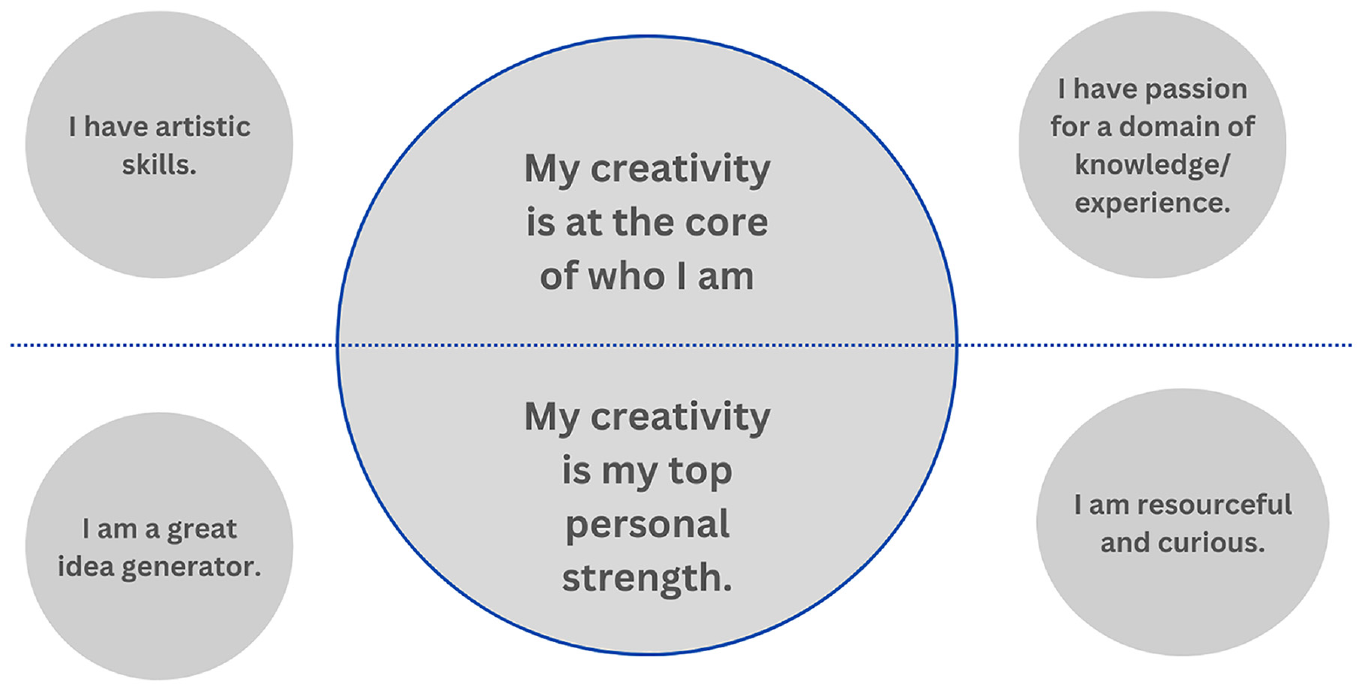
The four facets of one’s creative identity.
In conclusion, the insights professional creators get about the multifaceted nature of their perceived creativity can broaden their self-concepts and motivate the exploration of new activities. The reformulated creative identity may be expressed in the form of new projects within the existing job or brave new professional role choices.
The influence of work orientation for the evolving creative identity
The way in which the creative identity unfolds might be substantiated by the meaning of work that the individual holds. This is what is explored in this section.
After graduating from Architecture and Urbanism at Universidade Católica de Goiás in Brazil, Tulia Lopes got a postgraduate grant to work in Spain. A few years later, she was involved in IT project management in Ireland. Yet, she felt that she needed to do something creative. She quit her job to research the jewelry market in Brazil and Spain.
In 2005, she opened her jewelry shop in Barcelona. When the global economic crisis hit in 2008, Tulia had to close her business and reinvent herself again. She’s learned not to get attached to things, “Well, that’s not what I expected,” she said. She moved on, taking new courses and learning new skills while wondering, “What is my calling?”
The kind of meaning people attach to their work is defined as career orientation. Wrzesniewski et al. (1997) find that people can see their work as a job, as a source of income and as a necessity. Some people see their work as a career, as a way to advance to higher positions. Some other people see their work as a calling, which gives a sense of fulfillment and social impact. Although it’s not clear what shapes people’s work orientation, Wrzesniewski (2002) shows that external events, like the traumatic case of 9/11, could have an effect on people’s need to experience an increased meaning in their work.
Lebuda and Csikszentmihalyi (2017) identify five types of views that eminent creators might have on their creative work, as follows:
Creative work is a commitment to fulfill one’s potential.
Creative work is a social obligation.
Creative work is an integral part of life.
Creative work is a demanding profession.
Creative work as an additional activity, as a passion, or maybe a whim.
In this paper, the interviewees evidence one of the three work orientations, that might motivate them to initiate initiatives or make changes where their perceived creativity has a central place:
Work as a career. They consistently do more than what’s expected of them and contribute to the development of the work cultures and practices they are a part of. Positions of authority are their desired future.
Work as a cause. Here, we find creative people for whom the higher purpose of their professional role revolves around the positive impact on the beneficiaries of their work.
Work as a calling. The core skills that the creator performs in their role are their lifeblood.
Therefore, depending on whether work is seen as a career, as a meaningful impact, or as a calling, there can be four types of insights that can open possibilities for commitments to new actions and creative growth.
Work as a career
When work is seen as a career, creative individuals can become proactive in improving some aspects of the work culture or processes in the organization where they are currently employed. Some are seen as leaders of change, while others are seen as innovators.
The leaders of change
Three of the creators featured in this article are examples of individuals whose creative personalities develop around the role as a leader of change.
Vincenzo Cerullo is the head of the Drug Research Program at Helsinki University. At one point in his career, Vincenzo realized that scientific investigations needs creativity. Ever since, public talks have been activities for which he has made time. He talks about scientific research and life as a scientist either to students or his academic fellows. For example, in his 2018 talk at TEDxHelsinki University, Creativity goes viral!, Vincenzo advocates adopting a perspective of curiosity, openness and being “unfocused in a focused way” on scientific problems.
Helder Santos is a full professor in Biomedical Engineering at the University of Groningen. Helder is aware of the importance of being creative not only in research tasks, which are his main concern but also in his leadership role.
“… so I’m head of the department, and in order to introduce a new way of thinking, in order to introduce a new way to help the situation, even in interactions, you have to be creative. You have to try to think, ‘Okay, there is something to improve. How can I improve?’ And the only way you can improve is if you can come up with some kind of new creative way to do it. …”
His community-building tendency is visible in LinkedIn postings when he shares team-building moments, profiles newcomers or shares the best achievements of researchers about to leave the team. Helder is thus a department head, who embraces a creative leadership style, taking time to think about how to support his students to work in teams but also how to praise individual members for their merits.
(3)Oscar Santolalla is a Sales Engineer at a company specializing in digital identity management software. He discovered his interest in public speaking at the beginning of his career when he worked as a lecturer. Later, when he changed to the sales engineer title, he got interested in writing skills. This led to two books, Create and Deliver a Killer Product Demo and Rock the Tech Stage. Nowadays, Oscar is increasingly recognized as an authority in delivering effective tech presentations.
Therefore, professionals who see work as a career commit to creativity-fueled actions, which makes them perceived as leaders of change in their communities of practice.
The innovators
Some individuals who see their work as a career may invent new practical solutions that improve processes and practices in multiple organizations. They may then see possibilities of career development in entrepreneurship, as Peter Ivanov did. He is an independent management innovator. Over the years, Peter has developed an effective method known as—The 10 Big Rocks for leading remote, hybrid or virtual teams. The method promises to deliver projects faster, reduce costs and prepare organizations for the future. In 2012, it received the business award “Global IT Connect Award.”
Work as a cause
The individuals who derive satisfaction from seeing the positive impact of their work on others’ lives may decide to embark on a cause for the greater good of a focus audience. Therefore, they direct their attention to exploring social entrepreneurial pursuits that uplift some aspects of human existence and, at the same time, derive a personal meaning. Three of the interviewed professionals belong to this category. Tulia Lopes has found her calling in supporting female leaders to speak up. Pamela Thompson supports heart-centered leaders embracing change for positive impact. Harriet Fagerholm explores co-creation, guiding people in releasing their creative impulses and conscious evolution.
Work as a calling
The fourth type of insight that creative people might have at an unexpected moment in adulthood is that they are born for a calling. The more this intuition persists, the more likely that they start to look for opportunities to learn new skills as niche experts. When John Bates realized he excelled at emotional intelligence skills, he embarked on a new career as a Leadership Communication Expert who helps leaders in large corporations craft their speeches to be “TED-talk”—worthy.
To sum up, some experts choose to stand out in their fields as leaders of change. Some others may decide to explore their potential as innovators in a specific domain. Some others may commit their professional life to a mission for the greater good, becoming social entrepreneurs. A fourth category of creators may see potential in practising personal strengths that become central to their identity and help them become recognized experts.
Seeing and internalizing new possibilities of commitment to creativity related actions paves the way to consolidating one’s identity as a Pro-c creator. In the next section, we put together the theoretical framework that introduces creative self-knowledge and work orientation as agentic mechanisms for the negotiation of one’s creative identity in mid-career.
Possible agentic mechanisms in the negotiation of one’s creative identity
From the socio-cultural perspective, creativity is defined as “a complex socio-cultural-psychological process that, through working with ‘culturally-impregnated’ materials within an intersubjective space, leads to the generation of artifacts that are evaluated as new and significant by one or more persons or communities at a given time” (Glăveanu, 2010, p.11). The central aspect of this definition is the negotiation or the dialogue about what represents a creative act between the self,—the creator—and others,—the community, critiques, etc. This paper addresses the possible pathways of how the sense as a creative person is constantly formed and reconstructed in the representational space of the creative process, performance and feedback provided by the socio-cultural-psychological dynamism.
Based on the interviews, I propose that the ongoing reformulation of the creative identity as a non-artist Pro-c creator is enabled by the agentic action of two types of self-beliefs: beliefs of one’s creative strengths and the meaning of work. Acting on these beliefs, creators experiment with new roles (see Figure 3).
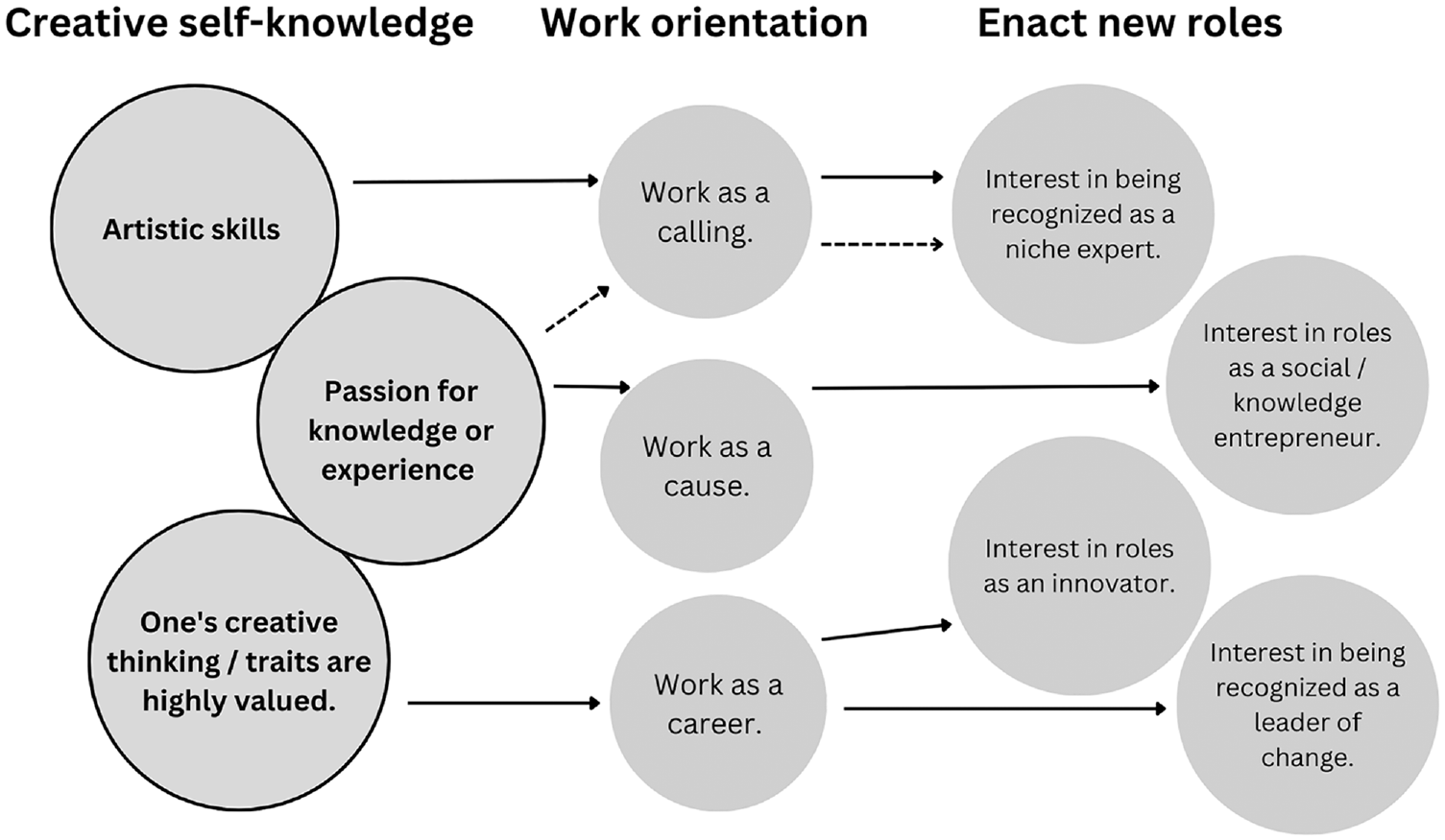
The developing creative identity.
As discussed in the previous sections, creativity can have unique meaning for each individual creator, which defines the content of their creative identity and shapes their actions. For instance, for Harriet Fagerholm, although creativity is understood as an artistic skill, she organizes workshops where artistic activities are a means to an end—they have the purpose of unleashing the creative impulse of the participants. So, seeing artistic skills at the core of who one is does not always mean that one expects to be recognized as an artist, rather as a therapeut, healer, inner work guide, etc.
Overall, the content of creative identities is reflected in the work activities that the interviewed creators perform. In addition to Harriet Fagerholm, three other interviewed experts,—Pamela Thompson, Peter Ivanov, and Tulia Lopes—, transitioned to new professional roles as entrepreneurs. They acquired interest in new skills and domains that had meaning for them and for which they became recognized in professional spheres.
Harriet Fagerholm studied international marketing. Pamela Thompson got a master’s degree in nursing and health education. At a given time in their working lives, thanks to or in spite of specific life circumstances, they made the leap to being business owners who work alone and explore their creativity in accordance with their meaning of creativity. Both for Harriet and Pamela, creativity is about personal expression through art forms and this is the perspective that they introduce to their clients.
Tulia Lopes, with a background in architecture, changed to knowledge solopreneurship, where her creativity is manifested in the courses and speeches she crafts and the way she communicates with her possible clients.
Peter Ivanov holds a master of science in mathematics and transitioned from a managerial to an entrepreneurial role when he understood that creativity is his strength. For Peter, creativity boils down to the ability to come up with surprising and effective ideas—new products, marketing messages, sales, etc.—to attract and maintain clients.
Three respondents experienced a more traditional career development: Vincenzo Cerullo,—doctoral degree in biotechnology—, Helder Santos,—doctoral degree in technology, physical chemistry, and electrochemistry—, and Oscar Santolalla,—masters in mobile computing and information security. Their professional roles are a continuation of their university degrees. They explore their creativity, as a thinking style and as a way to connect with their audience in their current occupational roles.
Out of all the interviews, the experience of John Bates is maybe the most eloquent of how the creative identity is under continuous construction during social interactions and events.
John Bates, with a bachelor’s degree in sociology, has built his entrepreneurship on his emotional intelligence competencies. During the interview with the author of this paper, John experienced changes in self-perceived creativity. Two years after the interview, John commented on his LinkedIn page: “The questions she 1 asked taught me a lot about myself, my view of myself, and my views on creativity, and opened my mind to new ways of thinking about creativity.”
To conclude, these interviewees’ answers show how societal interactions and events affect professionals’ images of their creative selves. In addition, the above proposed framework shows that it’s not only the way people understand their creativity but also the meaning that they assign to work that affects the projects that they may get involved with, at a given stage in adulthood. In particular, insights about a new creative potential are essential for orienting oneself towards new creative action that might lead to new work roles.
Conclusions
This paper adds to Glăveanu and Tanggaard (2014) paper on the typology and development of the creative identity. One of the central questions emerging from the framework proposed in the above mentioned paper is, “How does a creative identity change throughout the course of life and what are the consequences of this on one’s identity project?” (Glăveanu & Tanggaard, 2014, p. 19). This paper addresses the first part of the question by examining in what ways professional creators in non-artistic domains recognize their creativity and its importance in their roles and possible unfolding of their creative identities in mid-adulthood. By drawing on the socio-cultural and developmental perspectives, the focus of investigation was thus twofold: (1) gain insights into the creative-self beliefs of professional creators in realistic, investigative or entrepreneurial domains and (2) understand what professional changes might influence the development of their creative identities.
Extant research discussed the development of creative identities from early education to higher education classrooms and the Pro-c creators in artistic domains (Beghetto, 2021; Glăveanu & Tanggaard, 2014). To live is to create. Whether studied or not, there are creative identities, suppressed or under continuous development, in all domains and at different stages of career development. Moreover, considering the disengagement in active knowledge workers (Rastogi et al., 2018), creativity researchers could play an important role in societies by investigating how adults make sense of their creative identities and how they can be supported to develop their creative potentials for a professional life of meaning.
In this paper, a creator is defined as an individual who has a strong work identity and values their personal creativity and continuous learning for bringing something meaningful, original, and useful for their audiences. Previous papers that focused on the relationship between creativity and identity development, looked into creativity as creative thinking processes and creative commitments in identity formation (Barbot & Heuser, 2017). To my knowledge, this is the first paper to propose a framework that explores the development of one’s creative identity based on the interplay between creative self-knowledge and work orientation as agentic factors towards new roles as a creator in a non-artistic domain. Also, the paper adds to previous research (Lebuda & Csikszentmihalyi, 2017) that study the link between identity and creativity in eminent creators, by interviewing Pro-c creators who are recognized for their performances in their close professional communities in science, entrepreneurship, and engineering.
The essence of this paper consists in the proposal of the four-faceted and dynamic nature of one’s creative identity: as a specific artistic skill, as a passion for a domain of knowledge or experience, as an ability to generate ideas or as a creative personality trait, like curiosity or resourcefulness. To the extent that one of these sides becomes salient in a particular context, and depending on how one sees their work—as a calling, cause or career—, there are many possibilities for creative action and engagement in a new role, whether as a temporary involvement or a stronger commitment. These insights are useful for informing more detailed, larger-scale quantitative studies and for developing both new theories of creative identity throughout the lifespan.
Limitations and future research directions
The framework introduced in this paper is partly grounded in previous creativity research and partly grounded in the author’s perceptions of the respondents during the interviews. The findings have two main shortcomings: the subjectivity of the respondents and the interpretation bias of the researcher. By their nature, interviews are subjective, providing deep exploration of individual experiences and beliefs. The respondents may have biased memories or may present themselves in a favorable light. This subjectivity can influence the data, which in turn affects the reliability of the framework. At the same time, my interpretation of the data can also introduce bias, although I started this project with an open mind, with curiosity for what I might find during the transcripts analysis. Despite my intention to be open-minded, unconscious biases can still exist in how I formulated the questions, how I interpreted the responses, which are based on my own beliefs. In brief, I had no expectations of what I would find and the findings did surprise me. Before this study, to me, creative identity meant artistic talent. I now see creative identity as a versatile and fluid self-concept, changing in accordance with the situation in which the creator is required to take action.
Despite the limitations, the framework in Figure 3 adds insights in the diverse and dynamic nature of creative identities for professional creators in realistic, investigative and entrepreneurial domains. To ensure the scalability and validity of this model, further qualitative and quantitative research is needed.
Moreover, future papers on the development of creative identities across the lifespan might consider three research directions. First, it would be interesting to investigate the influence of societal events on creative self-beliefs and one’s need to create, which would reconstruct one’s creative identity. Why and what would determine an individual to stop seeing the appeal of leadership positions within a corporation (work as a career) and instead, get active in building their brand as an independent niche expert (work as a calling), or vice versa?
Multicultural living might be a contributing factor to creators’ openness to experiences and development of their creativity (Tadmor et al., 2012). Living abroad might thus be a promising context to study career decisions and development for professional creators. Moreover, six out of the eight interviewees are individuals who live and work in an adoptive culture and whose national identity is thus challenged. All the interviewed individuals have experiences working in multicultural environments.
Harriet Fagerholm, for instance, had a short but profound experience in another culture, which made her reflect on the way of living in her native country. In her view, the career transition that she experienced two decades later, was initiated by the shift in perspective during her studies abroad. Therefore, future research could examine in what ways multicultural experiences reformulate one’s creative identity. Under what circumstances and for what kind of creative individuals, does personal creativity become a coping strategy to find meaning into a new culture? Under what circumstances and for what kind of creative individuals, is moving to another country perceived as an opportunity to fulfil one’s creative potentials?
Second, the above-mentioned questions lead to other interesting questions, “To what extent the awareness of the existence of an inner conflict between a low-level role identity and the creative work orientation triggers the self-exploration?” In other words, when the self-view about the current job—“My life starts after 5 pm.”, “The competencies of this job no longer interest me.”, and “The expectations of this role are not inspiring anymore.”—is not in alignment with the long-term view on one’s professional life,—“I’d like to bring a positive impact with my work.”, “I’d like my creativity to be at the center of my working life.”, and “I’d like my work to feel personally meaningful.”—, what are the exploration paths that one can engage in, considering that living means constraints?
Third and last, is it true that scoring high on social or collective dimensions of identity leads to lower creative performance in work settings? A process-oriented approach may enable more accurate observations of the conditions under which the salience of social or collective aspects of identity determines creative self-exploration.
These research directions can have practical and theoretical implications. Professionals interested in meaning at work could benefit from understanding the multifaceted nature of their creative identities. Organizations that prioritize employee wellbeing would benefit from understanding how to support the creativity in employees’ lives.
Last but not least, from the theoretical perspective, there is more to understand about the nature of creative identities. This exploratory paper can pave the way for future research to refine the identified concepts and themes by combining the qualitative and quantitative methods. Theories on creative identity development can play an important role in the lives of the possible creators of today and tomorrow.
Footnotes
Acknowledgements
I am deeply grateful to the professionals who agreed to be interviewed on their relationship with their creativity and its importance in their professional lives.
Declaration of conflicting interests
The author declared no potential conflicts of interest with respect to the research, authorship, and/or publication of this article.
Funding
The author disclosed receipt of the following financial support for the research, authorship, and/or publication of this article: When working on the last two revisions of this paper, I benefited from funding from The Finnish Cultural Foundation (Suomen Kulttuurirahasto).
