



Abstract
Despite significant transformations in most domains of activities, there might still be some constancies in the creative spaces explored throughout history. This paper introduces the Creative Space Theory (CST), a conceptual framework delineating 10 distinct creative spaces, analogous to creative landscapes. These creative spaces are proposed as navigational terrains for an array of media, tools, activities, and domains. The 10 spaces of the theory are movement, sound, image, sensation, emotion, strategy, story, symbol, network, and system. Notably, these creative spaces transcend specific media, and cover artistic as well as intellectual domains. For example, the sound space would be relevant to music, poetry, filmmaking, and acting among others, whereas the system space may be relevant to engineering, medicine, science, and design among others. The proposed theory holds potential utility in three key areas: (1) nurturing individual’s creative potential, (2) helping creators adapt to continuously changing circumstances, and (3) fostering positive creative self-beliefs in overlooked domains of creation. The current paper is a theoretical elaboration. We describe the creative spaces and discuss the implications of the theory towards individuals, educational practices, and research within the fields of cognition and Artificial Intelligence.
Keywords
Creativity can take multiple forms. Indeed, its expression is potentially as varied as there are activities and domains filling the life of individuals. From more evident forms of expression, such as painting and music, to less obvious ones, such as mathematics, sports, and medicine, grasping creativity across domains is a pivotal pursuit in unraveling its multifaceted nature. The essence of creativity across domains poses two fundamental questions: how does creativity occur? And what creativity looks like in various fields? Recognizing the expressions of creativity can contribute not only to a better understanding of the creativity construct, but also to nurturing creative potentials in various domains, ultimately fostering a more innovative society.
All over the world, governments are investing vast amount of resources into educational programs designed to promote the creative thinking of students in anticipation of upcoming challenges (Barbot et al., 2019). Creative thinking is often cited among the top skill to master in order to work and live successfully in modern societies (Conner et al., 2018; Partnership for 21st Century Skills, 2008; Trilling & Fadel, 2009; Zhou, 2017). Creativity research has reliably found that personality traits such as openness to experience (e.g. Feist, 1998; Oleynick et al., 2017), cognitive mechanisms such as divergent thinking (e.g. Guilford, 1950; McCrae, 1987; Torrance, 1962; Wallach & Kogan, 1965), and the quality of one’s motivation (e.g. Amabile & Hennessey, 1992) stimulate the generation of creative ideas. Among the questions which still lack consensus is how creativity manifests in various domains of activities (Kaufman et al., 2017b). For instance, what does creativity looks like in politics, cooking, and engineering? Answering this question across various domains is important to nurture creativity in every discipline.
What is creativity?
To define the concept of creativity, a useful distinction has been made by earlier theorists between the process and the product (M. Rhodes, 1961). Formally, “creativity” is commonly defined as the generation of products which are novel (i.e., original) and valuable (i.e., useful, task appropriate, effective, or meaningful) as judged by oneself or others (Csikszentmihalyi, 1999; Forgeard & Kaufman, 2016; Runco & Jaeger, 2012; Stein, 1953; Sternberg & Lubart, 1999). The term “product” is used broadly here to refer to any proposals such as an idea, a sketch, or an actual product. Although creativity is often interpreted as referring to an ability, generating something is more accurately framed as a process. This distinction is important because an ability is located at the individual level, whereas a process can be distributed across many people, tools, and systems.
Creativity is often assumed to reside solely within individual minds, as if it was carried by one person and involved nothing else. However, ideas and products come from the interplay of a multifold of people and resources (Clapp, 2016a, 2016b; Corazza & Lubart, 2020; Glăveanu, 2010, 2014a, 2015; Hutchins, 1995). Glăveanu and Beghetto (2021) represented creativity as essentially made up of actions and interactions with other agents, social codes, and physical affordances. They argue that “people, products, processes and contexts are in simultaneous engagement” (p. 76), rather than any of these ‘elements’ being in isolation. In other words, the creative process should be understood as an organic system. Like seeing the forest, instead of individual trees. Consider, for instance, the production of an original photography. The latter results from the invention of cameras, having access to a location—which may involve cars, planes, streets, shoes—the luxury to invest time in that activity, the use of photo-editing softwares, and so on. An understanding of colors, lighting, visual angles, and conceptual elements may also prove beneficial to render the beauty of the scene. Thanks to earlier creators: theories, tools, and technics have been developed, such that the production of any photography combines the creative work and effort of many individuals (Clapp, 2016b; Clapp & Hanchett Hanson, 2019; Glăveanu, 2011). In essence, creative products emerge from all those steps which started many years ago, when the possibilities were not even the same, and from the work of many creators with overlapping goals (Corazza & Lubart, 2020).
Domains of creation
It is commonly agreed that creativity exists in all domains. However, there has been a longstanding debate about whether creative abilities apply universally across domains or whether they are domain-specific. The lack of consensus surrounding this question might come from the question itself. Despite its many variations, the question often boils down to whether creativity is a domain-general or domain-specific ability (e.g. Baer, 2012). This is problematic as soon as we consider creativity not as an ability, but as a process (see Plucker & Beghetto, 2004 for a discussion). On the one hand, it is generally accepted that the creative process has both domain-specific and domain-general components, taking into account the vast array of factors that influence creativity, including cognitive abilities, creative abilities, knowledge, personality, motivation, and resources (Kaufman & Baer, 2004; Sternberg, 1999). On the other hand, creative abilities may be more or less domain-specific depending on which ability is being considered. For example, imagination, divergent thinking, empathy, or incubation techniques could be more or less domain-general depending on which one is under scrutiny.
The debate on domain-specificity and domain-generality highlights the significant role of domains as a useful way to categorize distinct forms of creative expression. Theorists even suggested that “saying that someone is creative without specifying the domain (or domains) in which they are creative is rather like saying someone is an expert without mentioning the area of that person’s expertise.” (Kaufman et al., 2017a, p. 4). Perhaps creativity appears domain-specific because creative individuals are committed to particular domains of work (Plucker & Beghetto, 2004). For the purpose of this text, we will use the terms “domain,” “domain of activity,” “domain of creation,” “discipline,” “canal of expression,” or “media of creation” as synonyms.
Domains matter deeply, yet one crucial concern with the concept of domain is that each of them are not a homogeneous construct. Domains are made up of many different types of contents. For example, cinema is a complex domain which involves visual, auditive, emotional, and strategic components, to name a few. Producing high-quality cinematographic production typically involves many experts, from many disciplines, precisely because of this heterogeneity in content. The scriptwriter, director, sound engineer, costume designer, movie editor, and many other roles, combine their expertise and creative ideas to achieve a high-quality production.
Professional creators usually invest a lot of time and energy on a few domains of activities. Consequently, their contribution is also often limited to a few—and connected—domains (Baer, 2012; Kaufman & Baer, 2004; Plucker & Beghetto, 2004; Szen-Ziemiańvka et al., 2017). This specialization highlights what could be called the ecology of domains of creation (e.g. Glăveanu, 2015). The interlocking of individual abilities, social norms, material resources, and personal experiences shape the trajectory of individuals into some domains (e.g. medicine or engineering) versus others (e.g. teaching or acting). This ecology entails that individual factors—such as motivation, personality, and talent—, interact with proximal and distal social factors in determining which activity is prioritized. For example, not everyone has access to a violin, less alone to violin classes at a young age. The obstacles standing between an individual and certain activities reduces the likelihood of developing a passion for the latter. Initial exposure can foster both, interest and a sense of competence (Ericsson et al., 1993; Karwowski & Barbot, 2016). These feelings frequently reinforce each other and, ultimately, may translate into tangible achievements. Concretely, the opportunity to engage in an activity from a young age, coupled with positive reinforcements from parents, friends, mentors, and/or the cultural environment, can be deterministic in the decision to immerse oneself in that activity, and later push the boundaries of that field.
All domains and activities (such as violin, piano, tennis, or cooking), may serve as canals of creative expressions. A helpful analogy is to think of those domains and activities as actual vehicles, which role is to facilitate the navigation of roads within our mind. As the analogy goes, domains and activities necessitate initial learning, akin to acquiring driving skills. Similar to the social prestige of certain vehicles over others, some domains hold greater societal value, entail higher costs, and each offers a unique “feel.” Significantly, all vehicles are instrumental in navigating roads and landscapes. Hence, the analogy imply that domains and activities allow us to navigate the roads and landscapes of our mind. This navigation enables an exploration which is crucial to creativity.
The vehicle analogy is helpful to situate one of the roles of domains and activities within the creative process. Through their set of rules, tools, and technics, domains effectively constrain the options within a space, and incidentally allow us to exploit those spaces in specific ways. As a concrete example, in basketball, moving with the ball is allowed only through dribbling. In handball, walking and running with the ball is prohibited. These rules—coupled with the tools (i.e. the ball, the nets, and other equipment)—simultaneously enable and constraint the possibilities of the movement space.
Defining the spaces of possibilities
Searching through a space of possibilities is an essential aspect of the creative process (Boden, 2004; Hills et al., 2015; Mateja & Heinzl, 2021; Todd et al., 2012; Tromp, 2023; Veale et al., 2019). The idea of searching within a problem-space, and retaining the best candidate solution, is also central to computational implementations of creativity (Gardner, 1985; Turing, 1936). Consequently, delimiting the space and framing its possibilities is one of the main challenge of creative thinking. Assuming the solution space is large and noisy, not all possibilities are equivalently valuable to a specific question or problem. Therefore, a strategic search is used to constraint the possibilities, give direction, evaluate the options, and optimize the cost-benefit ratio of the search (Tromp, 2023).
A space can be defined at the problem-level, and ultimately those boundaries may include relevant solutions, exclude some, or be counter productive to problem-solving. This latter case is reminiscent of mental blocks—which are often examined with insight problems (e.g. Ash & Wiley, 2006; Smith & Blankenship, 1991)—and the famous “think outside the box” metaphor of creative thinking. However, thinking inside the “box” is no less creative (see also Boden, 2004; Damadzic et al., 2022; Stacey & Eckert, 2010). Nonetheless, defining a space at the problem-level entails to define as many spaces as there are problems.
Many cognitive theories in the field of creativity have identifed processes contributing to searching a space (e.g. Beaty et al., 2014; Boden, 2004; Veale & Cardoso, 2019). The construct of divergent thinking—which can be defined as the generation of variations—is one such example. In divergent thinking tasks, participants search within a space of loose associates for new and original solutions to an open-ended problem (e.g. Beaty et al., 2014; Benedek et al., 2012; De Dreu et al., 2012). In the field of computational creativity, Boden theorized three categories of creative skills: combinational, exploratory, and transformational (Boden, 2004, 2007) Briefly, combinational skills involve the combination of familiar units into novel and valuable propositions. Familiar units, such as words, musical notes, or colors can be combined into an almost infinite number of ways (assuming a large space), and any combinations which are simultaneously novel and valuable would be regarded as creative (Boden, 2004). Exploratory skills involve the exploration of new units and new possibilities. This includes seeking new knowledge or new ways of doing things. For example, a researcher might learn about new topics, delve into new analyses, or invent new tools to research a phenomenon. Discovering new units expands the combinative opportunities. Lastly, transformational skills involve the alteration of rules and transformation of constraints. Transformational skills fundamentally alter structures such that previously impossible combinations may now be seen as legitimate and valuable (and previously possible combinations might no longer be valued). Transformation skills does not mean removing the structure, it means proposing a new structure which adds value (Boden, 2004; Veale & Cardoso, 2019). As an example, Albert Einstein’s theory of general relativity may fall in transformational creativity, as it opened up the possibility that gravitational waves could propagate in the space-time manifold, among other proposals; a prediction inconceivable before his theory, which was confirmed much later, in 2016 (Abbott et al., 2016).
We propose the Creative Space Theory (CST) as an attempt to identify creative spaces at a fundamental level of analysis. The creative spaces defined by the CST capture large ensemble of mental contents. The theory act as a “map,” so to speak. The CST identifies 10 creative spaces, tentatively capturing creative landscapes. These creative spaces would be navigated in all possible directions by the variety of domains and activities that exist. The theory may prove useful to analyze the composition of domains and creative products.
The Creative Space Theory
The CST is an attempt to provide insights into creative expression across a wide variety of domains. The main challenge is to identify stable creative spaces which are independent from the media used to explore them. Those spaces should remain fairly stable throughout time, cultures, and the development of new technologies. Said otherwise, different media can be used to explore a creative space, such as using a guitar or a piano to explore the sound space. Identifying underlying creative spaces has potential implications for the field of education and may impact the cultivation of individual creative potential. It may offer avenues to consciously enhance one’s expertise and to expand one’s skillset through recognizing that some overlooked opportunities are also meaningful in exploring a particular creative space. Hence, new opportunities to practice, learn, develop versatility, and cultivate curiosity may emerge from the fact that an activity which initially seemed uninteresting shares a creative space with an activity for which a person is eager to improve. The implications of the CST are discussed more thoroughly in the general discussion.
The CST has delimited the following 10 creative spaces as a starting point of analysis: movement, sound, image, sensation, emotion, strategy, story, symbol, network, and system. The spaces are shown in Figure 1 and defined in Table A1 of the appendix. Those creative spaces were identified theoretically by (1) generating a list of domains and activities, and conceptually identifying their underling similarities. (2) Identifying combinable and meaningful units within each creative spaces. For example, words, musical notes, colors, movements, story characters, and parts of a system are seen as “units,” existing in many variations and combinable within their respective spaces. The combination of movements, for instance, is well exemplified by karate kata, where well-defined movements are chained togheter. (3) The creative spaces could not be domains themselves and must be independent of them. Lastly, (4) because domains are heterogenous in their content, it was expected that more than one creative space would be meaningful to any single domain. In the following section, we describe the 10 spaces of the CST and provide examples of their relationships towards various domains of activities.
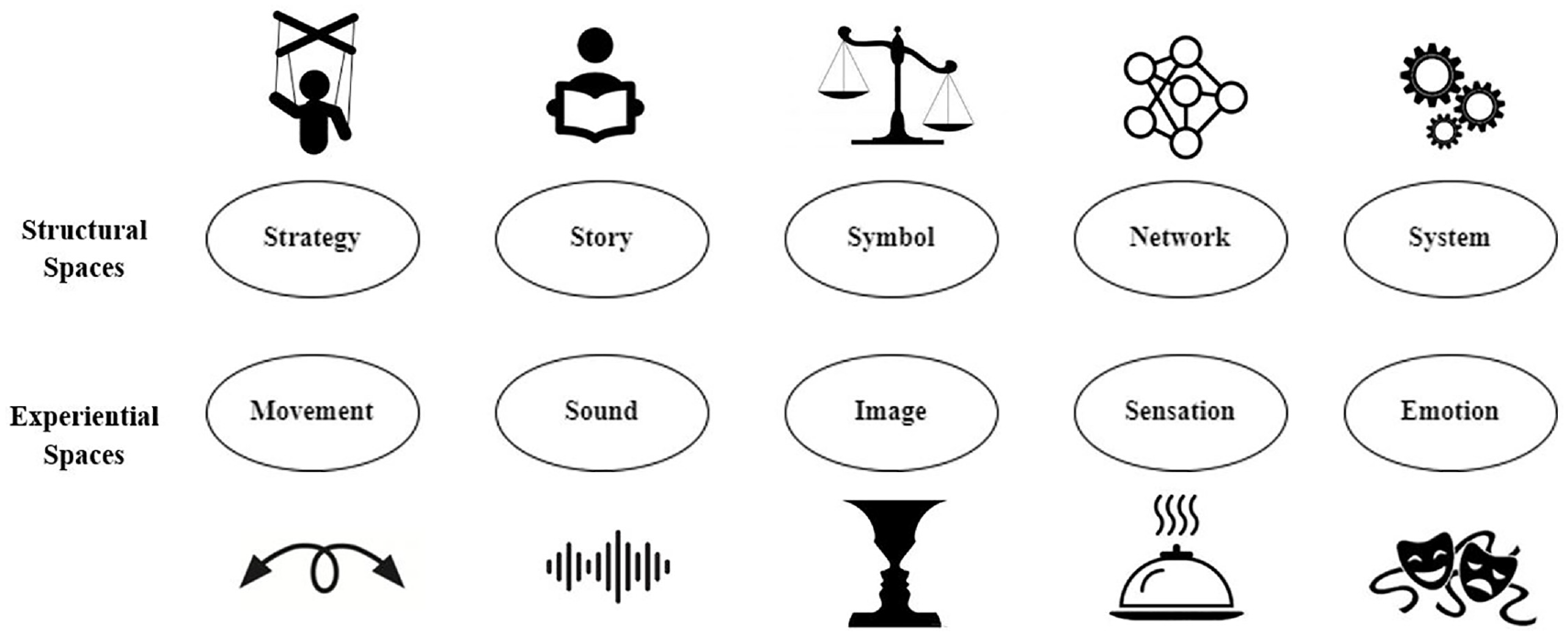
An organization of the 10 spaces of the Creative Space Theory.
The movement space
One great achievement of toddlers happens when they successfully walk for the first time. Later, they may learn how to climb, jump, swim, and doing a round-off-back handspring as a gymnastic combination. Movement is intuitive. Meaningful to the entire animal kingdom, the social importance of movements across cultures is embodied by international events like the Olympics. Watched by thousands of individuals across the world, spectators enthuse in front of novel and original movements performed by elite athletes. The use of various tools and objects has enabled endless possibilities within this space.
All sports share this common interest in the exploration of movements. Simple movements, such as moving forward, moving backward, or jumping, can be combined into complex sets, themselves combinable, hence enabling almost infinite combinations. Doing a backflip, for example, involves backward motion with the hands, coordinated with a jump high enough to have time to complete the rotation. Yet, the movement space is also meaningful to domains not typically labeled as sports. One aim of the CST is to facilitate the analysis of overlooked domains, by its proposal of a stable set of underlying creative spaces. For example, the movement space can be used to recognize creative expression within the domain of music. Indeed, instrument playing requires precise movements, rapid or slow executions, and excellent coordination (think of virtuoso). Creative movements from instrument playing, such as the vibrato, typically serve the greater purpose of achieving interesting sounds and acoustic effects. The challenge and satisfaction stemming from playing an instrument is often part of what musicians enjoy about their art. Hence, the CST may not only contribute to an understanding of the content of diverse domains, but may also isolate what motivates people within their domain of predilection. This being said, the movement space is not necessary to the music domain. Music produced through computer software’s may fully remove the movement component, while maintaining the focus on the exploration of sounds.
Another domain which evolved with the advent of computers is Electronic Sports (E-Sport). E-sport regroups competitive video games. Should video games be considered a sport? This debate is off the hook here, because the aim of the CST is not to classify activities in larger categories, such as “sports,” “arts,” or “sciences,” but rather to identify which landscape those activities navigate. Video games involve difficult movements. The difficulty comes from the precision required, the complexity of the combinations, and the speed of execution (Hallmann & Giel, 2018; Steinkuehler, 2020; Witkowski, 2012). Those very same elements help distinguish talented soccer players, talented golfers, talented dancers, and talented drivers from less talented ones. In fact, these elements, that is, aim, speed, timing, rhythm, coordination, endurance, directionality, orientation, and more, may be seen as the units of the movement space, and elements to be mastered and explored by creators.
The movement space is also relevant to cooking chefs, surgeons, and many technics used in painting, constructions, and sculpting to name a few. One core assumption of the CST is that each creative space can be explored from various media. The movement space can be explored through one’s own imagination. It is now well-established that motor imagery training (i.e. the mental simulation of an action without any corresponding motor output) improves muscle strength (e.g. Ranganathan et al., 2004), performance (e.g. Ruffino et al., 2021), flexibility (e.g. Kanthack et al., 2017), speed and accuracy (e.g. Gentili et al., 2010), and provides a highly promising method for motor rehabilitation (e.g. Jackson et al., 2001). Together, traditional sports, instrument playing, e-sports, and other activities are all contributing to exploring the possibilities of the movement space.
A legitimate concern regarding the movement space, and the remaining nine spaces of the CST, is where to draw the line? Are not movements everywhere, all the time? Is the movement space important in board games, such as chess, for example? The line is drawn by asking what space are you concerned with while doing an activity? What are the novel and useful proposals you want to make? Movements in chess are technically extremely limited. Just like music can be achieved by clicking with a mouse on a computer, one can play chess by asking someone else to move the pieces. New and original movements in chess, those which are deemed creative, are not movements per se, but strategies. The strategic possibilities of chess are extremely deep and complex. Although anyone can move the pieces, not everyone can achieve a winning combination or get out of an impasse. In many sports, the strategic space is important; in chess, it is predominant.
The strategy space
Searching through a space of strategies is more abstract than exploring movements. In fact, strategies are rarely brought up when individuals are asked about their creativity (Glăveanu, 2014b). Strategies as products are more elusive than typical art forms. Consider the following: from a very young age, children are questioned about the job they would like to do in the future. Having a goal is a first step into the world of strategy. Afterward, the many choices people make to bring themselves closer to that goal are strategic moves. The final product of strategy is achieving that goal.
Research have shown that goals could be held subconsciously and still interact with conscious goals (Stajkovic et al., 2006), as well as impact task/job performance (Chen et al., 2021), and influence well being (Gray et al., 2017). Other researchers have attempted to establish the architecture of our goal systems (e.g. Kruglanski et al., 2015). These research have mapped the nature of different means—end relationships. As Kruglanski et al. (2015) discussed, the multifinality configuration involves a single mean serving multiple goals simultaneously; the equifinality configuration involves substitutable means serving a single goal; lastly the counterfinality configuration involves a single mean undermining other goals while serving a single goal. These configurations shape the strategic choices of individuals when faced with conflicting and overlapping goals.
Creators of strategies include politicians, methodologists, policy analysts, military tacticians, coaches, sport players, board game players, managers, entrepreneurs, and more. In fact, one can find creative strategists in any competitive settings. They combine information, tactics, plans, goals, methodologies, resources, and procedures. Being creative in that space sometimes entails having different goals than other people, or different ways to achieve them. Sports serve as a good example to illustrate how creative spaces may be combined. Most competitive sports combine the movement space with the strategy space. From coaches to training programs, a lot of resources are invested in developing winning strategies. Strategies, as creative products, can be directly appreciated in sports where athletes are in direct competition, and especially in team sports. In other sports, like dance, the role of strategy is not at the forefront. In contrast to other sports, dance combine the movement space with the image space.
Jobs in politics, administration, and management rely heavily on creative strategists (Bilton & Cummings, 2010, 2014; McLean, 2009). Management has been said to be the art and science of handling the resources of an organization. Creativity in that domain often takes the form of optimization. Optimization is all about finding the strategy which maximizes one or many parameters. In another vein, planning is also part of the strategy space. We use planning all the time: for how we dress, how we commute, what we eat, when we sleep, etc. Planning a sequence of events is what allows us to move with confidence from one state of affairs to another (Sloan, 2006). Whenever an outcome is desired, our mind navigates the space of strategy to find the steps to achieve it.
Creative strategists are often inspired by their experience in various contexts and combine tactics from various spheres of life (Sloan, 2006). Winning strategies in chess, volleyball, or video games can teach something about the relevant information to consider, the amount of effort to invest, the timing, the types of goals to set, the role of cooperation, the obstacles, the role of chance, the role of misinformation, and so on. These elements apply to other “real-life” decision-making situations. Strategic thinking can be difficult, risky, complex, intuitive—but it is learnable. One environment where strategy is relevant is within the educational system. More specifically, the pursuit of high grades. Indeed, students are heavily rewarded for strategies that maximize their grades. This translates into many students with similar goals, and any tactics which optimize this parameter is highly valuable (Carmack & Galanes, 2013). Whether it is cheating, creating acronyms to better remember concepts, anticipating the exam questions, or finding ways to self-regulate into studying, there are ample room for creative thinking.
In brief, the strategy space structures our actions, successes, and failures. Animals have elaborated strategies for matting, finding food, covering eggs, protecting their nest, etc. It has allowed our species to thrive. Strategy starts very young and remains highly valuable throughout our lives, yet it is often overlooked when creativity is discussed.
The image space
Before the advent of photography, the image space was explored mainly through painting, drawing, and sculpting. When the first, black and white, photography was taken, the French painter Paul Delaroche (1797–1856), declared: “From today, painting is dead.” As Bellinetti puts it, “Painting did not die that day, but photography was born, disrupting the world and its social order through the creation of new ways to see, understand, and explore” (Bellinetti, 2019, p. 1).
Because pating and drawing are so closely associated with creativity, it can be easy to overlook the exploration of the image space from other media. However, the image space is not limited to those art forms. That space is explored by dance, clothing, design, architecture, dishes presentations, marketing, sculpting, crafts, photography, and cinema, among others. This space is about combining colors, lights, shadows, lines, geometrical shapes, visual focus, perspectives, visual angles, front, background, symmetry, and visual space, in order to create unique images (Hetland et al., 2015). Among the domains which exploit the image space, some have aesthetic purpose as their primary goal, such as painting, sculpting, and photography, whereas others might use aesthetic elements (such as styling) as a marketing or promotional tool, like a book cover (Charters, 2006).
Given the importance of visual information to navigate our environment—and their ease of implementation in research design compared to other human senses—, it should come to no surprise that much research has attempted to map the image space. Two notable pursuits in coding colors are the Munsell color system (Berns & Billmeyer, 1985) and the NCS-Natural Color System (Hård & Sivik, 1981). The former specifies colors based on three properties: hue (basic color), chroma (color intensity), and value (lightness). The later notation system is based on six elementary colors: white, black, yellow, red, blue, and green. Both coding scheme have been derived through experimental studies and are regularly used to codify, describe, and communicate colors (Pastilha et al., 2019).
Research on visual aesthetic has found reproducible regularities in specific populations (see Palmer et al., 2013 for a review). For example, there is a large literature on facial attractiveness showing that people tend to like symmetrical and average faces (for a review, see G. Rhodes, 2006). People tend to like prototypical exemplars across various stimuli, such as color (Martindale et al., 1988), furniture (Whitfield & Slatter, 1979), surrealist paintings (Farkas, 2002), and exemplars of semantic categories (Martindale et al., 1988). The Ecological Valence Theory predicts changes in color preference depending on color-object associations. Different cultures have different color-object associations and different valences for the same objects (Palmer & Schloss, 2010). Notably, Schloss found that students at two rival universities—the University of California, Berkeley and Stanford University—preferred their own university’s colors more than their rival’s colors, and the magnitude of these differences was correlated with their self-reported sense of belonging to their university (Schloss et al., 2011). Another common theme in aesthetic judgments concern low-level visual properties, such as lines orientation. Many research support that images are preferred when their structure mirrors that of natural scenes. Such findings suggest that people prefer images that have the statistical structure to which the human visual system has adapted, whether evolutionarily or ontogenetically.
Technological tools have contributed to the exploration of the possibilities within the image space, just like it did with many other spaces. However, technology has not changed our desire to explore the image space, it simply changed how we did it. Earlier artists were using clay, cement, and paints as mediums. Today, artists use a wider range of tools, which includes digital tools and artificial intelligences. The historical development of visual arts is a good example to illustrate how a domain may change over time, and how each domain is mostly a grouping of technics and rules which enable us to engage with an underlying space (Pelowski et al., 2017). The fact that photography is a different domain than painting, or that drawing on a computer is different from drawing on a canvas, strengthens the need for a stable theory of creative spaces accounting for the continuity in these explorative behaviors.
Interestingly, visual art often contains symbolic elements (Cupchik, 2002). The use of a skull in a picture to represent death, for instance, certainly adds an additional layer of meaning within an artwork (Charters, 2006). The symbolic purpose of art has been argued further by Goodman (1968), who sees the core of art as being essentially semiotic (signifying meaning).
The symbol space
The symbol space is a realm where abstraction and meaning intertwine. Symbols are omnipresent in our daily lives and offer evolutionary advantages. “Just as matter is highly concentrated energy, a symbol is highly concentrated meaning,” as Truby (2008) eloquently stated (p. 220). Symbols can be very sneaky yet very powerful at the same time. “A symbol creates a resonance, like ripples in a pond, every time it appears. As you repeat the symbol, the ripples expand and reverberate in the minds of the audience often without their being consciously aware of it” (Truby, 2008, p. 220).
Symbols are, by definition, something which stands for something else. We encounter symbols continuously. This space includes words, numbers, road signs, musical notations, and waving to say hi. Symbols are effective ways to anchor many experiences, feelings, thoughts, and vague impressions, into an easily manipulate unit (DeLoache, 1995; Perlovsky, 2006). The use of symbols tremendously reduces the cognitive load. To discuss love, for example, the brain needs not to activate all those experiences, feelings and thoughts which constitutes love, it can simply refer to the word-symbol “love.” Even children can refer to this symbol before experiencing it themselves. Evolutionnary wise, symbols may have contributed to our mental abilities to simulate entities. Simulating entities allow our mind to scrutinize them, and generalize them to other cases and events (Barsalou & Prinz, 1997). This in part account for our understanding of metaphors, such as: “love is a fine wine.”
Symbolism is used in drama to convey deeper meaning and remind the audience of the themes or issues it is discussing. It causes audiences to reflect more thoroughly upon what they have seen. Indeed, the nuance, depth, and subtleties of symbolic meanings provide a large flare of creative possibilities. Symbols carry meaning because of their associations. One property of symbols includes their degree of similarities with their referent (i.e. iconicity). Some symbols are purely arbitrary, with no physical resemblance at all. Others are partially iconic, such as maps which preserve spatial relations, but have few other iconic features. Other symbols are highly iconic: A color photograph, for example, closely resembles its referent (DeLoache, 1995).
Many impactful symbols have come from religious and political movements. Social and political organizations often control to some extent the production of symbols and their meaning (Wydra, 2012). Arguably, a culture is the outcome of the social exchanges of symbols, and a convergence toward shared meaning. Symbols are somewhat banal precisely because they pervade all spheres of social reality. Yet, they can be crafted through agency or power. Wydra (2012) described political crises as being able to produce new symbolizations “because people need to make sense of the disruptions of political existence of the community” (p. 59). He further argues that “given the fragility of human existence, symbolic meanings are malleable. Symbols give an exact reference to something elusive and indefinite” (p. 59). Across the ages, politics has seen the reappearance of archetypes such as the symbolism of the evil, the hero, the golden age, or the friend-enemy distinction. According to Wydra “every act of symbolization puts symbols at risk, inflecting the meanings of such symbols or transforming them by the uncertain consequences of practices” (p. 59). This is where the creative depth of the symbol space makes itself felt: through their transformation and organic construction.
The manipulation of symbols is central to many theories of child development (DeLoache, 1995). Children manifest naturally their exploration of that space when they use an object, such as a pencil case, in replacement for something else, such as a phone. Social constructivist’s views suggest that symbolic representation develops because “children are motivated to carve out meaning in social interactions where there is interplay of symbols (i.e. symbols are directed to them, and they direct symbols to others)” (Callaghan, 2020, p. 54). Child abilities to manipulate symbols develop by imitation, intentionality, analogical reasoning, perceptual similarity, and concept formation. The support provided by “expert symbol users” in the child’s social world further reinforce this development (Callaghan, 2020). Said otherwise, creative potential in the symbol space would develop largely from the intention to communicate and comprehend the world.
Other domains exploiting the symbol space include mathematics, engineering, language (including all form of notations), science, philosophy, poetry, drama, cinema, and marketing. For example, technical drawings by engineers, designers, and architects rely on an ensemble of symbols which convey the specific geometry and details about the space and its components. Standardized languages based on symbols limit errors caused by personal interpretation and facilitate the manipulation of real-world referent through their symbolic equivalent (J. R. Dixon, 1962; Hiebert, 1988).
In brief, symbols are a fundamental part of our functioning. Our minds navigate basic symbolic relationship with ease which allows us to communicate and co-construct reality. The depth of schemas, concepts, and symbols open up many creative possibilities.
The network space
A network is like a web, in the sense that one end is connected to the other by way of intermediary connections. The main purpose of a network is to connect things together. Networks are fundamental to humans: they underlie our relationships, memories, and semantic understanding. The evolutionary advantage of networks lies in the enhanced survival and reproductive success of individuals who were well connected. Creating large social networks allowed the exchange of information, resources, and benefits; it contributed to collaboration and mate selection, among other advantages.
The creation of new and meaningful relationships, connections, or associations may be regarded as the essence of creativity within the network space. Therefore, disciplines interested in social influence, communication, and meaning-making exploit this space. Network as a creative space contributes to our understanding of how creativity manifests in some domains. Entrepreneurs create networks made of businesses and people. Similarly, influencers are the nodes which connect a variety of people together. In another vein, the World Wide Web allowed the connection of millions of people with minimal geographical restrictions and latency. Modern platforms and tools of communication have made major creative contributions within the network space. Being creative in that space means finding new ways to make things and people connect or exchange information, and to propose new types of connections. Therefore, physical locations contribute to the creation of networks, one can think of churches, schools, bars, sports complexes, neighborhoods, grocery stores, and jobs. Other illustrations of network expansions include arranged marriage, sending celebration cards to a wide array of acquaintances, building roads, or presenting at conferences.
A growing number of studies are using network science methodologies to study human cognition, in particular memory and creative thinking processes (see Siew et al., 2019 for a review). Network sciences use mathematical graph theory to create measures and metrics about a network’s properties. Properties such as the number of intermediate nodes between two concepts, the number of subgroups of interconnected nodes, and the centrality of a node all provide quantitative information regarding the configuration of a network. In the same vein, the behaviors of networks can be objectively described. Many models of networks have been identified, such as the small-world, scale-free, hub, or star models (Zhong et al., 2007). Each have their own characteristics allowing for quantitative predictions. For example, the scale-free model is a common network where new links are made preferentially to nodes that already have many links. This means that the more connections a node has, the more connections it will have in the future. Within this model, a small number of nodes end up with many links, while a much larger number of nodes end up with only a few links (Zhong et al., 2007). This model can be applied to a lot of complex networks, including businesses, human social networks (such as influencers), and networks of roads.
The formation of mental categories seems intimately tied with networks configurations. Large networks naturally form from the combination of smaller networks cliques. The combination of networks enable members of a category to be members of another category through logical and hierarchical structures (Zhong et al., 2007).
In brief, networks are present and influent in our everyday life. People, ideas, symbols, and experience, connect in ways which are captured by that space. The network space can be creatively leveraged by exploring remote associates, deliberately connecting abstract or concrete entities together, such as people or businesses, or by proposing new ways to connect things and people, such as how social medias have imprinted human’s social interactions.
The sensation space
The sensation space encompasses the common senses of taste, smell, and touch. The word ``sensation'' is used here to refer to chemical information, and not in reference to emotional feelings nor to the five human senses. In the same way that music is dominant in the sound space, cooking is dominant in the sensation space. The sensation space is rarely the first one to come up when people are asked about their creative strengths. For example, it appears that cooking is one of those domains where many people are creatively involved in, yet because it is not part of the so called “art category,” most people overlook it.
The sensation space is not only relevant to cooking, but also to perfume, wine tasting, massage, gardening, ergotherapy, bodily care products making, sexual intercourses, and much more. Flavors, odors, and the sensation of the skin constitute the boundaries of this space. Interestingly, this conceptualization unites under the same creative space the experience of tasting a delicious meal, smelling fresh odors, and washing your body under the shower, snuggling into a blanket, receiving a massage, petting a cat, and sexual sensations. This suggests that the way one may think creatively about flavors might be very similar to how one may think creatively about odors and skin sensations. Indeed, most people find it hard to name the many sensations they experience when eating, smelling, or touching. Describing these sensations requires a rich vocabulary which enables the mind to identify and isolate the subcomponents of those sensations (Parr, 2019; Stuckey, 2012). This rich vocabulary is grounded into symbols, and metaphors, which schematically connect one sensation to another experience, often from a different modality. For example, describing a wine as rounded and delicate suggests a harmonious balance between its different flavors and notes. Describing a wine in terms of its “shape” (i.e. round), and materialistic strength (i.e. delicate), helps to distinguish that experience from other sensations (sharp and bold, for example). The role of symbols in describing sensations may be similar to its role in describing music. Proposing new and useful symbols to describe a sensation is a creative act within the symbol space, whereas proposing new and valuable flavors is a creative act within the sensation space.
Despite that taste and smell are commonly associated together, the sensory system also includes the chemical sensitivity of the skin (i.e. touch), which plays a role in sensations of warmth, cold, and pain (Green, 1996). For instance, “peppermint evokes coolness and sting because menthol stimulates cold fibers and pain fibers (nociceptors), and chili pepper evokes burning because capsaicin stimulates heat-sensitive pain fibers” (Green, 1996, p. 416). Interestingly, without smell or touch, the world feels emptier. Individuals suffering from anosmia (loss of smell), ageusia (loss of taste), or hypesthesia (loss of touch) report a loss of connection to the world and their surroundings (Pallanti, 2020). As described by Tafalla (2013) based on her own experience as a congenital anosmic, odors have an “enveloping effect” (p. 1293). When people are in a pine forest, they feel surrounded by the aroma of the pines, which reinforces their sensation of being within a pine forest (Tafalla, 2013). Likewise, a person who suffered a traumatic brain injury reported: Life lost a lot of its savour—one doesn’t realize how much “savour” is smell. You smell people, you smell books, you smell the city, you smell spring—maybe not consciously, but as a rich unconscious background to everything else. My whole world was suddenly radically poorer (Schildkrout et al., 2021).
The overlap between the creative process of cooking and that of making perfume is eloquently described in a book written by the expert chef Daniel Patterson and a professional perfumer, Mandy Aftel. They report: We found deep common ground not only in the ingredients we used but also in the ways we created with them: how we selected which ingredients to combine, how we fine-tuned a fragrance or a dish, even how we moved through the process, down to all the little decisions we made along the way. We might each choose, for example, to balance the soft, honeyed sweetness of rose with the bright citrus aspects of fresh ginger. Mandy would start by deciding whether it was going to be a spicy ginger scent with a bit of rounded rose or a buttery floral rose with a smidge of bright spice. Similarly, in the kitchen, Daniel might infuse a custard with the sweet, heavy perfume of dried rose, then lift it with the insistent floral spiciness of fresh ginger. Just as perfume is structured scent, flavor is structured taste (Patterson & Aftel, 2017, p. 2).
In brief, the sensation space is deep and complex. It offers many creative possibilities which are sometimes in the shadow of conventional art forms, such as painting and music. By uniting under the same space the common senses of taste, smell, and touch, the sensation space might offer insights into the creative overlap between these modalities.
The system space
Examples of systems include computers, cars, clocks, biology, the weather, the economy, physics, etc. A system is by definition an interconnected set of parts organized to achieve a function (Meadows, 2008). Human biology is a system which combines many subsystems, such as the nervous, endocrine, skeletal, muscular, cardiovascular, lymphatic, respiratory systems, and more. Thinking in terms of systems requires to understand each parts and their interactions. In a system, the role of each part is dependent upon the others. This is why seeing the entire system, like seeing the entire forest instead of individual trees, is crucial. Seeing the world through this lens means thinking not in terms of a static world, but in terms of a dynamic one. Instead of looking for who’s to blame; system thinkers ask “What’s the system?” because a system can cause its own behavior (Meadows, 2008). The human psyche is also likely a combination of many complex subsystems, such as the self, memory, attentional, and emotional. However, psychology has yet to reach a consensus on what systems make the list.
Systemic thinking encompasses a collection of concepts and methods, structured on the principle that each system is a whole in its own right while simultaneously contributing to a broader interconnected system (R. Dixon, 2007). The system space is relevant to scientists, politicians, economists, engineers, architects, designers, doctors, construction workers, craftspeople, businesspeople, policy makers, lawyers, and managers to name a few. The following components can be regarded as combinable units within this space, namely the parts, interconnections, rules, purpose, flow, stocks, and loops, as well self-organizing and emergent properties.
Some principles apply generally to all systems. For instance, changing parts in a system usually has the least effect on it. Meadows (2008) gave the original example of a football team. If you change the players on a football team, it is still a football team, although it plays differently— indeed parts of a system are important. Our body replaces its cells every year, but it is still essentially the same body, because each new cell carries the same function as the previous one. However, if the interconnections change, the system may be greatly altered. The efficiency of a car’s engine, for example, relies heavily on the functioning of the other parts of the vehicle. Therefore, stripping away the best parts of the best cars to create a “super-car” will not necessarily result in the best possible vehicle (Ackoff, 1994). Because the efficacy of each part was dependent upon the other parts of the car.
Valerdi and Rouse (2010) described seven systems thinking competencies: (1) the ability to define the larger system within which the targeted system operates. (2) The ability to define the system appropriately—defining the right boundaries. (3) The ability to see relationships—within the system and between the system and larger ones. (4) The ability to see things holistically—within and across relationships. (5) The ability to understand complexity—how relationships yield uncertain, dynamic, nonlinear states and situations. (6) The ability to communicate across disciplines—to bring multiple perspectives to bear. Lastly, (7) the ability to take advantage of a broad range of concepts, principles, models, methods, and tools—because any one view is inevitably wrong.
For Hitchins (1992), systems thinking regroup three generic themes: synthesis, organic behaviors, and holism (Monat & Gannon, 2015). Synthesis entails that the “various parts of a complex system cannot exist/survive/operate/ behave/even be considered in mutual isolation. A system comes into existence when the complementary parts are brought together” (Monat & Gannon, 2015, p. 15). The organismic analogy proposes that complex systems behave as unified wholes. Each has a life cycle, each exhibits growth, stability, or death. Lastly, the holism principle proposes that “everything within a system is connected/related to—and affects—everything else, so there is mutual interdependence. Viewing, or even considering, parts on their own is irrational” (Monat & Gannon, 2015, p. 16).
Systems have form spontaneously in nature. The system space constitutes an appreciation of the place that systems occupy in our world. Like our ability to decode visual information, our mind navigates effortlessly the basic “grammar” of systems. System thinking has been successfully applied to the process of creativity. Accordingly, creative products emerge from the interactions between cognitive agents, resources, self-organizing principles, and convergent goal pursuits (e.g. Corazza & Lubart, 2020; Csikszentmihalyi, 1999; Karwowski & Beghetto, 2019). Because the system space is a way to understand the world, nothing may escape its scope: from music to visual aesthetics, including cooking, human’s emotions, economy, and a culture’ ethos. As Hitchins believed, the system space is simply “trying to systematically understand the world around us, and how things might/could/should/do work; with an internally coherent model” (cited in Monat & Gannon, 2015, p. 16). Therefore, the role of the system space for the mind echoes the infamous quote from Carl Sagan: “Every kid starts out as a natural-born scientist.”
The emotion space
Emotions are a fundamental aspect of human experience. Some would say that human are not only the most intelligent beings, but also the most emotional (Sundararajan & Averill, 2007, p. 196). Creators within that space propose new and valuable emotions for members of a society to “consume,” figuratively speaking. For instance, a movie, a book, or a song may propose complex moments of joy, sadness, and worry. States such joy, sadness, fear, disgust, loneliness, pride, trust, and hunger are intricate and subtle states, decomposable into smaller states and combinable into more complex ones.
The domains of social interactions, religion, spirituality, theater, poetry, therapy, cinema, music, literature, and marketing are all exploring the possibilities of emotions. Social interactions in particular offer many opportunities to be emotionally creative or to hone one’s emotional skills. Social interactions almost always involve an emotional transaction (Fischer, 2009). Even trivial discussions about the weather may serve to fill ‘awkward’ silences, or simply connecting with the person. Among the creators of emotions, we find actors. Their ability to produce convincing emotions derives from a long work of sensibilization to their own and other people’s emotions, an exploration of alternative emotions to the same situation, a mastery of the display of emotions, and an understanding of the subtlety of emotions (Konijn, 2000).
Mastery of the emotion space has been framed according to the concept of emotional intelligence. The latter involves a capacity to reason about and with emotions, which typically translate into adaptive emotional responses to situations (Averill, 1999b, 2004; Kuška et al., 2020). In contrast, empathy may be regarded as a creative skill, allowing us to explore new and valuable emotions (Anderson, 2020).
An emotionally creative individual goes beyond stereotypical emotions and seek states which are more complex and not anticipated (Ivcevic et al., 2007). Individuals vary in their capacity to creatively shape and construct emotional experiences (Averill, 1999b). The conceptualization of emotional creativity is rooted in a social-constructionist view of emotion, which maintains that people not only regulate their emotions based on social expectations but also create and experience their emotions following social norms, thus creating differences across cultures and individuals (Averill, 1999a). A central assumption of emotional creativity is that people can actively craft emotions, rather than being passive vectors (Averill, 1980, 1999b; Barrett & Russell, 2014). As Averill (1980, 1999a) discussed, emotions are socially constructed syndromes, or temporary social roles. Without denying the contribution of biological systems to such emotional syndromes, this perspective suggests that the functional significance of our emotional responses is principally (if not only) meaningful within a sociocultural context. In terms of subjective experiences, individuals interpret their own emotions, much like an actor would interpret a character’s “feelings.” This involves “not only the monitoring of behavior (including feedback from physiological arousal, facial expressions, etc.), but also an understanding of how the emotional role fits into a larger ‘drama’ written by society.” (Averill, 1980, p. 1).
Creative thinking more generally contributes to solving everyday problems and may provide a sense of passion, purpose, and meaning to people, or even change a culture as a whole (Csikszentmihalyi, 1999; Ivcevic et al., 2017; Kaufman, 2018). Because the emotion space, like the strategy and network spaces, is not intuitively associated with creativity, it may have less impact on lay conceptions of creativity. However, far from being restricted to the creative combinations of emotions, the communication of emotions creatively, or creatively regulating one’s and other’s emotions (Ivcevic et al., 2017), eminent creators within this space can impact societal cultural practices, especially if combined with the symbol space. This has been the case of religious and political leaders, as well as eminent poets and artists. For example, a commonality across religions has been to explore and discuss emotions and emotional experiences within the context of human relationships with God, access to paradise, hell or reincarnation, moral conduct, forgiveness, and spiritual growth. Religious teachings offer guidance on how individuals should manage and express their emotions in various aspects of life, from putting their trust in god, being patient in times of adversity, expressing gratitude, being compassionate toward others, and being repentant for one’s sins. The numbers are estimated at 84 per cent of the worlds population who identifies with a religious group in 2010 (the number comes from a comprehensive demographic study of more than 230 countries and territories by the Pew Research Center’s Forum on Religion & Public Life, 2012) .
Paradoxically, emotions are often considered less serious than other disciplines of the mind. Currently, 450 million people worldwide struggle with mental illness, making it the leading cause of disability according to the World Health Organization (2022). In Canada, it prevents nearly 500,000 employees from attending work each week. This situation leaves open the possibility for an important paradigmatic shift in the place that emotions hold in Western societies, with significant repercussions on the structure of societies, as well as on the everyday life of its members.
In short, similarly to how various sports are contributing to raising everyone’s understanding of the possibilities of movements, therapy, poetry, acting, spirituality, social interactions, cinema, music, and other domains, are all contributing to an understanding of the possibilities of emotions.
The sound space
The sound space has been heavily shaped by the music industry. However, poetry, social interactions, humor, cinema, acting, and teaching are also exploring sounds. Poetry shares great interest in melodious content, rhymes, and harmonious sounding effect (Perloff & Dworkin, 2009). Likewise, actors master sounds by paying close attention to the voicing of their speech (McAllister-Viel, 2016; Rothman et al., 2002; Zeine & Faulkner, 2005). Similarly, social interactions also depend on correct voicing (LaPlante & Ambady, 2003). Regarding the cinema industry, it has stimulated the development of realistic sound effects, varied acoustic ambiances, and new technics to capture sounds in various situations. Sounds are used in cinema to convey information about the story, suggest emotions, and contribute to the immersion (Chion & Gorbman, 2009). Some movies have made a creative contribution through their soundtrack. One notable example is the film “Blade Runner” (1982), directed by Ridley Scott and featuring music composed by Vangelis. The synthesizer-driven soundtrack perfectly complements the futuristic and dystopian atmosphere of the movie, becoming iconic and influencing the science fiction genre as a whole. Moreover, the importance of sound effects is well exemplified by animated films. “Synchronized with the action but not naturalistically representing it (a drum roll for a running feet, for instance),” as Murch noted, “with animated films you have to create something that gives a sound where none is present” (cited in Licht, 2019, p. 25). Foley artistry is the name given to the creation and recording of sound effects that synchronize with the actions on-screen to enhance the auditory experience in diverse visual media. For example, footsteps, door creaks, or the rustling of clothing can be recreated using specific props in a foley studio. In their book called film, a sound art, the authors recast the history of film as the evolution of a genuine audiovisual language (Chion & Gorbman, 2009).
Musicality has been previously labeled a fundamental domain of the mind (Feist, 2006) and Gardner (1993) proposed musical intelligence as part of his Theory of Multiple Intelligences. The sound space englobes music, but it is not restricted by it. The attempt made by the CST here is to differentiate a sound space from the music domain, and sound artists from musicians (Licht, 2019), reinforcing the evolutionary aspect of sound and music even further. The sound space is composed of basic acoustic parameters which can be arranged in aesthetically pleasing or disturbing experiences (McDermott, 2012). Playing with the pitch, dynamics, tempo, timbre, rhythm, intonation, intensity, tone, or volume has given birth to signing and music more generally. Just like visual aesthetics, considerable agreement have been observed across listeners (Cardozo & van Lieshout, 1981; Terhardt & Stoll, 1981). Some musical regularities have been identified worldwide from quantitative and probabilistic analysis of large musical corpus (for a review see Justus & Hutsler, 2005; Kozbelt, 2017). These include the importance of the octave and the tonal, and other simple pitch ratios like the perfect fifth and the importance of melodic contour (Justus & Hutsler, 2005; Kozbelt, 2017). Huron (2008) outlined four common features observed in melodies globally: a tendency for small intervals in note-to-note transitions, an inclination for melodies to conclude on the tonic, a tendency for pitch to rise and then fall in melodic phrases, and an asymmetry between rising intervals being larger than falling.
According to a recent international survey, people spend on average 20 hr listening to music weekly (a global report by the International Federation of the Phonographic Industry, IFPI, 2023). The first recording of sound was arguably even more revolutionary than the first photography, because unlike visual art, which wasc easier to preserve, the reproduction of the human voice and sounds was believed to be unattainable (Licht, 2019). From this innovation onward, it was only a matter of time before original sounds would be processed to the point of unrecognizability (speeding up, slowing down, adding reverb, editing, or distorting, essentially modifying all possible parameters), becoming new sounds in and on themselves (called sonic objects by Schaeffer, 1966). The recording of sounds now plays a role in radio, television, cinema, audio books, and video games to name a few.
In brief, the sound space is not restricted to music, Relevant to the cinema industry, as well as actors, sound engineers, and poets, among others, the space explored through these various activities, and tools and technics, is fundamentally the same.
The story space
All myths—across time and across cultures—contain the same basic ingredients and follow the same general recipe. There are never any new stories—just the same stories retold. And the one overarching story, the blueprint for tales since humankind’s earliest days, is the “hero’s journey.”—Campbell, 1949, The Hero with a Thousand Faces
Like the other space, “basic ingredients” compose the story space. Small stories combine to form complex stories. For instance, most movies tell multiple stories simultaneously: the main character, the villain, a love story, and a side character. Characters are psychological units within this space. They have roles and archetypical characteristics, which allow to combine them intentionally to explore possible outcomes (Hogan, 2003). The goals, strengths, and flaws of one character collide with those of another character, and so on. Other combinable units may include narratives, plots, events, temporal order, transitions, conclusion, introduction, messages, conflicts, resolution, builds up, and more. Among the domains exploring this space, one can find humor, cinema, literature, religion, divination, social interactions, marketing, teaching, coaching, science, history, law, politics, entrepreneurial, and journalism. All those domains tell stories.
Stories are parts of everybody’s life, all the time. They produce experiences that are so absorbing that we seldom notice them. From internet memes, to television, music, and mundane discussions, our desire for stories is as strong as “the motivations for color vision or sentence structure” (Turner, 1996, p. 5). According to Turner, the small stories that we know best are stories of events in space: “the wind blows clouds through the sky, a child throws a rock, a whale swims through the water” (Turner, 1996, p. 13) These stories constitute our world. They have become so fundamental that when someone says, “Tell me a story,” what is meant is something unusual and interesting. But small stories are what we have instead of a chaotic experience (Turner, 1996). We need not to worry about our interaction with the world because we have absolute confidence in these stories. We know these are all just stories because physics offers a different representation of the world. One “that leaves out agency, motive, intentionality, and a range of structure that is part of” narratives out of the picture (Turner, 1996, p. 14).
Stories emerged from our needs to make sense of the world. In this regard, they have shaped our networks of beliefs and meaning. Creators of stories have influenced our thoughts, cultures, beliefs, and power relationships. For instance, stories of gods and prophets are historical creative contributions within this space. Some of these stories are still being consumed hundred of years later. These stories have shaped our moral codes. The role of stories for the mind is also obvious in small children. Their lives are filled with fictive scenarios. It is something they seem to crave. Without any assistance, children play together by agreeing on a scenario, skillfully improvising characters and problems, and acting them out (Gottschall, 2012). The fundamental role of stories is also noticeable in dreams. Vivid dreams usually focus on a protagonist—the dreamer—who struggles to reach its objective. These dreams are made of the same units as any good story: a theme, a plot, a character, a point of view, some conflicts, attempts to solve the conflicts, etc; although dreams appear as less complete and more fragmented stories (Montangero, 2012).
In brief, stories are powerful for the mind. They grab our attention and communicate information efficiently. The story space is deep and complex. Its possibilities are explored and mastered by a variety of creators in domains which can seem a priori quite different. Importantly, it seems possible to identify psychological units within this space. Understanding that the story space underlies many domains can help explore and give attention to the right elements.
Discussion
We introduced the Creative Space Theory, a theory proposing 10 creative spaces. Those spaces can be seen as creative landscapes, navigated through the use of various tools, rules, and constraints. The need for such theory lies in the necessity to explain the sense of continuity in human’s explorative behaviors. Despite significant transformations in how we explore, what we explore might be fundamentally the same. For example, modern tools for sound design now allows musicians to specify desired sound characteristics and explore a space of producible sounds through evolutionary algorithms; using this approach, musicians can create new sound objects and recombine them until they achieve a satisfactory result (Dahlstedt, 2001; Krekovi & Petrinovi, 2014). Although different ways of searching the sound space exist, that space may have remained fundamentally the same.
The main challenge of proposing this type of theory is to identify stable creative spaces which are independent from the media used to explore them. One strength of the CST is its coverage of intellectual and artistic domains, without being defined by those domains. The CST may contribute to a better understanding of how creativity manifests in intellectual domains such as politics, management, law, as well as STEM domains, including medicine, engineering, and mathematics, while also covering artistic domains, such as painting, photography, dance, sports, and up to cooking.
The broad categories of arts and science are useful as social constructs, and even scientifically to the extent that distinct personality traits predict an engagement in one more than the other. For example, one study found that the subfacet openness, from the overarching trait openness to experience, predicts creative accomplishments in arts, whereas its subfacet intellect predicts creativeaccomplishments in science (S. B. Kaufman et al., 2016). However, the content of domains is not made explicit by these categorizations. The CST attempts to describe the composition of different domains, based on underlying creative spaces.
Each domain coordinates several creative spaces. Therefore, it can be difficult to pinpoint the exact implications of each creative space in any single domain. This being said, it is usually possible to identify a dominant creative space. For example, music, cooking, painting, and engineering can be assigned primarily to the creative spaces of sound, sensation, image, and system, respectively. These assignation are derived theoretically, hence the next step is to conduct empirical validations. To test the relevance of the CST in accounting for creative expressions in diverse domains, a mix of qualitative and quantitative methods could be employed with experts, or diverse populations, to examine its criterion validity. Moreover, to test the practicality of the CST in assessing creative products, researchers could examine inter-judges agreements using the CST as a tool to evaluate the degree of novelty and usefulness a product may have occasioned in each space. It should be possible for individuals to judge the creative impact a product has had on each space. Many more research is possible from this line of thought, such as linking the CST to the consumption—literally and figuratively—of creative products and predicting how “rich” an experience may feel from the number of creative spaces it combines.
Implications for individuals
The CST was intended to be helpful to analyze the content of creative products and to describe creative expression. Therefore, assuming the 10 creative spaces are supported by empirical evidence, the CST may be useful, as a map, to guide individuals toward developing their own creativity. People's creative process is driven by their intention to create, express themselves themselves through a medium, and develop their talents. Metacreativity was described by Burch (1988) as “an approach to examining what to do and how to do it in creative processing, choosing and attending to the creative strategy under application, and reviewing in one’s mind and feelings what happens during the creative process” (p. 113). People are in need of a better understanding of their own creative potential and to find a satisfying answer to the question: what am I creative at? In mapping the creative landscapes, the CST contributes to a coherent connection of various media and activities into a continuous process of exploration. This may help individuals recognize new opportunities to develop their creative potential and contribute to a deeper grasp of the process associated with creative production in varied domains (Bruch, 1988; see also Glăveanu & Beghetto, 2021).
Creative polymaths—individuals capable of unique and meaningful contributions across unrelated domains— are rare. Yet, creative potential in many domains can be nurtured (Beghetto & Kaufman, 2009; Kaufman & Beghetto, 2009). The CST not only highlights often overlooked creative spaces, such as the emotion, strategy, and network spaces, but also provides practical directions to people. By describing how each space can be leveraged, the CST can be used to work on, one’s creative strengths and weaknesses—therefore potentially enriching people creative skills set. Lay conceptions of creativity disproportionately outweight the artistic canals of expression. The art bias concerns the misunderstanding that creativity equates artistic talent. Hence, only individuals with artistic talent are labeled as creative and this eventually solidifies into lower aspirations to be creative, and less identification with the creativity concept, if one is not invested in the art domains (Glăveanu, 2014b; Karwowski, 2009). We anticipate that the CST may help individuals in recognizing their involvement with a creative space, irrespective of whether their activity of predilection is considered an art or not.
Implications for education
The proposition of 10 creative spaces underlying various domains and activities has repercussions for talent development, motivation, and potentially transfer of knowledge from one domain to another. The transfer of knowledge and skills to new situations may only happen if individuals understand the deep, underlying, commonalities between different activities and contexts (Barnett & Ceci, 2002; Winner et al., 2013). This meta cognitive reasoning involves answering: What am I doing right now? Why am I doing it? And how does it help me? Although research with the CST is still lacking, the latter could potentially contribute to a deeper understanding of the commonalities between different activities, contexts, and domains, hence speeding up the acquisition of new skills and promoting creative thinking through cognitive flexibility.
A note of caution is warranted, however, on the transfer of knowledge and skills. The latter is notoriously difficult to demonstrate and has rarely stood up to expectations (Barnett & Ceci, 2002; Bransford & Schwartz, 1999; Detterman & Sternberg, 1993 ; Halpern, 1998 ; Schwartz et al., 2005 ; Winner et al., 2013). Winner et al. (2013) reviewed key findings from the literature on transfer from arts programs, expanding on the meta-analytic studies of Winner and Hetland (2000) . The most solid evidence has been for the domains of visual arts, drama/theater, and music (see also Sala & Gobet, 2016, 2017).
Above and beyond the implication for individuals, the CST may challenge siloed approaches to learning and teaching in school. This calls for a questioning of the assumptions behind normative educational practices (Karwowski, 2021; Robinson, 2011). People tend to believe that learning a specific discipline occurs only during the time explicitly given to that discipline. Although this is the most direct form of learning, it can prevent individuals from accessing their entire set of knowledge and skills whenever they are facing a new context or situation (Rounsaville et al., 2008; Winner et al., 2013). This is due to compartmentalized learning. For example, a study on the meta-cognition of students in writing tasks found that students tended “not to draw on the full range of their discursive resources when confronted with a new writing task in college” (Rounsaville et al., 2008, p. 105). Students tended to frame the task as a “school-task” and reported “only utilizing genres they associated with school despite their wide genre repertoire” (Rounsaville et al., 2008, p. 106). Siloed approaches to learning assume that the content of each discipline is fairly homogenous and independent. Therefore, these approaches typically separate each discipline into distinct classes (Robinson, 2011).
Why 10 creative spaces? Implicationsfor research in cognition and AI
Ten creative spaces were deemed necessary to fully capture the vast array of creative experiences. Ten is a fairly small number compared to the endless list of potential activities and domains. The fact that some of the spaces are intricately linked with one another, such as the story, symbol, and network spaces, or the strategy and system spaces, may suggest merging them. Although we have described each space one by one, it is clear that the human mind coordinates these spaces into an integrated experience. A legitimate concern directed at the CST is where to draw the line? The line is drawn by asking what familiar units are combined into a novel and valuable proposition? What do you find interesting about this activity? What is being explored? And what kind of contribution you intend to make? For example, are you exploring new motions or new strategies? Are you proposing new symbols or are you exploring flavors? As a researcher, are you proposing new types of stories or are you exploiting known story-structures to communicate new scientific results? In the same vein, are those scientific results linked to new ways of understanding the workings of a complex system? Thinking in terms of characters, transitions, twists and falls entails a search through the story space. In contrast, thinking in terms of parts and interconnections tap into the system space. Certainly, communicating scientific results may benefit from thinking creatively within the story space, however conventional writting is arguably just as valuable to the scientific community.
Cognitive models of the CST
Feist argued that “nothing less than the combined interdisciplinary evidence from archeology, primatology, developmental psychology, anthropology, giftedness/education, neuroscience, and genetics is required before something can be classified as a domain [of mind]” (Feist, 2006, p. 20). The CST calls for a transdisciplinary enterprise, where the contribution of all researchers and artists are welcomed, considering the broad coverage of human creativity. Below we address potential steams of research in cognition and AI.
The CST has not yet been articulated into a cognitive model. We have succinctly reviewed findings relevant to each creative space, however specifying the CST in cognitive terms entails a more elaborate integration. Some of the questions which remain open are: How does the creative spaces fit within an integrated view of cognitive processes? What are their relationships with processes of memory, attention, perception, the construct of intelligence, and mental representations? Those questions deserve thorough empirical and theoritical attention. Additional questions include (a) how the minds navigate those creative spaces? (b) how many creative space are there (c) how knowledge representations correspond to the 10 creative spaces proposed? (d) are the 10 spaces structured in a hierarchy or in a different architecture? The framework of the CST is compatible with the notion that creative skills, such as divergent thinking, enable an exploration of the possibilities of a space (see also Boden, 2004). It is also compatible with the notion that intelligence is an effective, but not creative, navigation of those spaces. Whether the same abilities are used accross the 10 spaces of the CST, or whether specificabilities are relevant to each space, is simply a reformulation of the domain-general vs. domain-specific debate about creativity. Here, the goal would be to verify that the 10 spaces of the CST are actually grounded into ourcognitive architecture.
Artificial intelligence
An important future avenue of research is AI. The CST is compatible with a computational approach to creativity.In fact, the theory was greatly inspired by the work of Boden (2004) in the field of computational creativity. The CST attempts to identify ``units'' which are assumed to be combinable or breakable into smaller components. The term ``unit'' is used broadly to reffer to any elements within a space that can becombined volontarily, such as two subsystems, adding a transition, or merging two symbols. This entails that cognitive mechanisms of combination and deconstruction may operate on those units, as a mean to explorethe possibilities of a space (Boden, 2004; Veale et al., 2019). An ongoing avenue of research is to delimit the content of the spaces. Moreover, human cognitive mechanisms can inspire AI programs. Inversely, new search strategiesfor humans may be inspired by AI algorithms. The collaboration between AI and creators is another promisingavenue of research (e.g. Anantrasirichai & Bull, 2022)
The advantage of formalizing psychological theories into computational terms lies in the fact that each concept must be clearly defined—all ambiguities must be dissolved. For example, a story character is assumed to be a psychological unit within the story space. A story character is a vague category which regroups archetypes such as “good guys” and “bad guys.” Translating “good guy” in computer terms requires to state explicitly which set of characteristics makes it “good” and a “story character” instead of something else (Finlayson et al., 2015) . This type of rigorous definition for each unit and each space, and a consensus surrounding those definitions, is precisely what is needed to push the theory forward and falsify it (e.g. Farrell & Lewandowsky, 2010) .
Conclusion
The Creative Space Theory was elaborated as an attempt to explain the continuity in the explorative behaviors of humans. Various tools and activities may be used to explore the same underlying space. The CST points to the presence of different creative landscapes, each with their unique possibilities. The creative spaces would be accessed through the use of tools, rules, and technics. The theory can be leveraged to nurture individual’s creative potential and has implications for research in cognition, neuroscience, AI, transfer of knowledge across domains and activities, as well as educational practices. This work will require the effort of many research teams to specify,support, or falsify the theory, as well as insights from artists considering the broad range of human creative expression.
Footnotes
Appendix A
The 10 spaces of the Creative Space Theory (CST), with their units, and their relations with domains.
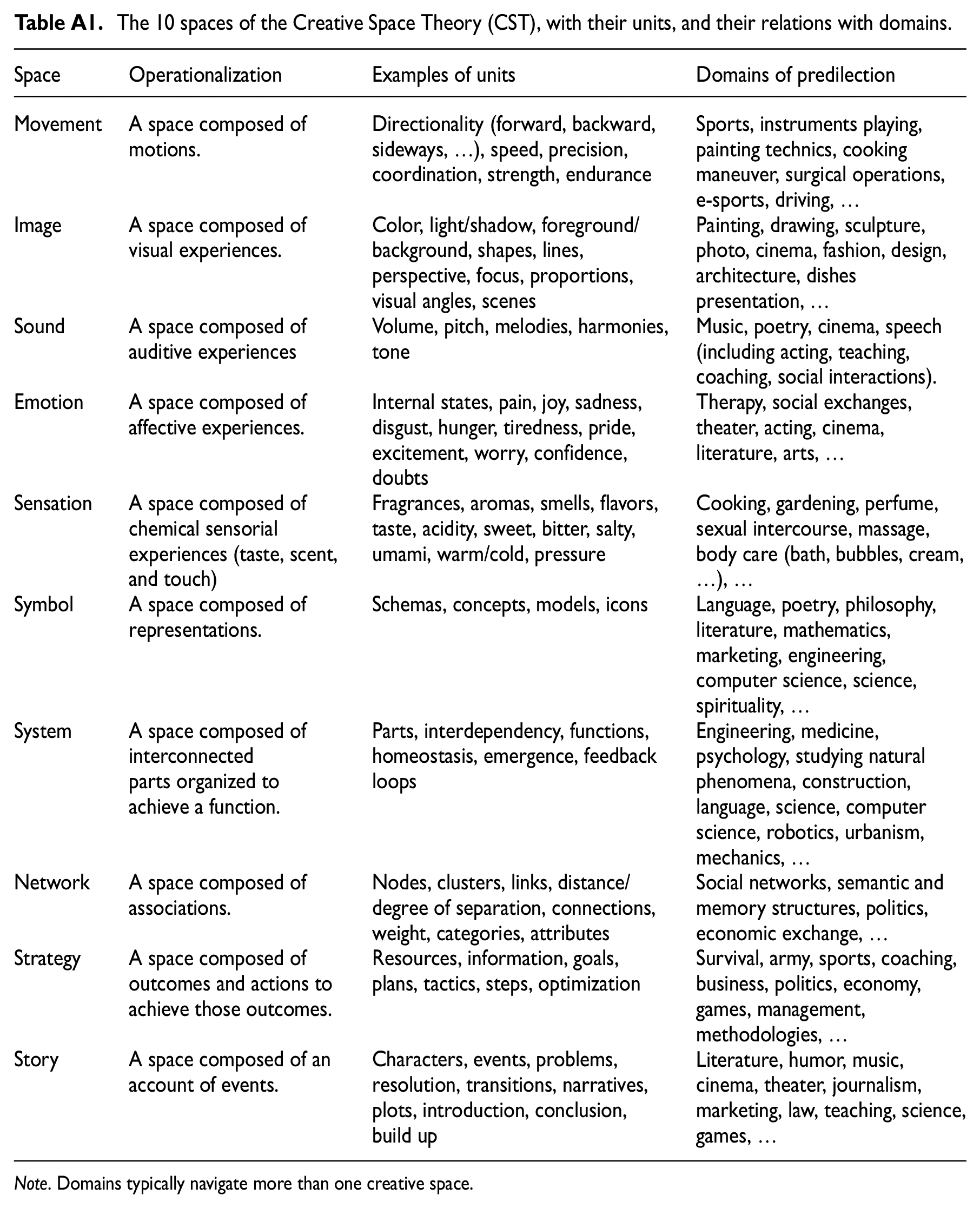
| Space | Operationalization | Examples of units | Domains of predilection |
|---|---|---|---|
| Movement | A space composed of motions. | Directionality (forward, backward, sideways, …), speed, precision, coordination, strength, endurance | Sports, instruments playing, painting technics, cooking maneuver, surgical operations, e-sports, driving, … |
| Image | A space composed of visual experiences. | Color, light/shadow, foreground/background, shapes, lines, perspective, focus, proportions, visual angles, scenes | Painting, drawing, sculpture, photo, cinema, fashion, design, architecture, dishes presentation, … |
| Sound | A space composed of auditive experiences | Volume, pitch, melodies, harmonies, tone | Music, poetry, cinema, speech (including acting, teaching, coaching, social interactions). |
| Emotion | A space composed of affective experiences. | Internal states, pain, joy, sadness, disgust, hunger, tiredness, pride, excitement, worry, confidence, doubts | Therapy, social exchanges, theater, acting, cinema, literature, arts, … |
| Sensation | A space composed of chemical sensorial experiences (taste, scent, and touch) | Fragrances, aromas, smells, flavors, taste, acidity, sweet, bitter, salty, umami, warm/cold, pressure | Cooking, gardening, perfume, sexual intercourse, massage, body care (bath, bubbles, cream, …), … |
| Symbol | A space composed of representations. | Schemas, concepts, models, icons | Language, poetry, philosophy, literature, mathematics, marketing, engineering, computer science, science, spirituality, … |
| System | A space composed of interconnected parts organized to achieve a function. | Parts, interdependency, functions, homeostasis, emergence, feedback loops | Engineering, medicine, psychology, studying natural phenomena, construction, language, science, computer science, robotics, urbanism, mechanics, … |
| Network | A space composed of associations. | Nodes, clusters, links, distance/degree of separation, connections, weight, categories, attributes | Social networks, semantic and memory structures, politics, economic exchange, … |
| Strategy | A space composed of outcomes and actions to achieve those outcomes. | Resources, information, goals, plans, tactics, steps, optimization | Survival, army, sports, coaching, business, politics, economy, games, management, methodologies, … |
| Story | A space composed of an account of events. | Characters, events, problems, resolution, transitions, narratives, plots, introduction, conclusion, build up | Literature, humor, music, cinema, theater, journalism, marketing, law, teaching, science, games, … |
Note. Domains typically navigate more than one creative space.
Declaration of conflicting interests
The author(s) declared no potential conflicts of interest with respect to the research, authorship, and/or publication of this article.
Funding
This research was supported by scholarships from the Conseil de recherches en sciences naturelles et en génie duCanada (CRSNG) awarded to the first author. DenisCousineau was supported by research grant 2016-03906 from the CRSNG.
