



Abstract
This study shares the outcome of a professional development program designed to support elementary school teachers reform their mathematics instruction using classroom discourse and invented strategies with whole number and fraction computations. A total of 21 elementary school teachers from eight schools in the southern part of the United States took part in the professional development program that consisted of 10 days of Summer Institute and 14 monthly meetings—spanning a 2-year period. The results of the study revealed that the participants enhanced their pedagogical content knowledge in whole number and fraction computations using invented strategies (evidenced by the gains from their pretest to posttest scores), improved their instructional practices in orchestrating classroom discourse (supported by the classroom videos submitted by the participants for monthly meetings discussions), and had begun changing their classroom instructions, particularly, with respect to using productive talk in teaching mathematics. The participants also reported some challenges they encountered in their efforts to transfer the knowledge they acquired from the professional development program to their classrooms. Characteristics that contributed to the success of the program, as well as implications for teacher education and professional development are presented.
Keywords
Introduction
The past two decades have witnessed several major reform initiatives in K-12 mathematics education in the United States and around the world (e.g., Common Core State Standards Initiative [CCSSI], 2010; Ministry of Education, Science, and Technology, 2011; Ministry of Education of the People's Republic of China, 2011; National Council of Teachers of Mathematics [NCTM], 2000, 2014). The main objectives of these reform initiatives were to improve teaching and learning of mathematics and to ensure that school mathematics is adequately preparing students to succeed in higher education, as well as in their future careers (NCTM, 2014). Several of the reform initiatives were motivated by changing theories about how students learn (e.g., constructivist and socio-cultural views of learning); changing trends and modalities of instruction in education (e.g., face-to-face and online education); influences of national and international assessments results (e.g., results from The Trends in International Mathematics and Science Study and the National Assessment of Educational Progress); and advances and influence of technology for teaching and learning mathematics (NCTM, 2000, 2014).
Amidst the many areas identified for improvement were calls on teachers to teach mathematics significantly different from the ways they learnt it when they were students (CCSSI, 2010; NCTM, 2000, 2014). The recommendations outlined in the NCTM Standards (2000) and subsequent documents (NCTM, 2014, 2018), for example, called on teachers to teach math through problem-solving; engage students in mathematics communication; create classroom environment that fosters collaborative learning; and use different representations to illustrate mathematics concepts to help students develop conceptual, as well as procedural understanding of mathematics. Similarly, the Common Core State Standards of Mathematics called on teachers to help students develop deeper knowledge in mathematics by linking topics across grades, develop a balance between conceptual understanding and procedural fluency, and develop critical thinking and problem-solving skills needed for twenty-first-century workforce (CCSSI, 2010).
The rigorous mathematical knowledge recommendations in many of these recent reform initiatives, coupled with a demand for greater mathematical sense-making on the part of students, require teachers to adopt new lesson structures and instructional practices such as engaging students in mathematical problem-solving; activating, assessing, and utilizing students’ prior knowledge; and posing insightful questions that elicit students’ mathematical thinking in order to enhance students learning (Smith & Stein, 2018). Several researchers have pointed out that, although teachers generally support these high standards for teaching and learning mathematics, the majority of them did not experience mathematics this way when they were students (e.g., Ball, 2003; Ball et al., 2008; Springer & Dick, 2006). Ball (2003) observed that teachers are graduates of the system that reform seeks to improve and that their own opportunities to learn mathematics have been uneven and often inadequate in meeting the demands of reform.
For example, numerous reports have acknowledged that the majority of teachers learned to teach mathematics by using models of teaching and learning that focus heavily on memorization of facts and devoid of conceptual and deeper understanding of subject matter knowledge (Ball et al., 2005, Boaler, 2009; Hill & Ball, 2004). Consequently, asking them to shift to a more balanced approach to teaching, which places more emphasis on conceptual understanding, applications of mathematics to real-life situations, and the use of new technologies in the teaching and learning of mathematics, means that teachers must learn more about the mathematics they teach, the pedagogies of teaching, and how students learn mathematics. These changes require support for teachers in a variety of ways, especially elementary school teachers (many of whom are generalists who did not specialize in a particular subject) to function effectively in their classrooms.
One of the areas of reform recommendations in mathematics education that has received significant attention over the past 15 years is classroom discourse. This is evident in the many policy documents calling for more emphasis on communication in mathematics classrooms (e.g., CCSSI, 2010; NCTM, 2000, 2014, 2018) and in the body of research that is being published in this area (Adler & Ronda, 2015; Gresham & Shannon, 2017; Smith & Stein, 2018; Smith et al., 2020). The purpose of this study, therefore, was to design a professional development program that builds on the work of prior researchers (e.g., Ball & Forzani, 2011; Smith & Stein, 2018; Smith et al., 2020) to provide elementary school teachers with guidelines and tools to enhance their pedagogical content knowledge in facilitating mathematical discourse and invented strategies on whole number and fraction computations.
These two topics (i.e., mathematical discourse and invented strategies on whole number and fraction computations) were selected because of the emphasis many recent reform initiatives place on them (e.g., CCSSI, 2010; NCTM, 2014), coupled with reports from several research studies suggesting that many mathematics teachers struggle to implement instructions that incorporate productive discourse (Gillies & Boyle, 2010; Ruys et al., 2014; Stiles, 2016; Store, 2014; Trocki et al., 2015). The topics were also chosen based on the results from a need assessment data collected from the participating teachers who indicated that they needed resources to help them incorporate these practices into instructions to ensure that they are adequately equipping their students with the relevant skills needed to be successful in the twenty-first-century economy (Howard, 2015; Johnson & Johnson, 2014; Schoenfeld & Floden, 2014; Smith & Sherin, 2019). A major aim of the professional development program, therefore, was to ensure that the activities discussed during the program were relevant to the everyday classroom practices of the participating teachers.
In light of the above, the study addressed four main research questions:
To what extent did the participants enhance their pedagogical content knowledge on invented strategies for whole number and fraction computations as a result of the professional development program? To what extent did the participants enhance their pedagogical content knowledge on facilitating classroom discourse as a result of the activities of the professional development? To what extent did the participants deem the activities of the professional development relevant to their everyday classroom practices? What types of challenges, if any, did the participants encounter as they transfer their knowledge into their classroom practices?
Literature review
Mathematical discourse
NCTM (2014) described mathematics discourse as the ways of representing, thinking, talking, writing, and engaging in educational argumentations with the goal of solving mathematical tasks in the classroom. Specifically, when students engage in mathematics discourse, they present and explain their ideas and reasoning to one another in pairs, small group, and whole-class discussions. They also listen carefully to and critique the reasoning of peers, as well as seek to understand the approaches used by peers. Due to its perceived importance in the teaching and learning mathematics, curriculum guidelines and research in mathematics education in recent years have presented the need for increased emphasis on communication in mathematics classrooms (CCSSI, 2010; NCTM, 2000, 2014, 2018). NCTM (2018), for example, recommends to use discourse to elicit students’ ideas and strategies and create space for students to interact with peers to value multiple contributions … and make discourse an expected and natural part of mathematical thinking and reasoning, and to ask questions that enhance their own mathematical learning. (NCTM, 2018, p. 33)
Other researchers call for transforming mathematics classrooms into learning communities where students engage in mathematical discourse to achieve a deeper understanding of mathematical concepts (O’Connor et al., 2017; Smith & Stein, 2018; Smith et al., 2020). Among others, these calls are based on research evidence that when students engage in mathematical discourse by justifying their mathematical thinking/processes and their reasoning and problem-solving strategies, they show increased level of conceptual understanding (NTCM, 2018; Xenofontos & Kyriakou, 2017; Zsoldos-Marchis, 2016). There is still a growing body of research exploring the benefits of mathematical discourse, as well as teachers’ knowledge of this pedagogical practice—and the extent to which teachers are able to implement lessons that incorporate productive talk effectively in their classrooms (e.g., Dunning, 2023; Smith et al., 2020).
The majority of the reports from this line of research have acknowledged that while the practice of mathematical discourse has been yielding positive results in enhancing students’ understanding of mathematics (Chapin & O’Connor, 2012; NCTM, 2014; O’Connor et al., 2017), implementing lessons that incorporate this practice in mathematics classrooms has been challenging for many mathematics teachers (Ruys et al., 2014; Stiles, 2016; Store, 2014; Trocki et al., 2015). This difficulty may be due to teachers’ unfamiliarity with these instructional strategies (e.g., Boerst et al., 2011; Smith & Stein, 2018; Smith et al., 2020), lack of sufficient understanding as to how to implement it effectively (Gillies & Boyle, 2010; Smith et al., 2020), and the demand classroom discourse places on teachers to move from teacher-centered classrooms to those that focus on students’ talk, thinking, reasoning, and justifying (Ball, 2003; Springer & Dick, 2006). Springer and Dick (2006), for example, examined some specific teachers’ practices related to implementing mathematical discourse (e.g., wait time, re-voicing, and modeling), and noted that “while teachers of mathematics are under growing pressure to increase student participation in classroom discussions, they have not been offered sufficient practical ideas on how to accomplish this feat” (p. 109).
The reluctance by teachers to embrace mathematical discourse has also been attributed to the challenges the instructional practice poses to the teachers’ control of the channels of communication, on curriculum re-organization, and the personal commitment teachers need to make to sustain their efforts in implementing it (Albert & Kim, 2013; Gillies & Boyle, 2010). Thus, while many mathematics teachers support the idea of mathematical discourse and feel some level of professional pressure to implement it in their classrooms, they lack the requisite training and understanding to orchestrate these practices effectively (Albert & Kim, 2013; Smith & Stein, 2018; Xenofontos & Kyriakou, 2017).
Given these complexities associated with implementing mathematical discourse in the classroom, it is not surprising that many teachers feel challenged in their attempt to engage students using these pedagogical practices in their classrooms. This situation, however, does not mean that teachers should desist from trying to incorporate mathematical discourse in their instruction; rather, it offers the opportunity to provide teachers with ongoing professional development in these practices. This is because several researchers have found that teachers are more likely to implement mathematical discourse in their classrooms when they have participated in professional development designed to provide them with the background knowledge and skills required for successful implementation (e.g., Gresham & Shannon, 2017; Ruys et al., 2011, 2014: Smith & Stein, 2018; Smith et al., 2020).
Algorithms and invented strategies for developing computational fluency
The use of algorithms has traditionally dominated mathematics education for many years. Barnett (1998) defined an algorithm as “a step-by-step process that guarantees the correct solution to a given problem, provided the steps are executed correctly” (p. 69). Historically, the application of standard algorithms has been a primary emphasis in the mathematics curriculum at the elementary and secondary levels (Mingus & Grassl, 1998) due to their accuracy, efficiency, and generalizability. However, while the use of algorithms represents efficient and universally applicable methods of computation, the way students are taught these algorithms without being provided with ample opportunities to explore their conceptual basis (i.e., learning them as rules without reasons) by teachers—who, themselves, may not understand the properties and structures that underlie these algorithms—makes it difficult for many students to apply the procedures meaningfully in problem-solving contexts. As Cobb and Wheatley (1988) noted, many students who correctly carry out standard algorithms procedurally do not understand the reasons for the procedures or the underlying concepts. Additionally, their success or failure in carrying out an instructed algorithm only gives insight into whether the student knows how to carry out a procedure and reveals very little about the students understanding of the underlying properties of the concept (Sahin et al., 2020).
Consequently, many recent reform recommendations in mathematics education have encouraged teachers to support students’ use of flexible methods to solving mathematics problems that are derived from their conceptual understanding of the underlying concepts (CCSSI, 2010; NCTM, 2000, 2014; Peters et al., 2013). These flexible methods of solving mathematics problems are referred to as invented strategies. Specifically, invented strategies involve students making deliberate decisions about how to solve mathematics problems based on intuitive or informal understanding of the underlying laws or properties of operations (Carpenter et al., 2015). A hallmark of these invented strategies is that students can use them flexibly to transfer their use to new situations (Sahin et al., 2020). Some scholars have argued that when students invent their own strategies for solving mathematics problems, they develop better understanding of the underlying mathematics concepts and perform better on tests of their mathematical abilities than those who use standard algorithms (Kamii & Dominick, 1998). One of the purposes of this study, therefore, was to support elementary school teachers enhance their knowledge of invented strategies on whole number and fraction computations and reform their mathematics instruction using invented strategies in their classroom.
Professional development as a tool for teacher learning
Professional development has become one of the most effective ways of addressing teacher's mathematical knowledge needed for teaching (e.g., Avalos, 2011; Borko et al., 2010; Prediger et al., 2015). It is a vital component of policies to enhance the quality of teaching and learning mathematics, with substantial resources being spent every year at the local, state, and federal levels on professional development to improve teachers’ knowledge. Through these professional development events, teachers are offered opportunities to engage in a variety of activities, including collaborative lesson planning, problem-solving, video lessons, listening to guest lectures, and visits to other classrooms or schools with similar programs with the aim of enhancing their understanding of the content they teach, acquiring effective instructional strategies for teaching the content, and exploring ways students learn mathematics (Avalos, 2011; Borko et al., 2010; Geiger et al., 2016). While some professional development programs have been praised for aiding teachers transform their instructional practices successfully, as well as helping to improve the mathematical achievement of their students, others have been criticized for failing to produce the desired change in teachers’ instructional practice because they focus on decontextualized information that does not resonate with teachers’ perceived needs (Borko et al., 2010; Saunders, 2016), and/or fail to provide teachers with the content necessary for increasing their knowledge and fostering meaningful changes in their classroom practices (Loucks-Horsley et al., 2003; Weiss et al., 2001).
Prior researchers have identified some key characteristics of effective professional development: (1) focus teachers’ thinking and learning on students’ thinking and learning; (2) foster a collegial environment in which teachers believe they can learn from one another; (3) offer teachers sustained rather than short-term professional development to help them understand new ideas and give them time to change their practice; and (4) Provide opportunities for teachers to test the theories in their classrooms in order to better understand the impact of their teaching on student learning. These core features of effective professional development have been found to enhance teachers’ knowledge, improve their instructional practice, and increase student achievement (Cwikla, 2004; Darling-Hammond et al., 2017; Desimone, 2009; Zehetmeier & Krainer, 2011). Zehetmeier and Krainer (2011) discussed three factors that enhance the sustainability of professional development programs beyond the termination of the project: content, community, and context. These researchers argued that the content should fit into the context in which the teachers operate, as well as provide teachers with opportunities to develop both content and pedagogical content knowledge. They pointed out further that, in order to foster sustainability, professional development programs should provide the participants with opportunities for community building and networking and resources in the form of school-based support by the principal and supports from colleagues and from students for a lasting continuation of achieved benefits of a project beyond its termination (Zehetmeier & Krainer, 2011).
The present study used professional development as a vehicle to help elementary school teachers enhance their pedagogical content knowledge related to mathematical discourse and invented strategies on whole number and fraction computations (Michaels & O’Connor, 2015; NTCM, 2014; Prediger et al., 2015) and to support the teachers’ efforts in adequately prepare their students with the relevant mathematical skills needed to be successful in the twenty-first-century economy (CCSSI, 2010; Johnson & Johnson, 2014; NCTM, 2014). A major aim of the program, therefore, was to ensure that the activities discussed during the professional development were relevant to the everyday classroom practices of the participating teachers.
Methods
Context of the study
This study was initiated as a result of calls from some elementary school teachers that they needed resources to help them enhance their instructional practices, as well as make sense of the complex challenges created for them by recent reform recommendations in mathematics education. To determine the specific interests and content to address during the program, a needs assessment questionnaire was administered to the teachers. The response data were used to choose the activities for the professional development. This ensured that the content of the program addressed the needs of the participants, as well as aligned well with standards adopted by their school districts. Two major themes emerged from the need assessment data: multiple ways of solving mathematics problems and engaging students in productive mathematics discussion in elementary school classroom.
Participants of the study
The participants for this study consisted of 21 elementary school mathematics teachers from eight schools within three school districts in the southern part of the United States registered for the program. They were made up of 20 females and one male teacher. The participants have classroom teaching experience ranging from 4 years to 20 years—with most of them having taught for more than 10 years.
Research design
The professional development program lasted for 2 years, with each year having two segments—a Summer Institute, followed by a School Year Monthly Meetings. Each of the Summer Institutes lasted for 5 days. The Summer Institutes took place in July preceding the school year in which the monthly meetings occurred. Each of the School Year Monthly Meetings began in September and ended in May (excluding December, and January—holidays). Figure 1 presents a summary of activities for the entire professional development project.
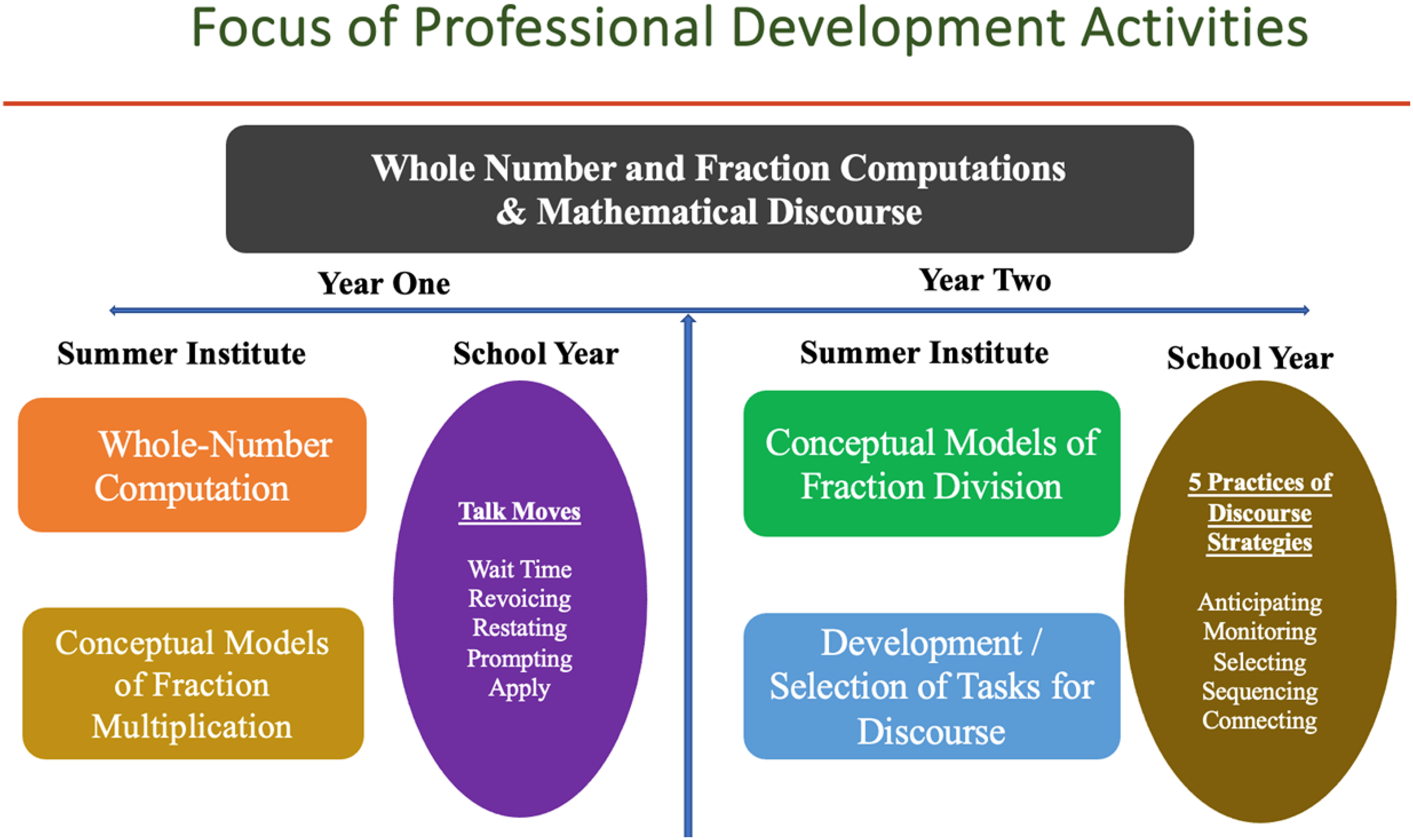
Summary of the focus of the professional development activities.
Year 1 summer institute was designed to help the participants enhance their pedagogical content knowledge on whole number computations using flexible methods/invented strategies and conceptual models (other than traditional algorithm) for multiplying fractions—within a discourse-intensive context. Figures 2–4 provide samples of invented strategies for whole number computations discussed during year one summer institute.
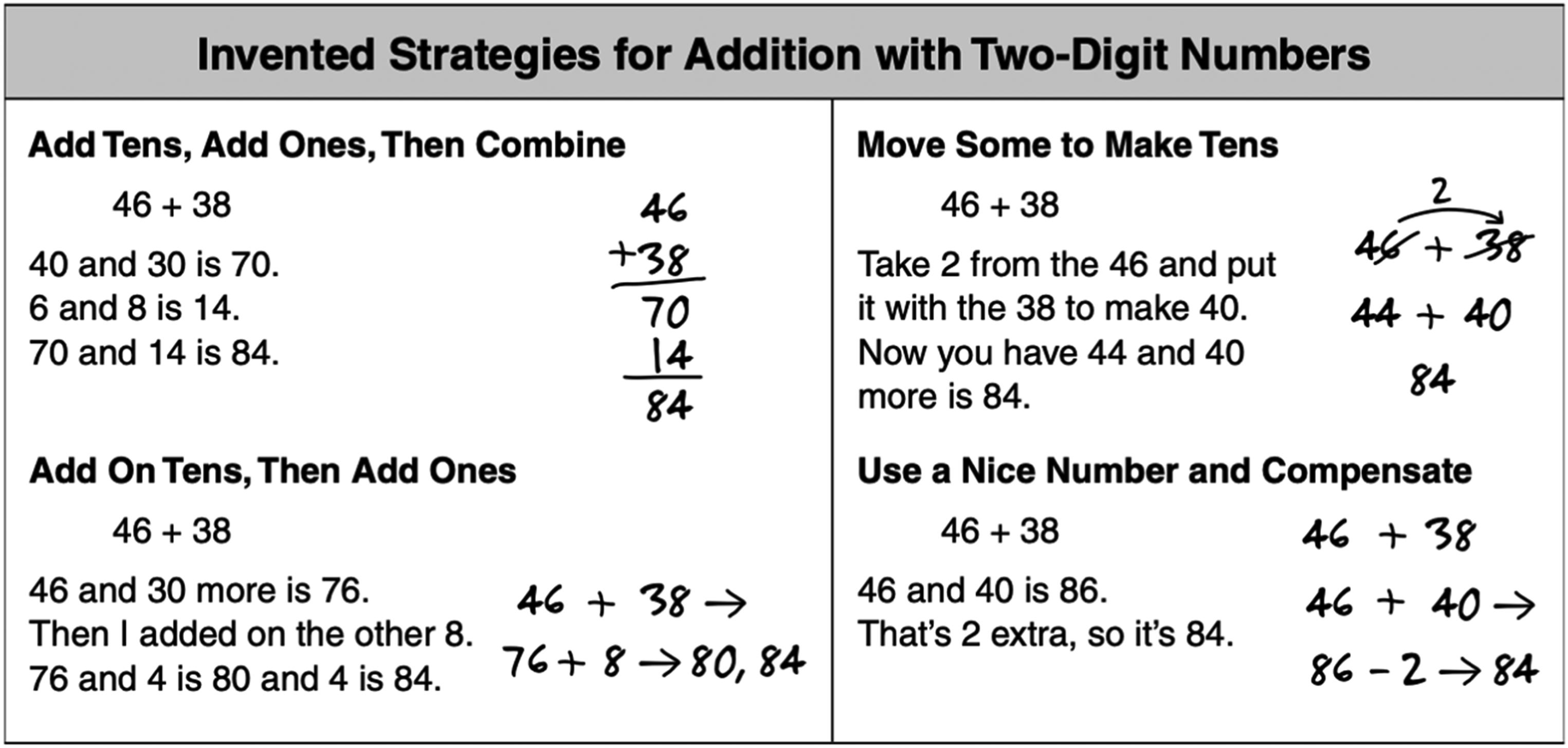
Four different invented strategies for computing 46 + 38. Taken from Van de Walle and Lovin (2013). Teaching Student-Centered Mathematics Grades 5–8.
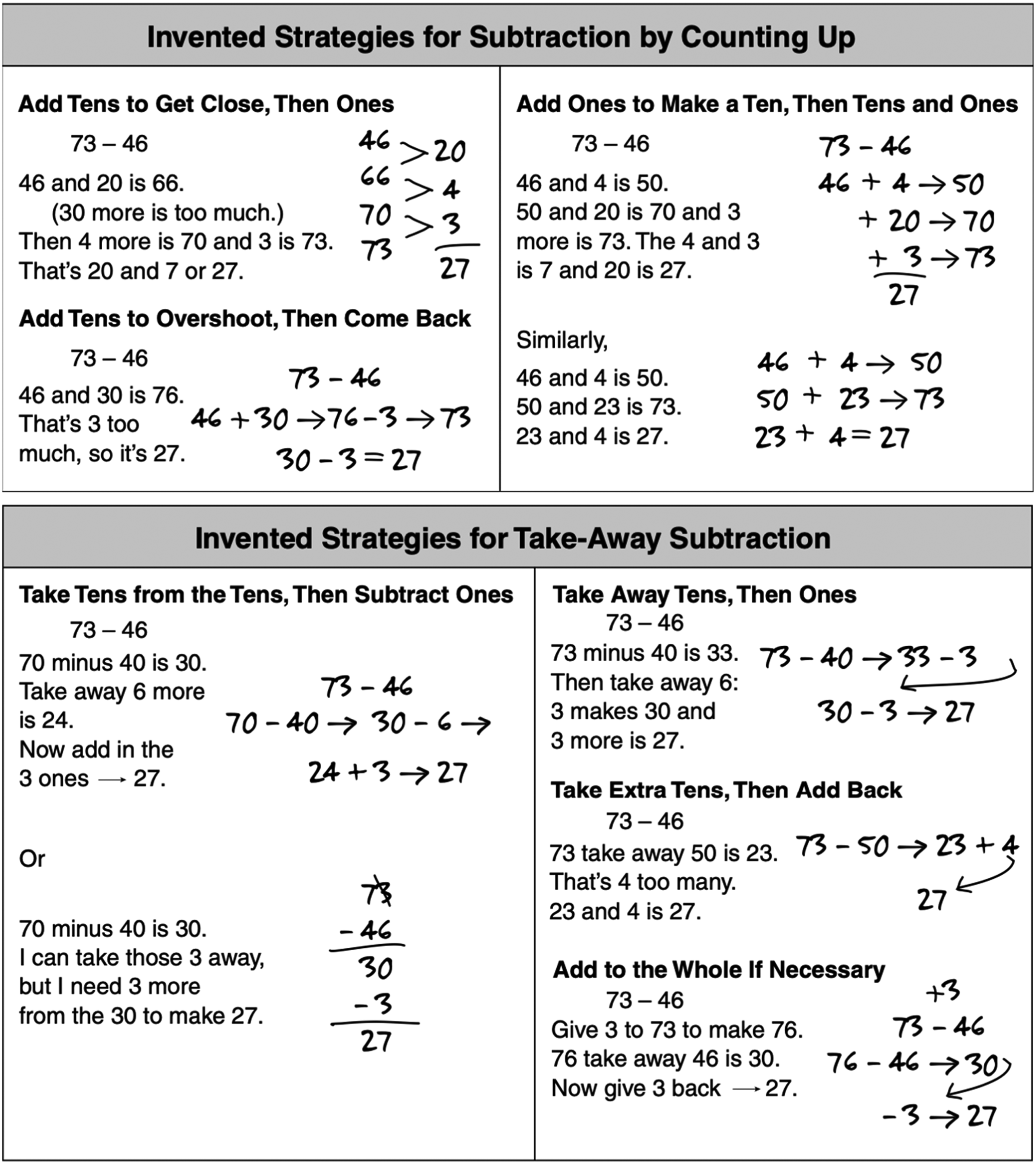
Three different invented strategies for computing 73–46. Taken from Van de Walle and Lovin (2013). Teaching Student-Centered Mathematics Grades 5–8.
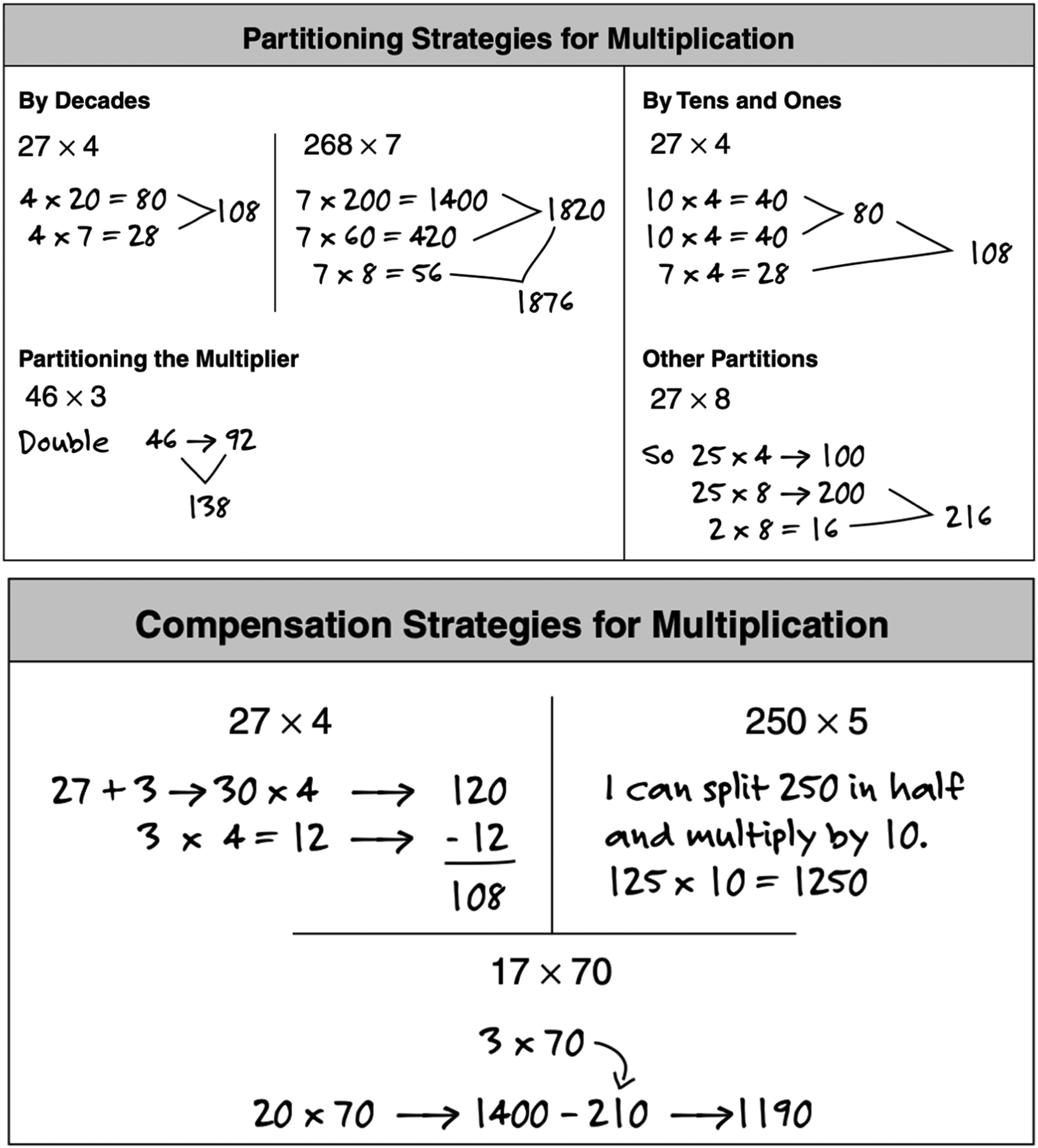
Four different invented strategies for multiplying whole numbers. Taken from Van de Walle and Lovin (2013). Teaching Student-Centered Mathematics Grades 5–8.
Participants were guided to use area models of multiplication of whole numbers to develop conceptual understanding of multiplication of fractions. Figure 5 provides samples of conceptual models of fraction multiplication discussed during the program.
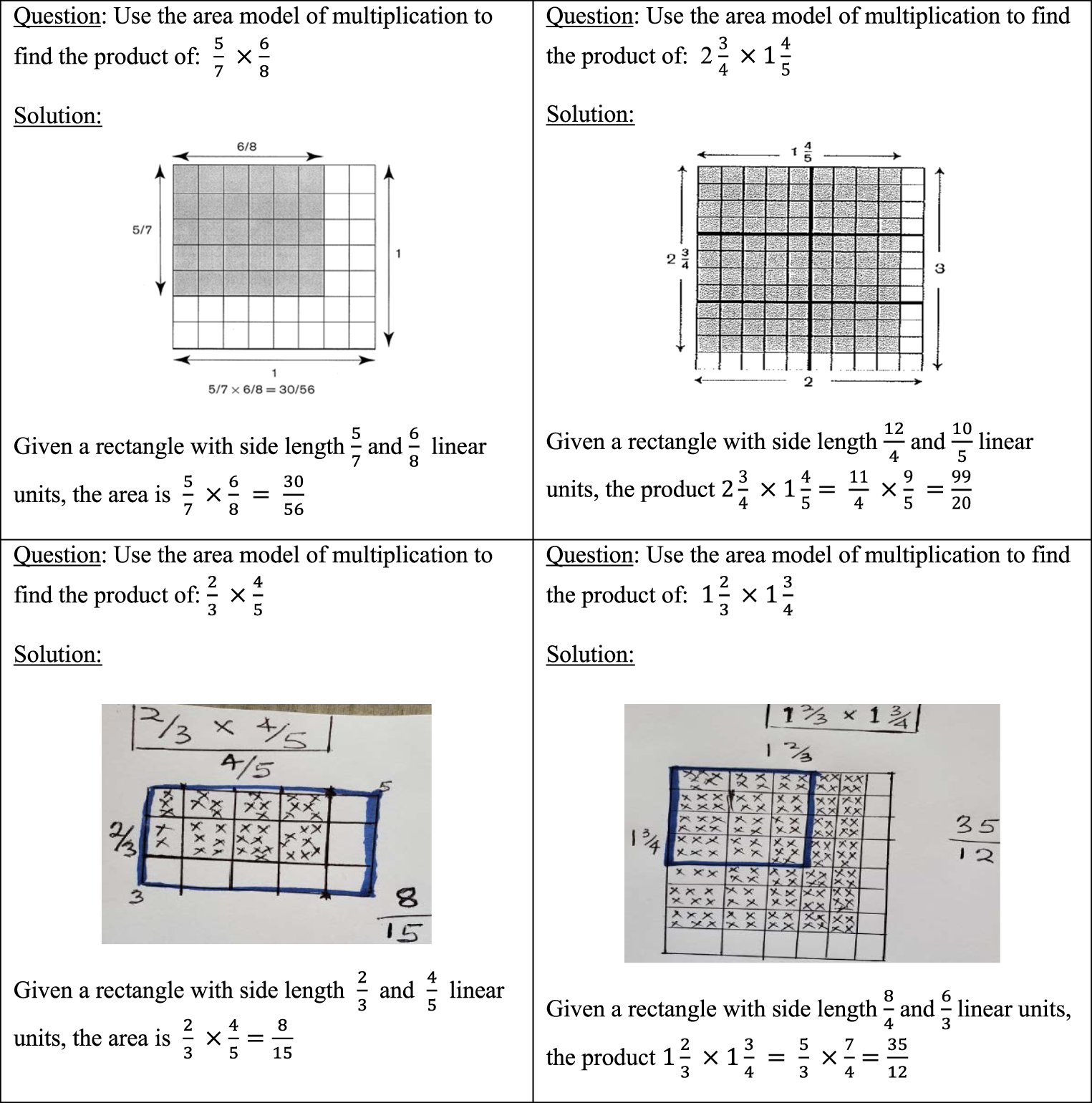
Area models for product of two fractions:
Throughout the Institute, the participants completed worksheets containing similar problems on whole number and fractions using invented strategies, after which they discussed their strategies in small groups. Following their small group discussions, the entire group watched videos of students from Grades 2 to 6 completing similar problems using invented strategies and then discussed how similar/different their own strategies/ideas matched the strategies used by the students in the videotapes. They also examined the extent to which the students in the videotapes were able to explain their thinking verbally, and/or in writing.
Year 1 monthly meetings are built on the activities from the summer institute to help the participants enhance their pedagogical skills in facilitating mathematical discourse during mathematics lessons. In particular, the meetings focused on helping the participants become familiar with the use of five talk moves—wait time, re-voicing, restating, prompting, and applying in facilitating mathematical discourse. A leading resource for classroom discourses: Classroom discussions in math: A facilitator's guide to support professional learning of discourse and the Common Core, Grades K-6 by Anderson et al. (2011), was used to guide the discussions on this topic. This book, which was published by Math Solutions, included links to over 70 video clips of students and teachers doing mathematics in their classrooms through mathematical discourse. Figure 6 presents brief information on each of the five talk moves and some of their functions that were discussed during the professional development program.
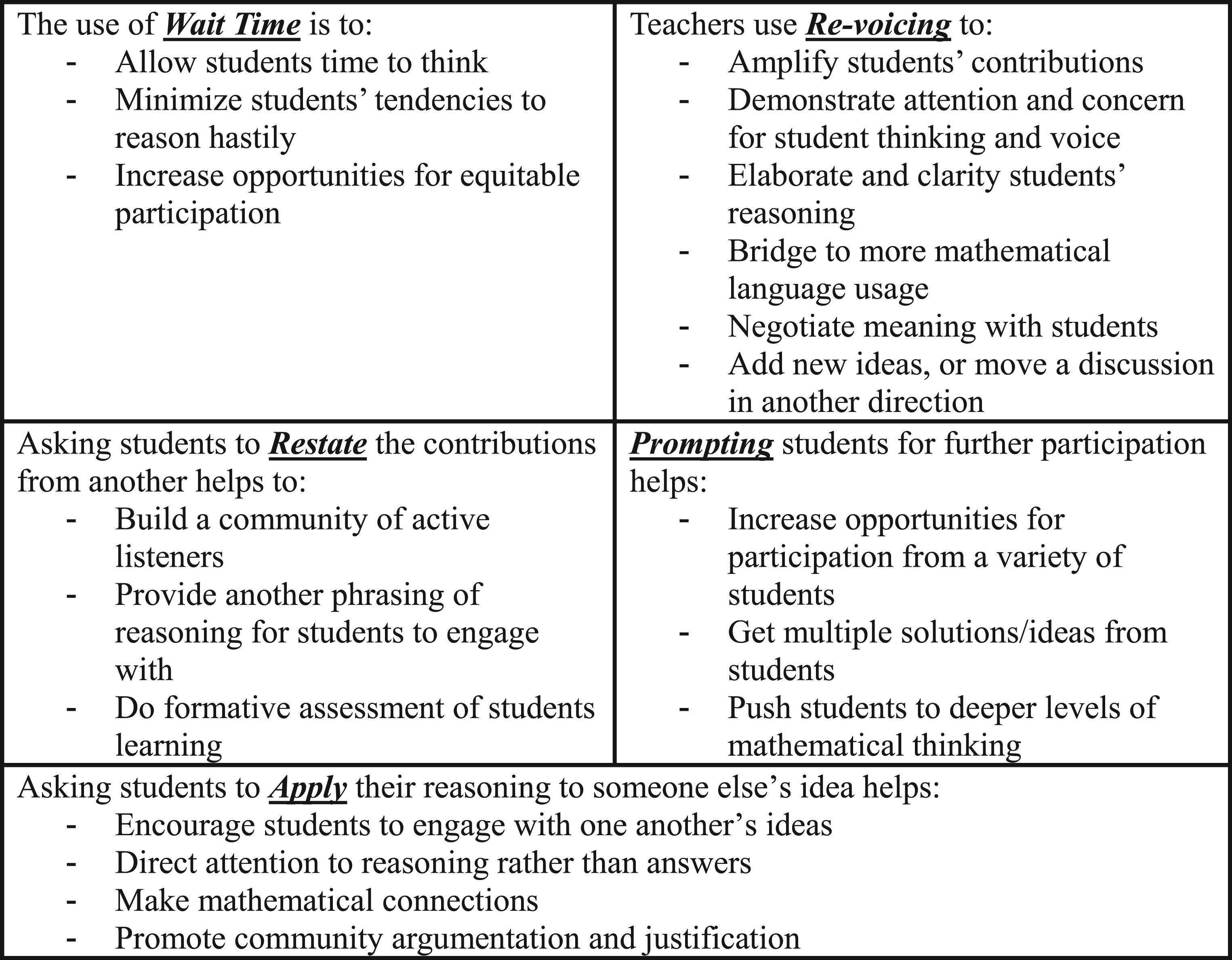
Functions of five talk moves for facilitating mathematical discourse.
After the participants were introduced to these talk moves and discussed the functions of each of them, they watched videos of mathematics lessons involving the use of these talk moves and took notes of where (in the videotaped lessons) a particular talk move was used, how effective the use of that move was, and where they think a particular move should have been used but was not used. At the end of each video-viewing segment (which lasted for 4−7 min), the participants engaged in a whole-class discussion about their observations. The use of the videotaped lessons was helpful in ensuring that the participants experienced how to facilitate mathematical discourse first-hand during the professional development (Delli Carpini, 2009; Lyman & Davidson, 2004).
Year 2 summer institute is built on the activities from year one to help participants enhance their knowledge on fraction division using conceptual models (see samples in Figure 7). As suggested by the Common Core State Standards for Mathematics, a critical area of study for students should be to “use the meaning of fractions, the meanings of multiplication and division, and the relationship between multiplication and division to understand and explain why the procedures for dividing fractions make sense” (CCSSI, 2010, p. 39). Using these models and relatable contexts, the participants explored division of fraction from measurement conception. This approach presents a more conceptual alternative to the traditional invert-and-multiply fraction division algorithm. Figure 7 provides samples of tasks for fraction division (using measurement conception of division) to develop a conceptual model for fraction division the participants explored during the program.
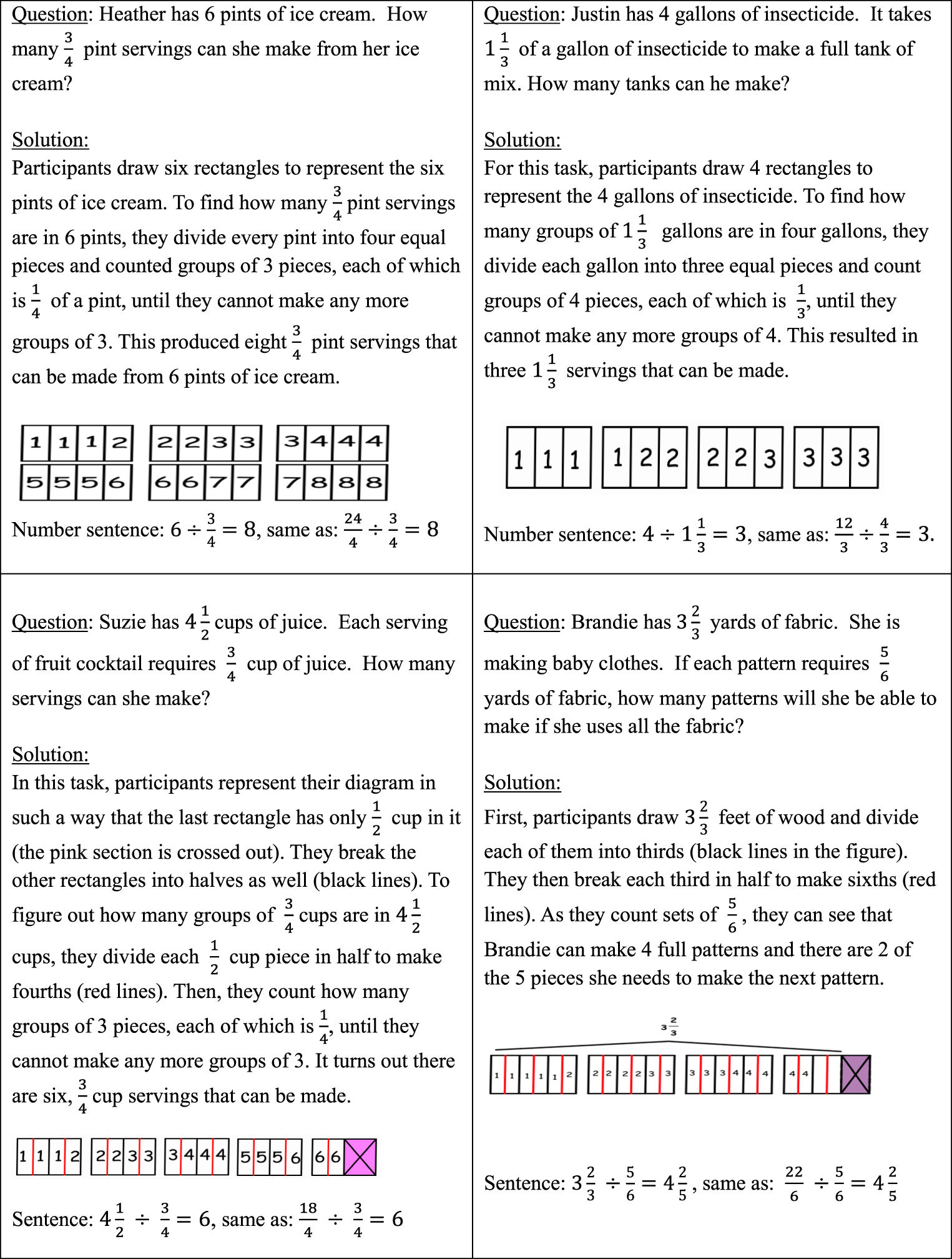
A conceptual model for division of fractions: a/b ÷ c/d.
The participants were also asked to write story problems for some indicated fraction division number sentences and equations (see Figure 8).
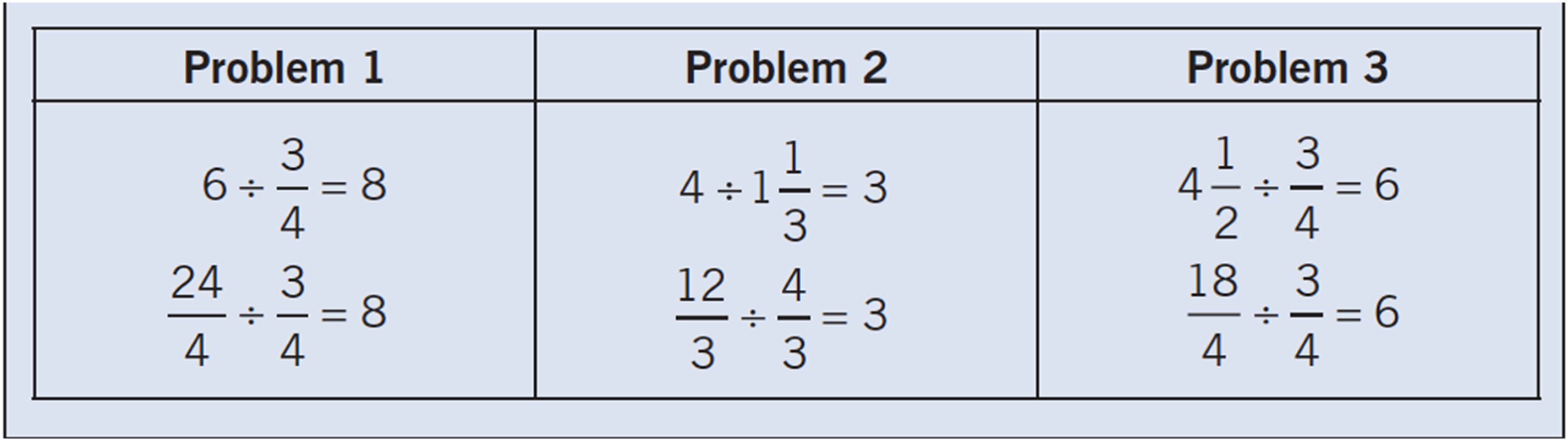
Division of fractions equations to translate into story problems.
Toward the end of year 2 summer institute, the participants worked on selecting and creating mathematical tasks for mathematics discourse. This is in recognition of the fact that the nature of mathematics tasks chosen by the teacher is a critical element to facilitating productive discussions. Franke et al. (2007) noted that discourse will be more effective if teachers use mathematical tasks that allow for multiple strategies, that are accessible to all (or, most) students, that connect core mathematical ideas, and that are of interest to the students. Working in small groups that were created based on grade level interests, the participants discussed the features of tasks that support productive talk in the classroom and identified, selected, or developed mathematical tasks that could be used in their classrooms in the upcoming school year to provide opportunities for students to use invented strategies and mathematical discourse in learning mathematics. There werer four working groups (based on grade level interests) for this segment of the events: Grade 2 group (consisted of five members), Grade 3 group (five members), Grade 4 group (six members), and Grade 5 group (five members). This grouping was intended to provide opportunities for teachers at the same grade level to collaborate within/across school/school districts.
The second-year monthly meetings focused on helping the participants become familiar with five practices for orchestrating productive mathematics discussions. Smith and Stein (2018) highlighted the complexity of orchestrating productive mathematics discourses and suggested that teachers use the following five strategies to enhance the practice of discourse in the mathematics classroom: (a) anticipating strategies, (b) monitoring strategies, (c) selecting strategies, (d) sequencing strategies, and (e) connecting strategies. Smith and Stein (2018) advocated that these five practices provide a coherent set of instructional practices that teachers can purposefully engage to enhance discourse.
Specifically, Smith and Stein (2018) argued that, for mathematics discourse to be productive, teachers must anticipate students’ strategies by completing the tasks beforehand and generate multiple strategies that students might use when engaging with the tasks. After posing the tasks to students, teachers should monitor students’ strategies as they engage with the problem. In selecting solutions for discussion, teachers should select both correct and incorrect answers to create opportunities to use students’ incorrect answers to address common misconceptions. As they select strategies, they must sequence these strategies to determine the order in which they should be shared. And, during the discussions, teachers must make efforts to connect the strategies, help students notice and articulate key mathematical ideas embedded in student strategies, and make mathematical comparisons among multiple strategies (Rubel et al., 2021; Smith & Stein, 2018).
Additionally, seven of the participants volunteered to bring videotape lessons of their students using invented strategies and mathematics discourse in their classrooms to the monthly meetings for discussions. Consequently, some of the monthly meetings were used to discuss the kind of instructional changes that were taking place in the participants’ classrooms, that is, the successes they were realizing, and the challenges they were facing in implementing these practices in their classrooms.
Data collection and analysis
The data for this study came from three different sources: pretest-posttest assessments, observation checklist, and reflective notes/exit surveys.
Pretest-posttest
The participants completed pretest and posttest assessments at the beginning and the end of the professional development program. The assessments consisted of 10 problems on whole number and fraction computations and assess whether the participants can solve some of these problems using invented strategies, make sense of students’ solution strategies presented for some of the items, and/or recognize some common students’ errors in some of the solutions presented. Thus, while some of the items asked participants to provide two to three different invented strategies for solving some of the tasks, others required the participants to examine the appropriateness of students’ solution strategies, and/or provide written justifications to students’ common errors in some of the solutions presented. Figure 9 provides sample of items on the pretest/posttest assessments:
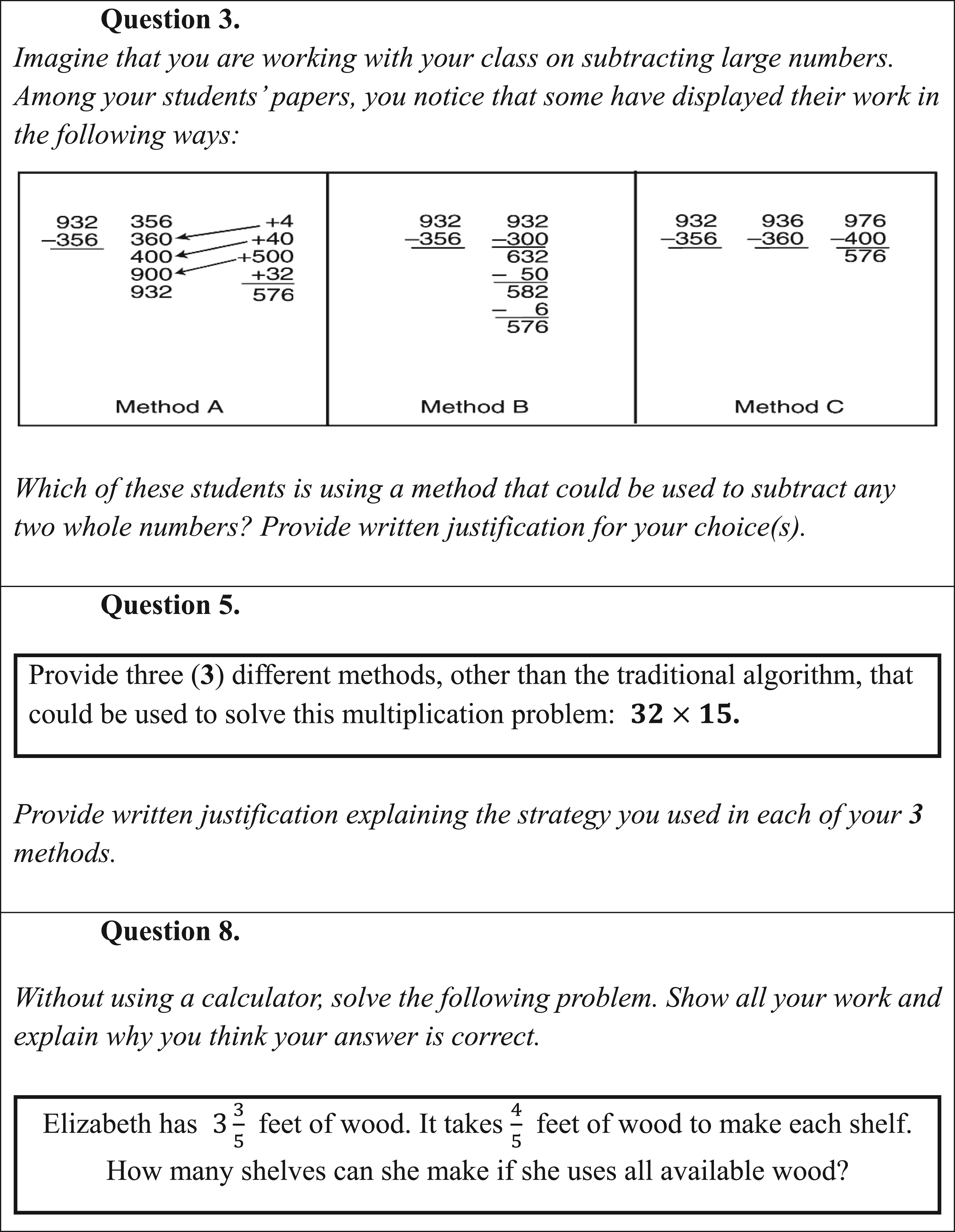
A sample items on the pretest-posttest assessment.
Six of the items on the pretest/posttest assessment were adapted from the University of Michigan's Learning Mathematics for Teaching project developed by Hill et al. (2004) that has been piloted with over 2,000 teachers with a well-documented validity and reliability measures. The remaining four items on the pretest/posttest assessment were developed by the researcher. In all, 21 participants completed both the pretest and posttest assessments—which were identical in nature to allow the researcher to analyze any changes in teachers’ pedagogical content knowledge that might occur during the professional development.
Each of the items on the assessment was scored out of 10 points, with partial credits awarded for incomplete solutions, with possibilities of scores between “0” (indicating no response or completely wrong answer) to “10” (indicating clear understanding and complete solution) to that question. Thus, the minimum scores any participant can obtain on the entire pretest or the posttest was 0 if they did not answer any of the 10 questions or answered all the 10 questions incorrectly and a maximum of 100 if they answered all the 10 questions correctly. The pretest/posttest assessment scores were analyzed quantitatively using a dependent t-test to determine whether there was any statistical difference in the participants’ performance from the pretest to the posttest.
The researcher observed the participants as they discussed problems and their solution strategies in their groups and as they watched videotaped lessons and discussed students’ solution strategies during the entire professional development. While the participants engaged in these discussions, the researcher took notes of any changes in the nature and the level of sophistication in their discussions over time. The participants were also provided with prompts to write down notes as they watched videotaped lessons of students doing mathematics—for example, “Based on evidence from the video, what can you tell about what students understand about the mathematics?”
Reflective notes and exit surveys
After every monthly meeting, each participant completed a reflection journal consisting of specific prompts that assessed their pedagogical content knowledge. These reflections were not only meant to provide opportunities for participants to think meaningfully about program activities, but they also provided the researcher with valuable, real-time feedback about participants’ understandings of the activities of the program and assisted in gauging the effectiveness of the program to assess any needs for modifications during the course of the 2-year period. Figure 10 provides a sample of prompts in the participants’ reflection journals.
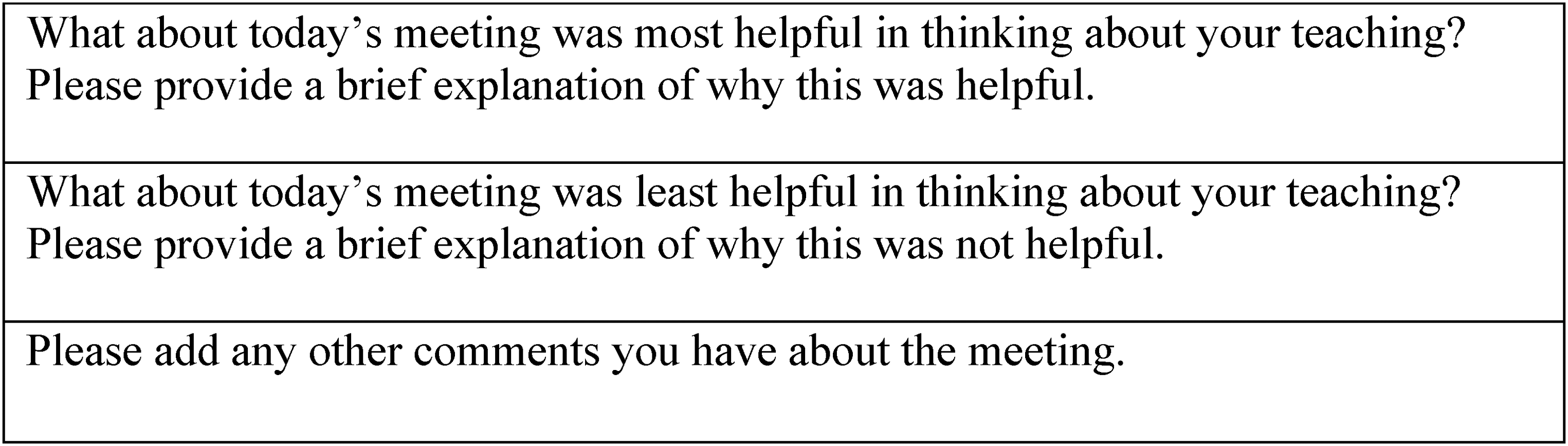
A sample of reflection journal prompts.
The exit surveys were completed at the end of each of the summer institutes, as well as at the end of each of the yearly meetings. These end-of-institute and end-of-year exit surveys asked the participants about their overall experience, if/how they are incorporating the instructional practices discussed during the professional development program into their classrooms, if they have initiated/maintained contacts with other participants from the professional development, and if they have any suggestions/recommendations that will improve future program implementation. It also asked them to identify any challenges they encountered as they attempt to transfer their learning from the program into their classrooms.
The data from the participants’ observations, reflective notes, and the exit surveys were analyzed qualitatively using constant comparative method (Creswell, 2013; Merriam, 2009; Miles et al., 2014). Merriam (2009) defined constant comparative technique as a method that involves comparing one segment of data with another to determine similarities and differences. Miles et al. (2014) stated that as new data are constantly compared with previous data, new topological dimensions, as well as new relationships, may be discovered. These dimensions become categories and are given names, with an overriding objective to locate patterns in the data and arrange them in relationship to each other. This method was used to examine the data from the observations, reflective notes, and the exit surveys and created initial list of categories related to invented strategies, mathematical discourse, relevance of program, and transfer of practice to classroom to identify themes (Creswell, 2013; Miles et al., 2014). The initial list included categories such as “multiple ways of solving the same problem,” “incorporating math talk,” “invented strategies,” “standard algorithm/method,” “arrangement of classroom,” “identifying good questions for discussions,” “family of talk moves,” “energized for the upcoming school year,” “learned new concepts,” “practical and relevant to my teaching,” “time consuming,” “hands-on,” “adequate feedback and support,” “school/district support,” “networking,” “transfer challenges,” and “state assessment.” These categories were then compared, refined, and, in some cases, merged to identify the final themes (Creswell, 2013; Miles et al., 2014). Table 1 in the results section displays the final themes that emerged from this analysis, and some of the supporting statements for each of the themes.
This study designed a professional development program to support elementary school teachers enhance their instructional practices on whole number and fraction computations using flexible/invented strategies and to implement productive mathematical discourse in their classrooms. Data were collected using pretest-posttest assessments, participants observations, and reflective journals and exit surveys to measure (1) the extent to which the participants increased their pedagogical content knowledge in the topics discussed during the professional development; (2) the extent to which the participants deemed the activities in the professional development sessions relevant to their instructional practice; and (3) the types of challenges the participants encounter as they transfer their knowledge into their classroom practices. Table 1 displays information on final themes and some supporting statements that emerged from analyzing participants’ data from observations/video-viewing notes and reflective notes/exit surveys using constant comparative method.
Summary of analysis of participants’ data from observations/video-viewing and reflective notes/exit surveys.
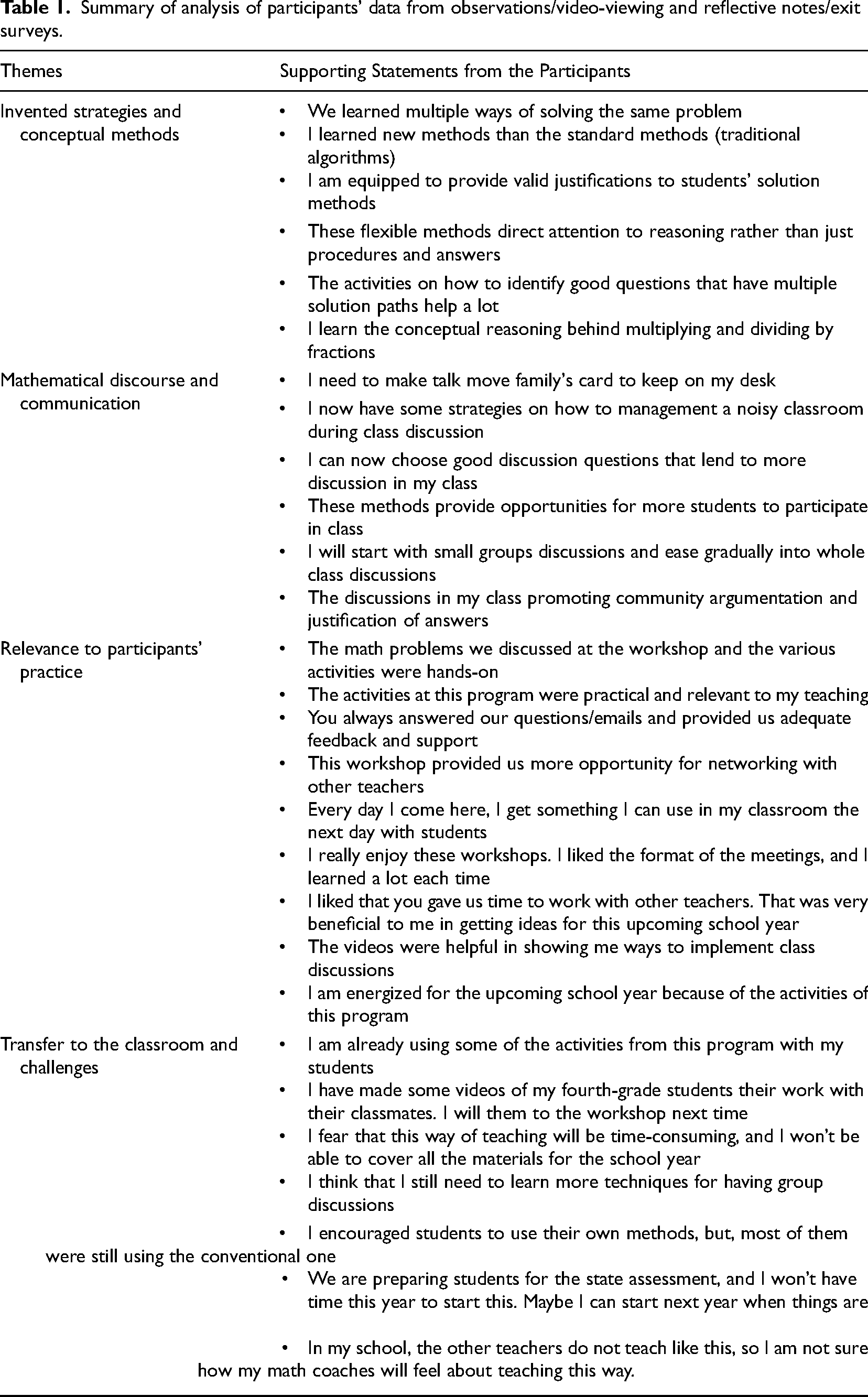
Summary of analysis of participants’ data from observations/video-viewing and reflective notes/exit surveys.
Table 2 presents the sample size, means, and standard deviations of the participants’ scores on pretest and posttest assessments of the whole number and fraction computations using invented strategies. A cursory examination of the information in the table shows that the mean performance on the posttest was 20.8 points higher than the mean performance on the pretest.
Means and standard deviations of participants’ scores on the pretest and posttest assessments.

Means and standard deviations of participants’ scores on the pretest and posttest assessments.
In order to investigate whether this gain on the posttest was statistically better than the performance on the pretest, a paired-sample t-test analysis was conducted at .05 level of alpha. The result shows that mean performance on the posttest (M = 75.9, SD = 13.1) was significantly higher than the mean performance on the pretest, M = 55.1, SD = 11.6; t(20) = 6.906, p < .0005, with a high effect size (Cohen's d = 1.68). Notably, the majority of the participants provided a variety of flexible methods (other than a traditional algorithm) in solving the problems on the posttest, as well as provided valid justifications of students’ solutions strategies (reasoning into students’ thinking) compared to their performance on the pretest.
Additionally, the participants reported (in their reflective journals and exit surveys) that the discussions on invented strategies for whole number and fraction computations and the discussions about students’ solution strategies enhanced their conceptual understanding of whole number and fractions, as well as their pedagogical content knowledge on whole number and fraction computations. They also reported learning many ways of solving the same problem and, as a result, are open to the idea of encouraging multiple solution strategies from students. Below are sample statements from the participants’ reflective notes and exit survey (see more excerpts also in Table 1): I was taught math in a direct way. I was not given the opportunity to explore how numbers come together. This professional development helped my conceptual understanding grew to a great extent, and now I want my next group of students to discover multiple ways to approach a problem. (Jane) When I was in school, I’ve only learned the process of doing math, not the concept. This program helped me learn the conceptual reasoning behind multiplying and dividing by fractions. (John) I feel that through observing my peers explain how and why they came up with answers to questions (and proved that there are many ways to do so) my conceptual knowledge grew as a result. (Jacky)
Analysis of the participants’ reflective notes and exit survey reports indicated that they have learned new concepts and instructional approaches and appreciated the value of the mathematical discourse in enhancing their instructional practices. The majority of the participants (i.e., 18 out of the 21 participants, representing a little over 85%) in response to questions on the final (end of program) exit survey indicated that they were planning to start, or had already begun incorporating productive talks more effectively in their instructional practice. Below are samples of participant's comments on how they were implementing (or planning to implement) mathematics discourse in their teaching: I have learned that I need to incorporate more math talk in my classroom. I don’t have to be the “one” giving all the notes/instructions while the students copy them and do not interact with each other. (Jessica) Because of the things I learned in this class, I plan on arranging my room differently this year. I will arrange my desks in a way that is conducive to discussion within small groups. I think that starting with the “Turn-and-Talk move” will be easier than jumping in with a whole class discussion. I want to ease into the steps toward productive classroom discussions and the more I feel confident with them, the more I will begin to use whole class discussions. I don’t want to try to do too much at one time and get overwhelmed. I want to start where I feel more comfortable and work my way up from there. (Joan) I am planning on coming up with good discussion questions that lend to more discussion in my class. I will use this talk as an assessment tool to know what my students need help with, and which students need more help. It is okay to have a noisy classroom, as long as the talk is productive. As each daily lesson progresses, I will make a conscious effort to use steps toward creating productive discussions. (Jodi) I plan on making me a “Talk Move Families” card to keep on my desk so that I will be constantly reminded of these techniques to use during my class instructions/lessons. If I’m able to look at them daily, I’ll be more likely to use them. I will also post the Students’ Rights and Obligations for classroom talk on my wall to remind myself and my students of the “rules” for classroom talk. This will also be included on my beginning of the year letter home to parents. (Jaclyn) Knowing and using these practices 5 practices of mathematics discourse really changed and improved my classroom discussions. Working through the problems by myself first and thinking about the possible students’ solutions (both correct and wrong) is making a big difference in how I implement classroom discussions now. I don’t only use this set of strategies for math, but I also use them in my reading and social study lessons. (Judith)
The participants also indicated that the videotaped lessons on elementary school students using mathematical discourse and working collaboratively in their classrooms that they watched during the professional development sessions provided them with practical models on how to implement these instructional strategies in their own classrooms. They also indicated that their experiences working with their colleagues in teams (working group sessions) during the professional development better prepared them to appreciate teaching their students to work in groups. Jennifer expressed the following view: I really did enjoy this class. I liked the format of the meetings and learned a lot. I liked that you gave us time to work with other teachers at the end of the event. That was very beneficial to me in getting ideas for this upcoming school year. The videos were helpful in showing me ways to implement class discussions. Thanks! (Jennifer)
Seventeen of the 21 participants (representing approximately 81%), in response to questions on the final (end of program) exit survey, reported that they had maintained contact with other participants from the professional development with whom they were establishing professional development network.
Participants’ observations and perceptions of relevance of the professional development to their classroom practice
The observation data revealed some noticeable changes in the nature of the participants’ discourse over time. In particular, the participants’ conversations about the mathematics they were doing and their discussions about students’ thinking and ideas in the videotaped lessons they were watching moved from simple statements to a more sophisticated analysis of students’ actions and ideas. For example, at the beginning of the program, after watching video segments of students doing mathematics, in discussing the video, the majority of the participants were just making general statements such as “Oh, I like that strategy; I can understand why John was solving the problem that way.”
Toward the end of the program, these types of statements changed to a more detailed description of the specific strategies that the students were using to solve the problems, such as “I see that Carl was using the idea of doubling and halving to solve the problem [32 × 15] because one of the products is even, whilst Molly was using partitioning with partial products to solve it.” A similar change in describing the actions of the teachers in the video segments was observed toward the end of the program, where the participants referred to the specific actions taken by the teachers in the videos, and why those actions were being taken (e.g., referring to particular talk moves by names: restating, re-voicing, … and why those moves were being used as opposed to just making general statements).
Additionally, the researcher observed that many of the participants who were reluctant at the beginning of the program to engage in the discussions of the videos about students’ thinking/teachers’ actions or share their own solution strategies began contributing to the discussions as well as sharing their own thought processes about the mathematics they were doing during the course of the professional development activities. Another important observation made by the researcher (which was also reported by some of the participants) was that almost all of the participants arrived at the monthly meetings (which were held immediately after school from 4:30 p.m. to 7:00 p.m.) very tired after their respective day-long duties at school but energized by the time they leave the monthly meeting events. Julie wrote the following in her reflective notes: On some of the meeting days, I feel so exhausted by the time I get here. But, after eating my snack and watching the videos of these kids doing math and discussing their methods, the tiredness goes away, and the meeting time runs by so quickly for me. I feel like doing more mathematics! (Julie)
One of the aims of the professional development was to ensure that the activities discussed during the program were relevant to the everyday classroom practices of the participating teachers. To this end, there were questions in the exit survey and prompts in reflective journals that asked the participants to provide information regarding their perceptions of relevance of the program activities to their instructional needs. Analysis of the information provided by these questions indicated that the participants enjoyed the activities of the professional development and that it was practical and relevant to their daily classroom practice—several of them stated that they have a product that they can “use tomorrow in their classrooms.” In fact, approximately 62% of the participants in response to questions on the final (end of program) exit survey indicated that the professional development activities addressed most of their pressing professional needs, while 86% of the participants reported that the instructional techniques used during the professional development were appropriate for their teaching and that they would share what they have learnt with colleagues in their schools who could not participate in the program.
They also appreciated the fact that the program was not “a one-time deal” phenomenon, but was sustained over 2 years, thereby, giving them time to try the new strategies they have learnt in their classrooms, as well as receiving help from a support team (i.e., from the program coordinator and their colleagues) whenever they faced challenges during the course of their implementations. Thus, the participants noted that the program's effectiveness to them was related to its relevance, delivery style, duration (long-term), availability of a support system, and the opportunities to network with other teachers.
Transfer challenges
While 15 of the 21 participants, representing approximately 71%, in response to questions on the final (end of program) exit survey reported that the program provided them with useful methods for transferring new knowledge and skills to their classrooms, others expressed concerns about not being able to implement these methods successfully in their classrooms because of time constraints (i.e., they feel that the methods will take up too much time and, thus, render them unable to cover their standards or schedules for the school year). A few of the participants also reported pushback from their administrators/supervisors who were not familiar with the new approaches to teaching that they were implementing. Additionally, some of the participants indicated that the new instructional strategies exert a great demand on them to re-organize their curriculum, in addition to putting them out of their comfort zones in terms of control of the channels of communication and that they do not feel adequately prepared yet to function effectively in such environments: Some of the participants expressed the desire to learn more about specific topics in their reflective notes and exit surveys: I think that I still need to learn more techniques for having group discussions and help writing questions that will lead to good class talk. I also want to know more about how to implement talk moves effectively. I think that the videos of real classroom teachers in action will help. I learned a lot by watching the videos in class and it will only help me to see more. I want to see how teachers handle uncooperative students. I think that seeing what other teachers do in their classrooms will help me the most. I am also interested in networking more with teachers and other professionals. (Jolie)
Discussion
This study shares the outcome of a professional development program designed to support elementary school teachers reform their instructional practices by enhancing their pedagogical content knowledge on whole number and fraction computations using flexible/invented strategies within a discourse-intensive learning environment. Data were collected through pretest-posttest assessments, participants’ observations, and reflective notes and exit surveys. The results indicated that the participants enhanced their pedagogical content knowledge on whole number and fraction computations using invented strategies (as evidenced by the gain score from their pretest-posttest performances) and in facilitating classroom discourse. The majority of the participants stated that they have learnt new concepts, new methods on whole number and fraction computations using flexible methods with conceptual basis, and new instructional approaches to teaching mathematics. All the participants reported that, as a result of the activities of the professional development, they are better equipped to examine students’ solution strategies and provide valid justifications to students’ solution methods and are now open to the idea of encouraging multiple solution strategies from students. Furthermore, the participants reported that their experiences with the working groups during the professional development program prepared them to appreciate teaching their students to work in groups, as well as provided them with opportunities to network with other teachers.
An important goal of this professional development program was to examine its impact on the pedagogical content knowledge and instructional practices of the participants to ensure that the activities of the professional development equip them with mathematical knowledge and skills that will be usable to them in ways that will help them teach mathematics more effectively (Avalos, 2011; Borko et al., 2010; Geiger et al., 2016; Prediger et al., 2015). In that respect, the results of this program were hopeful—the participants enhanced their pedagogical content knowledge on whole number and fraction computations, improved their instructional practices in orchestrating mathematical discourse, and deemed the activities and the delivery style of the professional development as practical and relevant to their daily classroom practices. As a result of the program activities, many of the participants reported that they have begun changing their instructional practices from a descriptive stance to a more inquiry approach and are now requiring multiple solution strategies, as well as written/verbal justifications from their students about their solution methods. It is worth pointing out that, although these are participants’ self-reports that have not been independently verified by the researcher (due to not having permission to visit and observe participants classroom activities in their respective schools), the videos of the instructional activities that some of the participants brought to the monthly meetings for discussions and the questions/issues that the majority of the participants brought to the monthly meetings for discussion seem to support these reports.
The findings from this study seem to support prior research reports that teachers were inclined to incorporate new instructional practices into their teaching when they have participated in professional development program that equips them with the background knowledge and skills required for successful implementation (e.g., Ruys et al., 2011, 2014; Xenofontos & Kyriakou, 2017). There is also growing research evidence showing that students will demonstrate more complex thinking and problem-solving skills, both in their discourse and follow-up learning outcomes, when their teachers participate in professional development on how to incorporate these instructional practices in classrooms (Xenofontos & Kyriakou, 2017; Zsoldos-Marchis, 2016).
There is a well-documented consensus over the past two decades that professional development programs that focus teachers’ thinking and learning on students’ thinking and learning; foster a collegial environment in which teachers believe they can learn from one another; offer teachers sustained rather than short-term professional development to help them understand new ideas and give them time to change their practice; and provide opportunities for teachers to test their theories in their classrooms in order to better understand the impact of their teaching on student learning yield the best results in producing changes in classroom practices, and hence in their students’ learning (e.g., Cwikla, 2004; Darling-Hammond et al., 2017; Desimone, 2009; Zehetmeier & Krainer, 2011). The researcher believed that the professional development program described in this paper was successful (to a great extent) in producing changes in the teachers’ knowledge and, subsequently, in their classroom practices because it shares some of these characteristics that are necessary for impactful professional development programs.
It is worth noting, however, that a few of the participants expressed concerns about implementing the new knowledge in their classrooms—stating that the implementation of the instructional approaches in their classrooms is taking up more instructional time and consequently rendering them unable to cover their required standards for the school year. As in this study, other studies have found that while teachers may be positive about embedding mathematical discourse in their instruction after participating in professional development programs, once they go back to their schools, they may feel the pressures of time and curriculum re-organization (Buchs et al., 2017; Jolliffe & Snaith, 2017) and, consequently may, at best, only embed these instructional practices occasionally. In fact, some reports indicated that only about 15%–30% of teachers who have received professional development in instructional practices such as mathematical discourse implement them routinely (Buchs et al., 2017). One way to address the pressure of time and the inability to cover their required standards for the school year due to efforts spent on implementing innovative practices in the classrooms could be for teachers to implement innovative practices incrementally (i.e., in small bites) and then scale them up, more seamlessly, as they gain confidence in their delivery.
Several researchers have examined the fostering factors that enhance the sustainability of professional development programs for teachers that will stay with them long after the project is terminated (e.g., Owston, 2007; Zehetmeier, 2008; Zehetmeier & Krainer, 2011). Among the most influential factors discussed were content, community, and context. In reflecting on the sustainability of the program described in the present study, the researcher observed that the working groups that were created based on grade levels across schools/school districts to provide support system and opportunities to network with other teachers (i.e., community) were not as effective as was envisaged. This was contrary to the researcher's initial belief that teachers from the same grade level (irrespective of schools/school districts) could collaborate better on common content they teach at that grade level, than creating working groups for teachers from the same school but teaching different grade levels to collaborate/network. Moreover, because there were very few participants from some of the schools (e.g., there was only one participant from school #6), it was impossible to create working groups based on the same school. Another issue about sustainability is related to context. As stated earlier, a few of the participants reported having observed a push back from their administrators/supervisors who were not familiar with the new approaches to teaching that they were implementing. Prior researchers emphasized that teachers need administrative and school-based supports, such as support from the principal, and support from colleagues and students for a lasting continuation of achieved benefits of a professional development project beyond its termination (e.g, Owston, 2007; Zehetmeier, 2008; Zehetmeier & Krainer, 2011).
To this end, school administrators can play crucial role in supporting teachers who participate in professional development programs to implement innovative instructional practices in their respective schools by creating a supporting environment that allows teachers the time, the space, and the flexibility to experiment with these new pedagogical skills without being penalized for not necessarily producing the desired outcomes immediately. Also, given the difficulty involved in lone teachers trying to implement knowledge acquired from professional development programs in their respective schools (as in the case of the teacher from school #6 in this study—who was the only teacher from her school), administrators can enhance teacher's efforts in this direction by sponsoring more than one teacher from their school to participate in professional development activities. In this way, teachers will have other colleagues in their schools who possess similar knowledge and share similar intentions to apply what they have learned from professional development activities. This will increase the likelihood of those practices being implemented and done more effectively—when they have collegial support in their schools. Similarly, teachers who participate in professional development programs could organize in-school sharing with colleagues in their schools who have not had the opportunity to participate in those programs and, if possible, invite school administrators to attend these in-house meetings to know what they have learnt and the benefits of suggested innovative practices. Such sharing sessions with colleagues and school administrators may be a form of professional development for the school or the school district.
Implications for teacher education and professional development
The research described here contributes to a growing body of studies on the support needed for teachers to orchestrate classroom discourse and help their students use flexible methods in developing computational fluency for whole number and fraction computations (e.g., Anderson et al., 2011; Ball & Forzani, 2011; Evans & Dawson, 2017; Michaels & O’Connor, 2015; Smith & Stein, 2018; Smith et al., 2020). In doing so, it concurs with prior research reports that professional development efforts need to do more than providing teachers with opportunities to gain new knowledge or instructional procedures. It must also enable teachers to move to the next level of expertise and enhance their ability to make changes that will result in increased student performance. This professional growth will only occur if teachers are provided with expanded learning opportunities, ample peer support, and extended time to practice, reflect, critique, and then practice again. In addition to the development of knowledge, skills, and strategies, professional development activities should teach participants how to transfer the knowledge acquired from professional development to their classrooms. In light of the results, the author agrees with the recommendation by Jolliffe and Snaith (2017) that teacher educators and professional development leaders should plan professional development programs that provide long-term and sustained classroom support that offers recursive opportunities for teachers to enhance their understanding and support application in the classroom.
Limitations of the study
There are three major limitations to this study. The first is the small sample size. As stated earlier, there were only 21 elementary school teachers (including only one male teacher) in this study. The researcher acknowledges that the findings from these 21 participants may not necessarily represent the results from a larger number of elementary school teachers on the same research questions and that a larger sample may yield different results. Also, there was only one male teacher in this study. Although the population of male teachers at elementary schools in the United States is very small, the researcher feels that recruiting more male teacher in this study could have enriched the results of the study. Future studies should make efforts to include more male elementary school teachers, as well as more than one teacher from each participating school so that teachers will have other colleagues in their schools who share similar knowledge and intentions to apply what they have learned from professional development activities to enhance implementation. Another limitation of this study was the researcher's inability to visit the participating teachers’ classrooms (due to not having the permission from the school district to visit), to observe the type of instructional changes that were taking place in the participating teachers’ classrooms but had to rely on the participants’ self-report data to analyze the impact of some aspects of this study. All these limitations discussed above constraint the generalizability of the results from the study. Thus, the results from this study should be considered within the context of the above limitations.
Footnotes
Declaration of conflicting interests
The author declared no potential conflicts of interest with respect to the research, authorship, and/or publication of this article.
Funding
The author received no financial support for the research, authorship, and/or publication of this article.
Informed consent
All the participating teachers in this study were provided with informed consent documentation, and they signed it prior to their involvement in the study.
