




Abstract
This study investigated how changes in discourse behaviors of teachers receiving an intervention on dialogic classroom discourse might be associated with students’ mathematics learning outcomes. Thirty-two Hong Kong mathematics teachers and their 891 students (ages 9–10) participated in this study. The results of multilevel mediation analysis show an intervention effect on the amount of student talk in classroom discussions, students’ mathematical reasoning test scores, and their perceived interest in learning mathematics. However, the teacher discourse behaviors to evaluate students’ responses showed a negative mediation effect of the intervention on students’ perceived classroom participation. The results indicate that classroom discourse influences students in general and also culturally specific ways of student learning.
Keywords
Introduction
Higher mental functioning of human, in particular language-mediated memory and thinking is rooted in the recursive transformation between interpersonal interaction and intrapersonal construction (Vygotsky, 1997). This social-cultural perspective of human development indicates the significance of classroom discourse in shaping the higher mental functioning of developing children. Classroom discourse engages children in the process with the three functions simultaneously: to communicate propositional information, to establish social relationships, and to express the speaker's identity and attitudes (Cazden, 2001). Therefore, the way in which classroom discourse is conducted by the teacher and students carries intellectual, interactional, and identity-related consequences in children's development (Mercer & Hodgkinson, 2009; Resnick et al., 2015; Yackel & Cobb, 1996).
Classroom discourse can range from monologic to dialogic, with the latter promoting communication and understanding through authentic exchanges as orchestrated by the classroom teacher. Dialogic classroom discourse on discipline-specific inquiry is characterized by three connected features: (1) a collective contribution by teachers and students; (2) reasoned participation in accordance with disciplinary norms; and (3) an advanced understanding of disciplinary ideas (Engle & Conant, 2002; Resnick et al., 2010). These features facilitate learning in students not only of domain specific knowledge and skills but also of beliefs and values about the discipline and about the community, thus nurturing students to become self-sufficient individuals and independent, responsible participants in civil society (Rezniskaya & Gregory, 2013; Schoenfeld, 1992; Walshaw & Anthony, 2008).
The hypothesized benefits of dialogic classroom discourse for student learning and development demand evidence. Despite the wide range of teacher intervention studies that have shown positive changes in teacher discourse behaviors, such as increased use of open questions (Lefstein et al., 2015; Sedova et al., 2016) and the occurrence of more extended discussion sequences engaging students in whole class discussion (Wells & Arauz, 2006), few studies link the changes in discourse behaviors of teachers receiving interventions on dialogic teaching with students’ long-term learning outcomes, especially in whole class teaching settings cross-cultural contexts. Among the few studies that attempted to establish the link, achievement test scores were the focus of student outcomes (e.g., Hardman, 2019; O’Connor et al., 2015). There is a need for more research on linking specific dialogic discourse behaviors of teachers with broader dimensions of student learning outcomes in order to establish a solid understanding of dialogic teaching from theoretical and empirical bases (Howe et al., 2019). Moreover, because teaching and learning is a cultural activity, classroom discourse is always embedded in a specific cultural context in which students’ learning outcomes are situated. It is of theoretical and empirical significance to conduct studies on classroom discourse in the cultural setting of Hong Kong, which not only has well-developed cultural norms about teaching and learning mathematics (e.g., Leung, 2001; Xu & Clarke, 2012), but which also differs from those cultural contexts that dominate the existing literature on classroom discourse and its influence on students (see Howe & Abedin, 2013 for a review).
The purpose of the present study was to address these research gaps by investigating whether or not changes in discourse behaviors of teachers who received an intervention on dialogic classroom discourse might be associated with changes in students’ mathematics learning outcomes, both cognitively and affectively, in Hong Kong elementary schools.
Conceptual background and framing of the study
The current study was informed by literature on the way that classroom discourse may influence student learning in general and culturally specific ways of student learning in particular. They are discussed below.
Effects of dialogic classroom discourse on student learning outcomes
Researchers have hypothesized four kinds of long-term learning outcomes to occur from the learning opportunities provided by dialogical classroom discourse (Resnick et al., 2015; Rezniskaya & Gregory, 2013). The first is related to epistemological understanding. As an individual student engages in making sense with others, they get to explain, to justify, to negotiate, and to appreciate others’ views. This kind of experience nurtures the epistemological understanding that knowledge is not fixed and that understanding is an ongoing process of inquiry both by oneself and with others. The second outcome is motivational. Through dialogic classroom discourse, a student is positioned as a thinker and develops a positive view of their own competence as well as ownership over his or her reasoning and learning. The third outcome is the development of transferable, high-level cognitive skills. By actively engaging in dialogic classroom talk, students exercise and develop the transferable skills to explain, to justify, and to negotiate. The fourth outcome is the fostering of deeper learning of content knowledge, which is often associated with improved academic achievement in students. These hypotheses demand evidence that dialogic classroom discourse enables students to acquire long-term learning outcomes and to develop the proposed dispositions and habits of mind.
Relatedly, support for the positive association between dialogic classroom discourse and student learning outcomes has come from a few correlational and intervention studies (e.g., Hardman, 2019; Howe et al., 2019; Lefstein et al., 2015; Muhonen et al., 2018; O’Connor et al., 2015; Sedova et al., 2016; Wells & Arauz, 2006). The studies found that teachers’ professional development in dialogic whole class teaching led to more active engagement in classroom discourse by students both in terms of the amount and elaborations of student talk. Evidence for the positive impact of such teacher interventions on long-term learning outcomes emerged in recent years and includes improvement in test scores (Hardman, 2019; O’Connor et al., 2015), cognitive and communication skills (Sun et al., 2015; van der Veen et al., 2017), and perceived autonomy and intrinsic motivation (Kiemer et al., 2015). An exception was found in Osborne and colleagues’ research (2013), which did not detect any difference between the intervention and comparison group in post-assessed student learning outcomes, including science test scores and epistemological beliefs about the nature of science.
The focus of learning outcomes on test scores in these intervention studies (except for Kiemer et al., 2015) reflects the significance of this learning outcome to stakeholders (e.g., teachers, students, parents, and policy makers). The intervention studies did not reveal many details about how dialogic classroom discourse affects student learnings except for Howe et al. (2019), who investigated six aspects of dialogic classroom discourse and their relationship to student learning outcomes. More studies are needed to systematically investigate the connections between dialogic classroom discourse and student learning outcomes beyond test scores.
Classroom discourse as a cultural practice that influences student learning outcomes
Teaching and learning is a cultural activity (Brunner, 1996). Classroom discourse is always embedded in a specific cultural context, which influences students’ learning outcomes. The conceptualization of thinking and learning as communicating (Sfard, 2001, 2007) stipulates that classroom discourse consists of two primary components: mediating tools and meta-discursive rules. Mediating tools are the means of communication, such as numerical notations, algebraic formulas, relationships between mathematical objects, and so on, which make up the object-level aspects of mathematical classroom discourse. Meta-discursive rules are those that regulate the processes of discourse. It is “within the system of meta-rules that people's culturally-specific norms, values, and beliefs are encoded” (Sfard, 2001, p. 31). For example, cultural beliefs and values, such as respect for authority (Cheng et al., 2022; Hofstede, 1991), teachers as authorities of knowledge (Ma, 1999), and taking school-work seriously as a duty of filial piety (Tam, 2016) are all an integral, tacit part of how classroom discourse is carried out and sustained particularly in East Asian cultural contexts (Xu & Clarke, 2012, 2019).
Students’ socialization with cultural values and norms is expected to mediate the influence of classroom discourse dynamics on student learning. One prominent structure of classroom discourse is the three-part sequence IRE (teacher's Initiation-student's Response-teacher's Evaluation); it is an integral part of classroom routine and an important tool for teaching and learning historically (Cazden, 2001; Mehan, 1979; Roth & Gardener, 2012). However, research efforts have attempted to address the limitations of the overly teacher-centered and passive student learning entailed in the IRE sequence. Specifically, it has been shown that a change in teacher Initiation from known-answer questions to information-seeking questions is more likely to elicit students’ diverse responses and more active participation in classroom discussion (Molinari et al., 2013; Sedova et al., 2016). Furthermore, using varied teacher Follow-Up (e.g., invitation to agree/ disagree or to explain) rather than teacher Evaluation following a student response is more likely to yield more open, collective, and engaging classroom dialogue (Lefstein et al., 2015; O’Connor & Michaels, 2007). Hence, changes at the level of utterance and utterance sequence—that is, teacher's Initiation changes from convergence to divergence and teacher's Follow-Up from evaluating the correctness of a student response to encouraging reasoning and engaging with others’ ideas—appeared to potentially transform classroom discourse from recitation to reasoning, and from being monologic to more dialogic (Mehan & Cazden, 2015).
Teacher Evaluation would become less frequent in a classroom which is transformed toward being more open for dialogic discourse. This change in classroom discourse may be significant for young children. Developmentally, young children are predisposed to follow and count on adult instructions, particularly those from teachers who are commonly perceived as figures providing some level of authority and security (Depaepe et al., 2016; Lewis-Shaw, 2001). By deciding the (in)correctness of a student response, teacher Evaluation serves as a catalyst for teachers’ classroom authority (Wagner & Herbel-Eisennman, 2014) in the sense of deciding what is to be learned in the classroom (i.e., knowledge authority) and what behaviors deserve administering rewards and punishment (i.e., bureaucratic authority; Pace & Hemmings, 2007). As teacher evaluation in determining a student's response being (in)correct involves assessing intellectual and social merits of students’ behaviors and works, it plays significant role in how students view themselves and peers (Langer-Osuna, 2016). In the Chinese context, Wang and Murphy (2004) observed that in classrooms influenced by Confucian culture, a teacher represents an authority of knowledge and Chinese students usually have low tolerance over ambiguity in classroom learning. Children's socialization in their cultural values and traditions with respect to teachers and teacher classroom authority affects how they perceive and thus respond to teacher evaluation behaviors. For example, the same controlling behaviors of teachers (e.g., asking a student to stay after school to complete homework) was found to carry different affective meanings for Chinese and American students, respectively, with the former viewing the behaviors as less controlling than the latter (Zhou et al., 2012). Therefore, Chinese students’ socialization with classroom discourse and teacher authority is likely to result in their valuing the approval from teacher evaluation.
Hence, the changes in teacher discourse behaviors, from reduced use of teacher evaluation to more frequent use of teacher prompts to engage students with others’ ideas, shall be expected in classrooms of teachers attempting to make classroom discourse more open and dialogic. The outcome of such changes to classroom discourse on Chinese students’ learning remains to be better understood given the students’ particular socialization with respect to teachers and teachers’ classroom authority. This inquiry is of theoretical and empirical interest in providing insights into the relationship between dialogic classroom discourse and student learning outcomes embedded in cultural contexts (Howe et al., 2019; O’Connor & Michaels, 2019; Sfard, 2007). Situated in the East Asian cultural context of Hong Kong, the current study represents an attempt in this regard, broadly addressing the latter of the research questions: “What changes did Hong Kong mathematics teachers’ classroom discourse behaviors exhibit before and after a teacher professional development intervention on promoting dialogic classroom discourse (Ni et al., 2021), and how did these discourse behaviors mediate student learning outcomes in the Hong Kong mathematics classroom context?” In the following, we specify the background, hypothesis, and purpose of the study.
Background, hypotheses, and purpose of the study
Drawing upon the literature as well as considering the cultural context of classroom discourse in Hong Kong schools, we implemented a teacher intervention with elementary school mathematics teachers during October 2016—February 2017; Ni et al., 2021). The purpose of the intervention was to address the need for teachers to develop the conceptual and practical tools that are required for engaging students in dialogical mathematics classroom discourse. Figure 1 provides a summary of the intervention (for details see Ni et al., 2021).
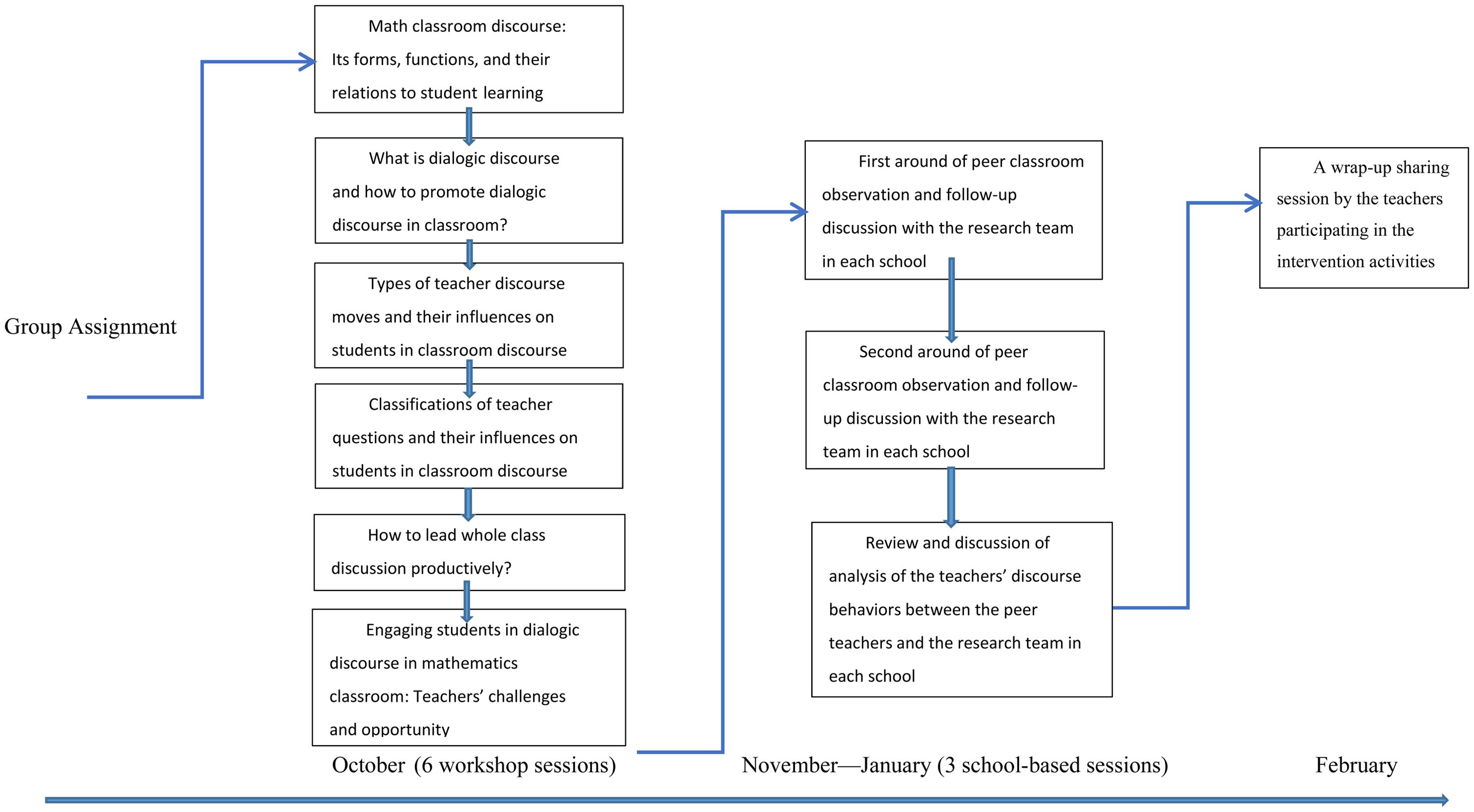
Content and procedure of the intervention.
The intervention was designed to support individual teachers to develop a “discourse stance” (Wells & Arauz, 2006, p. 418) from knowledge transmission to eliciting and facilitating student thinking through classroom discourse by assisting them in reflecting and learning from their own discourse practice. Meanwhile, the intervention assisted the teachers in applying the tools that facilitate dialogic classroom discourse (e.g., kinds of instructional tasks that afford more productive classroom discourse [Stein et al., 2007]; the talk moves likely to facilitate students’ thinking for themselves and with others, [Michaels & O’Connor, 2015]) in order to initiate the change to opening up more space for students’ engagement in classroom discussion. This combination of developing the discourse stance and the tool kits made dialogic instruction more accessible and manageable for the teachers.
An efficacy study measuring changes in teachers’ discourse behaviors before and after the intervention program (Ni et al., 2021) found that compared to the non-intervention group, the intervention group showed a reduced frequency in behaviors relating to evaluating the correctness of a student's response in classroom discussion. In addition, the intervention teachers showed a significant within-group change in the increased behaviors to press students to give explanations for their responses. The changes in teachers’ discourse behaviors were in the direction as expected with the intervention. They provide an excellent opportunity to investigate how the teachers’ changes in discourse behaviors might have affected students’ learning in a cultural setting. Considering the scope of our intervention study, we assessed a set of student learning outcomes that were hypothesized to be influenced by more dialogic classroom discourse. They included observed student participation and contribution in classroom discussion, students’ beliefs about how mathematics is learned, perceived classroom participation and interest in learning mathematics, and mathematics achievement (see Method section for details about the measures).
According to the literature on dialogic classroom discourse (e.g., Michaels & O’Connor, 2015; Sedova et al., 2016; Wells & Arauz, 2006), the reduced occurrence of teacher evaluation was hypothesized to open up more possibilities for non-IRE sequences, and in turn, provide more space for students to think for themselves and to participate actively in and contribute to classroom discussion. At the same time, increased classroom participation is expected to foster a more dynamic view of how knowledge is constructed, improve students’ sense of participating and contributing to classroom discussion, and thus foster students’ interest and achievement in learning subject matter. However, given the significance of teacher evaluation for young children socialized with cultural values and norms concerning teacher classroom authority, how this change in teacher discourse behavior would affect students’ cognitive and affective learning remains an empirical question.
In terms of the efficacy study's results on teachers’ increased prompting of students to explain their thinking, this was expected to improve learning by facilitating deep processing of incoming information (Chi et al., 1994). Teacher discourse behaviors to press a student to provide reasons behind his or her response expand the student's thinking (Wells & Arauz, 2006; Wells, 2007) and enhance the student's ownership over the learning process, hence improving their classroom participation and, consequently, school achievement.
In an earlier qualitative case study (Ng et al., 2021), the intervention teacher's discourse behaviors to encourage collective thinking in the sense of engaging with others’ ideas, as opposed to producing collective choral response have shown to making a student's idea available for peers to examine, question, and verify, raising cognitive demands and creating opportunities for students to learn through justifying and reasoning with each other's answers. According to Boaler and Greeno (2000), such a classroom discourse may increase students’ sense of learning agency in the mathematics classroom, leading toward affective changes and learning achievements.
In summary, the behavioral changes observed in the intervention teachers in making classroom discourse more open and dialogic were expected to influence students’ learning. Consequently, in the current study, an overall intervention effect was hypothesized and tested via the measured student learning outcomes (see Method section). Secondly, in order to understand whether each of the three kinds of teacher behavioral changes (i.e., the reduced tendency to evaluate a student's response, increased tendency to press for reasoning and explanation from students, and increased tendency to prompt students to engage with others’ ideas) would uniquely contribute to the intervention effect, if any, on the student learning outcomes, a mediation effect was hypothesized for each of the teachers’ behavioral changes and investigated in this study.
Participants
The present study analyzed the data collected from the teacher intervention study (Ni et al., 2021). The data involved 32 fourth-grade mathematic teachers and their 891 students from 16 schools in Hong Kong. The size of each teacher's class ranged from 18 to 36 students. The schools and teachers were among those who indicated an interest in participating in the study after we contacted 354 public local primary schools. Sixteen teachers from eight schools were assigned to the intervention group and the other 16 teachers of another eight schools to the non-intervention group. The schools in the two groups were paired by taking into consideration the following main factors as much as possible: (a) school neighborhood locations, (b) students’ mathematics achievement level based on a territory-wide basic competence test to monitor the city's compulsory education system, (c) participating teachers’ subjects with respect to their professional teaching training, and (d) participating teachers’ experience teaching mathematics. We were able to satisfy the first factor in pairing all of the schools and all but one pair for the second factor with only an approximation concerning the other two factors.
The schools, teachers, and students’ parents were informed of the purpose and procedure of the study and provided consent to participate before the study commenced.
Classroom observation
Each teacher in the two groups had their mathematics lessons videotaped four times, twice before and twice after the intervention. The average time for a lesson was 35 min. The teachers were told that the goal of the study was to see what would typically happen in their regular mathematical classes. Therefore, they were instructed to teach in a usual way and with no extra preparation. The nature of instruction in the both groups are comparable, beginning typically with a teacher-led lecture on the target mathematical topic while interacting with the students and writing on the board, followed by some class time student practice. Differences in teaching style and techniques, such as the use of audiovisual cues, physical tools, and board work with multiple representations, were observed. Considering the school calendar and feasibility of participating teachers’ work schedule, the post-observation was conducted after 3 months when all of the intervention activities were completed. Two cameras were used to videotape the lessons, one camera focusing on the teacher to track every movement of the teacher in the class, and the other focusing on the students. The camera focus was on capturing teacher–student interactions during whole-class discussions rather than interactions in small-group discussions.
A total of 128 lessons were videotaped, 32 each from the pre- and post-observation respectively, from each classroom of the two groups. Most of the video-taped lessons were those in which new knowledge was taught. The content presented in the lessons from the pre-observation covered 2- and 3-digit multiplication and division, common multiples and the least common multiple, factors and factoring; and quadrilaterals. The content from the post-observation involved fractions and their addition and subtraction; conversions between fractions and decimals; areas of quadrilaterals, symmetry, and perimeters. The content covered in the lessons for the two groups were very comparable because the local public schools followed the government's primary school mathematics curriculum.
Analyzing teachers’ discourse behaviors
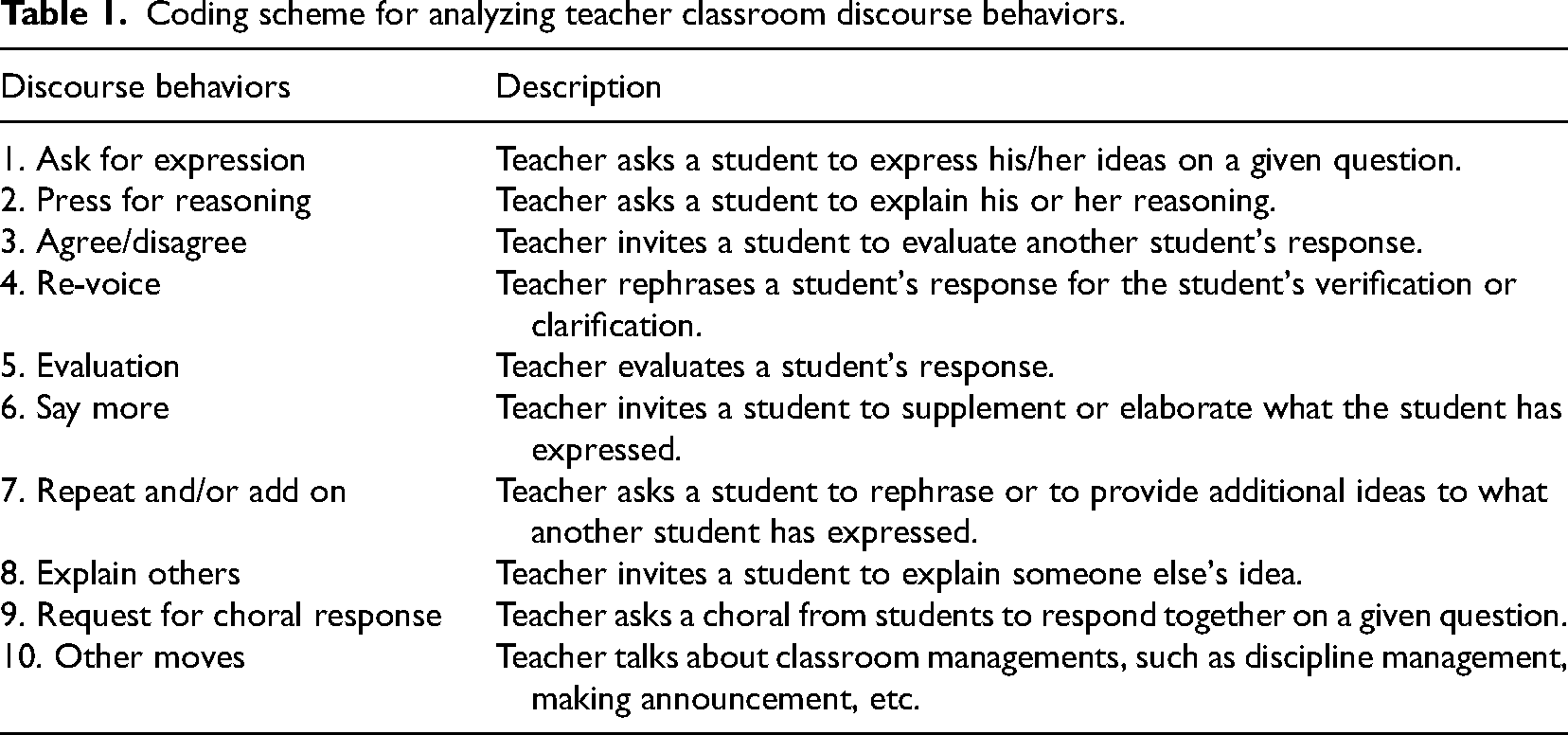
We developed a coding scheme to analyze teachers’ discourse behaviors by building on the existing literature on (productive) classroom discourse (Engle & Conant, 2002; Mercer & Howe, 2012; Resnick et al., 2010), particularly on the works by Michaels and O’Connor (2015) and O’Connor et al. (2015). Michaels and O’Connor conceptualize teacher discourse moves as useful tools to engage students in dialogic classroom discourse after studying the discourse behaviors of teachers who were more likely to engage students in classroom discussions. The coding scheme includes six codes from the researchers (Michaels & O’Connor, 2015; Michaels et al., 2008; O’Connor et al., 2015), that is, teachers re-voice, press for reasoning, encourage a student to say more, repeat/rephrase/add on, explain other students’ ideas, and agree/disagree to facilitate the students’ co-construction of understanding. The code ask for expression was added to capture the frequent teacher behavior of asking students to express without requiring any mathematical argumentations. The other two discourse moves, teacher evaluation of students’ responses and request for choral response, reflect a cultural practice in the Chinese context of mathematics teaching, which emphasize confirming curricular content that the teacher considers important for students to memorize and acquire. An explanation of the codes is provided in Table 1.
Coding scheme for analyzing teacher classroom discourse behaviors.
Coding scheme for analyzing teacher classroom discourse behaviors.
Also, the coding scheme identifies whether a teacher's discourse move of ask for expression or press for reasoning involved a request with the same student in a sequence of conversation or with another student or the whole class. When a teacher continually asked the same student a question concerning the same topic, say more was coded; when a teacher asked different students questions concerning the same topic, rephrase/add on or explain others was coded. The codes are helpful to understand the social interactional aspects of ask for expression and press for reasoning to accent shifts between students during classroom discourse. Agree/disagree, repeat/rephrase/add on, and explain others were also grouped as a category of teacher discourse behaviors that facilitate collaborative thinking. We made the grouping because it was observed that Chinese mathematics teachers were more used to two-way discourse between the teacher and individual students but less used to multiple-way discourse to facilitate collective thinking among students (Ni et al., 2014).
Double or multiple codes could be applied to a teacher's turn as long as corresponding discourse behaviors could be uniquely identified in a teacher turn. As an example, the teacher's turn “Could you explain why Mary performed this procedure?” was coded as press for reasoning because the teacher mentioned “explain why” as well as explain others because the teacher invited another student to explain “Mary's procedure.”
The 128 videotaped lessons contained a total of 14,960 identified teacher turns, that resulted in a total of 30,113 coded teacher discourse behaviors (Ni et al., 2021). Twenty-eight lessons, that is, 22% of the 128 videotaped lessons were coded by two coders with academic and professional backgrounds in mathematics education, 14 lessons each from the pre- and post-observation, respectively. Satisfactory inter-rater agreements were achieved, ranging from 72% to 100% agreement on the codes for the pre-observation and from 75% to 88% agreement on the codes for the post-observation. The other 100 lessons were single coded. The reader may refer to Ng et al., 2021 for more details about development and validation of the coding scheme.
The three teacher discourse variables, teacher evaluation, press for reasoning, and encouraging students to engage with others’ ideas, were chosen as mediating variables because they were either shown to have significant intervention effect in an earlier intervention efficacy study focusing on changes in teachers’ discourse behaviors (in the case of teacher evaluation and press for reasoning; Ni et al., 2021), or have shown to be linked to student learning outcomes in terms of performing at a higher cognitive level in an earlier qualitative study (in the case of encouraging students to engage with others’ ideas, Ng et al., 2021). These variables were tested for mediation effect on measures of student learning outcomes, described in the next sub-section.
Three sets of student learning outcomes were assessed before and after the teacher intervention. They included observed students’ classroom participation in terms of number of student turns and number of words spoken out in classroom discussions, students’ indicated interest and attitude toward learning mathematics, and mathematics test performance.
Observed student's classroom participation
The amount of student talking on learning tasks uniquely contributes to students’ perceived autonomy over learning (Reeve & Jang, 2006). Two indicators of the degree to which student participated in classroom discussions were measured. The first was the number of student turns per lesson, and the second was the number of words spoken by students per lesson. For example, if Student A took 2 turns in the first lesson and 4 turns in the second lesson from the pre-observation, then this student would have an average of (2 + 4)/2 = 3 turns per lesson for the pre-assessment. Similarly, if Student A uttered 10 words in the first lesson and 20 words in the second lesson from the pre-observation, then this student would have an average of (10 + 20)/2 = 15 words per lesson. The first measure assesses the frequency of students’ taking part in classroom discussion. The second measure of the number of words assesses how elaborated a student's utterances were. Overall, the number of students’ utterances unrelated to the development of the lesson was insignificant, and this justifies our choice of the two indicators for student participation in this study.
We attempted to code the content of student utterances, but it turned out that the kinds of student responses were highly dependent on the types of teachers’ initiations; for example, a teacher's pressing for reason would likely elicit a student's explanation, and a teacher's inviting to agree or disagree would prompt a student to agree or disagree with a peer's response. The dependence was not considered desirable for the current study which adopted a quantitative approach to investigate the research questions. Therefore, we decided to use the head counts and word counts—how many students talked and how much they talked—as the indicator of degree of student participation in classroom discussions.
Student's affective learning outcomes in mathematics classroom
The affective learning outcomes were assessed with a questionnaire consisting of 22 items (Ni et al., 2011) that inquire about students’ interest in mathematics and attitude toward learning mathematics (McLeod, 1992). These items address three dimensions: (1) students’ perceived interest in learning mathematics (e.g., “I’m interested in learning more mathematical knowledge.”), (2) students’ perceived classroom participation (e.g., “I am afraid to express my ideas in the mathematics classroom.”), and (3) students’ epistemological beliefs about how mathematics is learned (e.g., “I would look up for my math teacher to decide which answer is correct when I got an answer which is different from my classmate's.”). Students were asked to rate each statement on a 6-point Likert scale (from strongly disagree to strongly agree). The Alpha indices were .91, .77, and .69 for the scales of perceived mathematical interest, classroom participation, and views of how mathematics is learned, respectively, from the pre-assessment. They were .93, .82, and .69, respectively for the post-assessment. Efforts were made to improve the reliability of the third scale by removing a few items that had low associations with the scale. However, the improvement was limited. Possible reasons for the low reliability might be that the construct of epistemological beliefs is complex and young children's epistemological beliefs are not well developed (Depaepe et al., 2016; Kuhn et al., 2000).
Student's mathematics achievement
Two instruments were administered to assess students’ mathematics achievement. One instrument was constructed by the team based on the local school mathematics curriculum. It contained 15 items for the pre-test and 13 items for the post-test; two items from the pre-test were removed because of their lack of differentiation function from the pre-assessment. The other test consisted of 18 items adapted from Cai (2000) and assessed the cognitive processes, translation and integration (Mayer, 2003) that are used in solving mathematical word problems. The questions asked students to identify which number sentence from four choices corresponded to a statement (translation) or what information from four choices was relevant to solving a given word problem (integration).
Measure of family socioeconomic status
The students’ parents were asked to indicate their occupations, education levels (i.e., one of six levels including primary, secondary, high school, secondary polytechnic school or secondary teachers’ college, two-year to four-year college, and above) and total family monthly income (i.e., one of six levels from below Hong Kong dollars 20,000 or approximately US$2,565 to over HK$ 100,000 or approximately US$12,820) on a questionnaire. Index values for the parents’ indicated occupations were calculated according to the Standard International Socio-economic Index of Occupational Status (Ganzeboom et al., 1992). Through factor analysis, a score for SES, was formed based on the index values of parents’ occupations, parents’ highest education levels, and total family monthly income, which was standardized in the data analyses.
Analysis
Multilevel mediation analysis was utilized to evaluate experimental intervention effects on various teachers’ discourse behavior and in-turn the effects of teachers’ discourse behavior on student outcomes (Krull & MacKinnon, 2001). Multilevel analysis was adopted since students were nested within classes and each class was taught by different participating teacher. Intervention was conducted at teacher level, thus, intervention status was a class-level (or level-2) variable. Multilevel Structural Equation Modeling (MSEM) approach was employed to analyze the multilevel mediation model. With the statistical tool Mplus (Muthén & Muthén, 2017) which partitioned student outcomes into within (student-level) and between (class-level) components (Lüdtke et al., 2008; Tofighi & Thoemmes, 2014), MSEM estimated the mediation effect through investigating the effects within level-2 and effects from level-2 to level-1 simultaneously (MacKinnon & Valente, 2014; Preacher et al., 2010) instead of two-step non-simultaneous estimations (Krull & MacKinnon, 2001; Pituch et al., 2006). According to Preacher et al. (2010), a general MSEM approach could possibly perform better than traditional methods which may conflate between-group within and within-group effect.
In the present study, intervention status and teachers’ discourse behaviors were regarded as Level 2 (class-level) explanatory variable and mediator, respectively, while student learning outcomes were Level 1 (student-level) variables. A 2-2-1 design—that is, both the independent variable and mediation variable at Level 2 and the dependent variable at Level 1—was adopted for the current study of pretest-posttest control group design (Preacher et al., 2010). In order to reduce confounding bias, pre-intervention scores for both mediators and outcome variables were included in mediation model as control variables. Put differently, the effect of treatment on teachers’ discourse behavior was estimated at class-level after partialing out pre-intervention behavior scores. Similarly, the effect of intervention and teachers’ behavior on student outcomes was also adjusted with students’ pre-intervention scores. Furthermore, years of teaching was included as covariate in estimating student outcomes. The impact of experience has been found to be strongest during the first few years of teaching on teachers’ productivity gain (Rice, 2010) and the impact of years of early experience is strongest on students’ mathematics achievement (Harris & Sass, 2007). Corresponded to each outcome variable, pre-intervention students’ scores were included as grand-mean centered covariates at student level (level-1) since our objective was to investigate the intervention effect on student outcomes through teachers’ discourse behavior while controlling pre-intervention scores at student level (Enders & Tofighi, 2007; Ludtke et al., 2009). Multilevel mediation analysis was conducted using Mplus version 8.2 with maximum likelihood robust (MLR), which is the ML estimator such that standard errors are robust to nonnormality.
Figure 2 displays the conceptual framework of the multilevel model. In the model, path (a) refers to the effect of the intervention on teachers’ discourse behaviors controlling for pre-intervention scores, path (b) refers to the association between the mediator and the outcome variables, and path (c) represents the direct effect of the intervention on outcome variables, while controlling prior scores and other variables. The indirect effect of intervention on student outcomes through teachers’ behavior discourse is measured by product of coefficients, a*b. The total effect of the intervention on student outcomes would be the direct effect (c) + the indirect effect (a* b). Monte Carlo confidence interval method was employed to determine the statistical significance of indirect and total effect. A sample of 5000 random draws was generated to compute 95% confidence intervals (Selig & Preacher, 2008). The p-values for the average indirect effects were then obtained directly in R. The three variables of teachers’ discourse behaviors, to press a student for reasoning, to evaluate a student's response, and to promote students to think collectively, acting as mediators, were examined separately. Hence, three sets of multilevel mediation analysis were conducted for each mediator.
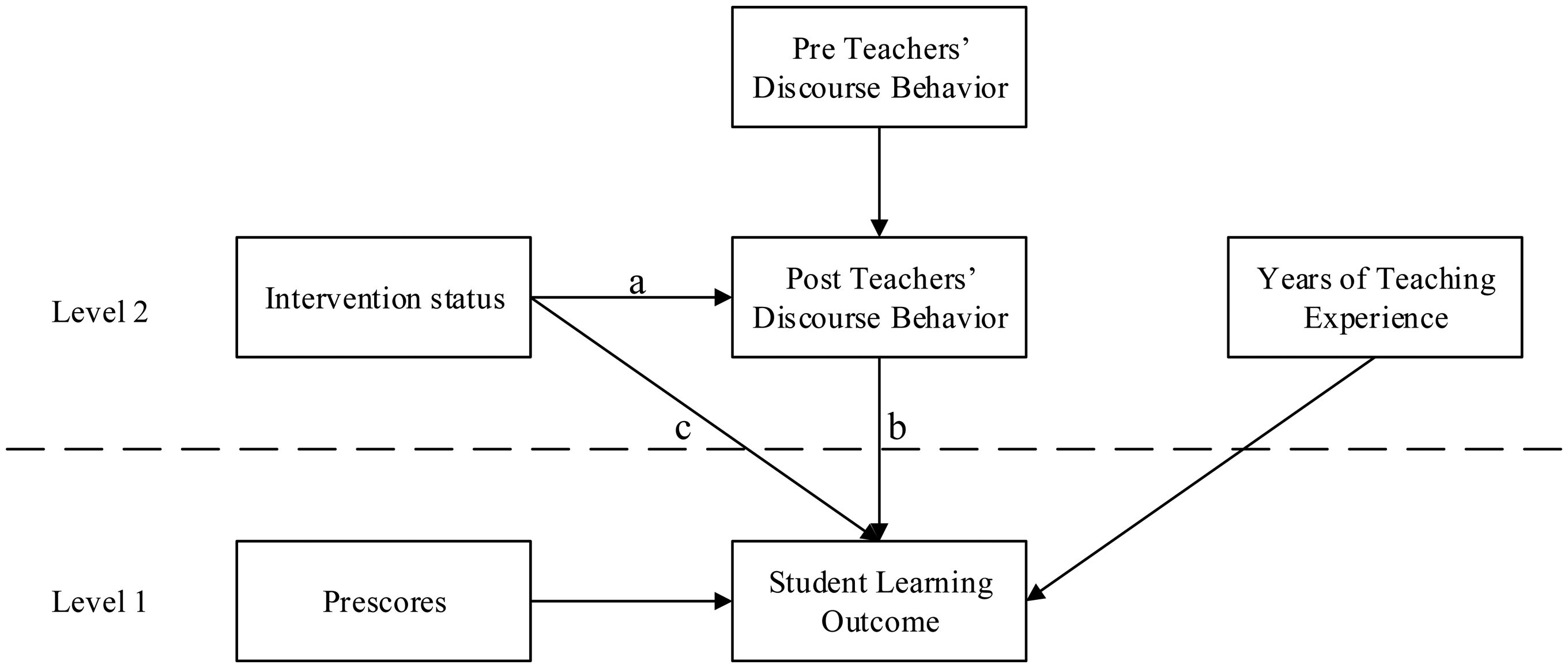
The conceptual framework of the multilevel model.
There were three kinds of missing student data from students’ responses to the paper-and-pencil questionnaires or tests. One kind of missing data resulted when a student responded to a measure but missed one or two items from the measure. This kind of missing data accounted for 0.008% from the expected total number of items from the pre-assessments and 0.006% from the post-assessment. These missed items were replaced with the class mean. The second kind of missing data occurred when a student failed to attend all five assessments for both pre- and post-test. Only 10 students (treatment group = 5) involved in the second kind which accounted for 1% of all sample students. The third kind of missing data occurred on students who were absent for absent at least one assessment for either pre-test or post-test. For this type of missing data, among the five assessments tests, missing responses ranged from 38 to 50 in pre-assessments, and from 29 to 38 in post-assessments. In addition, missing pre-test or post-test scores were spread across 32 classes that no system pattern was observed.
Analysis of each of these five student outcomes included only records with both pre-assessment and post-assessment scores, in this study, was still valid. In spite of this, a two-level imputation with 100 datasets was conducted and the results indicated that the differences between imputed data and non-imputed data were trivial in terms of standard errors and estimates. Therefore, results were reported with sample in which both pretest and posttest students’ outcomes were not missing.
Descriptive data on individual students and the classrooms
Tables 2 and 3 display descriptive data on individual students as well as on the classrooms for the two groups, respectively. For the intervention group, students’ indicated interest in learning mathematics increased significantly from the pre-assessment to the post-assessment. However, no pre-post difference was observed in students’ perceived classroom participation and beliefs about how mathematics is learned. In the cognitive domain, students’ test scores on the two mathematics tests improved significantly from the pre-assessment to the post-assessment. On the two measures of how much students talked in classroom discourse, the mean number of student turns per lesson and the mean number of student words per lesson increased significantly from the pre- to the post-assessment.
Intervention group's descriptive statistics of the student-level and class-level variables.
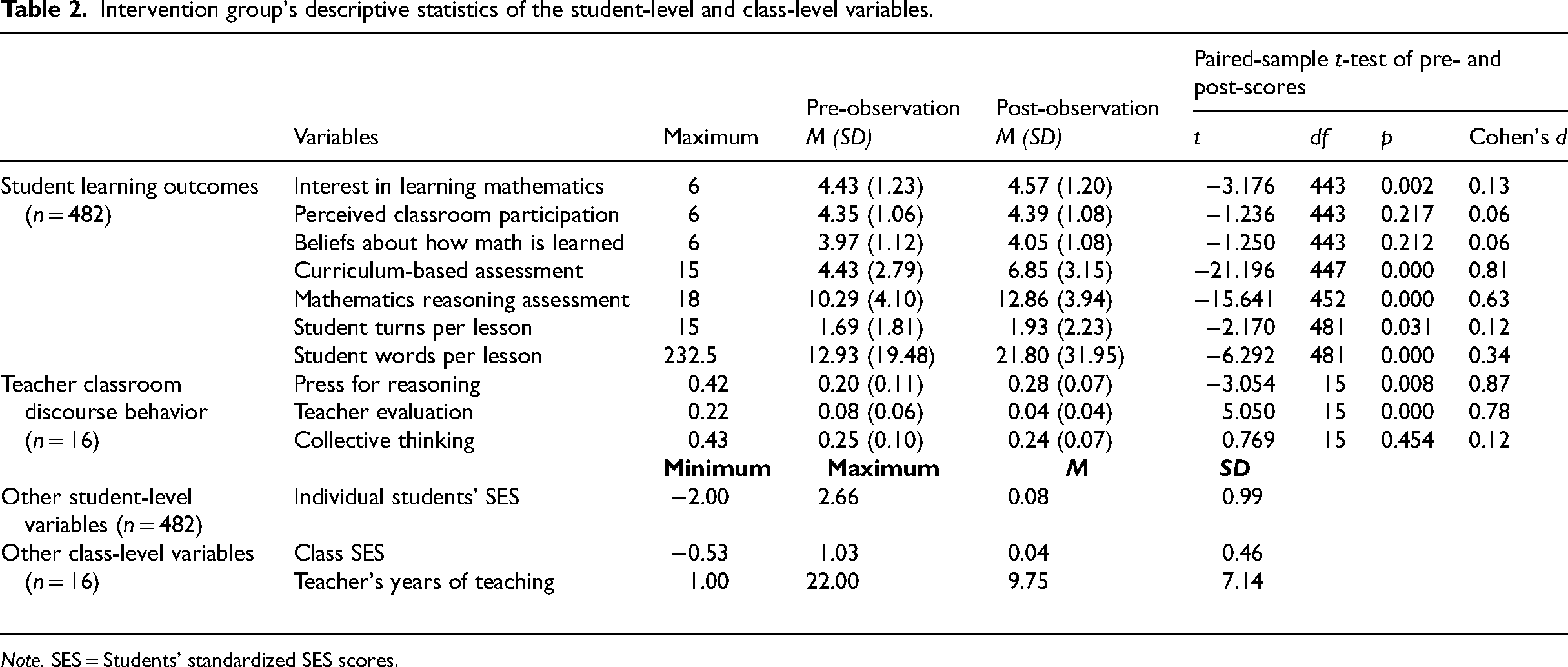
Intervention group's descriptive statistics of the student-level and class-level variables.
Note. SES = Students’ standardized SES scores.
Non-intervention group's descriptive statistics of the student-level and class-level variables.
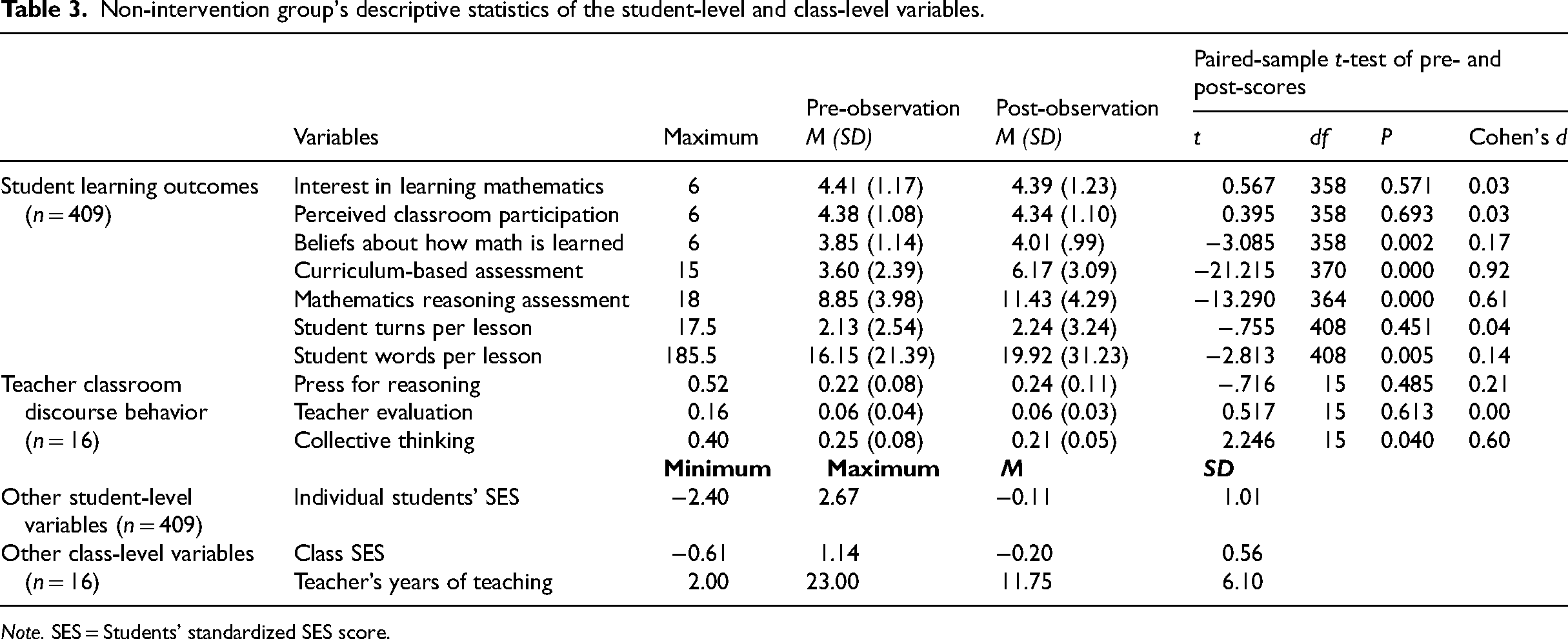
Note. SES = Students’ standardized SES score.
For the non-intervention group (Table 3), students’ learning in the affective domain improved significantly from the pre-assessment to the post-assessment on the measure of views about how mathematics is learned. However, there was no difference between the pre- and post-assessment of students’ indicated interest in learning mathematics and classroom participation. In the cognitive domain, students’ mathematics achievement on the two measures improved significantly from the pre-assessment to the post-assessment. On the measures of student participation in classroom discourse, there was a significant increase in the mean number of student words per lesson but no significant change in the mean number of student turn per lesson from the pre- to the post-assessment.
Tables 2 and 3 also display the ratios of the three teacher discourse behaviors. For the intervention group, there was a significant increase for the discourse behaviors of pressing students for reasoning but a significant decrease in the discourse behavior of evaluating a student's response from the pre- to post-observation. However, there was no significant change in the ratio of the discourse behaviors for promoting collective thinking among students. For the non-intervention group, there was no significant change in the teachers’ discourse behaviors of pressing students for reasoning and evaluating a student's response. However, there was a significant decrease in the teachers’ discourse behaviors for promoting students for collective thinking.
Presented in Table 4 are the variance components from a null model analysis of the student outcome measures. Between-class variance was significant for five out of the seven student outcome measures. Intra-class correlation coefficients (ICC) indicating the between-class difference was 16.6% for the curriculum-based mathematics assessment, 16.9% for the mathematical reasoning assessment, 7.6% for students’ perceived interest in learning mathematics, 4.6% for the mean number of student words per lesson, 4.2% for the number of student turns. Between-class variance was not significant for the measures of students’ perceived classroom participation (3.4%) and views about how to learn mathematics (2.7%), respectively.
Intra-class correlation of null model and variance of slope for pre-student assessment.
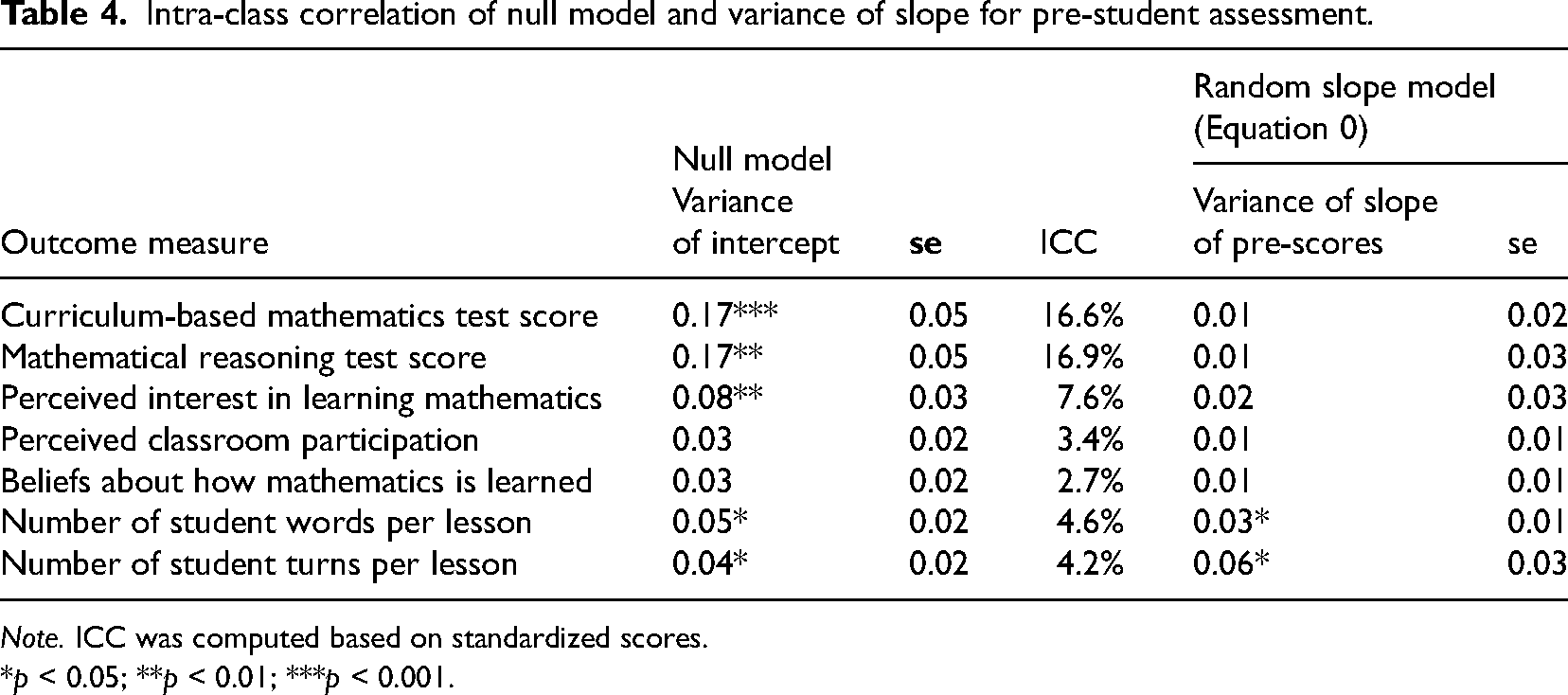
Intra-class correlation of null model and variance of slope for pre-student assessment.
Note. ICC was computed based on standardized scores.
*p < 0.05; **p < 0.01; ***p < 0.001.
The ICC values indicate that there was a much stronger relationship between the data collected from individuals within the same group for the cognitive measures (ICC around 17%) than for the affective measures (ICC ranged from 3% to 8%). This observation is comparable to that from another study with another Chinese student population (Ni et al., 2021) in which the ICC values were 11% for a measure of mathematics calculation and 2% to 7% for the affective measures.
Multilevel mediation analysis was supposed to be applied to the five student learning outcomes that showed significant variances at the class level (Table 4). However, we also applied the equations to explore relations between the changes in teacher discourse behaviors and the other two student learning outcomes (perceived classroom participation and beliefs about how mathematics is learned) even though no significant variance at the class level was observed for them.
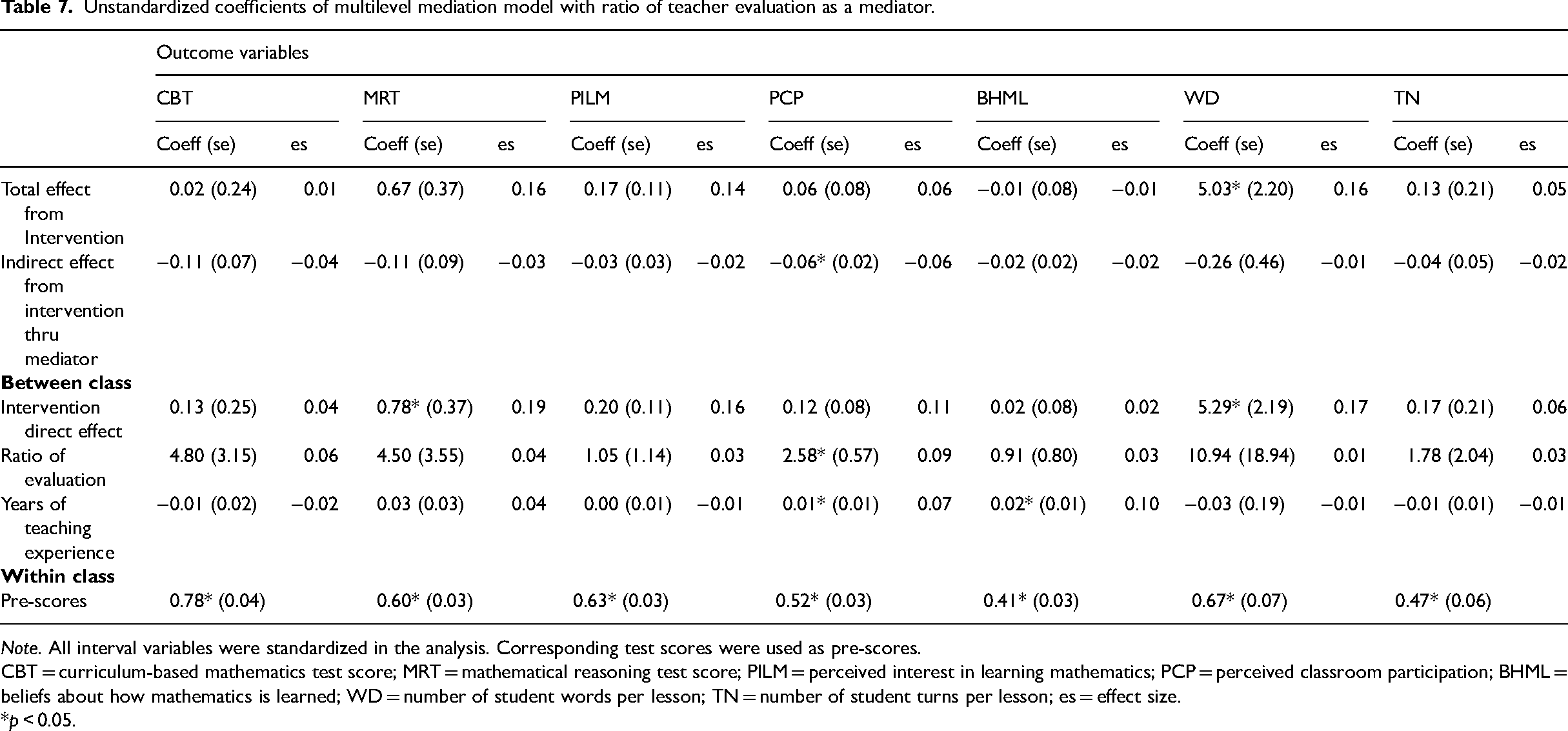
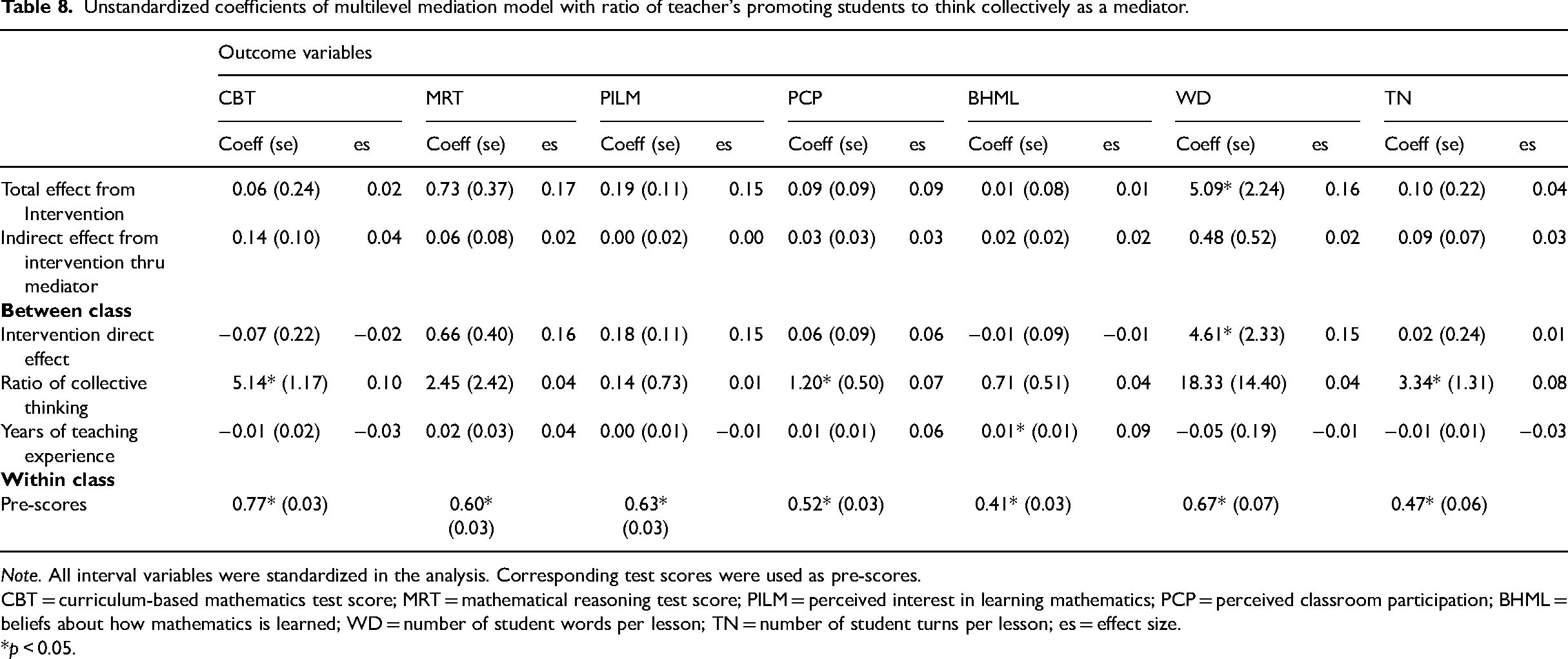
Tables 5 to 8 display the unstandardized coefficients from three multilevel mediation analyses to investigate any mediating effect associated with the changes in teacher discourse behaviors. In the tables, the effect size (es) values were obtained with standardized variables except for intervention status, which was coded with 0 and 1. Table 5 shows that after controlling for the pre-intervention ratio, the intervention teachers exhibited a significantly lower ratio of evaluating a student's response compared to those of the non-intervention group (β=−0.02, p < 0.05, es = −0.62), whereas the two groups did not show a significant difference in their ratios for the other two discourse behaviors.
Unstandardized coefficients of intervention effect on teachers’ discourse behaviors.
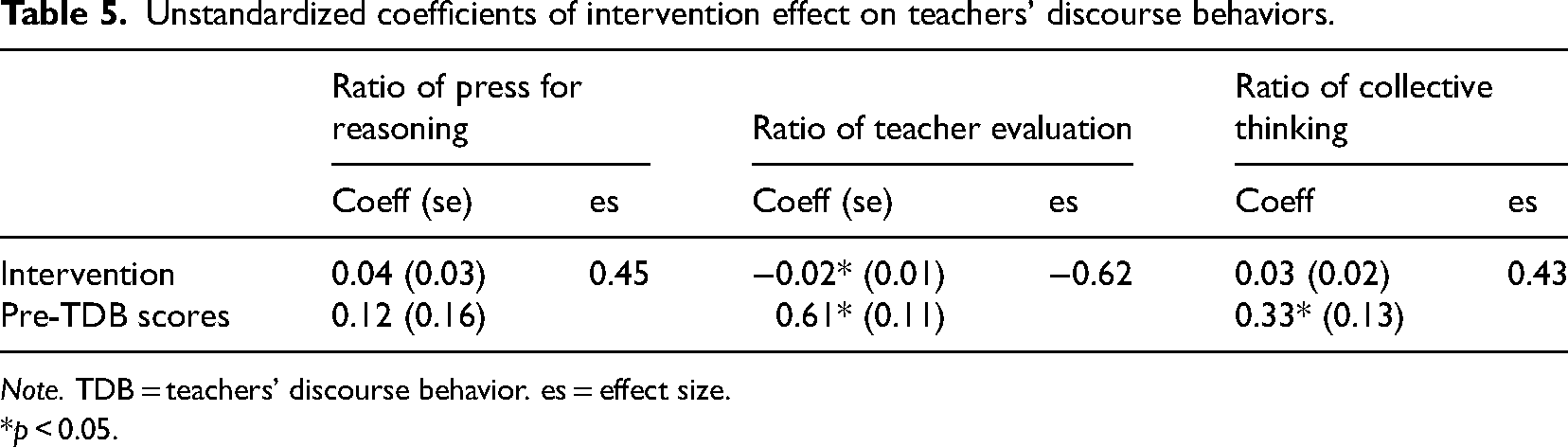
Note. TDB = teachers’ discourse behavior. es = effect size.
p < 0.05.
Unstandardized coefficients of multilevel mediation model with ratio of teachers’ pressing students for reasoning as a mediator.
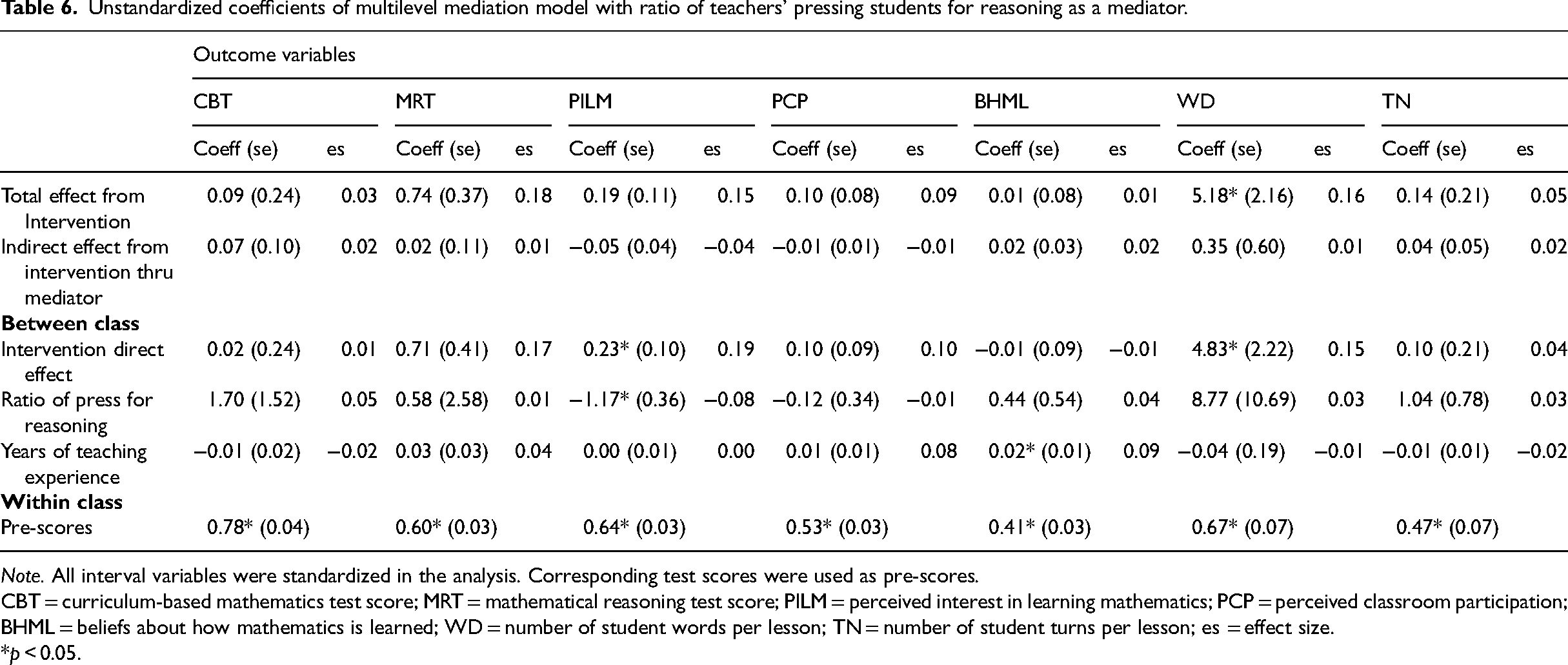
Note. All interval variables were standardized in the analysis. Corresponding test scores were used as pre-scores.
CBT = curriculum-based mathematics test score; MRT = mathematical reasoning test score; PILM = perceived interest in learning mathematics; PCP = perceived classroom participation; BHML = beliefs about how mathematics is learned; WD = number of student words per lesson; TN = number of student turns per lesson; es = effect size.
p < 0.05.
Unstandardized coefficients of multilevel mediation model with ratio of teacher evaluation as a mediator.
Note. All interval variables were standardized in the analysis. Corresponding test scores were used as pre-scores.
CBT = curriculum-based mathematics test score; MRT = mathematical reasoning test score; PILM = perceived interest in learning mathematics; PCP = perceived classroom participation; BHML = beliefs about how mathematics is learned; WD = number of student words per lesson; TN = number of student turns per lesson; es = effect size.
p < 0.05.
Unstandardized coefficients of multilevel mediation model with ratio of teacher's promoting students to think collectively as a mediator.
Note. All interval variables were standardized in the analysis. Corresponding test scores were used as pre-scores.
CBT = curriculum-based mathematics test score; MRT = mathematical reasoning test score; PILM = perceived interest in learning mathematics; PCP = perceived classroom participation; BHML = beliefs about how mathematics is learned; WD = number of student words per lesson; TN = number of student turns per lesson; es = effect size.
p < 0.05.
The multilevel mediation analysis provides the following findings: total and direct effect of the intervention, indirect or mediation effect through the concerned teacher discourse behaviors, and the association between the teacher discourse behaviors and student learning outcomes. They are reported below in order.
As shown in Table 6, the total effect of the intervention on average number of student words per lesson (β = 5.18, p < 0.05, es = 0.16) was significant. Moreover, the direct intervention effect on student outcomes was significant for students’ perceived interest in learning mathematics (β=0.23, p < 0.05, es = 0.19) and average number of student words per lesson (β=4.83, p < 0.05, es = 0.15). However, there was no significant mediation effect of the ratio of teachers’ pressing students for reasoning on the association between the intervention and any of the student outcome measures. Unexpectedly, there was a significant negative association between the ratios of teachers’ pressing students for reasoning and students’ perceived interest in learning mathematics (β = −1.17, p < 0.05, es = −0.09).
To help make sense of the negative association between teachers’ behaviors to press students for reasoning and students’ perceived interest in learning mathematics, we examined the content of the coded teacher behaviors to press for reasoning from the set of 28 lessons that were double coded, as mentioned in the Method section. The 28 lessons consisted of 14 lessons from the intervention group and 14 from the non-intervention group. Each group had seven lessons from the pre-observation and another seven lessons from the post-observation. We observed that teachers appeared to frequently repeat their utterances to press a student for reasoning. Here is an example in which the teacher repeatedly pressed a student to explain a relationship between the area and perimeter of a figure (Line 3 to 6).
Teacher: Do you think the perimeter and area of a figure have a relationship? Student 16? Student16: They have a relationship. Teacher: Student 16, you’ve just mentioned that the area of a figure has a relationship with the figure's perimeter. What is the relationship between the area and perimeter of a figure? Can you explain what is the relationship between the area and perimeter of a figure? What is their relationship? Student 16: (no response) Teacher: Who can help answer this question? What is the relationship between the area and perimeter of a figure?….
In our coding of teacher discourse behaviors, two behaviors were most frequent: asking a student to express his or her idea on a question without requiring any mathematical argument and pressing a student to explain his or her reasoning. In order to gain perspective on the teachers’ discourse behaviors, we looked into how often the repetition occurred with the teacher behavior to press for reasoning in comparison to the teacher behavior to ask for expression. It was expected that students would need more time to come up with a response with the teacher's pressing for reasoning than with the teacher's asking for expression because the former requires higher-level cognitive processing than the latter. Nevertheless, it was probably more likely for a teacher to repeat the utterance to press for reasoning while waiting for a student to respond. It was found from the sample of 14 lessons that the intervention teachers made the repletion at 4.70% out of 511 times when they asked students for expression in the pre-observation and 5.69% of 248 times in the post-observation. In contrast, it was 18.82% of the 169 times when they pressed students for reasoning in the pre-observation and 19.61% of 204 times in the post-observation. This pattern was similar for the non-intervention teachers. That is, the repetition happened three to four times more frequently for the teacher behavior to press for reasoning than asking for expression.
Teacher evaluation as a mediator
Results in Table 7 show that both the total effect (β = 5.03, p < 0.05, es = 0.16) and direct effect (β = 5.29, p < 0.05, es = 0.17) were significant for the average number of student words per lesson. Also, the intervention had a significant positive direct effect on the mathematical reasoning test scores (β = 0.78, p < 0.05, es = 0.19). There was a significant, negative mediation effect of the intervention on students’ perceived classroom participation through the ratio of a teacher's discourse behavior to evaluate a student's response (β = −0.06, p < 0.05, es = −0.06). That is, the intervention reduced the frequency of teacher evaluation behaviors but teacher evaluation behaviors had a significant positive association with students’ perceived classroom participation (β = 2.58, p < 0.05, es = 0.09). In other words, the adjusted mean of students’ perceived classroom participation for the intervention group was lower than that for the non-intervention group when other factors were controlled for.
To better understand this negative mediation effect, we conducted a content analysis of the coded teacher behaviors to evaluate a student's response from the 28 videotaped lessons. The intervention teachers made a total of 70 and 28 evaluations from the pre- and post-observation, respectively. Evaluating a student answer as being correct accounted for 93% of the teacher evaluations for both the pre- and post-observation. The others were those of evaluating a student response as being incorrect or partially correct or partially incorrect. The non-intervention teachers produced 47 and 53 evaluations from the pre- and post-observation, respectively, 92% of them were evaluating a student response as being correct. Among the teacher evaluations of student responses being correct, 10% of them on average over the pre- and the post-observation were accompanied with the teachers’ praising a student (e.g., “Excellent!”; “Good, let's give him an applaud!”; “I’ll give you an extra mark for your answer!”) for the intervention group. This was 8% for the non-intervention group.
Teachers’ promoting students to engage with others’ ideas as a mediator
Table 8 displays the results of the mediation analysis on the teachers’ discourse behaviors to promote students to engage with others’ ideas. Both the total effect (β = 5.09, p < 0.05, es = 0.16) and direct effect (β = 4.61, p < 0.05, es = 0.15) of the intervention were significant for the average number of student words per lesson. However, there was no significant, indirect effect of the intervention on any of the student outcomes through this mediator. Nevertheless, there was a significant association between teachers’ discourse behaviors to prompt students to think collectively and student curriculum-based mathematics scores (β = 5.14, p < 0.05, es = 0.10), perceived classroom participation (β = 1.20, p < 0.05, es = 0.07), and average number of student turns per lesson (β = 3.34, p < 0.05, es = 0.08).
Discussion
The present study investigated whether the teacher intervention influenced the measured student learning outcomes and whether the particular changes in the teacher discourse behaviors respectively mediated the intervention effect. The results consistently showed the intervention's effect on the gains in number of student words in classroom discourse. The intervention effect was indicated also on students’ perceived interest in learning mathematics and students’ improved performance on the mathematical reasoning test. However, the effect sizes were small, ranging from 0.16 to 0.19. The intervention effect was not observed on the other learning outcomes (number of student turns, students’ perceived participation in the classroom, views of how mathematics is learned, curriculum-based mathematics test scores).
The results appear a little complicated concerning any mediating effects of the three kinds of teacher discourse behaviors. Unexpectedly, a negative mediation effect (MacKinnon et al., 2000) was observed wherein the intervention reduced teacher evaluation behaviors but the association between the teacher discourse behavior and students’ perceived classroom participation was positive. No mediation effect was observed with the other two teacher discourse behaviors, namely pressing for reasoning and encouraging students to think collectively. Meanwhile, the teacher discourse behaviors to encourage students to think together showed a positive association with the number of student turns to speak out in classroom discussion, students’ perceived classroom participation, and students’ performance on the curriculum-based mathematics test. However, mediation analysis of the intervention through teachers’ discourse behavior to press students for reasoning indicated a negative association between the teacher discourse behavior and students’ perceived interest in learning mathematics.
Implications of the findings
The results indicate that the changes in teachers’ discourse behaviors increased students’ participation and contributions in classroom discussions. Students of the intervention teachers produced lengthier talks in terms of number of words spoken during whole-class discussion compared to those of the non-intervention teachers. This finding is consistent with the existing literature (O’Connor et al., 2015; Sedova et al., 2016; Wells & Arauz, 2006).
However, the intervention effects appeared less obvious on the long-term student learning outcomes, although the effect was indicated on students’ perceived interest in learning mathematics and improved performance on the mathematics reasoning test. We conjecture that three factors might have contributed to the elusive intervention effects on the long-term learning outcomes. One was that change in one's competence, attitude, and beliefs takes time to occur. The second factor is that orchestrating whole class discussion is complex with constraints on teachers to balance a set of requirements, each of which may be in a trade-off relationship with another (O’Connor et al., 2017). Related to the two factors, there was an interval of only 3 months between the teacher intervention and the post-assessment. The teachers and students were in the process of making their classrooms discourse more open and collective; it will require serious work for both teachers and students to bring about more transformed classroom discourse and consequently improvements in students’ long-term learning outcomes. Worth noting, this study was contextualized in Hong Kong, where direct instruction is a dominant mode of mathematics teaching, and memorization of mathematical facts remains a high priority of teaching and learning (Leung, 2001). It is also shown that Chinese students value fun and interesting mathematics while achieving good academic results (Hill & Seah, 2023). Given this context and the time frame of 3 months between the intervention and the post-intervention observations and assessments, the indicated intervention effect on students’ perceived interest in learning mathematics and improved performance on the reasoning test appears encouraging.
The finding of the negative mediation effect of reduced teacher evaluation on students’ perceived classroom participation is puzzling. Reduced teacher evaluation in classroom discourse is supposed to provide more space for students to engage in classroom discussion and to take greater personal accountability over their learning. This is assumed to be conducive to enhancing students’ perceived classroom participation and contribution. Contrary to this expectation, teacher evaluation had a positive association with students’ perceived classroom participation. We have tried to understand it based on two related perspectives. One is that both the teachers and students were adjusting to making classroom discourse more open, dialogic, and collective as the observation was made 3 months after the intervention. Meanwhile, the adjusting process could be influenced by the students’ particular socialization with respect to their perception of teachers’ classroom authority. Skovsmose (2001) argued that teachers generally prefer a high degree of predictability and teacher control in mathematics lessons. In our context––mathematics classrooms within a Confucian heritage––it would be even more difficult to challenge teachers’ sense of authority as someone who expects students’ responses and re-distribute the teacher's role as someone who evaluates the responses (Lee, 2009). We suggest that in the context of the Chinese students’ socialization and the presence of teacher authority (Zhou et al., 2012), it is likely that students greatly value the approval gained from teacher evaluation as a confirmation of one's intellectual status and also one's diligence toward school learning, as desired by Chinese parents who value education highly (Lam et al., 2002). The reduced tendency in the teachers to evaluate a student's response was an indication that the teachers were changing the ritual of the IRE sequence in order to create a more open and dialogic classroom. However, the students might have needed more time to get used to the change in their teachers’ discourse practice, and therefore indicated their classroom participation and contribution as being less appreciated by their teachers.
It is unclear why the more frequent teacher discourse behaviors to press students for reasoning was negatively associated with students’ perceived interest in learning mathematics. This might also be related to the particular socialization of Chinese students whereby they are expected by parents and teachers to be diligent and receptive toward school-work (Li, 2012). Perhaps the students felt challenged or inadequate when pressed by the teacher to provide explanations for their answers and, hence, experienced the pressure that they did not perform as well as expected, especially when they felt unsure about their answers. The pressure could have become more intensified by the teachers who repeatedly requested students to provide explanations at times when students needed more processing time to come up with explanations. Given that the intervention teachers showed a significantly increasing frequency in the use of this discourse prompt from the pre-observation (0.20; see Table 2) to the post-observation (0.28), the repetition became very frequent in the classrooms and hence increased the pressure on students. It seems that the matter of teacher wait time affects not only the quality of cognitive processing in students (Tobin, 1986, 1987) but also their affective processing toward how they perceive the classroom as well as themselves. The effect might be more nuanced in the Chinese context. For example, researchers have found that east Asian recipients of direct gaze were significantly more likely to report negative experiences of arousal than westerners (Akechi et al., 2013; Cheng & Borzi, 1997).
We consider that the findings of the present study resulted from a situation where the teachers were initiating changes for classroom discourse to be more open and dialogic and the students were adjusting to the changes. Also, the findings suggest that the dynamics of classroom discourse or teacher–student interactions, and consequently its influence on student learning, were mediated by students’ broader socialization with the cultural values and norms related to classroom authority.
Limitations of the study
Several limitations that were associated with the study should be noted. First, regarding the intervention effects on the learning outcomes, the two groups could not be assumed to be comparable from the very beginning of their schooling, although we made the effort to have the two groups be as comparable as possible. However, the fact that the intervention effect on student learning could still be observed between the groups, where the teachers and students carried out classroom discourse under diverse circumstances, suggests the influence of the changes in teachers’ discourse behaviors on student learning outcomes.
Secondly, lacking data on students’ voices prevented us from being able to better understand students’ lived experiences in classrooms where the teachers attempted to change their practice to make classroom discourse more open and dialogic. Students’ voices should be heard and understood in future (qualitative) research to better establish the linking between changes in teacher discourse behaviors and changes in student learning.
Thirdly, the effect sizes for the intervention effect on the several learning outcomes were small. The meaningfulness of this result may be illustrated by the following two perspectives. First, Cheung and Slavin's meta-analysis study (2016) showed a substantial negative association between effect sizes and sample sizes and an average effect size around 0.13 for a sample size of 1,000 to 1,999 because large-scale studies were less likely to be as tightly controlled when compared to small-scale studies. This meta-analysis may provide one perspective for understanding the small differences in the affective measures (see Table 4) observed in the present study that involved a relatively large sample of students. On the other hand, the relatively large student sample of the present study could have resulted in the detection of a significant difference when the actual changes in the affective outcome measures were small. We acknowledge that this was a limitation of the study.
Conclusions
The present study represents one of the few efforts to examine links between teacher professional development, desired changes in teacher classroom discourse behaviors, and fostering of students’ long-term learning outcomes. The findings of the present study indicate the need for teachers to develop the capacity for purposeful and skillful use of discourse strategies on one hand, and, on the other hand, the need for students to receive sustaining support from adults, particularly from teachers, in order to become more ready to accept the more distributed classroom authority and hence increased accountability and new authority relations offered by more dialogic classroom discourse. They also point to the need for future research to understand how students’ socialization with teachers and teacher authority affects their mathematics learning cognitively and emotionally across cultures.
Footnotes
Acknowledgements
The study was supported by the Research Grant Council of Hong Kong Special Administration Region, China under the Grant (14620515) and Hong Kong Institute of Educational Research at the Chinese University of Hong Kong under the Grant (6900840). However, positions expressed in the article do not necessarily reflect those of the funding agencies. The researchers wish to thank the teachers, students, and parents for their participation in the study.
Contributorship
The first two authors conceptualized the study and drafted the manuscript. The third and fourth author executed the methodology in terms of collecting and analyzing the data respectively, as supervised by the last author. All authors read and approved the final manuscript.
Declaration of conflicting interests
The authors declared no potential conflicts of interest with respect to the research, authorship, and/or publication of this article.
Funding
The authors disclosed receipt of the following financial support for the research, authorship, and/or publication of this article: This work was supported by the Research Grants Council, University Grants Committee (14620515) and Hong Kong Institute of Educational Research, Chinese University of Hong Kong (6900840).
