




Abstract
Private supplementary tutoring (PT; often referred to in Ireland as “grinds”) can be defined as education outside the formal schooling system where a tutor teaches a particular subject(s) in exchange for financial gain. While PT has long been popular in East Asian countries, its provision has become a widespread phenomenon both internationally and at all levels of the Irish education system in recent years, no more so than for the subject of mathematics. However, few empirical studies have been conducted thus far on its impact. In this paper, the authors sought to investigate mathematics teachers’ perceptions of the impact of the grinds culture on the subject at the secondary level in Ireland. The data was gathered using an online survey designed by the authors and circulated to secondary mathematics teachers in November 2020. The findings from responding teachers (n = 305) revealed mixed views, with both positive and negative impacts identified. Many teachers acknowledged the benefits of one-to-one support that grinds can provide and the resulting increase in students’ confidence in the subject. However, teachers also determined that grinds can cause some students to disengage in class and to be less responsible for their own individual work ethics.
Introduction
This paper sought to investigate mathematics teachers’ perspectives on the impact of private supplementary tutoring (PT) on the subject at the secondary level in Ireland. PT, often referred to as “grinds” in the Irish education context, is defined by Smyth (2009) as “paid private tuition outside of, and in additional to, the formal schooling system” (p. 2). In essence, it involves additional tutoring outside of the formal school day. Within the literature, PT is commonly referred to as “shadow education” (Bray, 2014). Yung and Bray (2017) note that it “shadows” and to some extent replicates the standard school curriculum. For many decades shadow education has been popular in East Asian countries influenced by Confucian cultural traditions including China, South Korea, Hong Kong, and Japan (Bray, 2013). However, in recent years PT has gained popularity in countries and states outside of East Asia, including in Europe and the United States (Zhang et al., 2022). Thus, shadow education is now a global phenomenon, but with variations across countries and cultures (Bray, 2021). For example, in some countries such as Greece, PT is considered to be “extremely common” (Tsiplakides, 2018, p. 73). However, in other countries while the provision is clearly growing, the sector is more muted and maintains a low profile (Bray, 2021). Regardless of such variations, private education has the potential to exert significant influences on teaching and learning in schools (Zhang et al., 2022). As noted by Bray (2021), its growth has challenged and exposed several limitations of formal school education. It has also reached such a scale that it is no longer possible for policy-makers and other stakeholders to ignore its existence (Bray, 2021). However, while PT may now be getting more attention, few empirical studies have been conducted on its impact, particularly outside of the East Asian context. The theoretical underpinning of this research is linked to the concept of Carroll's (1963) seminal model of school learning which hypothesizes that learning is a function of the ratio of the time spent on learning to the time needed to learn. However, as explored in O’Meara and Prendergast (2019), there are different dimensions of “time” in mathematics education. There is scheduled in-class time, “hidden” out-of-class time, homework time, and private tuition time. He et al. (2021) note that PT adds time, thus potentially enhancing students learning. However, we consider that this is not a linear relationship and while PT adds additional time to students’ learning, there can be varying levels of impact.
Impact of private supplementary tutoring
Bray (2014) asks the question “whether private supplementary tutoring works?” (p. 381). He goes on to note that this is too broad to be a meaningful question. However, as argued in the previous section, given the growing prevalence of PT globally, it is important to examine its impact. Zhang and Bray (2020) determine that such an impact is difficult to measure because multiple variables need to be considered. For example, there are different types of tutors (e.g., in-service teachers, retired teachers, university students), different types of settings (e.g., one-to-one, two-to-one, group), and different frequencies (e.g., once or twice a week, all year round, or directly before examinations) (Hof, 2014). All of the aforementioned may have a different impact on students. However, even with such variables in mind, PT has the potential to exert significant influences on teaching and learning in schools, and its impact, both positive and negative, must be further examined.
He et al. (2021) noted that “the fundamental role of PT is supplementing formal school education” (p. 2). There can be many positives when shadow education is utilized in this way. It can include remedial work to make up for missed classes and tailoring instruction and content to specific needs (Zhang & Bray, 2020). Individual tutoring in particular can be customized to the needs of the student as it allows the tutor to develop a good knowledge of the student's strengths and weaknesses (Ireson, 2004; Kim, 2016). Such personalized attention can undoubtedly have a positive impact on students’ affective domain (Hajar, 2018). With this in mind, most consider PT as valuable additional learning time for students and an effective means of improving academic achievement (Zhang et al., 2022). This is the positive side of PT.
From a negative perspective, tutoring can be “ineffective” and “counterproductive” (Bray, 2021, p. 468). While the very essence of PT is to provide students with additional learning time, this can impede their social activities, take up homework time, and leave them tired and disengaged in their school classes (Bray, 2021). Even in terms of improving academic achievement, there are many contrasting and contradictory findings in the literature (Bray, 2014). For example, Hof (2014) notes that research on remedial tutoring often indicates positive effects on the outcome. A longitudinal study in China by Zhang et al. (2022) investigating PT in middle school mathematics, found that regular tutoring could have a small effect on students’ achievements by the final year of middle school. However, on the other hand, Zhang et al. (2021) did not find any significant positive effect of regular PT attendance on mathematical achievements at the middle school level, even with continuous PT participation throughout the academic year. Further research is certainly needed in this area to identify when and how PT is most effective. However, it is clear from the studies to date that while tutoring certainly provides students with additional opportunities for enhancing knowledge, this does not necessarily have a positive impact on achievement (Zhang et al., 2022).
While some of these reasons are undoubtedly linked to the personal characteristics of those providing and receiving tutoring, there are also other reasons why shadow education can detract as well as supplement regular schooling. It is well documented that there can often be a conflict and lack of coherence in the pedagogical approaches of the tutor and the class teacher (He et al., 2021; Zhang & Bray, 2020). From the class teacher's perspective, “it changes who in their classrooms learns what, when, and where” (Bray, 2022, p. 73). This can be simply because of a concept being explained in two different, but equally effective ways. However, there is also an argument that PT focuses almost solely on academic attainment and does not encompass the holistic development of the learner (Ireson, 2004). Instead of facilitating a real understanding of concepts, there is evidence that much tutoring tends to focus exclusively on strategies, skills, and knowledge for examination success (Bray & Kwok, 2003; Zhang & Bray, 2020). This is linked to another area of conflict between PT and schooling. In an Indian study by Punjabi (2020), students expressed the view that their tutors were better at preparing their examination techniques, resulting in some developing an attitude of disrespect for their school teachers. This point was also noted by Bray (2022) who determined that “students who receive external tutoring for which they pay and over which they have a choice may view their regular teachers over whom they have no choice less positively than they would otherwise” (p. 74). A similar finding was noted in the work of Zhan et al. (2013) who determined that PT can reduce students’ respect for their teachers. Another way in which tutoring interferes with learning in schools is when some students already know the material before they have been taught the content in class (Bray, 2021). While this raises many issues for the class teacher in terms of differentiating content and making sure everyone is engaged, more broadly it raises questions about the distribution of educational opportunities.
Perhaps one of the overriding impacts of PT that is identified in the literature is that it creates educational inequality. Many countries, including Ireland, claim of fee-free early years, primary, and secondary education on the grounds of equality of opportunity. However, given the growing prevalence of PT, this claim becomes distorted. Bray and Ventura (2022) determine that the fundamental driver of shadow education is “social competition” (p. 3). While there is no doubting the positive impact that tutoring can have on students who are struggling or falling behind in their course work, the reality is that most demand comes from high achieving students and those from higher socio-economic status (Zhang & Bray, 2020). As Bray (2021) articulates “shadow education is much less about pupils who are in real need gaining support that they cannot find at school and much more about maintaining the competitive advantages within schools of the already successful and privileged” (p. 452). To sum up, the potential positive impacts are not available to all and PT can exacerbate rather than improve social inequalities (Bray & Kwok, 2003).
Private supplementary tutoring—the case of mathematics
While the provision and impact of PT can be found across many subjects, the case of mathematics is particularly notable. Zhang et al. (2022) determine that mathematics has clearly emerged as the most important subject in the shadow education order. For example, a UK study by Ireson and Rushforth (2005) found that mathematics was the subject area where PT was most in demand. They found that 19% of students in Year 13 (students aged 17–18 years old) reported receiving PT in mathematics while only 8% of students received PT in the next most popular subject, English. Their study also found that less than 3% of students were availing of PT across other curricular subjects. These findings were supported by the work of Kim and Jung-Hoon (2019) and that of Bray (2013) who found that “Mathematics and the national languages tend to be in especially high demand” (p. 415).
There are many interlinking reasons why the demand for mathematics grinds may be high, compared to other subjects. The importance of mathematics is noted throughout the literature. It is apparent as a core area of learning in most educational systems throughout the world and has been described as the “cornerstone from which all other subjects can be built” (Georgewill, 1990, p. 380). Its value as a component of general education, employment, and further and higher education is recognized by the community at large (Muijs & Reynolds, 2001). For example, in Ireland, mathematics is recognized as a core subject and virtually all students study the subject for both the Junior Cycle (lower secondary level; ages 12–15) and the Senior Cycle (upper secondary level; ages 16–18). Mathematics is also recognized as a “difficult” subject’ (Coe et al., 2008; Smyth et al., 2011). Thus, in terms of impact, it would be reasonable to conclude that shadow education has the potential to affect the teaching and learning of mathematics more than any other school subject. For instance, Liang (2014) reported that in China where PT is very common, some teachers expressed concern about it becoming the natural way of learning mathematics (as cited in Zhang et al., 2022).
Grinds—the Irish perspective
PT is locally referred to as “grinds” in the Irish context. In the Introduction, it was noted that the provision of PT has expanded internationally, and the case is no different in Ireland. Smyth (2009) reported that 45% of students surveyed in her sample had received grinds in their final year of schooling in 2003. This was a significant increase from 32% of the same age-group a decade earlier (Smyth, 2009). More recently, using data from the “Growing up in Ireland” study, McCoy and Byrne (2022) reported that nearly 60% of final year secondary students engaged in “shadow education.” Also, in line with other countries, Smyth et al. (2007) found that a significantly higher proportion of students availed of mathematics grinds compared to other subjects.
In Ireland, the Leaving Certificate (LC) examination at the end of secondary school is a gatekeeper to third-level education as a student’s entry relies almost entirely on their performance in this summative State examination. A study carried out by Smyth and Banks (2012) determined that students’ performance in the LC has “very significant consequences for young people’s future life chances” (p. 302). Thus, there is no doubting that the high-stakes nature of the LC is a driving force in the uptake of grinds in Ireland, particularly for the subject of mathematics. A large majority of university courses require students to pass mathematics. More so, in order to increase the numbers studying the subject at an advanced level, students in Ireland are now awarded an extra 25 “bonus points” in their overall LC examination results if they achieve ≥ 40% in advanced mathematics. While there are many merits in increasing these numbers, there have also been some unwarranted consequences. For example, in a study by Prendergast et al. (2020), some responding teachers voiced concerns that the awarding of bonus points is promoting a “grind culture” in the subject; “… if a parent throws enough money at the problem, the problem will be solved …” (Teacher response in Prendergast et al., 2020, p. 760). This consequence is in line with the findings of Bray (2021) who noted that while shadow education may have positive elements, it can also have very problematic ones. However, as outlined previously, there is a dearth of research on such impacts, particularly outside of the East Asian context. The research detailed in this paper aimed to explore Irish mathematics teachers’ perceptions of the impact of this “grinds culture” in more detail. It sought to address the following research question:
What are mathematics teachers’ perspectives on the impact of the grinds culture that currently exists in the subject at secondary education in Ireland?
Methodology
As part of a larger study, the authors designed an online survey that sought to investigate mathematics teachers’ perspectives on the scale, nature, driving forces, and impact of the grinds culture that currently exists in the subject at the secondary level in Ireland. Given that most studies on PT have been conducted quantitatively (Hajar, 2018), the authors designed a survey that enabled them to generate mixed data through the inclusion of dichotomous, multiple choice, Likert scales, and open-ended questions. The finalized instrument, which was piloted with eight experienced mathematics teachers, comprised six sections. One of these sections focused specifically on the impact of grinds. Here teachers were asked to indicate their level of agreement with a series of seven statements on the impact of grinds on various domains using a 5-point Likert scale (see Table 1). The seven statements focused on distinct items (e.g., students’ assessment performance, conceptual understanding, attitudes, etc.) that were identified by the authors in the literature review as important in gauging the impact of PT. The piloting of the instrument with the group of mathematics teachers also reaffirmed the inclusion of each item and associated statement. Four of the statements related directly to the impact of grinds on students’ knowledge, understanding, and performance in mathematics. For example, “In general, receiving grinds increases students’ conceptual understanding of mathematical concepts.” The remaining three statements were associated with the impact of grinds on the affective domain. For example, “In general, receiving grinds improves students’ attitudes towards mathematics.” In the finalized instrument, these Likert scale statements were proceeded by an open-ended question where teachers were asked to comment on their perspective regarding the impact of grinds.
Likert scale on the impact of grinds.
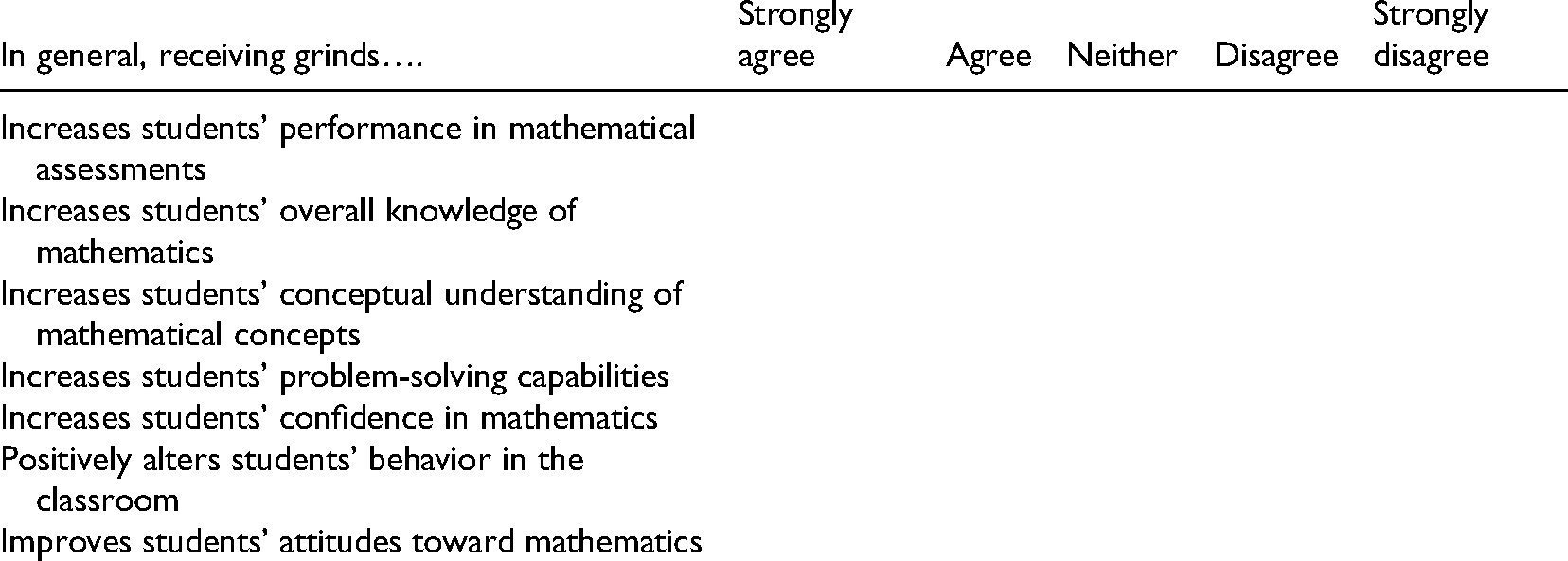
Likert scale on the impact of grinds.
Cross-tabulation of teachers who agreed/strongly agreed with each statement (%).
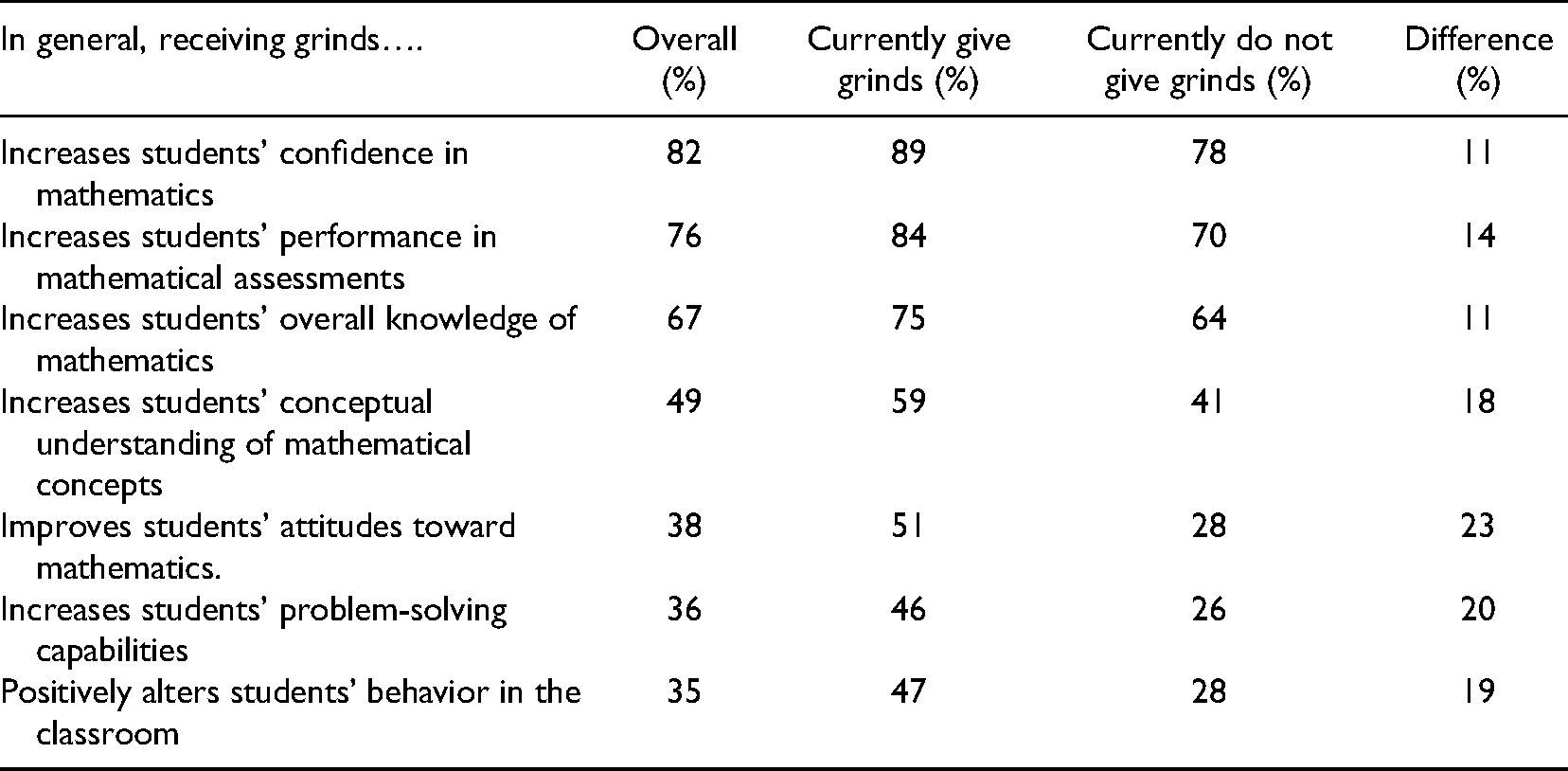
Impact of grinds.
The target sample for this study was all teachers of mathematics across the secondary school sector in Ireland. The study was conducted in the middle of the coronavirus disease 2019 pandemic and so it was decided against the distribution of a postal questionnaire to a stratified random sample of schools, as had been previously planned. Instead, an online questionnaire was distributed using a non-probability sampling method through the Qualtrics survey platform. The survey link was emailed to all national branches of the Irish Mathematics Teachers’ Association, and they were asked to share it with their members. The online link was left open over a 3-week period in November 2020 and 305 mathematics teachers responded to the survey.
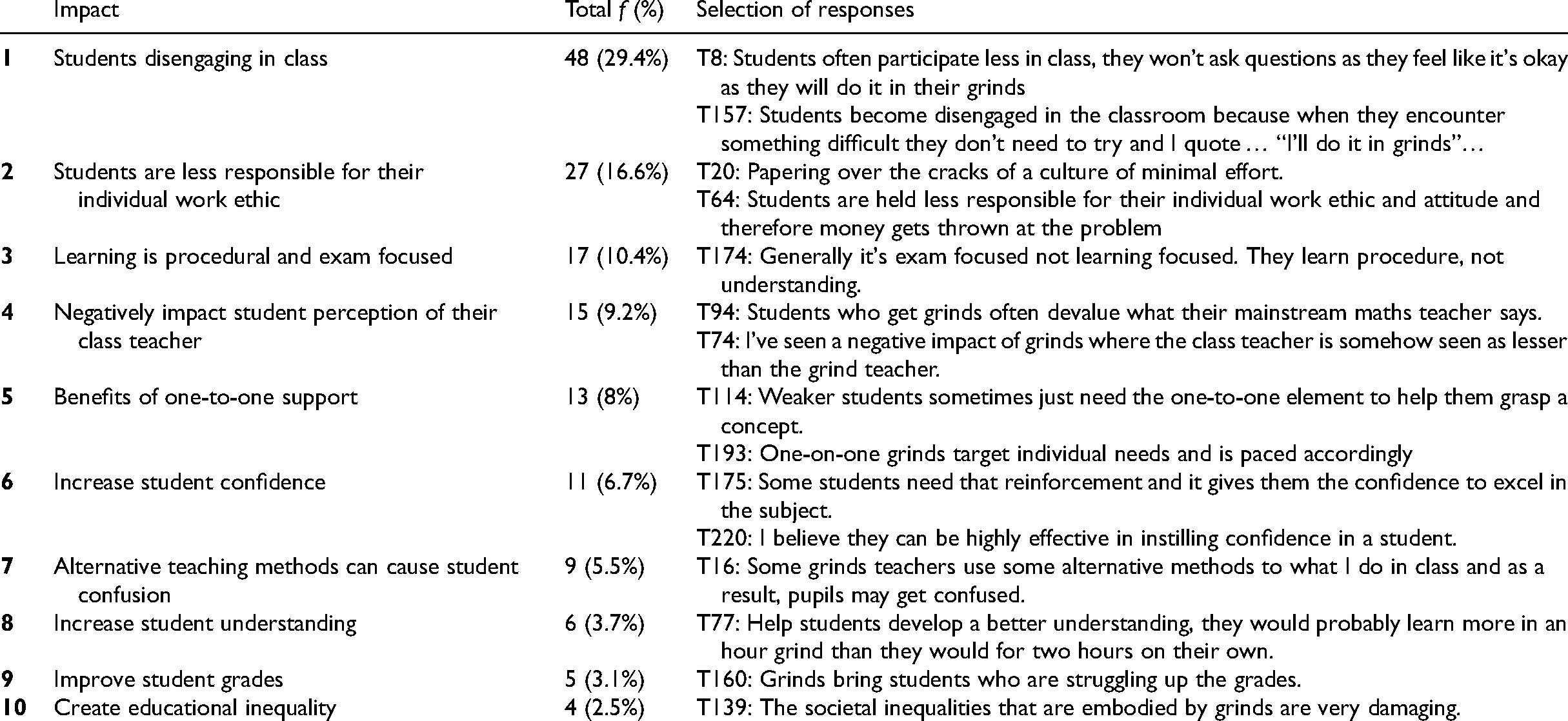
The quantitative data for this paper, which provided information on teachers’ level of agreement on the impact of grinds on various aspects, was recorded in SPSS (Version 26.0). These set of seven Likert scale statements were not designed by the authors to combine into a summated rating scale and responses to each item were analyzed individually using descriptive statistics. Estimating the reliability of scores on single-item measures can be difficult because commonly used internal consistency estimates of reliability cannot be calculated (Lucas & Brent Donnellan, 2012). Thus, some caution must be applied to the interpretation of these quantitative findings. In addition to the descriptive statistics, cross-tabulations also investigated any differences in the responses of participating teachers who identified as currently giving grinds versus those who do not. The data from the open-ended question was transcribed into a Microsoft Word document and an inductive “bottom up” thematic content analysis was performed in relation to the responding teachers’ perceptions of the impact of grinds. The work of Braun and Clarke (2021) provided a framework for this analysis. It was a flexible and recursive process, with repeated movement back and forth as initial codes were generated, and themes were reviewed. The coding process was thorough and comprehensive, and all themes were checked against each other and back to the original data set. While the initial analysis was completed by the first author, it was reviewed by the second author to ensure reliability. Overall, there were no major discrepancies with regard to the themes identified. Any disagreements in coding were discussed until both coders fully agreed with each other. Perhaps the most difficult part of the process was clearly defining and naming each theme so that there were no overlaps and ensuring each theme was internally coherent and distinctive. Once the authors had a set of fully worked-out themes, the coding framework was summarized using a frequency/percentage analysis and supported by direct quotations from participants’ responses where relevant. In the findings section, this coding framework is illustrated in Table 3. In each of these, ƒ refers to the number of teachers who mentioned a particular impact. Impacts repeated by the same teacher were not counted twice. However, participants sometimes mentioned more than one impact, explaining why the total number of f (163) exceeded the total number of teachers who responded to this survey question (134).
As noted, 305 mathematics teachers responded to the survey. Of these responding teachers, 116 (38%) identified as currently providing grinds. The data in relation to teachers’ levels of agreement (n = 284) with each of the seven statements are outlined in Figures 1 and 2. As evidenced by Figure 1, 216 (76%) responding teachers were in agreement that receiving grinds increases students’ performance in mathematical assessments. However, less than half of this number (102, which is equivalent to 36%), agreed that receiving grinds increases students’ problem-solving capabilities.
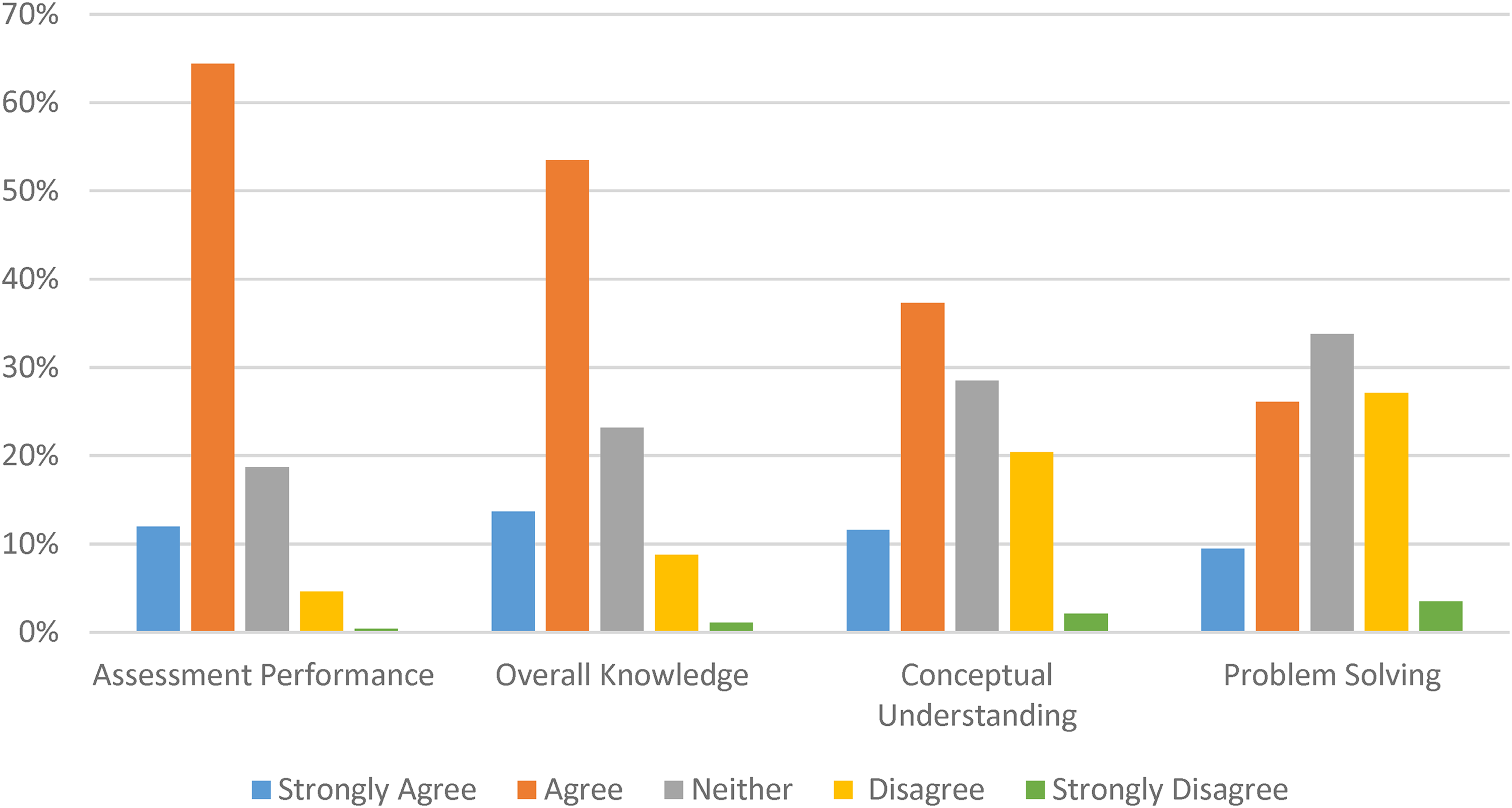
Teachers’ levels of agreement as to the impact of grinds on improving various domains.
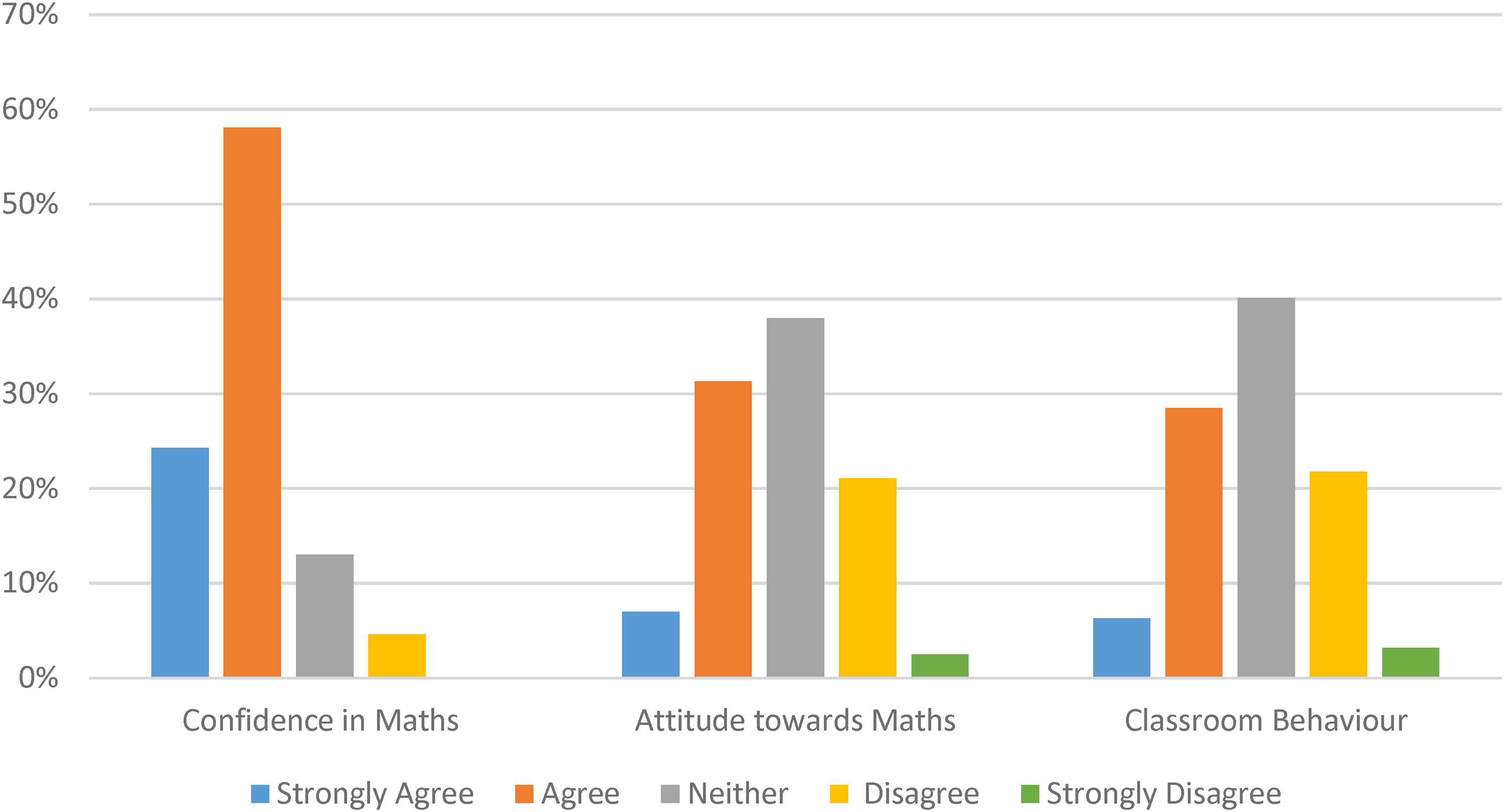
Teachers’ levels of agreement as to the impact of grinds on improving the affective domain.
Regarding the affective domain, the highest proportion of teachers (233, which is equivalent to 82%) was in agreement that receiving grinds increases students’ confidence in mathematics. However, on the other hand, only 99 (35%) agreed that receiving grinds positively alters students’ behavior in the classroom.
The authors also carried out a cross-tabulation comparing each of these seven statements against the responses of teachers who identified as currently giving/not giving grinds. Perhaps unsurprisingly, teachers who identified as currently giving grinds had more positive perceptions of the impact on all seven statements. For example, as evidenced in Table 2, 47 out of 93 teachers (51%) who identified as giving grinds were in agreement with the statement “In general, receiving grinds improves students’ attitudes towards mathematics.” However, only 42 out of 152 teachers (28%) who identified as not giving grinds were in agreement with the same statement.
These quantitative findings were further supported through the open-ended question where teachers were asked for comment on their perspectives regarding the impact of grinds. Analysis of this data highlights the mixed views of teachers with both positive and negative impacts being noted. From the ten themes identified, there were four positive and six negative impacts mentioned by teachers. However, it is noteworthy that when quantified, the negative impacts were most prevalent and made up the top four themes (see Table 3).
From a negative perspective, there were two most common impacts that responding teachers noted. The first was that grinds often lead to students disengaging in their regular mathematics lessons.
T100: Students can become disengaged in the classroom with the attitude that they will just learn it in grinds.
Secondly, teachers felt that grinds can often result in students being less responsible for their individual work ethic.
T134: Many students think doing a grind a week is a substitute for hard work and study.
In the quantitative data, only 49% (139) of teachers either agreed or strongly agreed that grinds improve students’ conceptual understanding. This is linked to the next negative impact in which some teachers determined that the learning which occurs through grinds is procedural and exam focused.
T298: Grinds generally go completely against the kind of teaching for conceptual understanding that I use in class…students will frequently be shown shortcuts and tricks. Focus is very often on the answer rather than the process.
Following on from this, some teachers felt that grinds can negatively impact students’ perceptions of their class teacher.
T175: Often it can alter a student’s opinion of the teacher negatively. They often think their grinds teacher is ‘better’ than their teacher. Maybe sometimes that is true. However, there is a huge difference in one-on-one help and sitting in a class with 30 other students which they don’t consider.
There were two other negative impacts of grinds mentioned by responding teachers. Some teachers noted the potential confusion caused by a tutor teaching an alternative method to the class teacher.
T275: Can cause problems when grinds teachers teach a different approach, rather than cementing prior knowledge. Some students insist on school teacher teaching them the alternative method, and fall between two stools.
The issue of grinds creating further inequality was also identified as a theme in teachers’ responses.
T48: Grinds, increase educational disadvantage. Students who need them and cannot pay, will perform worse than those who can pay (and may not need them). It’s like giving some students a 20 or 30 m head start in a 100 m race.
From a positive perspective, the most common impact that teachers noted was the benefit of one-to-one support that grinds can provide for struggling students.
T212: One-on-one will always be a more effective way of communicating an idea to a student.
In line with the quantitative data, many teachers also mentioned increased student confidence as a positive impact.
T175: I think that getting a grind is really about the feeling of confidence that a student derives from it. Often, nothing different is taught, but the one-to-one nature of the grind gives more self-belief.
Other positive impacts noted by some teachers were that grinds can increase student understanding and improve grades.
T60: Of course there is a small cohort of students that work hard in school and do require a little extra help to improve their understanding and this [grinds] often works well.
The findings of this study highlight the mixed views that mathematics teachers have in relation to the impact of PT that is permeating the subject at secondary level in Ireland. The contrasting views of teachers in the quantitative data who identified as currently giving/not giving grinds are particularly noteworthy and raise further questions around the reasons why teachers might decide to provide/ decide not to provide PT. In any case, in line with international literature, the findings emphasize that while there are positives aspects to PT, there are also very problematic ones (Bray, 2021).
There is no doubting the “benefits of one-to-one support” that grinds can provide. As summed up by one responding teacher, “there is a huge difference in one-on-one help and sitting in a class with 30 other students” (T175). This positive impact of grinds was also noted by students in a UK study conducted by Hajar (2018). One student noted that “instead of the teacher talking to everyone they’re just talking to you and giving you advice on what you should do in a specific task” (p. 523). This point is best summed up by Kim (2016) who stated that grinds can focus on the needs, learning styles, and academic goals of the individual student. As pointed out in the review of literature, such personalized attention can undoubtedly have a positive impact on students’ affective domain (Hajar, 2018). Responding teachers in this study were very cognizant of this positive impact, particularly in relation to how they can “increase student confidence.” For example, of all seven Likert scale statements, the highest proportion of teachers (82%) were in agreement that receiving grinds “increases students’ confidence in the subject.” This is noteworthy given the well-documented issues around the affective domain in mathematics, which is often associated with low confidence, low self-concept, and mathematics anxiety, particularly in relation to female students (O’Rourke & Prendergast, 2021). Furthermore, 76% of responding teachers were in agreement that receiving grinds “increases students’ performance in mathematical assessments.” This was also mentioned by a proportion of teachers in the open-ended responses. In line with Hof (2014), these positive effects are particularly evident with students who are taking part in remedial tutoring. For example, one teacher (T83) noted that grinds are “Good for very weak students who are struggling to pass.”
In the literature, He et al. (2021) determined that the fundamental role of PT is to supplement formal school education. However, the four most common impacts that were mentioned by teachers in this study were negative and implied that grinds detract rather than supplement regular schooling. The most commonly mentioned impact was that grinds often lead to “students disengaging in class.” Bray (2021) stated that PT can sometimes be counterproductive, and this impact is an example of such. As highlighted by some of the participating teachers’ responses, students’ disengagement in their regular mathematics lessons can take many forms including inattentiveness and unwillingness to complete class homework and tasks. For example, with reference to inattentiveness, one teacher (T101) stated that “Many students disengage in class as they feel they don’t have to work hard in school when they are paying for ‘magic’ grinds.” In relation to students’ unwillingness to work, another teacher (T99) noted “Some students I’ve come across only do assignments/homework set by their grinds teacher and I was even once asked to help a student with the grinds homework!!!” Such disengagement can also lead to negative classroom behavior. One respondent (T60) observed that students can often “work less in class as they will ‘learn it all at the grind’ and they can also be very disruptive and infringe on others learning in class.” This finding was supported by the quantitative data, where one in four teachers disagreed that receiving grinds improves students’ classroom behavior. The second most commonly mentioned impact was that grinds often lead to “students being less responsible for their own individual work ethic.” This is in line with some of the criticisms noted by teachers in a study by Wang and Bray (2016) investigating attitudes toward PT in Hong Kong. One teacher in their study noted that “It also gives students a wrong perception that they don’t have to work hard. They can just rely on tutoring” (p. 879).
In the quantitative data, it was found that 76% of responding teachers were in agreement that receiving grinds increases students’ performance in mathematical assessments. However, less than half of this number (36%), agreed that receiving grinds increases students’ problem-solving capabilities. This is an interesting finding, particularly given the renewed emphasis on problem solving in recent mathematics curricular changes, both in Ireland and internationally (Byrne & Prendergast, 2020; Prendergast et al., 2018). Furthermore, it raises questions around the pedagogical approaches used in grinds and links in with the third most cited impact in the qualitative data; “Learning is procedural, and exam focused.” This point was documented in the review of literature and is supported by Bray (2021) who noted that “Much tutoring is exclusively focused on past examination papers, tips on likely questions, and strategies for answering questions within the time constraints” (p. 464). Similar views were noted by many teachers in this study. For instance, one respondent (T117) stated that “Students often refer to tricks and shortcuts from their grinds and are asked to rote learn material.” It was also observed in the review of literature that some students developed an attitude of disrespect for their school teachers because tutors were better at coaching for examination techniques (Punjabi, 2020). This too was identified as a theme in the qualitative data. Teachers talked about how grinds “negatively impact student perception of their class teacher.” For example, “Students who get grinds often devalue what their mainstream maths teacher says” (T94).
It is noteworthy that one of the main impacts of tutoring that was identified in the literature was that it creates educational inequality. As evidenced from the data, this impact was only noted by 4 (2.5%) of the teachers who responded to the question in our study. However, this is not to say that this is not a real issue. As one responding teacher (T48) in this study noted “You pay and you get the privilege and advantage that puts you up the pecking order”. Not every family can pay for grinds and thus the potential positive impacts identified in this study of one-to-one support and increased student confidence are not available to all.
The last point recognizes one of the limitations of this study. The research investigated teachers’ perspectives of the impact and thus many of the resulting findings were micro-level and tended to be classroom related. While these classroom related impacts are important to identify, it is also important that further research on the impact of grinds takes into account the perspectives of many other stakeholders, including students, and their parents. As highlighted by McCoy and Byrne (2022) there is little evidence on the voice of the student and their embodied experiences in relation to PT. In addition to this, the authors are cognizant of the fact that the 305 teachers who responded were recruited voluntarily using non-probability sampling and this may have led to some bias in the findings presented. These teachers may be the ones who had the strongest opinions regarding the impact of grinds in mathematics and as such the results may be slightly skewed. Furthermore, as previously outlined, the reliability of the single Likert scale statements cannot be estimated and so those quantitative findings must be interpreted with caution. Despite these limitations, this study brings to the fore issues that can no longer be ignored by policymakers and those with a vested interest in education. As noted by Bray (2021), shadow education has reached such a scale that it must be addressed.
Conclusion
This research set out to explore mathematics teachers’ perspectives on the impact of the grinds culture in the subject at secondary education in Ireland. These perspectives are best summed up by the individual response of one mathematics teacher in the study:
T10: It is difficult to know exactly what the effects of grinds are. It depends on the student. If a student wants to improve, they will use grinds to their advantage, learn in them, improve their confidence for problem solving and have an improved attitude in class. If a student is made go to grinds or if they think the grinds tutor can improve them magically, then grinds can be a waste for everyone involved.
Although a large majority of responding teachers were in agreement that receiving grinds increases students’ confidence and their performance in mathematical assessments, it was clear from the qualitative data that teachers felt that grinds can cause students to disengage in class and to be less responsible for their own individual work ethic. These positive and negative impacts need to be carefully considered by all members of the tutoring triangle (tutors, students, and parents) before participating in shadow education. From an Irish context, there is somewhat of a perfect storm brewing in relation to the study of mathematics, its associated bonus points, and a growing grinds culture in the subject. The lure of the bonus points has driven students who find mathematics difficult into studying the subject at an advanced level (Prendergast et al., 2020; Treacy et al., 2020). These struggling students, often under pressure from parental expectations, turn to grinds in an attempt to make up for their deficit in knowledge. However, while the findings of this study suggest that such grinds may help students in their assessments, they also raise questions about the type of learning which grinds promote and the value of procedural versus conceptual understanding in the subject. For example, as one teacher (T174) noted “Generally, its exam focused, not learning focused. They learn procedure, not understanding.”
Shadow education continues to gain popularity around the world and there is an air of inevitability to its continued growth. As determined by Byun and Baker (2015), the provision of grinds is “unlikely to be banned or fall into disuse as its connection to the main social institution of formal education has become too strong” (p. 10). It is “inevitable, universal, and will likely continue to intensify into the foreseeable future” (Baker, 2020, p. 311). Thus, it is important that research such as this continues to investigate the impact of grinds and hypothesize how it may shape the future of education, especially in the subject of mathematics. Given the dearth of research in this area, particularly outside of an East Asian context, this paper offers important insights into Irish mathematics teachers’ perspectives on the impact of the grinds culture.
Footnotes
Contributorship
All authors contributed to the design of the study and the data collection phase. Mark Prendergast and Niamh O’Meara joined in the data analysis. Mark Prendergast drafted the manuscript and all authors read and approved the final manuscript.
Declaration of conflicting interests
The author(s) declared no potential conflicts of interest with respect to the research, authorship, and/or publication of this article.
Funding
The author(s) received the following financial support for the research, authorship, and/or publication of this article: This research was funded by the Teaching Council of Ireland, John Coolahan Research Support Framework.
Informed consent
This research received ethical approval for this research from the Social Research Ethics Committee in University College Cork in November 2019 (Log 2019-201). An anonymous online survey was used and the adult participants indicated their consent through the use of a ‘check-box’ on a landing page before they could proceed to the questionnaire.

Correction (October 2024):
Article updated to add Informed consent section.