




Abstract
Using data from the Kentucky Center for Statistics, this study aimed to explore the impact of participation in dual credit college algebra on longitudinal postsecondary education outcomes of high school seniors in Kentucky. Seniors were divided into students who took dual credit college algebra in high school and those who did not. Each group was further divided into two subgroups using junior ACT (American College Testing) math score of 22 (the benchmark in Kentucky for college algebra readiness). Propensity score matching was used to match dual credit college algebra participants with their non-participating peers based on student and school characteristics. The comparisons showed statistically significant advantages in terms of postsecondary enrollment, first year GPA, time to degree, and completion of a bachelor's degree for students in the low ACT group who took dual credit college algebra. Students in the high ACT group who took dual credit college algebra showed statistically significant advantages in terms of postsecondary enrollment, time to degree, and completion of a postsecondary certificate.
Keywords
1. Introduction
The contraction of the blue-collar economy is gradually rendering high school diploma obsolete as the entry level requirement for middle class employability (Hoffman et al., 2007). Although the trend is a worldwide phenomenon (e.g., Newfarmer & Sztajerowska, 2012), the United States (US) is perhaps one of the best places to make a strong case in terms of challenges and solutions. We would therefore focus on the US context in this brief literature review as a way to reflect on the international trend. This focus made sense because the findings of this study were based on data from one state within the US context.
During the four decades before 2010, jobs requiring postsecondary degrees or credentials increased from 28% to 62%, while jobs traditionally filled by high school graduates decreased from 72% to 38% (Carnevale et al., 2010). Okrent and Burke (2021) projected a significant increase in demand for qualified workers in the STEM (science, technology, engineering, and mathematics) fields (see also Carnevale et al., 2011). Obviously, future employees seeking to be part of the middle-class economy will need to attain a postsecondary degree to function in an economic environment of constant technological change and innovation (American College Testing [ACT], 2018; Aoun, 2017). It is thus critical for any educational system in the world to provide students with all necessary tools to enroll successfully in postsecondary education and complete successfully a degree, particularly in the STEM fields.
Challenges and solutions
Postsecondary enrollment and success represent the two most significant challenges facing most state universities and colleges (Long, 2018; Mintz, 2021). Both challenges originate from the inadequate secondary preparation; in other words, a substantial segment of students who graduate from high school are underprepared for postsecondary education (Chen & Simone, 2016; Ganga et al., 2018; Schak et al., 2017). The challenge in terms of enrollment pertains to the fact that underprepared high school graduates are often denied admission to postsecondary education of their choice or required to take extra noncredit-bearing courses once in postsecondary education (Schak et al., 2017). The challenge in terms of success pertains to the high failure rates in credit-bearing college courses for postsecondary (undergraduate) students who are identified as not college ready or insufficiently prepared for the rigor of college coursework (Ganga et al., 2018).
There are essentially two solutions, sometimes competitive, for these challenges. One solution is developmental education (DE) designed as postsecondary remediation or intervention in which underprepared (high school) students entering public postsecondary institutions are referred to the DE math and English courses with the intention of improving their ability to succeed in credit-bearing college courses (Bahr, 2009; Bailey et al., 2010). However, Chen and Simone (2016) found that nationally 50% of the DE students successfully complete their DE coursework at two-year institutions and 40% fail to complete their DE coursework at four-year institutions. It is nearly impossible for DE non-completers or even partial DE completers to be successful in postsecondary education. Chen and Simone (2016) further revealed that the completion rate of DE math is substantially lower than that of DE English (31% vs 49%). With such statistics, a substantial amount of work needs to be done to make DE an effective postsecondary remediation or intervention strategy that helps a large number of underprepared high school graduates pursue a postsecondary degree.
The other solution focuses on the institutional gap between secondary and postsecondary education as the reason for the challenges. Postsecondary enrollment and success, particularly in the STEM fields, are directly linked to adequate secondary preparation (Bound et al., 2010). Although there are various reasons why many high school graduates are underprepared for postsecondary education, many scholars identify the lack of professional collaboration and academic alignment between secondary and postsecondary institutions as one major cause (e.g., Bound et al., 2010; Grady, 2016; Pav et al., 2019; Traphagen & Traill, 2014; US Department of Education, 2012). These scholars argue that it is imperative that secondary and postsecondary institutions work together in a coordinated way to improve academic preparation of high school graduates.
Dual credit
Dual credit coursework, also known as concurrent enrollment, has been offered as an effective way to increase professional collaboration and academic alignment between secondary and postsecondary institutions (e.g., Tobolowsky & Allen, 2016). The idea is to provide high school students with rigorous credit-bearing courses that can concurrently fulfill coursework requirement for both secondary and postsecondary education. Therefore, compared with DE, dual credit is a secondary intervention strategy based on the joint efforts between secondary and postsecondary education. By its very nature, dual credit bridges the institutional gap by requiring interactions between secondary and postsecondary institutions, which in turn directly and indirectly influences academic preparation of high school students (Karp, 2013). With access to both secondary and postsecondary resources and supports, dual credit intends to allow high school students to experience the rigor and pacing of college courses while still attending high school and improve their postsecondary enrollment and success (Karp, 2006).
Although the research literature is quite thin on the effectiveness of the dual credit solution, a few studies did indicate a positive correlation between dual credit participation (in high school) and postsecondary enrollment and success (e.g., An, 2013; Jones, 2014). For example, high school students in a supportive high school environment who are exposed to postsecondary expectations through dual credit coursework demonstrate higher levels of academic motivation and engagement (An, 2015). When holding ACT scores and student characteristics such as gender, race-ethnicity, and socioeconomic status constant, concurrently enrolled high school students show an increase of 23% in the likelihood of enrolling in postsecondary education immediately after secondary graduation and a decrease of 11% in postsecondary assignment to DE courses (Bautsch, 2014; Giani et al., 2014).
College algebra
Students who participate in more academically intense math coursework in high school have higher enrollment and stronger persistence in postsecondary education than students who pursue fewer challenging math courses (Adelman, 2006; Noble & Schnelker, 2007; Poulsen, 2019). The completion of intensive high school math courses is also found to have the strongest effects on postsecondary completion regardless of study majors (Boser & Burd, 2009; Bozick & Ingels, 2008; Finkelstein et al., 2012; Grove, 2020; Woods et al., 2018). It is well known in secondary education that algebra is one of the most important courses functioning as the gatekeeper for high school graduation and for future pursuit in STEM (Cheng, 2016). In postsecondary education, college algebra continues to be regarded as the gatekeeper for degree completion (Ganga & Mazzariello, 2018; Li et al., 2010; Porter et al., 2015). Specifically, college algebra is a general education course required for graduation in nearly all two-year institutions and is considered critical for any further pursuit in postsecondary education (Herriott & Dunbar, 2009; Li et al., 2009; Wynegar & Fenster, 2009). For students who are not placed in higher level math courses, college algebra is a required gateway course for STEM, business, health, and other majors in need of math or technology competency (Herriott & Dunbar, 2009; Thiel et al., 2008). All these are perhaps good reasons why college algebra naturally becomes the most popular dual credit college course. Today, dual credit college algebra is available to high school students in many states including Kentucky.
In 2005, the National Center for Public Policy and Higher Education recommended a series of Key Quality Improvement Strategies (e.g., online tutorials, continuous assessment and feedback, increased interactions among students, on-demand support, mastery learning, detailed course plans, faculty training, and professional development) to help make college algebra a math course in which most students can succeed (see Twigg, 2005). These strategies came from various efforts in redesigning college algebra curriculum and instruction. Early successful stories include, for example, that after three years (2001–03), the Black Hills State University reported an increase in college algebra passing rate from 54% to 75%, with three times more students also passing trigonometry and precalculus; meanwhile, an increase of 25% in attendance was also noted together with a statistically significant increase in test scores on the Collegiate Assessment of Academic Proficiency (Hagerty et al., 2010). Over a period of three years (2003–05), student success in college algebra increased from 55% to 75%, with fewer students repeating the course at the University of Missouri in St Louise (Thiel et al., 2008). Such a promising trend, after the recommendation of Key Quality Improvement Strategies, appears to continue into recent years. For example, at the State University of New York in Albany, the average department passing rate in college algebra increased from 52% to 73% after just one year (2015), and the average score (percentage correct) on department standardized final exams improved from 58% to 70% in college algebra (Porter et al., 2015). Arizona State University increased its college algebra passing rate from 62% to 74% in just two years (2016–17) (McGraw-Hill, 2018). Although these encouraging reports are expected to pave the way for student success in dual credit college algebra in high school, empirical evidence has been extremely lacking on the effectiveness of dual credit college algebra. Speroni (2011) found that students who successfully complete college algebra as a dual credit course are substantially more likely to enroll in and earn a postsecondary degree of their choice.
Equal access
Equal access to dual credit coursework remains an educational issue. Even though dual credit courses are only available to secondary students, eligibility criteria for dual credit course enrollment tends to mimic postsecondary eligibility requirements with standardized test scores used as prerequisites for placement in dual credit courses. Many states have educational policies that require high school students to demonstrate a high level of academic skill in order to take dual credit courses (An, 2013; Bailey & Karp, 2003; Giani et al., 2014; Ozmun, 2013). As a result, the primary recipients of dual credit programs tend to be high-achieving high school students. Both Kentucky Department of Education and Kentucky Council on Postsecondary Education (KCPE) define college algebra readiness using junior ACT math score of 22 (i.e., students with ACT math score below 22 are not eligible for participation in dual credit college algebra).
Significance of this study
Given the critical importance of the dual credit strategy for better preparing high school graduates, it is surprising that empirical studies are extremely lacking, particularly those that use both regionally representative samples and credible statistical techniques to evaluate the effectiveness of dual credit coursework concerning postsecondary education outcomes. Furthermore, the issue of prerequisites for dual credit coursework renders very little research examining the impact of dual credit course taking on middle- and low-achieving students (Karp et al., 2004). This is unfortunate because middle- and low-achieving students actually need the most improvement for high school academic preparation.
This study sought to investigate the longitudinal impact on postsecondary education outcomes when high school students (in Kentucky) were allowed to take dual credit college algebra with or without meeting the standardized test score benchmark (i.e., junior ACT math score of 22). We attempted to address the following research questions.
After controlling for student and school characteristics, does enrollment in a dual credit college algebra course during high school increase the likelihood of enrollment in postsecondary education immediately following high school graduation? After controlling for student and school characteristics, does enrollment in a dual credit college algebra course during high school affect postsecondary education outcomes in terms of first-year persistence, first-year GPA, time to degree, degree completion, and degree attainment in the STEM fields?
Postsecondary education enrollment and the postsecondary education outcomes of degree completion and STEM degree attainment spoke directly to the challenges that postsecondary education faces as we discussed in detail earlier. Meanwhile, KCPE (2020) clearly identified “shortening time to degree” (p. 7) as well as “persisting to a second year of college” and “earning a first-year GPA of 3.0 or higher” (p. 9) as critical research questions that researchers need to address.
Professional collaboration and academic alignment between secondary and postsecondary education are a critical issue for educational reform not only in the United States but also in many countries of the world. Although this concept is sound, this is a rather poorly researched area. This study was practically significant because we addressed many important educational policy and practice issues relevant to this concept that lack empirical evidence at the current time. This study was also strong methodologically in that we utilized a representative sample (more precisely a comprehensive state longitudinal database tracking the entire population of high school seniors in Kentucky for years) and strategically matched dual credit college algebra participants and nonparticipants by means of an advanced statistical technique for more credible comparisons.
Method
Intervention
The curriculum of college algebra as a general education course is rather similar across postsecondary institutions because the primary goal of college algebra is to prepare students for calculus. The instruction of college algebra is rather “standardized” after the National Center for Public Policy and Higher Education introduced a series of Key Quality Improvement Strategies for college algebra in 2005. As a result, dual credit college algebra for high school students is also rather similar in both curriculum and instruction. In Kentucky, it is an online course with the prerequisite requirement for enrollment as a passing grade of C in Algebra II. In other words, the course promotes equitable access of all students to a rigorous college algebra curriculum. The course is aligned with the Key Quality Improvement Strategies, with some modifications in order to operate in a high school setting. Some hallmarks of the course are organically formed learning communities among secondary and postsecondary faculties, high and rigorous expectations for students, individual instruction, one-on-one interactions with students, peer-to-peer teaching and tutoring, software-based homework, online tutorials, and continuous assessment and feedback.
The core content includes linear and quadratic functions (solving, modeling, graphing, graph analysis, and transformations); circles; piecewise functions; variation applications; operations on functions; one-to-one and inverse functions; polynomial functions and their properties, graphing behavior, roots, and transformations; and exponential and logarithmic functions with applications. The course can be taught in one semester, and some high schools choose to offer the course in both semesters during one academic year. Other high schools complete the course over one academic year, with the fall semester dedicated to prerequisite preparation and actual course enrollment occurring in the spring semester. High school students primarily interact with their (on-site) high school math teachers. These supervising teachers cover prerequisite content, answer questions from students, provide continuous feedback, and monitor student progress. More importantly, they supplement the online lecture videos with whole-class discussions and activities to reinforce and prepare students for the content covered in each homework set. The online homework and corresponding video tutorials attached to each homework set allow more flexible, self-paced learning and more targeted, individualized teacher assistance (Bain, 2004).
Student learning is usually assessed through regular paper and pencil exams, one cumulative final exam, one course project, and a number of mastery-based online homework sets with corresponding paper and pencil quizzes. Student presentations are also a part of the course performance aimed to increase collaboration among students and introduce college learning experiences. The pace of the machine-graded homework and testing windows remain similar to those in the corresponding one-semester course taught on postsecondary campuses. In reality, even if some students cannot eventually pass the course, they would still be much better prepared for postsecondary education.
Data
The Kentucky Center for Statistics collects data on all students in the State of Kentucky about student demographics, transcripts, and student performance from preschool to college. We obtained extant data from the center that contained secondary and postsecondary records of high school seniors who had the opportunity to enroll in a dual credit college algebra course between the fall of 2009 and the spring of 2019. Postsecondary education outcomes for high school seniors who participated in dual credit college algebra were compared with those who did not participate in any dual credit college algebra course.
We started with data on all students who completed their senior year of high school and earned a high school diploma between the fall of 2009 and the spring of 2019. Because the dual credit college algebra course has been taught with rather similar curriculum and instruction, we combined all high school seniors who enrolled in dual credit college algebra during the ten-year period. Specifically, we identified 14,301 high school seniors who participated in a dual credit college algebra course and 192,864 high school seniors who did not. We then identified through an advanced statistical technique often referred to as propensity score matching (PSM) a cohort of nonparticipants comparable to the participants.
Matching
If dual credit college algebra could be considered as an intervention (i.e., the treatment group) in this study, we obviously did not have a randomly chosen control group. PSM attempts to replicate an experimental study after the fact by matching students in the control group who have similar observable characteristics (covariates or confounders) to students in the treatment group based on their propensity score which represents the conditional probability of a student being chosen to join the treatment group (see Blundell et al., 2005; Rosenbaum & Rubin, 1984). By matching students in both groups using observed covariates or confounders, the argument for causality is strengthened and the selection bias is reduced (Randolph et al., 2014).
The primary goal of PSM is to balance all of the covariates for the matched groups via estimating propensity scores. Thus, any successful application of PSM depends on finding a large group of students who have several pretreatment covariates similar to those of students in the treatment group (Caliendo & Kopeinig, 2008). We were in a good position to meet this standard in our case because the comprehensive state longitudinal database that we obtained contained high-quality data that were sufficiently rich.
Covariates which impact the probability of selection must be chosen carefully and have no influence on the treatment effects for the outcome variables (Rosenbaum & Rubin, 1984). Too many covariates can cause difficulties with matching and increase variability, but too few can exclude important confounders (Heckman & Robb, 1985). Student and school characteristics were potential sources of selection bias in this study. We aimed to identify nonparticipants with similar academic and family background as well as school background to those of the participants. We relied on the research literature for guidance for the selection of student and school characteristics. For example, we noticed in the literature that socioeconomic status (SES) is a potential confounder because students from high SES background tend to do better in postsecondary education than students from low SES background (e.g., Deming et al., 2014). Therefore, SES was included as one of the covariates for matching. Similarly, gender, race-ethnicity, (final) high school GPA, and ACT English and math scores were chosen as covariates. Furthermore, students were matched on essential school characteristics to control for differences in school demographics. School location and school Title 1 status (a measure of school socioeconomic condition) were chosen as covariates. We were confident that matching variables were appropriately chosen in our case, thus meeting the other critical standard for PSM. Other support (as another validity check) for the selection of matching variables was the behaviors of the selected variables themselves, all producing differences within optimal ranges between the control group (i.e., nonparticipants) and the treatment group (i.e., participants). Finally, all PSM procedures were implemented on the Stata platform.
Dependent variables
This study explored the differences in postsecondary education outcomes between dual credit college algebra participants and nonparticipants. The first research question compared enrollment in postsecondary institutions immediately following high school graduation with enrollment defined as full-time undergraduate attendance during the fall immediately following high school graduation. Full-time undergraduate enrollment was dummy coded (1 = yes, 0 = no).
The second research question compared postsecondary education outcomes of first-year persistence, first-year GPA, time to degree, degree completion (certificate, associate, or bachelor), and degree attainment in the STEM fields (including fields in need of math or technology competency). First-year persistence was defined as meeting a standard number of credit hours in which a student enrolled as a first-year undergraduate and was dummy coded (1 = yes = credit hours ≥ 24, 0 = no = credit hours < 24). First-year GPA was continuous on a scale from 0 to 4. Time to degree, beginning immediately after enrollment, was continuous measuring the number of academic years until graduation. Completion of a certificate or diploma needs less than two years and was dummy coded (1 = yes, 0 = no). Completion of an associate degree (usually two years) or a bachelor's degree (usually four years) were both dummy coded (1 = yes, 0 = no). Attainment of a STEM degree was also dummy coded (1 = yes, 0 = no).
Independent variables
Independent variables were used mainly in the PSM procedures functioning as covariates to match nonparticipants with participants in dual credit college algebra. As briefly discussed earlier, student characteristics included gender (a dummy variable), race-ethnicity (a categorical variable with categories combined into a dummy variable), SES (a dummy variable denoting the eligibility for the federal free or reduced-price lunch program), (final) high school GPA (a continuous variable on a scale from 0 to 4), and junior ACT English and math scores (both continuous variables on a scale from 1 to 36). School characteristics included school location (a categorical variable that was turned into two dummy variables) and school's Title 1 status (a dummy variable denoting the eligibility for school wide or targeted federal assistance).
The effects of enrollment in dual credit college algebra on both high- and low-achieving students were analyzed in this study. We adopted the state standard, using junior ACT math score of 22 to separate students into high- and low-achieving groups. Therefore, the matching of nonparticipants to participants was actually performed twice based on the same student and school characteristics, once for the high ACT group and once for the low ACT group.
Statistical analysis
Data analysis was performed on the Stata platform using Stata generated matched data. Group comparisons between nonparticipants and participants in dual credit college algebra on postsecondary education outcomes were made within the multiple regression framework. Each outcome was analyzed individually. Among postsecondary education outcomes, some were dummy variables (e.g., postsecondary enrollment), and others were continuous variables (e.g., first-year GAP). In response, logistic regression was used for dummy outcomes, and multiple regression was used for continuous outcomes. An effect size measure (η2) was employed to indicate the practical importance in terms of group differences in postsecondary education outcomes. Cohen (1988) has provided benchmarks to classify η2 = .01 as small, η2 = .06 as medium, and η2 = .14 as large.
Results
This study aimed to compare Kentucky high school seniors who participated in a dual credit college algebra course with those who did not participate in any dual credit college algebra course in terms of their postsecondary education outcomes. Both students who met and those who did not meet the Kentucky standard for college algebra readiness, junior ACT math score of 22, were analyzed (see Appendix for descriptive information on student and school characteristics of this sample of high school seniors). Within each ACT group, nonparticipants were then sought by means of PSM who matched participants in the same ACT group in terms of student and school characteristics (see Appendix). Table 1 presents descriptive statistics after matching on postsecondary education outcomes between nonparticipants and participants in each ACT group. With these descriptive backgrounds, group differences were estimated between nonparticipants and participants in each ACT group on each postsecondary education outcome.
Descriptive Statistics on Postsecondary Education Outcomes (After Propensity Score Matching).
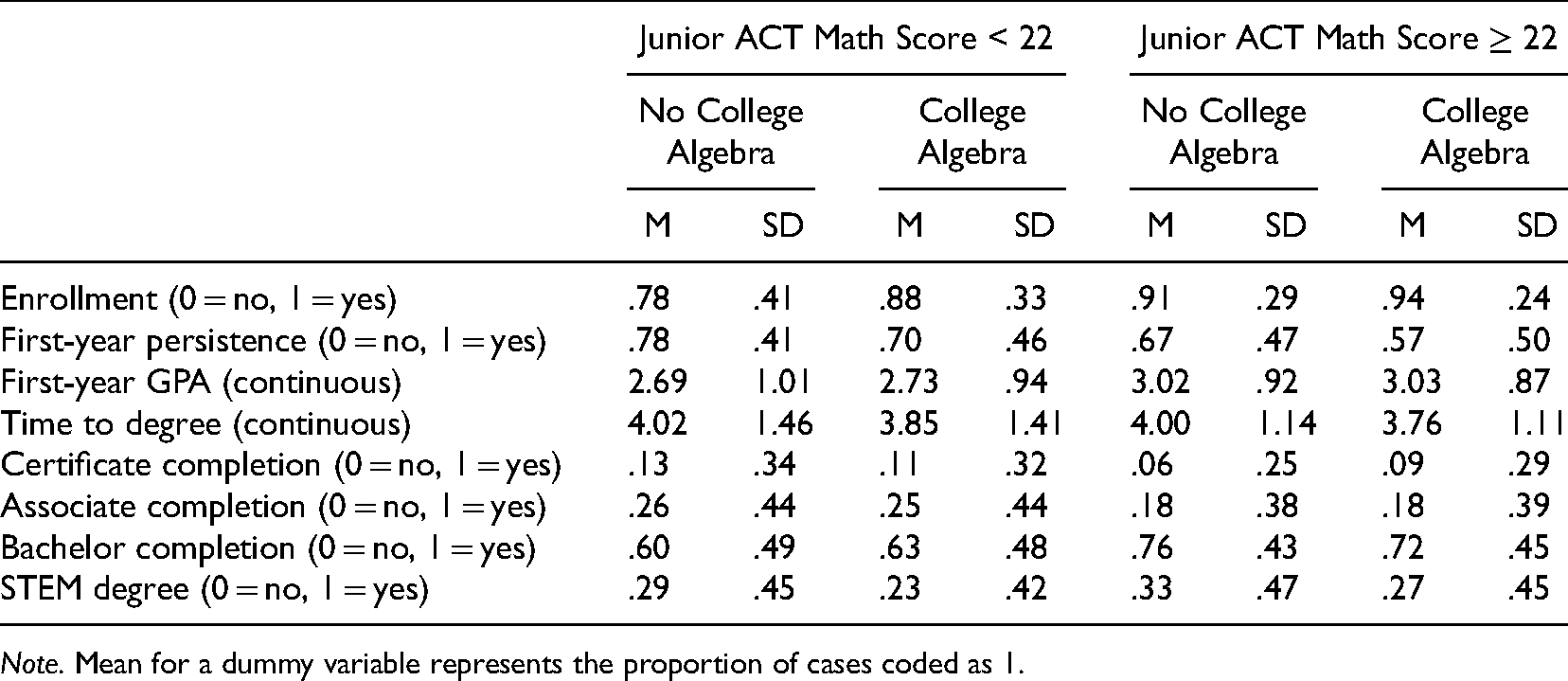
Descriptive Statistics on Postsecondary Education Outcomes (After Propensity Score Matching).
Note. Mean for a dummy variable represents the proportion of cases coded as 1.
Table 2 presents estimates on the effects of dual credit college algebra on postsecondary education outcomes for each of the ACT groups. It is customary to report effects from logistic regressions in terms of odds ratio and effects from multiple regressions in terms of unstandardized coefficients. In the low ACT group, participants in dual credit college algebra were 1.05 times more like to enroll in postsecondary education immediately following high school graduation than nonparticipants. Effect size indicated medium effects (η2 = .06). In the high ACT group, participants in dual credit college algebra were 1.02 times more like to enroll in postsecondary education immediately following high school graduation than nonparticipants, with a small effect size (η2 = .04).
Effects of Dual Credit College Algebra on Postsecondary Education Outcomes Based on Propensity Score Matching.
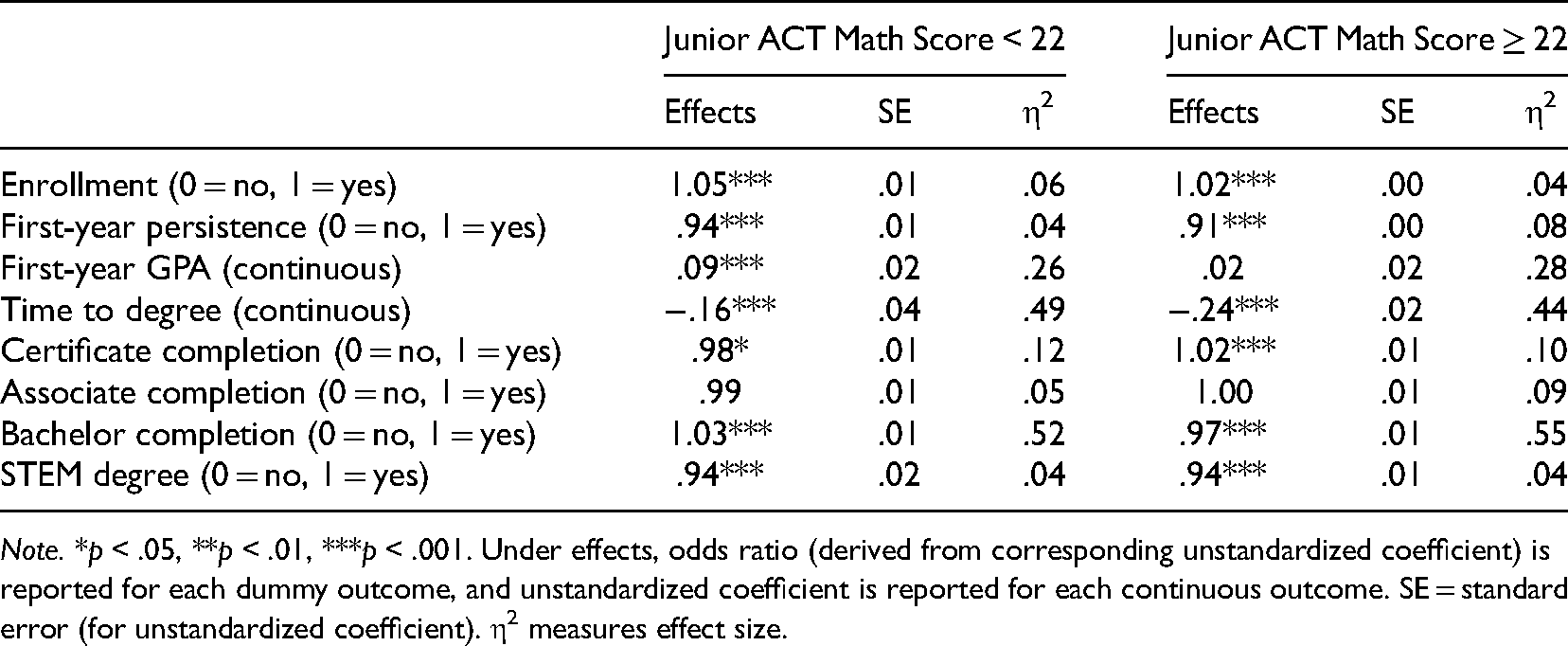
Note. *p < .05, **p < .01, ***p < .001. Under effects, odds ratio (derived from corresponding unstandardized coefficient) is reported for each dummy outcome, and unstandardized coefficient is reported for each continuous outcome. SE = standard error (for unstandardized coefficient). η2 measures effect size.
In the low ACT group, nonparticipants in dual credit college algebra were 1.06 times (1 ÷.94) more likely to demonstrate postsecondary first-year persistence than participants, with a small effect size (η2 = .04). In the high ACT group, nonparticipants in dual credit college algebra were 1.10 times (1 ÷.91) more likely to demonstrate postsecondary first-year persistence than participants, with a medium effect size (η2 = .08).
In the low ACT group, participants in dual credit college algebra achieved .09 points higher (on a scale of 0 to 4) in postsecondary first-year GPA than nonparticipants. This represented a large effect size (η2 = .26). In the high ACT group, there were not any statistically significant differences in postsecondary first-year GPA between nonparticipants and participants in dual credit college algebra.
In the low ACT group, participants in dual credit college algebra spent less time to complete their degree than nonparticipants. The time difference is .16 of an academic year (equivalent to 1.44 months based on one academic year as 9 months), and this was a rather large effect size (η2 = .49). In the high ACT group, participants in dual credit college algebra spent less time to complete their degree than nonparticipants. The time difference is .24 of an academic year (equivalent to 2.16 months), and this was a rather large effect size (η2 = .44).
In the low ACT group, nonparticipants in dual credit college algebra were 1.02 times (1 ÷.98) more likely to complete a postsecondary certificate than participants, with a medium effect size (η2 = .12). In the high ACT group, participants in dual credit college algebra were 1.02 times more likely to complete a postsecondary certificate than nonparticipants, with a medium effect size (η2 = .10).
Table 2 indicates that there were not statistically significant differences in the likelihood of completing an associate degree in postsecondary education between nonparticipants and participants in dual credit college algebra in either ACT group. Nonetheless, in the low ACT group, participants in dual credit college algebra were 1.03 times more likely to complete a bachelor's degree in postsecondary education than nonparticipants, with a rather large effect size (η2 = .52). In contrast, in the high ACT group, nonparticipants in dual credit college algebra were 1.03 times (1 ÷.97) more likely to complete a bachelor's degree in postsecondary education than participants, also with a rather large effect size (η2 = .55). Finally, in both ACT groups, nonparticipants in dual credit college algebra were 1.06 times (1 ÷.94) more likely to obtain a STEM degree than participants. Effect size was small in both cases (η2 = .04).
Summary of Principal Findings
In this study, we compared postsecondary education outcomes of high school seniors in Kentucky who participated in a dual credit college algebra course with those who did not participate. We separately examined students who met and did not meet the Kentucky standard for college algebra readiness (junior ACT math score of 22) when they participated in dual credit college algebra. For students in the low ACT group (ACT math score < 22), positive effects of participation in dual credit college algebra emerged in terms of postsecondary enrollment, first-year GPA, time to degree, and completion of a bachelor's degree. Three of these four positive findings showed a large effect size (first-year GPA, time to degree, and completion of a bachelor's degree). In fact, effect size was rather large in terms of time to degree and completion of a bachelor's degree. For students in the high ACT group (ACT math score ≥ 22), there were also positive effects of participation in dual credit college algebra in terms of postsecondary enrollment, time to degree, and completion of a postsecondary certificate. One of these three positive findings, time to degree, showed a rather large effect size. In the following space, we would focus on these positive findings so as to offer important policy and practice implications for secondary math education while relating our empirical findings to the research literature.
Dual credit college algebra reduces postsecondary time to degree
This is perhaps the most important finding of all in this study. High school seniors who participated in dual credit college algebra spent statistically significantly less time to earn a postsecondary degree than those who did not participate in any dual credit college algebra course, regardless of ACT groups. Although the research literature is very limited, dual credit students in general tend to enroll in more credit hours and miss fewer academic semesters throughout their postsecondary education, thus reducing time to degree (Allen & Dadgar, 2012; Edmunds et al., 2017; Giani et al., 2014). We contributed to the research literature by showing that such a reduction in time in the dual credit college algebra case is sizeable (i.e., with rather large effect size). We quantified the reduced time as approximately one and a half months for students in the low ACT group and approximately two and a quarter months for students in the high ACT group. Such a finding implies critically important economic benefits for both society and individuals. With this finding, postsecondary institutions can use the same amount of resources to serve more students, thus promoting economic benefits for society; while students (regardless of their high school math competence) can borrow less money for their postsecondary education (and are also likely to begin to pay back student loans sooner assuming jobs after postsecondary degrees), thus promoting economic benefits for individuals.
To a critical extent, it may not be an exaggeration to label dual credit college algebra “an educational miracle.” We strongly encourage education stakeholders and policymakers to make serious effort in offering high quality dual credit college algebra to more high school students regardless of their math competence. For example, more resources should be allocated to the implementation of this course on high school campuses for improvement in curriculum and instruction as well as supervision and management. Meanwhile, education stakeholders and policymakers should continue to create conducive ways for stronger professional collaboration and better academic alignment between secondary and postsecondary institutions (e.g., Bound et al., 2010; DeMaria et al., 2015). All these efforts may substantially increase “the intervention power” of dual credit college algebra for further improvement in postsecondary education outcomes of all high school graduates.
Dual credit college algebra helps high school low-achieving students
We consider this finding another most important finding of all in this study. Many administrators and educators traditionally hesitate to offer dual credit college algebra to high school low-achieving students in fear that they may overwhelmingly fail the course because of their low math competence. To some extent, this commonsense concern is reasonable. In many states including Kentucky, junior ACT math score has been used for screening high school students for any dual credit college algebra course, even though the relationship in academic performance between ACT and dual credit college coursework for high school students is unclear in the research literature (An & Taylor, 2015; Conley, 2007; Hoffman et al., 2007). Secondary and postsecondary institutions in Kentucky took a bold step to provide equitable access of all students regardless of their ACT performance to dual credit college algebra, creating a critical research condition for us to examine the “myth” that high school low-achieving students may not be college algebra ready. The results were positively surprising in this study.
In a comparative term, we have found that dual credit college algebra actually helped high school low achievers more than high school high achievers. In the low ACT group, dual credit college algebra helped high school seniors excel in time to degree (rather large effect size), completion of a bachelor's degree (rather large effect size), postsecondary first-year GPA (large effect size), and postsecondary enrollment immediately following high school graduation (small effect size). In contrast, in the high ACT group, dual credit college algebra helped high school seniors excel in time to degree (rather large effect size), completion of a postsecondary certificate (small effect size), and postsecondary enrollment immediately following high school graduation (small effect size). Therefore, high school low achievers were the “winner” of participation in dual credit college algebra. Some may also argue that practically it is more important (for high school low achievers) to earn a bachelor's degree than (for high school high achievers) to earn just a postsecondary certificate.
We are all confident in suggesting that education stakeholders and policymakers should make serious effort in promoting dual credit college algebra among low-achieving students in high school. This course may have the potential to alter the life path of many high school students who have little hope for life because of their low academic competence. We challenge the traditional wisdom of goodwill to shield high school students of low academic competence from vigorous dual credit college coursework. As far as dual credit college algebra is concerned, high school low-achieving students may benefit tremendously from participation in the course. If more attention, supervision, and management can be devoted to high school low-achieving students participating in dual credit college algebra, it is highly likely that the positive things we observed in this study will continue and additional positive findings may emerge.
Dual credit college algebra enhances postsecondary enrollment
One of the consistent findings on the effects of dual credit college algebra across ACT groups is that high school seniors who participated in a dual credit college algebra course were statistically significantly more likely to enroll in postsecondary education immediately after high school graduation, regardless of ACT groups. There is some evidence that participation in academically intense math coursework in high school enhances postsecondary enrollment (Darolia et al., 2020; Noble & Schnelker, 2007; Poulsen, 2019). There is also evidence that participation in dual credit college coursework in general enhances postsecondary enrollment (Gagnon et al., 2021; Giani et al., 2014; Struhl & Vargas, 2012). Nonetheless, using vigorously matched groups (via PSM) based on high quality data, we quantified the enhancement due to participation in dual credit college algebra as small (i.e., with small effect size) regardless of ACT groups. Therefore, we suggest that the enhancement should not be exaggerated, even though promoting dual credit college algebra is a potentially workable strategy for promoting postsecondary enrollment of all high school students regardless of their math competence.
The global perspective
Although this study was conducted within the US context, the issue has strong global relevance. First, college algebra matters worldwide as a gatekeeper math course “safeguarding” many study majors in postsecondary education (e.g., Ganga & Mazzariello, 2018; Porter et al., 2015). As early as 1996, Smith argued that early access to algebra “socializes” students to take advanced math courses and increase math performance. Indeed, taking algebra early matters to the building of lifetime thinking skills (Hadani & Rood, 2018; Study International, 2019; US Department of Education, 2018). We suggest that dual credit college algebra can be an effective form of early access to college algebra for high school students. In this study, we found that dual credit college algebra does predict postsecondary education outcomes, with the strongest effects on completion of a bachelor's degree and time to degree for low ACT students and on time to degree for high ACT students.
Second, preparing high school graduates for their postsecondary education is a common educational goal worldwide. All around the world, college readiness is not an issue for any elite universities but a common concern for universities (e.g., state universities within the US context) that serve the general (as opposed to gifted) population of high school students. We suggest that dual credit college algebra has great potential as an effective strategy for preparing the general population of high school students for success in postsecondary education, especially for students on the lower end of the academic spectrum. Finally, in this study, we did not find any positive evidence connecting dual credit college algebra with completion of a STEM degree. We encourage math educators worldwide to think about this finding because algebra is the very foundation of STEM (US Department of Education, 2018). If promoting STEM education is a common educational effort all around the world, then this finding would motivate math educators worldwide to examine the role of algebra in STEM education.
Limitations and further research
Even though this study was sound conceptually and methodologically, there were two major limitations. First, although we presented good reasons for the aggregation of data across dual credit college algebra courses and across a period of ten years (which strengthened our sample size considerably), such aggregation assumed that there was not any major variation in the coursework and there were not any major social events over a ten-year period that might impact any aspects of the coursework. Our data contained a certain level of “noises” due to this aggregation. Second, the Kentucky Center for Statistics provided considerably reliable data on the educational process of high school seniors. Although there was solid student demographic information that we used as matching variables for PSM, school demographic information was limited. More school background variables may make matching for PSM even more precise. We encourage further research to overcome these limitations with stronger data. Apart from these methodological suggestions, we would like to suggest some other further pursuits.
Although we have explained with excitement many findings from this study, we have to leave a couple for lack of any clear understanding for researchers who will pursue this line of inquiry. For example, why were nonparticipants in dual credit college algebra more likely to demonstrate postsecondary first-year persistence than participants in both ACT groups (in fact effect size was medium for the high ACT group)? In nontechnical term, nonparticipants in dual credit college algebra were more likely to enroll in postsecondary first-year coursework worthy of 24 credit hours or higher than participants across ACT groups. We believe that this phenomenon has to do with students’ self-confidence. Granted, dual credit college algebra is a difficult and challenging course for any high school seniors. After experiencing the difficulty and challenge, even if high school seniors could successfully complete the course, they might nonetheless become cautious (or lose some self-confidence) in handling postsecondary courses. If this is true, they might choose to take smaller but surer steps concerning coursework during their first year in postsecondary education. This is of course just our reasoned speculation, and the real story needs to be discovered in further research. For another example, why in both ACT groups were nonparticipants in dual credit college algebra more likely to obtain a STEM degree than participants? Overall, this study has opened doors to future researchers for replications and further investigations on many critical issues associated with dual credit college algebra and its effects on postsecondary education outcomes. It should inspire math educators worldwide to examine ways that improve professional collaboration and academic alignment between secondary and postsecondary institutions for the common goal of better preparing high school graduates for their postsecondary education.
Footnotes
Declaration of Conflicting Interests
The author(s) declared no potential conflicts of interest with respect to the research, authorship, and/or publication of this article.
Funding
The author(s) received no financial support for the research, authorship, and/or publication of this article.
