



Abstract
Pedagogies of Discomfort (PoD) emphasise teaching and learning that take place outside of ‘comfort zones’. Discomfort is not ‘pedagogised’ for the sake of discomfort; instead, it is a means to prompt transformative experiences. Embracing discomfort is a means to address fixed assumptions and move beyond ‘surface-level exploration’ (Faulkner and Latham, 2013; Nolan and Guo, 2019; Robinson, 2021; Sumara, 2002). While PoD have been extensively explored in scholarly literature, the diversity and breadth of this work are obstacles for educators and scholars seeking practical strategies and an overview of the ‘discomfort’ literature. To address these obstacles, this article curates the ‘discomfort’ literature to develop a model of practice for practitioners to adapt to their contexts. This model is a novel contribution that extends beyond what existing literature offers. Moreover, this model’s faithful curation of the ‘discomfort’ literature attempts to demarcate a specific body of knowledge on PoD.
Introduction
Disrupting convention requires an engaged pedagogy to uncover possibilities, value each student, and inspire transformation (Bastos, 2009). The opportunity to embrace an ‘engaged pedagogy’ may arise through including a controversial topic in the course syllabus or through co-curricular/extra-curricular activities. Pedagogies of discomfort (PoD) are a viable option for educators faced with the above two scenarios. Through dialogue, PoD enable educators and students to move outside their ‘comfort zones’; PoD assert that this move towards discomfort creates possibilities for individual and social transformation (Zembylas and McGlynn, 2012). PoD have attracted a rich and diverse body of literature. However, this abundance of interest can present challenges to practitioners seeking practical guidance. This essay aims to address this gap by curating the ‘discomfort’ literature to define and contextualise PoD and then formulate a model of practice (Faulkner and Latham, 2013; Nolan and Guo, 2019; Robinson, 2021; Sumara, 2002).
Pedagogies of discomfort
PoD involve the educators and students engaging in the discomforting process of questioning cherished beliefs and assumptions. Positioned within the genre of ‘disruptive pedagogies’, PoD challenge conventional practices to create space for ‘a language of possibility’ (Giroux, 1992: 204; Mills, 1997). The latter refers to an educational posture that engages with firmly established traditions through a lens of critique and transformation rather than through submission, reverence, or mere repetition (Gale, 1992; Giroux, 1988b). As is common practice with disruptive pedagogies, PoD will be pluralised to ‘pedagogies’ of discomfort to signify the variety of practices. A point of significance is that we do not seek to cause discomfort for the sake of discomfort; rather, it is a means to prompt transformative learning (Millner, 2021: 806). Felman (1992: 53) is even more explicit in their justification of discomfort, ‘Without embracing discomfort, you cannot address fixed assumptions and, arguably, you will not move beyond “surface-level exploration”’ (Faulkner and Latham, 2013; Nolan and Guo, 2019; Robinson, 2021; Sumara, 2002). There is also a moral impetus towards discomfort; since it is inevitable that students will have to contend with discomfort in their lives, Aultman (2005) maintains that it is the educators’ responsibility to give students what they need to develop professionally and morally beyond the classroom.
Questioning the assumptions of critical pedagogies
Our understanding and framing of PoD can be attributed to Megan Boler’s monograph, Feeling Power: Emotions and Education. This was followed by Boler’s articles with decolonial scholar, Michalinos Zembylas; their union further developed PoD (Boler and Zembylas, 2003; Porto and Zembylas, 2020; Zembylas, 2015; Zembylas and Boler, 2002; Zembylas and McGlynn, 2012). In recent times, Zembylas is the scholar most associated with PoD; in certain respects, Boler passed the mantle to Zembylas.
Although PoD are indebted to critical pedagogies, which are a set of approaches that apply concepts from critical theory to the field of education, PoD sought distance from critical pedagogies. Zembylas (2018: 96–97) points out: Although there may be convergences between the aims of social justice projects…it would be a mistake to subsume the latter under the former, as the two projects might be grounded in different epistemological and ontological frameworks. For example, there might be limitations in the Eurocentric modernist framework that undergirds critical theory and pedagogy, and thus, it is important to confront the possibility that critical pedagogies might be implicated in modernity and coloniality.
In this regard, Boler and Zembylas’ union is not entirely surprising considering that the main criticisms of critical pedagogies came from both of their intellectual traditions, poststructuralist feminism, and decolonial scholarship, respectively. To a degree, their concerns about critical pedagogy informed the development of PoD; the latter’s contours and idiosyncrasies came out of their negotiations with the limitations of critical pedagogies. Therefore, to appreciate the distinct character of PoD, it is necessary to explore the widely held concerns of critical pedagogies. Moreover, Zembylas and Boler did not develop an explicit model, so exploring what differentiates PoD from critical pedagogies enables us to craft some semblance of a model for practice.
Questioning the rational man
Critical theory and its offshoots are indebted to the ‘rationalist hopes of Enlightenment legacy’; rationality is placed at the heart of pedagogy (Zembylas and Boler. 2002: 5). Whereas Boler (1999) places emotional and affective exchange at the heart of pedagogy. PoD recognise that there is an entwined connection between our emotions and epistemology both within and external of our learning environments; this inseparable connection holds influence over our awareness and knowledge creation (Ojala, 2021; Robinson, 2021). Undoubtedly, there is some degree of rational inquiry bound up in PoD. However, it is argued that a central focus on rationality can obscure the role that emotions play in learning; ‘emotions define how and what one chooses to see, and conversely, not to see’ (Boler, 1999: 176). Thus, we find that although there is diversity in the theory and practice of PoD, the focus on emotion and affection remains consistent.
Ultimately, it appears that Boler made these distinctions between emotion-infused PoD and rational approaches to make the broader point that emotions have been problematised and trivialised and then contrasted with ‘pure’ and reliable rationality. Boler asserted that emotions were pushed to the ‘bad side of the fence’, along with women, I would also add that minorities kept the women company (Boler, 1999: xv–xvi).
Taking one step back, we can see that Boler’s effort to liberate pedagogy from its bondage to rationality was part of a wider ‘abolitionist’ movement that began a decade earlier with her poststructuralist feminist ally, Elizabeth Ellsworth’s groundbreaking articles (Ellsworth, 1989, 1990). Ellsworth endured severe backlash for her article’s critique of critical pedagogy’s use of rationality; such levels of epistemic violence are unavoidable when one challenges Eurocentric orthodoxies (Harvard Educational Review, 1990). Ellsworth (1989, 1990) argued that rationality was often used as a blunt instrument that inflicted pain on her students. The context of her critique was the racial strife on her campus at the University of Madison-Wisconsin. In response, Ellsworth developed a module to address the racial tensions. She initially saw it as a simple problem that could be addressed with the ‘go-to’ pedagogy of the period; she took critical pedagogy ‘off the shelf’ and almost mechanically applied it in her classroom. However, Ellsworth soon realised she was harming rather than helping her students. She stated that subjecting their lived experiences to the logics of rationalism, validity, and scientism exacerbated the conditions that she was trying to work against, and she inadvertently reproduced relations of domination in her classroom. This is not to say that Ellsworth advocated that the positions of students were to be taken up unproblematically; her point was that much of rational discourse was predicated on and made possible through the exclusion of the socially constructed irrational ‘other’. Therefore, how could she use that very same discourse to call on students of colour to justify and explicate their claims? Similarly, is it possible that the ‘master’s tools’ can dismantle the ‘master’s house’? (Lorde, 1984: 112).
Questioning the individual man
We can also see PoD’s emphasis on collective/group teaching stems from the notion that emotions are connective, and much of what causes discomfort are not ‘private problems’ but are an indicator to something larger and other than ourselves (Boler, 1999: 177–78). Boler contrasts this collective approach to teaching and learning with the fetishisation of individualised self-reflection (Boler, 1999: 177). Likewise, Tuck and Yang (2012: 20) explain further that critical pedagogies’ resoundingly echo the allegory of Plato’s Cave, ‘A continental philosophy of mental emancipation, whereby the thinking man individualistically emerges from the dark cave of ignorance into the light of critical consciousness’.
Questioning the ethical man
A body of ethics encases PoD and critical pedagogies; there is much agreement between them, particularly around the notion that it is unethical to preserve the status quo to the extent that it can be considered ‘poisonous’ to ignore normalised cruelties and injustices. The difference between pedagogies is one of emphasis; critical pedagogues appear to focus on the educator’s virtue ethics’, whereas PoD have spent more time wrestling with the ethics of harm. The former pertains to the educator acting conscientiously, while the latter relates to the most ethical way to ‘step into this murky minefield and come out as allies and without severe injury to any party’ (Boler, 1999: 176). Therefore, PoD scholarship focused on strategies to avoid stepping on ‘landmines’. A strategy of PoD seeks to minimise harm and maximise the potential for personal and emotional transformation (Porto and Zembylas, 2020).
Minimising harm and maximising transformation are best articulated through Zembylas’ engagement with Butler’s work on ‘ethical violence’. He argues that discomfort in pedagogical encounters risks tipping into harm when demands are imposed upon students without offering them meaningful alternatives. Put differently, students should never experience a session in which they feel entrapped or perceive that no viable way out exists. Second, forcing students to adopt a collective ethos of what is deemed ‘right’ or ‘wrong’, without providing them with sufficient context or the necessary information, constitutes a form of harm. Third, harm may also arise when students are denied access to the educator’s own vulnerability, when the educator positions themselves solely as the custodian of knowledge rather than as a co-participant in the learning process.
Questioning the assumptions of pedagogy of discomfort
The above separation of PoD from critical pedagogies established a distinct and innovative approach to navigating classroom discomfort, a model that this article will further develop. However, this crucial move did not exempt PoD from inheriting its own set of problematic assumptions. Therefore, this section will examine the assumptions of the PoD in order to reorient it toward a more equitable application. First, it is not uncommon in the PoD literature to see attention paid to introducing discomfort into the classroom; it is almost as if discomfort is a foreign object that can be escorted into the class. In contrast, discomfort is already there; no classroom is balanced or universally safe for all; comfort is not the default for classrooms, as most function as zones of unequal power and privilege, with certain groups always marginalised, relative to context (Zembylas and Boler, 2003). Similarly, Gill and Uppal (2020) state that, ‘Notions of inviting emotion and discomfort into the classroom rather than recognizing that this lived reality already exists in the educational context among the bodies who experience the oppression and violence on a daily basis, personally, socially, epistemologically, institutionally, and systemically’.
Therefore, rather than focussing on introducing discomfort, our discussions should centre on how to explore its presence in the classroom. This distinction between introducing discomfort and exploring discomfort impacts the pedagogical approach. If we act on introducing discomfort, we may treat it as something with a predefined shape, a fixed script, and a predictable outcome. This approach pushes educators to adopt a rigid, one-size-fits-all approach that can feel artificial and an external imposition rather than an authentic part of learning. In contrast, exploration begins with the understanding that discomfort is not an object to be imported but a reality already present. This approach empowers educators to become facilitators or guides, helping to illuminate and navigate the discomfort that emerges organically. While setting clear boundaries for safety and respect remains crucial, the educator’s role shifts from a rigid script to an improvisational yet purposeful journey.
Second, by offering only minimal discussion on the differential impact of discomfort, the Pedagogy of Discomfort (PoD) literature appears to operate under the problematic assumption that all students will feel discomfort. However, discomfort does not impact students in the same way; students from dominant cultures may experience discomfort by encountering revelatory or repressed information (Gill and Uppal, 2020). For example, Cooks (2010: 248) observed, ‘For most Whites, to think about what it means to be White is itself a radical move’. Whereas in students from marginalised backgrounds, such thoughts can occur throughout the day. Therefore, their discomfort is more likely to arise from having to voice their inner thoughts and feelings that were habitually policed or excluded (Flam, 2024; Gill and Uppal, 2020; Leibowitz et al., 2010; Mortenson et al., 2024). Even more problematically, their discomfort can be exacerbated by educators who assume that all students are similar predicaments. This final point marks a point of departure with the architects of PoD. Zembylas and Boler (2003: 111) stated, A pedagogy of discomfort invites not only members of the dominant cultures but also members of marginalized cultures to re-examine the hegemonic values inevitably internalized in the process of being exposed to curriculum and media that serve the interests of the ruling class. No one escapes hegemony.
Their notion that no one escapes ‘internalising dominant cultural values’ is problematic, even when moderated with ‘even though these values take different forms in different individuals’ (Boler and Zembylas, 2003: 115). Such an assertion speaks to lives lived outside of racialised and marginalised bodies. Many of us, especially those from ‘marginalised locations with profound and violent experiences of oppression and exclusion’, do resist internalising dominant cultural values and examine these values while experiencing hegemonic oppression on a regular basis (Gill and Uppal, 2020: 124). Even if members of marginalised communities internalise dominant cultural values, they maintain a clear understanding of the concessions that were made to function within these societies. For example, in the late twentieth century, Smith coined the term ‘bifurcation of consciousness’ to describe the dual existence of women navigating a male-dominated world. This concept refers to the tension between the abstract, male-centred ‘governing consciousness’, and women’s own practical consciousness, which is rooted in the everyday world (Appelrouth and Edles, 2008). For over a century, Black scholars have talked at length about the ‘double consciousness’ of their communities. Double consciousness is an awareness of the American who occupies an African Body. DuBois outlines the awareness: It is a peculiar sensation, this Double Consciousness, this sense of always looking at oneself through the eyes of others, of measuring one’s soul by the tape of the world that looks on in amused contempt and pity. One ever feels his twoness, an American, a Negro; two souls, two thoughts, two unreconciled strivings, two warring ideals in one dark body, whose dogged strength alone keep it from being torn asunder (Reed, 1997: 91).
Rather than adopt blanket approaches, we can draw from the ‘dogged strength’ of students from marginalised backgrounds to foreground our explorations of discomfort.
The third implicit assumption is revealed in the lack of discussion on the identity of the educator; the ‘assumption is often that the educator has no color, class, gender, and so on’ (Gill and Uppal, 2020). This is a significant oversight, as it fails to acknowledge that the educator’s body and lived experience are integral to the curriculum itself. As Gill and Uppal (2020) compellingly argue, ‘The body of an educator is curriculum’. An educator’s social identity, encompassing factors such as race, class, and gender, profoundly shapes both the content delivered and how students receive it. Therefore, PoD must fundamentally integrate the educator’s lived experience to genuinely address the complexities of pedagogical discomfort.
Drawing on the above critiques of assumptions, a reimagined Pedagogy of Discomfort (PoD) is a transformative educational approach that foregrounds the complex and pre-existing presence of discomfort within the classroom, viewing it not as an obstacle but as a catalyst for transformative learning. They move beyond introducing discomfort as an external tool, instead viewing discomfort as a dynamic, already-present reality. A reimagined PoD rejects the notion of the educator as a neutral, disembodied figure. Instead, it recognises that the educator’s own racial, class, and gender intersecting identities profoundly shape both the curriculum and the learning environment.
Building a model of practice
Search terms.

Inclusion and exclusion criteria.
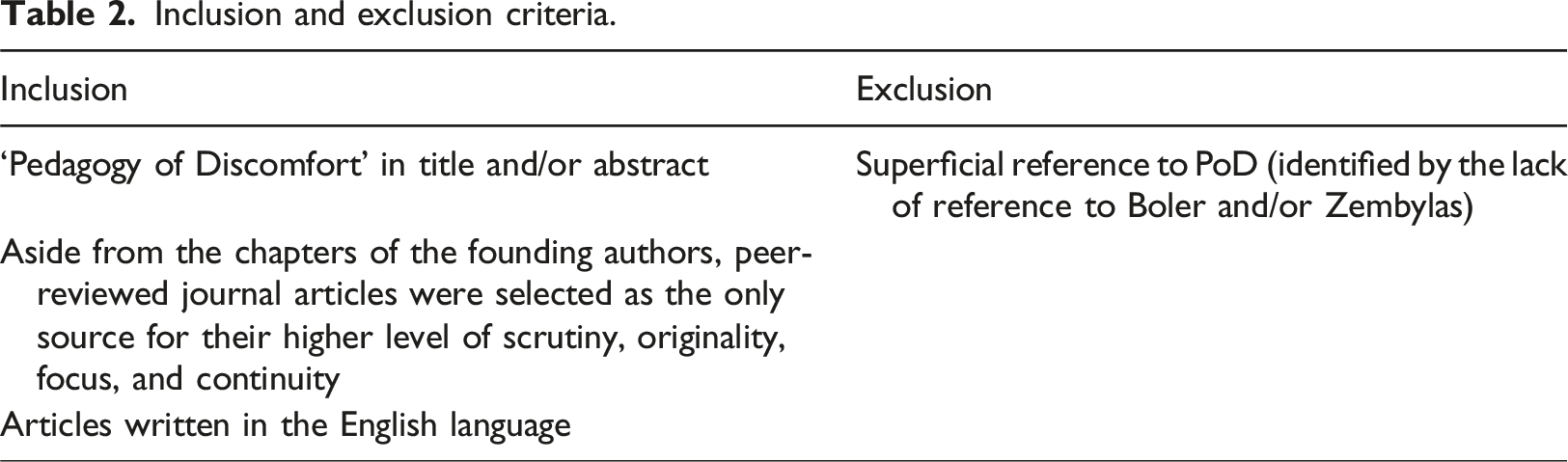
There was a total of 43 chapters and articles retrieved. A model was constructed from the oft-repeated concepts and approaches found in the 43 chapters and articles. Although more weighting was given to the works of the founding authors, the model is a faithful abridgement of the ‘discomfort’ literature.
Model of practice
This section will present the model and concrete examples derived from the 43 chapters and articles (see Figure 1). Henceforth, the 43 chapters and articles will be referred to as the ‘discomfort’ literature. Model of practice.
The model comprises four stages: (1) Reflexivity, (2) Safety, (3) Session, and (4) Action. Each stage will be discussed conceptually and supported by an example.
Reflexivity
Concept: The first stage is reflexivity. Reflexivity is the educator’s interrogation of himself or herself. Reflexivity is placed at the front of the model for three reasons. First, reflexivity’s prominent placement in the model speaks to its importance in the discomfort literature to the degree that it unifies the diverse literature. Second, its placement emphasises that it is vital for the educator to be reflexive before anything is done or planned. Third, its primary placement signifies that the uncomfortable process of interrogating oneself should start with the educator. It could be misconstrued that discomfort is just for the students. Instead, it is a shared journey; both parties need to face discomfort (Faulker and Lathan, 2013; Macdonald, 2013; Mokuria, 2024; Nolan and Guo, 2019; Quilty, 2017; Trahar, 2017).
As shown in the model of practice, reflexivity is not restricted to the first stage; it should be woven into the fabric of the session.
Example: Ideally, reflexivity should not be performed by the educator individually. Instead, it should be shared with people that the educator can be vulnerable with, either another individual or a collective (Boler, 1999; Wolgemuth and Donohue, 2006). Reflexivity can be conducted in several ways; it can commence with weighing up the harms and benefits of using a particular exercise (Boler, 1999; Lahiri-Roy et al., 2023; Zembylas, 2015). One could also reflect on one’s contradictions and inconsistencies relating to their beliefs, understandings, and practices (Boler, 1999; Mortenson et al., 2024; Nadan and Stark, 2017; Nolan and Molla 2018; Robinson, 2021). Additionally, educators should reflect on their positionality, how their positionality could impact the class and if the educator is from a minoritised background, and have they considered the enhanced consequences of running such a session? (Blum et al., 2021; Boler, 1999; Cooks, 2010; Gill and Uppal, 2020; Lahiri-Roy et al., 2023; Mortenson et al., 2024; Ohito, 2016).
Safety
Concept: The second stage is safety. Although we reject the notion that the typical classroom is safe for all parties, there is still a requirement to formulate ‘some sort of safety even under discomforting conditions’ (Zembylas and McGlynn, 2012: 44). ‘Some sort of safety’ is the delicate ethical balance between facilitating discussion on issues that are usually excluded from the classroom and ‘creating pain within the pedagogical process, layered on top of what is already a difficult and vulnerable enterprise’ (Ojala, 2021; Redmond, 2010; Zembylas, 2012, 2015). The key ethical question we must ask ourselves is ‘Where and how does one draw the line?’ (Zembylas, 2015: 164). Unanimously, the discomfort literature is very clear that the educator has a moral responsibility not to leave their students in abject pain. Therefore, a crucial component of PoD is employing a safety strategy.
Example: A strategy of safety can be implemented by co-constructing classroom guidelines, which serve as a shared framework to ensure that undue harm is minimised. The educator starts the session by putting forward guiding principles that encourage students to express their lived experiences without fear of repudiation and create a space of psychological safety. Then the educator arranges students into groups to develop more principles amongst themselves. This transfers agency to the students. Also, instead of surprising students with an unconventional session, co-construction provides scaffolding to walk students into the session gently and ‘free’ them from their typical constraints, and also by arranging the students into groups, the educator provides an opportunity for them to unpack what has occurred (Bryan, 2016; Faulker and Lathan, 2013; Millner, 2021). This speaks to what Zembylas and McGlynn (2012: 54) call ‘controlled discomfort’. In a way, co-construction is a means to gain informed consent from students as they have a part to play in constructing the rules of the game (Dutta et al., 2016). When the students report their guiding principles to the rest of the class, the educator can identify potential issues to which they can adapt their content. Co-construction is a more ‘productive’ alternative to ‘trigger’ or content warnings, which are ‘problematic’ due to their ‘potential conflation of trauma and offence and its entanglement with “questions of privilege”’ (Carniel, 2017: 142).
Session
Concept: Moving on to the actual session, there are three concepts within a single session to consider: (i) Strategic empathy, (ii) Dialogic exchange, and (iii) Affective content. It is vital that these concepts are interwoven into the session.
Strategic empathy
One of the basic tenets of PoD is that it promotes ‘active’ instead of ‘passive’ empathy (Boler, 1999; Zembylas, 2015). Zembylas (2015) develops this tenant into ‘strategic empathy’, which is to employ empathy when faced with problematic statements from students; you must dig deep to appreciate how an impoverishment of knowledge or experience would lead students to make problematic statements. Students need to feel that they can express their views without censure or judgment (Whitney et al., 2021). Zembylas (2015: 172) adds, ‘Taking sides too early may in fact make it impossible to build a constructive point of departure to navigate through and transform these knowledges and emotions’. However, this does not mean that ‘anything goes’ or necessitates that you agree or condone what was said (Jansen, 2009; Zembylas, 2015). Instead, as we will discuss later, it is vital to provide specific bordered spaces (thought experiments, heteroglossia, etc.) for students to express their views, lest their problematic statements ‘spill out’, and bring disproportionate discomfort to educators and their fellow students (Boler, 1999).
Dialogic exchange
Dialogue is fundamental to PoD; it is seen as a ‘key mechanism’ in the transformation process (Ivey and Johnston, 2024; Wiltse, Johnston and 2014). Bryan states (2016) In asking learners to confront difficult knowledge…, it was necessary to ensure that there were multiple dialogical spaces where they could reflect upon, and work through, the feelings they experienced in response to the course material and concepts.
PoD’s emphasis on dialogue is due to its relational pedagogy, which entails forging a relationship with students through dialogue and encouraging dialogue between students (Ivey and Johnston, 2024). Through carefully pre-planned dialogue prompts, educators present themselves to their students as humanly as possible; they show their curiosity, vulnerability, and humility.
Affective content
‘We feel, therefore we learn’ (Walker and Palacios, 2016: 176).
Affective content is teaching material that engages with our emotions, impulses, desires, and feelings (Zembylas, 2014). The role of the educator is to utilise affective content to support the integration and exploration of emotions, impulses, desires, and feelings as they arise and to ‘teach each person in his or her totality’ (Clark and Dirkx, 2008; Cutri, 2015; Dirkx, 2008; Walker and Palacios, 2016: 177). Affect is a core tenet of PoD; it is a powerful technology that connects and stimulates students. Neuroscience and educational and cognitive psychology have amassed a body of literature that confirms the place of affect in learning (Walker and Palacios, 2016). Furthermore, affective content can be used to prod ‘troubled views’; there is an understanding that students’ ‘troubled views’ of the Other do not solely reside at the cognitive level; they have ‘emotional roots’ which are buried deep in the psyche. For example, there are deeply embedded beliefs that precede any ‘evidence’. Rather, ‘evidence’ is sought to maintain these beliefs because one’s humanity is contingent on the inhumanity of the Other; for one to maintain one’s ‘Whiteness’, others must be ‘Blackened’. Likewise, Boler (1999: 190) maintains, ‘To challenge a student’s (or educator’s) cherished assumptions may be felt as a threat to their very identity’. Such matters are often beyond the reach of purely evidenced-based interventions (statistics, percentages, data, etc.); instead, what is needed is the development of content that speaks to the emotions, impulses, desires, and feelings of students (Leibowitz et al., 2010: 84).
Example: The above three concepts (Strategic empathy, Dialogic engagement, and Affective content) of a session require ‘housing’; otherwise, there is an increased risk that discomfort will overwhelm the gathering and become an impediment to transformative learning. Three types of ‘housing’ will be explained: (1) Thought experiments, (2) Heteroglossia exercises, and (3) Formative reflective assignments.
Thought experiments
Nolan and Molla (2018) laid the foundation for our ‘thought experiment’, which is a way to organise ‘learning experiences around real-life problems’. They postulate that learning experiences organised in a collegial environment that create discomfort can provoke reflection on deeply embedded dispositions. Moreover, since thought experiments are a caricature of the real world, students are more likely to contribute and interrogate the status quo; it is almost as if they ‘drop their guard’ and are prepared to have honest conversations that might not occur if we were talking about the actual issue. If possible, the educator can gradually move from the thought experiment to discussing the real issue, and it is a productive pathway to having a real conversation. What follows is an example of a thought experiment: The context to this example was to explore the existence of possible bias in science, technology, engineering and mathematics (STEM) topics. Therefore, the educator used the metaphor of the ‘neutral’ camera to illustrate the subtle nature of bias. Alternatively, it is possible to use the ‘neutral’ design of seatbelts, crash test dummies, spirometers, etc. The educator sets the scene by informing the students: ‘Camera technology has historically misrepresented darker skin tones. Lighter skin became the chemical baseline for film technology. Those of us with darker complexions are rendered unnaturally; we appear darker, artificially brighter, or washed out. In order for the camera to render my complexion accurately, I must sit in a particular location, invest in studio-grade lighting, and undertake significant post-production practices. Simply put, I need special artificial corrective care for me to appear natural. Before I became interested in photography, I assumed I was the problem for my lack of light skin, after all, the camera is just a neutral instrument that captures light. Far from it, photography is not just a system of capturing light, but a technology made from people's choices – what we value, we accommodate; what we do not value, we do not accommodate’ (Lewis, 2019; Roth, 2009a, 2009b, 2012). The educator arranges students into groups and asks them to explore bias in outwardly neutral processes: ‘Is there bias in the complaints department's decision not to uphold the complaints of the parents? Was there bias in the initial designs of camera technologies? Considering what we know about the rendering of darker skin tones, is there bias in the ongoing manufacturing of camera technologies?’
Heteroglossia
Heteroglossia refers to looking at a controversial issue from two or more perspectives. The Heteroglossia approach prepares students to engage with a plurality of perspectives about an issue (Leibowitz et al., 2010). To this point, Boler (1999) commented, ‘An ethical pedagogy would seem to require listening with equal attention to all views and perspectives’. The Heteroglossia approach can be used to encourage students to integrate their ‘troubled views’ into ‘socially just perspectives’ and demonstrate to them how our perspectives have been shaped by the ‘dominant culture of the historical moment’ (Boler, 1999: 179; Zembylas, 2012). The educator discusses a controversial issue to the class; this issue could be a current news headline, an enactment of a controversial law, etc. Then, the educator arranges students into groups to investigate the issue from various perspectives. For example, Heteroglossia approach could be a chronological exercise; the class could look at how a controversial issue was interpreted at different points in time. A group could look at how the issue was viewed in the past, another group could discuss how the issue is viewed now, and the last group could predict how the issue will be seen in the future. Alternatively, the educator organises the first group of students to look at the controversial issue from the perspective of the minority group affected, another group is tasked with looking at the issue from the perspective of the dominant culture, and another group will look at the issue from the perspective of a government department. What follows is an example of a Heteroglossia: Educator: ‘Today, we are going to explore this issue using heteroglossia. Remember, this means holding multiple perspectives in tension, listening to each with equal care. I’ll divide you into three groups. Group A, you will represent a minority community directly affected by the policy. Group B, you will represent the government’s perspective. Group C, you will represent members of the dominant culture who support the law’. Students move into groups, discuss, and then report back.
Reflective assignment
If discomfort forms part or most of your course, you can require students to reflect on moments of discomfort in a formative assignment or section of their portfolio. This assignment is announced at the beginning of the course, and students can complete the assignment whenever they feel discomfort. In a certain way, this assignment is an outlet for students to wrestle with their discomfort. Students may not be able to engage with the class in the ‘heat of the moment’; therefore, this allows them to collect their thoughts and articulate their discomfort. The assignment can contain prompts to help them reflect on how they felt; identify the possible motive of the lecturer; suggest why discomfort is an important part of the learning process. To take this assignment from a solitary action to a dialogic encounter, the lecturer can respond with an empathetic reflection on what the student wrote; instead of students receiving the typical assignment feedback, they will be gifted with the lecturer’s reflection on their reflection. There is a real chance of growth and reconciliation in this approach. Moreover, this assignment provides another option for the formal complaints process. As an alternative to the typical accusatorial and adversarial interactions associated with the complaints process, a complaint is transformed into a learning opportunity for both parties. What follows is an example of a reflective assessment cover sheet. • Describe the moment of discomfort: What happened? What was said or done? • Explore your feelings: How did you feel in that moment? What emotions arose for you? • Consider the intent: What do you believe was the possible motive or intent of the lecturer, peers, or material? • Connect to learning: How did this moment of discomfort contribute to your learning process? If you feel that no learning occurred, what could have been done differently to facilitate a more constructive outcome?Formative Reflective Assignment
Action plan
Conclusion
While Zembylas and Boler laid the foundational groundwork for PoD as a distinct field of inquiry, this article marks a significant step forward by elevating it into a cohesive genre of practice. The author is the first to synthesise the fragmented body of ‘discomfort’ scholarship, bringing diverse studies together under a single, unified model for implementation. This was not done uncritically; the proposed model directly questions the problematic assumptions inherent in the PoD literature.
Our primary findings demonstrate that a reimagined PoD can be a powerful tool for fostering equity and transformative learning. By shifting the focus from ‘introducing’ discomfort to ‘exploring’ its pre-existing presence, our model acknowledges that classrooms are not neutral spaces. We found that differentiating the experience of discomfort, recognising that it is felt differently by marginalised and dominant students, is crucial for preventing harm and promoting transformative learning. Furthermore, by moving beyond individualistic self-reflection, PoD emphasise that discomfort is a collective signal of systemic injustice, thereby linking personal experience to a broader call for action.
The proposed model is theoretical, and its effectiveness requires validation through empirical research. Future studies should implement and test this framework in diverse educational settings to assess its impact on student engagement, learning outcomes, and well-being.
At its core, the model reflects Boler’s ‘minimal hope’ of laying a pathway for students and educators to examine their values and analyse how those values were formed (Boler, 1999: 198). In doing so, this model bridges high concepts with practical application, providing a roadmap for educators who have chosen to disrupt the status quo. It redirects our focus from ‘macro social and political visions’ to the ‘ethical dimensions of micro, classroom-level interactions’ (Soto, 2020: 129).
Equity work is a continuous journey, not a destination. It is a perpetual process of reflection and adaptation’ in this light, we must view the model as being in a perpetual ‘beta’ mode. It requires scholarly attention to test, update, and edit, while practitioners can adapt it to suit their unique contexts. PoD is a worthwhile pursuit; at the very least, it helps the comfortable understand discomfort and provides a moment of relief for those who already feel uncomfortable in academic spaces.
Footnotes
Declaration of conflicting interests
The author declared no potential conflicts of interest with respect to the research, authorship, and/or publication of this article.
Funding
The author disclosed receipt of the following financial support for the research, authorship, and/or publication of this article: This study was funded by the Institute of Advanced Studies, University of Warwick.
